EVA – Economic Value Added
Corporate Finance
EVA - Economic Value Added
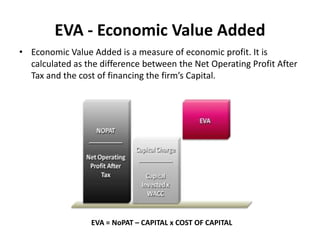
• Economic Value Added is a measure of economic profit. It is
calculated as the difference between the Net Operating Profit After
Tax and the cost of financing the firm’s Capital.

EVA = NoPAT – CAPITAL x COST OF CAPITAL
TO DERIVE THE NOPAT VALUE
SALES
VARIABLE COST
------------------------------------CONTRIBUTION
FIXED COST
-------------------------------------EBITAD
DEPRICIATION / AMORTIZATION
TAX
-------------------------------------NoPAT
Definition
In corporate finance, Economic Value Added or EVA, is an estimate
of a firm's economic profit - being the value created in excess of the
required return of the company's investors
(being shareholders and debt holders).

Application
It is determined to pay INCENTIVES & BONUS.
Benefits of EVA
• Measurement – designing a measure of value creation that best reflects
economic reality in a particular industry.
• Management—developing policies, procedures and tools which link
decision-making to the measure of value-creation.
• Motivation—establishing incentive plans that simulate ownership by
giving managers a share of value created. They understand that they
should be rewarded only if they create shareholder value.
Why use EVA as a performance metric?
* What separates EVA® from other performance metrics is that it
measures all of the costs of running a business-operating and financing.
This makes EVA® the soundest performance metric, and the one most
closely aligned with the creation of shareholder value.
Adjustments
• Key adjustments help translate financial statements from an accounting
framework into an economic framework
• EVA method was developed by Stern & Stewart Co. and they have
recommended around 164 adjustments.
• Common adjustments include capitalization of :
–
–
–
–

Research and development
Operating leases
Brand advertising
Amortization of Goodwill etc.
Ways to increase EVA
• First, the firm can grow the business by investing where the returns
exceed the WACC.
• Second, the firm can improve the operating efficiencies on its existing
Capital, thereby increasing the return on Capital.
• Third, a firm can harvest Capital from its losing investments, where the
return is less than the WACC and has almost no hope for improving. The
funds thus generated by harvesting is disgorged to the shareholders or it is
used to make worthwhile investments elsewhere.

For the Sample Calculation of EVA and Adjustments please refer Excel sheet:
EVA Modified
PRESENTED BY
Mitesh Naik A028
Neha Kumar A029
Pradeep Mestry A032
Prasad Naik A033
Rainu Rawat A036
Ranjeet Shah A037
Ruchit Butala A039

EVA - Economic Value Added

  • 1.
    EVA – EconomicValue Added Corporate Finance
  • 2.
    EVA - EconomicValue Added • Economic Value Added is a measure of economic profit. It is calculated as the difference between the Net Operating Profit After Tax and the cost of financing the firm’s Capital. EVA = NoPAT – CAPITAL x COST OF CAPITAL
  • 3.
    TO DERIVE THENOPAT VALUE SALES VARIABLE COST ------------------------------------CONTRIBUTION FIXED COST -------------------------------------EBITAD DEPRICIATION / AMORTIZATION TAX -------------------------------------NoPAT
  • 4.
    Definition In corporate finance,Economic Value Added or EVA, is an estimate of a firm's economic profit - being the value created in excess of the required return of the company's investors (being shareholders and debt holders). Application It is determined to pay INCENTIVES & BONUS.
  • 5.
    Benefits of EVA •Measurement – designing a measure of value creation that best reflects economic reality in a particular industry. • Management—developing policies, procedures and tools which link decision-making to the measure of value-creation. • Motivation—establishing incentive plans that simulate ownership by giving managers a share of value created. They understand that they should be rewarded only if they create shareholder value. Why use EVA as a performance metric? * What separates EVA® from other performance metrics is that it measures all of the costs of running a business-operating and financing. This makes EVA® the soundest performance metric, and the one most closely aligned with the creation of shareholder value.
  • 6.
    Adjustments • Key adjustmentshelp translate financial statements from an accounting framework into an economic framework • EVA method was developed by Stern & Stewart Co. and they have recommended around 164 adjustments. • Common adjustments include capitalization of : – – – – Research and development Operating leases Brand advertising Amortization of Goodwill etc.
  • 7.
    Ways to increaseEVA • First, the firm can grow the business by investing where the returns exceed the WACC. • Second, the firm can improve the operating efficiencies on its existing Capital, thereby increasing the return on Capital. • Third, a firm can harvest Capital from its losing investments, where the return is less than the WACC and has almost no hope for improving. The funds thus generated by harvesting is disgorged to the shareholders or it is used to make worthwhile investments elsewhere. For the Sample Calculation of EVA and Adjustments please refer Excel sheet: EVA Modified
  • 8.
    PRESENTED BY Mitesh NaikA028 Neha Kumar A029 Pradeep Mestry A032 Prasad Naik A033 Rainu Rawat A036 Ranjeet Shah A037 Ruchit Butala A039