Download to read offline
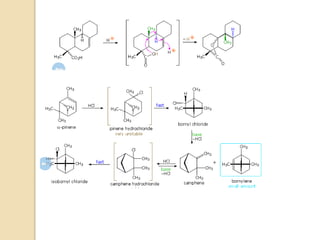
![In 1899, G. Wagner and W. Brickner reported the rearrangement of α-
pinene to bornyl chloride in the presence of hydrogen chloride. The
transformation baffled chemists at the time, since it contradicted the
classical structural theory that was based on the postulate of skeletal
invariance.
It was not until 1922, when H. Meerwein and coworkers revealed the
ionic nature of the rearrangement, that an explanation was offered.
The generation of a carbocation followed by the [1,2]-shift of an
adjacent carbon-carbon bond to generate a new carbocation is
known as the Wagner-Meerwein rearrangement. Originally this name
referred only to skeletal rearrangements in bicyclic systems, but
today it is used to describe all [1,2]-shifts of hydrogen, alkyl, and aryl
groups.](https://image.slidesharecdn.com/wagnormeerwinreaction-210522114405/85/Wagnor-meerwin-reaction-2-320.jpg)
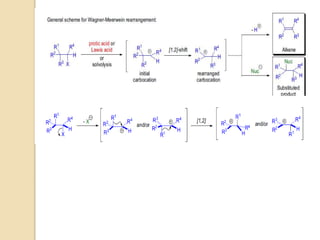
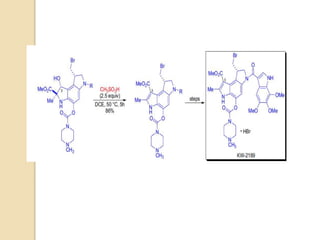
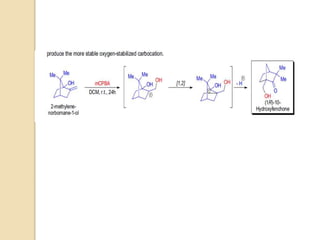
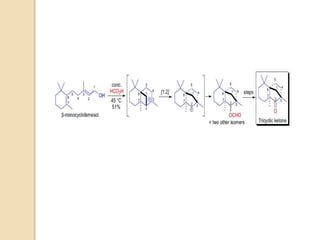
![The general features of the Wagner-Meerwein rearrangement are:
1) the generation of the initial carbocation can be achieved in a variety of ways (e.g.,
protonation of alkenes, alcohols, epoxides or cyclopropanes, solvolysis of secondary
and tertiary alkyl halides, or sulfonates in a polar protic solvent (semipinacol
rearrangement), deamination of amines with nitrous acid (Tiffeneau-Demjanov
rearrangement), treatment of an alkyl halide with Lewis acid, etc.;
2)the initial carbocation has a tendency to rearrange to a thermodynamically more stable
structure, a change that mayoccur in several different ways: e.g., [1,2]-alkyl, -aryl- or
hydride shift to afford a more stable carbocation, ringexpansionof strained small
rings such as cyclopropanes and cyclobutanes to give more stable five- or six-
memberedproducts, collapse by fragmentation, etc.;
3) several consecutive [1,2]-shifts are possible if the substrate contains multiple
structural elements that allow the formation of gradually more stable structures;
4) the various competing rearrangement pathways limit the synthetic utility of the
Wagner-Meerwein rearrangement, since one needs to install all the structural
features that will drive the rearrangement in the desired direction;
5) the final most stable carbocation's fate may be the loss of a proton to afford an alkene
or capture by a nucleophile present in the reaction mixture (solvent or conjugate
base of the acid used to promote the rearrangement); and
6) the stereochemistry of the migrating group is retained, which is in accordance of the
Woodward-Hofmann rules](https://image.slidesharecdn.com/wagnormeerwinreaction-210522114405/85/Wagnor-meerwin-reaction-4-320.jpg)

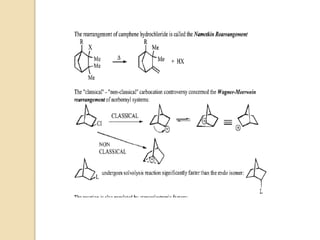
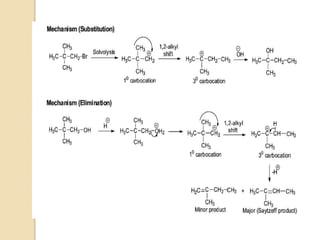
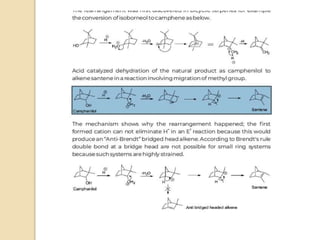
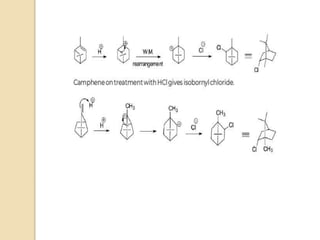

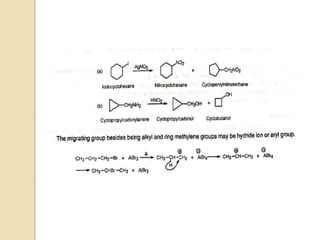
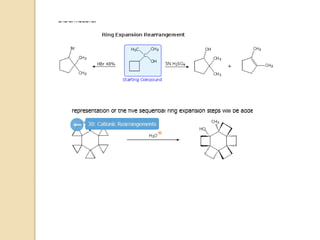


The document discusses the Wagner-Meerwein rearrangement, a reaction first observed in 1899 where a carbocation is generated followed by a [1,2]-shift of an adjacent carbon-carbon bond to form a new carbocation. This reaction was not fully understood until 1922 when its ionic nature was revealed. The rearrangement involves the migration of hydrogen, alkyl, or aryl groups between carbocations and can involve multiple consecutive shifts. It can be initiated through various means to generate the initial carbocation and the migrating group retains its stereochemistry.


![WAGNER-MEERWEIN REARRANGEMENT 123 [Autosaved].pptx](https://cdn.slidesharecdn.com/ss_thumbnails/wagner-meerweinrearrangement123autosaved-230919083558-487cc6f5-thumbnail.jpg?width=640&height=640&fit=bounds)


