PRE REQUISITE
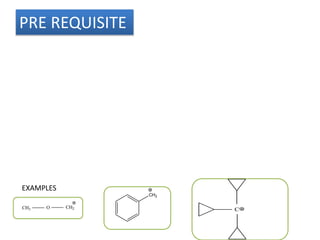
EXAMPLES
CH3 O CH2
CH2
C
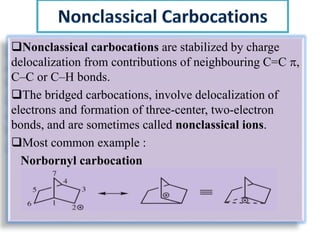
Nonclassical carbocations are stabilized by charge
delocalization from contributions of neighbouring C=C ,
C–C or C–H bonds.
The bridged carbocations, involve delocalization of
electrons and formation of three-center, two-electron
bonds, and are sometimes called nonclassical ions.
Most common example :
Norbornyl carbocation
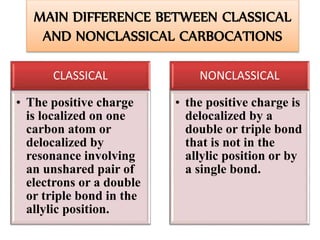
MAIN DIFFERENCE BETWEEN CLASSICAL
AND NONCLASSICAL CARBOCATIONS
CLASSICAL
• The positive charge
is localized on one
carbon atom or
delocalized by
resonance involving
an unshared pair of
electrons or a double
or triple bond in the
allylic position.
NONCLASSICAL
• the positive charge is
delocalized by a
double or triple bond
that is not in the
allylic position or by
a single bond.
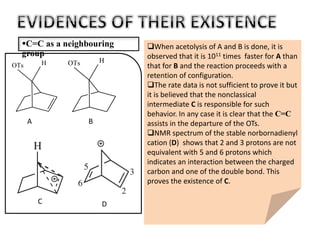
C=C as a neighbouring
group
OTs H OTs H
A B
When acetolysis of A and B is done, it is
observed that it is 1011 times faster for A than
that for B and the reaction proceeds with a
retention of configuration.
The rate data is not sufficient to prove it but
it is believed that the nonclassical
intermediate C is responsible for such
behavior. In any case it is clear that the C=C
assists in the departure of the OTs.
NMR spectrum of the stable norbornadienyl
cation (D) shows that 2 and 3 protons are not
equivalent with 5 and 6 protons which
indicates an interaction between the charged
carbon and one of the double bond. This
proves the existence of C.
C D
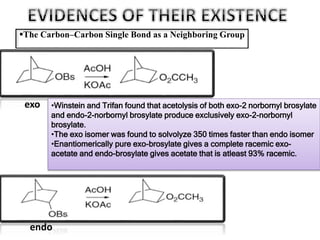
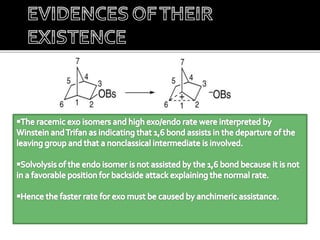
The Carbon–Carbon Single Bond as a Neighboring Group
•Winstein and Trifan found that acetolysis of both exo-2 norbornyl brosylate
and endo-2-norbornyl brosylate produce exclusively exo-2-norbornyl
brosylate.
•The exo isomer was found to solvolyze 350 times faster than endo isomer
•Enantiomerically pure exo-brosylate gives a complete racemic exo-
acetate and endo-brosylate gives acetate that is atleast 93% racemic.
exo
endo
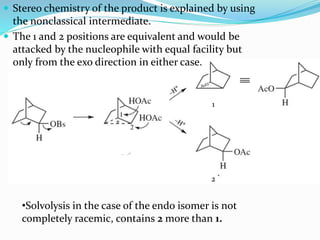
 Stereo chemistry of the product is explained by using
the nonclassical intermediate.
 The 1 and 2 positions are equivalent and would be
attacked by the nucleophile with equal facility but
only from the exo direction in either case.
•Solvolysis in the case of the endo isomer is not
completely racemic, contains 2 more than 1.
1
2
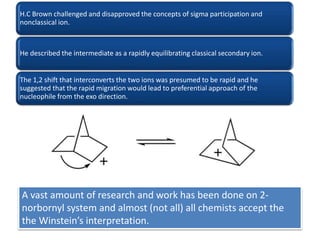
H.C Brown challenged and disapproved the concepts of sigma participation and
nonclassical ion.
He described the intermediate as a rapidly equilibrating classical secondary ion.
The 1,2 shift that interconverts the two ions was presumed to be rapid and he
suggested that the rapid migration would lead to preferential approach of the
nucleophile from the exo direction.
A vast amount of research and work has been done on 2-
norbornyl system and almost (not all) all chemists accept the
the Winstein’s interpretation.
References
 Advanced Organic Chemistry Part A:
Structure and Mechanisms, Francis A.
Carey and Richard J. Sundberg, Fifth
edition, Springer
 MARCH’S ADVANCED ORGANIC
CHEMISTRY REACTIONS, MECHANISMS,
AND STRUCTURE,Michael B. Smith, Jerry
March, SIXTH EDITION,WILEY
 www.unacademy.com
 https://chem.libretexts.org/

Nonclassical Carbocation

  • 2.
  • 3.
    Nonclassical carbocations arestabilized by charge delocalization from contributions of neighbouring C=C , C–C or C–H bonds. The bridged carbocations, involve delocalization of electrons and formation of three-center, two-electron bonds, and are sometimes called nonclassical ions. Most common example : Norbornyl carbocation
  • 4.
    MAIN DIFFERENCE BETWEENCLASSICAL AND NONCLASSICAL CARBOCATIONS CLASSICAL • The positive charge is localized on one carbon atom or delocalized by resonance involving an unshared pair of electrons or a double or triple bond in the allylic position. NONCLASSICAL • the positive charge is delocalized by a double or triple bond that is not in the allylic position or by a single bond.
  • 5.
    C=C as aneighbouring group OTs H OTs H A B When acetolysis of A and B is done, it is observed that it is 1011 times faster for A than that for B and the reaction proceeds with a retention of configuration. The rate data is not sufficient to prove it but it is believed that the nonclassical intermediate C is responsible for such behavior. In any case it is clear that the C=C assists in the departure of the OTs. NMR spectrum of the stable norbornadienyl cation (D) shows that 2 and 3 protons are not equivalent with 5 and 6 protons which indicates an interaction between the charged carbon and one of the double bond. This proves the existence of C. C D
  • 6.
    The Carbon–Carbon SingleBond as a Neighboring Group •Winstein and Trifan found that acetolysis of both exo-2 norbornyl brosylate and endo-2-norbornyl brosylate produce exclusively exo-2-norbornyl brosylate. •The exo isomer was found to solvolyze 350 times faster than endo isomer •Enantiomerically pure exo-brosylate gives a complete racemic exo- acetate and endo-brosylate gives acetate that is atleast 93% racemic. exo endo
  • 8.
     Stereo chemistryof the product is explained by using the nonclassical intermediate.  The 1 and 2 positions are equivalent and would be attacked by the nucleophile with equal facility but only from the exo direction in either case. •Solvolysis in the case of the endo isomer is not completely racemic, contains 2 more than 1. 1 2
  • 9.
    H.C Brown challengedand disapproved the concepts of sigma participation and nonclassical ion. He described the intermediate as a rapidly equilibrating classical secondary ion. The 1,2 shift that interconverts the two ions was presumed to be rapid and he suggested that the rapid migration would lead to preferential approach of the nucleophile from the exo direction. A vast amount of research and work has been done on 2- norbornyl system and almost (not all) all chemists accept the the Winstein’s interpretation.
  • 10.
    References  Advanced OrganicChemistry Part A: Structure and Mechanisms, Francis A. Carey and Richard J. Sundberg, Fifth edition, Springer  MARCH’S ADVANCED ORGANIC CHEMISTRY REACTIONS, MECHANISMS, AND STRUCTURE,Michael B. Smith, Jerry March, SIXTH EDITION,WILEY  www.unacademy.com  https://chem.libretexts.org/