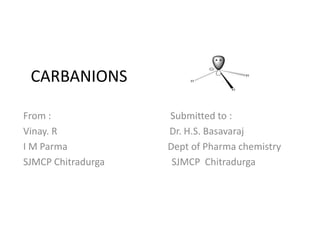
CARBANIONS
From : Submitted to :
Vinay. R Dr. H.S. Basavaraj
I M Parma Dept of Pharma chemistry
SJMCP Chitradurga SJMCP Chitradurga
Introduction :
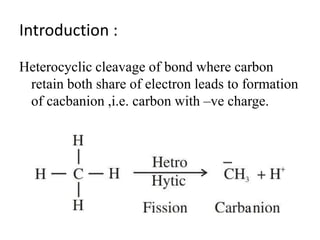
Heterocyclic cleavage of bond where carbon
retain both share of electron leads to formation
of cacbanion ,i.e. carbon with –ve charge.
Classification
Formation of carbanion
Basic formation
Proton obstruction
The acidic proton (H) of an organic
substance with appropriate base
Examples :
carbanion
carbanion
Decarboxylation
Decarboxylation of carboxylates leads to the
formation of carbanion intermediates.
Ex:
Carbanion
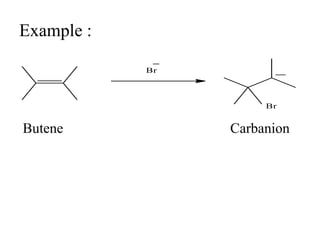
Addition of nucleotide to alkene
Addition of nucleophile to alkenes then there will be
nucleophilic attack take place and there will be
formation of negative charge on the adjacent carbon
pt the nucleophile attacked carbon .
Example :
Butene Carbanion
Carbanion formation during the formation
organo metallic compound
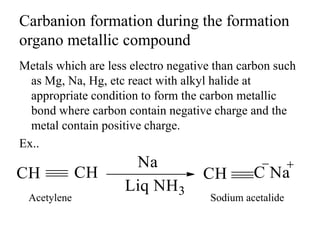
Metals which are less electro negative than carbon such
as Mg, Na, Hg, etc react with alkyl halide at
appropriate condition to form the carbon metallic
bond where carbon contain negative charge and the
metal contain positive charge.
Ex..
Acetylene Sodium acetalide
Stability of carbonions :
• Electro negativity of carbanionic carbon :
• Greater the electro negativity of carbanionic
carbon more is the stability of carbanion. Electro
negativity of carbon depend on
percentage S character. Carbanion stability,
thus, has been found to be in the order:
Sp Sp2 Sp3
Inductive effect :
Stability of alkyl carbanions can be explained by
inductive effect. Greater the number of alkyl group [+
I effect] attached to the carbon atom bearing
negative charge, lesser is the stability. Because there
inductive effect increase negative charge density on
the carbon.
Primary Secondary Tertiary
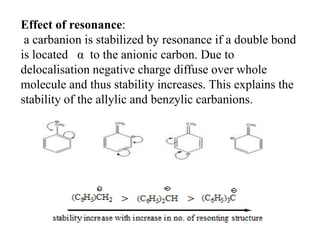
Effect of resonance:
a carbanion is stabilized by resonance if a double bond
is located α to the anionic carbon. Due to
delocalisation negative charge diffuse over whole
molecule and thus stability increases. This explains the
stability of the allylic and benzylic carbanions.
Stabilisation by Sulphur and Phosphorous:
Attachment of carbanionic carbon of a sulphur and
phosphorus atom causes an increase in carbanion
stability. The cause of stability is due to the
delocalisation of negative charge of carbanion by
vacant d-orbital (pπ–dπ bonding) of phosphorus
and sulphur.
Stability of Aromatic Carbanions :
Anions in which negative charge is present on carbon of
aromatic system is known as aromatic carbanions.
Aromatic carbanions are most stable carbaions because
unshared electron pair of carbaion itself take part in
delocalisation. Anions obeying Huckel rule are stable
because they are aromatic and there is complete
delocalisation of negative charge.
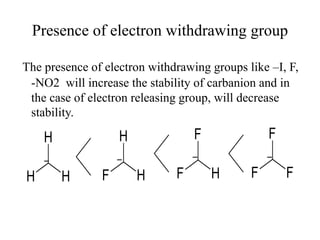
Presence of electron withdrawing group
The presence of electron withdrawing groups like –I, F,
-NO2 will increase the stability of carbanion and in
the case of electron releasing group, will decrease
stability.
Applications :
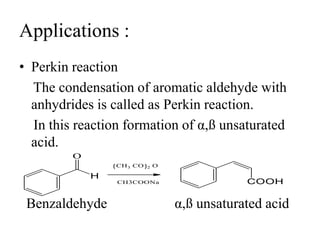
• Perkin reaction
The condensation of aromatic aldehyde with
anhydrides is called as Perkin reaction.
In this reaction formation of α,ß unsaturated
acid.
Benzaldehyde α,ß unsaturated acid
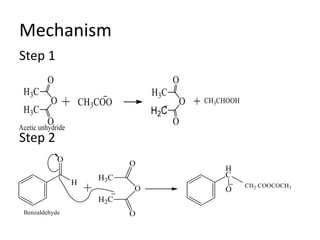
Mechanism
Step 1
Step 2
Step 3
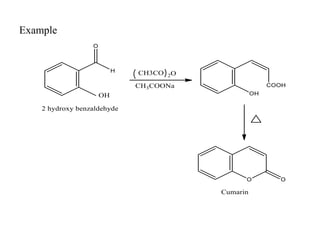
Example
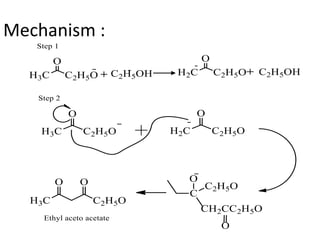
Clasein condensation :
When carboxylic ester containing an α
hydrogen are treated with a strong base such
as sodium ethoxide a condensation occurs to
give a ß keto ester .
Mechanism :
Other applications are
• Benzoin condensation
• Aldol condensation
Acetaldehyde
ß hydroxy aldehyde
Cannizzaro reaction
Reference :
Arun Bahl and B.S. Bahl Advanced Organic
Chemistry
Chemistrycolumn.com
S.M. Mukherji S.P Singh Reaction Mechanism in
Organic Chemistry
THANK YOU

Carbanions

  • 1.
    CARBANIONS From : Submittedto : Vinay. R Dr. H.S. Basavaraj I M Parma Dept of Pharma chemistry SJMCP Chitradurga SJMCP Chitradurga
  • 2.
    Introduction : Heterocyclic cleavageof bond where carbon retain both share of electron leads to formation of cacbanion ,i.e. carbon with –ve charge.
  • 3.
  • 4.
  • 5.
    Proton obstruction The acidicproton (H) of an organic substance with appropriate base
  • 6.
  • 7.
    Decarboxylation Decarboxylation of carboxylatesleads to the formation of carbanion intermediates. Ex: Carbanion
  • 8.
    Addition of nucleotideto alkene Addition of nucleophile to alkenes then there will be nucleophilic attack take place and there will be formation of negative charge on the adjacent carbon pt the nucleophile attacked carbon .
  • 9.
  • 10.
    Carbanion formation duringthe formation organo metallic compound Metals which are less electro negative than carbon such as Mg, Na, Hg, etc react with alkyl halide at appropriate condition to form the carbon metallic bond where carbon contain negative charge and the metal contain positive charge. Ex.. Acetylene Sodium acetalide
  • 11.
    Stability of carbonions: • Electro negativity of carbanionic carbon : • Greater the electro negativity of carbanionic carbon more is the stability of carbanion. Electro negativity of carbon depend on percentage S character. Carbanion stability, thus, has been found to be in the order: Sp Sp2 Sp3
  • 12.
    Inductive effect : Stabilityof alkyl carbanions can be explained by inductive effect. Greater the number of alkyl group [+ I effect] attached to the carbon atom bearing negative charge, lesser is the stability. Because there inductive effect increase negative charge density on the carbon. Primary Secondary Tertiary
  • 13.
    Effect of resonance: acarbanion is stabilized by resonance if a double bond is located α to the anionic carbon. Due to delocalisation negative charge diffuse over whole molecule and thus stability increases. This explains the stability of the allylic and benzylic carbanions.
  • 14.
    Stabilisation by Sulphurand Phosphorous: Attachment of carbanionic carbon of a sulphur and phosphorus atom causes an increase in carbanion stability. The cause of stability is due to the delocalisation of negative charge of carbanion by vacant d-orbital (pπ–dπ bonding) of phosphorus and sulphur.
  • 15.
    Stability of AromaticCarbanions : Anions in which negative charge is present on carbon of aromatic system is known as aromatic carbanions. Aromatic carbanions are most stable carbaions because unshared electron pair of carbaion itself take part in delocalisation. Anions obeying Huckel rule are stable because they are aromatic and there is complete delocalisation of negative charge.
  • 16.
    Presence of electronwithdrawing group The presence of electron withdrawing groups like –I, F, -NO2 will increase the stability of carbanion and in the case of electron releasing group, will decrease stability.
  • 17.
    Applications : • Perkinreaction The condensation of aromatic aldehyde with anhydrides is called as Perkin reaction. In this reaction formation of α,ß unsaturated acid. Benzaldehyde α,ß unsaturated acid
  • 18.
  • 19.
  • 20.
  • 21.
    Clasein condensation : Whencarboxylic ester containing an α hydrogen are treated with a strong base such as sodium ethoxide a condensation occurs to give a ß keto ester .
  • 22.
  • 23.
    Other applications are •Benzoin condensation • Aldol condensation Acetaldehyde ß hydroxy aldehyde
  • 24.
  • 25.
    Reference : Arun Bahland B.S. Bahl Advanced Organic Chemistry Chemistrycolumn.com S.M. Mukherji S.P Singh Reaction Mechanism in Organic Chemistry
  • 26.