OSMIUM TETROXIDE
SHYAM R. DESHMUKH
DEPARTMENT OF PHARMACEUTICAL CHEMISTRY
SKB COLLEGE OF PHARMACY, KAMPTEE
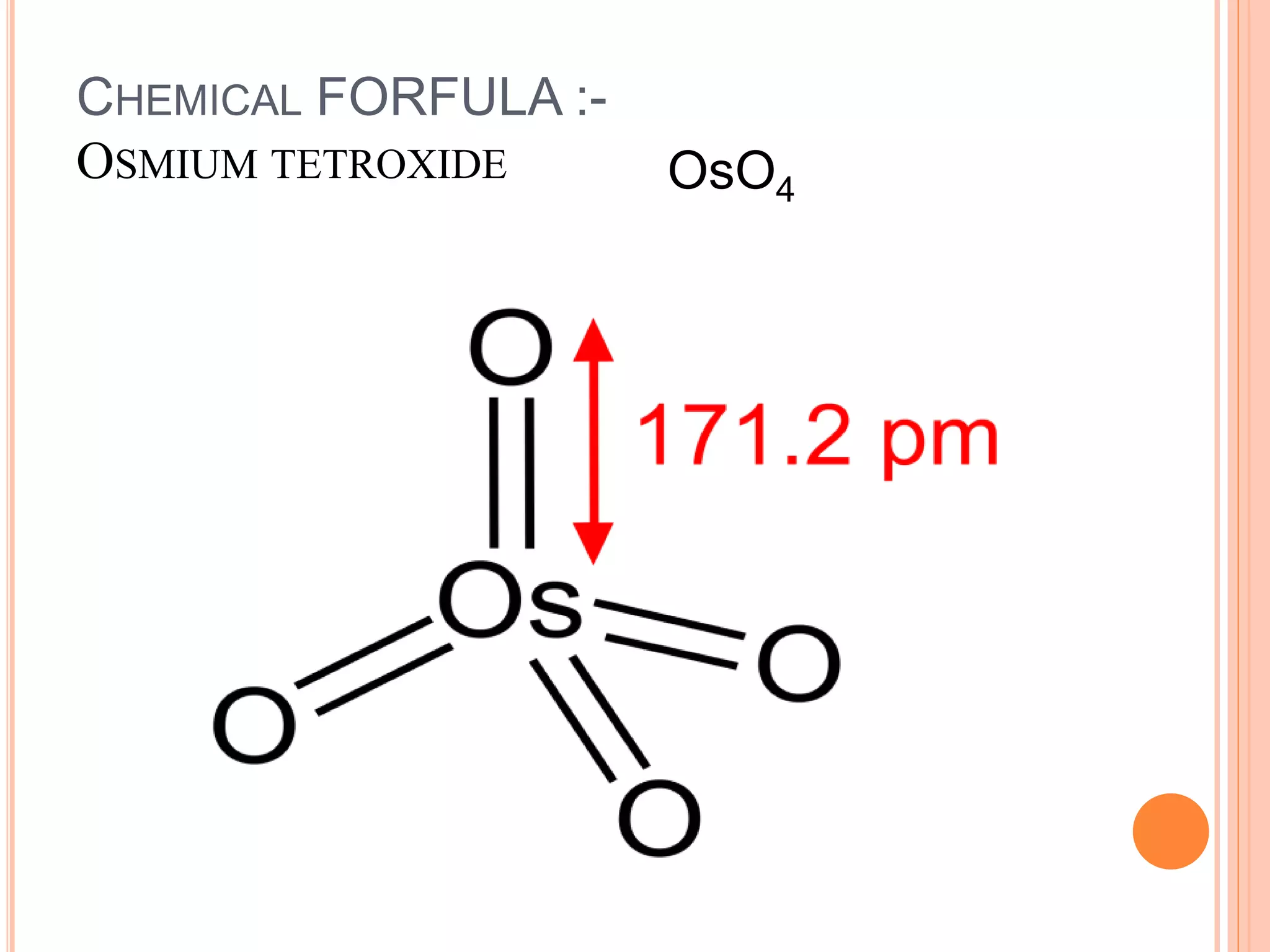
CHEMICAL FORFULA :-
OSMIUM TETROXIDE OsO4
INTRODUCTION
 Osmium tetroxide (also osmium(VIII) oxide) is
the chemical compound with the formula OsO4.
 The compound is noteworthy for its many uses, despite
its toxicity and the rarity of osimum.
 It also has a number of interesting properties, one being
that the solid is volatile.
 The compound is colourless, but most samples appear
yellow. This is most likely due to the presence of the
impurity OsO2, which is yellow-brown in colour.
PHYSICAL PROPERTIES
 Osmium(VIII) oxide forms monoclinic crystals. It has a
characteristic acrid chlorine-like odour
Crystal structure of OsO4
 The element name osmium is derived from osme, Greek
for odor. OsO4 is volatile: it sublimes at room
temperature
PHYSICAL PROPERTIES
 It is soluble in a wide range of organic solvents. It is also
moderately soluble in water, with which it reacts reversibly to
form osmic acid.
 Pure osmium(VIII) oxide is probably colourless and it has
been suggested that its yellow hue is due to osmium
dioxide (OsO2) impurities.
 The osmium tetroxide molecule is tetrahedral and therefore
non-polar.
 Melting Point = 40°C
 Sublimes At Room Temperature
 Boiling Point = 130°C
 Solubility In Water = 6.2 g/100 ml
 Solubility In CCl₄ = 375 g/100 ml
STRUCTURE AND ELECTRON CONFIGURATION
 The osmium of OsO4 has an oxidation number of VIII,
however the metal does not possess a corresponding 8+
charge as the bonding in the compound is
largely covalent in character (the ionization
energy required to produce a formal 8+ charge also far
exceeds the energies available in normal chemical
reactions).
 The osmium atom has eight valence electrons (6s2, 5d6)
with double bonds to the four oxide ligands resulting in
a 16 electron complex. This is isoelectronic
with permanganate and chromate ions.
SYNTHESIS
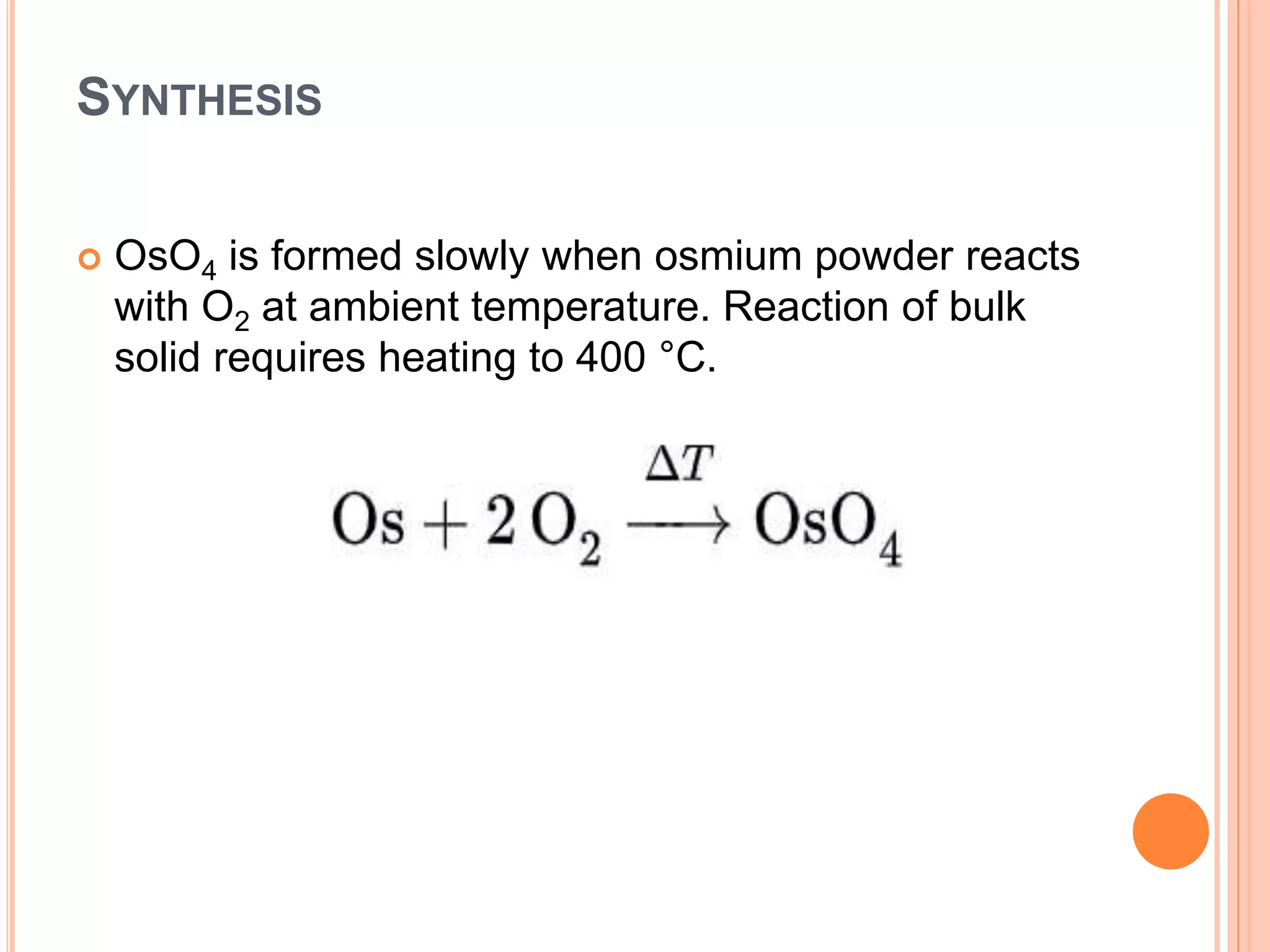
 OsO4 is formed slowly when osmium powder reacts
with O2 at ambient temperature. Reaction of bulk
solid requires heating to 400 °C.
APPLICATION OF OSMIUM TETROXIDE
I. Oxidation of alkenes
Alkenes add to OsO4 to give diolate species that hydrolyze
to cis-diols. The net process is called dihydroxylation. This
proceeds via a [3+ 2] cycloaddition reaction between the
OsO4 and alkene to form an intermediate osmate ester which
rapidly hydrolyses to yield the vicinal diol. As the oxygen
atoms are added in a concerted step the resulting
stereochemistry is cis
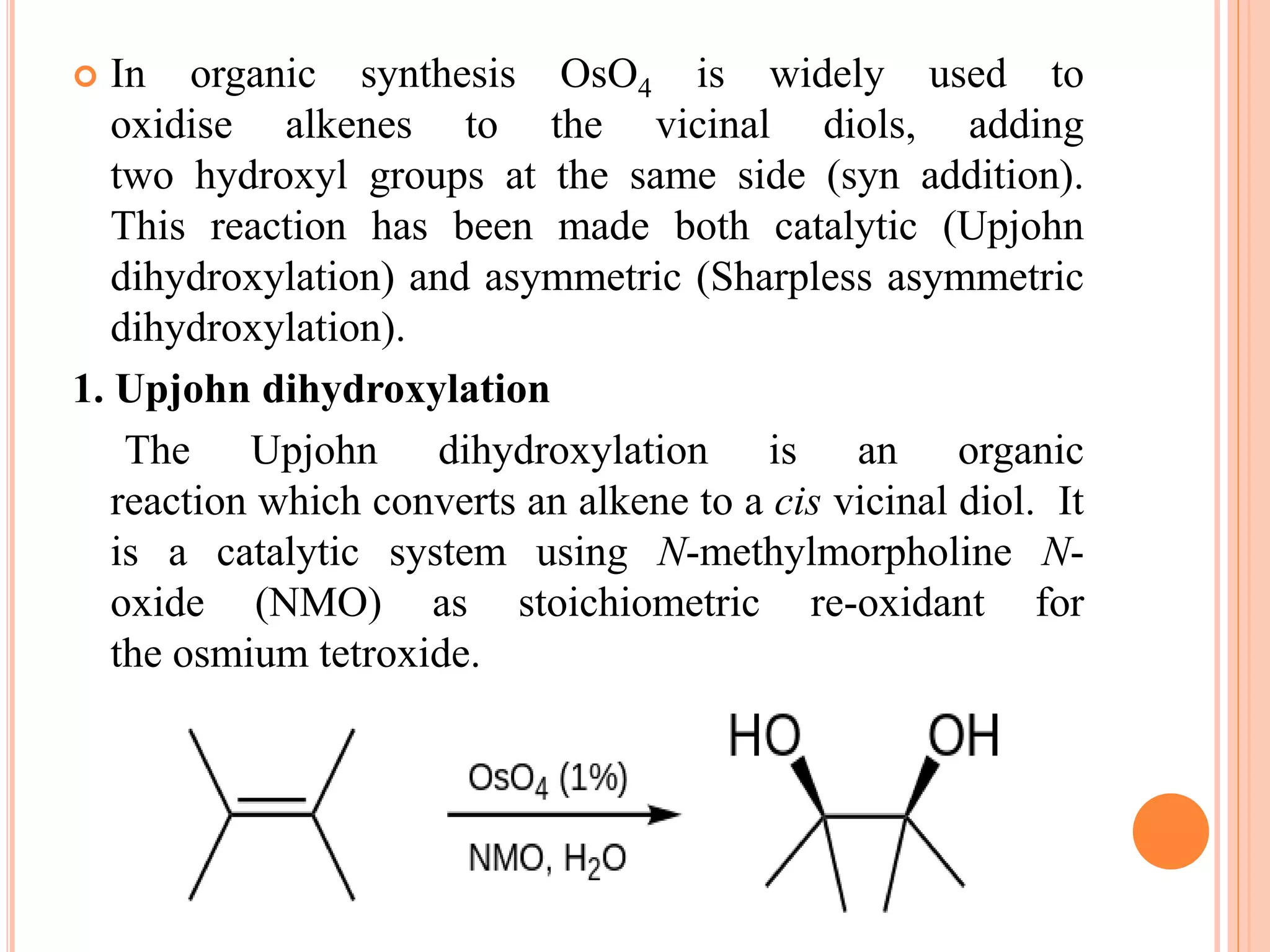
 In organic synthesis OsO4 is widely used to
oxidise alkenes to the vicinal diols, adding
two hydroxyl groups at the same side (syn addition).
This reaction has been made both catalytic (Upjohn
dihydroxylation) and asymmetric (Sharpless asymmetric
dihydroxylation).
1. Upjohn dihydroxylation
The Upjohn dihydroxylation is an organic
reaction which converts an alkene to a cis vicinal diol. It
is a catalytic system using N-methylmorpholine N-
oxide (NMO) as stoichiometric re-oxidant for
the osmium tetroxide.
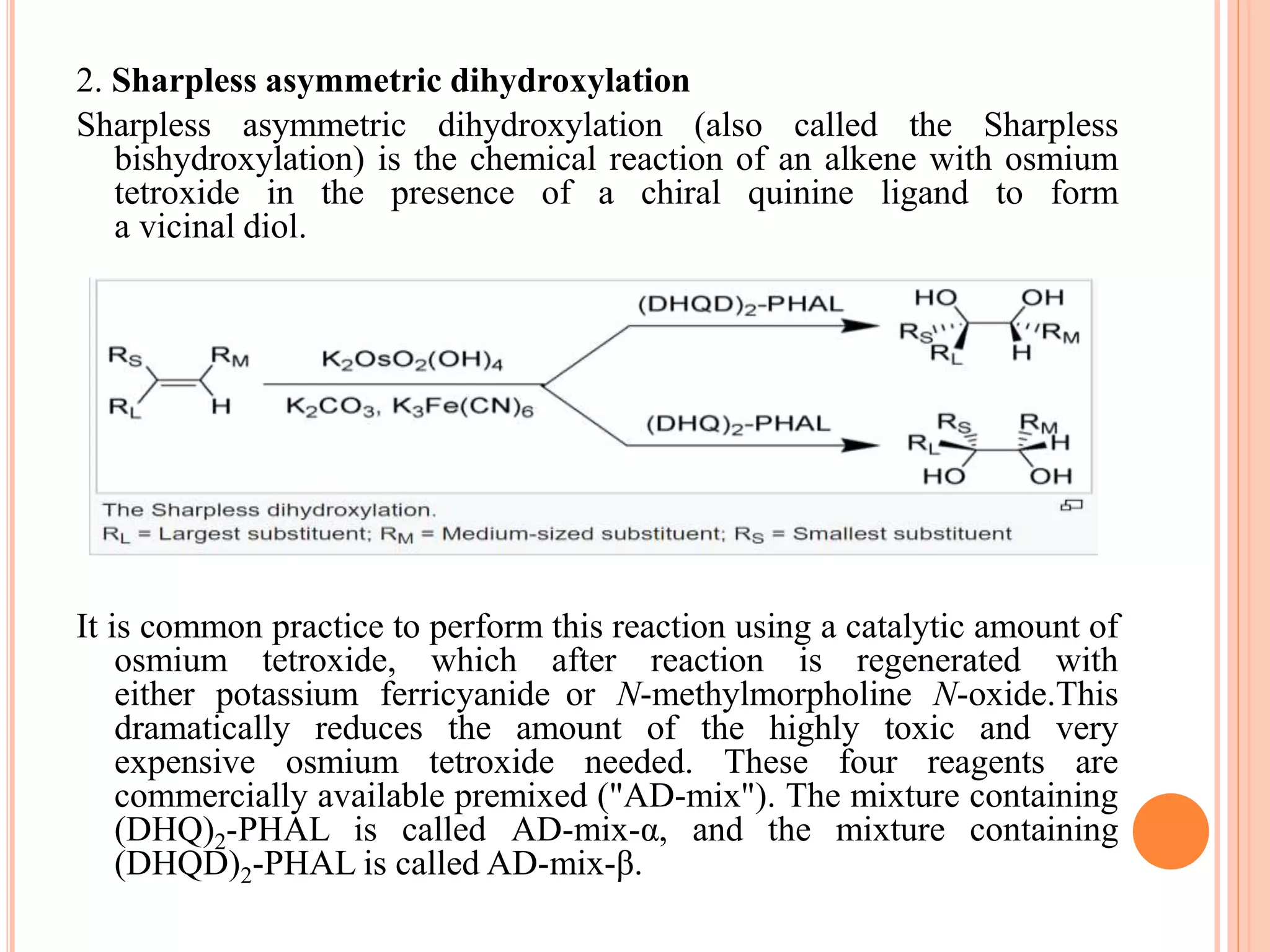
2. Sharpless asymmetric dihydroxylation
Sharpless asymmetric dihydroxylation (also called the Sharpless
bishydroxylation) is the chemical reaction of an alkene with osmium
tetroxide in the presence of a chiral quinine ligand to form
a vicinal diol.
It is common practice to perform this reaction using a catalytic amount of
osmium tetroxide, which after reaction is regenerated with
either potassium ferricyanide or N-methylmorpholine N-oxide.This
dramatically reduces the amount of the highly toxic and very
expensive osmium tetroxide needed. These four reagents are
commercially available premixed ("AD-mix"). The mixture containing
(DHQ)2-PHAL is called AD-mix-α, and the mixture containing
(DHQD)2-PHAL is called AD-mix-β.
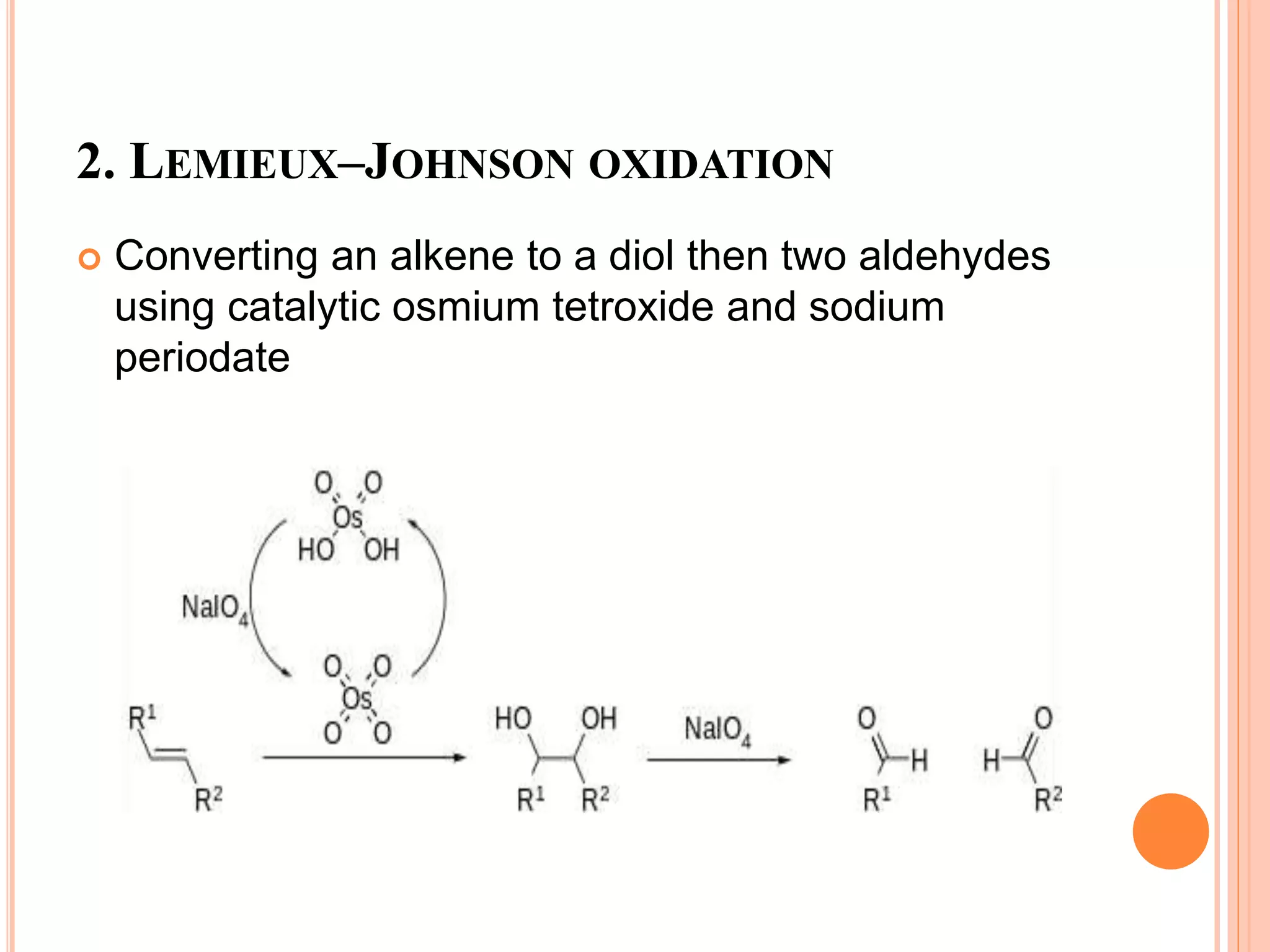
2. LEMIEUX–JOHNSON OXIDATION
 Converting an alkene to a diol then two aldehydes
using catalytic osmium tetroxide and sodium
periodate
SYNTHESIS OF ISOSTEVIOL
 In combination with sodium periodate, OsO4 is used for
the oxidative cleavage of alkenes (Lemieux-Johnson
oxidation) when the periodate serves both to cleave the
diol formed by dihydroxylation, and to reoxidize the
OsO3 back to OsO4. The net transformation is identical
to that produced by ozonolysis.
3. COORDINATION CHEMISTRY
 When the Lewis base is an amine, adducts are also
formed. Thus OsO4 can be stored in the form of osmeth,
in which OsO4 is complexed with hexamine
1. With tert-BuNH2, the imido derivative is produced:
OsO4 + Me3CNH2 → OsO3(NCMe3) + H2O
2. With NH3 one obtains the nitrido complex:
OsO4 + NH3 + KOH → K[Os(N)O3] + 2 H2O
3. OsO4 is very soluble in tert-butyl alcohol. In solution,
it is readily reduced by hydrogen to osmium metal
OsO4 + 4 H2 → Os + 4 H2O
4. OsO4 undergoes "reductive carbonylation" with carbon
monoxide in methanol at 400 K and 200 sbar to produce
the triangular cluster Os3(CO)12:
3 OsO4 + 24 CO → Os3(CO)12 + 12 CO2
4. OXOFLUORIDES
 Osmium forms several oxofluorides, all of which are
very sensitive to moisture. Purple cis-OsO2F4 forms at
77 K in an anhydrous KrF2 solution:
OsO4 + 2 KrF2 → cis-OsO2F4 + 2 Kr + O2
 OsO4 also reacts with F2 to form yellowOsO3F2:
2 OsO4 + 2 F2 → 2 OsO3F2 + O2
OsO4 + 2 [Me4N]F → [Me4N]2[cis-OsO4F2]
THANK YOU

Osmium tetroxide

  • 1.
    OSMIUM TETROXIDE SHYAM R.DESHMUKH DEPARTMENT OF PHARMACEUTICAL CHEMISTRY SKB COLLEGE OF PHARMACY, KAMPTEE
  • 2.
  • 3.
    INTRODUCTION  Osmium tetroxide(also osmium(VIII) oxide) is the chemical compound with the formula OsO4.  The compound is noteworthy for its many uses, despite its toxicity and the rarity of osimum.  It also has a number of interesting properties, one being that the solid is volatile.  The compound is colourless, but most samples appear yellow. This is most likely due to the presence of the impurity OsO2, which is yellow-brown in colour.
  • 4.
    PHYSICAL PROPERTIES  Osmium(VIII)oxide forms monoclinic crystals. It has a characteristic acrid chlorine-like odour Crystal structure of OsO4  The element name osmium is derived from osme, Greek for odor. OsO4 is volatile: it sublimes at room temperature
  • 5.
    PHYSICAL PROPERTIES  Itis soluble in a wide range of organic solvents. It is also moderately soluble in water, with which it reacts reversibly to form osmic acid.  Pure osmium(VIII) oxide is probably colourless and it has been suggested that its yellow hue is due to osmium dioxide (OsO2) impurities.  The osmium tetroxide molecule is tetrahedral and therefore non-polar.  Melting Point = 40°C  Sublimes At Room Temperature  Boiling Point = 130°C  Solubility In Water = 6.2 g/100 ml  Solubility In CCl₄ = 375 g/100 ml
  • 6.
    STRUCTURE AND ELECTRONCONFIGURATION  The osmium of OsO4 has an oxidation number of VIII, however the metal does not possess a corresponding 8+ charge as the bonding in the compound is largely covalent in character (the ionization energy required to produce a formal 8+ charge also far exceeds the energies available in normal chemical reactions).  The osmium atom has eight valence electrons (6s2, 5d6) with double bonds to the four oxide ligands resulting in a 16 electron complex. This is isoelectronic with permanganate and chromate ions.
  • 7.
    SYNTHESIS  OsO4 isformed slowly when osmium powder reacts with O2 at ambient temperature. Reaction of bulk solid requires heating to 400 °C.
  • 8.
    APPLICATION OF OSMIUMTETROXIDE I. Oxidation of alkenes Alkenes add to OsO4 to give diolate species that hydrolyze to cis-diols. The net process is called dihydroxylation. This proceeds via a [3+ 2] cycloaddition reaction between the OsO4 and alkene to form an intermediate osmate ester which rapidly hydrolyses to yield the vicinal diol. As the oxygen atoms are added in a concerted step the resulting stereochemistry is cis
  • 9.
     In organicsynthesis OsO4 is widely used to oxidise alkenes to the vicinal diols, adding two hydroxyl groups at the same side (syn addition). This reaction has been made both catalytic (Upjohn dihydroxylation) and asymmetric (Sharpless asymmetric dihydroxylation). 1. Upjohn dihydroxylation The Upjohn dihydroxylation is an organic reaction which converts an alkene to a cis vicinal diol. It is a catalytic system using N-methylmorpholine N- oxide (NMO) as stoichiometric re-oxidant for the osmium tetroxide.
  • 10.
    2. Sharpless asymmetricdihydroxylation Sharpless asymmetric dihydroxylation (also called the Sharpless bishydroxylation) is the chemical reaction of an alkene with osmium tetroxide in the presence of a chiral quinine ligand to form a vicinal diol. It is common practice to perform this reaction using a catalytic amount of osmium tetroxide, which after reaction is regenerated with either potassium ferricyanide or N-methylmorpholine N-oxide.This dramatically reduces the amount of the highly toxic and very expensive osmium tetroxide needed. These four reagents are commercially available premixed ("AD-mix"). The mixture containing (DHQ)2-PHAL is called AD-mix-α, and the mixture containing (DHQD)2-PHAL is called AD-mix-β.
  • 11.
    2. LEMIEUX–JOHNSON OXIDATION Converting an alkene to a diol then two aldehydes using catalytic osmium tetroxide and sodium periodate
  • 12.
    SYNTHESIS OF ISOSTEVIOL In combination with sodium periodate, OsO4 is used for the oxidative cleavage of alkenes (Lemieux-Johnson oxidation) when the periodate serves both to cleave the diol formed by dihydroxylation, and to reoxidize the OsO3 back to OsO4. The net transformation is identical to that produced by ozonolysis.
  • 13.
    3. COORDINATION CHEMISTRY When the Lewis base is an amine, adducts are also formed. Thus OsO4 can be stored in the form of osmeth, in which OsO4 is complexed with hexamine 1. With tert-BuNH2, the imido derivative is produced: OsO4 + Me3CNH2 → OsO3(NCMe3) + H2O 2. With NH3 one obtains the nitrido complex: OsO4 + NH3 + KOH → K[Os(N)O3] + 2 H2O
  • 14.
    3. OsO4 isvery soluble in tert-butyl alcohol. In solution, it is readily reduced by hydrogen to osmium metal OsO4 + 4 H2 → Os + 4 H2O 4. OsO4 undergoes "reductive carbonylation" with carbon monoxide in methanol at 400 K and 200 sbar to produce the triangular cluster Os3(CO)12: 3 OsO4 + 24 CO → Os3(CO)12 + 12 CO2
  • 15.
    4. OXOFLUORIDES  Osmiumforms several oxofluorides, all of which are very sensitive to moisture. Purple cis-OsO2F4 forms at 77 K in an anhydrous KrF2 solution: OsO4 + 2 KrF2 → cis-OsO2F4 + 2 Kr + O2  OsO4 also reacts with F2 to form yellowOsO3F2: 2 OsO4 + 2 F2 → 2 OsO3F2 + O2 OsO4 + 2 [Me4N]F → [Me4N]2[cis-OsO4F2]
  • 16.