Rearrangement reactions
Prepared by- Mohamad Haider
Department of Pharmaceutical Chemistry, DIPSAR
Roll no.- 04/MPH/DIPSAR/19
Introduction
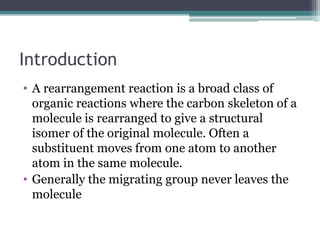
• A rearrangement reaction is a broad class of
organic reactions where the carbon skeleton of a
molecule is rearranged to give a structural
isomer of the original molecule. Often a
substituent moves from one atom to another
atom in the same molecule.
• Generally the migrating group never leaves the
molecule
Classification
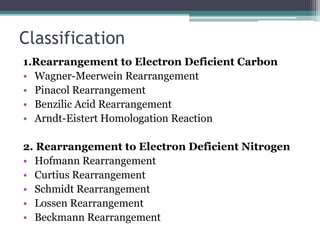
1.Rearrangement to Electron Deficient Carbon
• Wagner-Meerwein Rearrangement
• Pinacol Rearrangement
• Benzilic Acid Rearrangement
• Arndt-Eistert Homologation Reaction
2. Rearrangement to Electron Deficient Nitrogen
• Hofmann Rearrangement
• Curtius Rearrangement
• Schmidt Rearrangement
• Lossen Rearrangement
• Beckmann Rearrangement
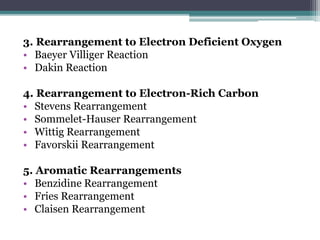
3. Rearrangement to Electron Deficient Oxygen
• Baeyer Villiger Reaction
• Dakin Reaction
4. Rearrangement to Electron-Rich Carbon
• Stevens Rearrangement
• Sommelet-Hauser Rearrangement
• Wittig Rearrangement
• Favorskii Rearrangement
5. Aromatic Rearrangements
• Benzidine Rearrangement
• Fries Rearrangement
• Claisen Rearrangement
Wagner-Meerwein Rearrangement
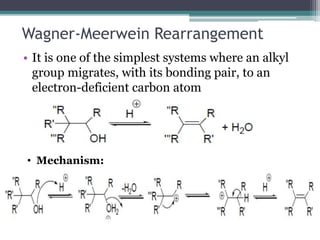
• It is one of the simplest systems where an alkyl
group migrates, with its bonding pair, to an
electron-deficient carbon atom
• Mechanism:
Pinacol Rearrangement
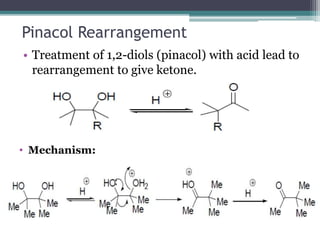
• Treatment of 1,2-diols (pinacol) with acid lead to
rearrangement to give ketone.
• Mechanism:
Benzilic Acid Rearrangement
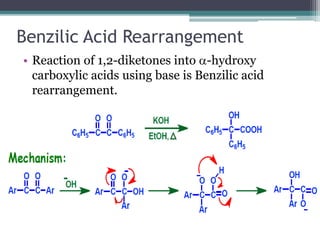
• Reaction of 1,2-diketones into a-hydroxy
carboxylic acids using base is Benzilic acid
rearrangement.
•
Arndt-Eistert Homologation Reaction
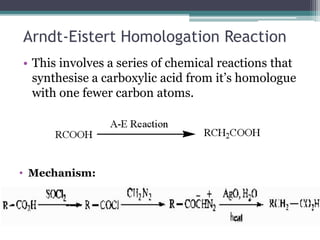
• This involves a series of chemical reactions that
synthesise a carboxylic acid from it’s homologue
with one fewer carbon atoms.
• Mechanism:
Hofmann Rearrangement
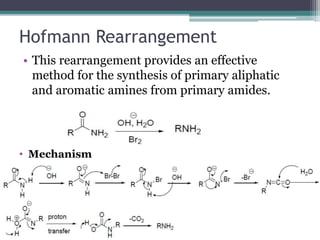
• This rearrangement provides an effective
method for the synthesis of primary aliphatic
and aromatic amines from primary amides.
• Mechanism
Lossen Rearrangement
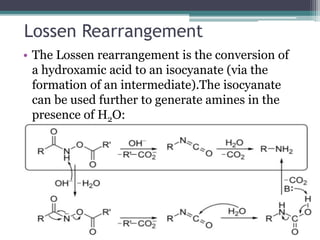
• The Lossen rearrangement is the conversion of
a hydroxamic acid to an isocyanate (via the
formation of an intermediate).The isocyanate
can be used further to generate amines in the
presence of H2O:
Curtius Rearrangement
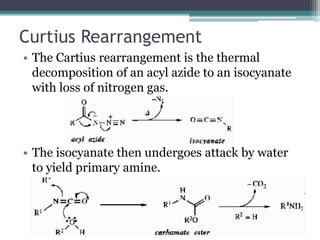
• The Cartius rearrangement is the thermal
decomposition of an acyl azide to an isocyanate
with loss of nitrogen gas.
• The isocyanate then undergoes attack by water
to yield primary amine.
Schmidt Rearrangement
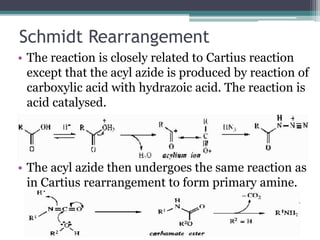
• The reaction is closely related to Cartius reaction
except that the acyl azide is produced by reaction of
carboxylic acid with hydrazoic acid. The reaction is
acid catalysed.
• The acyl azide then undergoes the same reaction as
in Cartius rearrangement to form primary amine.
Beckmann Rearrangement
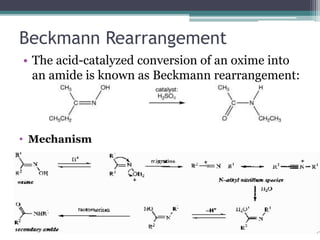
• The acid-catalyzed conversion of an oxime into
an amide is known as Beckmann rearrangement:
• Mechanism
Baeyer Villiger Reaction
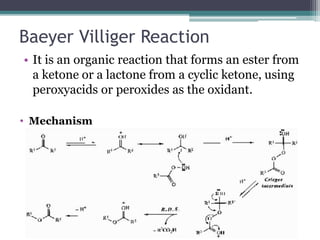
• It is an organic reaction that forms an ester from
a ketone or a lactone from a cyclic ketone, using
peroxyacids or peroxides as the oxidant.
• Mechanism
Dakin Reaction
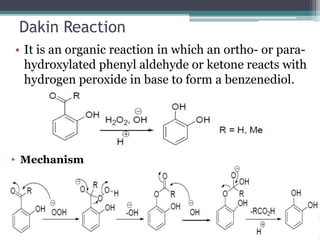
• It is an organic reaction in which an ortho- or para-
hydroxylated phenyl aldehyde or ketone reacts with
hydrogen peroxide in base to form a benzenediol.
• Mechanism
Stevens Rearrangement
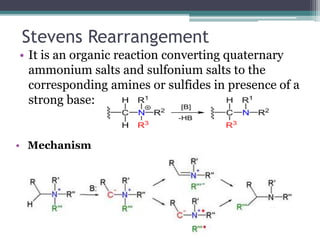
• It is an organic reaction converting quaternary
ammonium salts and sulfonium salts to the
corresponding amines or sulfides in presence of a
strong base:
• Mechanism
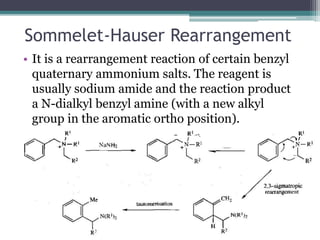
Sommelet-Hauser Rearrangement
• It is a rearrangement reaction of certain benzyl
quaternary ammonium salts. The reagent is
usually sodium amide and the reaction product
a N-dialkyl benzyl amine (with a new alkyl
group in the aromatic ortho position).
Wittig Rearrangement
• The [1,2]-Wittig Rearrangement is the base-
promoted reaction of ethers to yield secondary
or tertiary alcohol:
• Mechanism
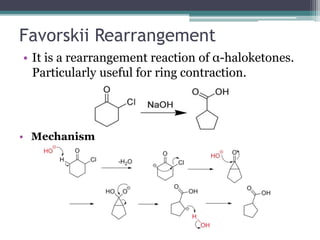
Favorskii Rearrangement
• It is a rearrangement reaction of α-haloketones.
Particularly useful for ring contraction.
• Mechanism
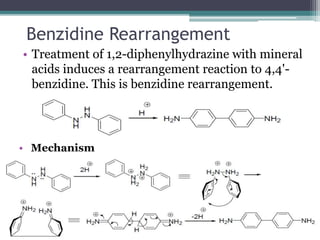
Benzidine Rearrangement
• Treatment of 1,2-diphenylhydrazine with mineral
acids induces a rearrangement reaction to 4,4'-
benzidine. This is benzidine rearrangement.
• Mechanism
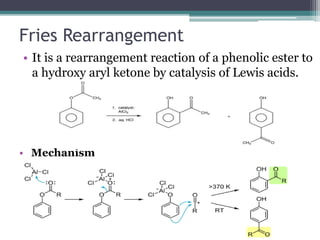
Fries Rearrangement
• It is a rearrangement reaction of a phenolic ester to
a hydroxy aryl ketone by catalysis of Lewis acids.
• Mechanism
Claisen Rearrangement
• It is a [3,3]-sigmatropic reaction where an Aryl
allyl ethers on being heating converts into
allylphenols.
• Mechanism
THANK YOU !

Rearrangement reactions

  • 1.
    Rearrangement reactions Prepared by-Mohamad Haider Department of Pharmaceutical Chemistry, DIPSAR Roll no.- 04/MPH/DIPSAR/19
  • 2.
    Introduction • A rearrangementreaction is a broad class of organic reactions where the carbon skeleton of a molecule is rearranged to give a structural isomer of the original molecule. Often a substituent moves from one atom to another atom in the same molecule. • Generally the migrating group never leaves the molecule
  • 3.
    Classification 1.Rearrangement to ElectronDeficient Carbon • Wagner-Meerwein Rearrangement • Pinacol Rearrangement • Benzilic Acid Rearrangement • Arndt-Eistert Homologation Reaction 2. Rearrangement to Electron Deficient Nitrogen • Hofmann Rearrangement • Curtius Rearrangement • Schmidt Rearrangement • Lossen Rearrangement • Beckmann Rearrangement
  • 4.
    3. Rearrangement toElectron Deficient Oxygen • Baeyer Villiger Reaction • Dakin Reaction 4. Rearrangement to Electron-Rich Carbon • Stevens Rearrangement • Sommelet-Hauser Rearrangement • Wittig Rearrangement • Favorskii Rearrangement 5. Aromatic Rearrangements • Benzidine Rearrangement • Fries Rearrangement • Claisen Rearrangement
  • 5.
    Wagner-Meerwein Rearrangement • Itis one of the simplest systems where an alkyl group migrates, with its bonding pair, to an electron-deficient carbon atom • Mechanism:
  • 6.
    Pinacol Rearrangement • Treatmentof 1,2-diols (pinacol) with acid lead to rearrangement to give ketone. • Mechanism:
  • 7.
    Benzilic Acid Rearrangement •Reaction of 1,2-diketones into a-hydroxy carboxylic acids using base is Benzilic acid rearrangement. •
  • 8.
    Arndt-Eistert Homologation Reaction •This involves a series of chemical reactions that synthesise a carboxylic acid from it’s homologue with one fewer carbon atoms. • Mechanism:
  • 9.
    Hofmann Rearrangement • Thisrearrangement provides an effective method for the synthesis of primary aliphatic and aromatic amines from primary amides. • Mechanism
  • 10.
    Lossen Rearrangement • TheLossen rearrangement is the conversion of a hydroxamic acid to an isocyanate (via the formation of an intermediate).The isocyanate can be used further to generate amines in the presence of H2O:
  • 11.
    Curtius Rearrangement • TheCartius rearrangement is the thermal decomposition of an acyl azide to an isocyanate with loss of nitrogen gas. • The isocyanate then undergoes attack by water to yield primary amine.
  • 12.
    Schmidt Rearrangement • Thereaction is closely related to Cartius reaction except that the acyl azide is produced by reaction of carboxylic acid with hydrazoic acid. The reaction is acid catalysed. • The acyl azide then undergoes the same reaction as in Cartius rearrangement to form primary amine.
  • 13.
    Beckmann Rearrangement • Theacid-catalyzed conversion of an oxime into an amide is known as Beckmann rearrangement: • Mechanism
  • 14.
    Baeyer Villiger Reaction •It is an organic reaction that forms an ester from a ketone or a lactone from a cyclic ketone, using peroxyacids or peroxides as the oxidant. • Mechanism
  • 15.
    Dakin Reaction • Itis an organic reaction in which an ortho- or para- hydroxylated phenyl aldehyde or ketone reacts with hydrogen peroxide in base to form a benzenediol. • Mechanism
  • 16.
    Stevens Rearrangement • Itis an organic reaction converting quaternary ammonium salts and sulfonium salts to the corresponding amines or sulfides in presence of a strong base: • Mechanism
  • 17.
    Sommelet-Hauser Rearrangement • Itis a rearrangement reaction of certain benzyl quaternary ammonium salts. The reagent is usually sodium amide and the reaction product a N-dialkyl benzyl amine (with a new alkyl group in the aromatic ortho position).
  • 18.
    Wittig Rearrangement • The[1,2]-Wittig Rearrangement is the base- promoted reaction of ethers to yield secondary or tertiary alcohol: • Mechanism
  • 19.
    Favorskii Rearrangement • Itis a rearrangement reaction of α-haloketones. Particularly useful for ring contraction. • Mechanism
  • 20.
    Benzidine Rearrangement • Treatmentof 1,2-diphenylhydrazine with mineral acids induces a rearrangement reaction to 4,4'- benzidine. This is benzidine rearrangement. • Mechanism
  • 21.
    Fries Rearrangement • Itis a rearrangement reaction of a phenolic ester to a hydroxy aryl ketone by catalysis of Lewis acids. • Mechanism
  • 22.
    Claisen Rearrangement • Itis a [3,3]-sigmatropic reaction where an Aryl allyl ethers on being heating converts into allylphenols. • Mechanism
  • 23.