SUZUKI REACTION
SUZUKI MIYAURA REACTION
SUZUKI COUPLING REACTION
SUBMITTED BY :
RINSHANA FATHIMA ABDUL AZEEZ
FIRST YEAR M.PHARM
PHARMACEUTICAL CHEMISTRY
AL SHIFA COLLEGE OF PHARMACY
1
Suzuki reaction is the Pd catalysed cross coupling reaction[1]
between the boronic / organoboronic acids / organoboranes with
organic halides[2], triflates, etc under basic conditions[3] which leads
to the formation of carbon carbon single bonds.[4]
This reaction is commonly used for synthesising biaryl
compounds.
2
GENERAL SCHEME
3
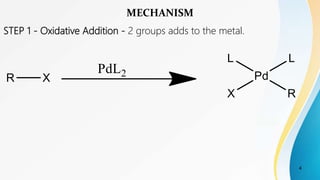
STEP 1 - Oxidative Addition - 2 groups adds to the metal.
4
MECHANISM
STEP 2 - Hydroxide attacks Pd, kicking off X
5
STEP 3 - Lewis base (OH-) attacks Lewis acid (B)
6
The Organo Boron has only 3 bonds around it and it is sp2 hybrised with
an empty p orbital, making it a very good lewis acid.
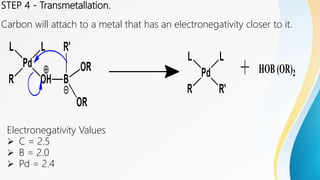
STEP 4 - Transmetallation.
Carbon will attach to a metal that has an electronegativity closer to it.
Electronegativity Values
 C = 2.5
 B = 2.0
 Pd = 2.4
STEP 5 - Reductive Elimination - 2 groups are removed from a
metal.
8
ADVANTAGES
• Mild reaction conditions. (From 20-80℃)
• Commercial availability of many boronic acids.
• The inorganic by-products are easily removed from the reaction
mixture, making the reaction suitable for industrial processes
9
• Generally aryl halides react sluggishly.
• By-products such as self-coupling products are formed because
of solvent-dissolved oxygen.
DISADVANTAGES
10
• Development of catalysts facilitating coupling of unreactive aryl
halides.
Eg: Ni catalysts have been used as catalysts for coupling aryl
chlorides, for the following reasons.
 No handling of air or moisture - sensitive material is necessary.
 A wide variety of functional groups are tolerated and
unsymmetrical biaryls are obtained in high yields.
ADVANCEMENTS
11
• Xenbucin 1, an analgesic drug, was synthesized in 4 steps using two
different routes. The biaryl fragment could successfully be produced
via a Pd/C catalysed Suzuki coupling [5]
12
SYNTHETIC APPLICATIONS
• Boscalid, a fungicide is prepared via Suzuki reaction.[6]
13
• In Valsartan, the biaryls can easily be prepared by this reaction. [6]
14
• The formal total synthesis of Oximidine by G.A.Molander et al. was
done by using this reaction. [4]
15
• The key step in the total synthesis of Myxalamide A by C.H. Heathcock
et al. was Suzuki Cross-Coupling.
16
• The natural anti tumour product Epothilone A was synthesized in
the laboratory by J.S. Panek by using the Suzuki Cross Coupling
Reaction.
17
REFERENCE
1. Jie Jack Li; Name Reactions: A Collection of Detailed Mechanisms and
Synthetic Applications Fifth Edition; Springer Science & Business Media,
30-Jan-2014; Page no. 544
2. Benny K G Theng; Clay Mineral Catalysis of Organic Reactions; CRC
Press, 27-Jul-2018; Page No.2016
3. Ranjit S. Dhillon; Hydroboration and Organic Synthesis : 9-Borabicclo
[3.3.1] nonane (9-BBN); Springer Science & Business Media; 01 - May -
2007; Page No. 523
4. Laszlo Kurti, Barbara Czako; Strategic Applications of Named Reactions
in Organic Synthesis; Elsevier, 29-Apr-2005; Page no. 37
18
4. Noora KuulojaTuula KylmäläYoujun XuRobert Franzén; Synthesis of
Xenbucin using Suzuki reaction catalyzed by Pd/C in water; Central
European Journal of Chemistry; September 2008, Volume 6, Issue 3, pp
390–392
5. .A. MAUREEN ROUHI, C&EN WASHINGTON;FINE CHEMICALS Suzuki-
coupling chemistry takes hold in commercial practice, from small-scale
synthesis of screening compounds to industrial production of active
ingredients; American Chemical Society; September 6, 2004 Volume 82,
Number 36 pp. 49-58
19
THANK YOU
20

Suzuki reaction

  • 1.
    SUZUKI REACTION SUZUKI MIYAURAREACTION SUZUKI COUPLING REACTION SUBMITTED BY : RINSHANA FATHIMA ABDUL AZEEZ FIRST YEAR M.PHARM PHARMACEUTICAL CHEMISTRY AL SHIFA COLLEGE OF PHARMACY 1
  • 2.
    Suzuki reaction isthe Pd catalysed cross coupling reaction[1] between the boronic / organoboronic acids / organoboranes with organic halides[2], triflates, etc under basic conditions[3] which leads to the formation of carbon carbon single bonds.[4] This reaction is commonly used for synthesising biaryl compounds. 2
  • 3.
  • 4.
    STEP 1 -Oxidative Addition - 2 groups adds to the metal. 4 MECHANISM
  • 5.
    STEP 2 -Hydroxide attacks Pd, kicking off X 5
  • 6.
    STEP 3 -Lewis base (OH-) attacks Lewis acid (B) 6 The Organo Boron has only 3 bonds around it and it is sp2 hybrised with an empty p orbital, making it a very good lewis acid.
  • 7.
    STEP 4 -Transmetallation. Carbon will attach to a metal that has an electronegativity closer to it. Electronegativity Values  C = 2.5  B = 2.0  Pd = 2.4
  • 8.
    STEP 5 -Reductive Elimination - 2 groups are removed from a metal. 8
  • 9.
    ADVANTAGES • Mild reactionconditions. (From 20-80℃) • Commercial availability of many boronic acids. • The inorganic by-products are easily removed from the reaction mixture, making the reaction suitable for industrial processes 9
  • 10.
    • Generally arylhalides react sluggishly. • By-products such as self-coupling products are formed because of solvent-dissolved oxygen. DISADVANTAGES 10
  • 11.
    • Development ofcatalysts facilitating coupling of unreactive aryl halides. Eg: Ni catalysts have been used as catalysts for coupling aryl chlorides, for the following reasons.  No handling of air or moisture - sensitive material is necessary.  A wide variety of functional groups are tolerated and unsymmetrical biaryls are obtained in high yields. ADVANCEMENTS 11
  • 12.
    • Xenbucin 1,an analgesic drug, was synthesized in 4 steps using two different routes. The biaryl fragment could successfully be produced via a Pd/C catalysed Suzuki coupling [5] 12 SYNTHETIC APPLICATIONS
  • 13.
    • Boscalid, afungicide is prepared via Suzuki reaction.[6] 13
  • 14.
    • In Valsartan,the biaryls can easily be prepared by this reaction. [6] 14
  • 15.
    • The formaltotal synthesis of Oximidine by G.A.Molander et al. was done by using this reaction. [4] 15
  • 16.
    • The keystep in the total synthesis of Myxalamide A by C.H. Heathcock et al. was Suzuki Cross-Coupling. 16
  • 17.
    • The naturalanti tumour product Epothilone A was synthesized in the laboratory by J.S. Panek by using the Suzuki Cross Coupling Reaction. 17
  • 18.
    REFERENCE 1. Jie JackLi; Name Reactions: A Collection of Detailed Mechanisms and Synthetic Applications Fifth Edition; Springer Science & Business Media, 30-Jan-2014; Page no. 544 2. Benny K G Theng; Clay Mineral Catalysis of Organic Reactions; CRC Press, 27-Jul-2018; Page No.2016 3. Ranjit S. Dhillon; Hydroboration and Organic Synthesis : 9-Borabicclo [3.3.1] nonane (9-BBN); Springer Science & Business Media; 01 - May - 2007; Page No. 523 4. Laszlo Kurti, Barbara Czako; Strategic Applications of Named Reactions in Organic Synthesis; Elsevier, 29-Apr-2005; Page no. 37 18
  • 19.
    4. Noora KuulojaTuulaKylmäläYoujun XuRobert Franzén; Synthesis of Xenbucin using Suzuki reaction catalyzed by Pd/C in water; Central European Journal of Chemistry; September 2008, Volume 6, Issue 3, pp 390–392 5. .A. MAUREEN ROUHI, C&EN WASHINGTON;FINE CHEMICALS Suzuki- coupling chemistry takes hold in commercial practice, from small-scale synthesis of screening compounds to industrial production of active ingredients; American Chemical Society; September 6, 2004 Volume 82, Number 36 pp. 49-58 19
  • 20.