Presented By:
Diwan
Topic Covered
 Introduction
 Mechanism
 Examples
 Asymmetric Michael reaction
 References
Definition
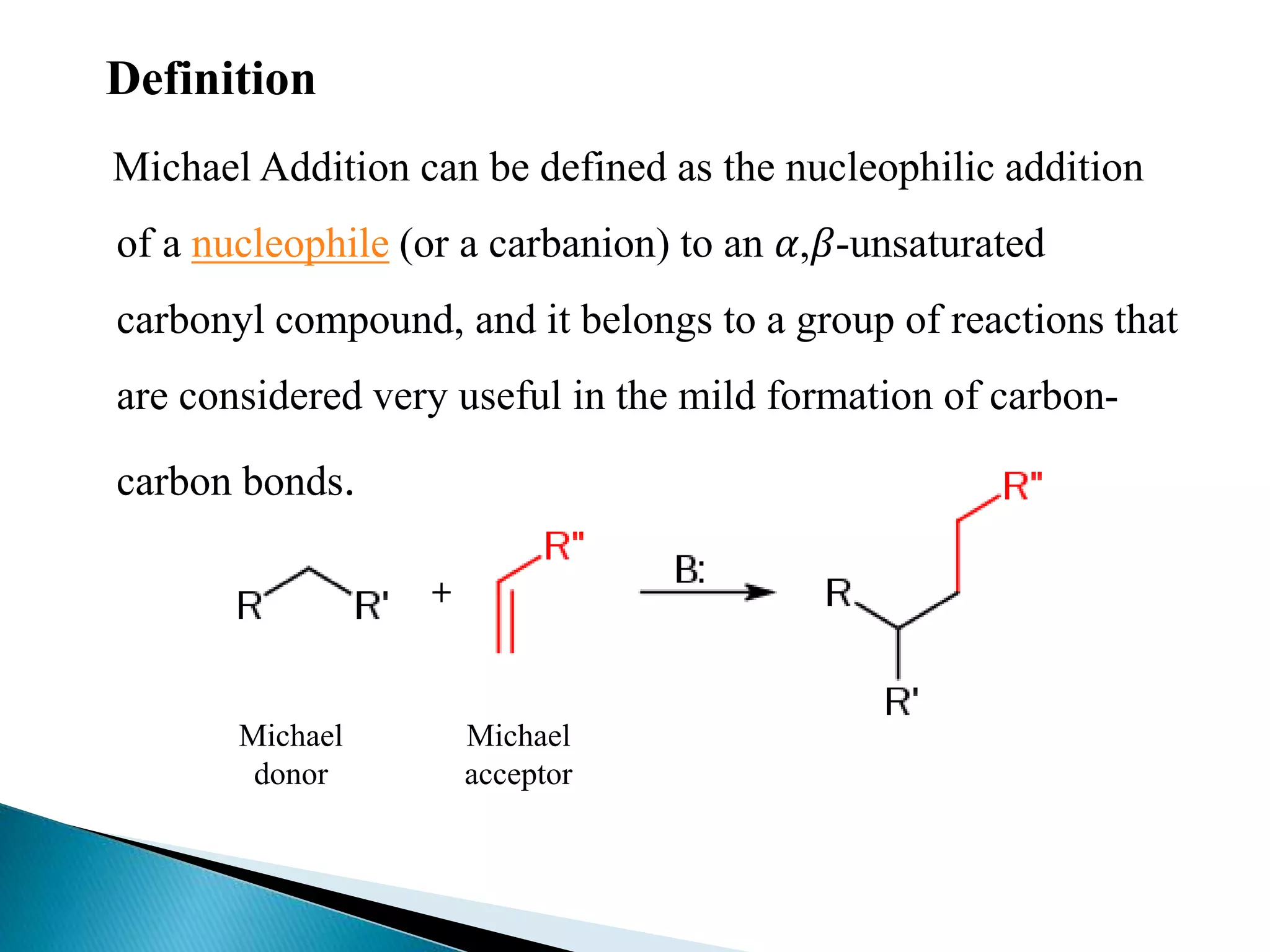
Michael Addition can be defined as the nucleophilic addition
of a nucleophile (or a carbanion) to an 𝛼,𝛽-unsaturated
carbonyl compound, and it belongs to a group of reactions that
are considered very useful in the mild formation of carbon-
carbon bonds.
Michael
donor
Michael
acceptor
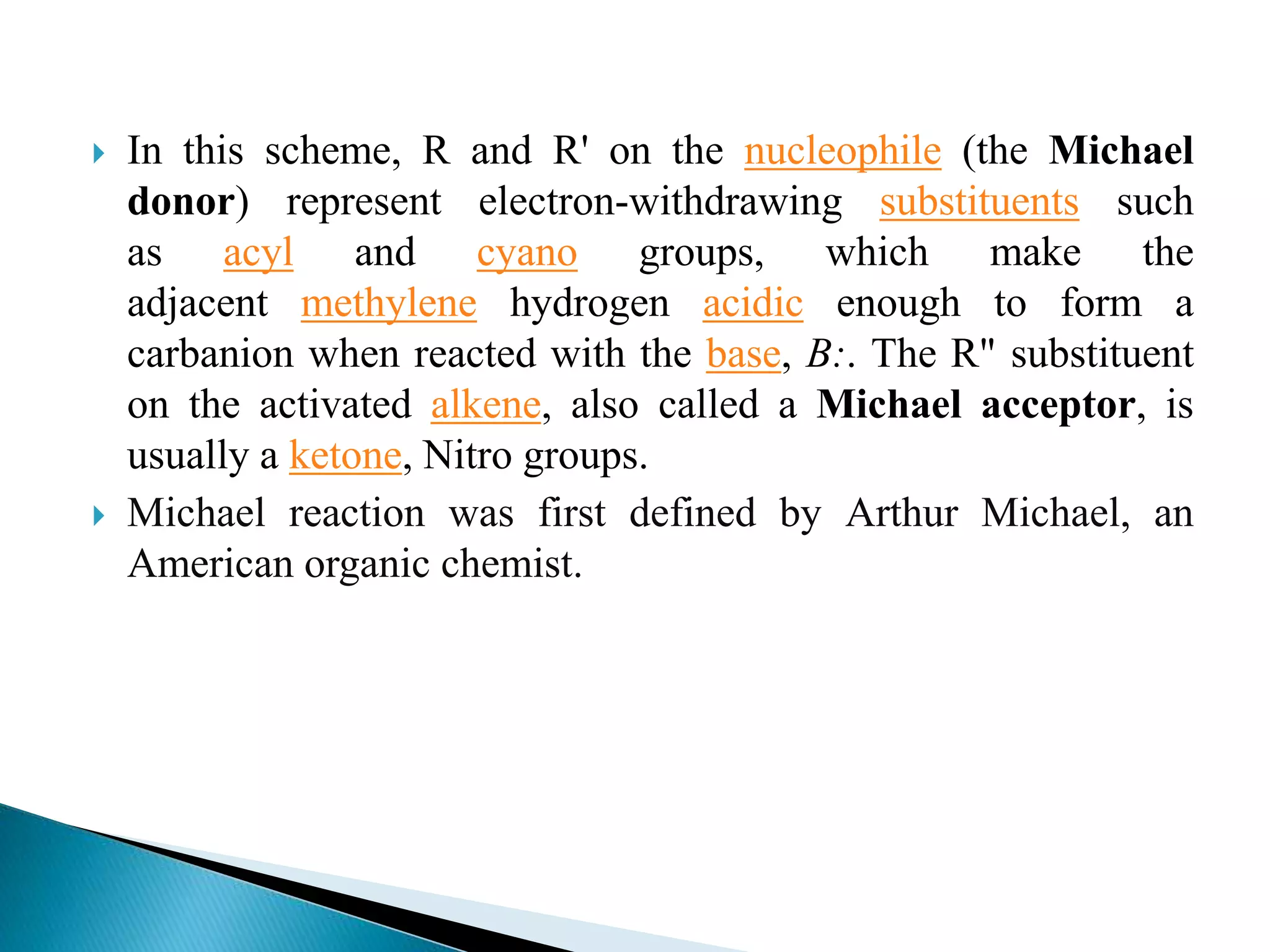
 In this scheme, R and R' on the nucleophile (the Michael
donor) represent electron-withdrawing substituents such
as acyl and cyano groups, which make the
adjacent methylene hydrogen acidic enough to form a
carbanion when reacted with the base, B:. The R" substituent
on the activated alkene, also called a Michael acceptor, is
usually a ketone, Nitro groups.
 Michael reaction was first defined by Arthur Michael, an
American organic chemist.
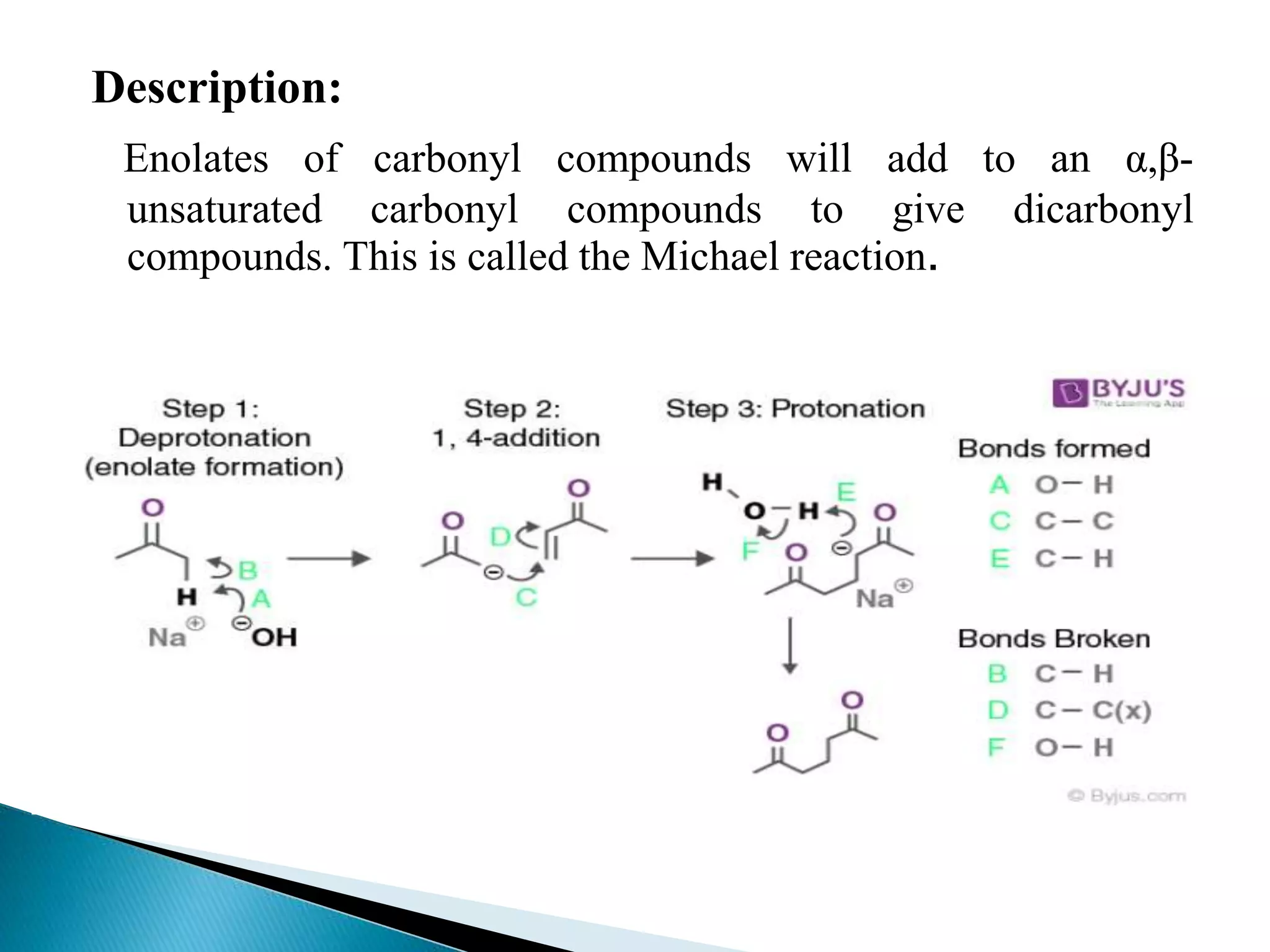
Description:
Enolates of carbonyl compounds will add to an α,β-
unsaturated carbonyl compounds to give dicarbonyl
compounds. This is called the Michael reaction.
 Mechanism
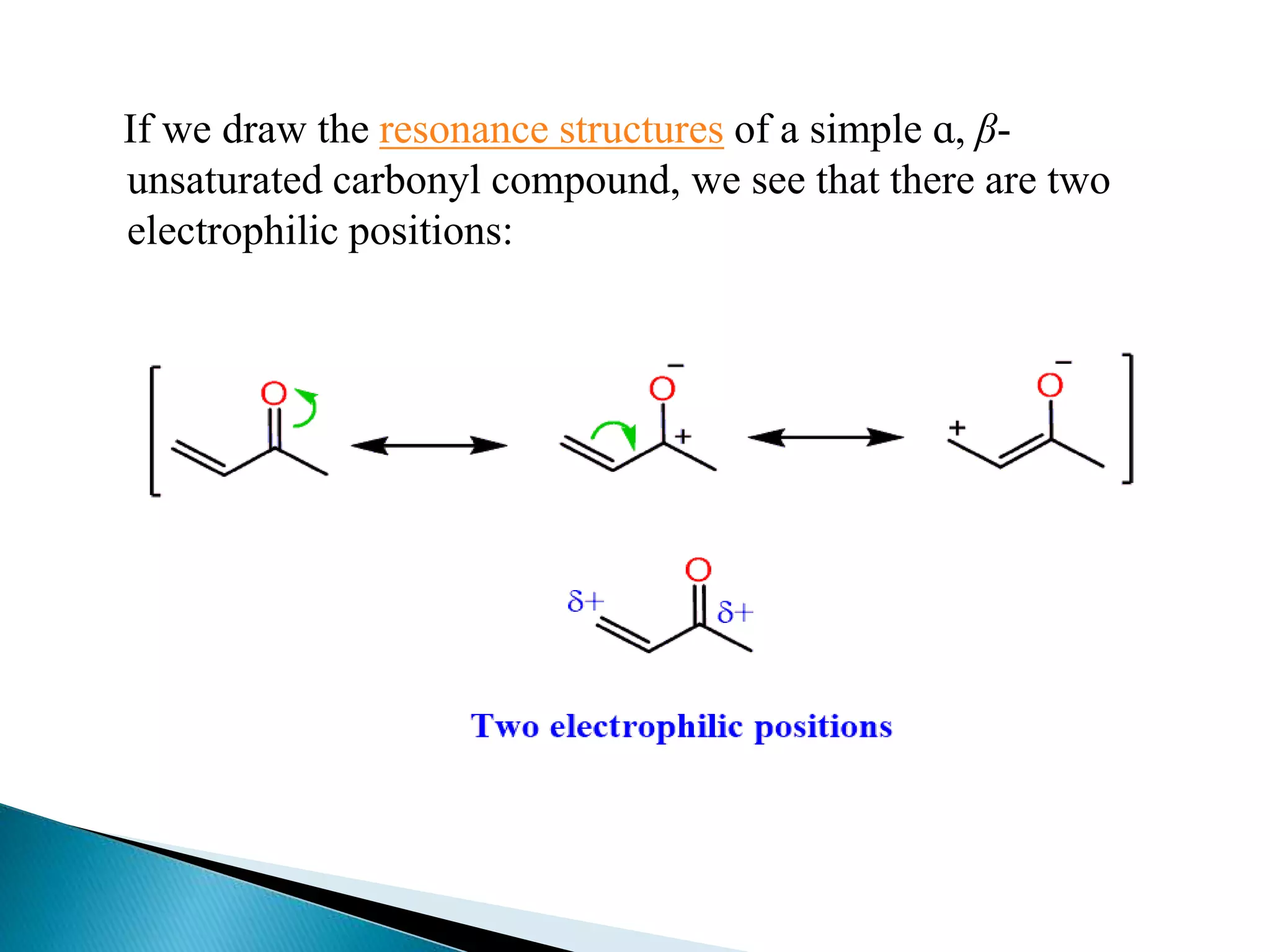
If we draw the resonance structures of a simple ɑ, β-
unsaturated carbonyl compound, we see that there are two
electrophilic positions:
Michael Addition Mechanism
Step 1
 The carbonyl-containing compound is attacked by the
base in the first step of the Michael addition mechanism.
Subsequently, the alpha hydrogen of the carbonyl
compound is deprotonated by the base, leading to the
formation of the carbanion (which has enolate ion).
Step 2
 The electron withdrawing groups of the carbanion give it
stability. The enolate ion and the Michael acceptor now
react together, leading to the formation of a new carbon-
carbon bond. Thus, the enolate ion completes a 1,4
addition on the 𝛼,𝛽-unsaturated carbonyl compound.
Step 3
 The compound formed from the 1,4 addition of the enolate on
the 𝛼,𝛽-unsaturated carbonyl compound is now protonated,
giving the required product. The Michael addition mechanism
is illustrated above along with the list of bonds formed and
broken during the Michael reaction.
 Thus, the 1,5 dicarbonyl compound is formed from the
addition of the enolate of a carbonyl compound to an 𝛼,𝛽-
unsaturated carbonyl compound. This product is commonly
referred to as a Michael Adduct.
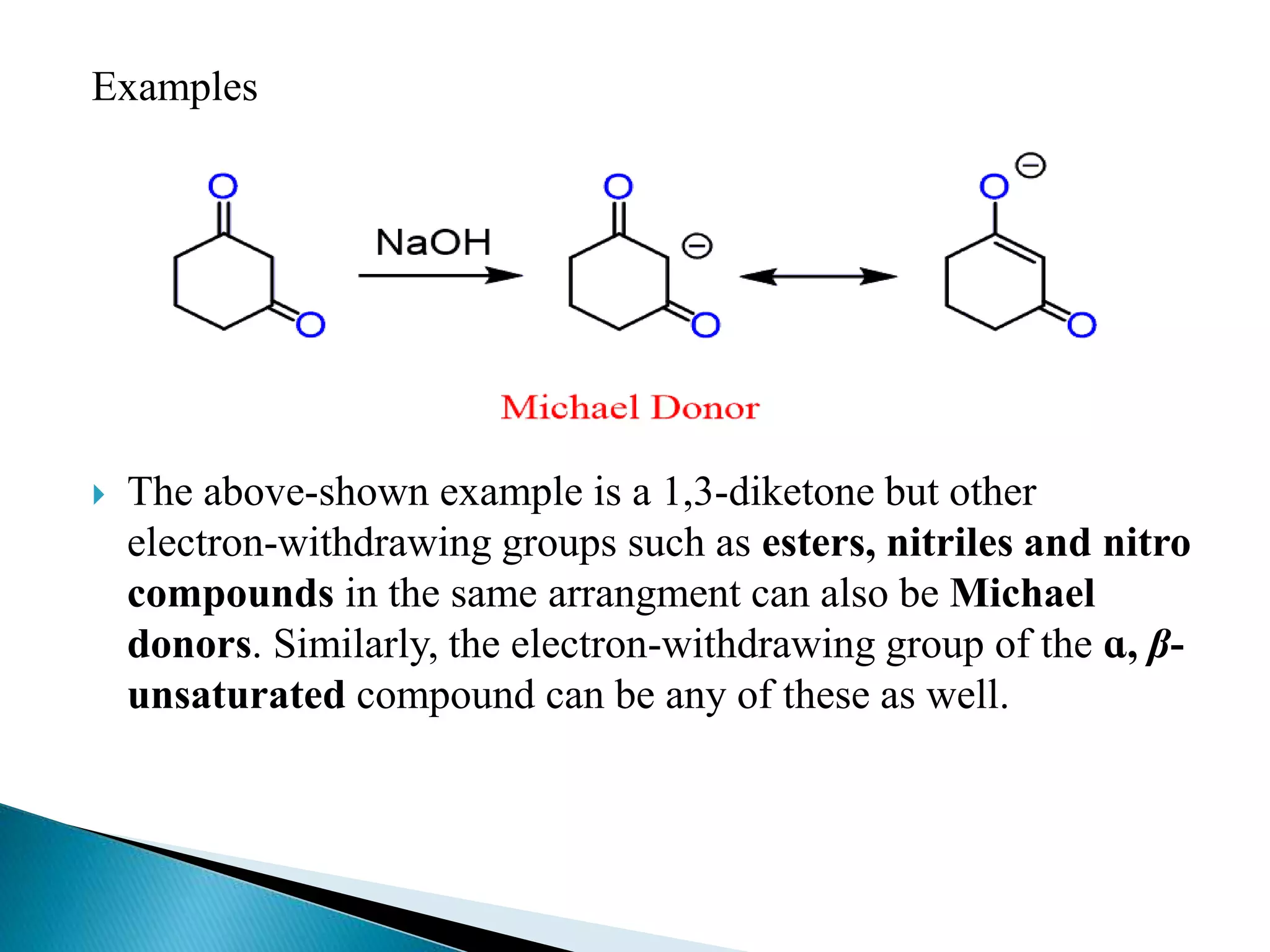
Examples
 The above-shown example is a 1,3-diketone but other
electron-withdrawing groups such as esters, nitriles and nitro
compounds in the same arrangment can also be Michael
donors. Similarly, the electron-withdrawing group of the ɑ, β-
unsaturated compound can be any of these as well.
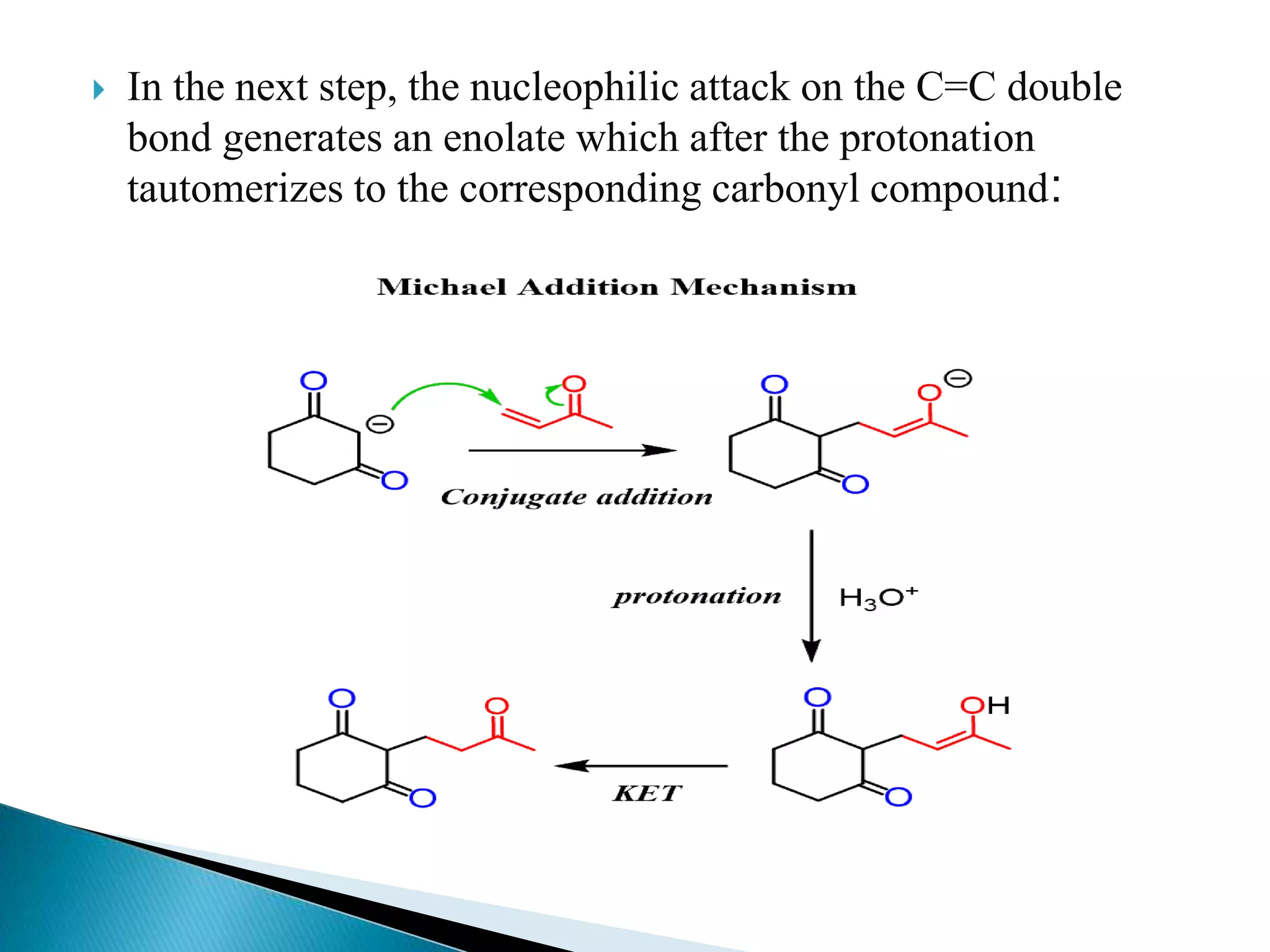
 In the next step, the nucleophilic attack on the C=C double
bond generates an enolate which after the protonation
tautomerizes to the corresponding carbonyl compound:
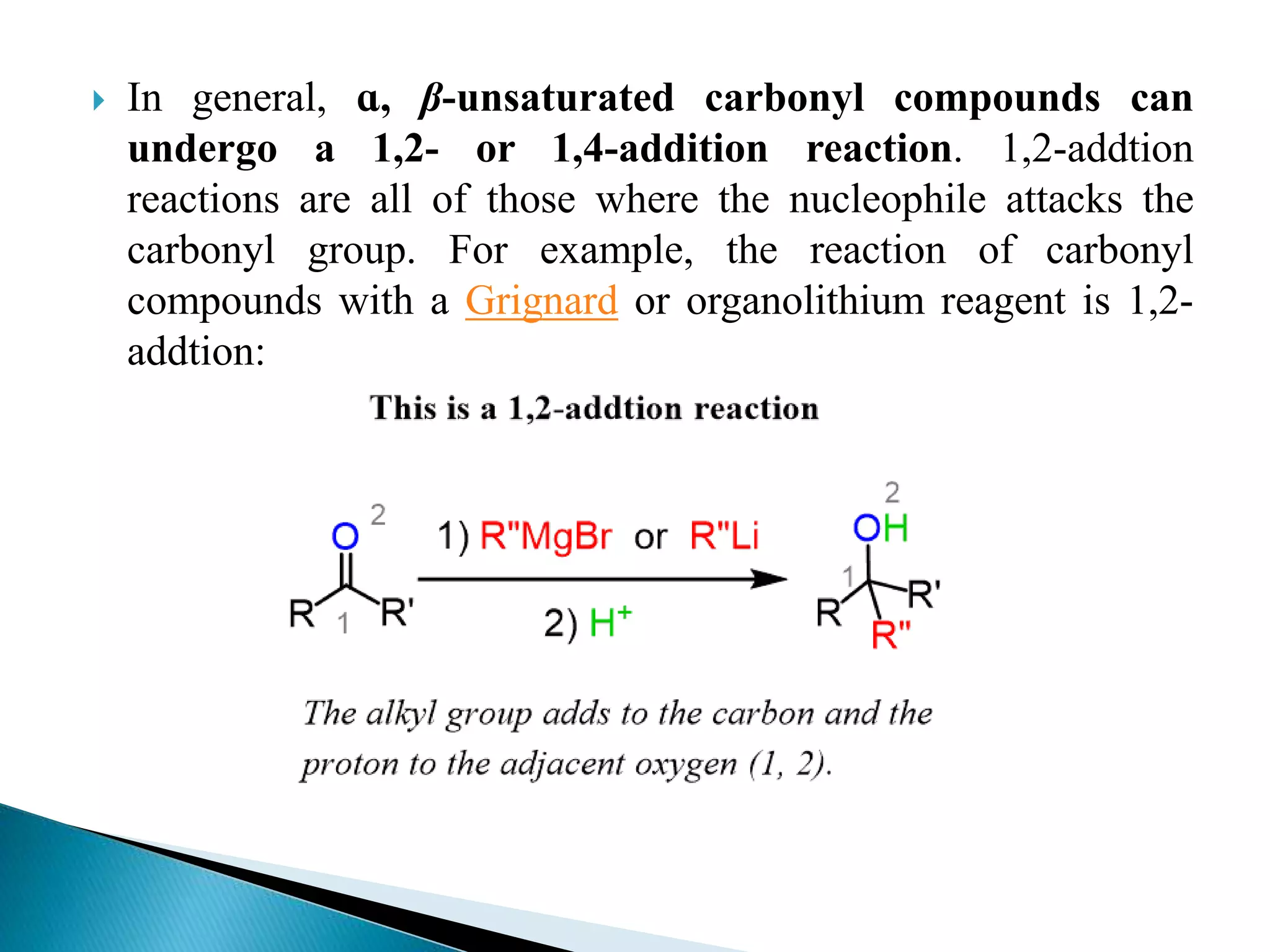
 In general, ɑ, β-unsaturated carbonyl compounds can
undergo a 1,2- or 1,4-addition reaction. 1,2-addtion
reactions are all of those where the nucleophile attacks the
carbonyl group. For example, the reaction of carbonyl
compounds with a Grignard or organolithium reagent is 1,2-
addtion:
 Both the Grignard and especially organolithiums are very
strong bases, and stronger bases tend to give 1,2 carbonyl
addition reactions while weaker bases give 1,4 conjugate
addition. The basicity and nucleophilicity are mostly parallel
for this concept.
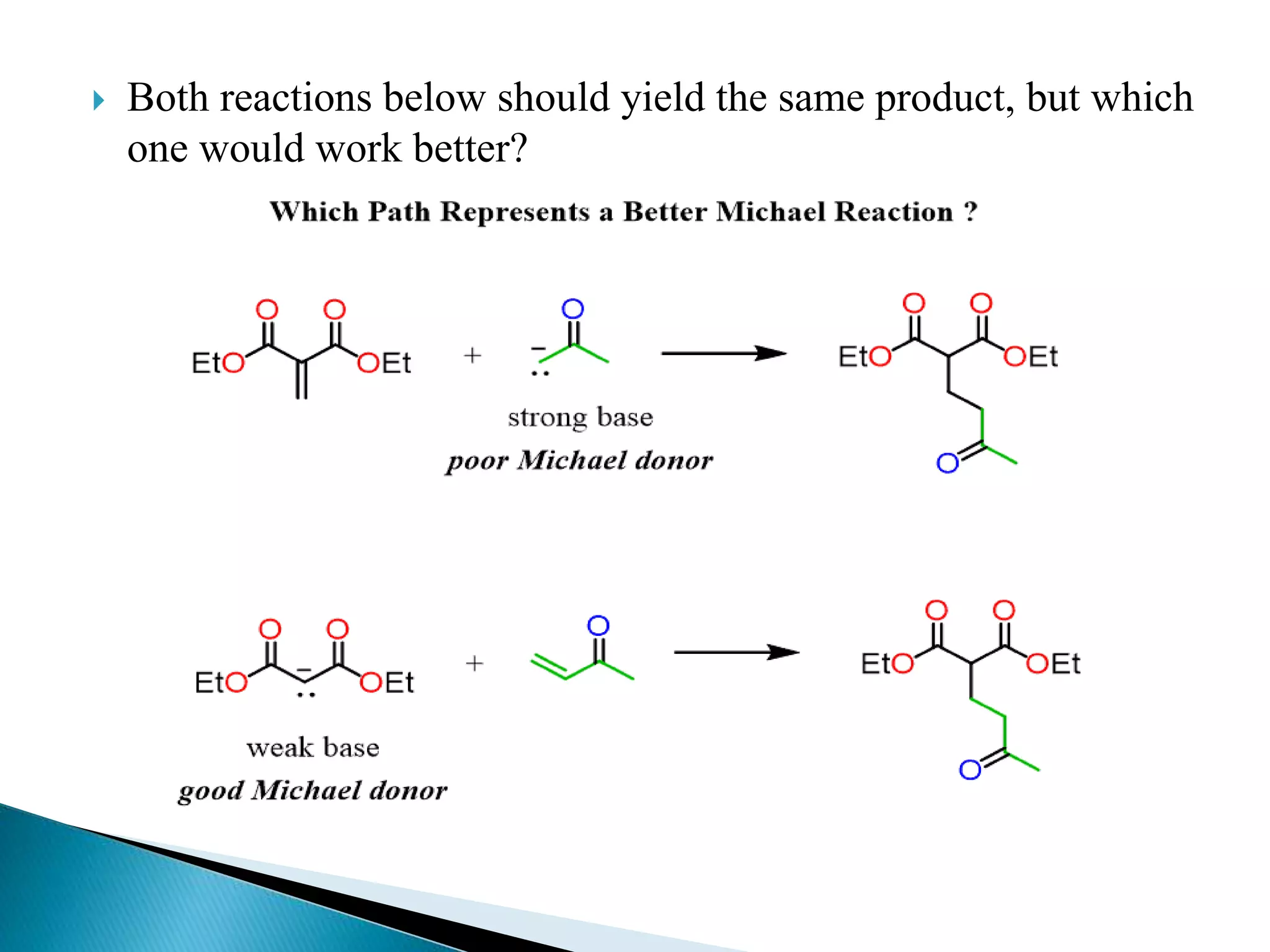
 Both reactions below should yield the same product, but which
one would work better?
 Both are Michael reactions, since it is a nucleophilic addition
to an ɑ, β-unsaturated carbonyl compound. However, the first
option is using a regular enolate which is a strong base and not
a good Michael donor.
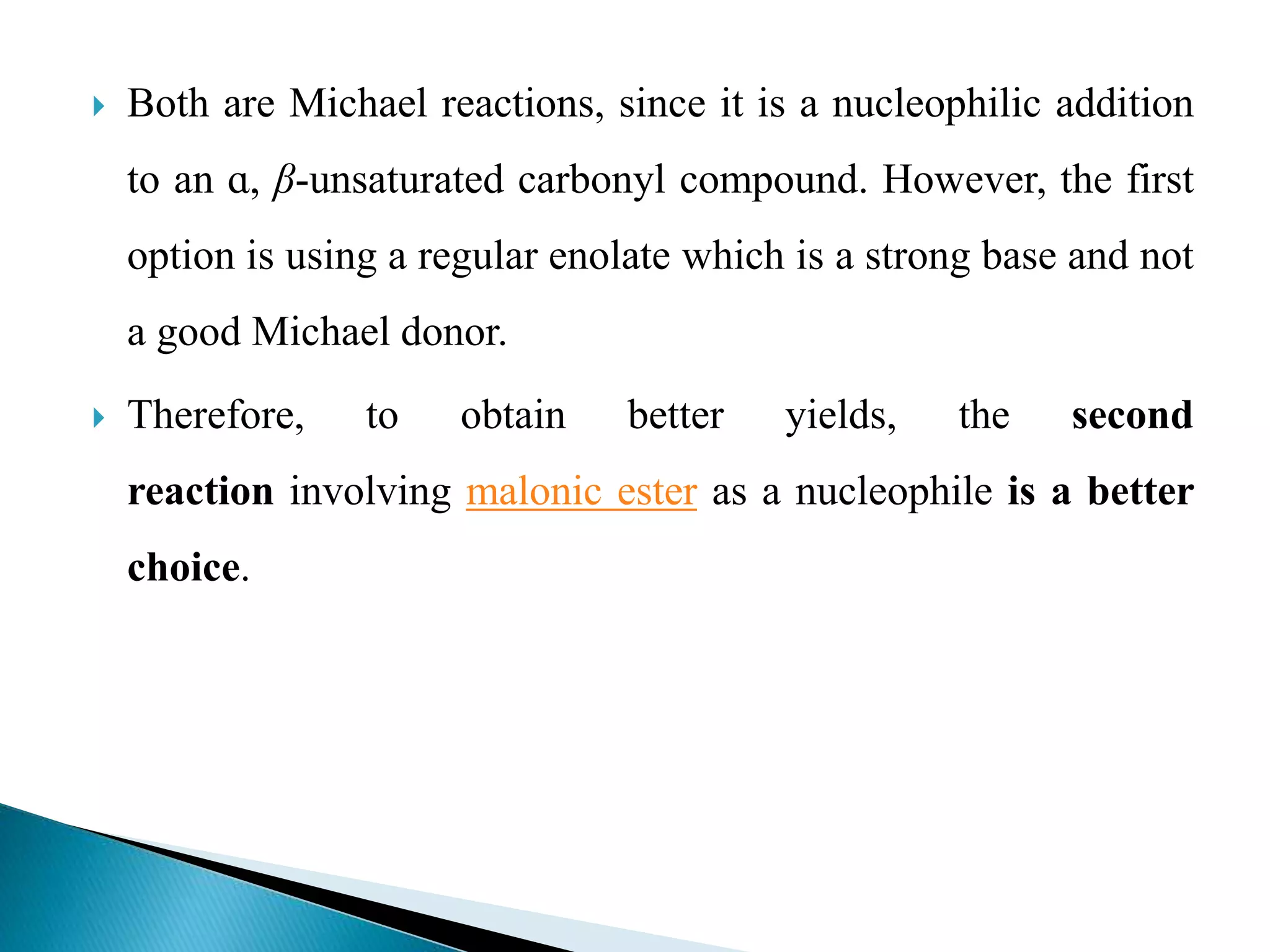
 Therefore, to obtain better yields, the second
reaction involving malonic ester as a nucleophile is a better
choice.
Example
 Diethyl Malonate to Methyl Acrylates
diethyl [2-
(methoxycarbonyl)et
hyl]malonate
diethyl bis[2-
(methoxycarbonyl)ethyl]malo
nate
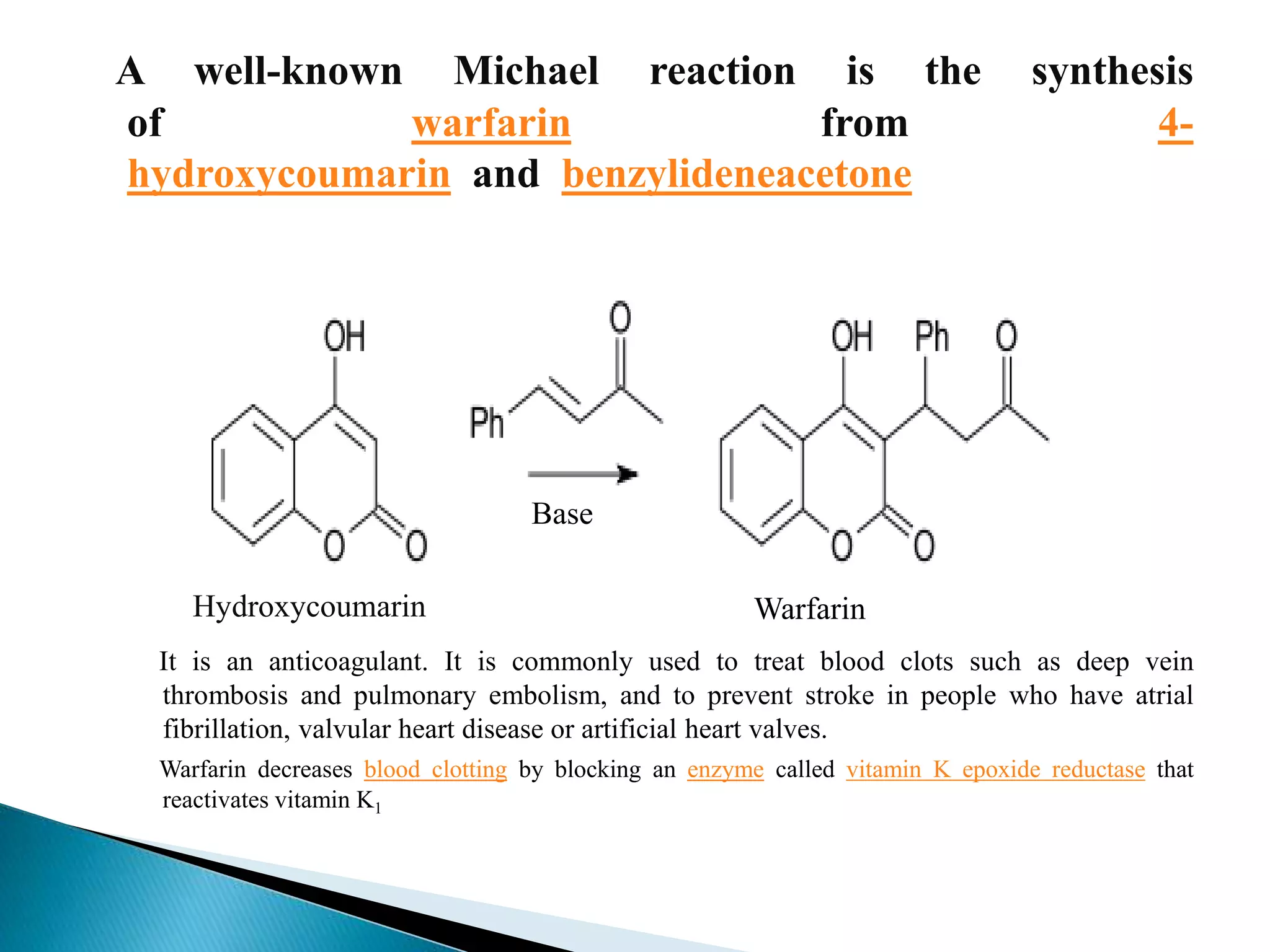
A well-known Michael reaction is the synthesis
of warfarin from 4-
hydroxycoumarin and benzylideneacetone
It is an anticoagulant. It is commonly used to treat blood clots such as deep vein
thrombosis and pulmonary embolism, and to prevent stroke in people who have atrial
fibrillation, valvular heart disease or artificial heart valves.
Warfarin decreases blood clotting by blocking an enzyme called vitamin K epoxide reductase that
reactivates vitamin K1
Base
Hydroxycoumarin Warfarin
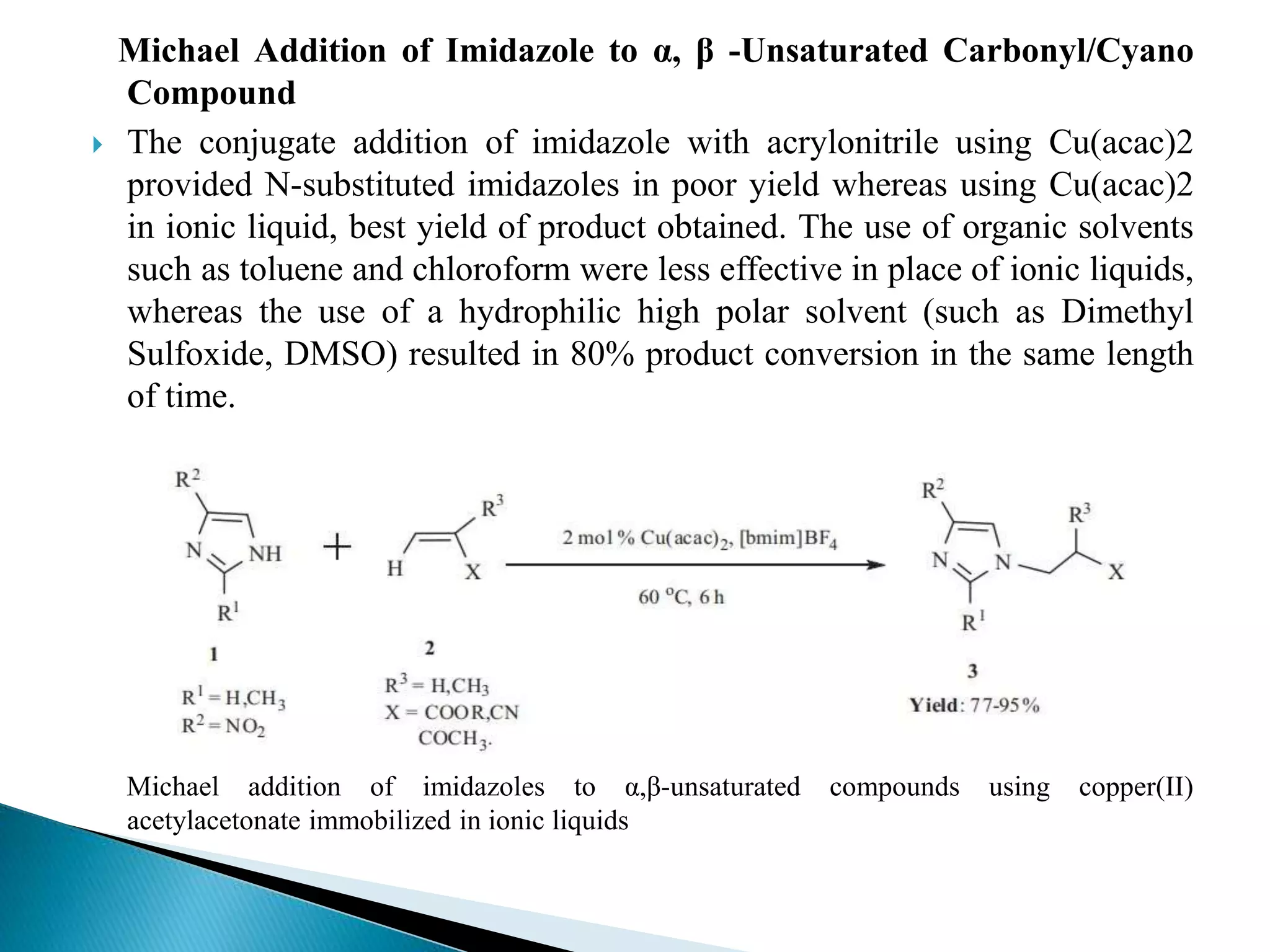
Michael Addition of Imidazole to α, β -Unsaturated Carbonyl/Cyano
Compound
 The conjugate addition of imidazole with acrylonitrile using Cu(acac)2
provided N-substituted imidazoles in poor yield whereas using Cu(acac)2
in ionic liquid, best yield of product obtained. The use of organic solvents
such as toluene and chloroform were less effective in place of ionic liquids,
whereas the use of a hydrophilic high polar solvent (such as Dimethyl
Sulfoxide, DMSO) resulted in 80% product conversion in the same length
of time.
Michael addition of imidazoles to α,β-unsaturated compounds using copper(II)
acetylacetonate immobilized in ionic liquids
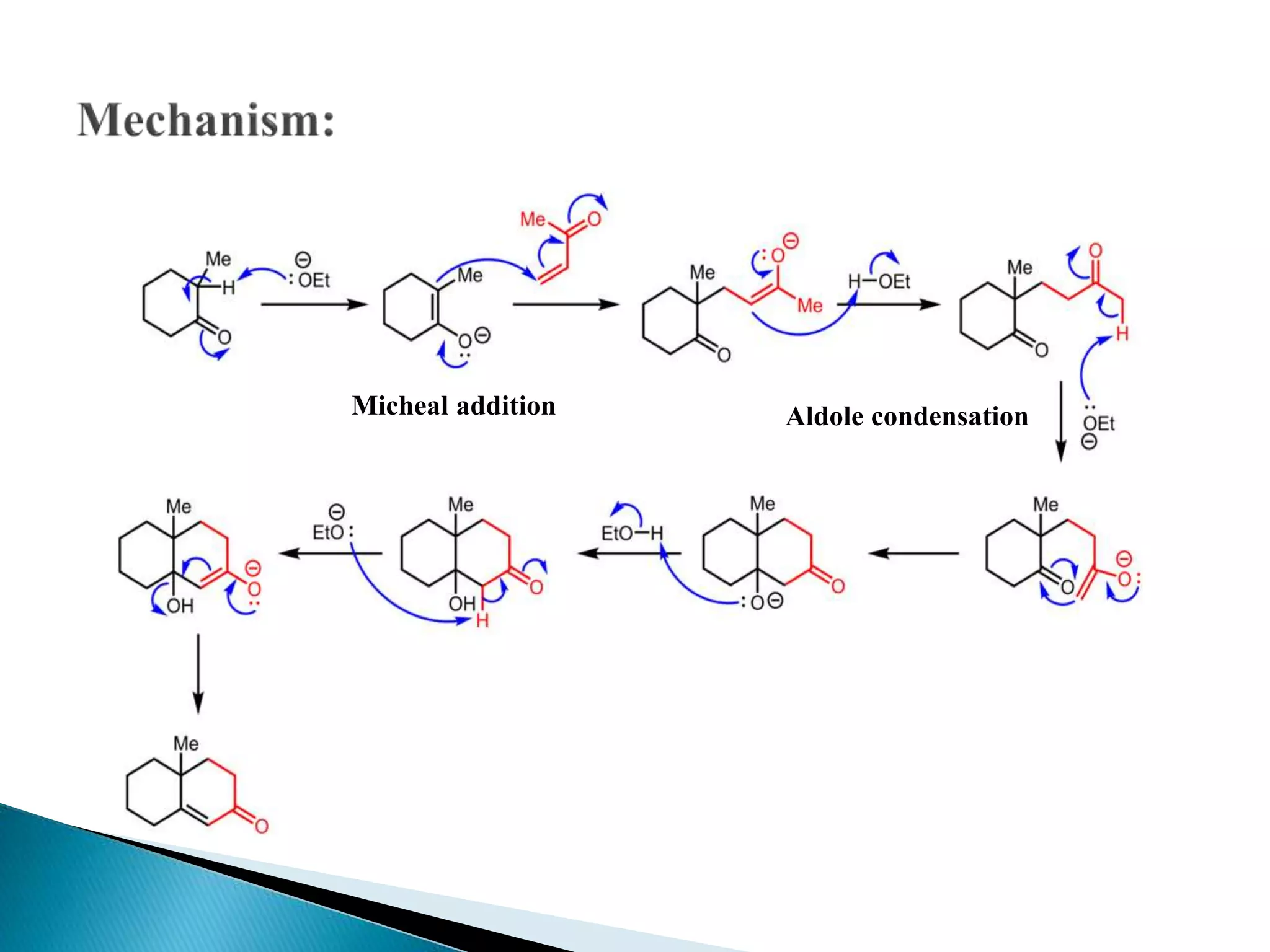
 Robinson annulation
 The Robinson annulation is a chemical reaction used in organic
chemistry for ring formation. It was discovered by Robert Robinson in
1935 as a method to create a six membered ring by forming three new
carbon–carbon bonds.[1] The method uses a ketone and a methyl vinyl
ketone to form an α,β-unsaturated ketone in a cyclohexane ring by
a Michael addition followed by an aldol condensation. This procedure is
one of the key methods to form fused ring systems
Micheal addition Aldole condensation
Asymmetric Michael reaction
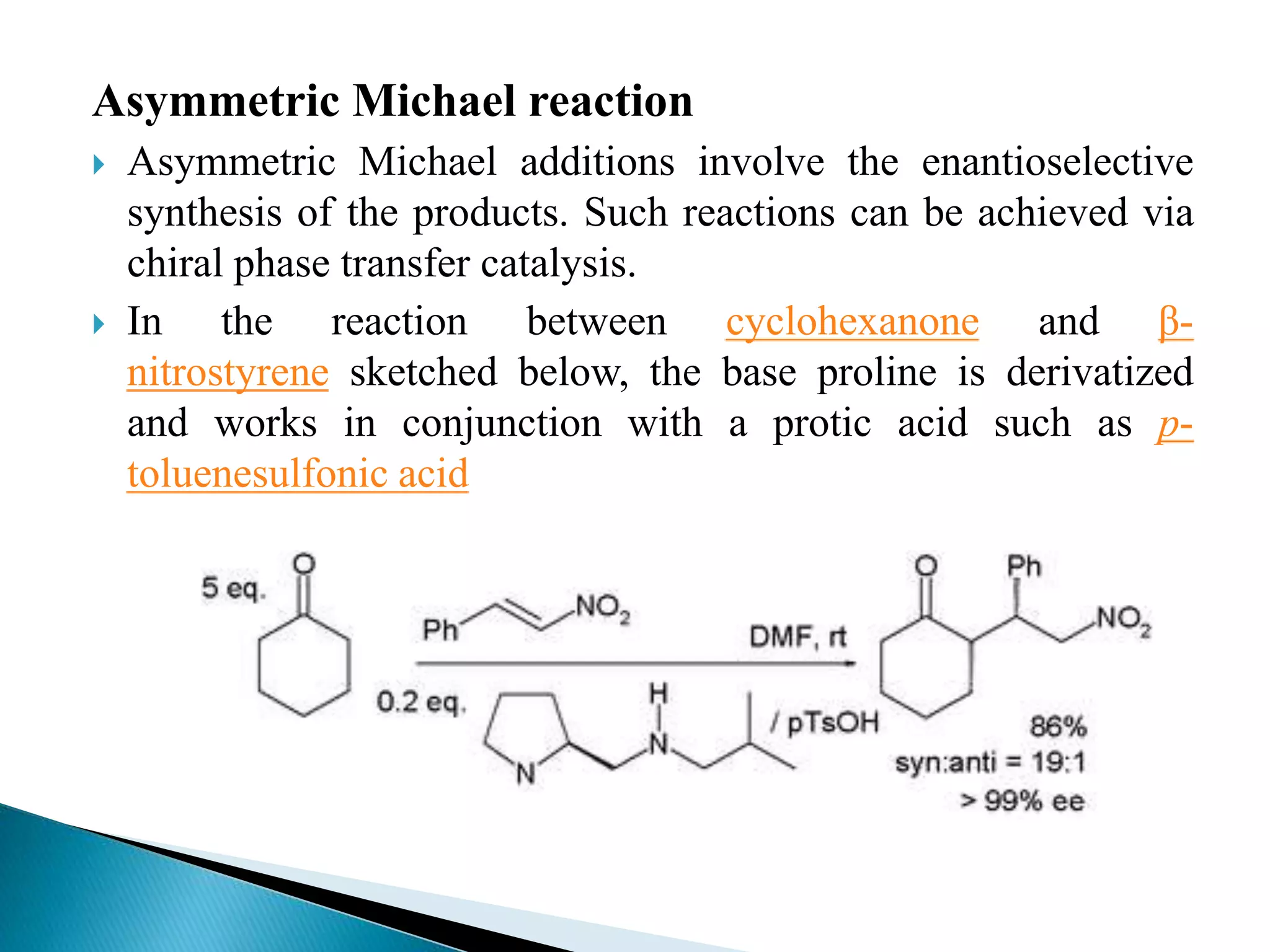
 Asymmetric Michael additions involve the enantioselective
synthesis of the products. Such reactions can be achieved via
chiral phase transfer catalysis.
 In the reaction between cyclohexanone and β-
nitrostyrene sketched below, the base proline is derivatized
and works in conjunction with a protic acid such as p-
toluenesulfonic acid
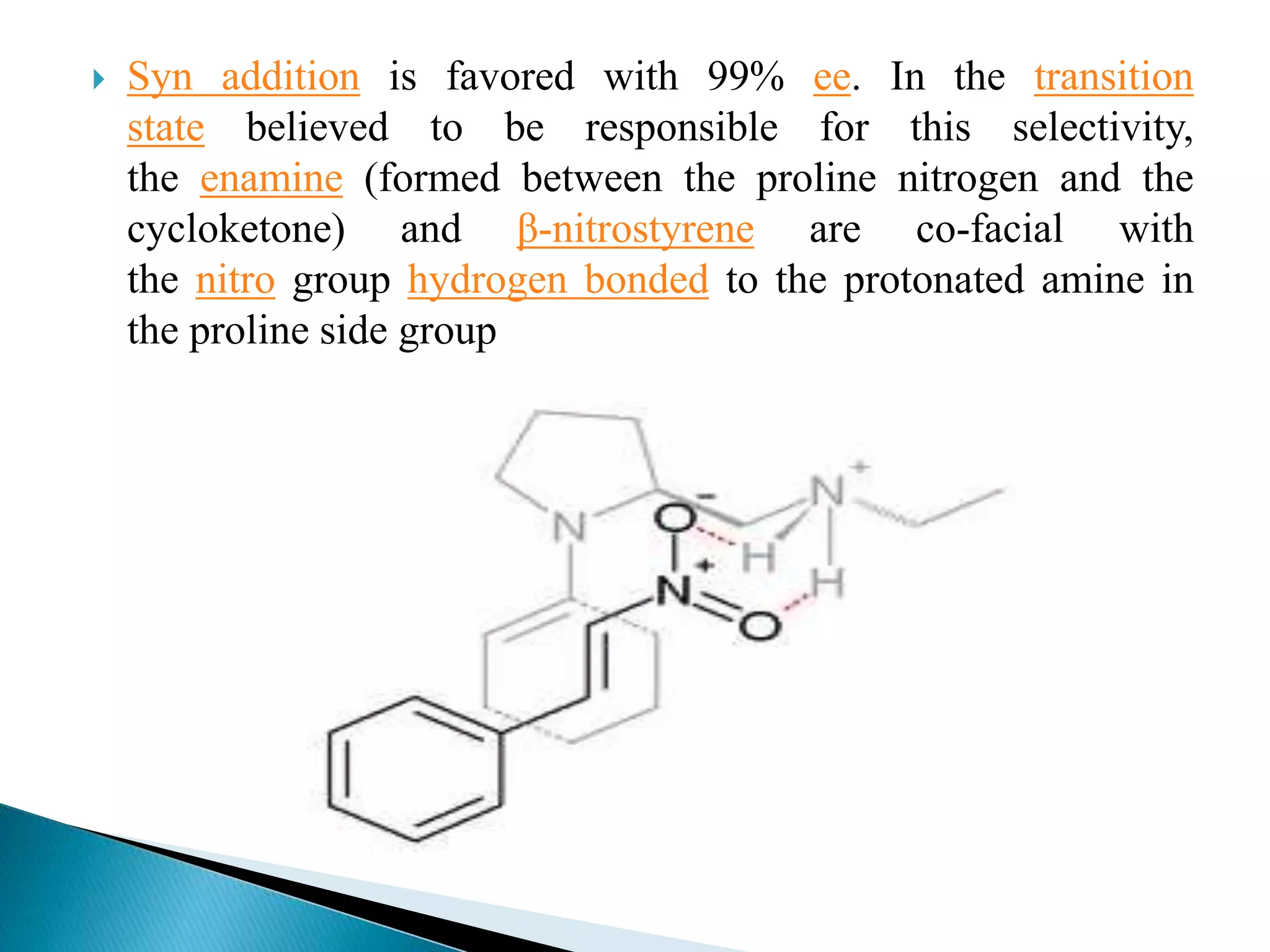
 Syn addition is favored with 99% ee. In the transition
state believed to be responsible for this selectivity,
the enamine (formed between the proline nitrogen and the
cycloketone) and β-nitrostyrene are co-facial with
the nitro group hydrogen bonded to the protonated amine in
the proline side group
References
 https://en.wikipedia.org/wiki/Michael_reaction
 Mather, B.; Viswanathan, K.; Miller, K.; Long, T. (2006).
"Michael addition reactions in macromolecular design for
emerging technologies“
 Michael Addition Mechanism
https://byjus.com/chemistry/michael-addition-mechanism/

Michael addition reaction

  • 1.
  • 2.
    Topic Covered  Introduction Mechanism  Examples  Asymmetric Michael reaction  References
  • 3.
    Definition Michael Addition canbe defined as the nucleophilic addition of a nucleophile (or a carbanion) to an 𝛼,𝛽-unsaturated carbonyl compound, and it belongs to a group of reactions that are considered very useful in the mild formation of carbon- carbon bonds. Michael donor Michael acceptor
  • 4.
     In thisscheme, R and R' on the nucleophile (the Michael donor) represent electron-withdrawing substituents such as acyl and cyano groups, which make the adjacent methylene hydrogen acidic enough to form a carbanion when reacted with the base, B:. The R" substituent on the activated alkene, also called a Michael acceptor, is usually a ketone, Nitro groups.  Michael reaction was first defined by Arthur Michael, an American organic chemist.
  • 5.
    Description: Enolates of carbonylcompounds will add to an α,β- unsaturated carbonyl compounds to give dicarbonyl compounds. This is called the Michael reaction.
  • 6.
  • 7.
    If we drawthe resonance structures of a simple ɑ, β- unsaturated carbonyl compound, we see that there are two electrophilic positions:
  • 8.
    Michael Addition Mechanism Step1  The carbonyl-containing compound is attacked by the base in the first step of the Michael addition mechanism. Subsequently, the alpha hydrogen of the carbonyl compound is deprotonated by the base, leading to the formation of the carbanion (which has enolate ion). Step 2  The electron withdrawing groups of the carbanion give it stability. The enolate ion and the Michael acceptor now react together, leading to the formation of a new carbon- carbon bond. Thus, the enolate ion completes a 1,4 addition on the 𝛼,𝛽-unsaturated carbonyl compound.
  • 9.
    Step 3  Thecompound formed from the 1,4 addition of the enolate on the 𝛼,𝛽-unsaturated carbonyl compound is now protonated, giving the required product. The Michael addition mechanism is illustrated above along with the list of bonds formed and broken during the Michael reaction.  Thus, the 1,5 dicarbonyl compound is formed from the addition of the enolate of a carbonyl compound to an 𝛼,𝛽- unsaturated carbonyl compound. This product is commonly referred to as a Michael Adduct.
  • 10.
    Examples  The above-shownexample is a 1,3-diketone but other electron-withdrawing groups such as esters, nitriles and nitro compounds in the same arrangment can also be Michael donors. Similarly, the electron-withdrawing group of the ɑ, β- unsaturated compound can be any of these as well.
  • 11.
     In thenext step, the nucleophilic attack on the C=C double bond generates an enolate which after the protonation tautomerizes to the corresponding carbonyl compound:
  • 12.
     In general,ɑ, β-unsaturated carbonyl compounds can undergo a 1,2- or 1,4-addition reaction. 1,2-addtion reactions are all of those where the nucleophile attacks the carbonyl group. For example, the reaction of carbonyl compounds with a Grignard or organolithium reagent is 1,2- addtion:
  • 13.
     Both theGrignard and especially organolithiums are very strong bases, and stronger bases tend to give 1,2 carbonyl addition reactions while weaker bases give 1,4 conjugate addition. The basicity and nucleophilicity are mostly parallel for this concept.
  • 14.
     Both reactionsbelow should yield the same product, but which one would work better?
  • 15.
     Both areMichael reactions, since it is a nucleophilic addition to an ɑ, β-unsaturated carbonyl compound. However, the first option is using a regular enolate which is a strong base and not a good Michael donor.  Therefore, to obtain better yields, the second reaction involving malonic ester as a nucleophile is a better choice.
  • 16.
    Example  Diethyl Malonateto Methyl Acrylates diethyl [2- (methoxycarbonyl)et hyl]malonate diethyl bis[2- (methoxycarbonyl)ethyl]malo nate
  • 17.
    A well-known Michaelreaction is the synthesis of warfarin from 4- hydroxycoumarin and benzylideneacetone It is an anticoagulant. It is commonly used to treat blood clots such as deep vein thrombosis and pulmonary embolism, and to prevent stroke in people who have atrial fibrillation, valvular heart disease or artificial heart valves. Warfarin decreases blood clotting by blocking an enzyme called vitamin K epoxide reductase that reactivates vitamin K1 Base Hydroxycoumarin Warfarin
  • 18.
    Michael Addition ofImidazole to α, β -Unsaturated Carbonyl/Cyano Compound  The conjugate addition of imidazole with acrylonitrile using Cu(acac)2 provided N-substituted imidazoles in poor yield whereas using Cu(acac)2 in ionic liquid, best yield of product obtained. The use of organic solvents such as toluene and chloroform were less effective in place of ionic liquids, whereas the use of a hydrophilic high polar solvent (such as Dimethyl Sulfoxide, DMSO) resulted in 80% product conversion in the same length of time. Michael addition of imidazoles to α,β-unsaturated compounds using copper(II) acetylacetonate immobilized in ionic liquids
  • 19.
     Robinson annulation The Robinson annulation is a chemical reaction used in organic chemistry for ring formation. It was discovered by Robert Robinson in 1935 as a method to create a six membered ring by forming three new carbon–carbon bonds.[1] The method uses a ketone and a methyl vinyl ketone to form an α,β-unsaturated ketone in a cyclohexane ring by a Michael addition followed by an aldol condensation. This procedure is one of the key methods to form fused ring systems
  • 20.
  • 21.
    Asymmetric Michael reaction Asymmetric Michael additions involve the enantioselective synthesis of the products. Such reactions can be achieved via chiral phase transfer catalysis.  In the reaction between cyclohexanone and β- nitrostyrene sketched below, the base proline is derivatized and works in conjunction with a protic acid such as p- toluenesulfonic acid
  • 22.
     Syn additionis favored with 99% ee. In the transition state believed to be responsible for this selectivity, the enamine (formed between the proline nitrogen and the cycloketone) and β-nitrostyrene are co-facial with the nitro group hydrogen bonded to the protonated amine in the proline side group
  • 23.
    References  https://en.wikipedia.org/wiki/Michael_reaction  Mather,B.; Viswanathan, K.; Miller, K.; Long, T. (2006). "Michael addition reactions in macromolecular design for emerging technologies“  Michael Addition Mechanism https://byjus.com/chemistry/michael-addition-mechanism/