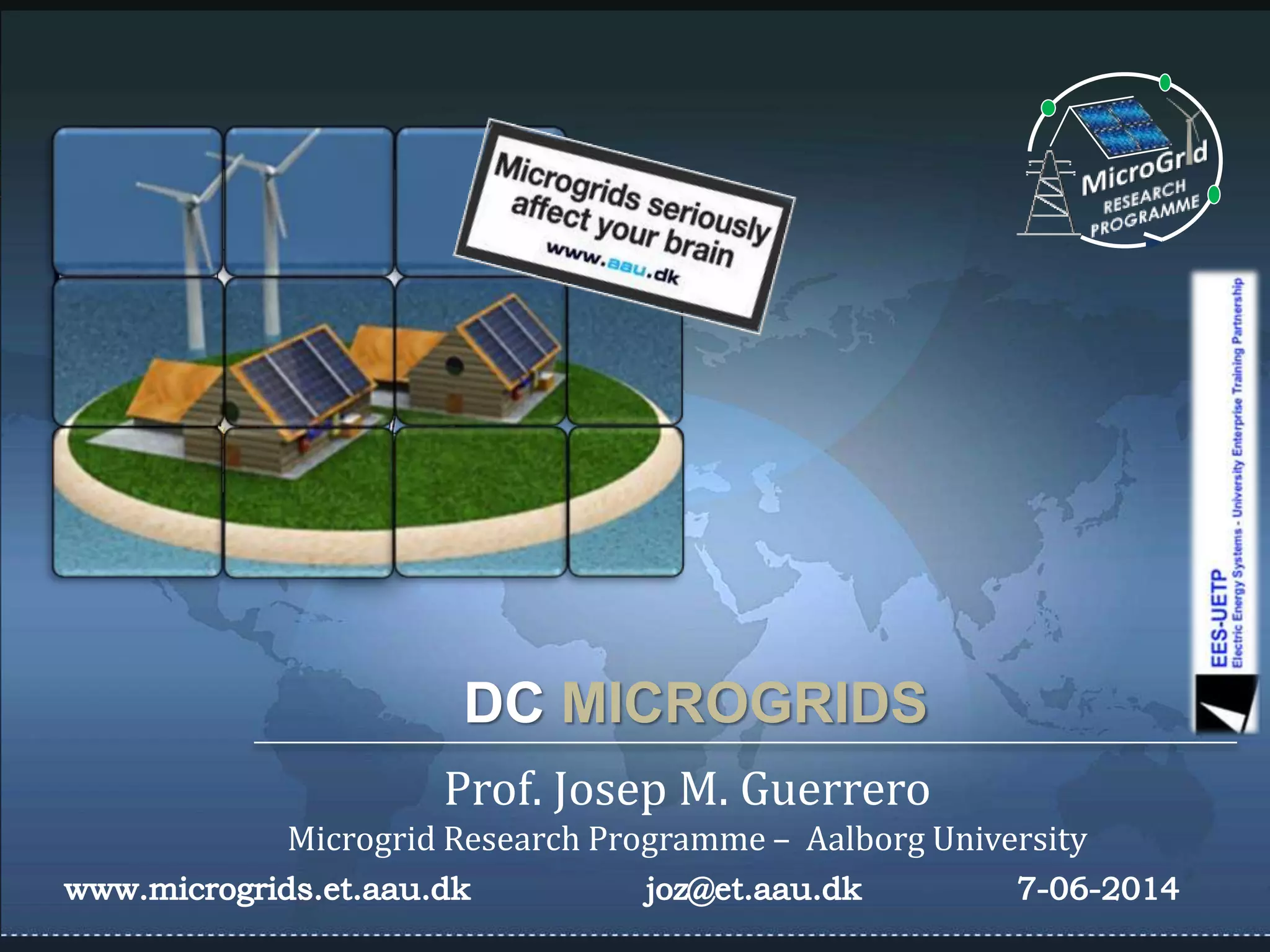
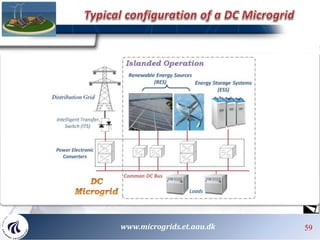
DC MICROGRIDS
Prof. Josep M. Guerrero
Microgrid Research Programme – Aalborg University
2Microgrid Research Programme – ET – AAU
 Microgrid Research Programme in AAU
 Microgrid Definition and Operation
 Microgrids Projects
 DC Microgrid Control Architectures
Microgrid Research Programme – ET – AAU 3
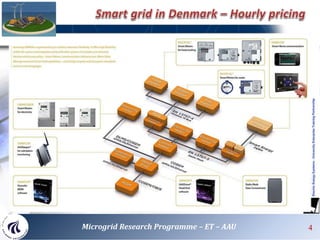
Microgrid Research Programme – ET – AAU 4
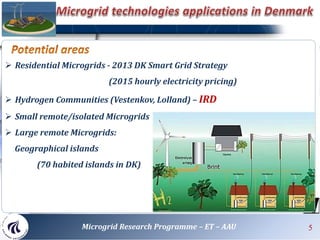
 Residential Microgrids - 2013 DK Smart Grid Strategy
(2015 hourly electricity pricing)
 Hydrogen Communities (Vestenkov, Lolland) – IRD
 Small remote/isolated Microgrids
 Large remote Microgrids:
Geographical islands
(70 habited islands in DK)
Microgrid Research Programme – ET – AAU 5
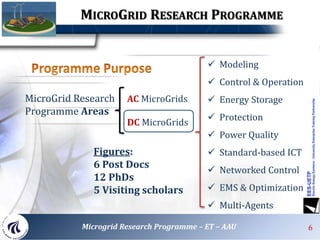
MicroGrid Research
Programme Areas
AC MicroGrids
DC MicroGrids
 Modeling
 Control & Operation
 Energy Storage
 Protection
 Power Quality
 Standard-based ICT
 Networked Control
 EMS & Optimization
 Multi-Agents
MICROGRID RESEARCH PROGRAMME
6
Microgrid Research Programme – ET – AAU 6
Figures:
6 Post Docs
12 PhDs
5 Visiting scholars
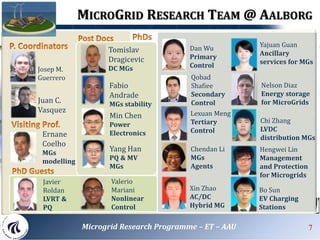
MICROGRID RESEARCH TEAMMICROGRID RESEARCH TEAM @ AALBORG
Josep M.
Guerrero
Tomislav
Dragicevic
DC MGs
Fabio
Andrade
MGs stability
Qobad
Shafiee
Secondary
Control
Lexuan Meng
Tertiary
Control
Dan Wu
Primary
Control
Chendan Li
MGs
Agents
Yajuan Guan
Ancillary
services for MGs
Nelson Diaz
Energy storage
for MicroGrids
Chi Zhang
LVDC
distribution MGs
Hengwei Lin
Management
and Protection
for Microgrids
Xin Zhao
AC/DC
Hybrid MG
Bo Sun
EV Charging
Stations
Javier
Roldan
LVRT &
PQ
Valerio
Mariani
Nonlinear
Control
Ernane
Coelho
MGs
modelling
Juan C.
Vasquez
Min Chen
Power
Electronics
Yang Han
PQ & MV
MGs
7
Microgrid Research Programme – ET – AAU 7
8
8
Microgrid Research Programme – ET – AAU 8
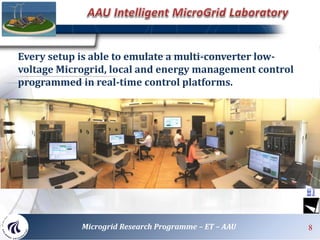
Every setup is able to emulate a multi-converter low-
voltage Microgrid, local and energy management control
programmed in real-time control platforms.
9 9
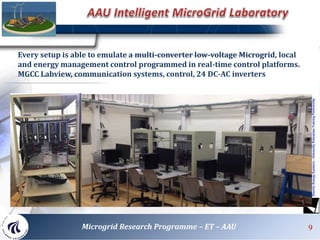
Every setup is able to emulate a multi-converter low-voltage Microgrid, local
and energy management control programmed in real-time control platforms.
MGCC Labview, communication systems, control, 24 DC-AC inverters
Microgrid Research Programme – ET – AAU
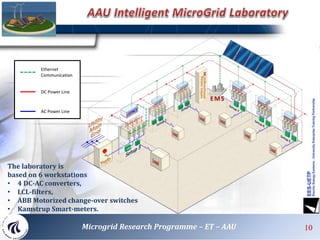
Ethernet
Communication
DC Power Line
AC Power Line
10 10Microgrid Research Programme – ET – AAU
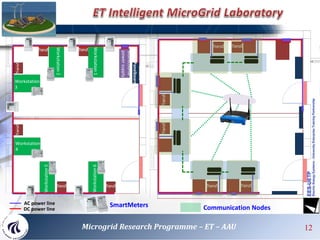
The laboratory is
based on 6 workstations
• 4 DC-AC converters,
• LCL-filters,
• ABB Motorized change-over switches
• Kamstrup Smart-meters.
1111 11Microgrid Research Programme – ET – AAU
Bidirectional
powersupply
Electric
Panelboard
Workstation
4
DC power line
AC power line SmartMeters
Cabine
t
Workstation
3
Workstation5
Workstation6
Workstation2
Workstation1
Communication Nodes
12
Microgrid Research Programme – ET – AAU 12
13Microgrid Research Programme – ET – AAU
 Microgrid Research Programme in AAU
 Microgrid Definition and Operation
 Microgrids Projects
 DC Microgrid Control Architectures
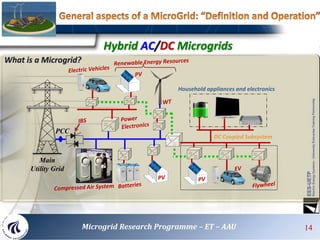
What is a Microgrid?
Main
Utility Grid
PCC
Household appliances and electronics
DC Coupled Subsystem
Hybrid AC/DC Microgrids
14
Microgrid Research Programme – ET – AAU 14
1515
151515
15Microgrid Research Programme – ET – AAU
16
1616
161616
16Microgrid Research Programme – ET – AAU
17
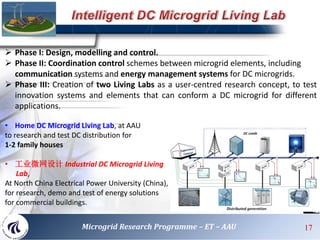
 Phase I: Design, modelling and control.
 Phase II: Coordination control schemes between microgrid elements, including
communication systems and energy management systems for DC microgrids.
 Phase III: Creation of two Living Labs as a user-centred research concept, to test
innovation systems and elements that can conform a DC microgrid for different
applications.
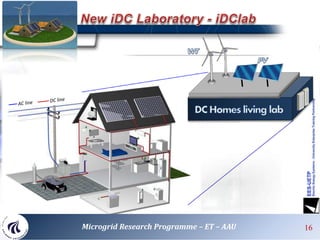
• Home DC Microgrid Living Lab, at AAU
to research and test DC distribution for
1-2 family houses
• 工业微网设计 Industrial DC Microgrid Living
Lab,
At North China Electrical Power University (China),
for research, demo and test of energy solutions
for commercial buildings.
Microgrid Research Programme – ET – AAU
Danish
18
Danish
19
Microgrid Research Programme – ET – AAU 19
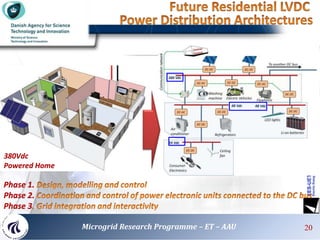
Phase 1.
Phase 2.
Phase 3
380Vdc
Powered Home
20
Microgrid Research Programme – ET – AAU 20
21
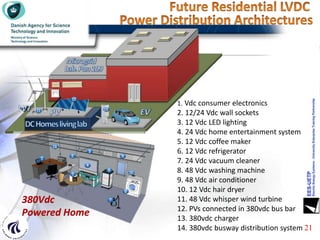
380Vdc
Powered Home
1. Vdc consumer electronics
2. 12/24 Vdc wall sockets
3. 12 Vdc LED lighting
4. 24 Vdc home entertainment system
5. 12 Vdc coffee maker
6. 12 Vdc refrigerator
7. 24 Vdc vacuum cleaner
8. 48 Vdc washing machine
9. 48 Vdc air conditioner
10. 12 Vdc hair dryer
11. 48 Vdc whisper wind turbine
12. PVs connected in 380vdc bus bar
13. 380vdc charger
14. 380vdc busway distribution system
2222
222222
22Microgrid Research Programme – ET – AAU
23
242424 24
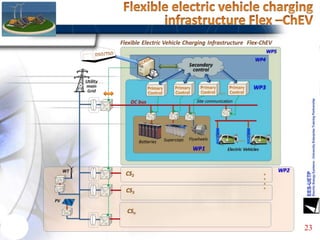
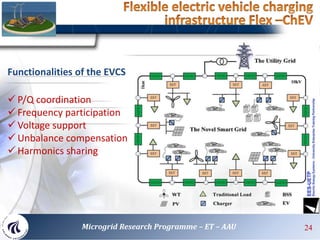
Functionalities of the EVCS
 P/Q coordination
 Frequency participation
 Voltage support
 Unbalance compensation
 Harmonics sharing
Microgrid Research Programme – ET – AAU
25Microgrid Research Programme – ET – AAU
 Microgrid Research Programme in AAU
 Microgrid Definition and Operation
 Microgrids Projects
 DC Microgrid Control Architectures
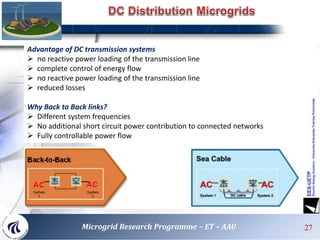
Advantage of DC transmission systems
 no reactive power loading of the transmission line
 complete control of energy flow
 no reactive power loading of the transmission line
 reduced losses
Why Back to Back links?
 Different system frequencies
 No additional short circuit power contribution to connected networks
 Fully controllable power flow
27Microgrid Research Programme – ET – AAU
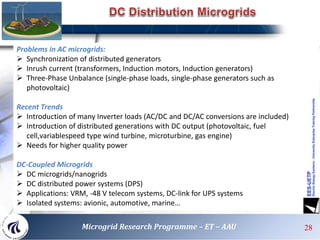
Problems in AC microgrids:
 Synchronization of distributed generators
 Inrush current (transformers, Induction motors, Induction generators)
 Three-Phase Unbalance (single-phase loads, single-phase generators such as
photovoltaic)
Recent Trends
 Introduction of many Inverter loads (AC/DC and DC/AC conversions are included)
 Introduction of distributed generations with DC output (photovoltaic, fuel
cell,variablespeed type wind turbine, microturbine, gas engine)
 Needs for higher quality power
DC-Coupled Microgrids
 DC microgrids/nanogrids
 DC distributed power systems (DPS)
 Applications: VRM, -48 V telecom systems, DC-link for UPS systems
 Isolated systems: avionic, automotive, marine…
28Microgrid Research Programme – ET – AAU
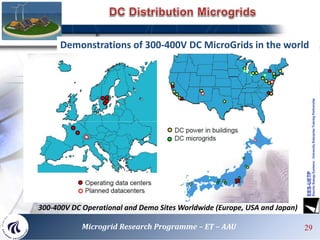
300-400V DC Operational and Demo Sites Worldwide (Europe, USA and Japan)
Demonstrations of 300-400V DC MicroGrids in the world
29Microgrid Research Programme – ET – AAU
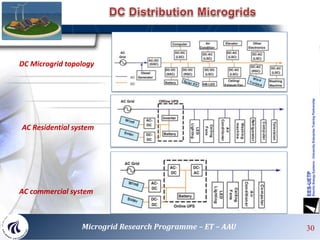
AC Residential system
AC commercial system
DC Microgrid topology
30Microgrid Research Programme – ET – AAU
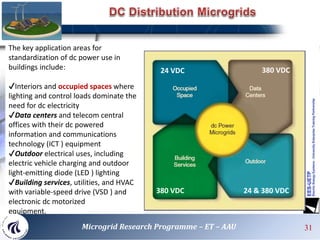
The key application areas for
standardization of dc power use in
buildings include:
✔Interiors and occupied spaces where
lighting and control loads dominate the
need for dc electricity
✔Data centers and telecom central
offices with their dc powered
information and communications
technology (ICT ) equipment
✔Outdoor electrical uses, including
electric vehicle charging and outdoor
light-emitting diode (LED ) lighting
✔Building services, utilities, and HVAC
with variable-speed drive (VSD ) and
electronic dc motorized
equipment.
24 VDC 380 VDC
380 VDC 24 & 380 VDC
31Microgrid Research Programme – ET – AAU
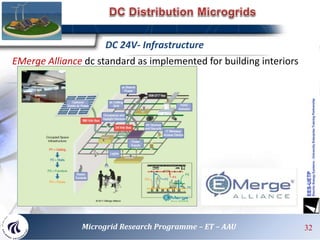
EMerge Alliance dc standard as implemented for building interiors
DC 24V- Infrastructure
32Microgrid Research Programme – ET – AAU
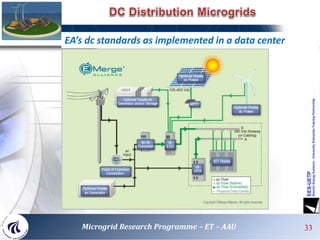
EA’s dc standards as implemented in a data center
33Microgrid Research Programme – ET – AAU
Barriers: The Challenges of Increased DC Use in Buildings
The use of dc power is not without it challenges. These fall into 5 major categories:
1) lack of application and equipment standards for dc power distribution
2) lack of common understanding and basic application knowledge of building
distribution-level dc
3) differences in safety and power protection device application
4) lack of a robust ecosystem to support the use of dc in building-level electrification
5) unclear pathway for moving from ac-centric power distribution to dc-inclusive
distribution schemes.
The first 3 challenges are being addressed with increasing resources by such standards
and trade organizations as:
EA , the European Telecommunications Standards Institute (ETSI ), the International
Electrotechnical Commission (IEC ), IEEE , NE MA, NFPA, the Power Sources
Manufacturers Association (PSMA), the Smart Grid Interoperability Panel (SGI P) of the
National Institute of Standards and Technology (NIST ), UL , and others.
34Microgrid Research Programme – ET – AAU
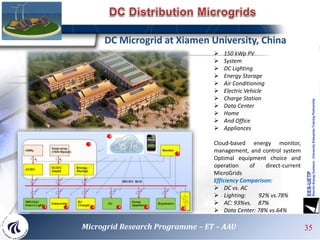
DC Microgrid at Xiamen University, China
 150 kWp PV
 System
 DC Lighting
 Energy Storage
 Air Conditioning
 Electric Vehicle
 Charge Station
 Data Center
 Home
 And Office
 Appliances
Cloud-based energy monitor,
management, and control system
Optimal equipment choice and
operation of direct-current
MicroGrids
Efficiency Comparison:
 DC vs. AC
 Lighting: 92% vs.78%
 AC: 93%vs. 87%
 Data Center: 78% vs.64%
 EV Charger: 94% vs.76%
35Microgrid Research Programme – ET – AAU
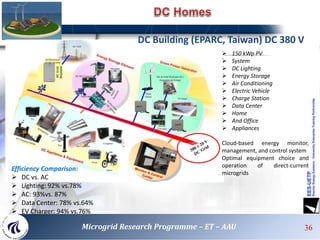
DC Building (EPARC, Taiwan) DC 380 V
 150 kWp PV
 System
 DC Lighting
 Energy Storage
 Air Conditioning
 Electric Vehicle
 Charge Station
 Data Center
 Home
 And Office
 Appliances
Cloud-based energy monitor,
management, and control system
Optimal equipment choice and
operation of direct-current
microgrids
Efficiency Comparison:
 DC vs. AC
 Lighting: 92% vs.78%
 AC: 93%vs. 87%
 Data Center: 78% vs.64%
 EV Charger: 94% vs.76%
36Microgrid Research Programme – ET – AAU
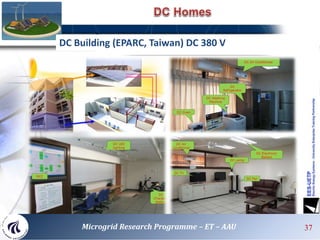
DC Building (EPARC, Taiwan) DC 380 V
37Microgrid Research Programme – ET – AAU
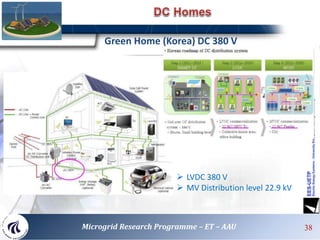
Green Home (Korea) DC 380 V
 LVDC 380 V
 MV Distribution level 22.9 kV
38Microgrid Research Programme – ET – AAU
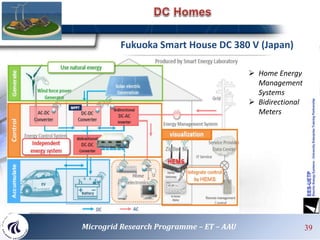
Fukuoka Smart House DC 380 V (Japan)
 Home Energy
Management
Systems
 Bidirectional
Meters
39Microgrid Research Programme – ET – AAU
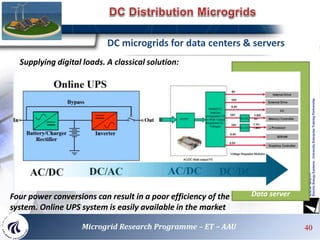
Data server
DC microgrids for data centers & servers
Four power conversions can result in a poor efficiency of the
system. Online UPS system is easily available in the market
Supplying digital loads. A classical solution:
40Microgrid Research Programme – ET – AAU
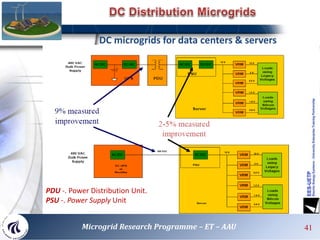
PDU -. Power Distribution Unit.
PSU -. Power Supply Unit
DC microgrids for data centers & servers
41Microgrid Research Programme – ET – AAU
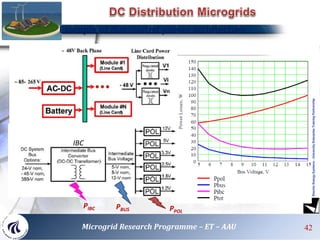
Example of distributed power architecture
Source: Intechopen
PIBC PBUS PPOL
IBC
42Microgrid Research Programme – ET – AAU
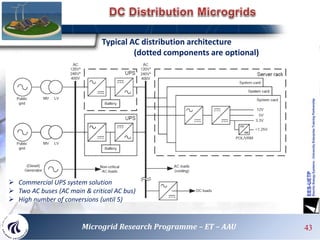
Typical AC distribution architecture
(dotted components are optional)
 Commercial UPS system solution
 Two AC buses (AC main & critical AC bus)
 High number of conversions (until 5)
Source: Leonardo Energy
43Microgrid Research Programme – ET – AAU
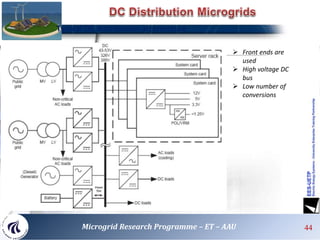
Typical DC distribution architecture
 Front ends are
used
 High voltage DC
bus
 Low number of
conversions
Source: Leonardo Energy
44Microgrid Research Programme – ET – AAU
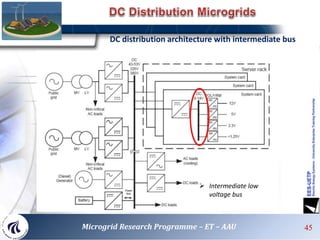
DC distribution architecture with intermediate bus
 Intermediate low
voltage bus
Source: Leonardo Energy
45Microgrid Research Programme – ET – AAU
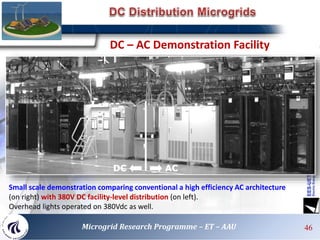
Small scale demonstration comparing conventional a high efficiency AC architecture
(on right) with 380V DC facility-level distribution (on left).
Overhead lights operated on 380Vdc as well.
DC – AC Demonstration Facility
46Microgrid Research Programme – ET – AAU
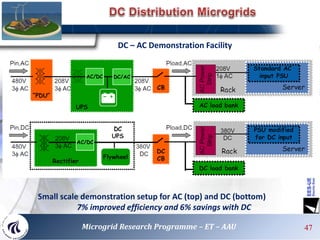
Small scale demonstration setup for AC (top) and DC (bottom)
7% improved efficiency and 6% savings with DC
DC – AC Demonstration Facility
47Microgrid Research Programme – ET – AAU
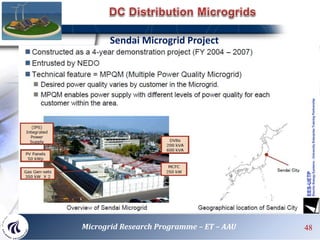
Sendai Microgrid Project
48Microgrid Research Programme – ET – AAU
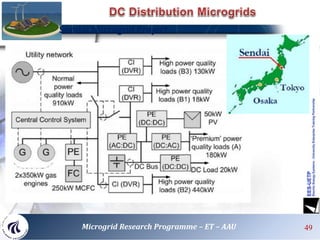
Sendai Microgrid Project
49Microgrid Research Programme – ET – AAU
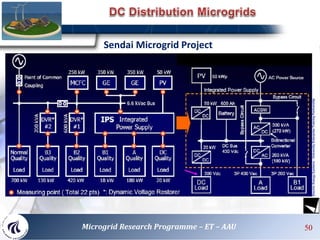
Sendai Microgrid Project
50Microgrid Research Programme – ET – AAU
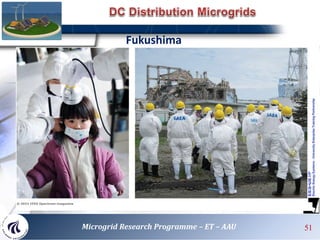
Fukushima
51Microgrid Research Programme – ET – AAU
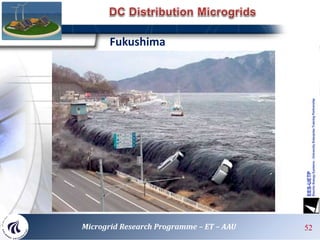
Fukushima
52Microgrid Research Programme – ET – AAU
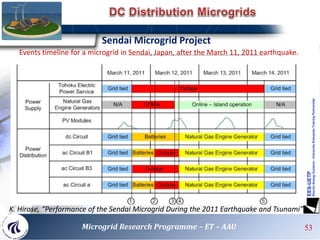
Events timeline for a microgrid in Sendai, Japan, after the March 11, 2011 earthquake.
K. Hirose, “Performance of the Sendai Microgrid During the 2011 Earthquake and Tsunami”
Sendai Microgrid Project
53Microgrid Research Programme – ET – AAU
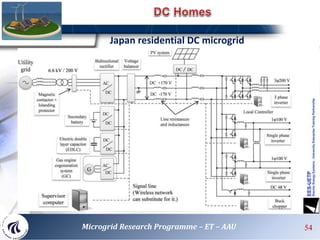
Japan residential DC microgrid
54Microgrid Research Programme – ET – AAU
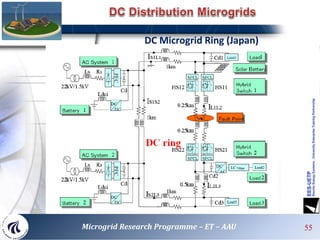
DC Microgrid Ring (Japan)
55Microgrid Research Programme – ET – AAU
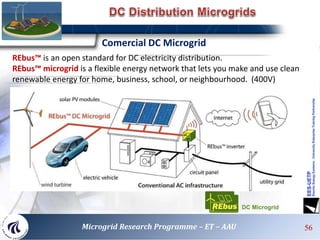
REbus™ is an open standard for DC electricity distribution.
REbus™ microgrid is a flexible energy network that lets you make and use clean
renewable energy for home, business, school, or neighbourhood. (400V)
Comercial DC Microgrid
56Microgrid Research Programme – ET – AAU
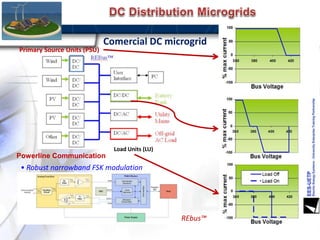
Primary Source Units (PSU)
Load Units (LU)
Powerline Communication
• Robust narrowband FSK modulation
• Programmable transmission data rate up to 30kbps
• Programmable communication frequency from
50kHz to 500kHz
• Complete Media Access Control (MAC) logic
• CSMA/CD type collision detection and resolution
• Programmable automatic preamble generation
• Programmable automatic packet-priority
management with four levels
• Error detection (CRC 16) REbus™
Comercial DC microgrid
58
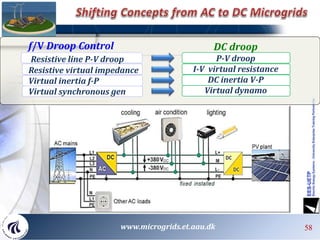
f/V Droop Control
Resistive line P-V droop
Resistive virtual impedance
Virtual inertia f-P
Virtual synchronous gen
DC droop
P-V droop
I-V virtual resistance
DC inertia V-P
Virtual dynamo
www.microgrids.et.aau.dk 58
5959 59www.microgrids.et.aau.dk
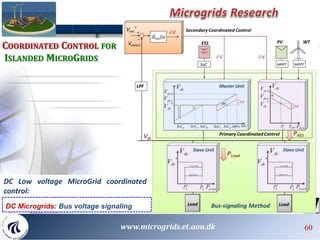
60
COORDINATED CONTROL FOR
ISLANDED MICROGRIDS
DC Low voltage MicroGrid coordinated
control:
DC Microgrids: Bus voltage signaling
www.microgrids.et.aau.dk
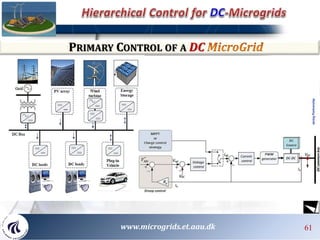
61
PRIMARY CONTROL OF A DC
www.microgrids.et.aau.dk
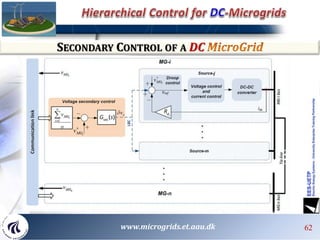
62 62
SECONDARY CONTROL OF A DC
www.microgrids.et.aau.dk
636363 63www.microgrids.et.aau.dk
64646464 64www.microgrids.et.aau.dk
656565 65
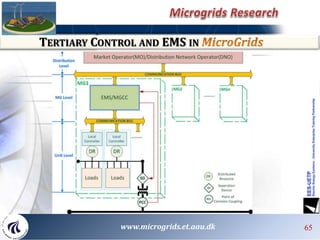
TERTIARY CONTROL AND EMS IN
www.microgrids.et.aau.dk
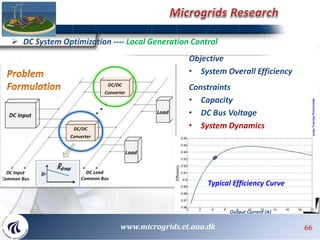
 DC System Optimization ---- Local Generation Control
Typical Efficiency Curve
Constraints
• Capacity
• DC Bus Voltage
• System Dynamics
Objective
• System Overall Efficiency
Output Current (A)
666666 66www.microgrids.et.aau.dk
67
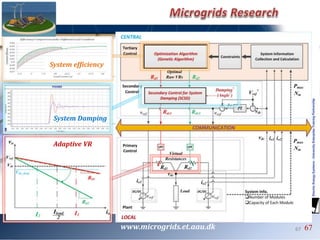
Adaptive VR
System Damping
System efficiency
676767 67www.microgrids.et.aau.dk
68
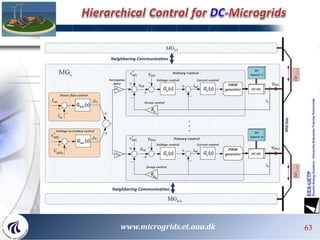
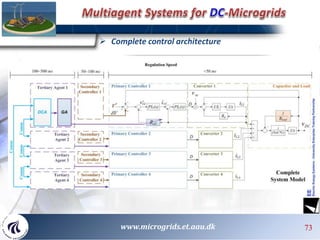
 The research is based on droop controlled paralleled dc-dc converters.
 In primary control level, adaptive virtual resistance method is proposed and
implemented for changing the load sharing ratio among converters.
 Secondary control for system damping is proposed to achieve desirable system
damping level when tertiary control shifts virtual resistance.
 Tertiary control for system efficiency optimization is proposed and
demonstrated to be capable of improving system level efficiency.
686868 68www.microgrids.et.aau.dk
6969696969 69www.microgrids.et.aau.dk
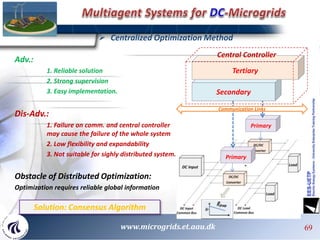
 Centralized Optimization Method
Primary
Primary
Secondary
Tertiary
Communication Links
Central Controller
Adv.:
1. Reliable solution
2. Strong supervision
3. Easy implementation.
Dis-Adv.:
1. Failure on comm. and central controller
may cause the failure of the whole system
2. Low flexibility and expandability
3. Not suitable for sighly distributed system.
Obstacle of Distributed Optimization:
Optimization requires reliable global information
Solution: Consensus Algorithm
7070707070 70www.microgrids.et.aau.dk
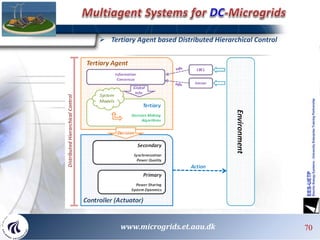
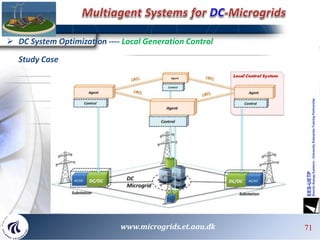
 Tertiary Agent based Distributed Hierarchical Control
7171717171 71www.microgrids.et.aau.dk
 DC System Optimization ---- Local Generation Control
Study Case
7272727272 72www.microgrids.et.aau.dk
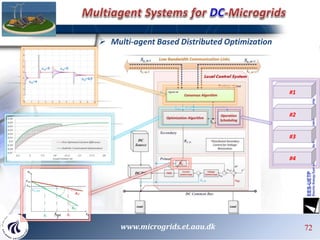
 Multi-agent Based Distributed Optimization
#1
#2
#3
#4
7373737373 73www.microgrids.et.aau.dk
 Complete control architecture
7474747474 74www.microgrids.et.aau.dk
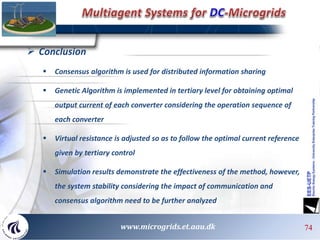
 Conclusion
 Consensus algorithm is used for distributed information sharing
 Genetic Algorithm is implemented in tertiary level for obtaining optimal
output current of each converter considering the operation sequence of
each converter
 Virtual resistance is adjusted so as to follow the optimal current reference
given by tertiary control
 Simulation results demonstrate the effectiveness of the method, however,
the system stability considering the impact of communication and
consensus algorithm need to be further analyzed
75
Dragicevic, Tomislav; Pandžić, Hrvoje; Škrlec, Davor; Kuzle, Igor; Guerrero, Josep M.; Kirschen, Daniel ” Capacity
Optimization of Renewable Energy Sources and Battery Storage in an Autonomous Telecommunication Facility.
I E E E Transactions on Sustainable Energy, 2014.
Dragicevic, Tomislav; Shafiee, Qobad; Wu, Dan; Meng, Lexuan; Vasquez, Juan Carlos; Guerrero, Josep M. / Modeling
and Control of Flexible HEV Charging Station upgraded with Flywheel Energy Storage.
Proceedings of the 11th International Multi-Conference on Systems, Signals and Devices, SSD 2014. IEEE Press, 2014.
El Fadil, Hassan; Giri, Fouad; Guerrero, Josep M. / Modeling and Nonlinear Control of Fuel Cell / Supercapacitor
Hybrid Energy Storage System for Electric Vehicles.
In: I E E E Transactions on Vehicular Technology, 2014.
Dragicevic, Tomislav; Vasquez, Juan Carlos; Guerrero, Josep M.; Skrlec, Davor / Advanced LVDC Electrical Power
Architectures and Microgrids : A Step towards a New Generation of Power Distribution Networks.
In: I E E E Electrification Magazine, Vol. 2, No. 1, 03.2014, p. 54-65 .
Dragicevic, Tomislav; Guerrero, Josep M.; Sucic, Stepjan / Flywheel-Based Distributed Bus Signalling Strategy for the
Public Fast Charging Station. In: I E E E Transactions on Smart Grid, 2014.
Gouveia, C.; Moreira, C.L.; Lopes, J.A.P., "Microgrids emergency management exploiting EV, demand response and
energy storage units," PowerTech (POWERTECH), 2013 IEEE Grenoble , vol., no., pp.1,6, 16-20 June 2013
J.A. Peças Lopes, Silvan A. Polenz, C.L. Moreira, Rachid Cherkaoui, Identification of control and management
strategies for LV unbalanced microgrids with plugged-in electric vehicles, Electric Power Systems Research, Volume
80, Issue 8, August 2010, Pages 898-906.
76
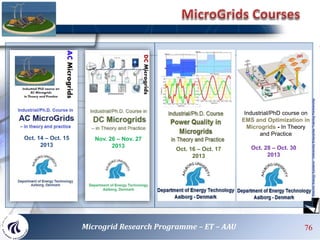
Oct. 14 – Oct. 15
2013
Nov. 26 – Nov. 27
2013
Oct. 16 – Oct. 17
2013
Oct. 28 – Oct. 30
2013
Industrial/PhD course on
EMS and Optimization in
Microgrids - In Theory
and Practice
Microgrid Research Programme – ET – AAU
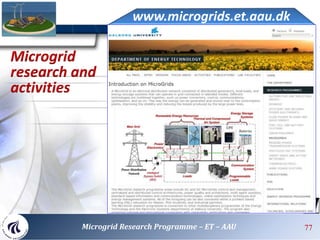
www.microgrids.et.aau.dk
Microgrid
research and
activities
77
Microgrid Research Programme – ET – AAU 77
78 78
Juan C. Vasquez juq@et.aau.dk
Josep M. Guerrero joz@et.aau.dk
www.microgrids.aau.dk
Microgrid Research Programme – ET – AAU

EES-UETP Microgrid course

  • 1.
    DC MICROGRIDS Prof. JosepM. Guerrero Microgrid Research Programme – Aalborg University
  • 2.
    2Microgrid Research Programme– ET – AAU  Microgrid Research Programme in AAU  Microgrid Definition and Operation  Microgrids Projects  DC Microgrid Control Architectures
  • 3.
  • 4.
  • 5.
     Residential Microgrids- 2013 DK Smart Grid Strategy (2015 hourly electricity pricing)  Hydrogen Communities (Vestenkov, Lolland) – IRD  Small remote/isolated Microgrids  Large remote Microgrids: Geographical islands (70 habited islands in DK) Microgrid Research Programme – ET – AAU 5
  • 6.
    MicroGrid Research Programme Areas ACMicroGrids DC MicroGrids  Modeling  Control & Operation  Energy Storage  Protection  Power Quality  Standard-based ICT  Networked Control  EMS & Optimization  Multi-Agents MICROGRID RESEARCH PROGRAMME 6 Microgrid Research Programme – ET – AAU 6 Figures: 6 Post Docs 12 PhDs 5 Visiting scholars
  • 7.
    MICROGRID RESEARCH TEAMMICROGRIDRESEARCH TEAM @ AALBORG Josep M. Guerrero Tomislav Dragicevic DC MGs Fabio Andrade MGs stability Qobad Shafiee Secondary Control Lexuan Meng Tertiary Control Dan Wu Primary Control Chendan Li MGs Agents Yajuan Guan Ancillary services for MGs Nelson Diaz Energy storage for MicroGrids Chi Zhang LVDC distribution MGs Hengwei Lin Management and Protection for Microgrids Xin Zhao AC/DC Hybrid MG Bo Sun EV Charging Stations Javier Roldan LVRT & PQ Valerio Mariani Nonlinear Control Ernane Coelho MGs modelling Juan C. Vasquez Min Chen Power Electronics Yang Han PQ & MV MGs 7 Microgrid Research Programme – ET – AAU 7
  • 8.
    8 8 Microgrid Research Programme– ET – AAU 8 Every setup is able to emulate a multi-converter low- voltage Microgrid, local and energy management control programmed in real-time control platforms.
  • 9.
    9 9 Every setupis able to emulate a multi-converter low-voltage Microgrid, local and energy management control programmed in real-time control platforms. MGCC Labview, communication systems, control, 24 DC-AC inverters Microgrid Research Programme – ET – AAU
  • 10.
    Ethernet Communication DC Power Line ACPower Line 10 10Microgrid Research Programme – ET – AAU The laboratory is based on 6 workstations • 4 DC-AC converters, • LCL-filters, • ABB Motorized change-over switches • Kamstrup Smart-meters.
  • 11.
    1111 11Microgrid ResearchProgramme – ET – AAU
  • 12.
    Bidirectional powersupply Electric Panelboard Workstation 4 DC power line ACpower line SmartMeters Cabine t Workstation 3 Workstation5 Workstation6 Workstation2 Workstation1 Communication Nodes 12 Microgrid Research Programme – ET – AAU 12
  • 13.
    13Microgrid Research Programme– ET – AAU  Microgrid Research Programme in AAU  Microgrid Definition and Operation  Microgrids Projects  DC Microgrid Control Architectures
  • 14.
    What is aMicrogrid? Main Utility Grid PCC Household appliances and electronics DC Coupled Subsystem Hybrid AC/DC Microgrids 14 Microgrid Research Programme – ET – AAU 14
  • 15.
  • 16.
  • 17.
    17  Phase I:Design, modelling and control.  Phase II: Coordination control schemes between microgrid elements, including communication systems and energy management systems for DC microgrids.  Phase III: Creation of two Living Labs as a user-centred research concept, to test innovation systems and elements that can conform a DC microgrid for different applications. • Home DC Microgrid Living Lab, at AAU to research and test DC distribution for 1-2 family houses • 工业微网设计 Industrial DC Microgrid Living Lab, At North China Electrical Power University (China), for research, demo and test of energy solutions for commercial buildings. Microgrid Research Programme – ET – AAU
  • 18.
  • 19.
  • 20.
    Phase 1. Phase 2. Phase3 380Vdc Powered Home 20 Microgrid Research Programme – ET – AAU 20
  • 21.
    21 380Vdc Powered Home 1. Vdcconsumer electronics 2. 12/24 Vdc wall sockets 3. 12 Vdc LED lighting 4. 24 Vdc home entertainment system 5. 12 Vdc coffee maker 6. 12 Vdc refrigerator 7. 24 Vdc vacuum cleaner 8. 48 Vdc washing machine 9. 48 Vdc air conditioner 10. 12 Vdc hair dryer 11. 48 Vdc whisper wind turbine 12. PVs connected in 380vdc bus bar 13. 380vdc charger 14. 380vdc busway distribution system
  • 22.
  • 23.
  • 24.
    242424 24 Functionalities ofthe EVCS  P/Q coordination  Frequency participation  Voltage support  Unbalance compensation  Harmonics sharing Microgrid Research Programme – ET – AAU
  • 25.
    25Microgrid Research Programme– ET – AAU  Microgrid Research Programme in AAU  Microgrid Definition and Operation  Microgrids Projects  DC Microgrid Control Architectures
  • 27.
    Advantage of DCtransmission systems  no reactive power loading of the transmission line  complete control of energy flow  no reactive power loading of the transmission line  reduced losses Why Back to Back links?  Different system frequencies  No additional short circuit power contribution to connected networks  Fully controllable power flow 27Microgrid Research Programme – ET – AAU
  • 28.
    Problems in ACmicrogrids:  Synchronization of distributed generators  Inrush current (transformers, Induction motors, Induction generators)  Three-Phase Unbalance (single-phase loads, single-phase generators such as photovoltaic) Recent Trends  Introduction of many Inverter loads (AC/DC and DC/AC conversions are included)  Introduction of distributed generations with DC output (photovoltaic, fuel cell,variablespeed type wind turbine, microturbine, gas engine)  Needs for higher quality power DC-Coupled Microgrids  DC microgrids/nanogrids  DC distributed power systems (DPS)  Applications: VRM, -48 V telecom systems, DC-link for UPS systems  Isolated systems: avionic, automotive, marine… 28Microgrid Research Programme – ET – AAU
  • 29.
    300-400V DC Operationaland Demo Sites Worldwide (Europe, USA and Japan) Demonstrations of 300-400V DC MicroGrids in the world 29Microgrid Research Programme – ET – AAU
  • 30.
    AC Residential system ACcommercial system DC Microgrid topology 30Microgrid Research Programme – ET – AAU
  • 31.
    The key applicationareas for standardization of dc power use in buildings include: ✔Interiors and occupied spaces where lighting and control loads dominate the need for dc electricity ✔Data centers and telecom central offices with their dc powered information and communications technology (ICT ) equipment ✔Outdoor electrical uses, including electric vehicle charging and outdoor light-emitting diode (LED ) lighting ✔Building services, utilities, and HVAC with variable-speed drive (VSD ) and electronic dc motorized equipment. 24 VDC 380 VDC 380 VDC 24 & 380 VDC 31Microgrid Research Programme – ET – AAU
  • 32.
    EMerge Alliance dcstandard as implemented for building interiors DC 24V- Infrastructure 32Microgrid Research Programme – ET – AAU
  • 33.
    EA’s dc standardsas implemented in a data center 33Microgrid Research Programme – ET – AAU
  • 34.
    Barriers: The Challengesof Increased DC Use in Buildings The use of dc power is not without it challenges. These fall into 5 major categories: 1) lack of application and equipment standards for dc power distribution 2) lack of common understanding and basic application knowledge of building distribution-level dc 3) differences in safety and power protection device application 4) lack of a robust ecosystem to support the use of dc in building-level electrification 5) unclear pathway for moving from ac-centric power distribution to dc-inclusive distribution schemes. The first 3 challenges are being addressed with increasing resources by such standards and trade organizations as: EA , the European Telecommunications Standards Institute (ETSI ), the International Electrotechnical Commission (IEC ), IEEE , NE MA, NFPA, the Power Sources Manufacturers Association (PSMA), the Smart Grid Interoperability Panel (SGI P) of the National Institute of Standards and Technology (NIST ), UL , and others. 34Microgrid Research Programme – ET – AAU
  • 35.
    DC Microgrid atXiamen University, China  150 kWp PV  System  DC Lighting  Energy Storage  Air Conditioning  Electric Vehicle  Charge Station  Data Center  Home  And Office  Appliances Cloud-based energy monitor, management, and control system Optimal equipment choice and operation of direct-current MicroGrids Efficiency Comparison:  DC vs. AC  Lighting: 92% vs.78%  AC: 93%vs. 87%  Data Center: 78% vs.64%  EV Charger: 94% vs.76% 35Microgrid Research Programme – ET – AAU
  • 36.
    DC Building (EPARC,Taiwan) DC 380 V  150 kWp PV  System  DC Lighting  Energy Storage  Air Conditioning  Electric Vehicle  Charge Station  Data Center  Home  And Office  Appliances Cloud-based energy monitor, management, and control system Optimal equipment choice and operation of direct-current microgrids Efficiency Comparison:  DC vs. AC  Lighting: 92% vs.78%  AC: 93%vs. 87%  Data Center: 78% vs.64%  EV Charger: 94% vs.76% 36Microgrid Research Programme – ET – AAU
  • 37.
    DC Building (EPARC,Taiwan) DC 380 V 37Microgrid Research Programme – ET – AAU
  • 38.
    Green Home (Korea)DC 380 V  LVDC 380 V  MV Distribution level 22.9 kV 38Microgrid Research Programme – ET – AAU
  • 39.
    Fukuoka Smart HouseDC 380 V (Japan)  Home Energy Management Systems  Bidirectional Meters 39Microgrid Research Programme – ET – AAU
  • 40.
    Data server DC microgridsfor data centers & servers Four power conversions can result in a poor efficiency of the system. Online UPS system is easily available in the market Supplying digital loads. A classical solution: 40Microgrid Research Programme – ET – AAU
  • 41.
    PDU -. PowerDistribution Unit. PSU -. Power Supply Unit DC microgrids for data centers & servers 41Microgrid Research Programme – ET – AAU
  • 42.
    Example of distributedpower architecture Source: Intechopen PIBC PBUS PPOL IBC 42Microgrid Research Programme – ET – AAU
  • 43.
    Typical AC distributionarchitecture (dotted components are optional)  Commercial UPS system solution  Two AC buses (AC main & critical AC bus)  High number of conversions (until 5) Source: Leonardo Energy 43Microgrid Research Programme – ET – AAU
  • 44.
    Typical DC distributionarchitecture  Front ends are used  High voltage DC bus  Low number of conversions Source: Leonardo Energy 44Microgrid Research Programme – ET – AAU
  • 45.
    DC distribution architecturewith intermediate bus  Intermediate low voltage bus Source: Leonardo Energy 45Microgrid Research Programme – ET – AAU
  • 46.
    Small scale demonstrationcomparing conventional a high efficiency AC architecture (on right) with 380V DC facility-level distribution (on left). Overhead lights operated on 380Vdc as well. DC – AC Demonstration Facility 46Microgrid Research Programme – ET – AAU
  • 47.
    Small scale demonstrationsetup for AC (top) and DC (bottom) 7% improved efficiency and 6% savings with DC DC – AC Demonstration Facility 47Microgrid Research Programme – ET – AAU
  • 48.
    Sendai Microgrid Project 48MicrogridResearch Programme – ET – AAU
  • 49.
    Sendai Microgrid Project 49MicrogridResearch Programme – ET – AAU
  • 50.
    Sendai Microgrid Project 50MicrogridResearch Programme – ET – AAU
  • 51.
  • 52.
  • 53.
    Events timeline fora microgrid in Sendai, Japan, after the March 11, 2011 earthquake. K. Hirose, “Performance of the Sendai Microgrid During the 2011 Earthquake and Tsunami” Sendai Microgrid Project 53Microgrid Research Programme – ET – AAU
  • 54.
    Japan residential DCmicrogrid 54Microgrid Research Programme – ET – AAU
  • 55.
    DC Microgrid Ring(Japan) 55Microgrid Research Programme – ET – AAU
  • 56.
    REbus™ is anopen standard for DC electricity distribution. REbus™ microgrid is a flexible energy network that lets you make and use clean renewable energy for home, business, school, or neighbourhood. (400V) Comercial DC Microgrid 56Microgrid Research Programme – ET – AAU
  • 57.
    Primary Source Units(PSU) Load Units (LU) Powerline Communication • Robust narrowband FSK modulation • Programmable transmission data rate up to 30kbps • Programmable communication frequency from 50kHz to 500kHz • Complete Media Access Control (MAC) logic • CSMA/CD type collision detection and resolution • Programmable automatic preamble generation • Programmable automatic packet-priority management with four levels • Error detection (CRC 16) REbus™ Comercial DC microgrid
  • 58.
    58 f/V Droop Control Resistiveline P-V droop Resistive virtual impedance Virtual inertia f-P Virtual synchronous gen DC droop P-V droop I-V virtual resistance DC inertia V-P Virtual dynamo www.microgrids.et.aau.dk 58
  • 59.
  • 60.
    60 COORDINATED CONTROL FOR ISLANDEDMICROGRIDS DC Low voltage MicroGrid coordinated control: DC Microgrids: Bus voltage signaling www.microgrids.et.aau.dk
  • 61.
    61 PRIMARY CONTROL OFA DC www.microgrids.et.aau.dk
  • 62.
    62 62 SECONDARY CONTROLOF A DC www.microgrids.et.aau.dk
  • 63.
  • 64.
  • 65.
    656565 65 TERTIARY CONTROLAND EMS IN www.microgrids.et.aau.dk
  • 66.
     DC SystemOptimization ---- Local Generation Control Typical Efficiency Curve Constraints • Capacity • DC Bus Voltage • System Dynamics Objective • System Overall Efficiency Output Current (A) 666666 66www.microgrids.et.aau.dk
  • 67.
    67 Adaptive VR System Damping Systemefficiency 676767 67www.microgrids.et.aau.dk
  • 68.
    68  The researchis based on droop controlled paralleled dc-dc converters.  In primary control level, adaptive virtual resistance method is proposed and implemented for changing the load sharing ratio among converters.  Secondary control for system damping is proposed to achieve desirable system damping level when tertiary control shifts virtual resistance.  Tertiary control for system efficiency optimization is proposed and demonstrated to be capable of improving system level efficiency. 686868 68www.microgrids.et.aau.dk
  • 69.
    6969696969 69www.microgrids.et.aau.dk  CentralizedOptimization Method Primary Primary Secondary Tertiary Communication Links Central Controller Adv.: 1. Reliable solution 2. Strong supervision 3. Easy implementation. Dis-Adv.: 1. Failure on comm. and central controller may cause the failure of the whole system 2. Low flexibility and expandability 3. Not suitable for sighly distributed system. Obstacle of Distributed Optimization: Optimization requires reliable global information Solution: Consensus Algorithm
  • 70.
    7070707070 70www.microgrids.et.aau.dk  TertiaryAgent based Distributed Hierarchical Control
  • 71.
    7171717171 71www.microgrids.et.aau.dk  DCSystem Optimization ---- Local Generation Control Study Case
  • 72.
    7272727272 72www.microgrids.et.aau.dk  Multi-agentBased Distributed Optimization #1 #2 #3 #4
  • 73.
  • 74.
    7474747474 74www.microgrids.et.aau.dk  Conclusion Consensus algorithm is used for distributed information sharing  Genetic Algorithm is implemented in tertiary level for obtaining optimal output current of each converter considering the operation sequence of each converter  Virtual resistance is adjusted so as to follow the optimal current reference given by tertiary control  Simulation results demonstrate the effectiveness of the method, however, the system stability considering the impact of communication and consensus algorithm need to be further analyzed
  • 75.
    75 Dragicevic, Tomislav; Pandžić,Hrvoje; Škrlec, Davor; Kuzle, Igor; Guerrero, Josep M.; Kirschen, Daniel ” Capacity Optimization of Renewable Energy Sources and Battery Storage in an Autonomous Telecommunication Facility. I E E E Transactions on Sustainable Energy, 2014. Dragicevic, Tomislav; Shafiee, Qobad; Wu, Dan; Meng, Lexuan; Vasquez, Juan Carlos; Guerrero, Josep M. / Modeling and Control of Flexible HEV Charging Station upgraded with Flywheel Energy Storage. Proceedings of the 11th International Multi-Conference on Systems, Signals and Devices, SSD 2014. IEEE Press, 2014. El Fadil, Hassan; Giri, Fouad; Guerrero, Josep M. / Modeling and Nonlinear Control of Fuel Cell / Supercapacitor Hybrid Energy Storage System for Electric Vehicles. In: I E E E Transactions on Vehicular Technology, 2014. Dragicevic, Tomislav; Vasquez, Juan Carlos; Guerrero, Josep M.; Skrlec, Davor / Advanced LVDC Electrical Power Architectures and Microgrids : A Step towards a New Generation of Power Distribution Networks. In: I E E E Electrification Magazine, Vol. 2, No. 1, 03.2014, p. 54-65 . Dragicevic, Tomislav; Guerrero, Josep M.; Sucic, Stepjan / Flywheel-Based Distributed Bus Signalling Strategy for the Public Fast Charging Station. In: I E E E Transactions on Smart Grid, 2014. Gouveia, C.; Moreira, C.L.; Lopes, J.A.P., "Microgrids emergency management exploiting EV, demand response and energy storage units," PowerTech (POWERTECH), 2013 IEEE Grenoble , vol., no., pp.1,6, 16-20 June 2013 J.A. Peças Lopes, Silvan A. Polenz, C.L. Moreira, Rachid Cherkaoui, Identification of control and management strategies for LV unbalanced microgrids with plugged-in electric vehicles, Electric Power Systems Research, Volume 80, Issue 8, August 2010, Pages 898-906.
  • 76.
    76 Oct. 14 –Oct. 15 2013 Nov. 26 – Nov. 27 2013 Oct. 16 – Oct. 17 2013 Oct. 28 – Oct. 30 2013 Industrial/PhD course on EMS and Optimization in Microgrids - In Theory and Practice Microgrid Research Programme – ET – AAU
  • 77.
  • 78.
    78 78 Juan C.Vasquez juq@et.aau.dk Josep M. Guerrero joz@et.aau.dk www.microgrids.aau.dk Microgrid Research Programme – ET – AAU