IEEE New Hampshire Section
Radar Systems Course 1
Propagation 1/1/2010 IEEE AES Society
Radar Systems Engineering
Lecture 5
Propagation through the Atmosphere
Dr. Robert M. O’Donnell
IEEE New Hampshire Section
Guest Lecturer
Radar Systems Course 2
Propagation 1/1/2010
IEEE New Hampshire Section
IEEE AES Society
Block Diagram of Radar System
Transmitter
Waveform
Generation
Power
Amplifier
T / R
Switch
Propagation
Medium
Target
Radar
Cross
Section
Pulse
Compression
Receiver
Clutter Rejection
(Doppler Filtering)
A / D
Converter
General Purpose Computer
Tracking
Data
Recording
Parameter
Estimation
Detection
Signal Processor Computer
Thresholding
Antenna
Display /
Consoles
Received
Signal
Energy
= [ ] [ ][ ]tA
R4
1
2 ⎥
⎦
⎤
⎢
⎣
⎡
π
σ[ ] ⎥
⎦
⎤
⎢
⎣
⎡
π⎥
⎦
⎤
⎢
⎣
⎡
λ
π
22t
R4
1A4
P ⎥
⎦
⎤
⎢
⎣
⎡
SL
1
Propagation
Loss
Propagation
Factor
System
Losses
⎥
⎦
⎤
⎢
⎣
⎡
PL
1 4
F
Radar Systems Course 3
Propagation 1/1/2010
IEEE New Hampshire Section
IEEE AES Society
Block Diagram of Radar System
Transmitter
Waveform
Generation
Power
Amplifier
T / R
Switch
Propagation
Medium
Target
Radar
Cross
Section
Pulse
Compression
Receiver
Clutter Rejection
(Doppler Filtering)
A / D
Converter
General Purpose Computer
Tracking
Data
Recording
Parameter
Estimation
Detection
Signal Processor Computer
Thresholding
Antenna
Display /
Consoles
Received
Signal
Energy
= [ ] [ ][ ]tA
R4
1
2 ⎥
⎦
⎤
⎢
⎣
⎡
π
σ[ ] ⎥
⎦
⎤
⎢
⎣
⎡
π⎥
⎦
⎤
⎢
⎣
⎡
λ
π
22t
R4
1A4
P ⎥
⎦
⎤
⎢
⎣
⎡
SL
1
Propagation
Loss
Propagation
Factor
System
Losses
⎥
⎦
⎤
⎢
⎣
⎡
PL
1 4
F
oE
E
F r
r
≡
E
r
oE
r = actual
= free space
Radar Systems Course 4
Propagation 1/1/2010
IEEE New Hampshire Section
IEEE AES Society
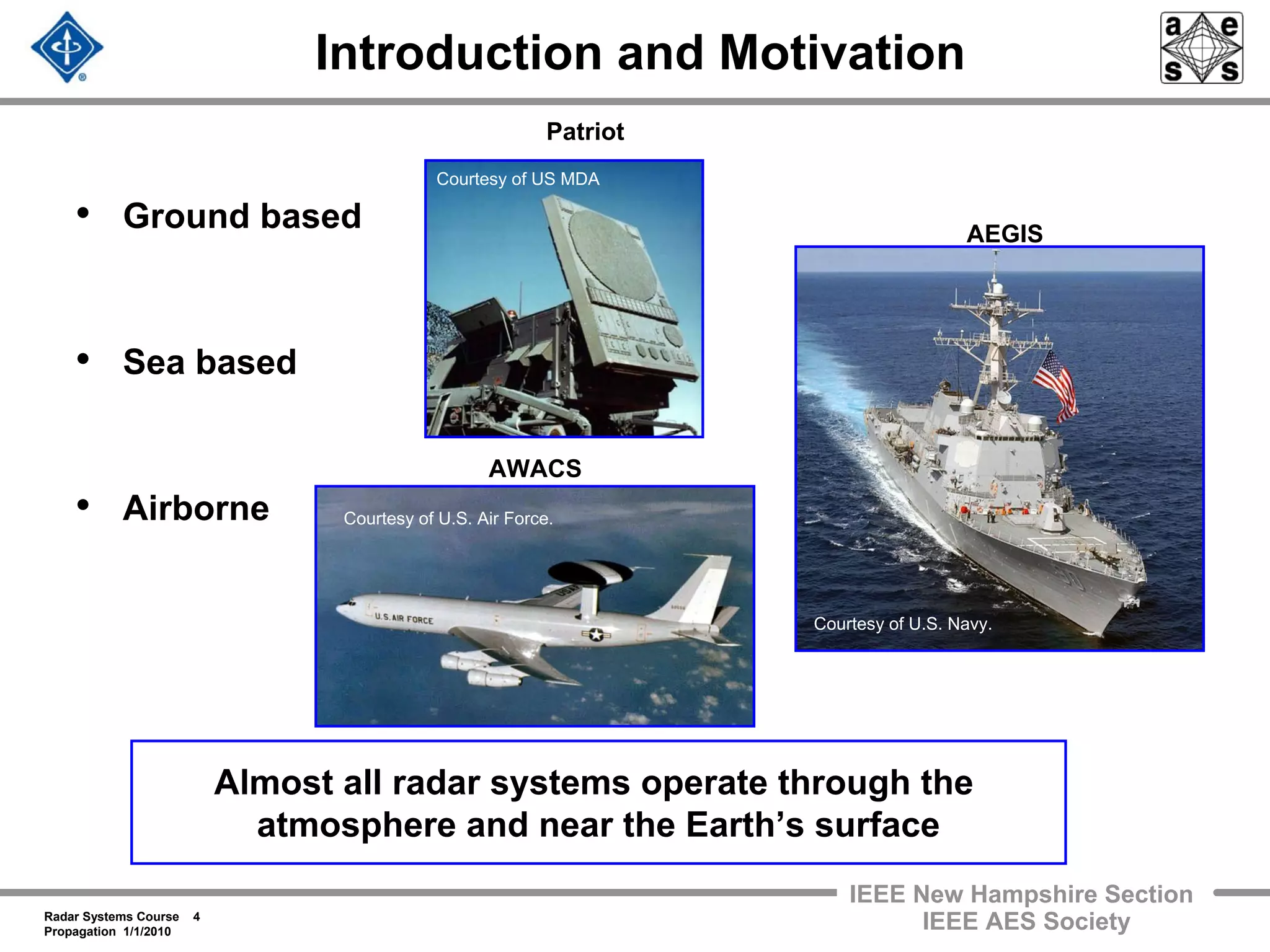
Introduction and Motivation
• Ground based
• Sea based
• Airborne
Almost all radar systems operate through the
atmosphere and near the Earth’s surface
AEGIS
Patriot
AWACS
Courtesy of U.S. Air Force.
Courtesy of U.S. Navy.
Courtesy of US MDA
Radar Systems Course 5
Propagation 1/1/2010
IEEE New Hampshire Section
IEEE AES Society
Effect of the Atmosphere on Radar
Performance
• Attenuation of radar beam
• Refraction (bend) of the radar beam as it passes through the
atmosphere
• “Multipath” effect
– Reflection of energy from the lower part of the radar beam off
of the earth’s surface
– Result is an interference effect
• Over the horizon diffraction of the radar beam over ground
obstacles
• Propagation effects vary with:
– Changing atmospheric conditions and wavelength
– Temporal and geographical variations
Radar Systems Course 6
Propagation 1/1/2010
IEEE New Hampshire Section
IEEE AES Society
A Multiplicity of Atmospheric and
Geographic Parameters
• Atmospheric parameters vary with altitude
– Index of refraction
– Rain rate
– Air density and humidity
– Fog/cloud water content
• Earth’s surface
– Curvature of the earth
– Surface material (sea / land)
– Surface roughness (waves, mountains / flat, vegetation)
Radar Systems Course 7
Propagation 1/1/2010
IEEE New Hampshire Section
IEEE AES Society
Outline
• Reflection from the Earth’s surface
• Atmospheric refraction
• Over-the-horizon diffraction
• Atmospheric attenuation
• Ionospheric propagation
Radar Systems Course 8
Propagation 1/1/2010
IEEE New Hampshire Section
IEEE AES Society
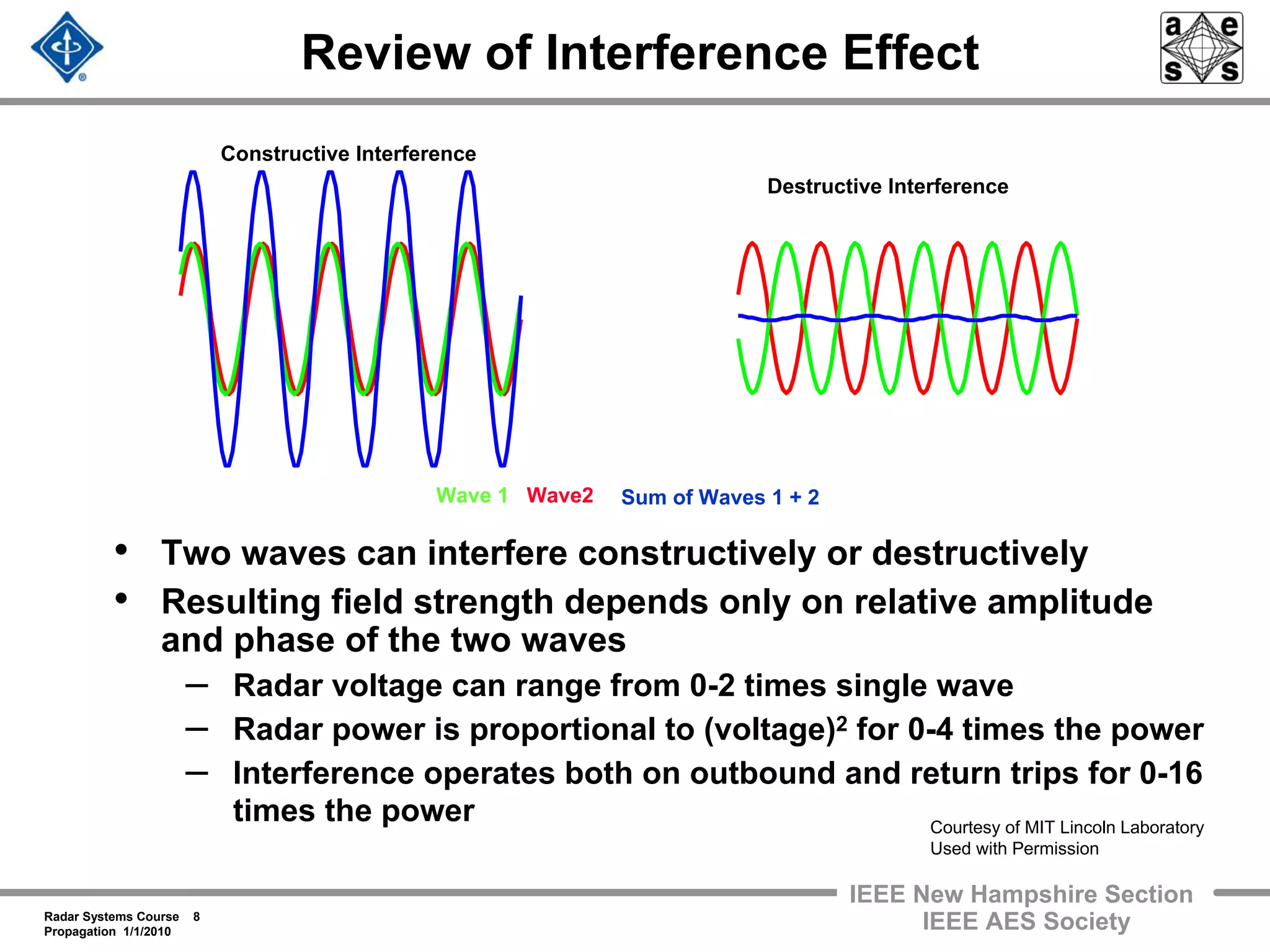
Review of Interference Effect
• Two waves can interfere constructively or destructively
• Resulting field strength depends only on relative amplitude
and phase of the two waves
– Radar voltage can range from 0-2 times single wave
– Radar power is proportional to (voltage)2 for 0-4 times the power
– Interference operates both on outbound and return trips for 0-16
times the power
Destructive Interference
Constructive Interference
Wave 1 Wave2 Sum of Waves 1 + 2
Courtesy of MIT Lincoln Laboratory
Used with Permission
Radar Systems Course 9
Propagation 1/1/2010
IEEE New Hampshire Section
IEEE AES Society
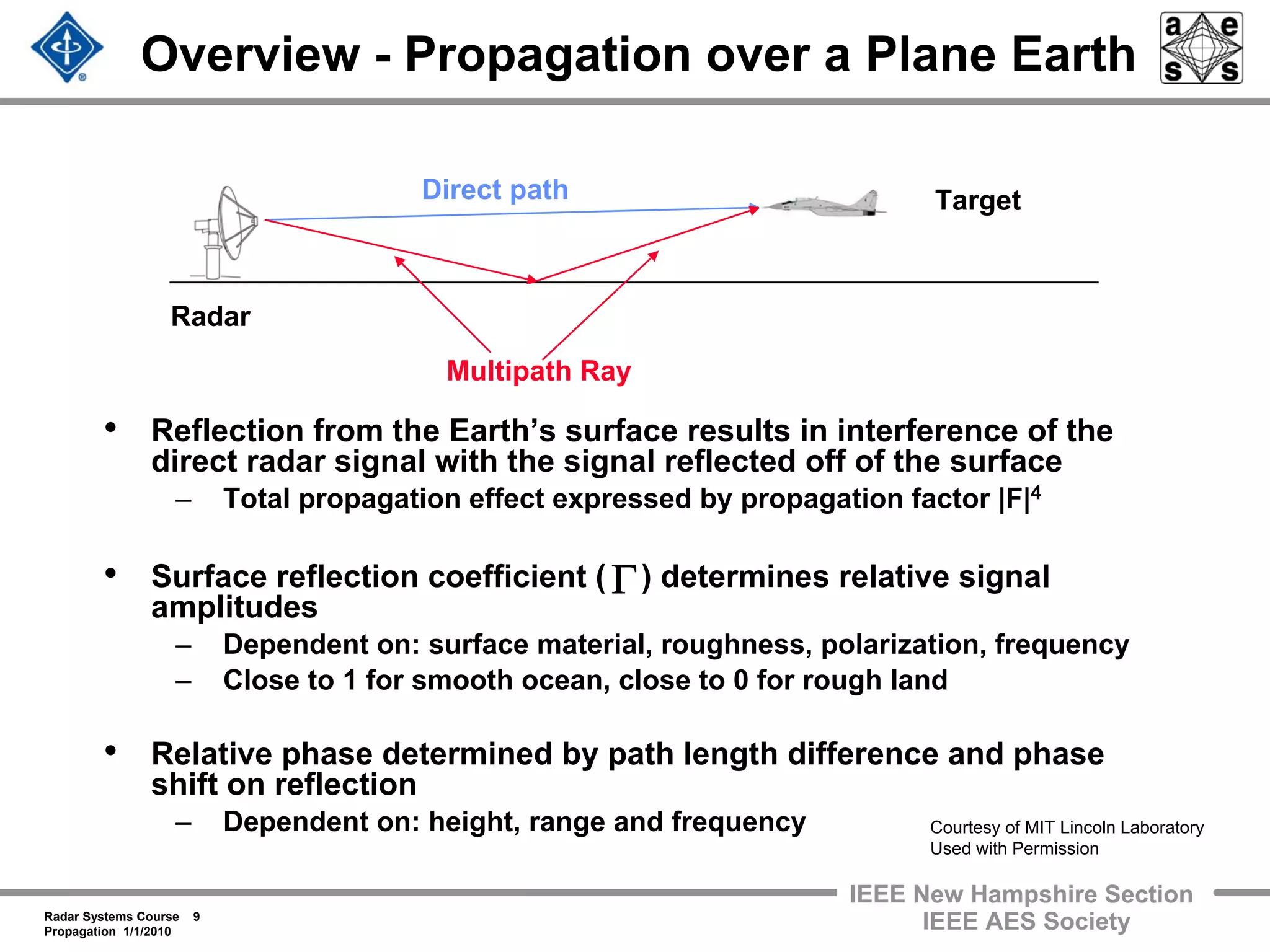
Overview - Propagation over a Plane Earth
• Reflection from the Earth’s surface results in interference of the
direct radar signal with the signal reflected off of the surface
– Total propagation effect expressed by propagation factor |F|4
• Surface reflection coefficient ( ) determines relative signal
amplitudes
– Dependent on: surface material, roughness, polarization, frequency
– Close to 1 for smooth ocean, close to 0 for rough land
• Relative phase determined by path length difference and phase
shift on reflection
– Dependent on: height, range and frequency
Radar
Direct path
Multipath Ray
Target
Γ
Courtesy of MIT Lincoln Laboratory
Used with Permission
Radar Systems Course 10
Propagation 1/1/2010
IEEE New Hampshire Section
IEEE AES Society
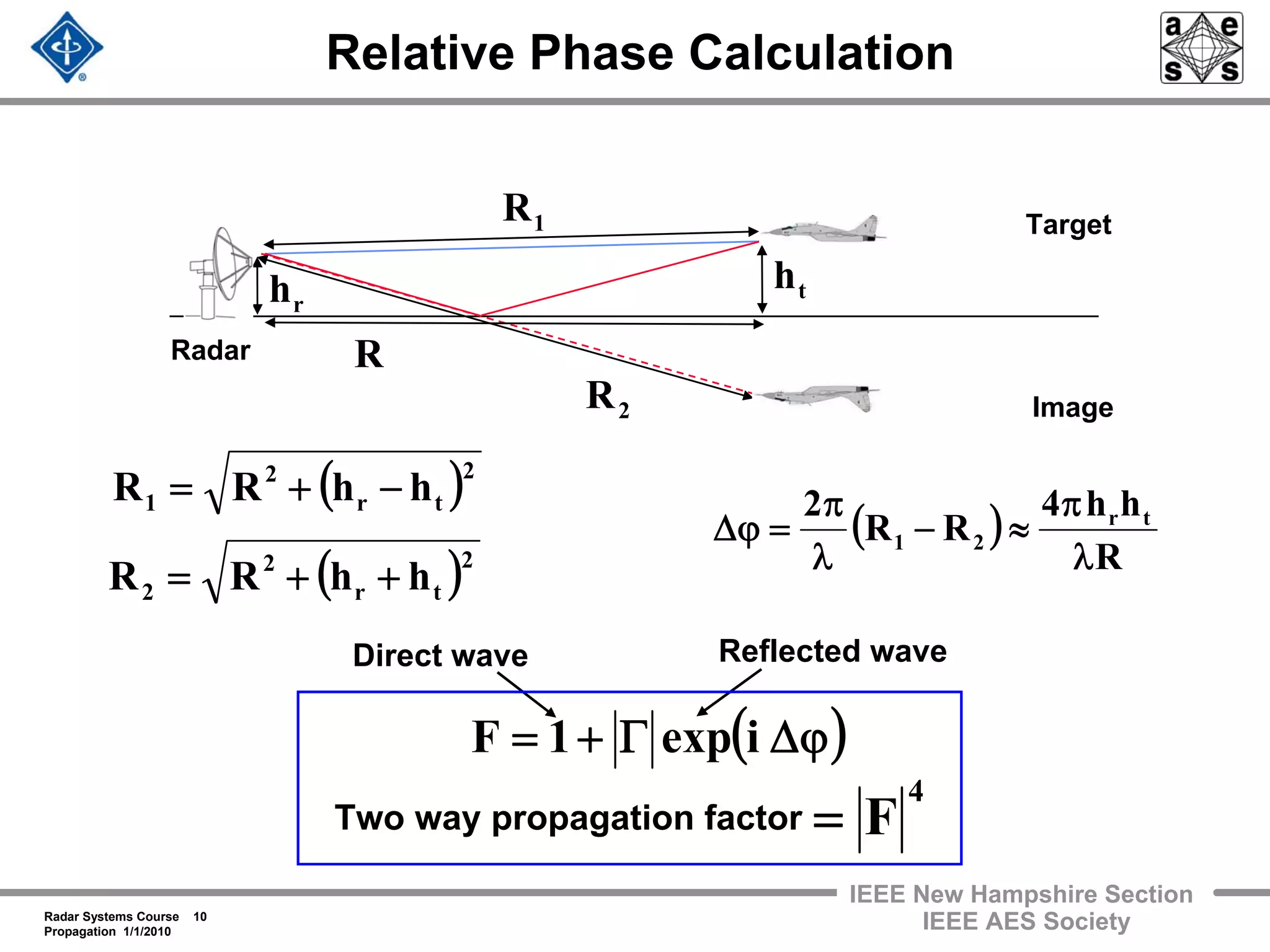
Relative Phase Calculation
( )2
tr
2
1 hhRR −+=
( )2
tr
2
2 hhRR ++=
( )
R
hh4
RR
2 tr
21
λ
π
≈−
λ
π
=ϕΔ
( )ϕΔΓ+= iexp1F
4
F=Two way propagation factor
Direct wave Reflected wave
Radar
Target
R
th
rh
1R
2R Image
Radar Systems Course 11
Propagation 1/1/2010
IEEE New Hampshire Section
IEEE AES Society
Propagation over a Plane Earth
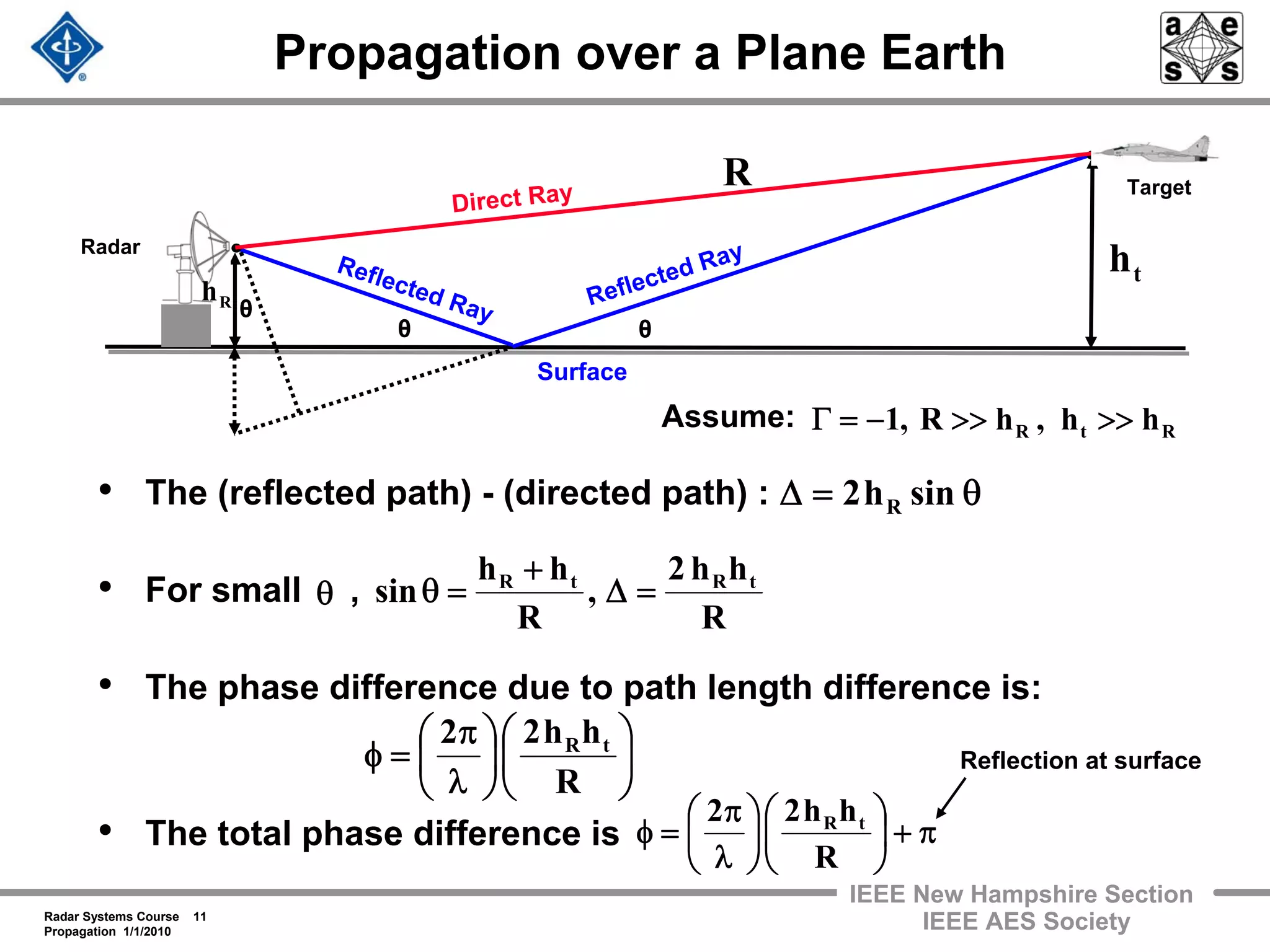
• The (reflected path) - (directed path) :
• For small ,
• The phase difference due to path length difference is:
• The total phase difference is
⎟
⎠
⎞
⎜
⎝
⎛
⎟
⎠
⎞
⎜
⎝
⎛
λ
π
=φ
R
hh22 tR
θ=Δ sinh2 R
R
hh2
,
R
hh
sin tRtR
=Δ
+
=θθ
π+⎟
⎠
⎞
⎜
⎝
⎛
⎟
⎠
⎞
⎜
⎝
⎛
λ
π
=φ
R
hh22 tR
th
θ
θ θ
RtR hh,hR,1 >>>>−=Γ
R
Direct Ray
Reflected RayReflected Ray
Surface
Radar
Target
Assume:
Reflection at surface
Rh
Radar Systems Course 12
Propagation 1/1/2010
IEEE New Hampshire Section
IEEE AES Society
Propagation over a Plane Earth
(continued)
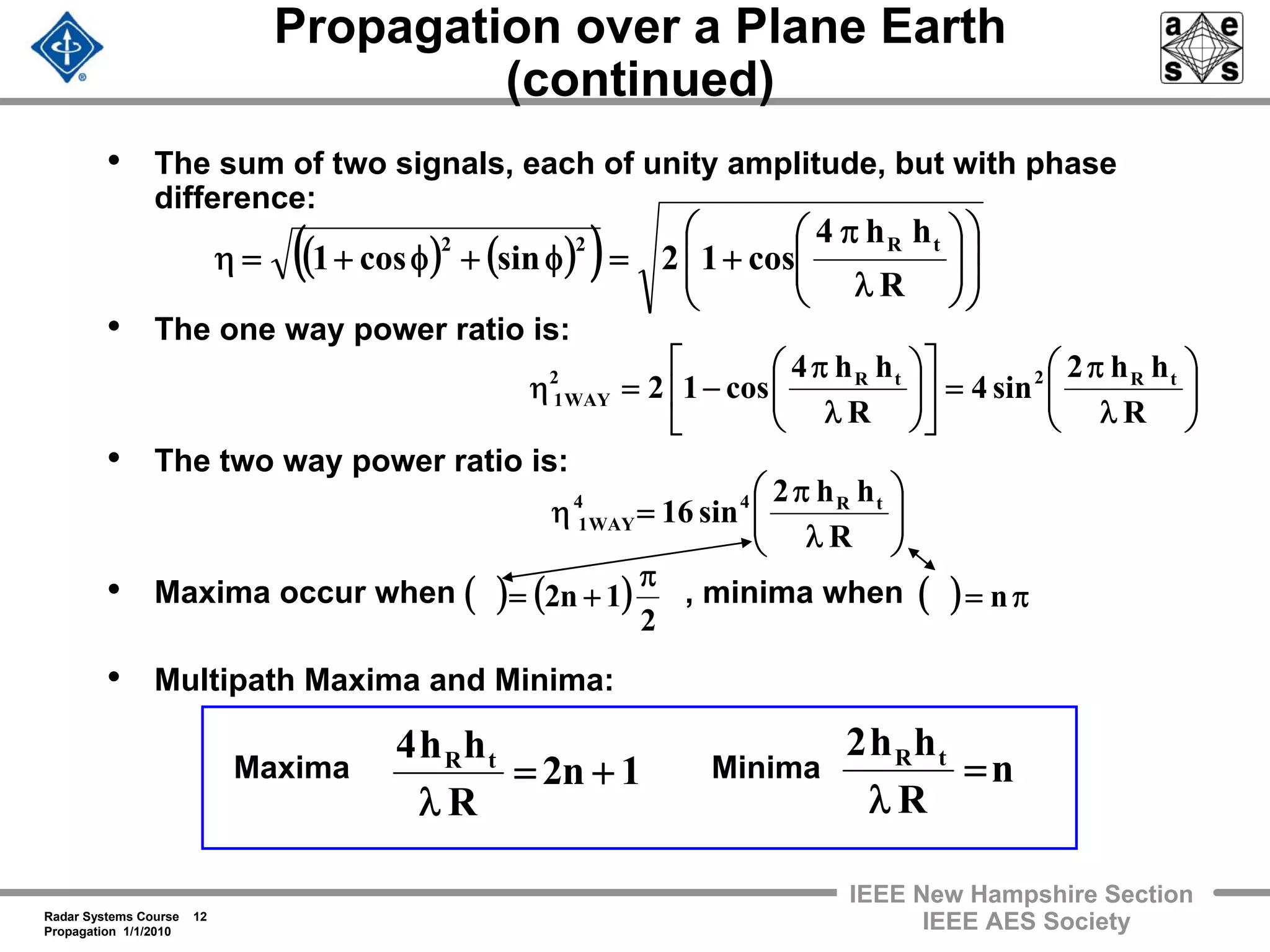
• The sum of two signals, each of unity amplitude, but with phase
difference:
• The one way power ratio is:
• The two way power ratio is:
• Maxima occur when , minima when
• Multipath Maxima and Minima:
Maxima Minima
⎟⎟
⎠
⎞
⎜⎜
⎝
⎛
λ
π
=⎥
⎦
⎤
⎢
⎣
⎡
⎟⎟
⎠
⎞
⎜⎜
⎝
⎛
λ
π
−=η
R
hh2
sin4
R
hh4
cos12 tR2tR2
WAY1
( ) ( )( ) ⎟
⎟
⎠
⎞
⎜
⎜
⎝
⎛
⎟⎟
⎠
⎞
⎜⎜
⎝
⎛
λ
π
+=φ+φ+=η
R
hh4
cos12sincos1
tR22
1n2
R
hh4 tR
+=
λ
( ) ( )
2
1n2
π
+=
⎟⎟
⎠
⎞
⎜⎜
⎝
⎛
λ
π
=η
R
hh2
sin16 tR44
WAY1
( ) π= n
n
R
hh2 tR
=
λ
Radar Systems Course 13
Propagation 1/1/2010
IEEE New Hampshire Section
IEEE AES Society
Multipath Effect on Radar Detection Range
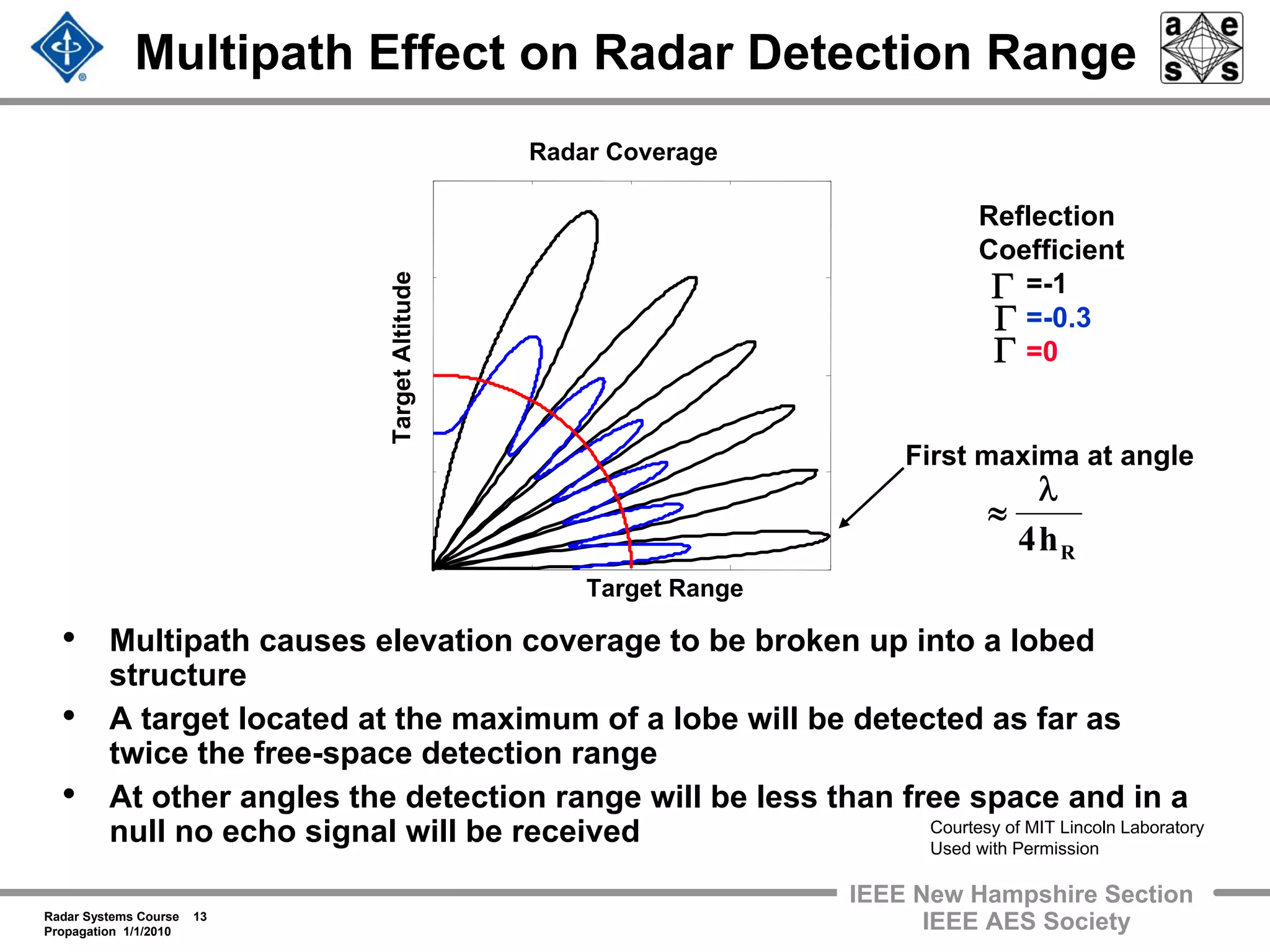
• Multipath causes elevation coverage to be broken up into a lobed
structure
• A target located at the maximum of a lobe will be detected as far as
twice the free-space detection range
• At other angles the detection range will be less than free space and in a
null no echo signal will be received
Reflection
Coefficient
=-1
=-0.3
=0
Target Range
TargetAltitude
Radar Coverage
First maxima at angle
Rh4
λ
≈
Γ
Γ
Γ
Courtesy of MIT Lincoln Laboratory
Used with Permission
Radar Systems Course 14
Propagation 1/1/2010
IEEE New Hampshire Section
IEEE AES Society
Multipath is Frequency Dependent
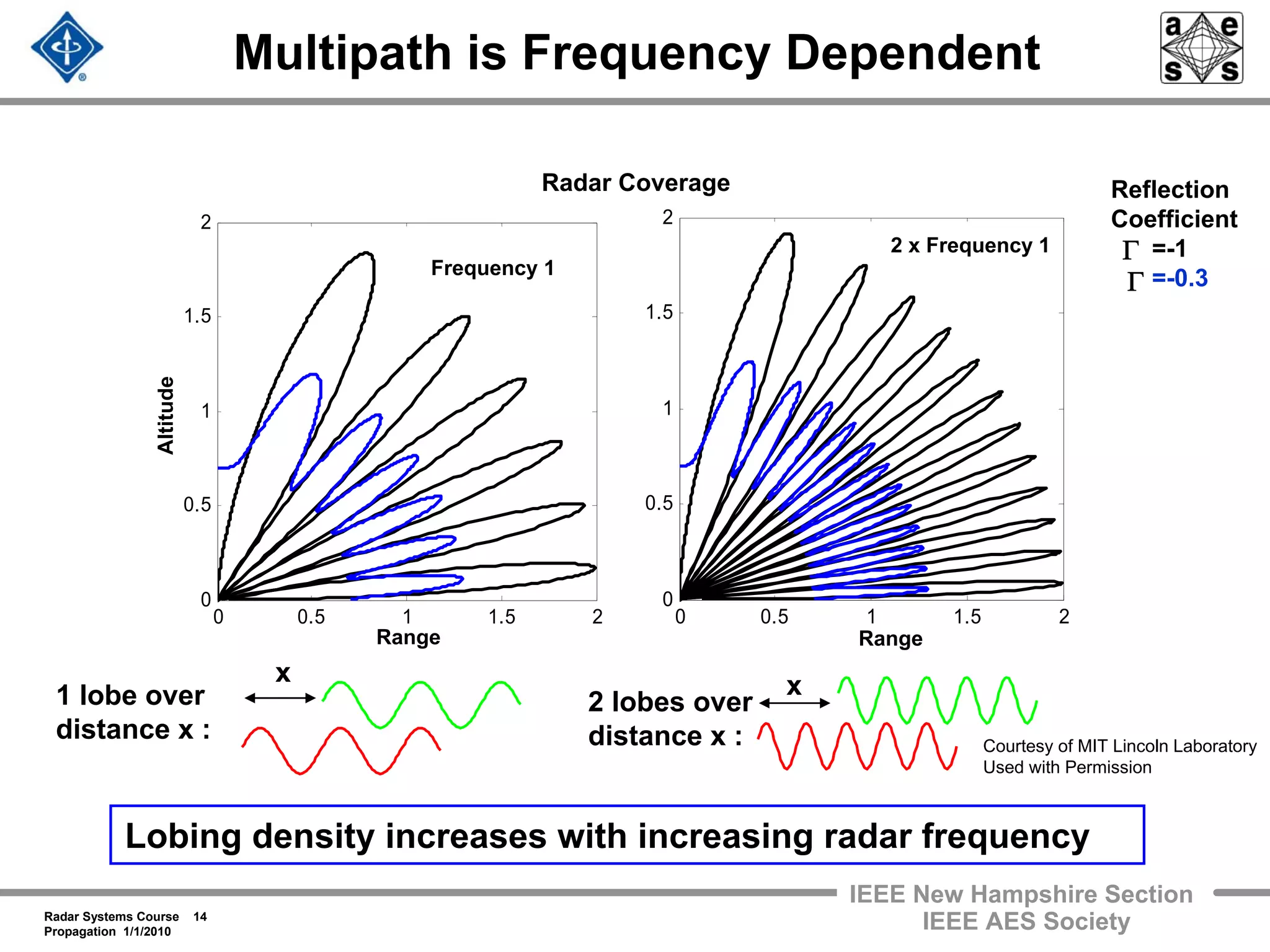
Lobing density increases with increasing radar frequency
Reflection
Coefficient
=-1
=-0.3
Range
Altitude
Range
Radar Coverage
0 0.5 1 1.5 2
0
0.5
1
1.5
2
0 0.5 1 1.5 2
0
0.5
1
1.5
2
Frequency 1
2 x Frequency 1
x x1 lobe over
distance x :
2 lobes over
distance x : Courtesy of MIT Lincoln Laboratory
Used with Permission
Γ
Γ
Radar Systems Course 15
Propagation 1/1/2010
IEEE New Hampshire Section
IEEE AES Society
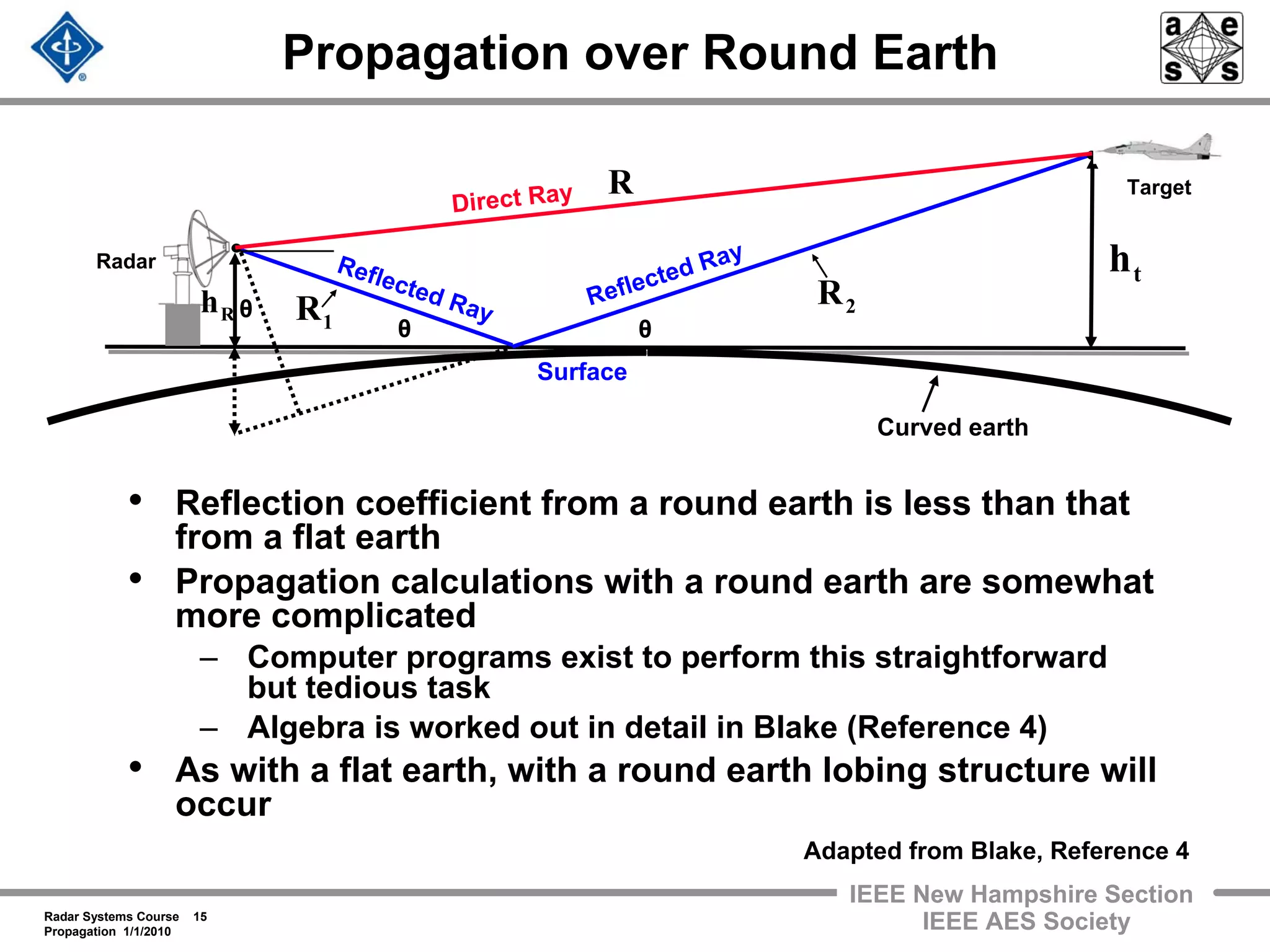
Propagation over Round Earth
• Reflection coefficient from a round earth is less than that
from a flat earth
• Propagation calculations with a round earth are somewhat
more complicated
– Computer programs exist to perform this straightforward
but tedious task
– Algebra is worked out in detail in Blake (Reference 4)
• As with a flat earth, with a round earth lobing structure will
occur
th
Rh θ
θ θ
Direct Ray
Reflected RayReflected Ray
Surface
Radar
Target
Curved earth
R
1R 2R
Adapted from Blake, Reference 4
Radar Systems Course 16
Propagation 1/1/2010
IEEE New Hampshire Section
IEEE AES Society
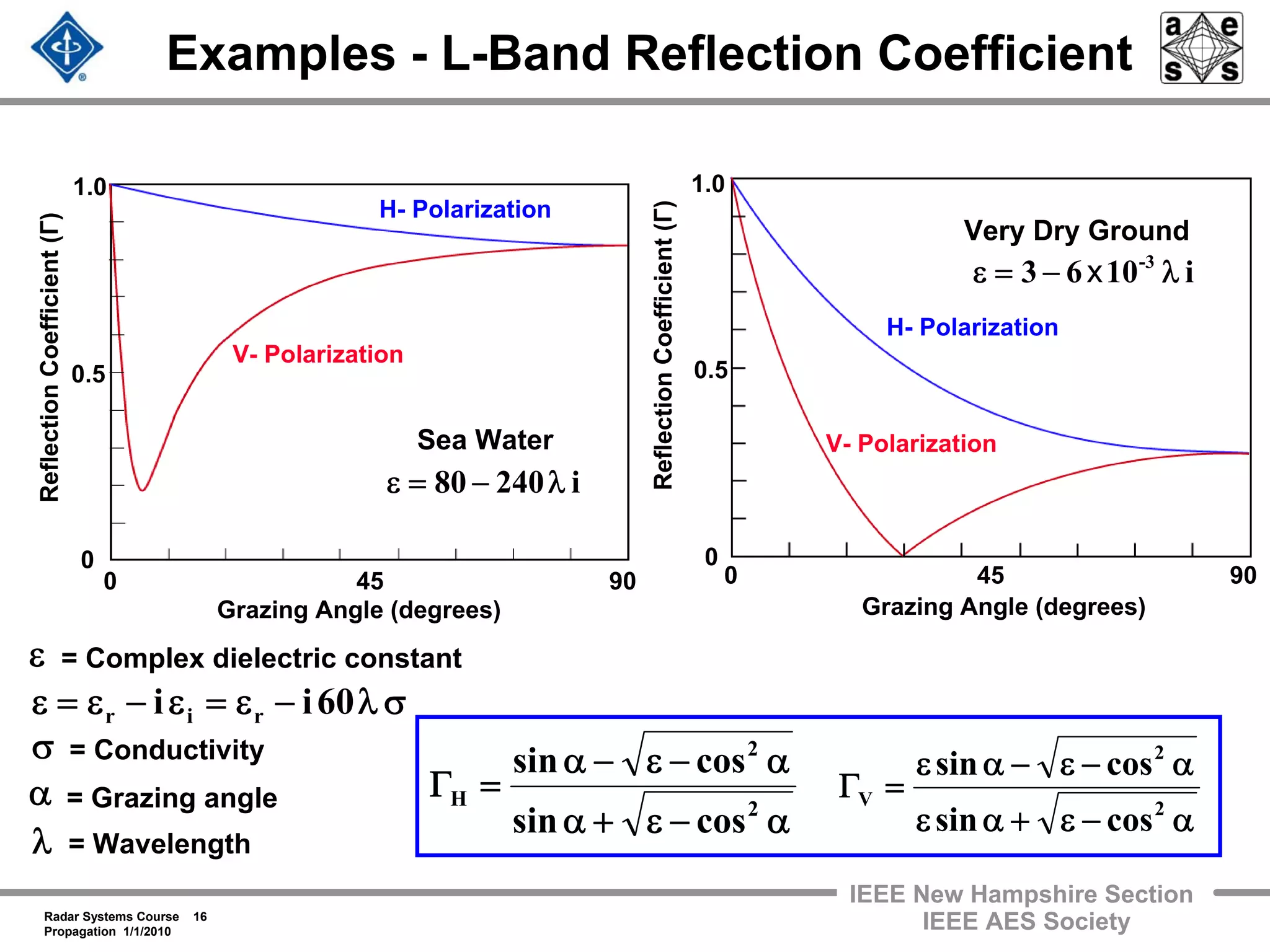
Examples - L-Band Reflection Coefficient
H- Polarization
V- Polarization
0 45 90
Grazing Angle (degrees)
Sea Water
i24080 λ−=ε
H- Polarization
V- Polarization
0 45 90
Grazing Angle (degrees)
Very Dry Ground
i1063 -3
λ−=ε x
ReflectionCoefficient(Γ)
00
0.5 0.5
1.0 1.0
= Grazing angleα
= Complex dielectric constantε
= Wavelengthλ
σλ−ε=ε−ε=ε 60ii rir
= Conductivityσ
α−ε+α
α−ε−α
=Γ
2
2
H
cossin
cossin
α−ε+αε
α−ε−αε
=Γ
2
2
V
cossin
cossin
Radar Systems Course 17
Propagation 1/1/2010
IEEE New Hampshire Section
IEEE AES Society
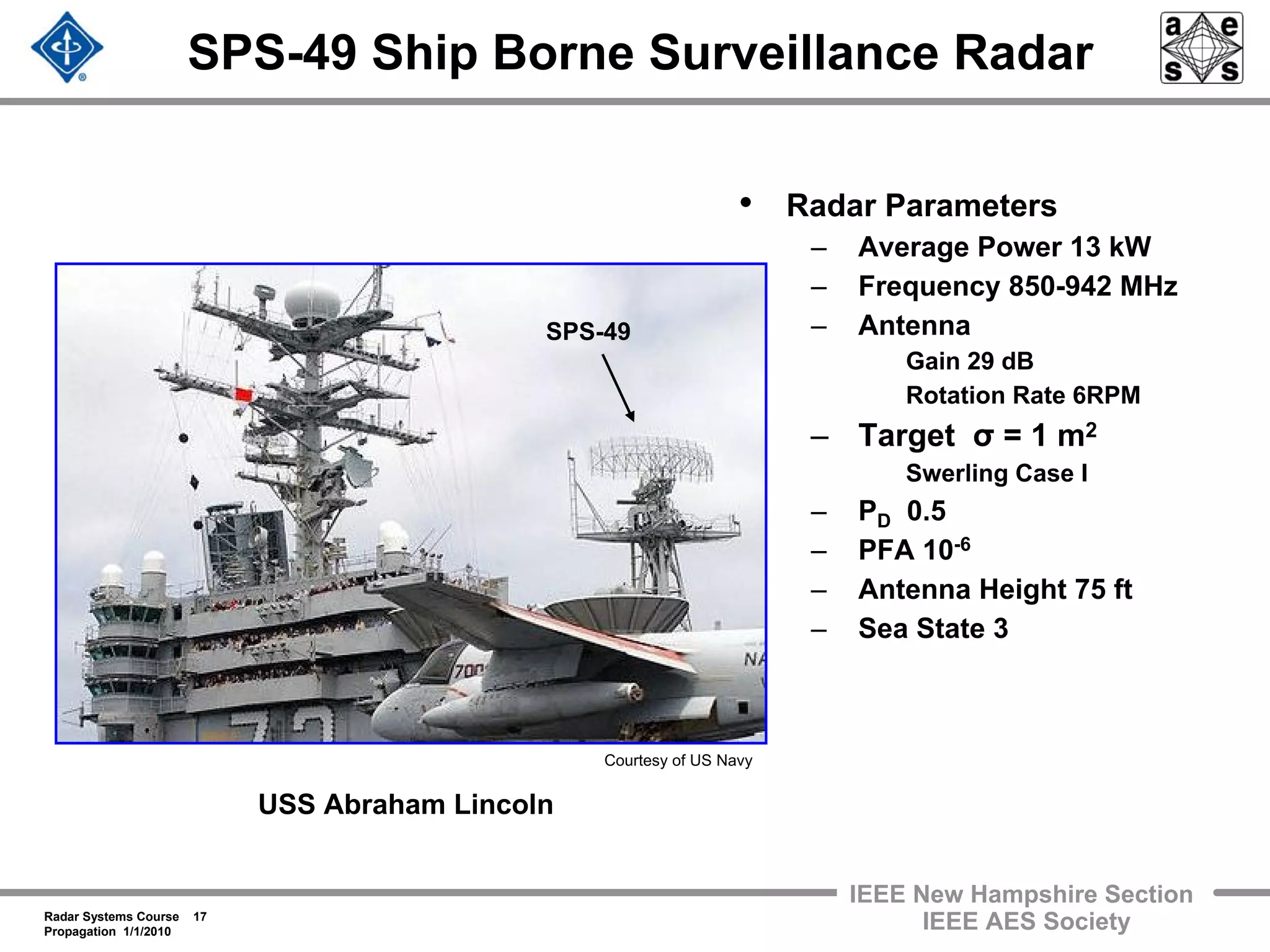
SPS-49 Ship Borne Surveillance Radar
• Radar Parameters
– Average Power 13 kW
– Frequency 850-942 MHz
– Antenna
Gain 29 dB
Rotation Rate 6RPM
– Target σ = 1 m2
Swerling Case I
– PD 0.5
– PFA 10-6
– Antenna Height 75 ft
– Sea State 3
USS Abraham Lincoln
SPS-49
Courtesy of US Navy
Radar Systems Course 18
Propagation 1/1/2010
IEEE New Hampshire Section
IEEE AES Society
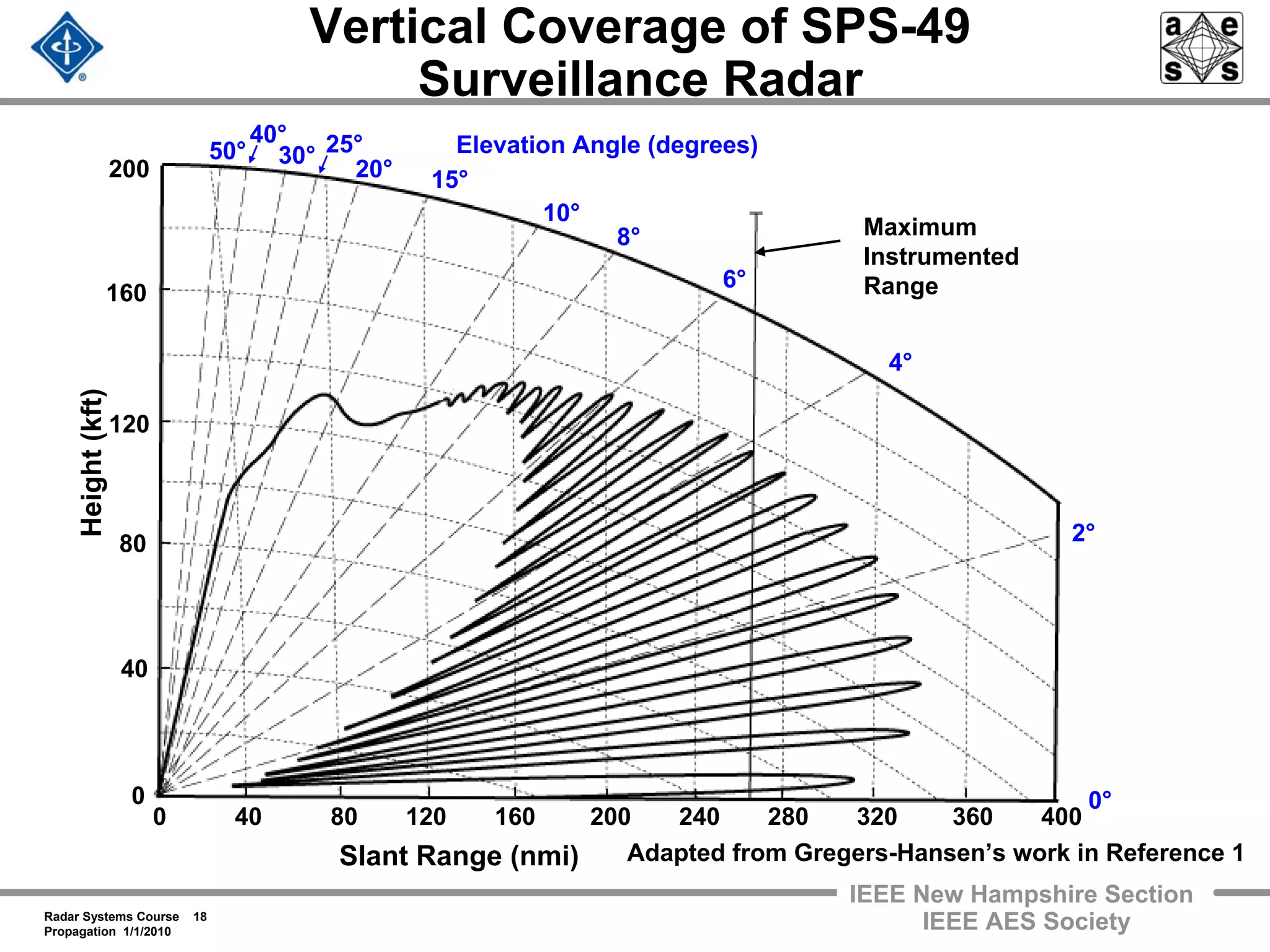
Vertical Coverage of SPS-49
Surveillance Radar
0 40 80 120 160 200 240 280 320 360 400
Slant Range (nmi)
Height(kft)
0
200
160
120
80
40
0°
Elevation Angle (degrees)
6°
4°
2°
20° 15°
10°
8°
50°
40° 25°30°
Maximum
Instrumented
Range
Adapted from Gregers-Hansen’s work in Reference 1
Radar Systems Course 19
Propagation 1/1/2010
IEEE New Hampshire Section
IEEE AES Society
Outline
• Reflection from the Earth’s surface
• Atmospheric refraction
• Over-the-horizon diffraction
• Atmospheric attenuation
• Ionospheric propagation
Radar Systems Course 20
Propagation 1/1/2010
IEEE New Hampshire Section
IEEE AES Society
Refraction of Radar Beams
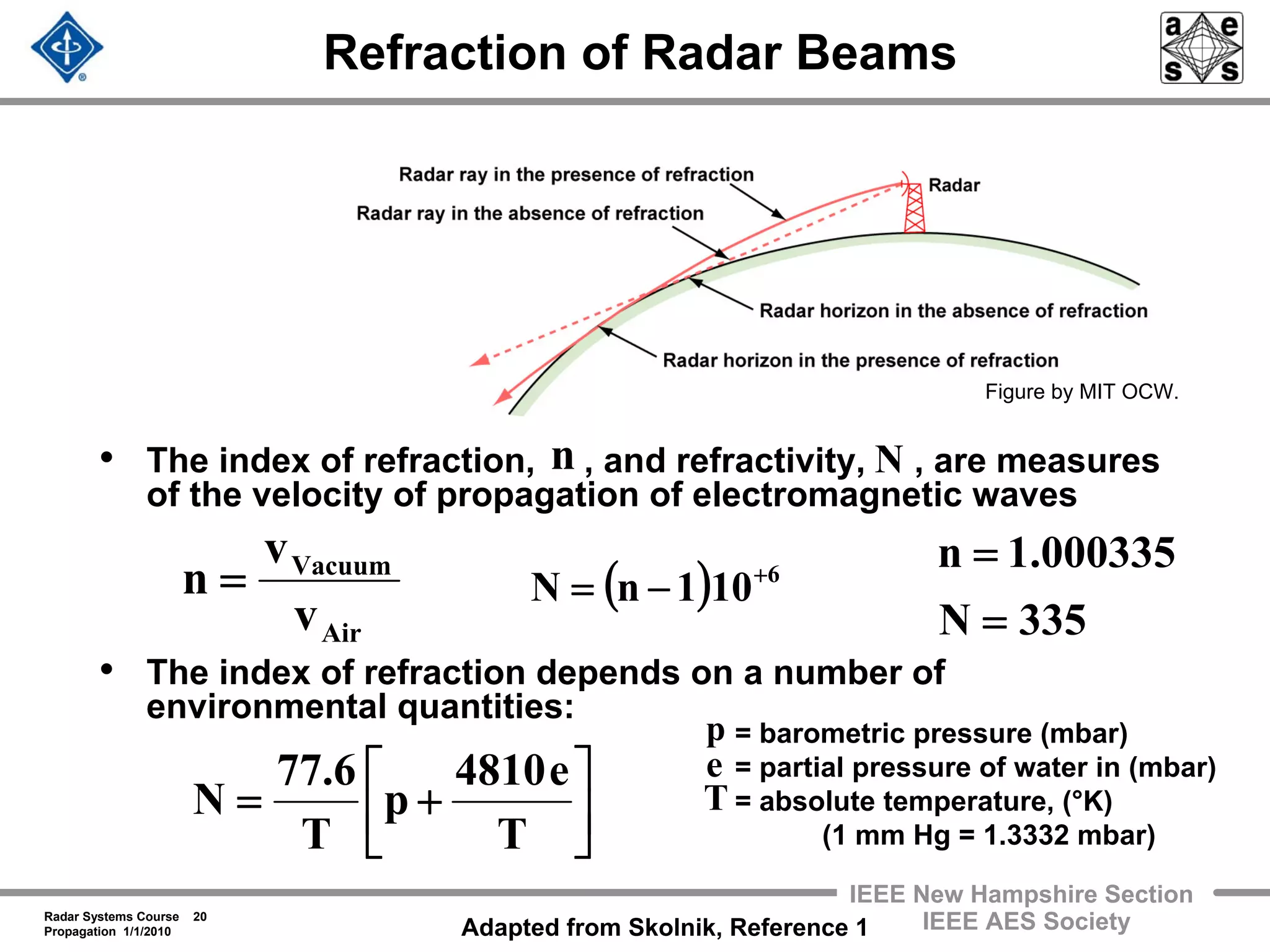
• The index of refraction, , and refractivity, , are measures
of the velocity of propagation of electromagnetic waves
• The index of refraction depends on a number of
environmental quantities:
Figure by MIT OCW.
Air
Vacuum
v
v
n =
n N
( ) 6
101nN +
−=
335N
000335.1n
=
=
⎥
⎦
⎤
⎢
⎣
⎡
+=
T
e4810
p
T
6.77
N
= barometric pressure (mbar)
= partial pressure of water in (mbar)
= absolute temperature, (°K)
(1 mm Hg = 1.3332 mbar)
e
T
p
Adapted from Skolnik, Reference 1
Radar Systems Course 21
Propagation 1/1/2010
IEEE New Hampshire Section
IEEE AES Society
Refraction of Radar Beams
Figure by MIT OCW.
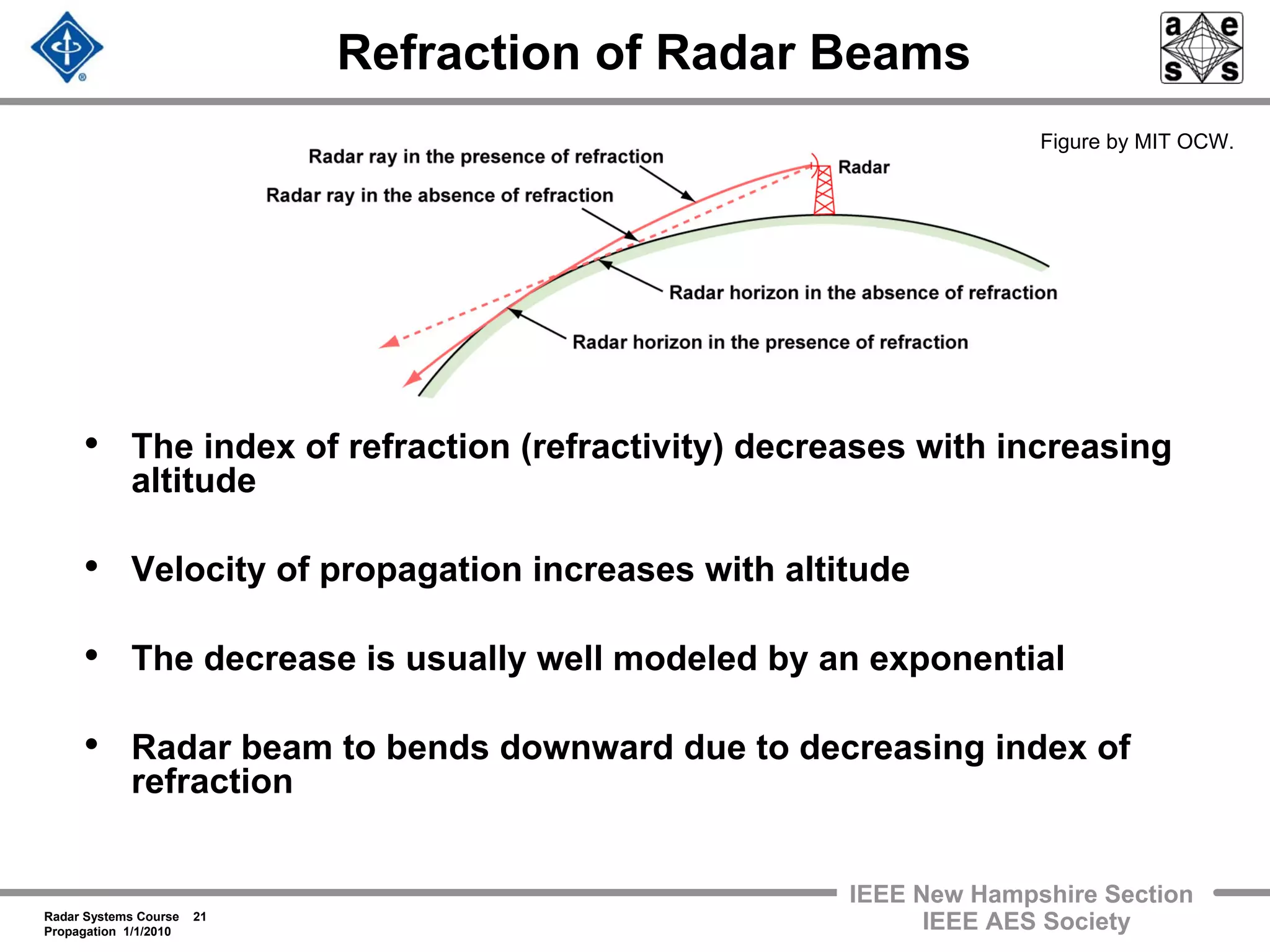
• The index of refraction (refractivity) decreases with increasing
altitude
• Velocity of propagation increases with altitude
• The decrease is usually well modeled by an exponential
• Radar beam to bends downward due to decreasing index of
refraction
Radar Systems Course 22
Propagation 1/1/2010
IEEE New Hampshire Section
IEEE AES Society
Earth’s Radius Modified to Account for
Refraction Effects
Figure by MIT OCW.
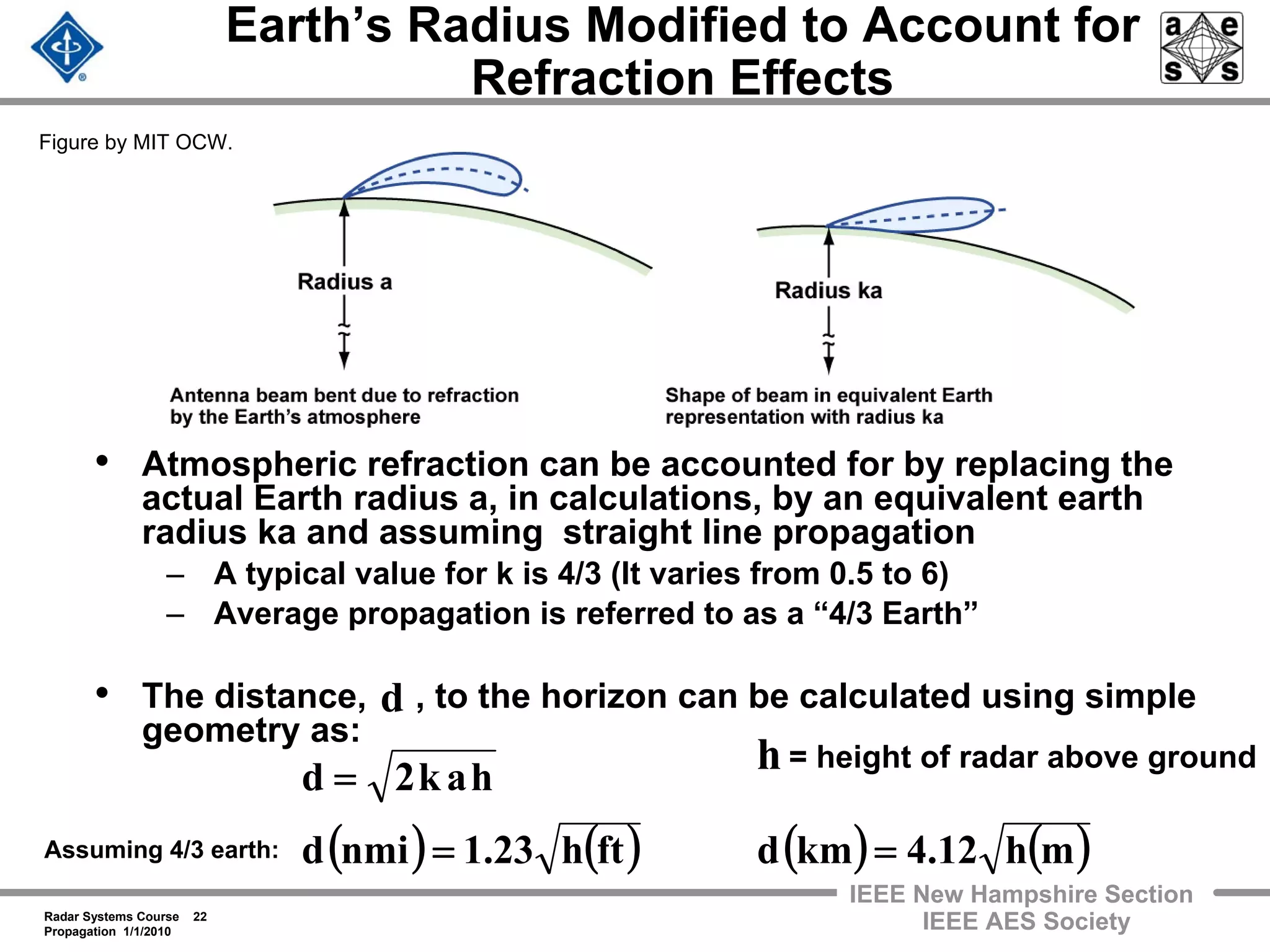
• Atmospheric refraction can be accounted for by replacing the
actual Earth radius a, in calculations, by an equivalent earth
radius ka and assuming straight line propagation
– A typical value for k is 4/3 (It varies from 0.5 to 6)
– Average propagation is referred to as a “4/3 Earth”
• The distance, , to the horizon can be calculated using simple
geometry as:
( ) ( ) ( ) ( )mh12.4kmdfth23.1nmid
hak2d
==
=
= height of radar above groundh
d
Assuming 4/3 earth:
Radar Systems Course 23
Propagation 1/1/2010
IEEE New Hampshire Section
IEEE AES Society
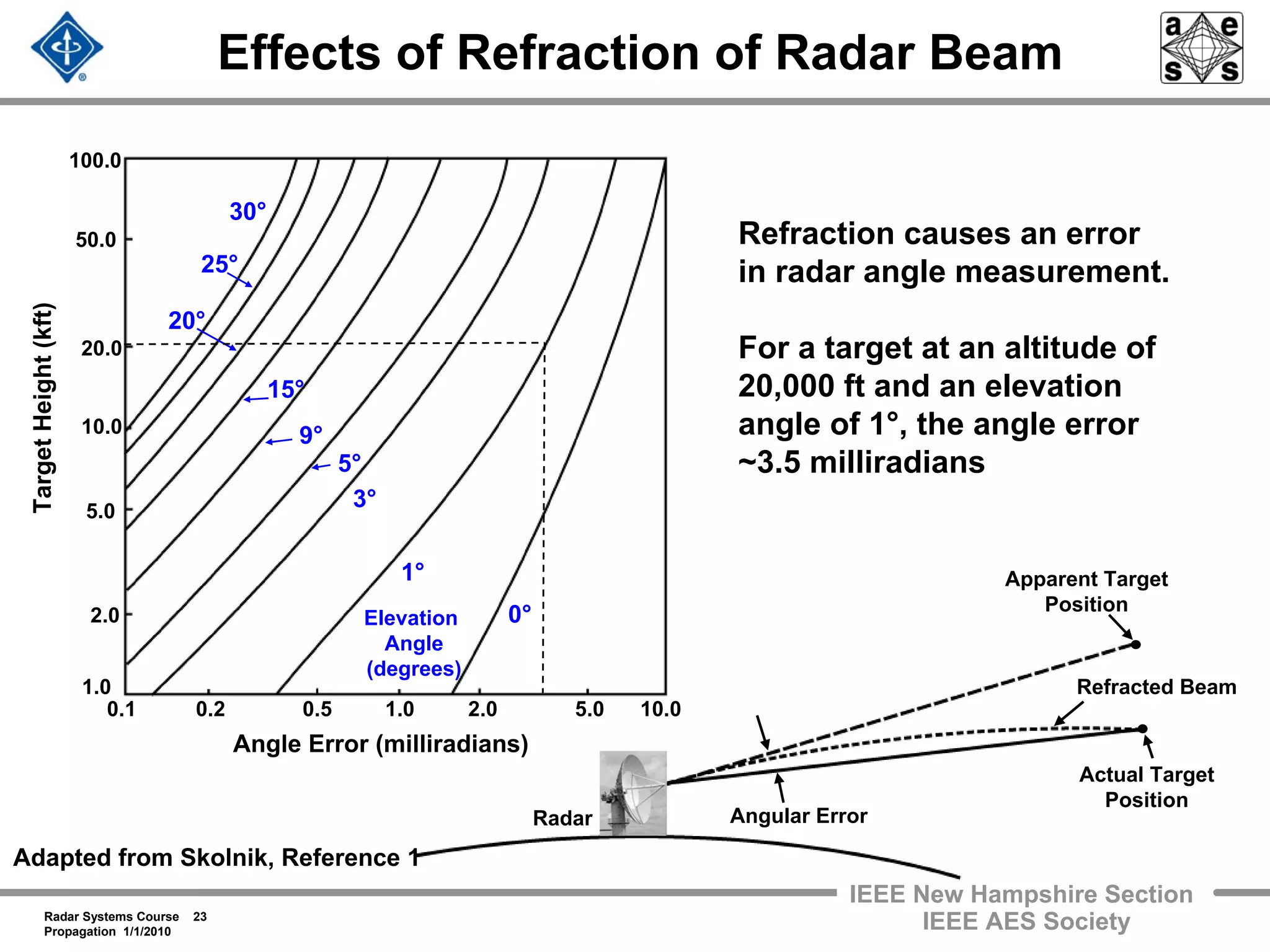
Effects of Refraction of Radar Beam
Apparent Target
Position
Actual Target
Position
Refracted Beam
Radar Angular Error
Angle Error (milliradians)
0.1 0.2 0.5 1.0 2.0 5.0 10.0
TargetHeight(kft)
100.0
10.0
1.0
Elevation
Angle
(degrees)
50.0
2.0
5.0
20.0
30°
25°
20°
15°
9°
5°
3°
1°
0°
Refraction causes an error
in radar angle measurement.
For a target at an altitude of
20,000 ft and an elevation
angle of 1°, the angle error
~3.5 milliradians
Adapted from Skolnik, Reference 1
Radar Systems Course 24
Propagation 1/1/2010
IEEE New Hampshire Section
IEEE AES Society
Non-Standard Propagation
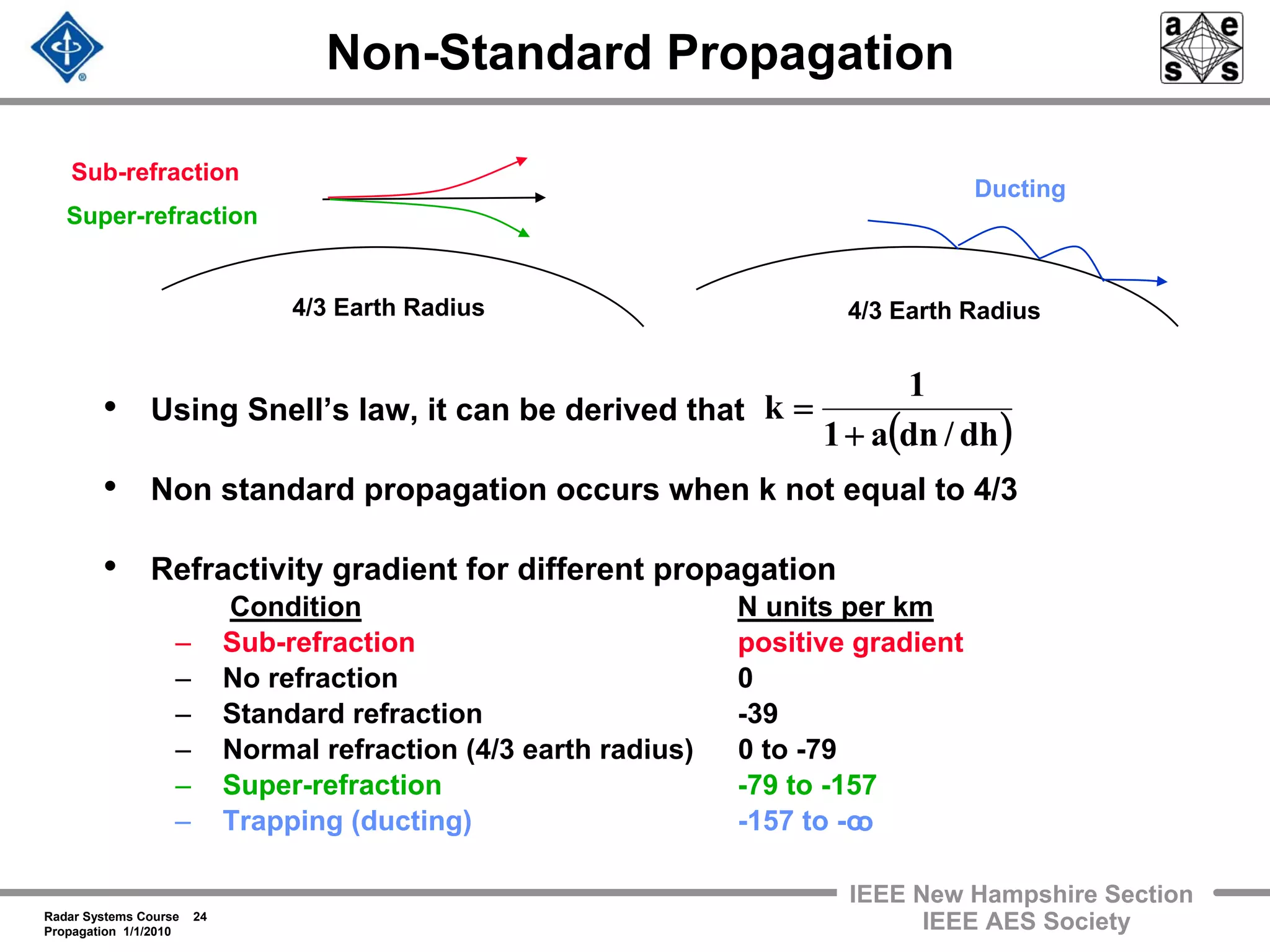
• Using Snell’s law, it can be derived that
• Non standard propagation occurs when k not equal to 4/3
• Refractivity gradient for different propagation
Condition N units per km
– Sub-refraction positive gradient
– No refraction 0
– Standard refraction -39
– Normal refraction (4/3 earth radius) 0 to -79
– Super-refraction -79 to -157
– Trapping (ducting) -157 to -o
4/3 Earth Radius 4/3 Earth Radius
Sub-refraction
Super-refraction
Ducting
( )dh/dna1
1
k
+
=
o
Radar Systems Course 25
Propagation 1/1/2010
IEEE New Hampshire Section
IEEE AES Society
Anomalous Propagation
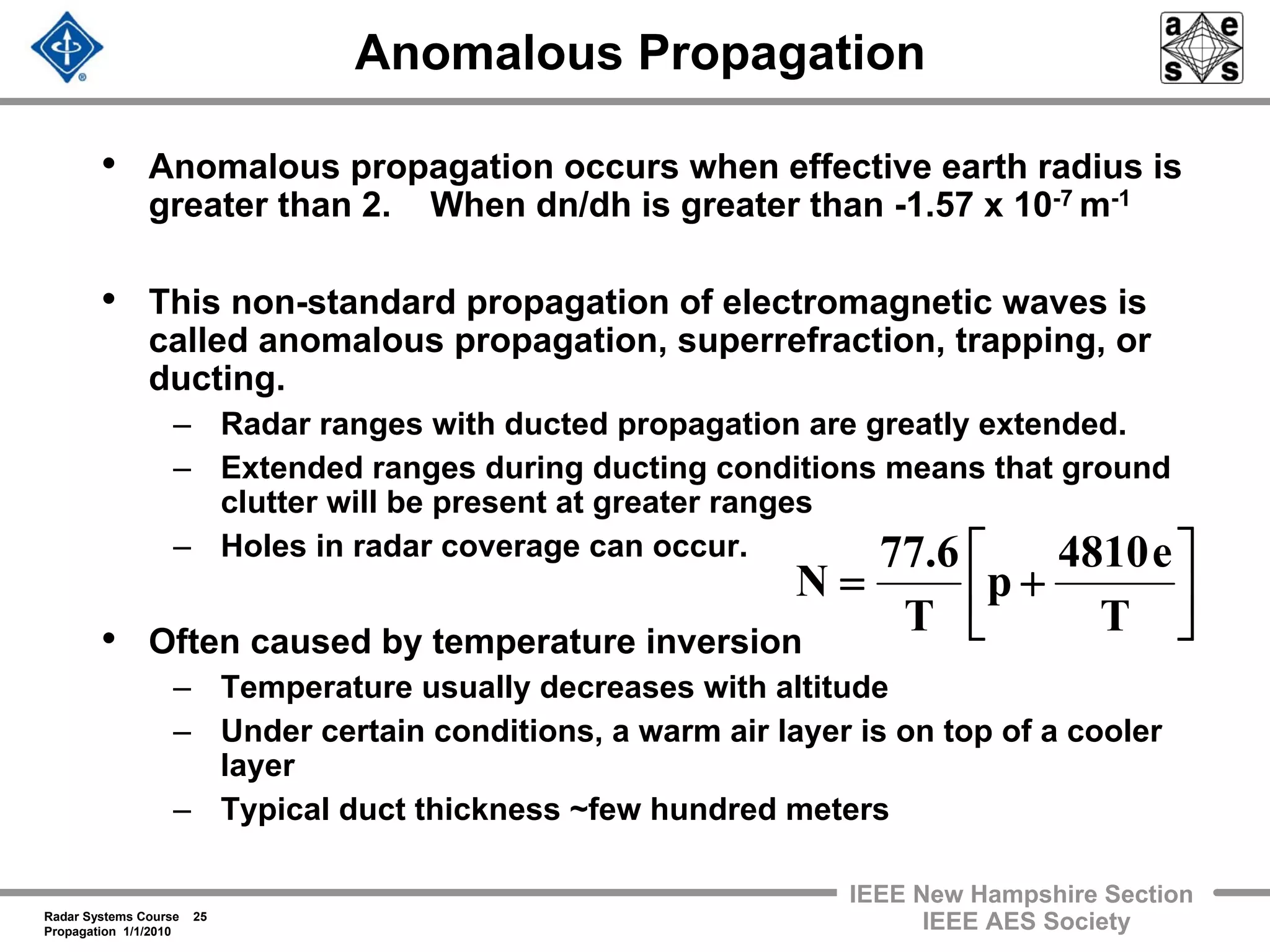
• Anomalous propagation occurs when effective earth radius is
greater than 2. When dn/dh is greater than -1.57 x 10⁻⁷ m-1
• This non-standard propagation of electromagnetic waves is
called anomalous propagation, superrefraction, trapping, or
ducting.
– Radar ranges with ducted propagation are greatly extended.
– Extended ranges during ducting conditions means that ground
clutter will be present at greater ranges
– Holes in radar coverage can occur.
• Often caused by temperature inversion
– Temperature usually decreases with altitude
– Under certain conditions, a warm air layer is on top of a cooler
layer
– Typical duct thickness ~few hundred meters
⎥
⎦
⎤
⎢
⎣
⎡
+=
T
e4810
p
T
6.77
N
Radar Systems Course 26
Propagation 1/1/2010
IEEE New Hampshire Section
IEEE AES Society
Effect of Ducting on Target Detection
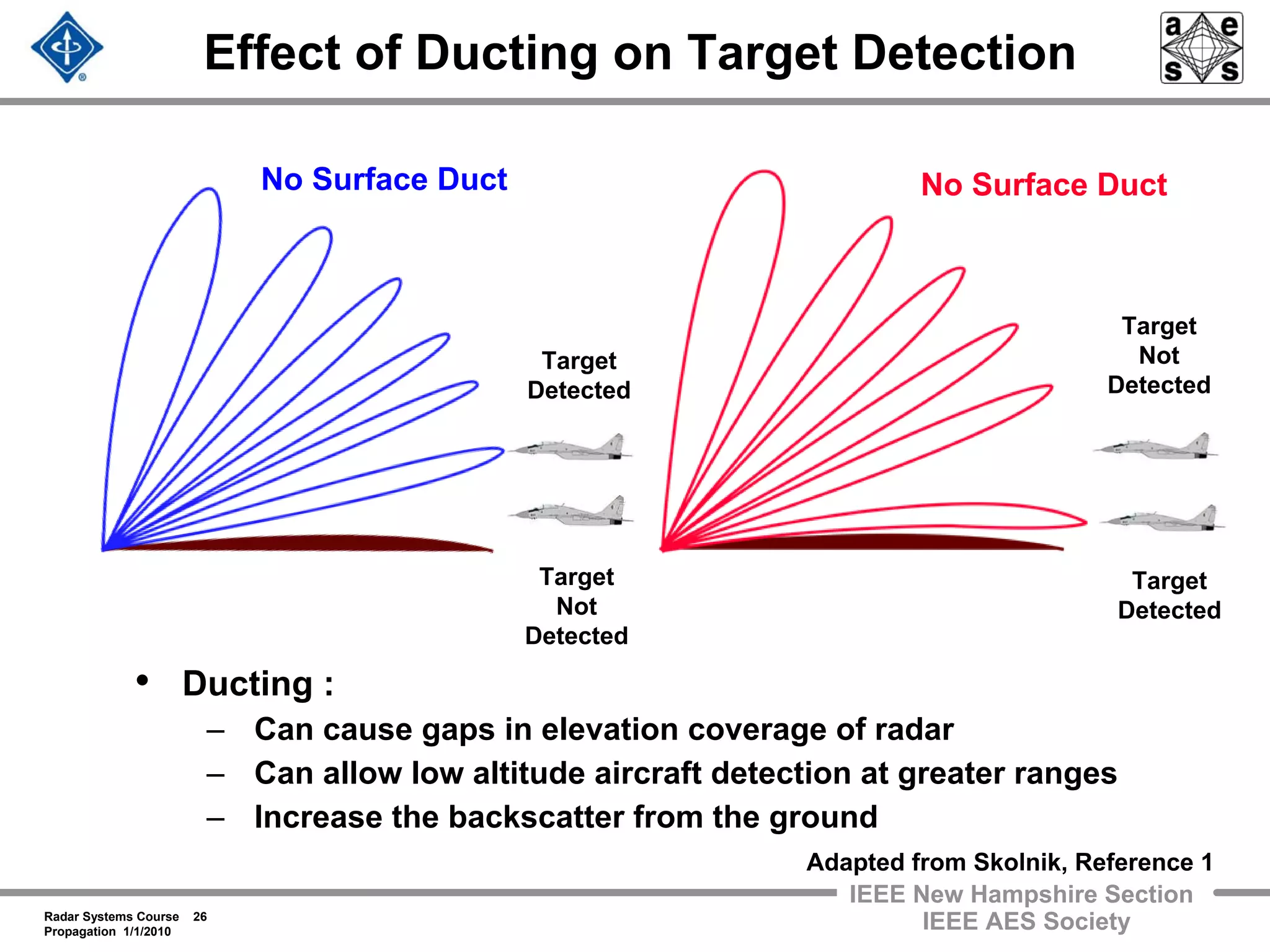
• Ducting :
– Can cause gaps in elevation coverage of radar
– Can allow low altitude aircraft detection at greater ranges
– Increase the backscatter from the ground
Target
Detected
Target
Detected
Target
Not
Detected
Target
Not
Detected
No Surface Duct No Surface Duct
Adapted from Skolnik, Reference 1
Radar Systems Course 27
Propagation 1/1/2010
IEEE New Hampshire Section
IEEE AES Society
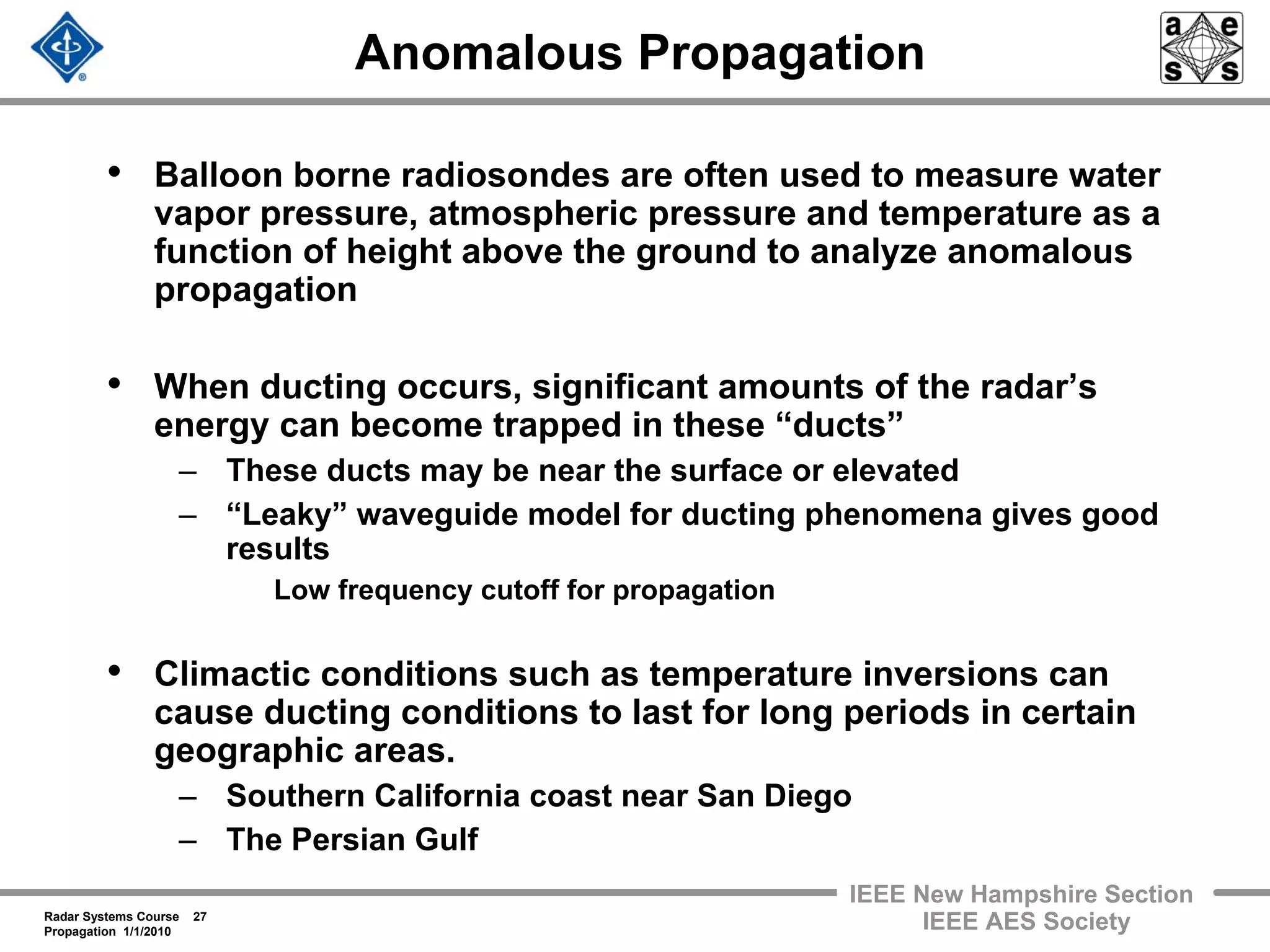
Anomalous Propagation
• Balloon borne radiosondes are often used to measure water
vapor pressure, atmospheric pressure and temperature as a
function of height above the ground to analyze anomalous
propagation
• When ducting occurs, significant amounts of the radar’s
energy can become trapped in these “ducts”
– These ducts may be near the surface or elevated
– “Leaky” waveguide model for ducting phenomena gives good
results
Low frequency cutoff for propagation
• Climactic conditions such as temperature inversions can
cause ducting conditions to last for long periods in certain
geographic areas.
– Southern California coast near San Diego
– The Persian Gulf
Radar Systems Course 28
Propagation 1/1/2010
IEEE New Hampshire Section
IEEE AES Society
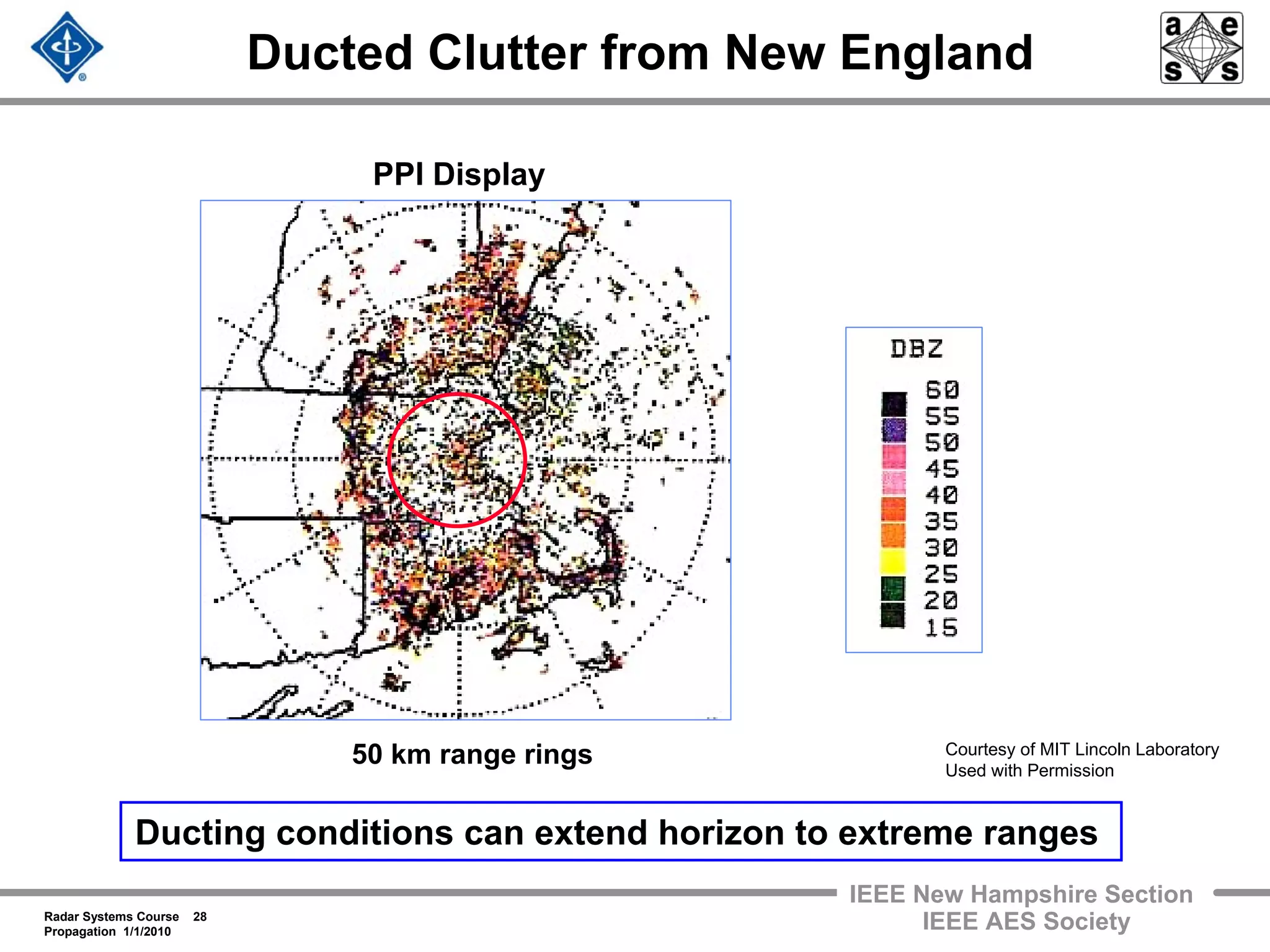
Ducted Clutter from New England
Ducting conditions can extend horizon to extreme ranges
50 km range rings
PPI Display
Courtesy of MIT Lincoln Laboratory
Used with Permission
Radar Systems Course 29
Propagation 1/1/2010
IEEE New Hampshire Section
IEEE AES Society
Outline
• Reflection from the Earth’s surface
• Atmospheric refraction
• Over-the-horizon diffraction
• Atmospheric attenuation
• Ionospheric propagation
Radar Systems Course 30
Propagation 1/1/2010
IEEE New Hampshire Section
IEEE AES Society
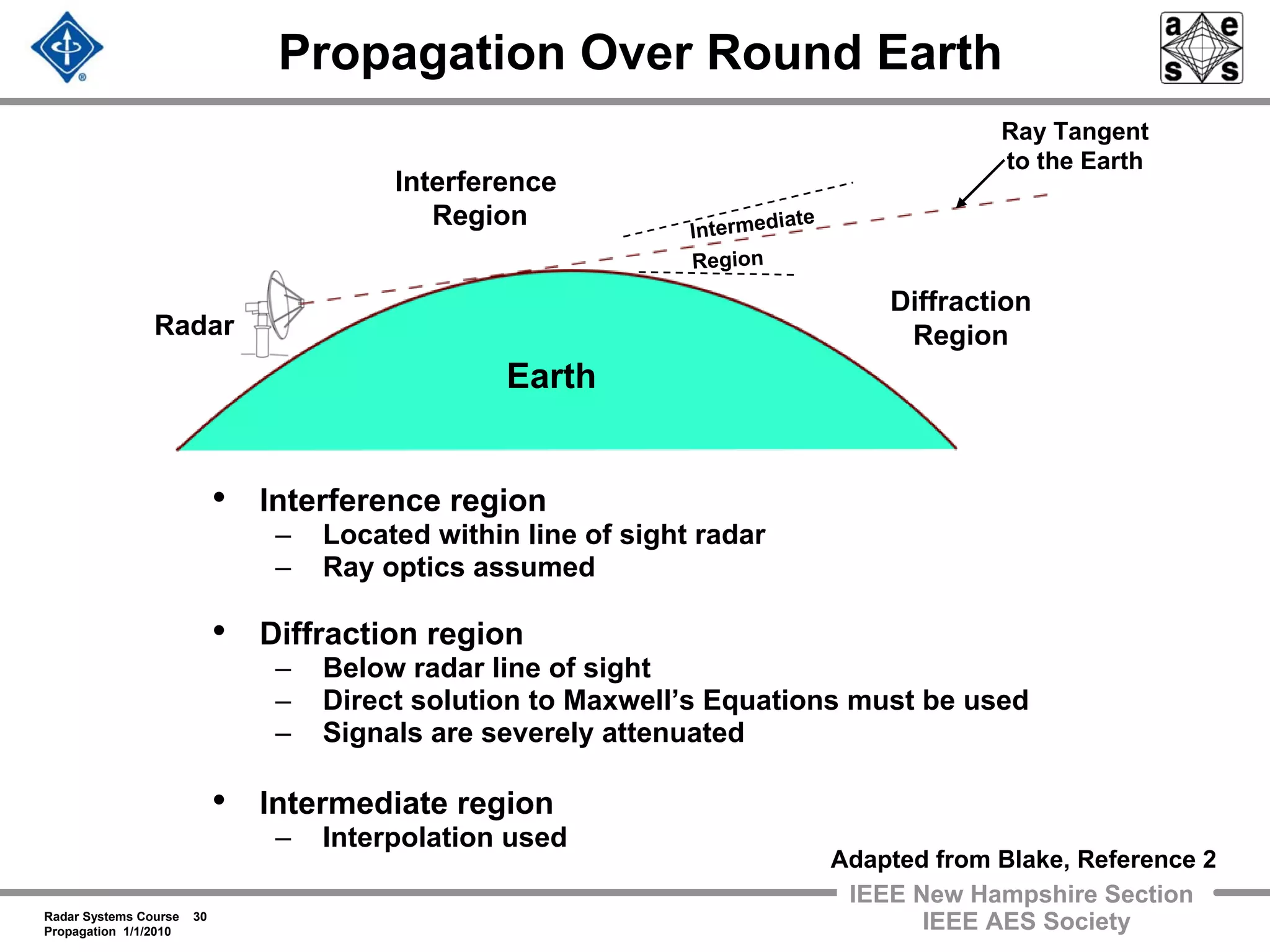
Propagation Over Round Earth
Earth
Ray Tangent
to the Earth
Interference
Region
Diffraction
RegionRadar
• Interference region
– Located within line of sight radar
– Ray optics assumed
• Diffraction region
– Below radar line of sight
– Direct solution to Maxwell’s Equations must be used
– Signals are severely attenuated
• Intermediate region
– Interpolation used
Intermediate
Region
Adapted from Blake, Reference 2
Radar Systems Course 31
Propagation 1/1/2010
IEEE New Hampshire Section
IEEE AES Society
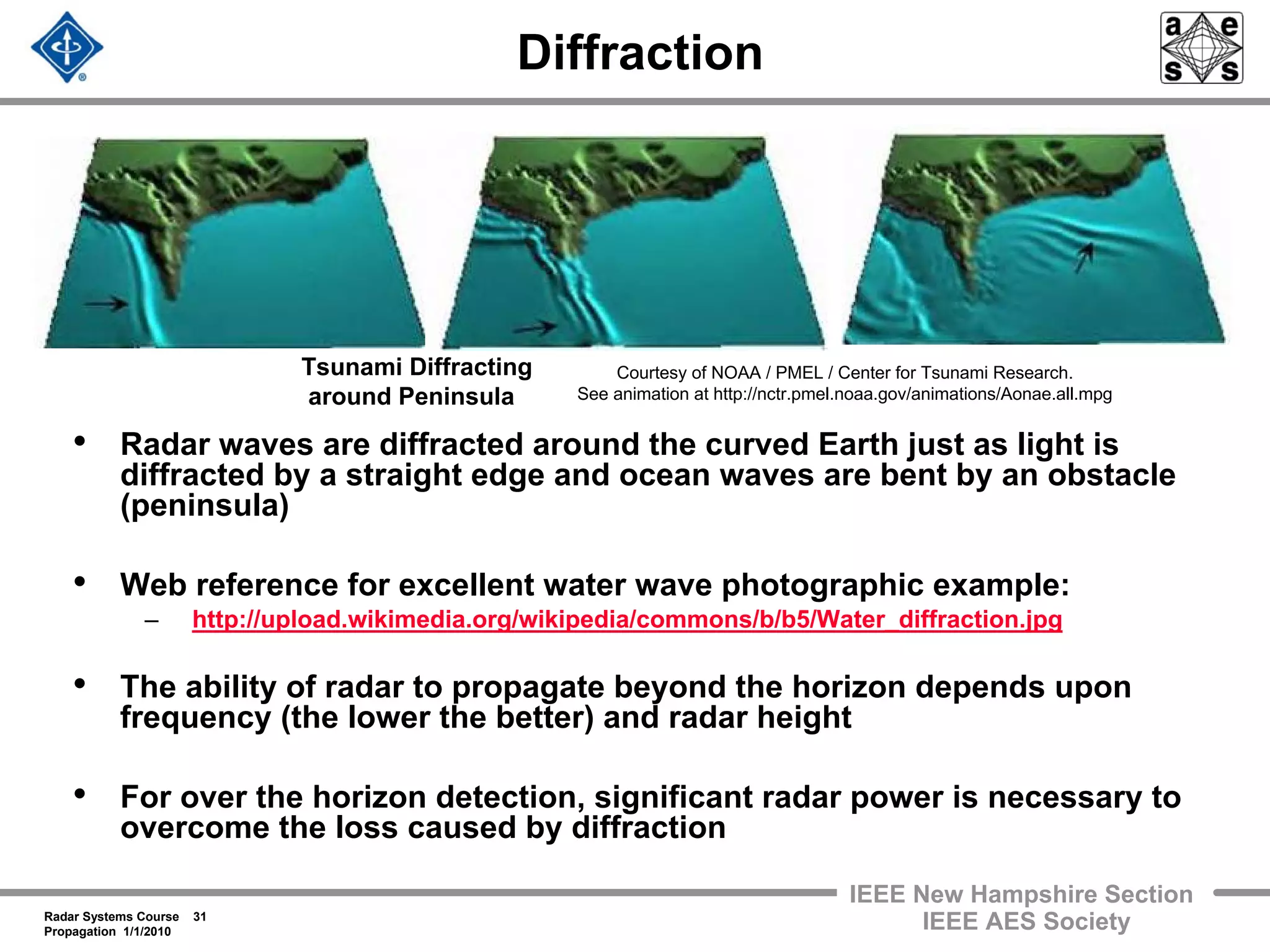
Tsunami Diffracting
around Peninsula
Diffraction
• Radar waves are diffracted around the curved Earth just as light is
diffracted by a straight edge and ocean waves are bent by an obstacle
(peninsula)
• Web reference for excellent water wave photographic example:
– http://upload.wikimedia.org/wikipedia/commons/b/b5/Water_diffraction.jpg
• The ability of radar to propagate beyond the horizon depends upon
frequency (the lower the better) and radar height
• For over the horizon detection, significant radar power is necessary to
overcome the loss caused by diffraction
Courtesy of NOAA / PMEL / Center for Tsunami Research.
See animation at http://nctr.pmel.noaa.gov/animations/Aonae.all.mpg
Radar Systems Course 32
Propagation 1/1/2010
IEEE New Hampshire Section
IEEE AES Society
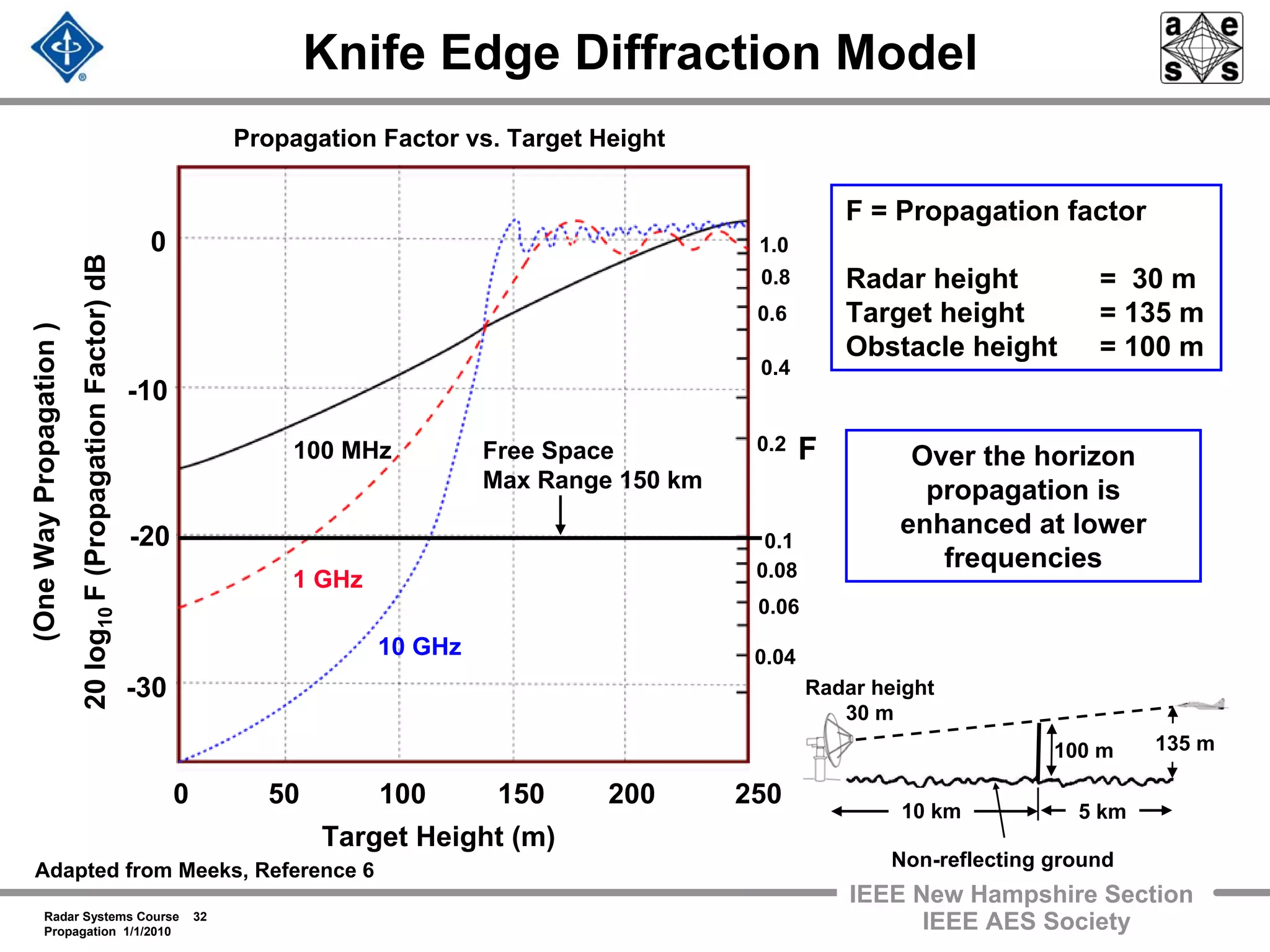
Knife Edge Diffraction Model
F = Propagation factor
Radar height = 30 m
Target height = 135 m
Obstacle height = 100 m
Over the horizon
propagation is
enhanced at lower
frequencies
10 km 5 km
100 m 135 m
Radar height
30 m
Non-reflecting ground
(OneWayPropagation)
20log10F(PropagationFactor)dB
Propagation Factor vs. Target Height
Target Height (m)
Adapted from Meeks, Reference 6
0 50 100 150 200 250
1.0
0.8
0.6
0.4
0.2
0.1
0.08
0.06
0.04
Free Space
Max Range 150 km
100 MHz
10 GHz
1 GHz
0
-30
-20
-10
F
Radar Systems Course 33
Propagation 1/1/2010
IEEE New Hampshire Section
IEEE AES Society
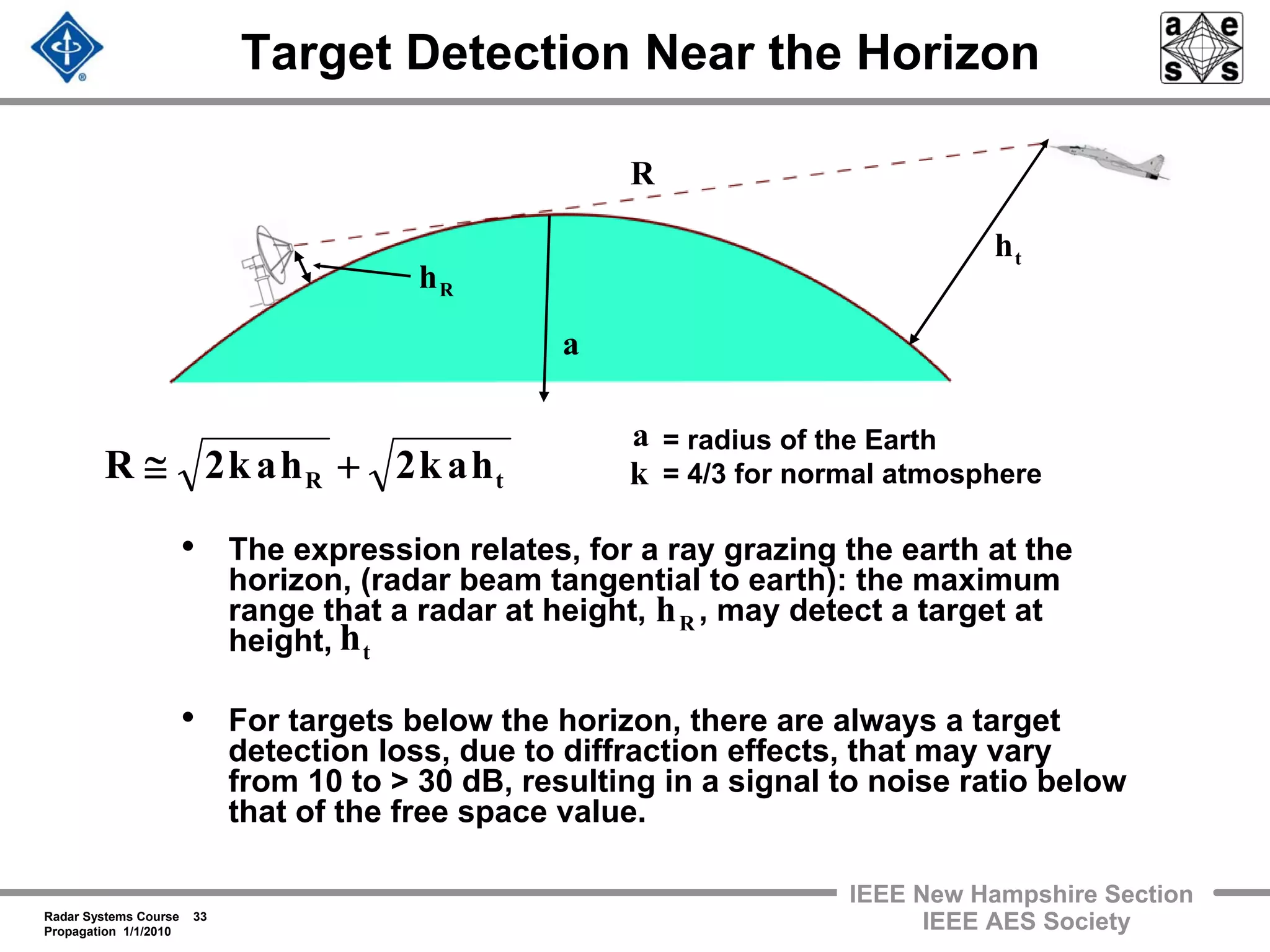
Target Detection Near the Horizon
• The expression relates, for a ray grazing the earth at the
horizon, (radar beam tangential to earth): the maximum
range that a radar at height, , may detect a target at
height,
• For targets below the horizon, there are always a target
detection loss, due to diffraction effects, that may vary
from 10 to > 30 dB, resulting in a signal to noise ratio below
that of the free space value.
tR hak2hak2R +≅
= radius of the Earth
= 4/3 for normal atmosphere
a
th
Rh
k
Rh
R
th
a
Radar Systems Course 34
Propagation 1/1/2010
IEEE New Hampshire Section
IEEE AES Society
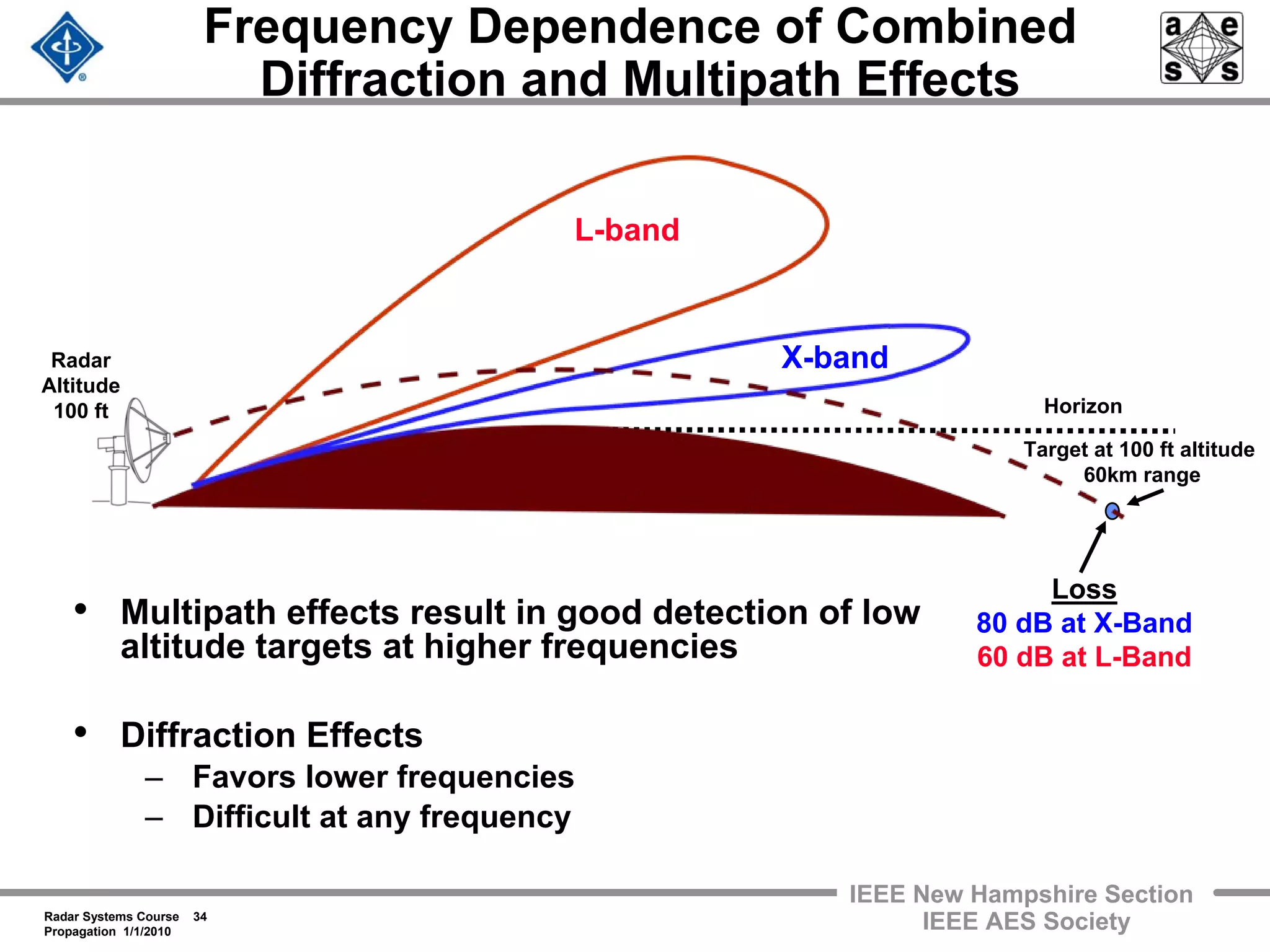
Frequency Dependence of Combined
Diffraction and Multipath Effects
• Multipath effects result in good detection of low
altitude targets at higher frequencies
• Diffraction Effects
– Favors lower frequencies
– Difficult at any frequency
L-band
X-bandRadar
Altitude
100 ft Horizon
Target at 100 ft altitude
60km range
Loss
80 dB at X-Band
60 dB at L-Band
Radar Systems Course 35
Propagation 1/1/2010
IEEE New Hampshire Section
IEEE AES Society
Outline
• Reflection from the Earth’s surface
• Atmospheric refraction
• Over-the-horizon diffraction
• Atmospheric attenuation
• Ionospheric propagation
Radar Systems Course 36
Propagation 1/1/2010
IEEE New Hampshire Section
IEEE AES Society
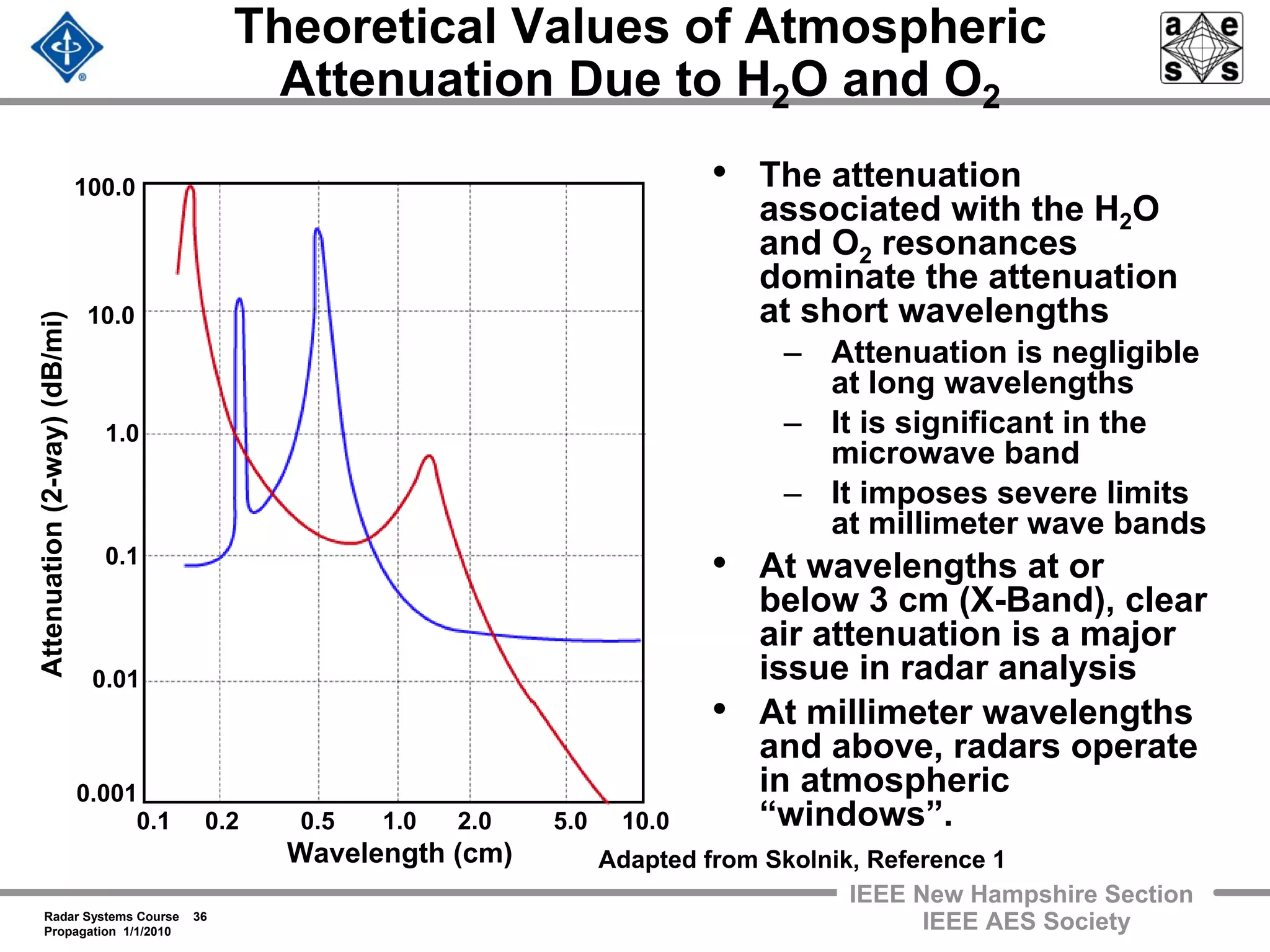
Theoretical Values of Atmospheric
Attenuation Due to H2O and O2
• The attenuation
associated with the H2O
and O2 resonances
dominate the attenuation
at short wavelengths
– Attenuation is negligible
at long wavelengths
– It is significant in the
microwave band
– It imposes severe limits
at millimeter wave bands
• At wavelengths at or
below 3 cm (X-Band), clear
air attenuation is a major
issue in radar analysis
• At millimeter wavelengths
and above, radars operate
in atmospheric
“windows”.0.1 0.2 0.5 1.0 2.0 5.0 10.0
Wavelength (cm)
Attenuation(2-way)(dB/mi)
0.01
0.1
1.0
10.0
100.0
0.001
Adapted from Skolnik, Reference 1
Radar Systems Course 37
Propagation 1/1/2010
IEEE New Hampshire Section
IEEE AES Society
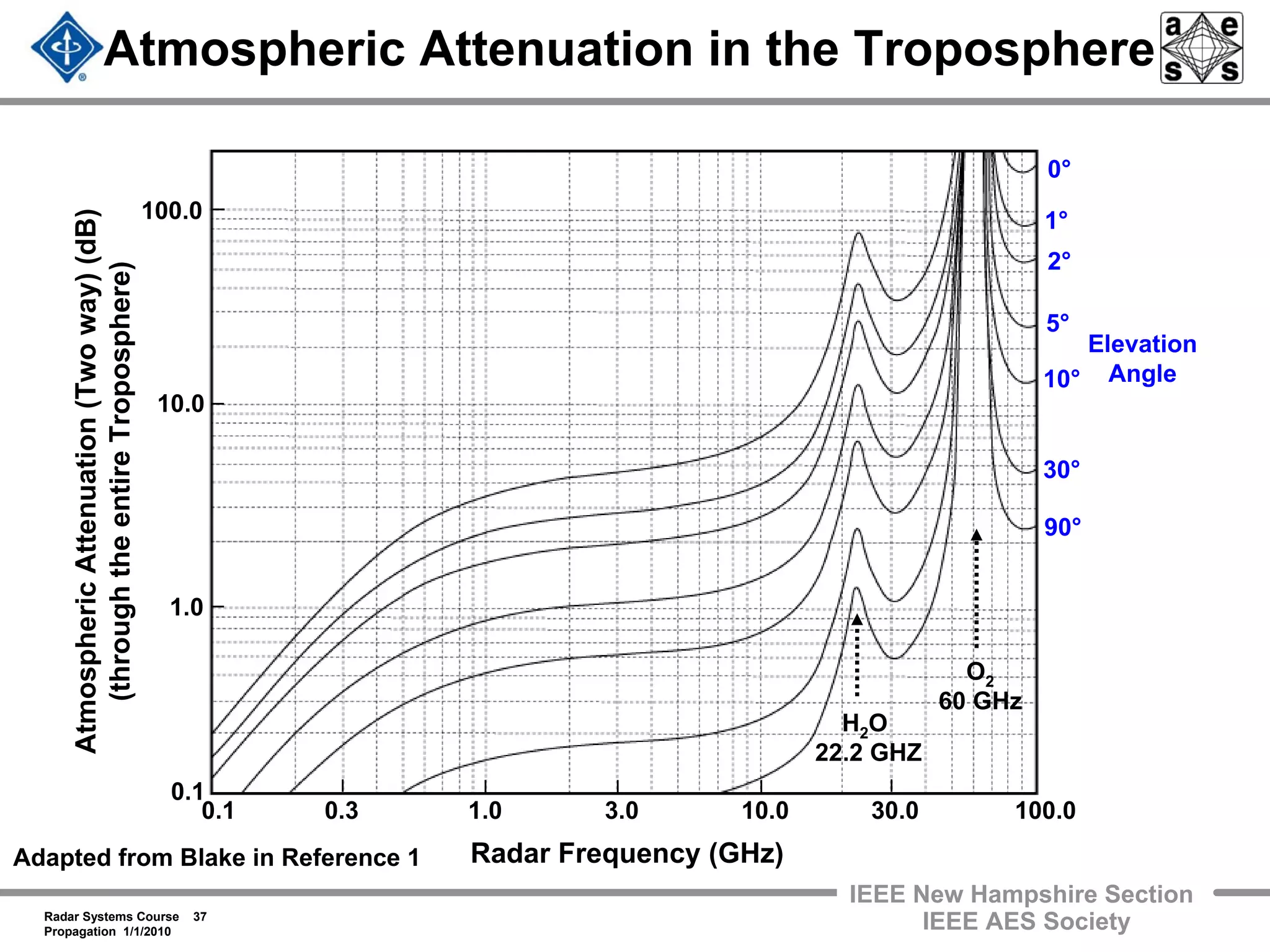
Atmospheric Attenuation in the Troposphere
Radar Frequency (GHz)
0.1 0.3 1.0 3.0 10.0 30.0 100.0
0.1
1.0
100.0
10.0
AtmosphericAttenuation(Twoway)(dB)
(throughtheentireTroposphere)
Elevation
Angle
0°
1°
2°
5°
10°
30°
90°
H2O
22.2 GHZ
O2
60 GHz
Adapted from Blake in Reference 1
Radar Systems Course 38
Propagation 1/1/2010
IEEE New Hampshire Section
IEEE AES Society
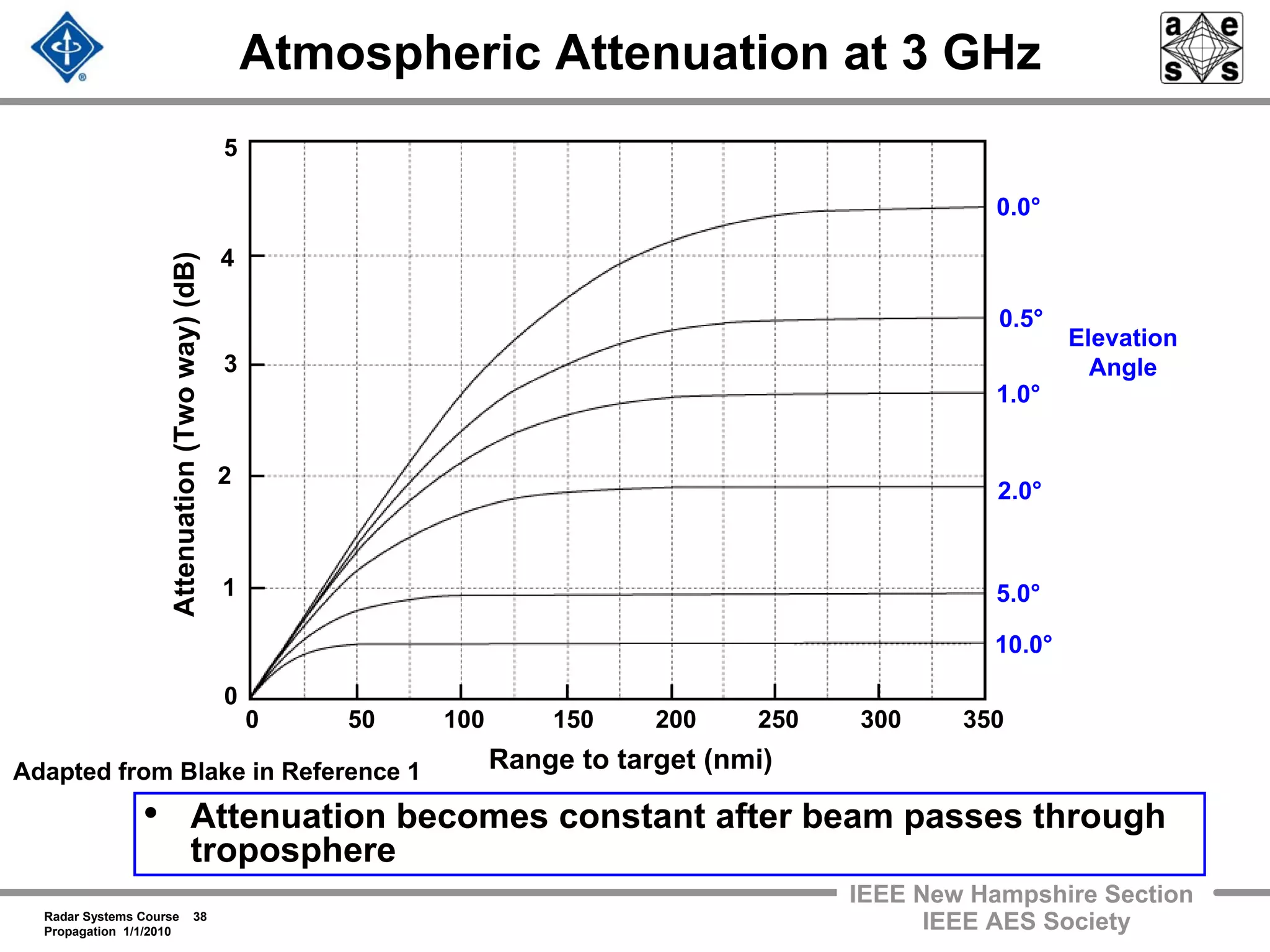
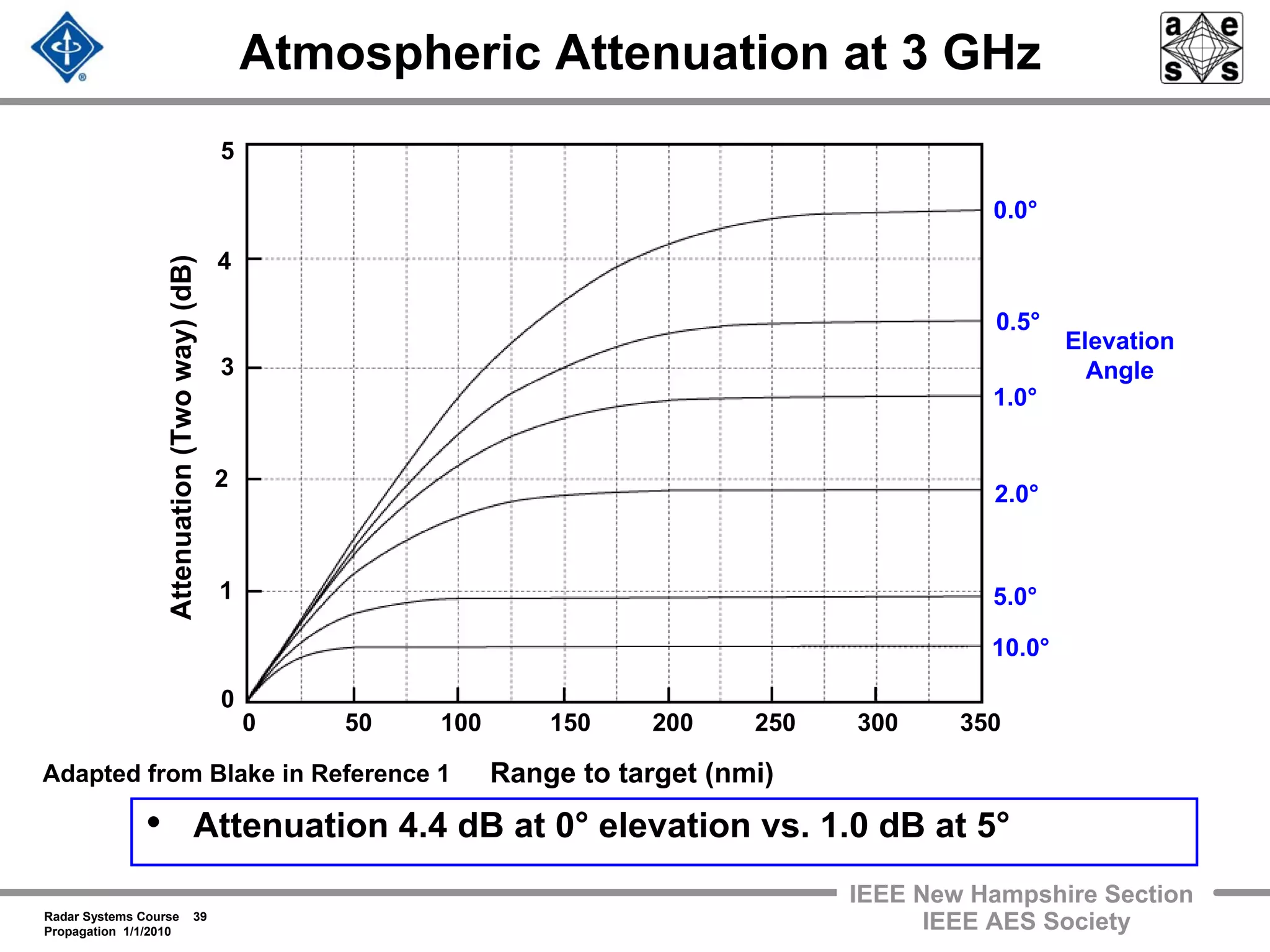
Atmospheric Attenuation at 3 GHz
• Attenuation becomes constant after beam passes through
troposphere
0 50 100 150 200 250 300 350
Range to target (nmi)
1
2
3
4
5
0
Attenuation(Twoway)(dB)
Elevation
Angle
0.0°
0.5°
1.0°
2.0°
10.0°
5.0°
Adapted from Blake in Reference 1
Radar Systems Course 39
Propagation 1/1/2010
IEEE New Hampshire Section
IEEE AES Society
Atmospheric Attenuation at 3 GHz
• Attenuation 4.4 dB at 0° elevation vs. 1.0 dB at 5°
0 50 100 150 200 250 300 350
Range to target (nmi)
1
2
3
4
5
0
Attenuation(Twoway)(dB)
Elevation
Angle
0.0°
0.5°
1.0°
2.0°
10.0°
5.0°
Adapted from Blake in Reference 1
Radar Systems Course 40
Propagation 1/1/2010
IEEE New Hampshire Section
IEEE AES Society
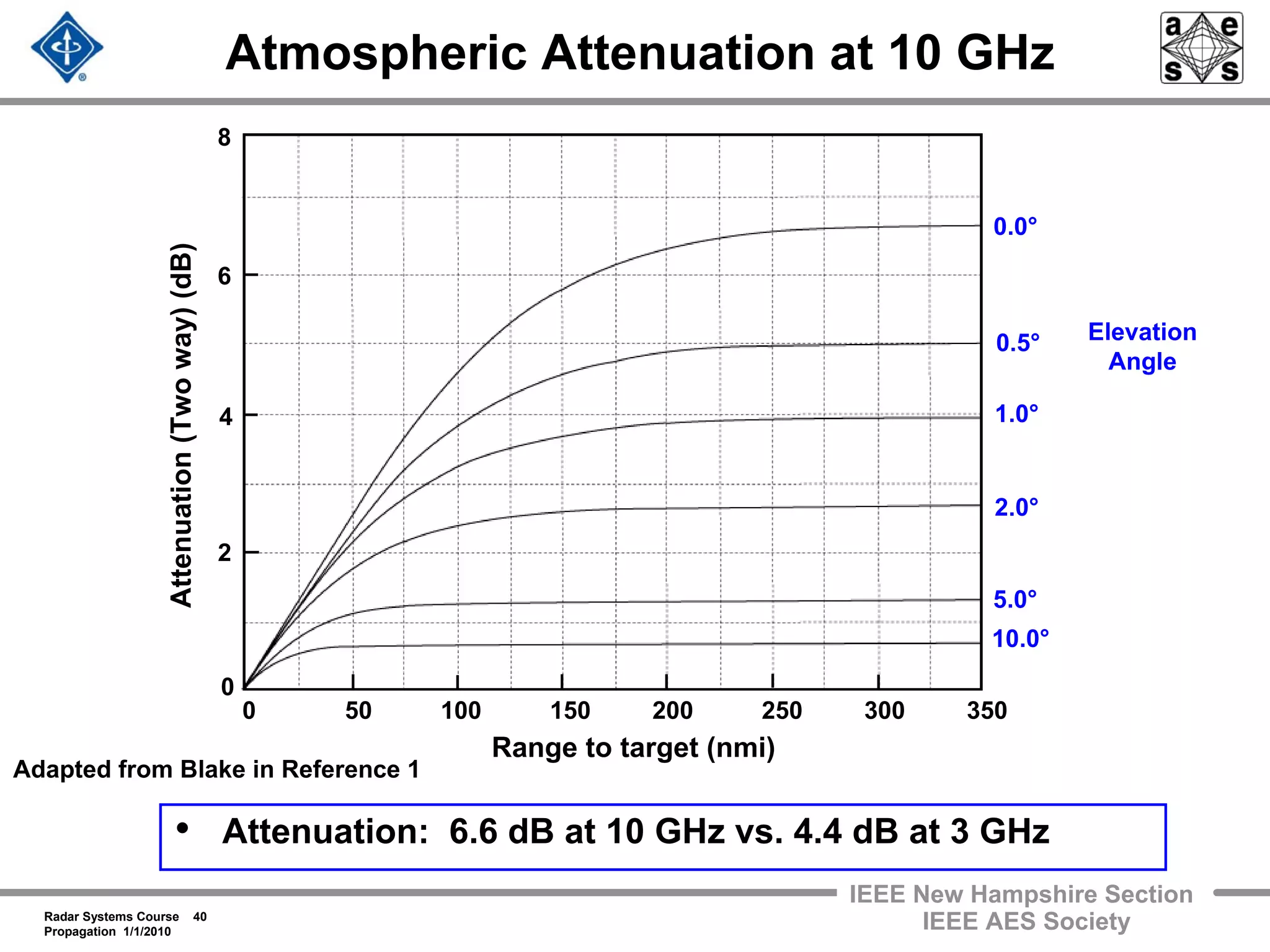
Atmospheric Attenuation at 10 GHz
• Attenuation: 6.6 dB at 10 GHz vs. 4.4 dB at 3 GHz
0 50 100 150 200 250 300 350
Elevation
Angle
2
6
4
0
Attenuation(Twoway)(dB)
8
0.0°
0.5°
1.0°
2.0°
10.0°
5.0°
Range to target (nmi)
Adapted from Blake in Reference 1
Radar Systems Course 41
Propagation 1/1/2010
IEEE New Hampshire Section
IEEE AES Society
Atmospheric Attenuation at 10 GHz
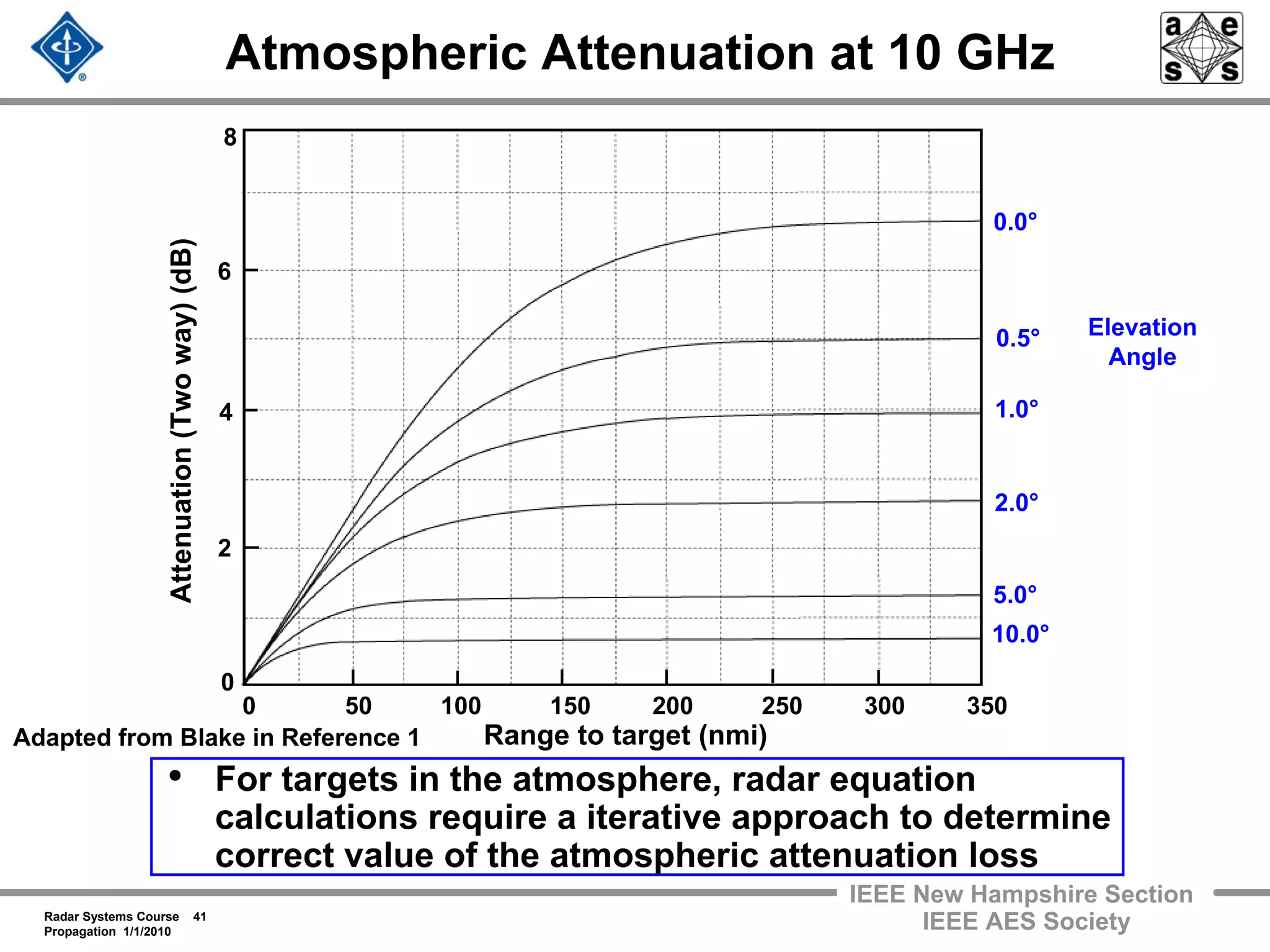
• For targets in the atmosphere, radar equation
calculations require a iterative approach to determine
correct value of the atmospheric attenuation loss
0 50 100 150 200 250 300 350
Elevation
Angle
2
6
4
0
Attenuation(Twoway)(dB)
8
0.0°
0.5°
1.0°
2.0°
10.0°
5.0°
Range to target (nmi)Adapted from Blake in Reference 1
Radar Systems Course 42
Propagation 1/1/2010
IEEE New Hampshire Section
IEEE AES Society
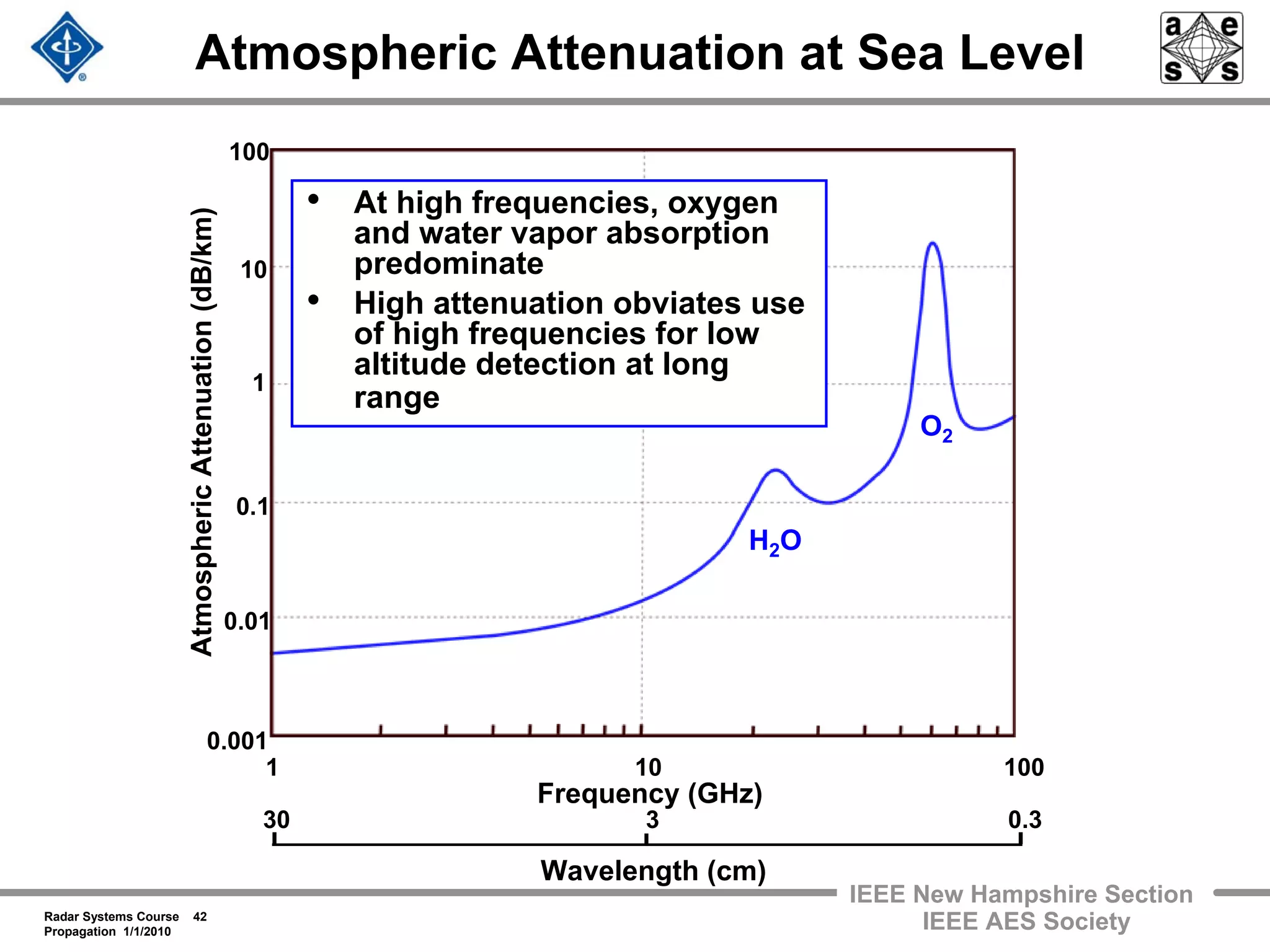
AtmosphericAttenuation(dB/km)
Frequency (GHz)
Wavelength (cm)
1 10 100
30 3 0.3
0.01
10
0.001
0.1
1
100
Atmospheric Attenuation at Sea Level
• At high frequencies, oxygen
and water vapor absorption
predominate
• High attenuation obviates use
of high frequencies for low
altitude detection at long
range
H2O
O2
Radar Systems Course 43
Propagation 1/1/2010
IEEE New Hampshire Section
IEEE AES Society
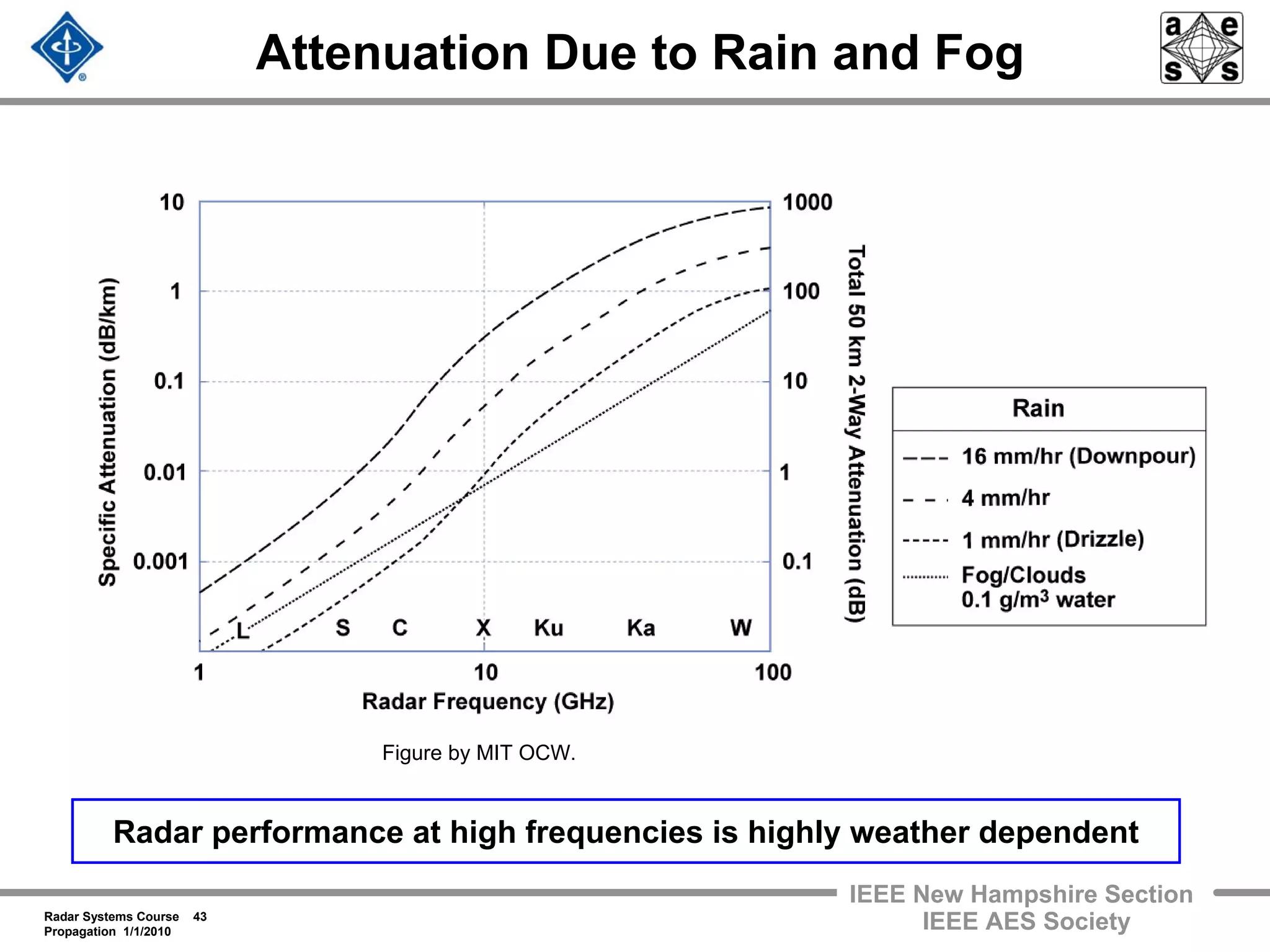
Attenuation Due to Rain and Fog
Radar performance at high frequencies is highly weather dependent
Figure by MIT OCW.
Radar Systems Course 44
Propagation 1/1/2010
IEEE New Hampshire Section
IEEE AES Society
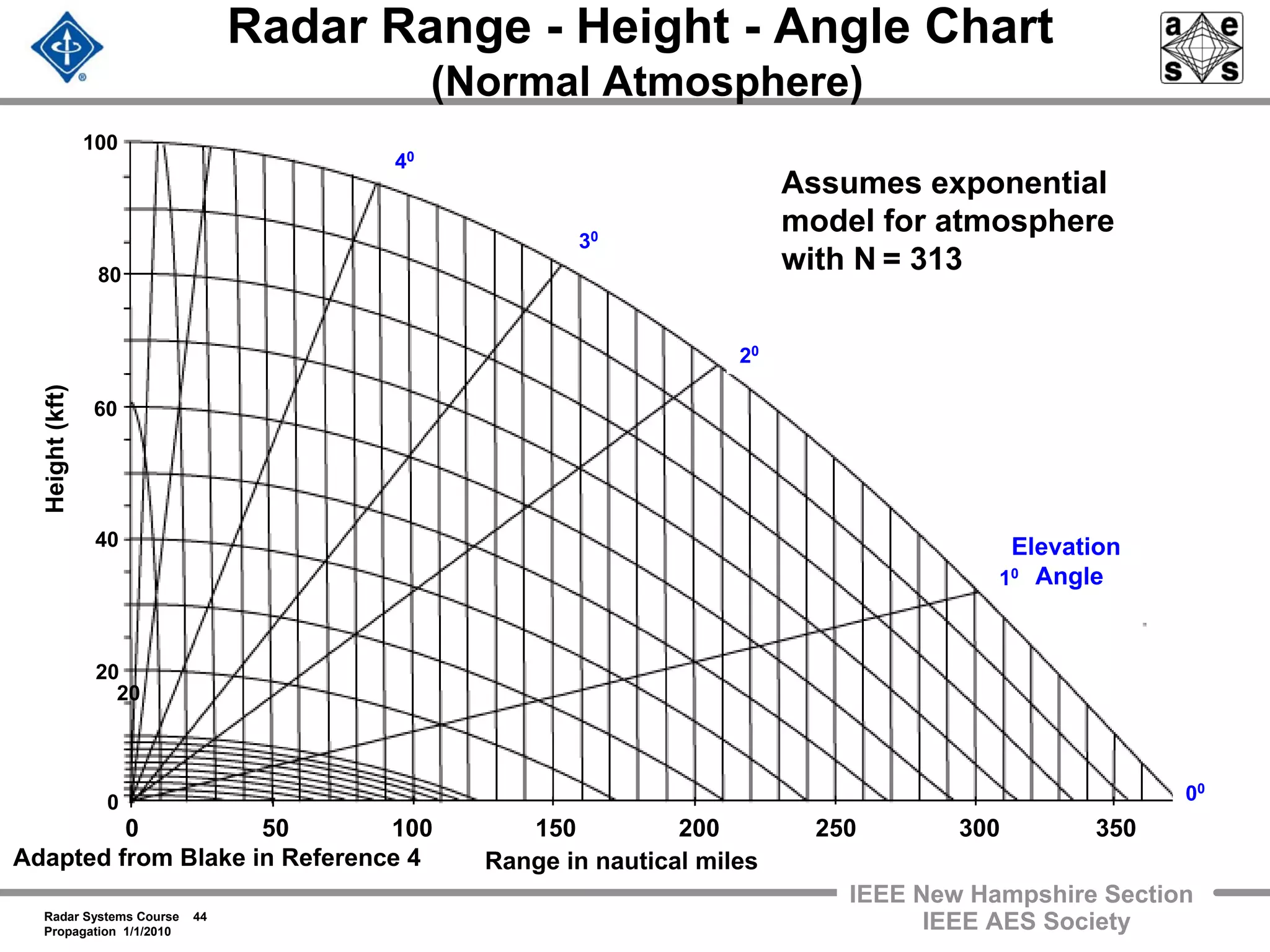
Radar Range - Height - Angle Chart
(Normal Atmosphere)
0 50 100 150 200 250 300 350
Range in nautical miles
Assumes exponential
model for atmosphere
with N = 313
0
20
Height(kft)
20
00
30
40
10
40
60
80
100
Elevation
Angle
20
Adapted from Blake in Reference 4
Radar Systems Course 45
Propagation 1/1/2010
IEEE New Hampshire Section
IEEE AES Society
Outline
• Reflection from the Earth’s surface
• Atmospheric refraction
• Over-the-horizon diffraction
• Atmospheric attenuation
• Ionospheric propagation
Radar Systems Course 46
Propagation 1/1/2010
IEEE New Hampshire Section
IEEE AES Society
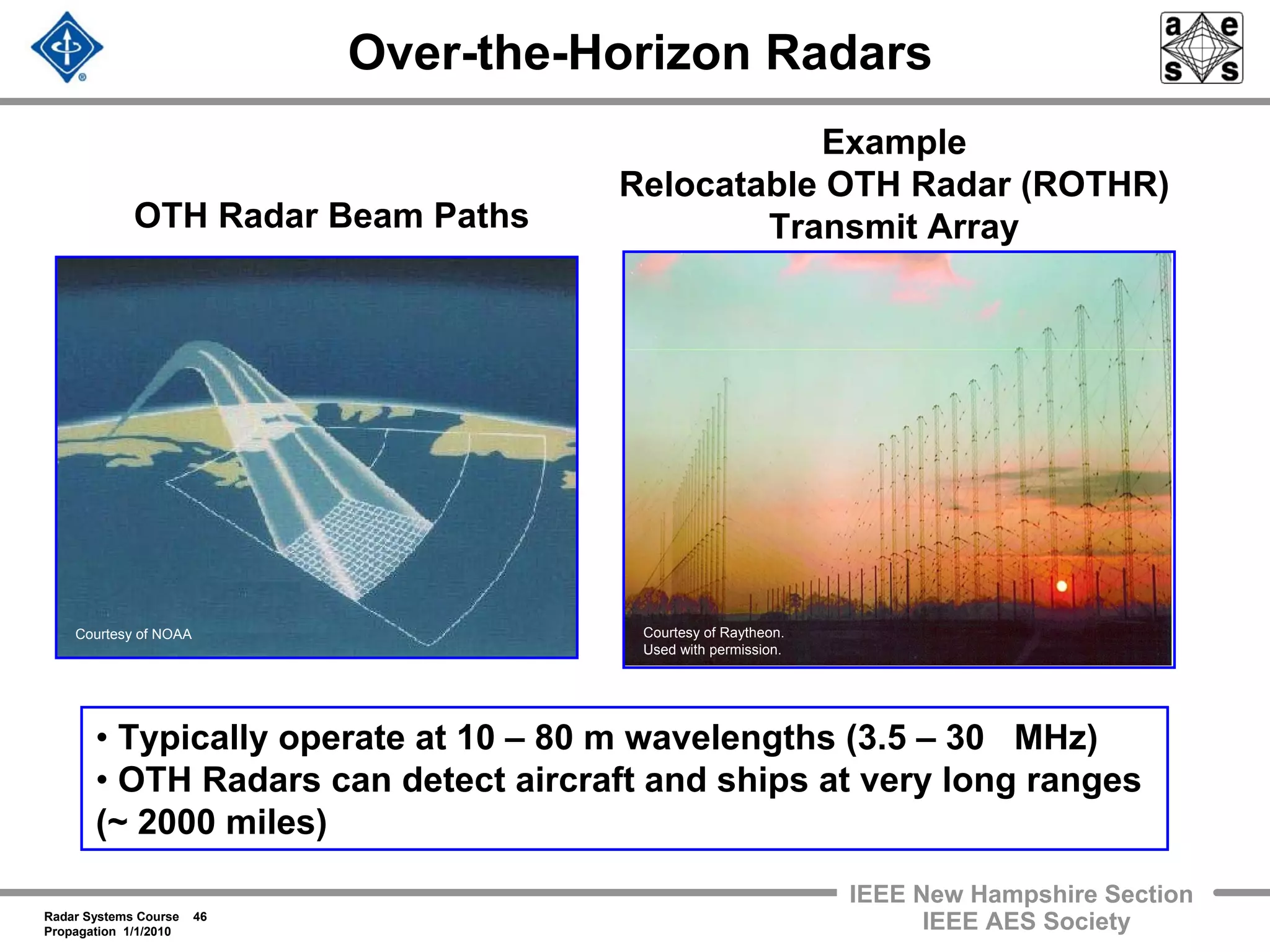
Over-the-Horizon Radars
OTH Radar Beam Paths
• Typically operate at 10 – 80 m wavelengths (3.5 – 30 MHz)
• OTH Radars can detect aircraft and ships at very long ranges
(~ 2000 miles)
Example
Relocatable OTH Radar (ROTHR)
Transmit Array
Courtesy of Raytheon.
Used with permission.
Courtesy of NOAA
Radar Systems Course 47
Propagation 1/1/2010
IEEE New Hampshire Section
IEEE AES Society
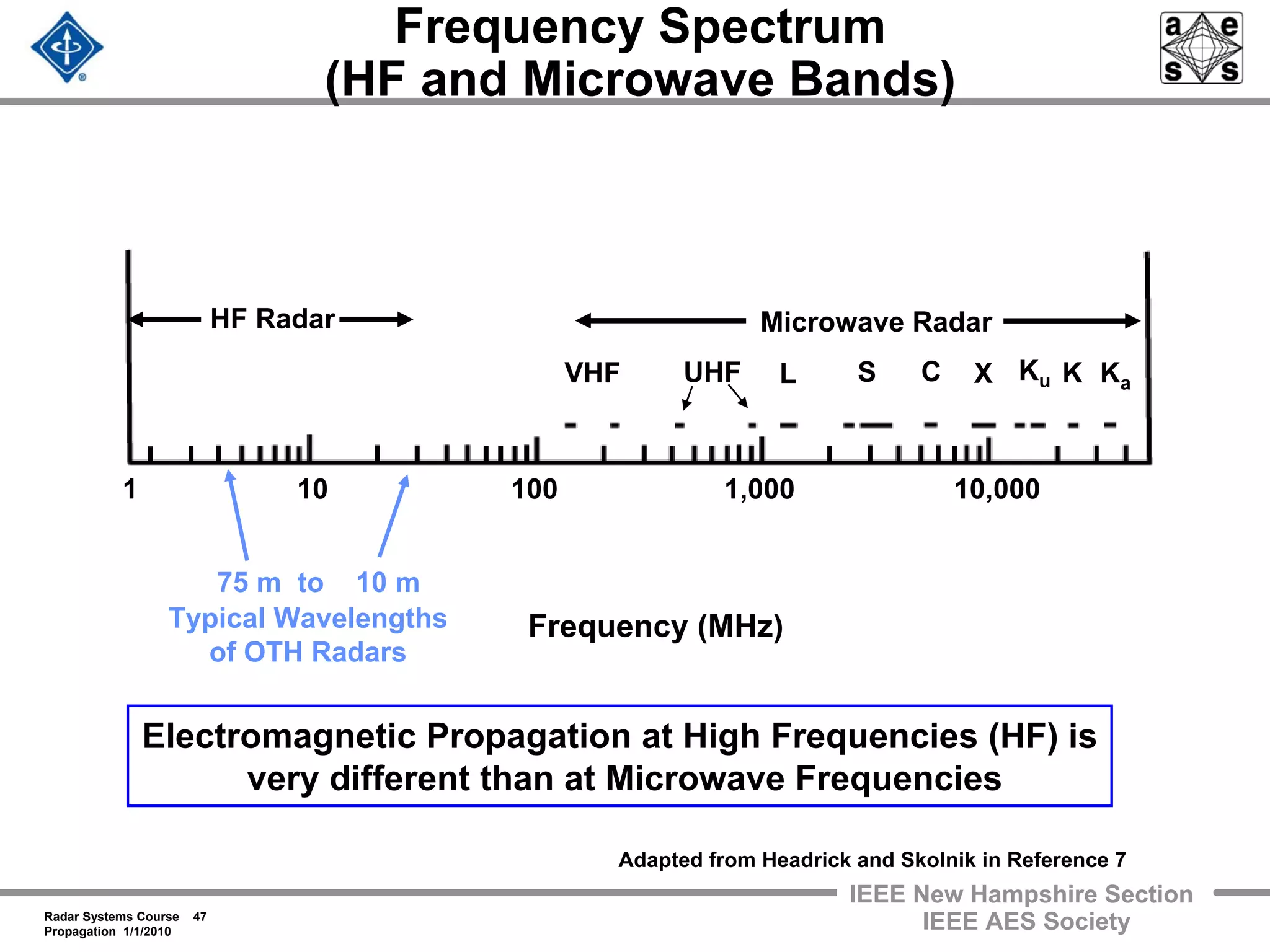
Frequency Spectrum
(HF and Microwave Bands)
HF Radar Microwave Radar
VHF UHF L S C X KaKu K
Frequency (MHz)
1 10 100 1,000 10,000
Typical Wavelengths
of OTH Radars
75 m to 10 m
Electromagnetic Propagation at High Frequencies (HF) is
very different than at Microwave Frequencies
Adapted from Headrick and Skolnik in Reference 7
Radar Systems Course 48
Propagation 1/1/2010
IEEE New Hampshire Section
IEEE AES Society
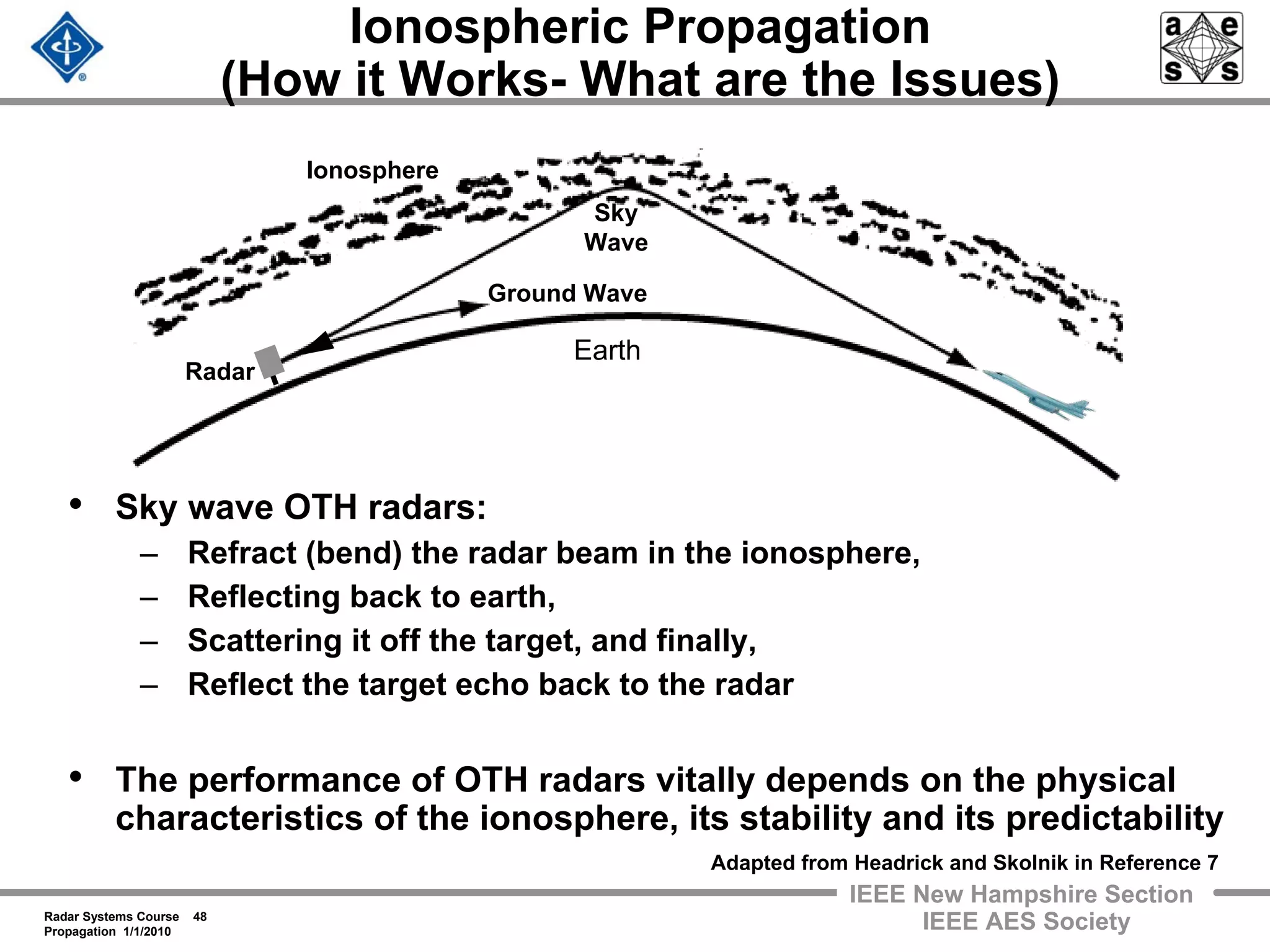
Ionospheric Propagation
(How it Works- What are the Issues)
• Sky wave OTH radars:
– Refract (bend) the radar beam in the ionosphere,
– Reflecting back to earth,
– Scattering it off the target, and finally,
– Reflect the target echo back to the radar
• The performance of OTH radars vitally depends on the physical
characteristics of the ionosphere, its stability and its predictability
Radar
Ground Wave
Sky
Wave
Ionosphere
Earth
Adapted from Headrick and Skolnik in Reference 7
Radar Systems Course 49
Propagation 1/1/2010
IEEE New Hampshire Section
IEEE AES Society
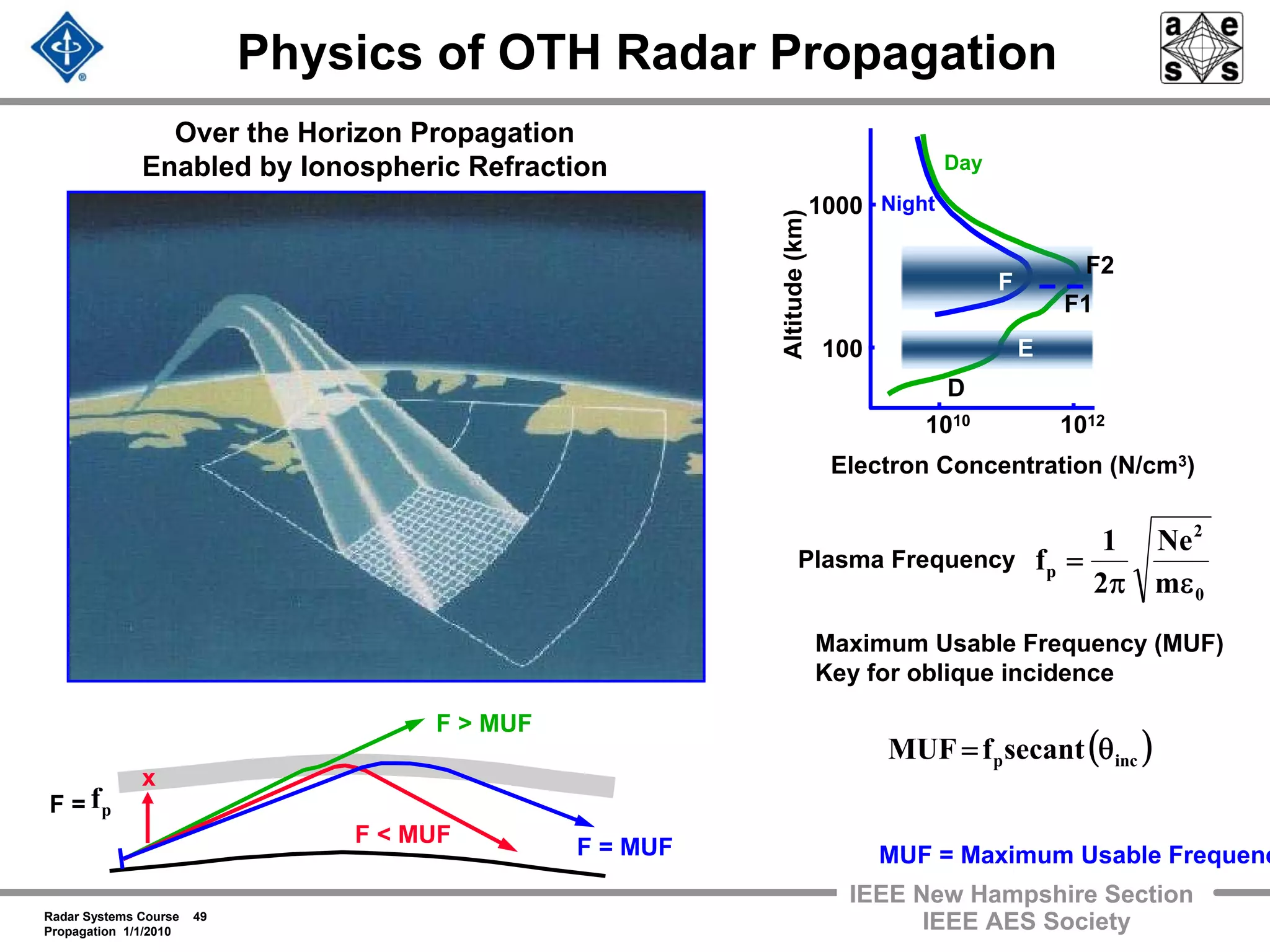
Physics of OTH Radar Propagation
ΡΟΤΗΡ ΡΞ
ΡΟΤΗΡ
ΤΞ
0
2
p
m
Ne
2
1
f
επ
=Plasma Frequency
F > MUF
F = MUF
F < MUF
MUF = Maximum Usable Frequenc
Electron Concentration (N/cm3)
Altitude(km)
1010
1000
Day
Night
F
E
D
F1
F1
F2
100
1012
Maximum Usable Frequency (MUF)
Key for oblique incidence
( )incpsecantfMUF θ=
F =
x
pf
Over the Horizon Propagation
Enabled by Ionospheric Refraction
Radar Systems Course 50
Propagation 1/1/2010
IEEE New Hampshire Section
IEEE AES Society
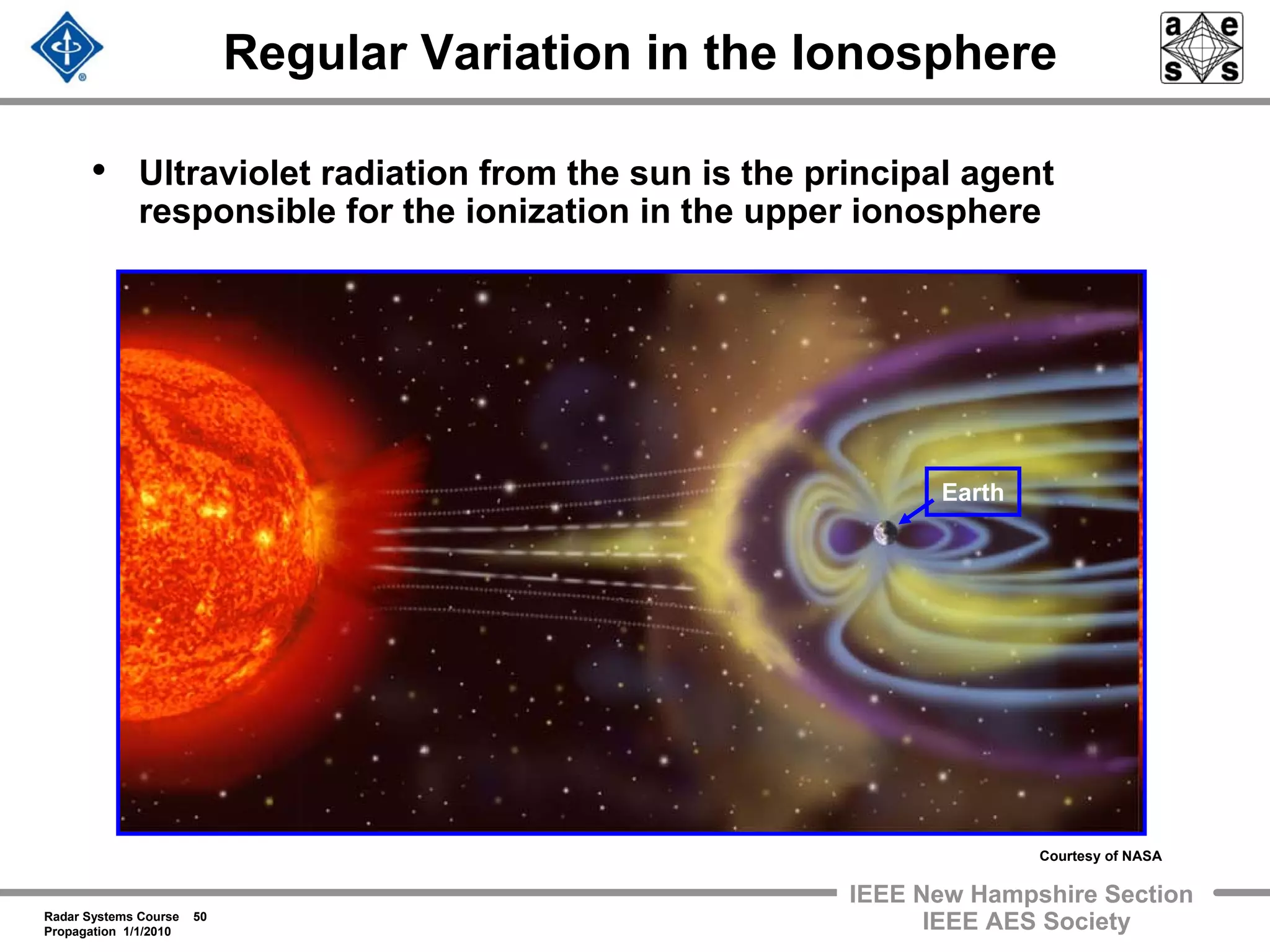
Regular Variation in the Ionosphere
• Ultraviolet radiation from the sun is the principal agent
responsible for the ionization in the upper ionosphere
Earth
Courtesy of NASA
Radar Systems Course 51
Propagation 1/1/2010
IEEE New Hampshire Section
IEEE AES Society
Different Layers of the Ionosphere
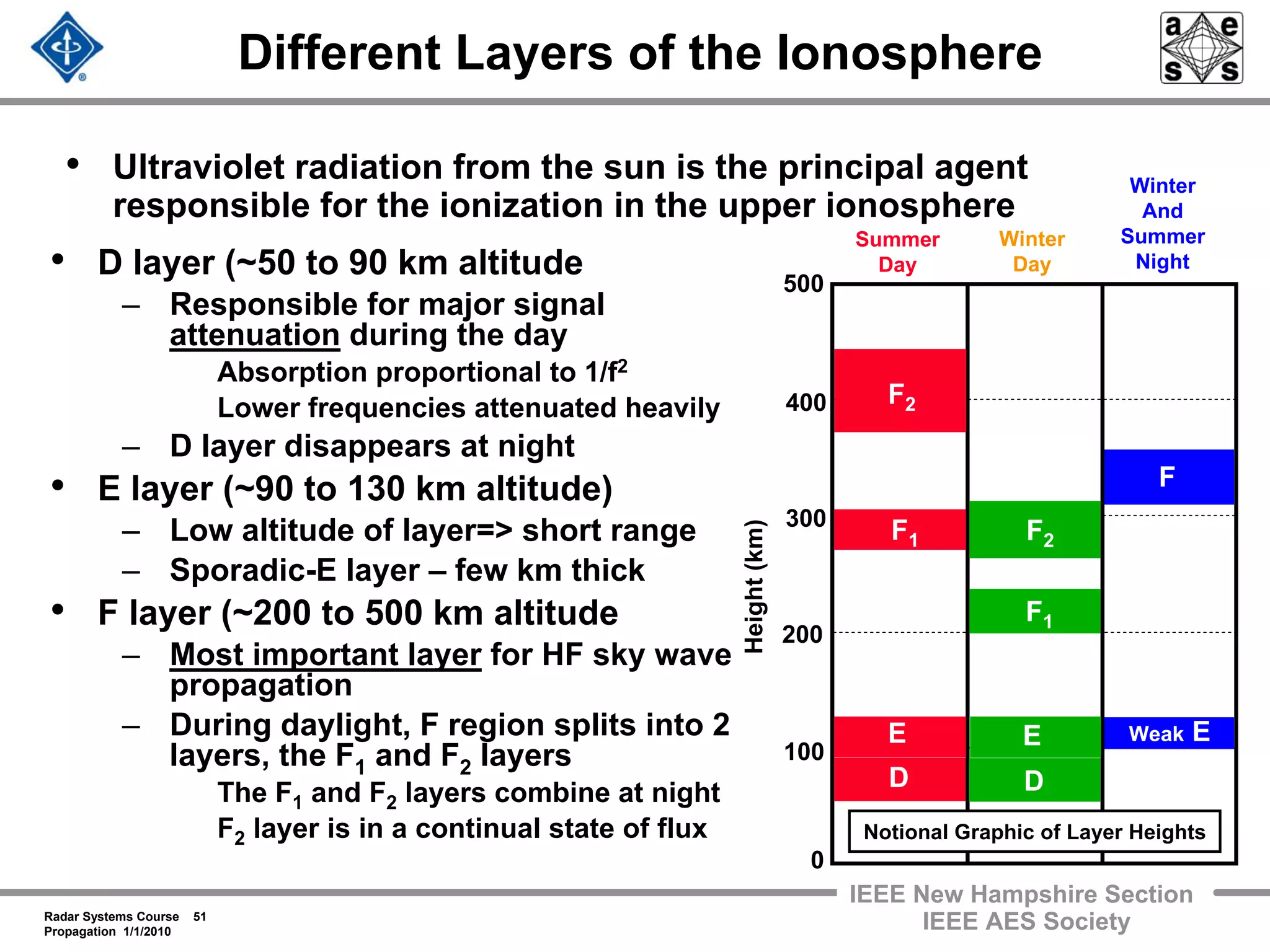
• D layer (~50 to 90 km altitude
– Responsible for major signal
attenuation during the day
Absorption proportional to 1/f2
Lower frequencies attenuated heavily
– D layer disappears at night
• E layer (~90 to 130 km altitude)
– Low altitude of layer=> short range
– Sporadic-E layer – few km thick
• F layer (~200 to 500 km altitude
– Most important layer for HF sky wave
propagation
– During daylight, F region splits into 2
layers, the F1 and F2 layers
The F1 and F2 layers combine at night
F2 layer is in a continual state of flux
• Ultraviolet radiation from the sun is the principal agent
responsible for the ionization in the upper ionosphere
0
500
400
300
200
100
Summer
Day
Winter
And
Summer
Night
Winter
Day
Height(km)
F
Weak E
DD
E E
F2
F1
F1
F2
Notional Graphic of Layer Heights
Radar Systems Course 52
Propagation 1/1/2010
IEEE New Hampshire Section
IEEE AES Society
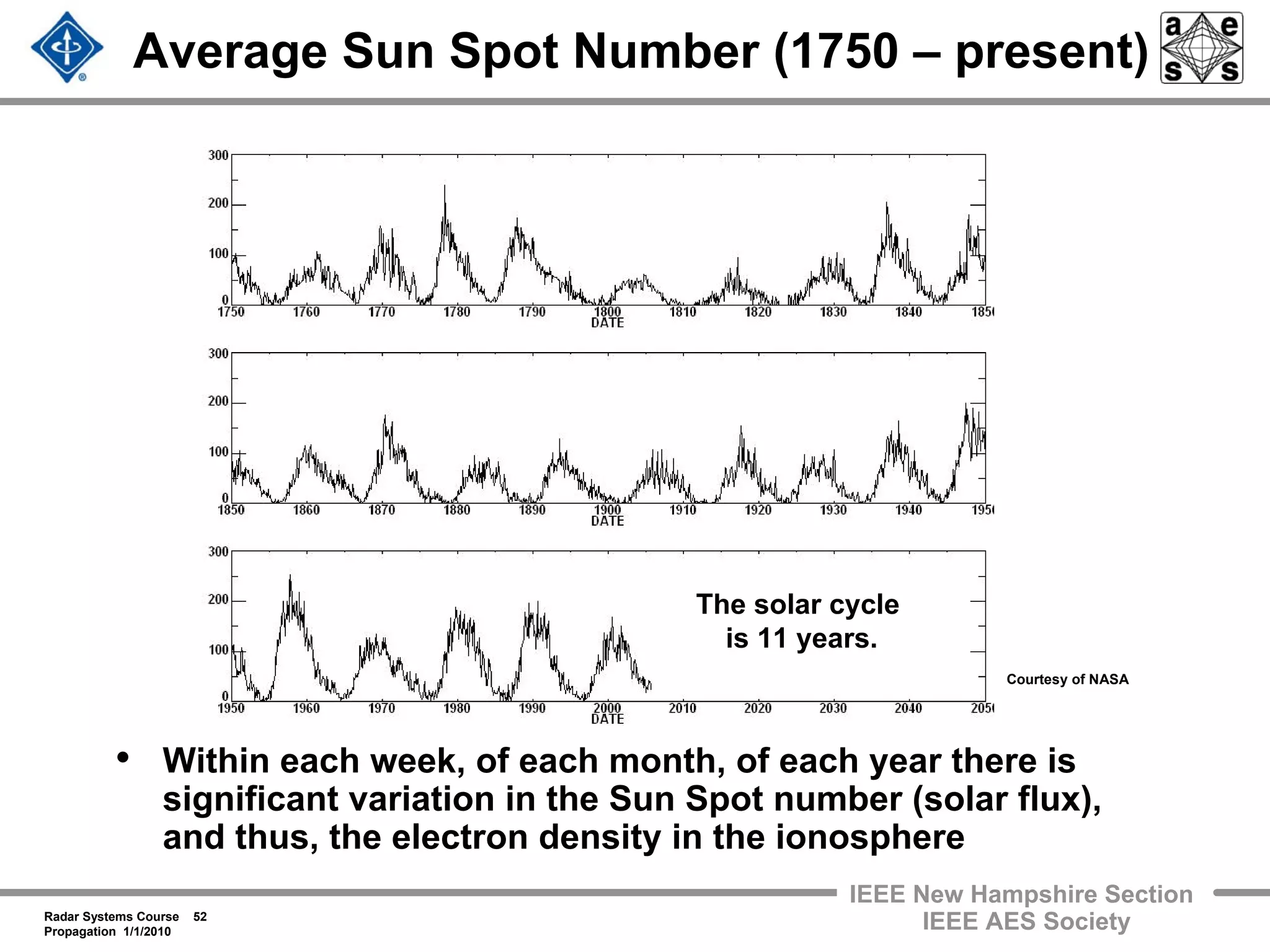
Average Sun Spot Number (1750 – present)
• Within each week, of each month, of each year there is
significant variation in the Sun Spot number (solar flux),
and thus, the electron density in the ionosphere
The solar cycle
is 11 years.
Courtesy of NASA
Radar Systems Course 53
Propagation 1/1/2010
IEEE New Hampshire Section
IEEE AES Society
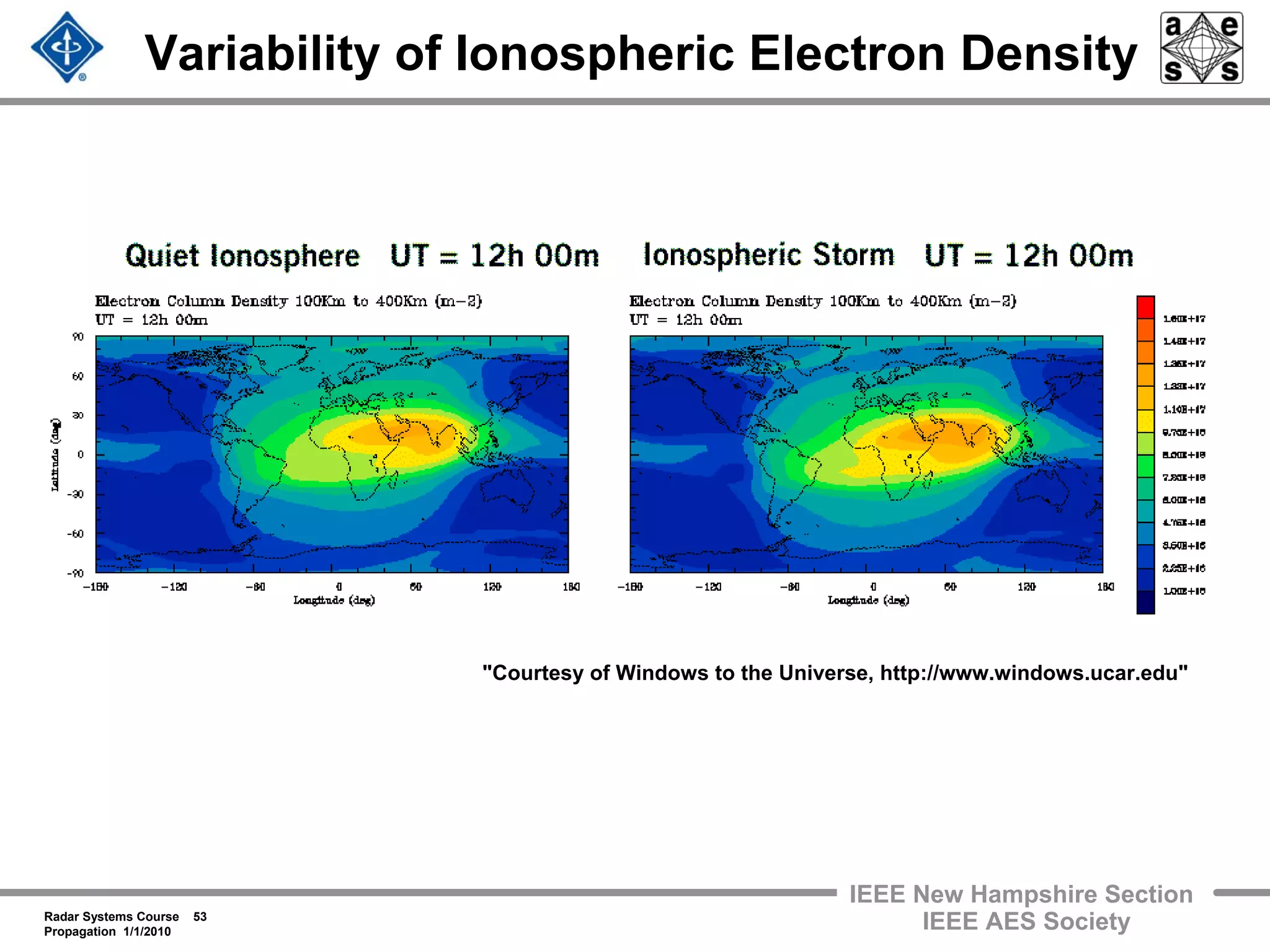
Variability of Ionospheric Electron Density
"Courtesy of Windows to the Universe, http://www.windows.ucar.edu"
Radar Systems Course 54
Propagation 1/1/2010
IEEE New Hampshire Section
IEEE AES Society
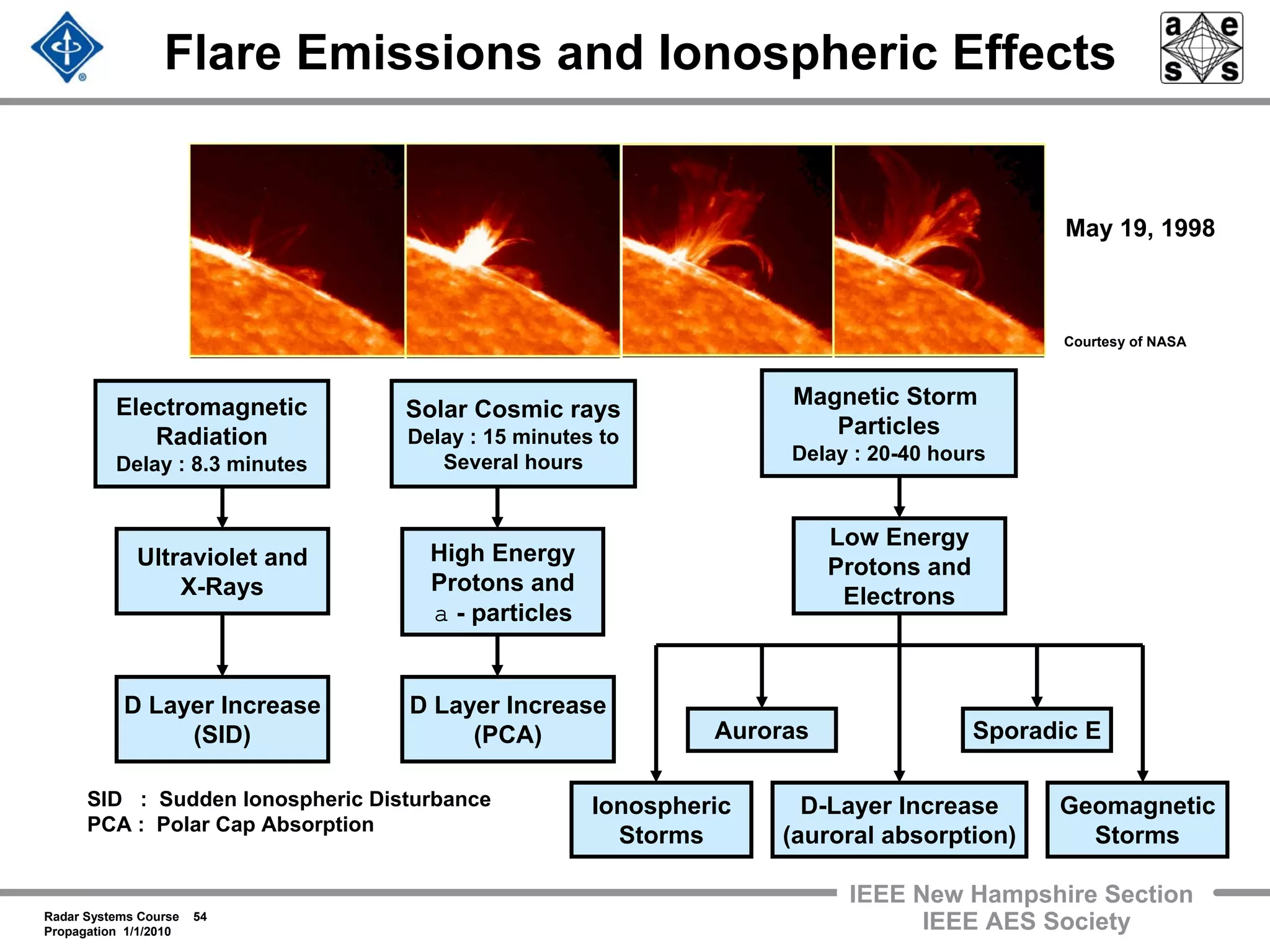
Flare Emissions and Ionospheric Effects
Electromagnetic
Radiation
Delay : 8.3 minutes
Ultraviolet and
X-Rays
Solar Cosmic rays
Delay : 15 minutes to
Several hours
Magnetic Storm
Particles
Delay : 20-40 hours
Low Energy
Protons and
Electrons
High Energy
Protons and
a - particles
D Layer Increase
(SID)
D-Layer Increase
(auroral absorption)
Ionospheric
Storms
Geomagnetic
Storms
Sporadic EAuroras
D Layer Increase
(PCA)
SID : Sudden Ionospheric Disturbance
PCA : Polar Cap Absorption
May 19, 1998
Courtesy of NASA
Radar Systems Course 55
Propagation 1/1/2010
IEEE New Hampshire Section
IEEE AES Society
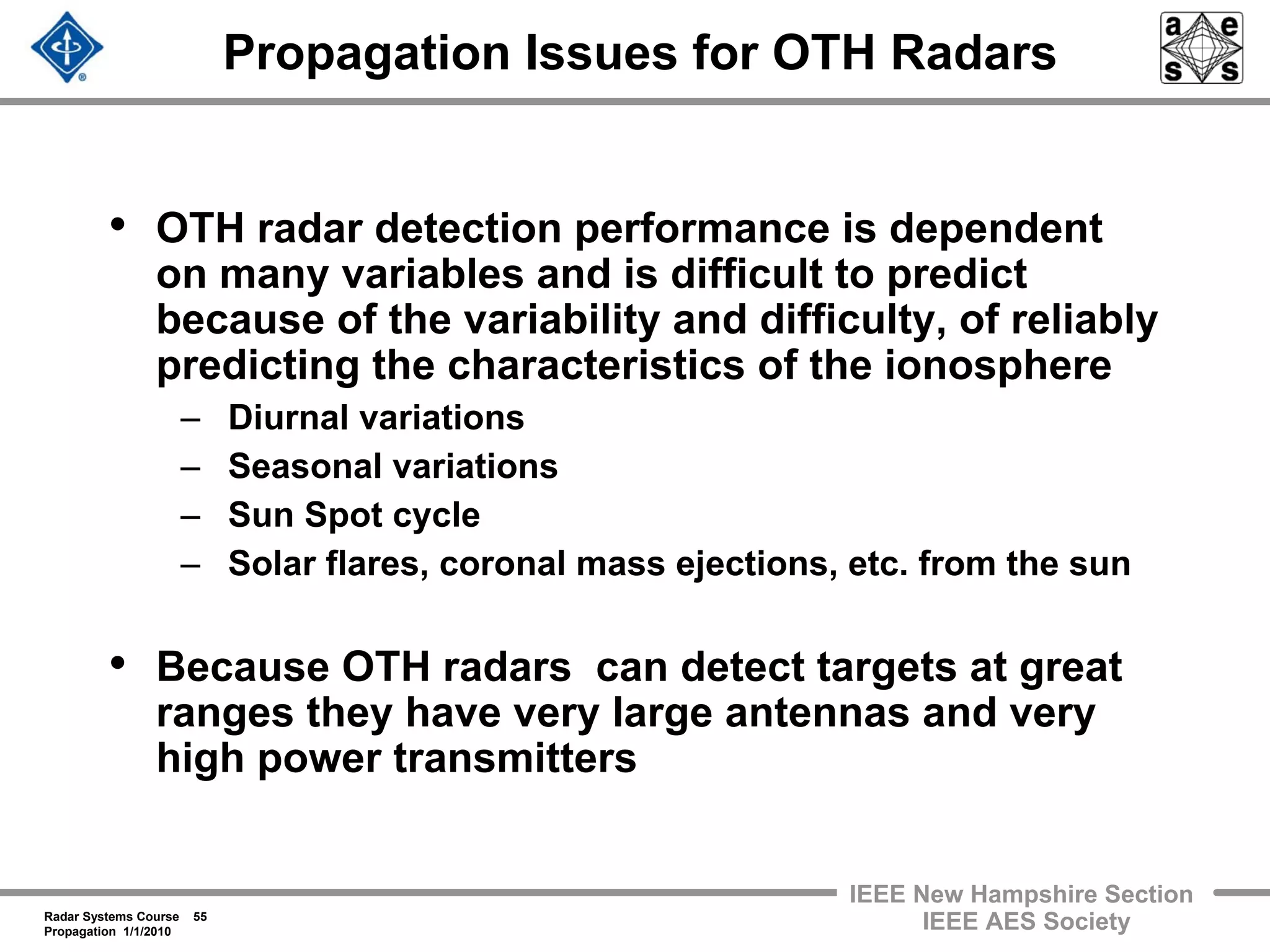
Propagation Issues for OTH Radars
• OTH radar detection performance is dependent
on many variables and is difficult to predict
because of the variability and difficulty, of reliably
predicting the characteristics of the ionosphere
– Diurnal variations
– Seasonal variations
– Sun Spot cycle
– Solar flares, coronal mass ejections, etc. from the sun
• Because OTH radars can detect targets at great
ranges they have very large antennas and very
high power transmitters
Radar Systems Course 56
Propagation 1/1/2010
IEEE New Hampshire Section
IEEE AES Society
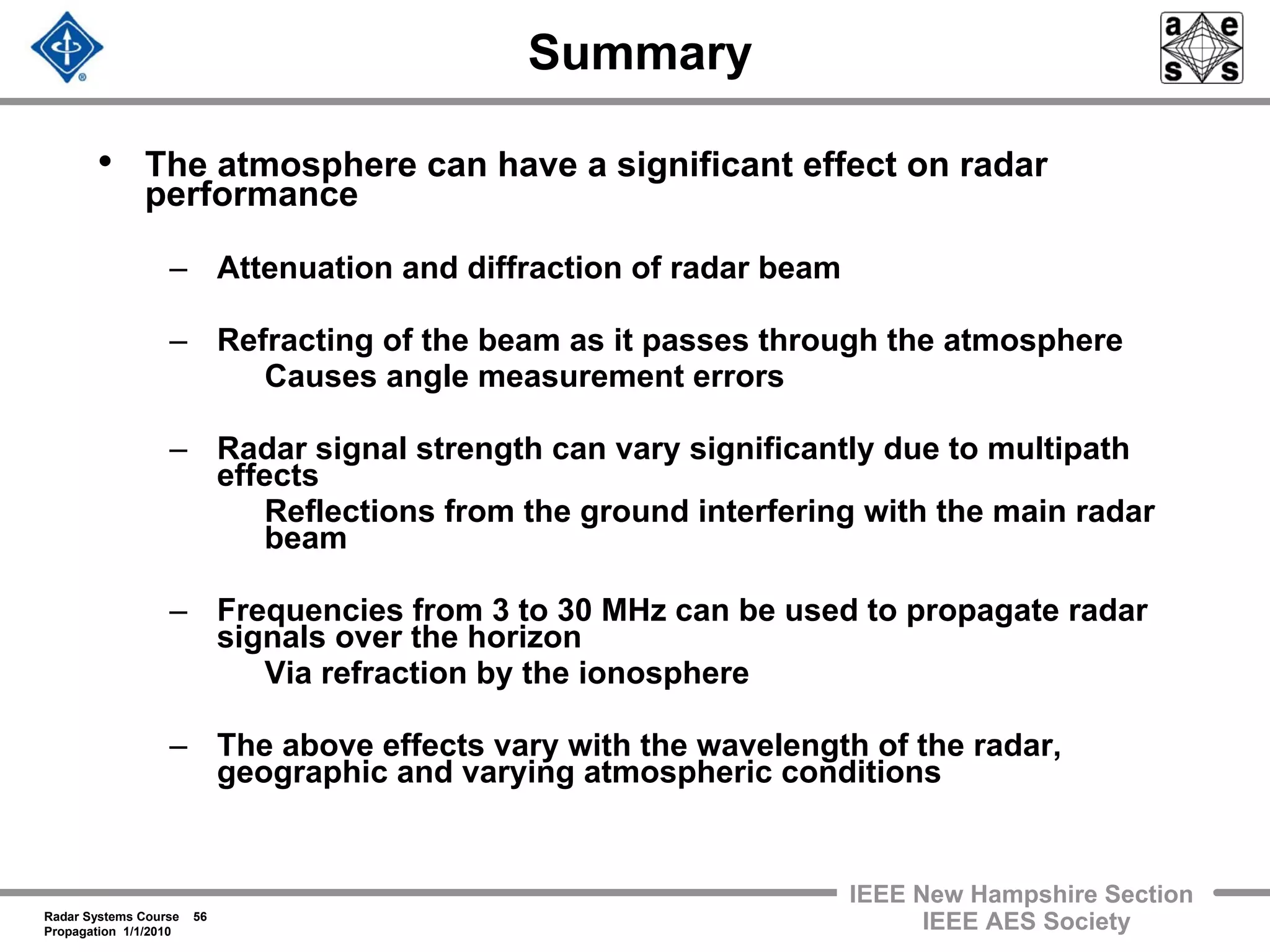
Summary
• The atmosphere can have a significant effect on radar
performance
– Attenuation and diffraction of radar beam
– Refracting of the beam as it passes through the atmosphere
Causes angle measurement errors
– Radar signal strength can vary significantly due to multipath
effects
Reflections from the ground interfering with the main radar
beam
– Frequencies from 3 to 30 MHz can be used to propagate radar
signals over the horizon
Via refraction by the ionosphere
– The above effects vary with the wavelength of the radar,
geographic and varying atmospheric conditions
Radar Systems Course 57
Propagation 1/1/2010
IEEE New Hampshire Section
IEEE AES Society
References
1. Skolnik, M., Introduction to Radar Systems, McGraw-Hill, New York,
NY, 3rd Edition, 2001
2. Skolnik, M., Radar Handbook, New York, NY, McGraw-Hill, 2rd
Edition, 1990
3. Skolnik, M., Radar Handbook, New York, NY, McGraw-Hill, 3rd
Edition, 2008
4. Blake, L. V. Radar Range-Performance Analysis, Munro, Silver
Springs, MD,1991
5. Bougust, Jr., A. J., Radar and the Atmosphere, Artech House, Inc.,
Norwood, MA,1989
6. Meeks, M. L. ,Radar Propagation at Low Altitudes, Artech House,
Inc., Norwood, MA,1982.
7. Headrick, J. M. and Skolnik, M. I., “Over-the-Horizon Radar in the
HF Band”, IEEE Proceedings, Vol. 62, No. 6, June 1974, pp 664-673
Radar Systems Course 58
Propagation 1/1/2010
IEEE New Hampshire Section
IEEE AES Society
Homework Problems
• From Reference 1, Skolnik, M., Introduction to Radar
Systems, 3rd Edition, 2001
– Problem 8-1
– Problem 8.8
– Problem 8-11
Radar Systems Course 59
Propagation 1/1/2010
IEEE New Hampshire Section
IEEE AES Society
Acknowledgements
• Dr. Robert J. Galejs
• Dr. Curt W Davis, III

Radar 2009 a 5 propagation effects

  • 1.
    IEEE New HampshireSection Radar Systems Course 1 Propagation 1/1/2010 IEEE AES Society Radar Systems Engineering Lecture 5 Propagation through the Atmosphere Dr. Robert M. O’Donnell IEEE New Hampshire Section Guest Lecturer
  • 2.
    Radar Systems Course2 Propagation 1/1/2010 IEEE New Hampshire Section IEEE AES Society Block Diagram of Radar System Transmitter Waveform Generation Power Amplifier T / R Switch Propagation Medium Target Radar Cross Section Pulse Compression Receiver Clutter Rejection (Doppler Filtering) A / D Converter General Purpose Computer Tracking Data Recording Parameter Estimation Detection Signal Processor Computer Thresholding Antenna Display / Consoles Received Signal Energy = [ ] [ ][ ]tA R4 1 2 ⎥ ⎦ ⎤ ⎢ ⎣ ⎡ π σ[ ] ⎥ ⎦ ⎤ ⎢ ⎣ ⎡ π⎥ ⎦ ⎤ ⎢ ⎣ ⎡ λ π 22t R4 1A4 P ⎥ ⎦ ⎤ ⎢ ⎣ ⎡ SL 1 Propagation Loss Propagation Factor System Losses ⎥ ⎦ ⎤ ⎢ ⎣ ⎡ PL 1 4 F
  • 3.
    Radar Systems Course3 Propagation 1/1/2010 IEEE New Hampshire Section IEEE AES Society Block Diagram of Radar System Transmitter Waveform Generation Power Amplifier T / R Switch Propagation Medium Target Radar Cross Section Pulse Compression Receiver Clutter Rejection (Doppler Filtering) A / D Converter General Purpose Computer Tracking Data Recording Parameter Estimation Detection Signal Processor Computer Thresholding Antenna Display / Consoles Received Signal Energy = [ ] [ ][ ]tA R4 1 2 ⎥ ⎦ ⎤ ⎢ ⎣ ⎡ π σ[ ] ⎥ ⎦ ⎤ ⎢ ⎣ ⎡ π⎥ ⎦ ⎤ ⎢ ⎣ ⎡ λ π 22t R4 1A4 P ⎥ ⎦ ⎤ ⎢ ⎣ ⎡ SL 1 Propagation Loss Propagation Factor System Losses ⎥ ⎦ ⎤ ⎢ ⎣ ⎡ PL 1 4 F oE E F r r ≡ E r oE r = actual = free space
  • 4.
    Radar Systems Course4 Propagation 1/1/2010 IEEE New Hampshire Section IEEE AES Society Introduction and Motivation • Ground based • Sea based • Airborne Almost all radar systems operate through the atmosphere and near the Earth’s surface AEGIS Patriot AWACS Courtesy of U.S. Air Force. Courtesy of U.S. Navy. Courtesy of US MDA
  • 5.
    Radar Systems Course5 Propagation 1/1/2010 IEEE New Hampshire Section IEEE AES Society Effect of the Atmosphere on Radar Performance • Attenuation of radar beam • Refraction (bend) of the radar beam as it passes through the atmosphere • “Multipath” effect – Reflection of energy from the lower part of the radar beam off of the earth’s surface – Result is an interference effect • Over the horizon diffraction of the radar beam over ground obstacles • Propagation effects vary with: – Changing atmospheric conditions and wavelength – Temporal and geographical variations
  • 6.
    Radar Systems Course6 Propagation 1/1/2010 IEEE New Hampshire Section IEEE AES Society A Multiplicity of Atmospheric and Geographic Parameters • Atmospheric parameters vary with altitude – Index of refraction – Rain rate – Air density and humidity – Fog/cloud water content • Earth’s surface – Curvature of the earth – Surface material (sea / land) – Surface roughness (waves, mountains / flat, vegetation)
  • 7.
    Radar Systems Course7 Propagation 1/1/2010 IEEE New Hampshire Section IEEE AES Society Outline • Reflection from the Earth’s surface • Atmospheric refraction • Over-the-horizon diffraction • Atmospheric attenuation • Ionospheric propagation
  • 8.
    Radar Systems Course8 Propagation 1/1/2010 IEEE New Hampshire Section IEEE AES Society Review of Interference Effect • Two waves can interfere constructively or destructively • Resulting field strength depends only on relative amplitude and phase of the two waves – Radar voltage can range from 0-2 times single wave – Radar power is proportional to (voltage)2 for 0-4 times the power – Interference operates both on outbound and return trips for 0-16 times the power Destructive Interference Constructive Interference Wave 1 Wave2 Sum of Waves 1 + 2 Courtesy of MIT Lincoln Laboratory Used with Permission
  • 9.
    Radar Systems Course9 Propagation 1/1/2010 IEEE New Hampshire Section IEEE AES Society Overview - Propagation over a Plane Earth • Reflection from the Earth’s surface results in interference of the direct radar signal with the signal reflected off of the surface – Total propagation effect expressed by propagation factor |F|4 • Surface reflection coefficient ( ) determines relative signal amplitudes – Dependent on: surface material, roughness, polarization, frequency – Close to 1 for smooth ocean, close to 0 for rough land • Relative phase determined by path length difference and phase shift on reflection – Dependent on: height, range and frequency Radar Direct path Multipath Ray Target Γ Courtesy of MIT Lincoln Laboratory Used with Permission
  • 10.
    Radar Systems Course10 Propagation 1/1/2010 IEEE New Hampshire Section IEEE AES Society Relative Phase Calculation ( )2 tr 2 1 hhRR −+= ( )2 tr 2 2 hhRR ++= ( ) R hh4 RR 2 tr 21 λ π ≈− λ π =ϕΔ ( )ϕΔΓ+= iexp1F 4 F=Two way propagation factor Direct wave Reflected wave Radar Target R th rh 1R 2R Image
  • 11.
    Radar Systems Course11 Propagation 1/1/2010 IEEE New Hampshire Section IEEE AES Society Propagation over a Plane Earth • The (reflected path) - (directed path) : • For small , • The phase difference due to path length difference is: • The total phase difference is ⎟ ⎠ ⎞ ⎜ ⎝ ⎛ ⎟ ⎠ ⎞ ⎜ ⎝ ⎛ λ π =φ R hh22 tR θ=Δ sinh2 R R hh2 , R hh sin tRtR =Δ + =θθ π+⎟ ⎠ ⎞ ⎜ ⎝ ⎛ ⎟ ⎠ ⎞ ⎜ ⎝ ⎛ λ π =φ R hh22 tR th θ θ θ RtR hh,hR,1 >>>>−=Γ R Direct Ray Reflected RayReflected Ray Surface Radar Target Assume: Reflection at surface Rh
  • 12.
    Radar Systems Course12 Propagation 1/1/2010 IEEE New Hampshire Section IEEE AES Society Propagation over a Plane Earth (continued) • The sum of two signals, each of unity amplitude, but with phase difference: • The one way power ratio is: • The two way power ratio is: • Maxima occur when , minima when • Multipath Maxima and Minima: Maxima Minima ⎟⎟ ⎠ ⎞ ⎜⎜ ⎝ ⎛ λ π =⎥ ⎦ ⎤ ⎢ ⎣ ⎡ ⎟⎟ ⎠ ⎞ ⎜⎜ ⎝ ⎛ λ π −=η R hh2 sin4 R hh4 cos12 tR2tR2 WAY1 ( ) ( )( ) ⎟ ⎟ ⎠ ⎞ ⎜ ⎜ ⎝ ⎛ ⎟⎟ ⎠ ⎞ ⎜⎜ ⎝ ⎛ λ π +=φ+φ+=η R hh4 cos12sincos1 tR22 1n2 R hh4 tR += λ ( ) ( ) 2 1n2 π += ⎟⎟ ⎠ ⎞ ⎜⎜ ⎝ ⎛ λ π =η R hh2 sin16 tR44 WAY1 ( ) π= n n R hh2 tR = λ
  • 13.
    Radar Systems Course13 Propagation 1/1/2010 IEEE New Hampshire Section IEEE AES Society Multipath Effect on Radar Detection Range • Multipath causes elevation coverage to be broken up into a lobed structure • A target located at the maximum of a lobe will be detected as far as twice the free-space detection range • At other angles the detection range will be less than free space and in a null no echo signal will be received Reflection Coefficient =-1 =-0.3 =0 Target Range TargetAltitude Radar Coverage First maxima at angle Rh4 λ ≈ Γ Γ Γ Courtesy of MIT Lincoln Laboratory Used with Permission
  • 14.
    Radar Systems Course14 Propagation 1/1/2010 IEEE New Hampshire Section IEEE AES Society Multipath is Frequency Dependent Lobing density increases with increasing radar frequency Reflection Coefficient =-1 =-0.3 Range Altitude Range Radar Coverage 0 0.5 1 1.5 2 0 0.5 1 1.5 2 0 0.5 1 1.5 2 0 0.5 1 1.5 2 Frequency 1 2 x Frequency 1 x x1 lobe over distance x : 2 lobes over distance x : Courtesy of MIT Lincoln Laboratory Used with Permission Γ Γ
  • 15.
    Radar Systems Course15 Propagation 1/1/2010 IEEE New Hampshire Section IEEE AES Society Propagation over Round Earth • Reflection coefficient from a round earth is less than that from a flat earth • Propagation calculations with a round earth are somewhat more complicated – Computer programs exist to perform this straightforward but tedious task – Algebra is worked out in detail in Blake (Reference 4) • As with a flat earth, with a round earth lobing structure will occur th Rh θ θ θ Direct Ray Reflected RayReflected Ray Surface Radar Target Curved earth R 1R 2R Adapted from Blake, Reference 4
  • 16.
    Radar Systems Course16 Propagation 1/1/2010 IEEE New Hampshire Section IEEE AES Society Examples - L-Band Reflection Coefficient H- Polarization V- Polarization 0 45 90 Grazing Angle (degrees) Sea Water i24080 λ−=ε H- Polarization V- Polarization 0 45 90 Grazing Angle (degrees) Very Dry Ground i1063 -3 λ−=ε x ReflectionCoefficient(Γ) ReflectionCoefficient(Γ) 00 0.5 0.5 1.0 1.0 = Grazing angleα = Complex dielectric constantε = Wavelengthλ σλ−ε=ε−ε=ε 60ii rir = Conductivityσ α−ε+α α−ε−α =Γ 2 2 H cossin cossin α−ε+αε α−ε−αε =Γ 2 2 V cossin cossin
  • 17.
    Radar Systems Course17 Propagation 1/1/2010 IEEE New Hampshire Section IEEE AES Society SPS-49 Ship Borne Surveillance Radar • Radar Parameters – Average Power 13 kW – Frequency 850-942 MHz – Antenna Gain 29 dB Rotation Rate 6RPM – Target σ = 1 m2 Swerling Case I – PD 0.5 – PFA 10-6 – Antenna Height 75 ft – Sea State 3 USS Abraham Lincoln SPS-49 Courtesy of US Navy
  • 18.
    Radar Systems Course18 Propagation 1/1/2010 IEEE New Hampshire Section IEEE AES Society Vertical Coverage of SPS-49 Surveillance Radar 0 40 80 120 160 200 240 280 320 360 400 Slant Range (nmi) Height(kft) 0 200 160 120 80 40 0° Elevation Angle (degrees) 6° 4° 2° 20° 15° 10° 8° 50° 40° 25°30° Maximum Instrumented Range Adapted from Gregers-Hansen’s work in Reference 1
  • 19.
    Radar Systems Course19 Propagation 1/1/2010 IEEE New Hampshire Section IEEE AES Society Outline • Reflection from the Earth’s surface • Atmospheric refraction • Over-the-horizon diffraction • Atmospheric attenuation • Ionospheric propagation
  • 20.
    Radar Systems Course20 Propagation 1/1/2010 IEEE New Hampshire Section IEEE AES Society Refraction of Radar Beams • The index of refraction, , and refractivity, , are measures of the velocity of propagation of electromagnetic waves • The index of refraction depends on a number of environmental quantities: Figure by MIT OCW. Air Vacuum v v n = n N ( ) 6 101nN + −= 335N 000335.1n = = ⎥ ⎦ ⎤ ⎢ ⎣ ⎡ += T e4810 p T 6.77 N = barometric pressure (mbar) = partial pressure of water in (mbar) = absolute temperature, (°K) (1 mm Hg = 1.3332 mbar) e T p Adapted from Skolnik, Reference 1
  • 21.
    Radar Systems Course21 Propagation 1/1/2010 IEEE New Hampshire Section IEEE AES Society Refraction of Radar Beams Figure by MIT OCW. • The index of refraction (refractivity) decreases with increasing altitude • Velocity of propagation increases with altitude • The decrease is usually well modeled by an exponential • Radar beam to bends downward due to decreasing index of refraction
  • 22.
    Radar Systems Course22 Propagation 1/1/2010 IEEE New Hampshire Section IEEE AES Society Earth’s Radius Modified to Account for Refraction Effects Figure by MIT OCW. • Atmospheric refraction can be accounted for by replacing the actual Earth radius a, in calculations, by an equivalent earth radius ka and assuming straight line propagation – A typical value for k is 4/3 (It varies from 0.5 to 6) – Average propagation is referred to as a “4/3 Earth” • The distance, , to the horizon can be calculated using simple geometry as: ( ) ( ) ( ) ( )mh12.4kmdfth23.1nmid hak2d == = = height of radar above groundh d Assuming 4/3 earth:
  • 23.
    Radar Systems Course23 Propagation 1/1/2010 IEEE New Hampshire Section IEEE AES Society Effects of Refraction of Radar Beam Apparent Target Position Actual Target Position Refracted Beam Radar Angular Error Angle Error (milliradians) 0.1 0.2 0.5 1.0 2.0 5.0 10.0 TargetHeight(kft) 100.0 10.0 1.0 Elevation Angle (degrees) 50.0 2.0 5.0 20.0 30° 25° 20° 15° 9° 5° 3° 1° 0° Refraction causes an error in radar angle measurement. For a target at an altitude of 20,000 ft and an elevation angle of 1°, the angle error ~3.5 milliradians Adapted from Skolnik, Reference 1
  • 24.
    Radar Systems Course24 Propagation 1/1/2010 IEEE New Hampshire Section IEEE AES Society Non-Standard Propagation • Using Snell’s law, it can be derived that • Non standard propagation occurs when k not equal to 4/3 • Refractivity gradient for different propagation Condition N units per km – Sub-refraction positive gradient – No refraction 0 – Standard refraction -39 – Normal refraction (4/3 earth radius) 0 to -79 – Super-refraction -79 to -157 – Trapping (ducting) -157 to -o 4/3 Earth Radius 4/3 Earth Radius Sub-refraction Super-refraction Ducting ( )dh/dna1 1 k + = o
  • 25.
    Radar Systems Course25 Propagation 1/1/2010 IEEE New Hampshire Section IEEE AES Society Anomalous Propagation • Anomalous propagation occurs when effective earth radius is greater than 2. When dn/dh is greater than -1.57 x 10⁻⁷ m-1 • This non-standard propagation of electromagnetic waves is called anomalous propagation, superrefraction, trapping, or ducting. – Radar ranges with ducted propagation are greatly extended. – Extended ranges during ducting conditions means that ground clutter will be present at greater ranges – Holes in radar coverage can occur. • Often caused by temperature inversion – Temperature usually decreases with altitude – Under certain conditions, a warm air layer is on top of a cooler layer – Typical duct thickness ~few hundred meters ⎥ ⎦ ⎤ ⎢ ⎣ ⎡ += T e4810 p T 6.77 N
  • 26.
    Radar Systems Course26 Propagation 1/1/2010 IEEE New Hampshire Section IEEE AES Society Effect of Ducting on Target Detection • Ducting : – Can cause gaps in elevation coverage of radar – Can allow low altitude aircraft detection at greater ranges – Increase the backscatter from the ground Target Detected Target Detected Target Not Detected Target Not Detected No Surface Duct No Surface Duct Adapted from Skolnik, Reference 1
  • 27.
    Radar Systems Course27 Propagation 1/1/2010 IEEE New Hampshire Section IEEE AES Society Anomalous Propagation • Balloon borne radiosondes are often used to measure water vapor pressure, atmospheric pressure and temperature as a function of height above the ground to analyze anomalous propagation • When ducting occurs, significant amounts of the radar’s energy can become trapped in these “ducts” – These ducts may be near the surface or elevated – “Leaky” waveguide model for ducting phenomena gives good results Low frequency cutoff for propagation • Climactic conditions such as temperature inversions can cause ducting conditions to last for long periods in certain geographic areas. – Southern California coast near San Diego – The Persian Gulf
  • 28.
    Radar Systems Course28 Propagation 1/1/2010 IEEE New Hampshire Section IEEE AES Society Ducted Clutter from New England Ducting conditions can extend horizon to extreme ranges 50 km range rings PPI Display Courtesy of MIT Lincoln Laboratory Used with Permission
  • 29.
    Radar Systems Course29 Propagation 1/1/2010 IEEE New Hampshire Section IEEE AES Society Outline • Reflection from the Earth’s surface • Atmospheric refraction • Over-the-horizon diffraction • Atmospheric attenuation • Ionospheric propagation
  • 30.
    Radar Systems Course30 Propagation 1/1/2010 IEEE New Hampshire Section IEEE AES Society Propagation Over Round Earth Earth Ray Tangent to the Earth Interference Region Diffraction RegionRadar • Interference region – Located within line of sight radar – Ray optics assumed • Diffraction region – Below radar line of sight – Direct solution to Maxwell’s Equations must be used – Signals are severely attenuated • Intermediate region – Interpolation used Intermediate Region Adapted from Blake, Reference 2
  • 31.
    Radar Systems Course31 Propagation 1/1/2010 IEEE New Hampshire Section IEEE AES Society Tsunami Diffracting around Peninsula Diffraction • Radar waves are diffracted around the curved Earth just as light is diffracted by a straight edge and ocean waves are bent by an obstacle (peninsula) • Web reference for excellent water wave photographic example: – http://upload.wikimedia.org/wikipedia/commons/b/b5/Water_diffraction.jpg • The ability of radar to propagate beyond the horizon depends upon frequency (the lower the better) and radar height • For over the horizon detection, significant radar power is necessary to overcome the loss caused by diffraction Courtesy of NOAA / PMEL / Center for Tsunami Research. See animation at http://nctr.pmel.noaa.gov/animations/Aonae.all.mpg
  • 32.
    Radar Systems Course32 Propagation 1/1/2010 IEEE New Hampshire Section IEEE AES Society Knife Edge Diffraction Model F = Propagation factor Radar height = 30 m Target height = 135 m Obstacle height = 100 m Over the horizon propagation is enhanced at lower frequencies 10 km 5 km 100 m 135 m Radar height 30 m Non-reflecting ground (OneWayPropagation) 20log10F(PropagationFactor)dB Propagation Factor vs. Target Height Target Height (m) Adapted from Meeks, Reference 6 0 50 100 150 200 250 1.0 0.8 0.6 0.4 0.2 0.1 0.08 0.06 0.04 Free Space Max Range 150 km 100 MHz 10 GHz 1 GHz 0 -30 -20 -10 F
  • 33.
    Radar Systems Course33 Propagation 1/1/2010 IEEE New Hampshire Section IEEE AES Society Target Detection Near the Horizon • The expression relates, for a ray grazing the earth at the horizon, (radar beam tangential to earth): the maximum range that a radar at height, , may detect a target at height, • For targets below the horizon, there are always a target detection loss, due to diffraction effects, that may vary from 10 to > 30 dB, resulting in a signal to noise ratio below that of the free space value. tR hak2hak2R +≅ = radius of the Earth = 4/3 for normal atmosphere a th Rh k Rh R th a
  • 34.
    Radar Systems Course34 Propagation 1/1/2010 IEEE New Hampshire Section IEEE AES Society Frequency Dependence of Combined Diffraction and Multipath Effects • Multipath effects result in good detection of low altitude targets at higher frequencies • Diffraction Effects – Favors lower frequencies – Difficult at any frequency L-band X-bandRadar Altitude 100 ft Horizon Target at 100 ft altitude 60km range Loss 80 dB at X-Band 60 dB at L-Band
  • 35.
    Radar Systems Course35 Propagation 1/1/2010 IEEE New Hampshire Section IEEE AES Society Outline • Reflection from the Earth’s surface • Atmospheric refraction • Over-the-horizon diffraction • Atmospheric attenuation • Ionospheric propagation
  • 36.
    Radar Systems Course36 Propagation 1/1/2010 IEEE New Hampshire Section IEEE AES Society Theoretical Values of Atmospheric Attenuation Due to H2O and O2 • The attenuation associated with the H2O and O2 resonances dominate the attenuation at short wavelengths – Attenuation is negligible at long wavelengths – It is significant in the microwave band – It imposes severe limits at millimeter wave bands • At wavelengths at or below 3 cm (X-Band), clear air attenuation is a major issue in radar analysis • At millimeter wavelengths and above, radars operate in atmospheric “windows”.0.1 0.2 0.5 1.0 2.0 5.0 10.0 Wavelength (cm) Attenuation(2-way)(dB/mi) 0.01 0.1 1.0 10.0 100.0 0.001 Adapted from Skolnik, Reference 1
  • 37.
    Radar Systems Course37 Propagation 1/1/2010 IEEE New Hampshire Section IEEE AES Society Atmospheric Attenuation in the Troposphere Radar Frequency (GHz) 0.1 0.3 1.0 3.0 10.0 30.0 100.0 0.1 1.0 100.0 10.0 AtmosphericAttenuation(Twoway)(dB) (throughtheentireTroposphere) Elevation Angle 0° 1° 2° 5° 10° 30° 90° H2O 22.2 GHZ O2 60 GHz Adapted from Blake in Reference 1
  • 38.
    Radar Systems Course38 Propagation 1/1/2010 IEEE New Hampshire Section IEEE AES Society Atmospheric Attenuation at 3 GHz • Attenuation becomes constant after beam passes through troposphere 0 50 100 150 200 250 300 350 Range to target (nmi) 1 2 3 4 5 0 Attenuation(Twoway)(dB) Elevation Angle 0.0° 0.5° 1.0° 2.0° 10.0° 5.0° Adapted from Blake in Reference 1
  • 39.
    Radar Systems Course39 Propagation 1/1/2010 IEEE New Hampshire Section IEEE AES Society Atmospheric Attenuation at 3 GHz • Attenuation 4.4 dB at 0° elevation vs. 1.0 dB at 5° 0 50 100 150 200 250 300 350 Range to target (nmi) 1 2 3 4 5 0 Attenuation(Twoway)(dB) Elevation Angle 0.0° 0.5° 1.0° 2.0° 10.0° 5.0° Adapted from Blake in Reference 1
  • 40.
    Radar Systems Course40 Propagation 1/1/2010 IEEE New Hampshire Section IEEE AES Society Atmospheric Attenuation at 10 GHz • Attenuation: 6.6 dB at 10 GHz vs. 4.4 dB at 3 GHz 0 50 100 150 200 250 300 350 Elevation Angle 2 6 4 0 Attenuation(Twoway)(dB) 8 0.0° 0.5° 1.0° 2.0° 10.0° 5.0° Range to target (nmi) Adapted from Blake in Reference 1
  • 41.
    Radar Systems Course41 Propagation 1/1/2010 IEEE New Hampshire Section IEEE AES Society Atmospheric Attenuation at 10 GHz • For targets in the atmosphere, radar equation calculations require a iterative approach to determine correct value of the atmospheric attenuation loss 0 50 100 150 200 250 300 350 Elevation Angle 2 6 4 0 Attenuation(Twoway)(dB) 8 0.0° 0.5° 1.0° 2.0° 10.0° 5.0° Range to target (nmi)Adapted from Blake in Reference 1
  • 42.
    Radar Systems Course42 Propagation 1/1/2010 IEEE New Hampshire Section IEEE AES Society AtmosphericAttenuation(dB/km) Frequency (GHz) Wavelength (cm) 1 10 100 30 3 0.3 0.01 10 0.001 0.1 1 100 Atmospheric Attenuation at Sea Level • At high frequencies, oxygen and water vapor absorption predominate • High attenuation obviates use of high frequencies for low altitude detection at long range H2O O2
  • 43.
    Radar Systems Course43 Propagation 1/1/2010 IEEE New Hampshire Section IEEE AES Society Attenuation Due to Rain and Fog Radar performance at high frequencies is highly weather dependent Figure by MIT OCW.
  • 44.
    Radar Systems Course44 Propagation 1/1/2010 IEEE New Hampshire Section IEEE AES Society Radar Range - Height - Angle Chart (Normal Atmosphere) 0 50 100 150 200 250 300 350 Range in nautical miles Assumes exponential model for atmosphere with N = 313 0 20 Height(kft) 20 00 30 40 10 40 60 80 100 Elevation Angle 20 Adapted from Blake in Reference 4
  • 45.
    Radar Systems Course45 Propagation 1/1/2010 IEEE New Hampshire Section IEEE AES Society Outline • Reflection from the Earth’s surface • Atmospheric refraction • Over-the-horizon diffraction • Atmospheric attenuation • Ionospheric propagation
  • 46.
    Radar Systems Course46 Propagation 1/1/2010 IEEE New Hampshire Section IEEE AES Society Over-the-Horizon Radars OTH Radar Beam Paths • Typically operate at 10 – 80 m wavelengths (3.5 – 30 MHz) • OTH Radars can detect aircraft and ships at very long ranges (~ 2000 miles) Example Relocatable OTH Radar (ROTHR) Transmit Array Courtesy of Raytheon. Used with permission. Courtesy of NOAA
  • 47.
    Radar Systems Course47 Propagation 1/1/2010 IEEE New Hampshire Section IEEE AES Society Frequency Spectrum (HF and Microwave Bands) HF Radar Microwave Radar VHF UHF L S C X KaKu K Frequency (MHz) 1 10 100 1,000 10,000 Typical Wavelengths of OTH Radars 75 m to 10 m Electromagnetic Propagation at High Frequencies (HF) is very different than at Microwave Frequencies Adapted from Headrick and Skolnik in Reference 7
  • 48.
    Radar Systems Course48 Propagation 1/1/2010 IEEE New Hampshire Section IEEE AES Society Ionospheric Propagation (How it Works- What are the Issues) • Sky wave OTH radars: – Refract (bend) the radar beam in the ionosphere, – Reflecting back to earth, – Scattering it off the target, and finally, – Reflect the target echo back to the radar • The performance of OTH radars vitally depends on the physical characteristics of the ionosphere, its stability and its predictability Radar Ground Wave Sky Wave Ionosphere Earth Adapted from Headrick and Skolnik in Reference 7
  • 49.
    Radar Systems Course49 Propagation 1/1/2010 IEEE New Hampshire Section IEEE AES Society Physics of OTH Radar Propagation ΡΟΤΗΡ ΡΞ ΡΟΤΗΡ ΤΞ 0 2 p m Ne 2 1 f επ =Plasma Frequency F > MUF F = MUF F < MUF MUF = Maximum Usable Frequenc Electron Concentration (N/cm3) Altitude(km) 1010 1000 Day Night F E D F1 F1 F2 100 1012 Maximum Usable Frequency (MUF) Key for oblique incidence ( )incpsecantfMUF θ= F = x pf Over the Horizon Propagation Enabled by Ionospheric Refraction
  • 50.
    Radar Systems Course50 Propagation 1/1/2010 IEEE New Hampshire Section IEEE AES Society Regular Variation in the Ionosphere • Ultraviolet radiation from the sun is the principal agent responsible for the ionization in the upper ionosphere Earth Courtesy of NASA
  • 51.
    Radar Systems Course51 Propagation 1/1/2010 IEEE New Hampshire Section IEEE AES Society Different Layers of the Ionosphere • D layer (~50 to 90 km altitude – Responsible for major signal attenuation during the day Absorption proportional to 1/f2 Lower frequencies attenuated heavily – D layer disappears at night • E layer (~90 to 130 km altitude) – Low altitude of layer=> short range – Sporadic-E layer – few km thick • F layer (~200 to 500 km altitude – Most important layer for HF sky wave propagation – During daylight, F region splits into 2 layers, the F1 and F2 layers The F1 and F2 layers combine at night F2 layer is in a continual state of flux • Ultraviolet radiation from the sun is the principal agent responsible for the ionization in the upper ionosphere 0 500 400 300 200 100 Summer Day Winter And Summer Night Winter Day Height(km) F Weak E DD E E F2 F1 F1 F2 Notional Graphic of Layer Heights
  • 52.
    Radar Systems Course52 Propagation 1/1/2010 IEEE New Hampshire Section IEEE AES Society Average Sun Spot Number (1750 – present) • Within each week, of each month, of each year there is significant variation in the Sun Spot number (solar flux), and thus, the electron density in the ionosphere The solar cycle is 11 years. Courtesy of NASA
  • 53.
    Radar Systems Course53 Propagation 1/1/2010 IEEE New Hampshire Section IEEE AES Society Variability of Ionospheric Electron Density "Courtesy of Windows to the Universe, http://www.windows.ucar.edu"
  • 54.
    Radar Systems Course54 Propagation 1/1/2010 IEEE New Hampshire Section IEEE AES Society Flare Emissions and Ionospheric Effects Electromagnetic Radiation Delay : 8.3 minutes Ultraviolet and X-Rays Solar Cosmic rays Delay : 15 minutes to Several hours Magnetic Storm Particles Delay : 20-40 hours Low Energy Protons and Electrons High Energy Protons and a - particles D Layer Increase (SID) D-Layer Increase (auroral absorption) Ionospheric Storms Geomagnetic Storms Sporadic EAuroras D Layer Increase (PCA) SID : Sudden Ionospheric Disturbance PCA : Polar Cap Absorption May 19, 1998 Courtesy of NASA
  • 55.
    Radar Systems Course55 Propagation 1/1/2010 IEEE New Hampshire Section IEEE AES Society Propagation Issues for OTH Radars • OTH radar detection performance is dependent on many variables and is difficult to predict because of the variability and difficulty, of reliably predicting the characteristics of the ionosphere – Diurnal variations – Seasonal variations – Sun Spot cycle – Solar flares, coronal mass ejections, etc. from the sun • Because OTH radars can detect targets at great ranges they have very large antennas and very high power transmitters
  • 56.
    Radar Systems Course56 Propagation 1/1/2010 IEEE New Hampshire Section IEEE AES Society Summary • The atmosphere can have a significant effect on radar performance – Attenuation and diffraction of radar beam – Refracting of the beam as it passes through the atmosphere Causes angle measurement errors – Radar signal strength can vary significantly due to multipath effects Reflections from the ground interfering with the main radar beam – Frequencies from 3 to 30 MHz can be used to propagate radar signals over the horizon Via refraction by the ionosphere – The above effects vary with the wavelength of the radar, geographic and varying atmospheric conditions
  • 57.
    Radar Systems Course57 Propagation 1/1/2010 IEEE New Hampshire Section IEEE AES Society References 1. Skolnik, M., Introduction to Radar Systems, McGraw-Hill, New York, NY, 3rd Edition, 2001 2. Skolnik, M., Radar Handbook, New York, NY, McGraw-Hill, 2rd Edition, 1990 3. Skolnik, M., Radar Handbook, New York, NY, McGraw-Hill, 3rd Edition, 2008 4. Blake, L. V. Radar Range-Performance Analysis, Munro, Silver Springs, MD,1991 5. Bougust, Jr., A. J., Radar and the Atmosphere, Artech House, Inc., Norwood, MA,1989 6. Meeks, M. L. ,Radar Propagation at Low Altitudes, Artech House, Inc., Norwood, MA,1982. 7. Headrick, J. M. and Skolnik, M. I., “Over-the-Horizon Radar in the HF Band”, IEEE Proceedings, Vol. 62, No. 6, June 1974, pp 664-673
  • 58.
    Radar Systems Course58 Propagation 1/1/2010 IEEE New Hampshire Section IEEE AES Society Homework Problems • From Reference 1, Skolnik, M., Introduction to Radar Systems, 3rd Edition, 2001 – Problem 8-1 – Problem 8.8 – Problem 8-11
  • 59.
    Radar Systems Course59 Propagation 1/1/2010 IEEE New Hampshire Section IEEE AES Society Acknowledgements • Dr. Robert J. Galejs • Dr. Curt W Davis, III