IEEE New Hampshire Section
Radar Systems Course 1
Tracking 1/1/2010 IEEE AES Society
Radar Systems Engineering
Lecture 16
Parameter Estimation and Tracking
Part 2
Dr. Robert M. O’Donnell
IEEE New Hampshire Section
Guest Lecturer
Radar Systems Course 2
Tracking 1/1/2010
IEEE New Hampshire Section
IEEE AES Society
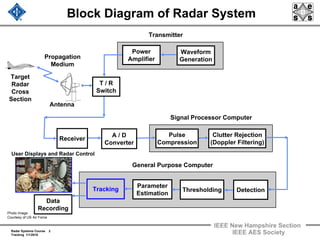
Pulse
Compression
Receiver
Clutter Rejection
(Doppler Filtering)
A / D
Converter
Block Diagram of Radar System
Antenna
Propagation
Medium
Target
Radar
Cross
Section
Transmitter
General Purpose Computer
Tracking
Data
Recording
Parameter
Estimation
Waveform
Generation
Detection
Power
Amplifier
T / R
Switch
Signal Processor Computer
Thresholding
User Displays and Radar Control
Photo Image
Courtesy of US Air Force
Radar Systems Course 3
Tracking 1/1/2010
IEEE New Hampshire Section
IEEE AES Society
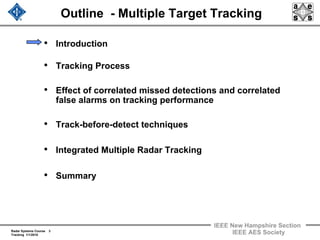
Outline - Multiple Target Tracking
• Introduction
• Tracking Process
• Effect of correlated missed detections and correlated
false alarms on tracking performance
• Track-before-detect techniques
• Integrated Multiple Radar Tracking
• Summary
Radar Systems Course 4
Tracking 1/1/2010
IEEE New Hampshire Section
IEEE AES Society
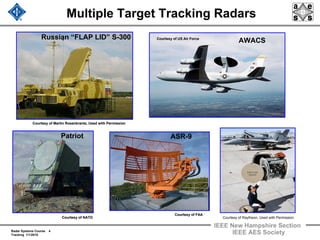
Multiple Target Tracking Radars
Courtesy of USAF
Courtesy of FAACourtesy of FAA
Courtesy of Raytheon, Used with Permission.Courtesy of NATOCourtesy of NATO
ASR-9Patriot
AWACSRussian “FLAP LID” S-300
Courtesy of Martin Rosenkrantz, Used with PermissionCourtesy of Martin Rosenkrantz, Used with Permission
Courtesy of US Air ForceCourtesy of US Air Force
Radar Systems Course 5
Tracking 1/1/2010
IEEE New Hampshire Section
IEEE AES Society
Radar Tracking Example
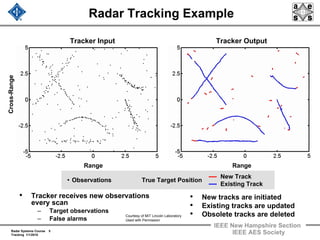
• Tracker receives new observations
every scan
– Target observations
– False alarms
Tracker Input Tracker Output
RangeRange
Cross-Range
• New tracks are initiated
• Existing tracks are updated
• Obsolete tracks are deleted
New Track
Existing Track
Observations True Target Position
Courtesy of MIT Lincoln Laboratory
Used with Permission
Radar Systems Course 6
Tracking 1/1/2010
IEEE New Hampshire Section
IEEE AES Society
Outline - Multiple Target Tracking
• Introduction
• Tracking Process
• Effect of correlated missed detections and correlated
false alarms on tracking performance
• Track-before-detect techniques
• Integrated Multiple Radar Tracking
• Summary
Radar Systems Course 7
Tracking 1/1/2010
IEEE New Hampshire Section
IEEE AES Society
Track File
(Track States)
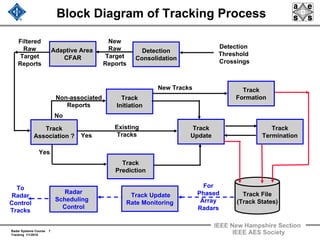
Block Diagram of Tracking Process
Detection
Threshold
Crossings
Adaptive Area
CFAR
Track
Termination
Track
Association ?
Detection
Consolidation
Track
Update
Track
Prediction
Track
Initiation
Radar
Scheduling
Control
Track Update
Rate Monitoring
For
Phased
Array
Radars
New
Raw
Target
Reports
Filtered
Raw
Target
Reports
Non-associated
Reports
Existing
TracksYes
Yes
No
New Tracks Track
Formation
To
Radar
Control
Tracks
Radar Systems Course 8
Tracking 1/1/2010
IEEE New Hampshire Section
IEEE AES Society
Simplified Tracking Tasks
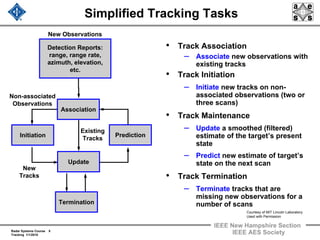
• Track Association
– Associate new observations with
existing tracks
• Track Initiation
– Initiate new tracks on non-
associated observations (two or
three scans)
• Track Maintenance
– Update a smoothed (filtered)
estimate of the target’s present
state
– Predict new estimate of target’s
state on the next scan
• Track Termination
– Terminate tracks that are
missing new observations for a
number of scans
Existing
Tracks
New
Tracks
New Observations
Non-associated
Observations
Detection Reports:
range, range rate,
azimuth, elevation,
etc.
Association
PredictionInitiation
Update
Termination
Courtesy of MIT Lincoln Laboratory
Used with Permission
Radar Systems Course 9
Tracking 1/1/2010
IEEE New Hampshire Section
IEEE AES Society
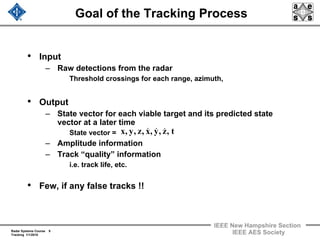
Goal of the Tracking Process
• Input
– Raw detections from the radar
Threshold crossings for each range, azimuth,
• Output
– State vector for each viable target and its predicted state
vector at a later time
State vector =
– Amplitude information
– Track “quality” information
i.e. track life, etc.
• Few, if any false tracks !!
t,z,y,x,z,y,x &&&
Radar Systems Course 10
Tracking 1/1/2010
IEEE New Hampshire Section
IEEE AES Society
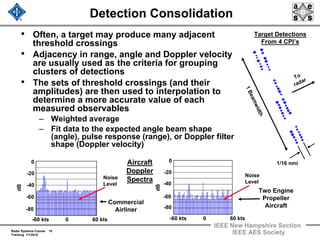
Detection Consolidation
• Often, a target may produce many adjacent
threshold crossings
• Adjacency in range, angle and Doppler velocity
are usually used as the criteria for grouping
clusters of detections
• The sets of threshold crossings (and their
amplitudes) are then used to interpolation to
determine a more accurate value of each
measured observables
– Weighted average
– Fit data to the expected angle beam shape
(angle), pulse response (range), or Doppler filter
shape (Doppler velocity)
To
radar
1/16 nmi
Target Detections
From 4 CPI’s
1Beamwidth
-60 kts 0 60 kts
dB
0
-80
-60
-40
-20
Noise
Level
-60 kts 0 60 kts
dB
0
-20
-40
-60
-80
Noise
Level
Commercial
Airliner
Two Engine
Propeller
Aircraft
Aircraft
Doppler
Spectra
Radar Systems Course 11
Tracking 1/1/2010
IEEE New Hampshire Section
IEEE AES Society
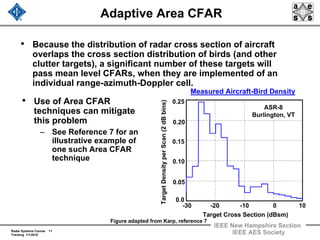
Adaptive Area CFAR
• Because the distribution of radar cross section of aircraft
overlaps the cross section distribution of birds (and other
clutter targets), a significant number of these targets will
pass mean level CFARs, when they are implemented of an
individual range-azimuth-Doppler cell.
• Use of Area CFAR
techniques can mitigate
this problem
– See Reference 7 for an
illustrative example of
one such Area CFAR
technique
Figure adapted from Karp, reference 7
Target Cross Section (dBsm)
-30 -20 -10 0 10
TargetDensityperScan(2dBbins)
0.25
0.20
0.10
0.15
0.05
0.0
Measured Aircraft-Bird Density
ASR-8
Burlington, VT
Radar Systems Course 12
Tracking 1/1/2010
IEEE New Hampshire Section
IEEE AES Society
Track Initiation
• A track is usually initiated after the detection of three on more scans
of the radar to prevent excessive false track from being established.
– These detections are checked consistent motion along a reasonable
trajectory and velocity profile of targets of interest
• A clutter map may be used to prevent track initiation in areas of
strong clutter echoes not suppressed by the Doppler processing
– The clutter map may also keep track of large bird echoes, so as to not be
reinitiating track on them, repeatedly
• Military aircraft often have requirements that demand quicker track
initiation than civil ATC radars (4–12 sec scans rates)
– High speed, low altitude targets that break the horizon at short range
– Issue mitigated by use of phased arrays with variable update rates
• Track initiation in a dense clutter environment can be quite
demanding on computer software and hardware resources
Radar Systems Course 13
Tracking 1/1/2010
IEEE New Hampshire Section
IEEE AES Society
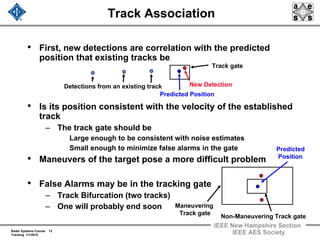
• First, new detections are correlation with the predicted
position that existing tracks be
• Is its position consistent with the velocity of the established
track
– The track gate should be
Large enough to be consistent with noise estimates
Small enough to minimize false alarms in the gate
• Maneuvers of the target pose a more difficult problem
• False Alarms may be in the tracking gate
– Track Bifurcation (two tracks)
– One will probably end soon
Track Association
Detections from an existing track New Detection
Track gate
Predicted Position
Non-Maneuvering Track gate
Maneuvering
Track gate
Predicted
Position
Radar Systems Course 14
Tracking 1/1/2010
IEEE New Hampshire Section
IEEE AES Society
Track Association
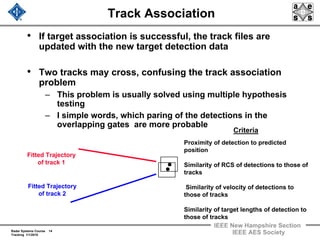
• If target association is successful, the track files are
updated with the new target detection data
• Two tracks may cross, confusing the track association
problem
– This problem is usually solved using multiple hypothesis
testing
– I simple words, which paring of the detections in the
overlapping gates are more probable
Fitted Trajectory
of track 1
Fitted Trajectory
of track 2
Criteria
Proximity of detection to predicted
position
Similarity of RCS of detections to those of
tracks
Similarity of velocity of detections to
those of tracks
Similarity of target lengths of detection to
those of tracks
Radar Systems Course 15
Tracking 1/1/2010
IEEE New Hampshire Section
IEEE AES Society
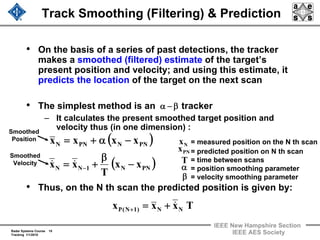
• On the basis of a series of past detections, the tracker
makes a smoothed (filtered) estimate of the target’s
present position and velocity; and using this estimate, it
predicts the location of the target on the next scan
• The simplest method is an tracker
– It calculates the present smoothed target position and
velocity thus (in one dimension) :
• Thus, on the N th scan the predicted position is given by:
Track Smoothing (Filtering) & Prediction
β−α
( )PNNPNN xxxx −α+=
( )PNN1NN xx
T
xx −
β
+= −
&&
= measured position on the N th scan
= predicted position on N th scan
= time between scans
= position smoothing parameter
= velocity smoothing parameter
Nx
T
PNx
α
β
Txxx NN)1N(P
&+=+
Smoothed
Position
Smoothed
Velocity
Radar Systems Course 16
Tracking 1/1/2010
IEEE New Hampshire Section
IEEE AES Society
Track Smoothing (Filtering) & Prediction
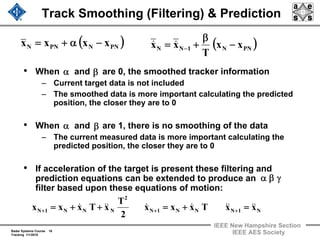
• When and are 0, the smoothed tracker information
– Current target data is not included
– The smoothed data is more important calculating the predicted
position, the closer they are to 0
• When and are 1, there is no smoothing of the data
– The current measured data is more important calculating the
predicted position, the closer they are to 0
• If acceleration of the target is present these filtering and
prediction equations can be extended to produce an
filter based upon these equations of motion:
( )PNNPNN xxxx −α+= ( )PNN1NN xx
T
xx −
β
+= −
&&
α
α
β
β
γβα
N1NNN1N
2
NNN1N xxTxxx
2
T
xTxxx &&&&&&&&& =+=++= +++
Radar Systems Course 17
Tracking 1/1/2010
IEEE New Hampshire Section
IEEE AES Society
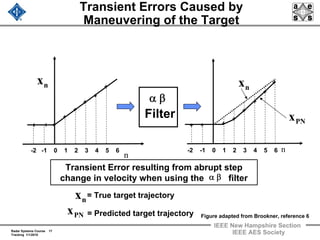
Transient Errors Caused by
Maneuvering of the Target
Filter
-2 -1 0 1 2 3 4 5 6
+
+
+
+
+
+ +
nx
n
-2 -1 0 1 2 3 4 5 6
+
+
+
+
++
+
n
Transient Error resulting from abrupt step
change in velocity when using the filter
nx
+ ++
= True target trajectory
nx
PNx = Predicted target trajectory
PNx
βα
βα
Figure adapted from Brookner, reference 6
Radar Systems Course 18
Tracking 1/1/2010
IEEE New Hampshire Section
IEEE AES Society
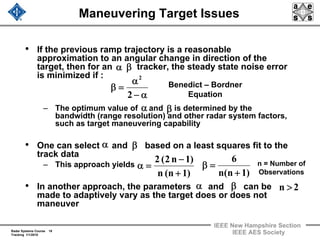
Maneuvering Target Issues
• If the previous ramp trajectory is a reasonable
approximation to an angular change in direction of the
target, then for an tracker, the steady state noise error
is minimized if :
– The optimum value of and is determined by the
bandwidth (range resolution) and other radar system factors,
such as target maneuvering capability
• One can select and based on a least squares fit to the
track data
– This approach yields
• In another approach, the parameters and can be
made to adaptively vary as the target does or does not
maneuver
βα
α−
α
=β
2
2
Benedict – Bordner
Equation
)1n(n
6
+
=β
β
)1n(n
)1n2(2
+
−
=α
α
n = Number of
Observations
2n >
α β
α β
Radar Systems Course 19
Tracking 1/1/2010
IEEE New Hampshire Section
IEEE AES Society
Examples of Maneuvering Targets
• Bar-Shalom has noted that a commercial airliner , which
can perform a 90° maneuver in 30 seconds ( turn rate
3°/sec) will detect the aircraft 3 times.
– That is a very difficult task for a typical long range ATC radar
– Fortunately, away from the terminal area they rarely, if ever
take such drastic turns
– In the terminal area (range 60 nmi), they are seen by ASR with
a 4.8 sec data rate
• On the other hand, military fighter aircraft can execute up to
5 g turns!
– As one would expect, military radars have much higher track
revisit times
Many of these are phased array radars with appropriately high
track update rates
Radar Systems Course 20
Tracking 1/1/2010
IEEE New Hampshire Section
IEEE AES Society
Kalman Filter
• As opposed to the filter , the Kalman filter intrinsically
is capable of dealing with maneuvering targets
• Kalman filter inputs:
– Model of measurement error
– Target trajectory and its errors (equations of motion)
– Trajectory uncertainties
Atmospheric turbulence, Unexpected maneuvers, etc.
• The Kalman filter reduces to an filter for Gaussian white
noise and a constant velocity trajectory and are
computed sequentially by the Kalman filter process
• Skolnik notes in Reference 1, “The Kalmen filter has much
better performance than the tracker since it utilizes
more information”
– Other have noted the same judgments (see reference 1)
– It should be noted that the Kalman filter is much more
computationally intensive that the filter
βα
βα
α β
βα
βα
Radar Systems Course 21
Tracking 1/1/2010
IEEE New Hampshire Section
IEEE AES Society
Two State Kalman Filter
(in Brookner’s notation)
[ ]xy
T
xx *
1n,nn
n*
-1nn,
*
n,1n −+ −
α
+= &&
[ ]*
-1nn,nn
*
n1,n
*
-1nn,
*
n1,n xyxTxx −β++= ++
&
Solution is an Filter with Weights, and , that
Vary with n (scan number)
βα nβnα
See Brookner, reference 6
Radar Systems Course 22
Tracking 1/1/2010
IEEE New Hampshire Section
IEEE AES Society
Filter ( Filter) in Brookner’s Notation
[ ]xy
T
Txxx *
1n,nn
n*
n,1n
*
-1nn,
*
1n,n −++ −
β
++= &&&&
[ ]*
-1nn,nn
2
*
n,1n
*
nn,
*
-1nn,
*
n1,n xy
2
T
xTxxx −α+++= ++
&&&
[ ]xy
T
2
xx *
1n,nn2
n*
-1nn,
*
n,1n −+ −
γ
+= &&&&
Where:
[ ]xy
T
xx *
1n,nn
n*
-1nn,
*
n,n −−
β
+= &&
See Brookner, reference 6
γβα
Radar Systems Course 23
Tracking 1/1/2010
IEEE New Hampshire Section
IEEE AES Society
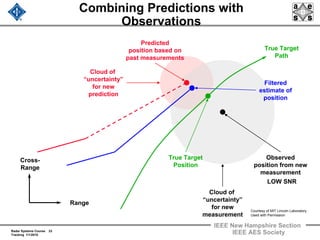
Filtered
estimate of
position
LOW SNR
Combining Predictions with
Observations
Observed
position from new
measurement
Predicted
position based on
past measurements
Range
Cross-
Range
True Target
Position
Cloud of
“uncertainty”
for new
measurement
Cloud of
“uncertainty”
for new
prediction
True Target
Path
Courtesy of MIT Lincoln Laboratory
Used with Permission
Radar Systems Course 24
Tracking 1/1/2010
IEEE New Hampshire Section
IEEE AES Society
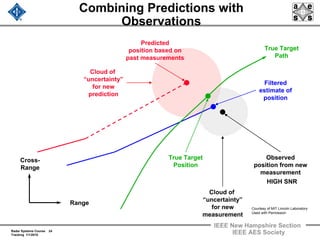
Predicted
position based on
past measurements
True Target
Position
Combining Predictions with
Observations
Range
Cross-
Range
True Target
Path
HIGH SNR
Observed
position from new
measurement
Cloud of
“uncertainty”
for new
prediction
Cloud of
“uncertainty”
for new
measurement
Filtered
estimate of
position
Courtesy of MIT Lincoln Laboratory
Used with Permission
Radar Systems Course 25
Tracking 1/1/2010
IEEE New Hampshire Section
IEEE AES Society
Track Files and Track Updating
• A master Track File is kept of all track that have been
initiated
• The Track File usually contains the following information
– Position and amplitude, and Doppler velocity (if available)
measurements of each detection and their time tag
– Smoothed position and velocity information
– Predicted position and velocity information at the time of the
next track update
– Track firmness (a measure of detection quality)
• After a detection is associated with a track, the Track File is
updated
Radar Systems Course 26
Tracking 1/1/2010
IEEE New Hampshire Section
IEEE AES Society
Track Termination
• Track termination
– If data from target is missing on a scan of radar, track may
be “coasted”
– If data from target missing for a number of scans, the track
is terminated
• The criterion for terminating a track varies for different
types of radars
– Skolnik (see reference 1) suggests that, if three scans are
used to establish a track, then five consecutive missed
detections is a reasonable criterion for track termination”
• For a “high value target”, such as a sea skimming missile
heading towards a ship, different approaches would
probably be taken
Radar Systems Course 27
Tracking 1/1/2010
IEEE New Hampshire Section
IEEE AES Society
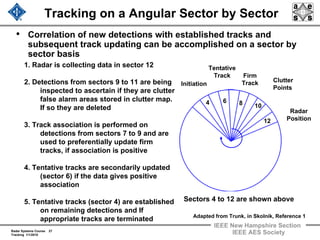
Tracking on a Angular Sector by Sector
• Correlation of new detections with established tracks and
subsequent track updating can be accomplished on a sector by
sector basis
4 86
10
12
Initiation
Tentative
Track Firm
Track Clutter
Points
Radar
Position
Adapted from Trunk, in Skolnik, Reference 1
Sectors 4 to 12 are shown above
1. Radar is collecting data in sector 12
2. Detections from sectors 9 to 11 are being
inspected to ascertain if they are clutter
false alarm areas stored in clutter map.
If so they are deleted
3. Track association is performed on
detections from sectors 7 to 9 and are
used to preferentially update firm
tracks, if association is positive
4. Tentative tracks are secondarily updated
(sector 6) if the data gives positive
association
5. Tentative tracks (sector 4) are established
on remaining detections and If
appropriate tracks are terminated
Radar Systems Course 28
Tracking 1/1/2010
IEEE New Hampshire Section
IEEE AES Society
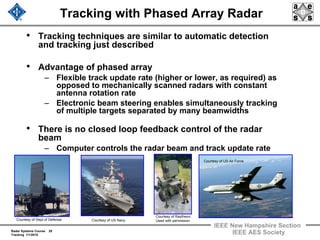
Tracking with Phased Array Radar
• Tracking techniques are similar to automatic detection
and tracking just described
• Advantage of phased array
– Flexible track update rate (higher or lower, as required) as
opposed to mechanically scanned radars with constant
antenna rotation rate
– Electronic beam steering enables simultaneously tracking
of multiple targets separated by many beamwidths
• There is no closed loop feedback control of the radar
beam
– Computer controls the radar beam and track update rate
Courtesy of Dept of Defense. Courtesy of US Navy.
Courtesy of Raytheon.
Used with permission.
Courtesy of US Air Force.
Radar Systems Course 29
Tracking 1/1/2010
IEEE New Hampshire Section
IEEE AES Society
Outline - Multiple Target Tracking
• Introduction
• Tracking Process
• Effect of correlated missed detections and correlated
false alarms on tracking performance
• Track-before-detect techniques
• Integrated Multiple Radar Tracking
• Summary
Radar Systems Course 30
Tracking 1/1/2010
IEEE New Hampshire Section
IEEE AES Society
Background
• Most trackers assume that false detection and missed
detections on a target in track are uncorrelated, random
and noise-like
– The theory for predicting the performance with correlated
noise and /or missed detections is more complex
– The phenomena, which cause these effects, is difficult to
predict
• Often this assumption is incorrect and leads to poor
tracking performance
– In many cases these false detections and missed detections
are correlated both spatially and temporally
Radar Systems Course 31
Tracking 1/1/2010
IEEE New Hampshire Section
IEEE AES Society
Phenomena Causing Correlated False
Detections
• Birds (Swarms of bats and insects, too!)
– Real targets whose cross section distribution overlap that of a civil
ATC target environment (see Viewgraph 11 of this lecture)
– Even more so for military aircraft with RCS reduction techniques
applied)
• Sea spikes (See clutter lecture)
• Rain clutter
– When ineffective non-coherent integration and techniques are
employed in the radar
– Adaptive thresholding edge effects
– Use of too few pulses in the coherent Doppler filter processing
At least 8 are necessary in low PRF ATC radars
Result is high Doppler sidelobes and thus poor rain rejection
• Ground Clutter
– In regions, where the radar has insufficient A/D dynamic range, to
allow effective clutter suppression
Radar Systems Course 32
Tracking 1/1/2010
IEEE New Hampshire Section
IEEE AES Society
Phenomena Causing Correlated Missed
Detections
• Blind Speed effects
• Insufficiently high Doppler velocity filter sidelobes to reject
rain (see previous viewgraph) in conjunction with a good
CFAR
• Good CFAR thresholding in regions of significant ground
clutter break through
Radar Systems Course 33
Tracking 1/1/2010
IEEE New Hampshire Section
IEEE AES Society
Outline - Multiple Target Tracking
• Introduction
• Tracking Process
• Effect of correlated missed detections and correlated
false alarms on tracking performance
• Track-before-detect techniques
• Integrated Multiple Radar Tracking
• Summary
Radar Systems Course 34
Tracking 1/1/2010
IEEE New Hampshire Section
IEEE AES Society
Track Before Detect Techniques
• Probability of detection may be improved by non-coherently
integrating the radar echoes over multiple scans of the radar
– Used for weak targets or to extend detection range
• Long integration times implies target may traverse many
resolution cells during the integration time
• Since target trajectory usually not known beforehand,
integration must be performed assuming all possible
trajectories
– Computationally intensive problem
• A correct trajectory is one that provides a realistic speed
and direction for the type of target being observed
– Unexpected maneuvers of target can limit the viability of this
technique
Radar Systems Course 35
Tracking 1/1/2010
IEEE New Hampshire Section
IEEE AES Society
Track Before Detect Techniques
• The target must be tracked before it is detected
– Also called: Retrospective detection, long term integration
• N Scans of data are for all reasonable trajectory hypotheses
– This type of straightforward exhaustive search can become
computational impractical for very large values of N
– Dynamic programming techniques have been developed ,
which can reduce the computational load by at least five
orders of magnitude
• Higher single scan probability of false alarm can be tolerated
– PFA= 10-3 rather than 10-5 or 10-6
• Use of track before detect techniques requires :
– Significantly increased data processing capability
– Longer observation time
Implying longer delay time before track initiation is declared
Courtesy of MIT Lincoln Laboratory
Used with Permission
Radar Systems Course 36
Tracking 1/1/2010
IEEE New Hampshire Section
IEEE AES Society
Outline - Multiple Target Tracking
• Introduction
• Tracking Process
• Effect of correlated missed detections and correlated
false alarms on tracking performance
• Track-before-detect techniques
• Integrated Multiple Radar Tracking
• Summary
Radar Systems Course 37
Tracking 1/1/2010
IEEE New Hampshire Section
IEEE AES Society
Integrated Multiple Radar Tracking
• Advantages
– Improved tracking
– Greater data rate than a single radar
– Less vulnerability to electronic counter measures
– Fewer overall missed detections
Fewer gaps in Coverage
Filling in of multipath nulls
Detection at multiple look angles, reduces chance of a RCS null
• Co-located radars vs. multiple radar sites
– Co-located radars can operate at different frequencies
– Multiple sites
Tracks from each radar must be correlated with the others radars
This issue has been a long standing problem
Implementation of GPS at each radar site (for accurate site
geographic registration) has greatly reduced this issues
significance
Radar Systems Course 38
Tracking 1/1/2010
IEEE New Hampshire Section
IEEE AES Society
Summary – Part 2
• The multi-target tracking function, by which radar
detections from successive scans are associated and
formed into tracks, was describe
• The various parts of this tracking process were presented,
among them:
– Track Initiation
– Association of detections with tracks
– Track smoothing (filtering) and prediction
filter and Kalman filter
– Track updating and termination
• The effect on tracking of correlated missed detections and
false alarms was presented
• The benefits of multi-radar netting were discussed
βα
Radar Systems Course 39
Tracking 1/1/2010
IEEE New Hampshire Section
IEEE AES Society
Homework Problems
• From Skolnik, Reference 1
– Problems 4.17, 4.18, and 4.19
• Brookner, Reference 6
– Problems 1.2.1-1, 1.2.1-2, and 1.2.1-3
– Note an α – β filter in notation of the lecture is a “f-g” filter in
Broonker’s notation
His problems are at the end of his book, not at the end of each
chapter
Radar Systems Course 40
Tracking 1/1/2010
IEEE New Hampshire Section
IEEE AES Society
References
1. Skolnik, M., Introduction to Radar Systems, McGraw-Hill,
New York, 3rd Ed., 2001
2. Barton, D. K., Modern Radar System Analysis, Norwood,
Mass., Artech House, 1988
3. Skolnik, M., Editor in Chief, Radar Handbook, New York,
McGraw-Hill, 3rd Ed., 2008
4. Skolnik, M., Editor in Chief, Radar Handbook, New York,
McGraw-Hill, 2nd Ed., 1990
5. O’Donnell, R. M., "The Effect of Correlated Missed Detections
and Correlated False Alarms on the Performance of an
Automated Radar Tracking System“ , IEEE EASCON '77
Proceedings, Washington D.C., October 1977.
6. Brookner, E., Tracking and Kalman Filtering Made Easy, New
York, Wiley, 1998
7. Karp, D. Moving Target Detector Mod II Summary Report,
Project Report ATC 96, MIT Lincoln Laboratory. 1981
Radar Systems Course 41
Tracking 1/1/2010
IEEE New Hampshire Section
IEEE AES Society
Acknowledgements
• Dr Katherine A. Rink
• Dr Eli Brookner, Raytheon Co.

Radar 2009 a 16 parameter estimation and tracking part2

  • 1.
    IEEE New HampshireSection Radar Systems Course 1 Tracking 1/1/2010 IEEE AES Society Radar Systems Engineering Lecture 16 Parameter Estimation and Tracking Part 2 Dr. Robert M. O’Donnell IEEE New Hampshire Section Guest Lecturer
  • 2.
    Radar Systems Course2 Tracking 1/1/2010 IEEE New Hampshire Section IEEE AES Society Pulse Compression Receiver Clutter Rejection (Doppler Filtering) A / D Converter Block Diagram of Radar System Antenna Propagation Medium Target Radar Cross Section Transmitter General Purpose Computer Tracking Data Recording Parameter Estimation Waveform Generation Detection Power Amplifier T / R Switch Signal Processor Computer Thresholding User Displays and Radar Control Photo Image Courtesy of US Air Force
  • 3.
    Radar Systems Course3 Tracking 1/1/2010 IEEE New Hampshire Section IEEE AES Society Outline - Multiple Target Tracking • Introduction • Tracking Process • Effect of correlated missed detections and correlated false alarms on tracking performance • Track-before-detect techniques • Integrated Multiple Radar Tracking • Summary
  • 4.
    Radar Systems Course4 Tracking 1/1/2010 IEEE New Hampshire Section IEEE AES Society Multiple Target Tracking Radars Courtesy of USAF Courtesy of FAACourtesy of FAA Courtesy of Raytheon, Used with Permission.Courtesy of NATOCourtesy of NATO ASR-9Patriot AWACSRussian “FLAP LID” S-300 Courtesy of Martin Rosenkrantz, Used with PermissionCourtesy of Martin Rosenkrantz, Used with Permission Courtesy of US Air ForceCourtesy of US Air Force
  • 5.
    Radar Systems Course5 Tracking 1/1/2010 IEEE New Hampshire Section IEEE AES Society Radar Tracking Example • Tracker receives new observations every scan – Target observations – False alarms Tracker Input Tracker Output RangeRange Cross-Range • New tracks are initiated • Existing tracks are updated • Obsolete tracks are deleted New Track Existing Track Observations True Target Position Courtesy of MIT Lincoln Laboratory Used with Permission
  • 6.
    Radar Systems Course6 Tracking 1/1/2010 IEEE New Hampshire Section IEEE AES Society Outline - Multiple Target Tracking • Introduction • Tracking Process • Effect of correlated missed detections and correlated false alarms on tracking performance • Track-before-detect techniques • Integrated Multiple Radar Tracking • Summary
  • 7.
    Radar Systems Course7 Tracking 1/1/2010 IEEE New Hampshire Section IEEE AES Society Track File (Track States) Block Diagram of Tracking Process Detection Threshold Crossings Adaptive Area CFAR Track Termination Track Association ? Detection Consolidation Track Update Track Prediction Track Initiation Radar Scheduling Control Track Update Rate Monitoring For Phased Array Radars New Raw Target Reports Filtered Raw Target Reports Non-associated Reports Existing TracksYes Yes No New Tracks Track Formation To Radar Control Tracks
  • 8.
    Radar Systems Course8 Tracking 1/1/2010 IEEE New Hampshire Section IEEE AES Society Simplified Tracking Tasks • Track Association – Associate new observations with existing tracks • Track Initiation – Initiate new tracks on non- associated observations (two or three scans) • Track Maintenance – Update a smoothed (filtered) estimate of the target’s present state – Predict new estimate of target’s state on the next scan • Track Termination – Terminate tracks that are missing new observations for a number of scans Existing Tracks New Tracks New Observations Non-associated Observations Detection Reports: range, range rate, azimuth, elevation, etc. Association PredictionInitiation Update Termination Courtesy of MIT Lincoln Laboratory Used with Permission
  • 9.
    Radar Systems Course9 Tracking 1/1/2010 IEEE New Hampshire Section IEEE AES Society Goal of the Tracking Process • Input – Raw detections from the radar Threshold crossings for each range, azimuth, • Output – State vector for each viable target and its predicted state vector at a later time State vector = – Amplitude information – Track “quality” information i.e. track life, etc. • Few, if any false tracks !! t,z,y,x,z,y,x &&&
  • 10.
    Radar Systems Course10 Tracking 1/1/2010 IEEE New Hampshire Section IEEE AES Society Detection Consolidation • Often, a target may produce many adjacent threshold crossings • Adjacency in range, angle and Doppler velocity are usually used as the criteria for grouping clusters of detections • The sets of threshold crossings (and their amplitudes) are then used to interpolation to determine a more accurate value of each measured observables – Weighted average – Fit data to the expected angle beam shape (angle), pulse response (range), or Doppler filter shape (Doppler velocity) To radar 1/16 nmi Target Detections From 4 CPI’s 1Beamwidth -60 kts 0 60 kts dB 0 -80 -60 -40 -20 Noise Level -60 kts 0 60 kts dB 0 -20 -40 -60 -80 Noise Level Commercial Airliner Two Engine Propeller Aircraft Aircraft Doppler Spectra
  • 11.
    Radar Systems Course11 Tracking 1/1/2010 IEEE New Hampshire Section IEEE AES Society Adaptive Area CFAR • Because the distribution of radar cross section of aircraft overlaps the cross section distribution of birds (and other clutter targets), a significant number of these targets will pass mean level CFARs, when they are implemented of an individual range-azimuth-Doppler cell. • Use of Area CFAR techniques can mitigate this problem – See Reference 7 for an illustrative example of one such Area CFAR technique Figure adapted from Karp, reference 7 Target Cross Section (dBsm) -30 -20 -10 0 10 TargetDensityperScan(2dBbins) 0.25 0.20 0.10 0.15 0.05 0.0 Measured Aircraft-Bird Density ASR-8 Burlington, VT
  • 12.
    Radar Systems Course12 Tracking 1/1/2010 IEEE New Hampshire Section IEEE AES Society Track Initiation • A track is usually initiated after the detection of three on more scans of the radar to prevent excessive false track from being established. – These detections are checked consistent motion along a reasonable trajectory and velocity profile of targets of interest • A clutter map may be used to prevent track initiation in areas of strong clutter echoes not suppressed by the Doppler processing – The clutter map may also keep track of large bird echoes, so as to not be reinitiating track on them, repeatedly • Military aircraft often have requirements that demand quicker track initiation than civil ATC radars (4–12 sec scans rates) – High speed, low altitude targets that break the horizon at short range – Issue mitigated by use of phased arrays with variable update rates • Track initiation in a dense clutter environment can be quite demanding on computer software and hardware resources
  • 13.
    Radar Systems Course13 Tracking 1/1/2010 IEEE New Hampshire Section IEEE AES Society • First, new detections are correlation with the predicted position that existing tracks be • Is its position consistent with the velocity of the established track – The track gate should be Large enough to be consistent with noise estimates Small enough to minimize false alarms in the gate • Maneuvers of the target pose a more difficult problem • False Alarms may be in the tracking gate – Track Bifurcation (two tracks) – One will probably end soon Track Association Detections from an existing track New Detection Track gate Predicted Position Non-Maneuvering Track gate Maneuvering Track gate Predicted Position
  • 14.
    Radar Systems Course14 Tracking 1/1/2010 IEEE New Hampshire Section IEEE AES Society Track Association • If target association is successful, the track files are updated with the new target detection data • Two tracks may cross, confusing the track association problem – This problem is usually solved using multiple hypothesis testing – I simple words, which paring of the detections in the overlapping gates are more probable Fitted Trajectory of track 1 Fitted Trajectory of track 2 Criteria Proximity of detection to predicted position Similarity of RCS of detections to those of tracks Similarity of velocity of detections to those of tracks Similarity of target lengths of detection to those of tracks
  • 15.
    Radar Systems Course15 Tracking 1/1/2010 IEEE New Hampshire Section IEEE AES Society • On the basis of a series of past detections, the tracker makes a smoothed (filtered) estimate of the target’s present position and velocity; and using this estimate, it predicts the location of the target on the next scan • The simplest method is an tracker – It calculates the present smoothed target position and velocity thus (in one dimension) : • Thus, on the N th scan the predicted position is given by: Track Smoothing (Filtering) & Prediction β−α ( )PNNPNN xxxx −α+= ( )PNN1NN xx T xx − β += − && = measured position on the N th scan = predicted position on N th scan = time between scans = position smoothing parameter = velocity smoothing parameter Nx T PNx α β Txxx NN)1N(P &+=+ Smoothed Position Smoothed Velocity
  • 16.
    Radar Systems Course16 Tracking 1/1/2010 IEEE New Hampshire Section IEEE AES Society Track Smoothing (Filtering) & Prediction • When and are 0, the smoothed tracker information – Current target data is not included – The smoothed data is more important calculating the predicted position, the closer they are to 0 • When and are 1, there is no smoothing of the data – The current measured data is more important calculating the predicted position, the closer they are to 0 • If acceleration of the target is present these filtering and prediction equations can be extended to produce an filter based upon these equations of motion: ( )PNNPNN xxxx −α+= ( )PNN1NN xx T xx − β += − && α α β β γβα N1NNN1N 2 NNN1N xxTxxx 2 T xTxxx &&&&&&&&& =+=++= +++
  • 17.
    Radar Systems Course17 Tracking 1/1/2010 IEEE New Hampshire Section IEEE AES Society Transient Errors Caused by Maneuvering of the Target Filter -2 -1 0 1 2 3 4 5 6 + + + + + + + nx n -2 -1 0 1 2 3 4 5 6 + + + + ++ + n Transient Error resulting from abrupt step change in velocity when using the filter nx + ++ = True target trajectory nx PNx = Predicted target trajectory PNx βα βα Figure adapted from Brookner, reference 6
  • 18.
    Radar Systems Course18 Tracking 1/1/2010 IEEE New Hampshire Section IEEE AES Society Maneuvering Target Issues • If the previous ramp trajectory is a reasonable approximation to an angular change in direction of the target, then for an tracker, the steady state noise error is minimized if : – The optimum value of and is determined by the bandwidth (range resolution) and other radar system factors, such as target maneuvering capability • One can select and based on a least squares fit to the track data – This approach yields • In another approach, the parameters and can be made to adaptively vary as the target does or does not maneuver βα α− α =β 2 2 Benedict – Bordner Equation )1n(n 6 + =β β )1n(n )1n2(2 + − =α α n = Number of Observations 2n > α β α β
  • 19.
    Radar Systems Course19 Tracking 1/1/2010 IEEE New Hampshire Section IEEE AES Society Examples of Maneuvering Targets • Bar-Shalom has noted that a commercial airliner , which can perform a 90° maneuver in 30 seconds ( turn rate 3°/sec) will detect the aircraft 3 times. – That is a very difficult task for a typical long range ATC radar – Fortunately, away from the terminal area they rarely, if ever take such drastic turns – In the terminal area (range 60 nmi), they are seen by ASR with a 4.8 sec data rate • On the other hand, military fighter aircraft can execute up to 5 g turns! – As one would expect, military radars have much higher track revisit times Many of these are phased array radars with appropriately high track update rates
  • 20.
    Radar Systems Course20 Tracking 1/1/2010 IEEE New Hampshire Section IEEE AES Society Kalman Filter • As opposed to the filter , the Kalman filter intrinsically is capable of dealing with maneuvering targets • Kalman filter inputs: – Model of measurement error – Target trajectory and its errors (equations of motion) – Trajectory uncertainties Atmospheric turbulence, Unexpected maneuvers, etc. • The Kalman filter reduces to an filter for Gaussian white noise and a constant velocity trajectory and are computed sequentially by the Kalman filter process • Skolnik notes in Reference 1, “The Kalmen filter has much better performance than the tracker since it utilizes more information” – Other have noted the same judgments (see reference 1) – It should be noted that the Kalman filter is much more computationally intensive that the filter βα βα α β βα βα
  • 21.
    Radar Systems Course21 Tracking 1/1/2010 IEEE New Hampshire Section IEEE AES Society Two State Kalman Filter (in Brookner’s notation) [ ]xy T xx * 1n,nn n* -1nn, * n,1n −+ − α += && [ ]* -1nn,nn * n1,n * -1nn, * n1,n xyxTxx −β++= ++ & Solution is an Filter with Weights, and , that Vary with n (scan number) βα nβnα See Brookner, reference 6
  • 22.
    Radar Systems Course22 Tracking 1/1/2010 IEEE New Hampshire Section IEEE AES Society Filter ( Filter) in Brookner’s Notation [ ]xy T Txxx * 1n,nn n* n,1n * -1nn, * 1n,n −++ − β ++= &&&& [ ]* -1nn,nn 2 * n,1n * nn, * -1nn, * n1,n xy 2 T xTxxx −α+++= ++ &&& [ ]xy T 2 xx * 1n,nn2 n* -1nn, * n,1n −+ − γ += &&&& Where: [ ]xy T xx * 1n,nn n* -1nn, * n,n −− β += && See Brookner, reference 6 γβα
  • 23.
    Radar Systems Course23 Tracking 1/1/2010 IEEE New Hampshire Section IEEE AES Society Filtered estimate of position LOW SNR Combining Predictions with Observations Observed position from new measurement Predicted position based on past measurements Range Cross- Range True Target Position Cloud of “uncertainty” for new measurement Cloud of “uncertainty” for new prediction True Target Path Courtesy of MIT Lincoln Laboratory Used with Permission
  • 24.
    Radar Systems Course24 Tracking 1/1/2010 IEEE New Hampshire Section IEEE AES Society Predicted position based on past measurements True Target Position Combining Predictions with Observations Range Cross- Range True Target Path HIGH SNR Observed position from new measurement Cloud of “uncertainty” for new prediction Cloud of “uncertainty” for new measurement Filtered estimate of position Courtesy of MIT Lincoln Laboratory Used with Permission
  • 25.
    Radar Systems Course25 Tracking 1/1/2010 IEEE New Hampshire Section IEEE AES Society Track Files and Track Updating • A master Track File is kept of all track that have been initiated • The Track File usually contains the following information – Position and amplitude, and Doppler velocity (if available) measurements of each detection and their time tag – Smoothed position and velocity information – Predicted position and velocity information at the time of the next track update – Track firmness (a measure of detection quality) • After a detection is associated with a track, the Track File is updated
  • 26.
    Radar Systems Course26 Tracking 1/1/2010 IEEE New Hampshire Section IEEE AES Society Track Termination • Track termination – If data from target is missing on a scan of radar, track may be “coasted” – If data from target missing for a number of scans, the track is terminated • The criterion for terminating a track varies for different types of radars – Skolnik (see reference 1) suggests that, if three scans are used to establish a track, then five consecutive missed detections is a reasonable criterion for track termination” • For a “high value target”, such as a sea skimming missile heading towards a ship, different approaches would probably be taken
  • 27.
    Radar Systems Course27 Tracking 1/1/2010 IEEE New Hampshire Section IEEE AES Society Tracking on a Angular Sector by Sector • Correlation of new detections with established tracks and subsequent track updating can be accomplished on a sector by sector basis 4 86 10 12 Initiation Tentative Track Firm Track Clutter Points Radar Position Adapted from Trunk, in Skolnik, Reference 1 Sectors 4 to 12 are shown above 1. Radar is collecting data in sector 12 2. Detections from sectors 9 to 11 are being inspected to ascertain if they are clutter false alarm areas stored in clutter map. If so they are deleted 3. Track association is performed on detections from sectors 7 to 9 and are used to preferentially update firm tracks, if association is positive 4. Tentative tracks are secondarily updated (sector 6) if the data gives positive association 5. Tentative tracks (sector 4) are established on remaining detections and If appropriate tracks are terminated
  • 28.
    Radar Systems Course28 Tracking 1/1/2010 IEEE New Hampshire Section IEEE AES Society Tracking with Phased Array Radar • Tracking techniques are similar to automatic detection and tracking just described • Advantage of phased array – Flexible track update rate (higher or lower, as required) as opposed to mechanically scanned radars with constant antenna rotation rate – Electronic beam steering enables simultaneously tracking of multiple targets separated by many beamwidths • There is no closed loop feedback control of the radar beam – Computer controls the radar beam and track update rate Courtesy of Dept of Defense. Courtesy of US Navy. Courtesy of Raytheon. Used with permission. Courtesy of US Air Force.
  • 29.
    Radar Systems Course29 Tracking 1/1/2010 IEEE New Hampshire Section IEEE AES Society Outline - Multiple Target Tracking • Introduction • Tracking Process • Effect of correlated missed detections and correlated false alarms on tracking performance • Track-before-detect techniques • Integrated Multiple Radar Tracking • Summary
  • 30.
    Radar Systems Course30 Tracking 1/1/2010 IEEE New Hampshire Section IEEE AES Society Background • Most trackers assume that false detection and missed detections on a target in track are uncorrelated, random and noise-like – The theory for predicting the performance with correlated noise and /or missed detections is more complex – The phenomena, which cause these effects, is difficult to predict • Often this assumption is incorrect and leads to poor tracking performance – In many cases these false detections and missed detections are correlated both spatially and temporally
  • 31.
    Radar Systems Course31 Tracking 1/1/2010 IEEE New Hampshire Section IEEE AES Society Phenomena Causing Correlated False Detections • Birds (Swarms of bats and insects, too!) – Real targets whose cross section distribution overlap that of a civil ATC target environment (see Viewgraph 11 of this lecture) – Even more so for military aircraft with RCS reduction techniques applied) • Sea spikes (See clutter lecture) • Rain clutter – When ineffective non-coherent integration and techniques are employed in the radar – Adaptive thresholding edge effects – Use of too few pulses in the coherent Doppler filter processing At least 8 are necessary in low PRF ATC radars Result is high Doppler sidelobes and thus poor rain rejection • Ground Clutter – In regions, where the radar has insufficient A/D dynamic range, to allow effective clutter suppression
  • 32.
    Radar Systems Course32 Tracking 1/1/2010 IEEE New Hampshire Section IEEE AES Society Phenomena Causing Correlated Missed Detections • Blind Speed effects • Insufficiently high Doppler velocity filter sidelobes to reject rain (see previous viewgraph) in conjunction with a good CFAR • Good CFAR thresholding in regions of significant ground clutter break through
  • 33.
    Radar Systems Course33 Tracking 1/1/2010 IEEE New Hampshire Section IEEE AES Society Outline - Multiple Target Tracking • Introduction • Tracking Process • Effect of correlated missed detections and correlated false alarms on tracking performance • Track-before-detect techniques • Integrated Multiple Radar Tracking • Summary
  • 34.
    Radar Systems Course34 Tracking 1/1/2010 IEEE New Hampshire Section IEEE AES Society Track Before Detect Techniques • Probability of detection may be improved by non-coherently integrating the radar echoes over multiple scans of the radar – Used for weak targets or to extend detection range • Long integration times implies target may traverse many resolution cells during the integration time • Since target trajectory usually not known beforehand, integration must be performed assuming all possible trajectories – Computationally intensive problem • A correct trajectory is one that provides a realistic speed and direction for the type of target being observed – Unexpected maneuvers of target can limit the viability of this technique
  • 35.
    Radar Systems Course35 Tracking 1/1/2010 IEEE New Hampshire Section IEEE AES Society Track Before Detect Techniques • The target must be tracked before it is detected – Also called: Retrospective detection, long term integration • N Scans of data are for all reasonable trajectory hypotheses – This type of straightforward exhaustive search can become computational impractical for very large values of N – Dynamic programming techniques have been developed , which can reduce the computational load by at least five orders of magnitude • Higher single scan probability of false alarm can be tolerated – PFA= 10-3 rather than 10-5 or 10-6 • Use of track before detect techniques requires : – Significantly increased data processing capability – Longer observation time Implying longer delay time before track initiation is declared Courtesy of MIT Lincoln Laboratory Used with Permission
  • 36.
    Radar Systems Course36 Tracking 1/1/2010 IEEE New Hampshire Section IEEE AES Society Outline - Multiple Target Tracking • Introduction • Tracking Process • Effect of correlated missed detections and correlated false alarms on tracking performance • Track-before-detect techniques • Integrated Multiple Radar Tracking • Summary
  • 37.
    Radar Systems Course37 Tracking 1/1/2010 IEEE New Hampshire Section IEEE AES Society Integrated Multiple Radar Tracking • Advantages – Improved tracking – Greater data rate than a single radar – Less vulnerability to electronic counter measures – Fewer overall missed detections Fewer gaps in Coverage Filling in of multipath nulls Detection at multiple look angles, reduces chance of a RCS null • Co-located radars vs. multiple radar sites – Co-located radars can operate at different frequencies – Multiple sites Tracks from each radar must be correlated with the others radars This issue has been a long standing problem Implementation of GPS at each radar site (for accurate site geographic registration) has greatly reduced this issues significance
  • 38.
    Radar Systems Course38 Tracking 1/1/2010 IEEE New Hampshire Section IEEE AES Society Summary – Part 2 • The multi-target tracking function, by which radar detections from successive scans are associated and formed into tracks, was describe • The various parts of this tracking process were presented, among them: – Track Initiation – Association of detections with tracks – Track smoothing (filtering) and prediction filter and Kalman filter – Track updating and termination • The effect on tracking of correlated missed detections and false alarms was presented • The benefits of multi-radar netting were discussed βα
  • 39.
    Radar Systems Course39 Tracking 1/1/2010 IEEE New Hampshire Section IEEE AES Society Homework Problems • From Skolnik, Reference 1 – Problems 4.17, 4.18, and 4.19 • Brookner, Reference 6 – Problems 1.2.1-1, 1.2.1-2, and 1.2.1-3 – Note an α – β filter in notation of the lecture is a “f-g” filter in Broonker’s notation His problems are at the end of his book, not at the end of each chapter
  • 40.
    Radar Systems Course40 Tracking 1/1/2010 IEEE New Hampshire Section IEEE AES Society References 1. Skolnik, M., Introduction to Radar Systems, McGraw-Hill, New York, 3rd Ed., 2001 2. Barton, D. K., Modern Radar System Analysis, Norwood, Mass., Artech House, 1988 3. Skolnik, M., Editor in Chief, Radar Handbook, New York, McGraw-Hill, 3rd Ed., 2008 4. Skolnik, M., Editor in Chief, Radar Handbook, New York, McGraw-Hill, 2nd Ed., 1990 5. O’Donnell, R. M., "The Effect of Correlated Missed Detections and Correlated False Alarms on the Performance of an Automated Radar Tracking System“ , IEEE EASCON '77 Proceedings, Washington D.C., October 1977. 6. Brookner, E., Tracking and Kalman Filtering Made Easy, New York, Wiley, 1998 7. Karp, D. Moving Target Detector Mod II Summary Report, Project Report ATC 96, MIT Lincoln Laboratory. 1981
  • 41.
    Radar Systems Course41 Tracking 1/1/2010 IEEE New Hampshire Section IEEE AES Society Acknowledgements • Dr Katherine A. Rink • Dr Eli Brookner, Raytheon Co.