LOG-PERIODIC ANTENNA
BY :
H.P ANUSH
1560547
6BTEC
CONTENTS
• INTRODUCTION
• LPDA
• STRUCTURE OF LP ANTENNA
• WORKING OF LP ANTENNA
• RADIATION PATTERN
• POINT OF EXCITATION
• TYPES OF LP ANTENNA
• ADVANTAGES & DISADVANTAGES
• APPLICATION
• CONCLUSION
INTRODUCTION
• A log-periodic antenna (LP), also known as a log-periodic array or log-periodic aerial, is a multi-element,
directional antenna designed to operate over a wide band of frequencies.
• It was invented by Dwight Isbell and Raymond DuHamel at the University of Illinois in 1958.
• It is a broadband, multi-element, unidirectional, narrow-beam antenna.
LPDA (Log – Periodic Dipole Array )
• The most common form of log-periodic antenna is the log-periodic dipole array or LPDA.
• The LPDA normally consists of a series of dipoles known as "elements" positioned along a support boom lying
along the antenna axis
• LPDA antennas look somewhat similar to Yagi antennas, in that they both consist of dipole rod elements mounted
in a line along a support boom.
• Both LPDA & Yagi Antenna work in a different manner.
STRUCTURE OF LP ANTENNA
• Log periodic antenna has an array of dipole which has their length according to logarithmic scale.
• The elements at the back of the array where the elements are the largest is a half wavelength at lowest
frequency of operation.
• It is basically a wideband antenna due to the presence of many dipole elements which are of different length,
radiating in a different frequency.
WORKING OF LP ANTENNA
• The construction and operation of a log-periodic antenna is similar to that of a Yagi-Uda antenna.
• The major difference with this antenna when compared to other antenna’s is that it exhibits
constant characteristics over a desired frequency range of operation.
• It has the same radiation resistance and therefore the same SWR. The gain and front-to-back ratio
are also the same.
RADIATION PATTERN
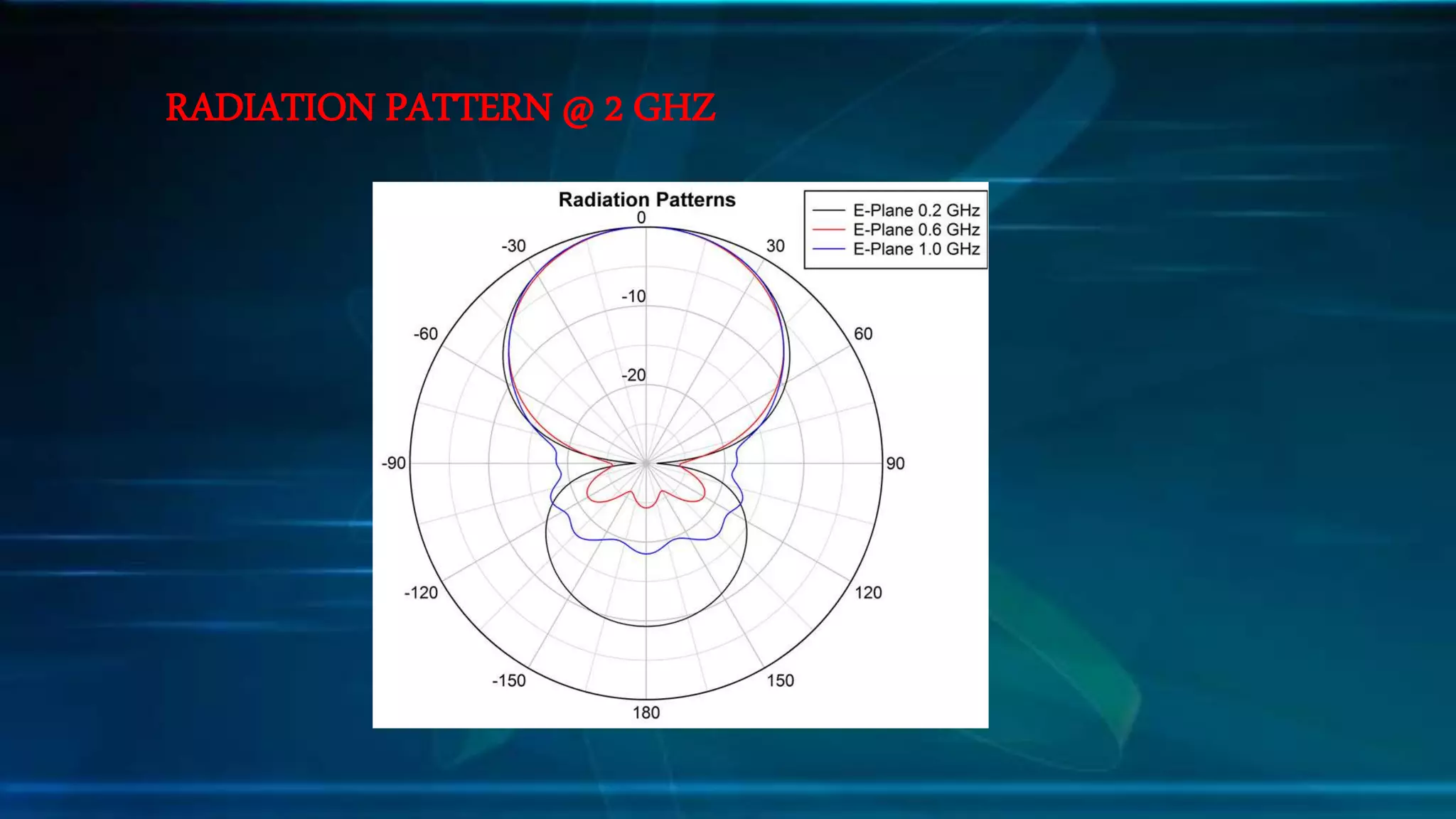
• From the Radiation pattern one can say that it has less directivity than compared to other antennas like Yagi-uda.
• But we can obtain wide frequency response than any other antenna‘.
• Here the radiation pattern is shown at 2GHz frequency.
RADIATION PATTERN @ 2 GHZ
POINT OF EXCITATION
• The single element is provided excitation via these cross connection lines.
• Here in the example taken only one element has provided excitation and other element has no separate
excitation.
• By varying the point of excitation we can change the radiation pattern of log periodic antenna.
TYPES OF LP ANTENNA
• There are several forms of log periodic antenna. The exact type that is most applicable for any given application
will depend upon the requirements.
• The main types of log periodic antenna include:
• Log periodic dipole array, LPDA
• Slot log periodic
• Zig zag log periodic array
• Trapezoidal log periodic
• V log periodic
ADVANTAGES & DISADVANTAGES
ADVANTAGES
• The antenna design is compact.
• Gain and radiation pattern are varied according to the requirements.
DISADVANTAGES
• External mount.
• Installation cost is high.
APPLICATIONS
• Used for HF communications.
• Used for particular sort of TV receptions.
• Used for all round monitoring in higher frequency bands.
THANK YOU

Log periodic antenna

  • 1.
    LOG-PERIODIC ANTENNA BY : H.PANUSH 1560547 6BTEC
  • 2.
    CONTENTS • INTRODUCTION • LPDA •STRUCTURE OF LP ANTENNA • WORKING OF LP ANTENNA • RADIATION PATTERN • POINT OF EXCITATION • TYPES OF LP ANTENNA • ADVANTAGES & DISADVANTAGES • APPLICATION • CONCLUSION
  • 3.
    INTRODUCTION • A log-periodicantenna (LP), also known as a log-periodic array or log-periodic aerial, is a multi-element, directional antenna designed to operate over a wide band of frequencies. • It was invented by Dwight Isbell and Raymond DuHamel at the University of Illinois in 1958. • It is a broadband, multi-element, unidirectional, narrow-beam antenna.
  • 4.
    LPDA (Log –Periodic Dipole Array ) • The most common form of log-periodic antenna is the log-periodic dipole array or LPDA. • The LPDA normally consists of a series of dipoles known as "elements" positioned along a support boom lying along the antenna axis • LPDA antennas look somewhat similar to Yagi antennas, in that they both consist of dipole rod elements mounted in a line along a support boom. • Both LPDA & Yagi Antenna work in a different manner.
  • 5.
    STRUCTURE OF LPANTENNA • Log periodic antenna has an array of dipole which has their length according to logarithmic scale. • The elements at the back of the array where the elements are the largest is a half wavelength at lowest frequency of operation. • It is basically a wideband antenna due to the presence of many dipole elements which are of different length, radiating in a different frequency.
  • 7.
    WORKING OF LPANTENNA • The construction and operation of a log-periodic antenna is similar to that of a Yagi-Uda antenna. • The major difference with this antenna when compared to other antenna’s is that it exhibits constant characteristics over a desired frequency range of operation. • It has the same radiation resistance and therefore the same SWR. The gain and front-to-back ratio are also the same.
  • 8.
    RADIATION PATTERN • Fromthe Radiation pattern one can say that it has less directivity than compared to other antennas like Yagi-uda. • But we can obtain wide frequency response than any other antenna‘. • Here the radiation pattern is shown at 2GHz frequency.
  • 9.
  • 10.
    POINT OF EXCITATION •The single element is provided excitation via these cross connection lines. • Here in the example taken only one element has provided excitation and other element has no separate excitation. • By varying the point of excitation we can change the radiation pattern of log periodic antenna.
  • 11.
    TYPES OF LPANTENNA • There are several forms of log periodic antenna. The exact type that is most applicable for any given application will depend upon the requirements. • The main types of log periodic antenna include: • Log periodic dipole array, LPDA • Slot log periodic • Zig zag log periodic array • Trapezoidal log periodic • V log periodic
  • 12.
    ADVANTAGES & DISADVANTAGES ADVANTAGES •The antenna design is compact. • Gain and radiation pattern are varied according to the requirements. DISADVANTAGES • External mount. • Installation cost is high.
  • 13.
    APPLICATIONS • Used forHF communications. • Used for particular sort of TV receptions. • Used for all round monitoring in higher frequency bands.
  • 14.