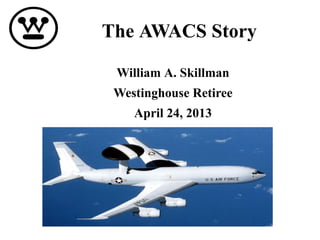
The AWACS Story 
William A. Skillman 
Westinghouse Retiree 
April 24, 2013
The Need for AWACS 
1962 – Air Force AEW Pulse Radar (EC-121 Warning Star) 
blind to low-flying targets 
Pulse Doppler developing technology offered look-down 
capability: 
Westinghouse: BOMARC, F-4J (F-4 A/C) Single Target radars, 
APQ-81-Track-While-Scan (U.S. Navy) 
Hughes: F-15 
General Electric/Northrop Grumman: E-2, Hawkeye, carrier 
AEW 
1963 USAF TAC & ADC issued 
SOR-206 “Airborne Warning and Control System (AWACS)”
Response to SOR 206 
AIRFRAME Proposals: 
Boeing, Douglas, Lockheed 
RADAR Proposals: 
Westinghouse, Hughes, Raytheon, GE, 3 
others 
AIR FORCE: 
SAB determined proof of concept needed, 
ASD formulated Overland Technology 
Program(ORT) 
DOD funded ORT program – 1964
ORT Aircraft – EC121-1966 
Three Aircraft with scaled radars: 
Westinghouse–High PRF (Pulse Repetition Frequency) 
Hughes – Medium PRF 
Raytheon – Low PRF 
Radar Antenna mounted in lower radome
ORT Antenna in EC-121 Radome 
Low sidelobe slotted waveguide array
Results of ORT Flight Tests 
1968 Raytheon and GE dropped 
1968-70 AWACS Support Program to develop 
critical radar technologies 
1970 Boeing selected as “prime” contractor 
1970 Radar Fly-off initiated: WECO and Hughes 
design & build Brassboard radars
Brassboard Fly-off 
Dec. 1971- Radars delivered to Boeing - Seattle 
1972 - Radars installed in 2 Boeing 707s 
Mar.-Sep. 1972 Radar Test Flights 
Westinghouse: 49 flights, 300 hours 
Oct. 1972 Flight test results and DDT& E 
proposals resulted in Westinghouse win
Westinghouse Brassboard Radar
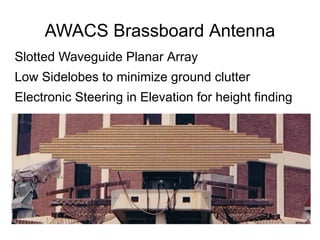
AWACS Brassboard Antenna 
Slotted Waveguide Planar Array 
Low Sidelobes to minimize ground clutter 
Electronic Steering in Elevation for height finding
Brassboard Aircraft
The Road to Production 
Post-Win: Airborne Tracking Demo - 6 flights 
VIP flights Andrews AFB 
Jan. 1973 Full Scale Production Authorized 
1974 Jamming Vulnerability “Adequate” 
1975 Production Radar Flight test begun 
Oct. 1976 1st Prod. Radar delivered to Boeing 
Mar. 1977 1st E-3A, Sentry, delivered to A.F. 
May 1978 Initial Operational Capability - 6 A/C
1980 Icelandic Odyssey! 
Balto. > Tinker > Keflavik> England + Reverse 
Purpose: observe performance of improvement
Who has 707 AWACS? 
U.S.A.F. AN/APY-1 
Active: …........................................31 
Scrap (TS-3 – BB A/C).................... 1 
Crashes (Nellis & Elmendorf AFB)..2 
NATO AN/APY-2 
Active: …........................................17 
Crash (Greece) …............................1 
U.K. …..................................................7 
France ….............................................4 
Saudi Arabia …....................................5 
TOTAL..........................................68
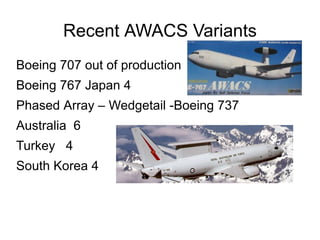
Recent AWACS Variants 
Boeing 707 out of production 
Boeing 767 Japan 4 
Phased Array – Wedgetail -Boeing 737 
Australia 6 
Turkey 4 
South Korea 4
AWACS Deployments 
Saudi Arabia – Yemen 
Desert Storm - Iraq 
Allied Force - Kosovo 
Enduring Freedom - Afganistan 
Iraqi Freedom 
Odyssey Dawn/Unified Protector - Libya 
Noble Eagle – Homeland defense 
Humanitarian Relief – Hurricanes Rita & Katrina
Non-US AWACS Radars 
These countries are the only exporters, besides 
the U.S., of an AWACS type radar. 
Russia IL-76 or A50 or Mainstay 
Sweden – SAAB, Ericsson, Erieye 
China – KJ-2000 (mod IL-76) 
Israel – Israeli Aircraft Industries – Phalcon 
Numerous radar/aircraft combinations are being 
supplied to other countries.
References 
Much of the material was drawn from: 
“Development of the Airborne Warning and Control System 
(AWACS) Radar” by Wm. A. Skillman and Robert E. Cowdery, 
recipients of the IEEE AESS 1995 Pioneer Award for the 
development of AWACS. Published in the IEEE Trans. on 
Aerospace and Electronic Systems, Vol 31, No. 4, Oct. 1995. 
For a later version with color pictures, as well as this slide 
show, see the author's website at 
“http://SkillmansofAmerica.com” 
Link to my home page top right 
Here you can also find two eye-witness accounts of the 
Hindenburg disaster of 1937 and a slide show “Remembering 
the Hindenburg” by the author.

AWACS Radar History

  • 1.
    The AWACS Story William A. Skillman Westinghouse Retiree April 24, 2013
  • 2.
    The Need forAWACS 1962 – Air Force AEW Pulse Radar (EC-121 Warning Star) blind to low-flying targets Pulse Doppler developing technology offered look-down capability: Westinghouse: BOMARC, F-4J (F-4 A/C) Single Target radars, APQ-81-Track-While-Scan (U.S. Navy) Hughes: F-15 General Electric/Northrop Grumman: E-2, Hawkeye, carrier AEW 1963 USAF TAC & ADC issued SOR-206 “Airborne Warning and Control System (AWACS)”
  • 3.
    Response to SOR206 AIRFRAME Proposals: Boeing, Douglas, Lockheed RADAR Proposals: Westinghouse, Hughes, Raytheon, GE, 3 others AIR FORCE: SAB determined proof of concept needed, ASD formulated Overland Technology Program(ORT) DOD funded ORT program – 1964
  • 4.
    ORT Aircraft –EC121-1966 Three Aircraft with scaled radars: Westinghouse–High PRF (Pulse Repetition Frequency) Hughes – Medium PRF Raytheon – Low PRF Radar Antenna mounted in lower radome
  • 5.
    ORT Antenna inEC-121 Radome Low sidelobe slotted waveguide array
  • 6.
    Results of ORTFlight Tests 1968 Raytheon and GE dropped 1968-70 AWACS Support Program to develop critical radar technologies 1970 Boeing selected as “prime” contractor 1970 Radar Fly-off initiated: WECO and Hughes design & build Brassboard radars
  • 7.
    Brassboard Fly-off Dec.1971- Radars delivered to Boeing - Seattle 1972 - Radars installed in 2 Boeing 707s Mar.-Sep. 1972 Radar Test Flights Westinghouse: 49 flights, 300 hours Oct. 1972 Flight test results and DDT& E proposals resulted in Westinghouse win
  • 8.
  • 9.
    AWACS Brassboard Antenna Slotted Waveguide Planar Array Low Sidelobes to minimize ground clutter Electronic Steering in Elevation for height finding
  • 10.
  • 11.
    The Road toProduction Post-Win: Airborne Tracking Demo - 6 flights VIP flights Andrews AFB Jan. 1973 Full Scale Production Authorized 1974 Jamming Vulnerability “Adequate” 1975 Production Radar Flight test begun Oct. 1976 1st Prod. Radar delivered to Boeing Mar. 1977 1st E-3A, Sentry, delivered to A.F. May 1978 Initial Operational Capability - 6 A/C
  • 12.
    1980 Icelandic Odyssey! Balto. > Tinker > Keflavik> England + Reverse Purpose: observe performance of improvement
  • 13.
    Who has 707AWACS? U.S.A.F. AN/APY-1 Active: …........................................31 Scrap (TS-3 – BB A/C).................... 1 Crashes (Nellis & Elmendorf AFB)..2 NATO AN/APY-2 Active: …........................................17 Crash (Greece) …............................1 U.K. …..................................................7 France ….............................................4 Saudi Arabia …....................................5 TOTAL..........................................68
  • 14.
    Recent AWACS Variants Boeing 707 out of production Boeing 767 Japan 4 Phased Array – Wedgetail -Boeing 737 Australia 6 Turkey 4 South Korea 4
  • 15.
    AWACS Deployments SaudiArabia – Yemen Desert Storm - Iraq Allied Force - Kosovo Enduring Freedom - Afganistan Iraqi Freedom Odyssey Dawn/Unified Protector - Libya Noble Eagle – Homeland defense Humanitarian Relief – Hurricanes Rita & Katrina
  • 16.
    Non-US AWACS Radars These countries are the only exporters, besides the U.S., of an AWACS type radar. Russia IL-76 or A50 or Mainstay Sweden – SAAB, Ericsson, Erieye China – KJ-2000 (mod IL-76) Israel – Israeli Aircraft Industries – Phalcon Numerous radar/aircraft combinations are being supplied to other countries.
  • 17.
    References Much ofthe material was drawn from: “Development of the Airborne Warning and Control System (AWACS) Radar” by Wm. A. Skillman and Robert E. Cowdery, recipients of the IEEE AESS 1995 Pioneer Award for the development of AWACS. Published in the IEEE Trans. on Aerospace and Electronic Systems, Vol 31, No. 4, Oct. 1995. For a later version with color pictures, as well as this slide show, see the author's website at “http://SkillmansofAmerica.com” Link to my home page top right Here you can also find two eye-witness accounts of the Hindenburg disaster of 1937 and a slide show “Remembering the Hindenburg” by the author.