IEEE New Hampshire Section
Radar Systems Course 1
Airborne PD 1/1/2010 IEEE AES Society
Radar Systems Engineering
Lecture 14
Airborne Pulse Doppler Radar
Dr. Robert M. O’Donnell
IEEE New Hampshire Section
Guest Lecturer
Radar Systems Course 2
Airborne PD 1/1/2010
IEEE New Hampshire Section
IEEE AES Society
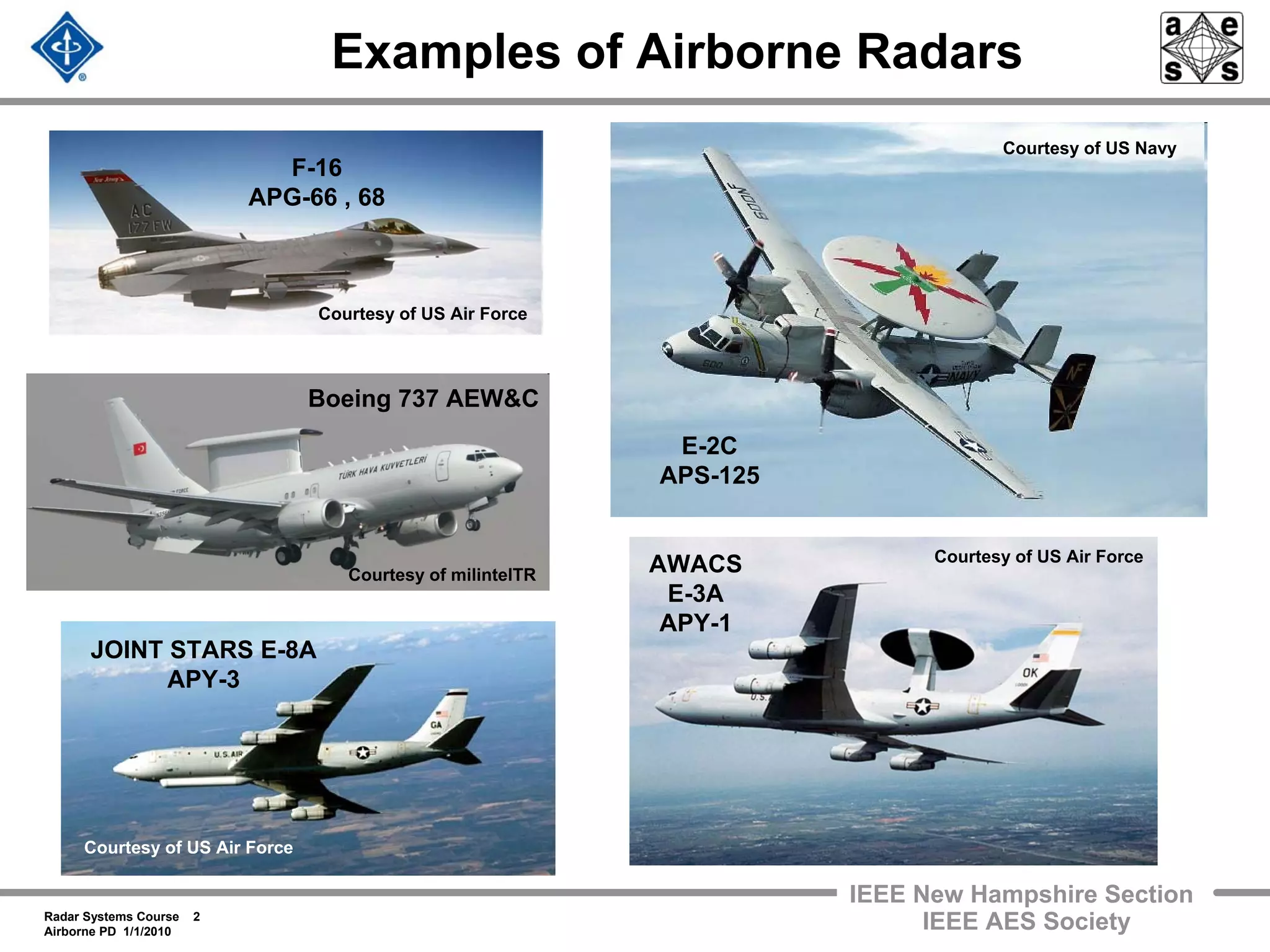
Examples of Airborne Radars
Courtesy of US Air Force
AWACS
E-3A
APY-1
F-16
APG-66 , 68
E-2C
APS-125
Courtesy of US Navy
JOINT STARS E-8A
APY-3
Courtesy of US Air Force
Courtesy of milintelTR
Boeing 737 AEW&C
Radar Systems Course 3
Airborne PD 1/1/2010
IEEE New Hampshire Section
IEEE AES Society
Outline
• Introduction
– The airborne radar mission and environment
Clutter is the main issue
• Different airborne radar missions
– Pulse Doppler radar in small fighter / interceptor aircraft
F-14, F-15, F-16, F-35
– Airborne, surveillance, early warning radars
E-2C (Hawkeye), E-3 (AWACS), E-8A (JOINT STARS)
– Airborne synthetic aperture radar
Military and civilian remote sensing missions
To be covered in lecture 19, later in the course
• Summary
Radar Systems Course 4
Airborne PD 1/1/2010
IEEE New Hampshire Section
IEEE AES Society
Pulse
Compression
Receiver
Clutter Rejection
(Doppler Filtering)
A / D
Converter
Block Diagram of Radar System
Antenna
Propagation
Medium
Target
Radar
Cross
Section
Transmitter
General Purpose Computer
Tracking
Data
Recording
Parameter
Estimation
Waveform
Generation
Detection
Power
Amplifier
T / R
Switch
Signal Processor Computer
Thresholding
User Displays and Radar Control
Photo Image
Courtesy of US Air Force
Clutter as seen from an airborne platform,
Signal waveforms, and Doppler processing
will be the focus in this lecture
Radar Systems Course 5
Airborne PD 1/1/2010
IEEE New Hampshire Section
IEEE AES Society
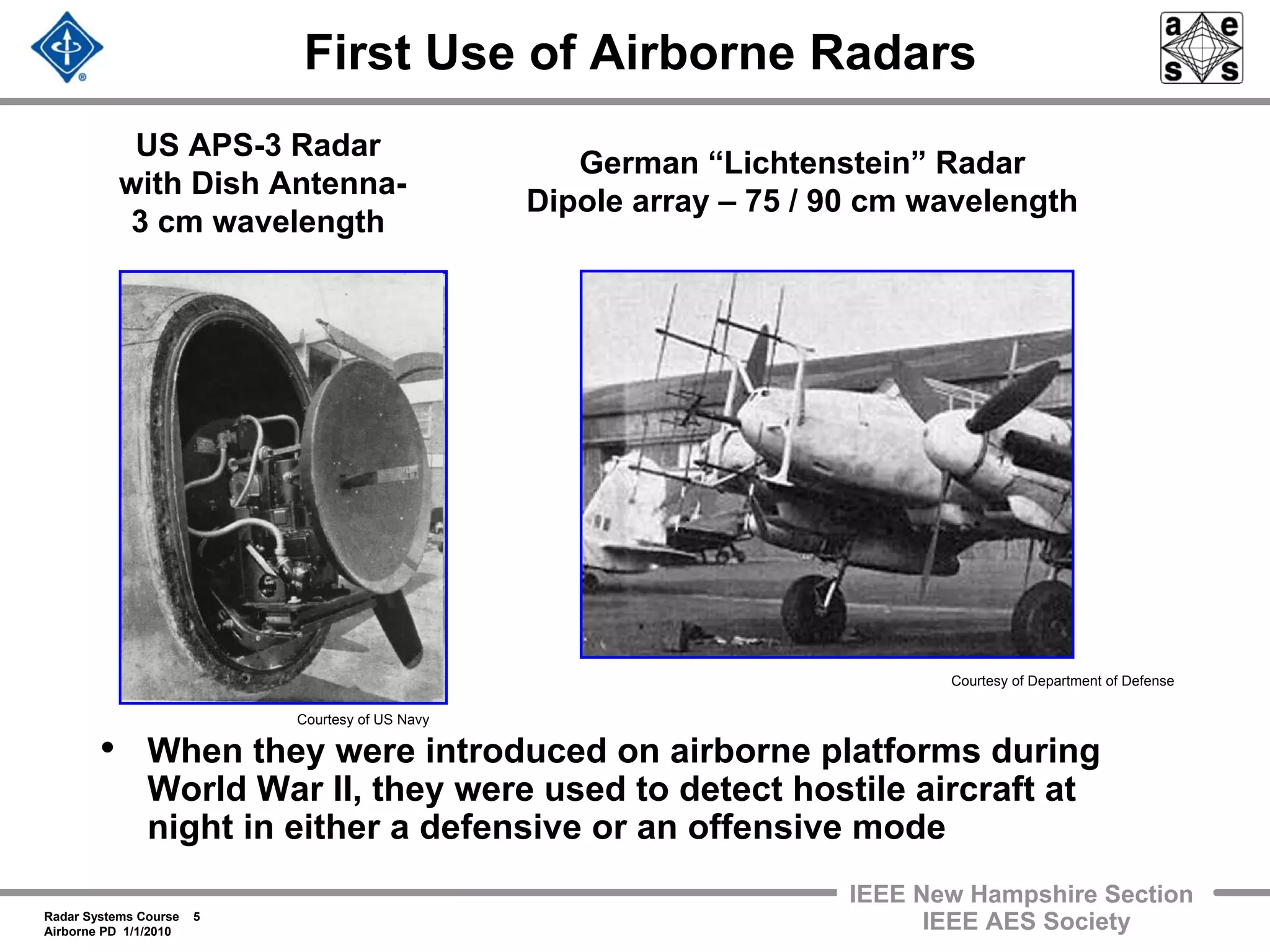
First Use of Airborne Radars
• When they were introduced on airborne platforms during
World War II, they were used to detect hostile aircraft at
night in either a defensive or an offensive mode
US APS-3 Radar
with Dish Antenna-
3 cm wavelength
German “Lichtenstein” Radar
Dipole array – 75 / 90 cm wavelength
Courtesy of US Navy
Courtesy of Department of Defense
Radar Systems Course 6
Airborne PD 1/1/2010
IEEE New Hampshire Section
IEEE AES Society
Role of Airborne Military Radars
• Missions and Functions
– Surveillance, Tracking, Fire Control
– Reconnaissance
– Intelligence
• Examples
– Air-to-air fighter combat
Aircraft interception (against air breathing targets)
– Airborne Early warning
– Air to ground missions
– Close air support
– Ground target detection and tracking
• Radar modes
– Pulse Doppler radar
– Synthetic Aperture radar
– Displaced Phase Center Antenna (DPCA)
– Ground Moving Target Indication
Radar Systems Course 7
Airborne PD 1/1/2010
IEEE New Hampshire Section
IEEE AES Society
Geometry of Airborne Clutter
• Key components of the ground clutter echo from radar’s on
an airborne platform:
– Main beam of antenna illuminates the ground
– Antenna sidelobes illuminate clutter over a wide range of
viewing angles
– Altitude return reflects from the ground directly below the radar
The Doppler frequency distributions of these effects and how
they affect radar performance differ with:
1. radar platform velocity (speed and angle), and
2. the geometry (aspect angle of aircraft relative to ground
illumination point)
PV
Radar Systems Course 8
Airborne PD 1/1/2010
IEEE New Hampshire Section
IEEE AES Society
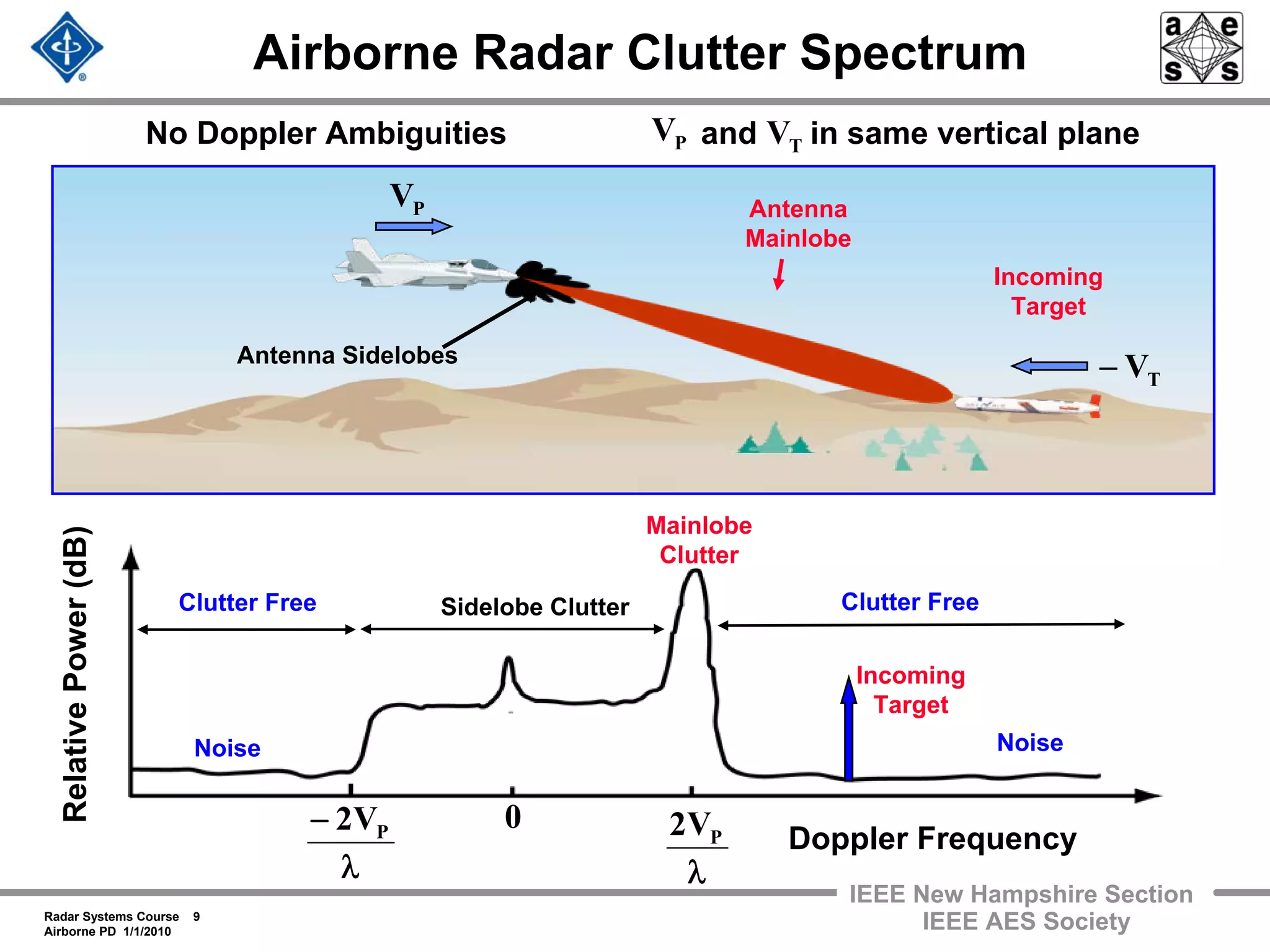
Airborne Radar Clutter Spectrum
Antenna
Mainlobe
Antenna Sidelobes
PV
Outgoing
Target
RelativePower(dB)
λ
PV20
λ
− PV2
Outgoing
Target
Doppler Frequency
Noise Noise
Clutter Free Clutter FreeSidelobe Clutter
Mainlobe
Clutter
TV
No Doppler Ambiguities and in same vertical planePV TV
Radar Systems Course 9
Airborne PD 1/1/2010
IEEE New Hampshire Section
IEEE AES Society
Airborne Radar Clutter Spectrum
Antenna
Mainlobe
Antenna Sidelobes
PV
Incoming
Target
RelativePower(dB)
λ
PV20
λ
− PV2
Doppler Frequency
Noise Noise
Clutter Free Clutter FreeSidelobe Clutter
Mainlobe
Clutter
Incoming
Target
No Doppler Ambiguities and in same vertical planePV TV
TV−
Radar Systems Course 10
Airborne PD 1/1/2010
IEEE New Hampshire Section
IEEE AES Society
MIT Lincoln Laboratory
Viewgraph Courtesy of MIT Lincoln Laboratory Used with permission
Radar Systems Course 11
Airborne PD 1/1/2010
IEEE New Hampshire Section
IEEE AES Society
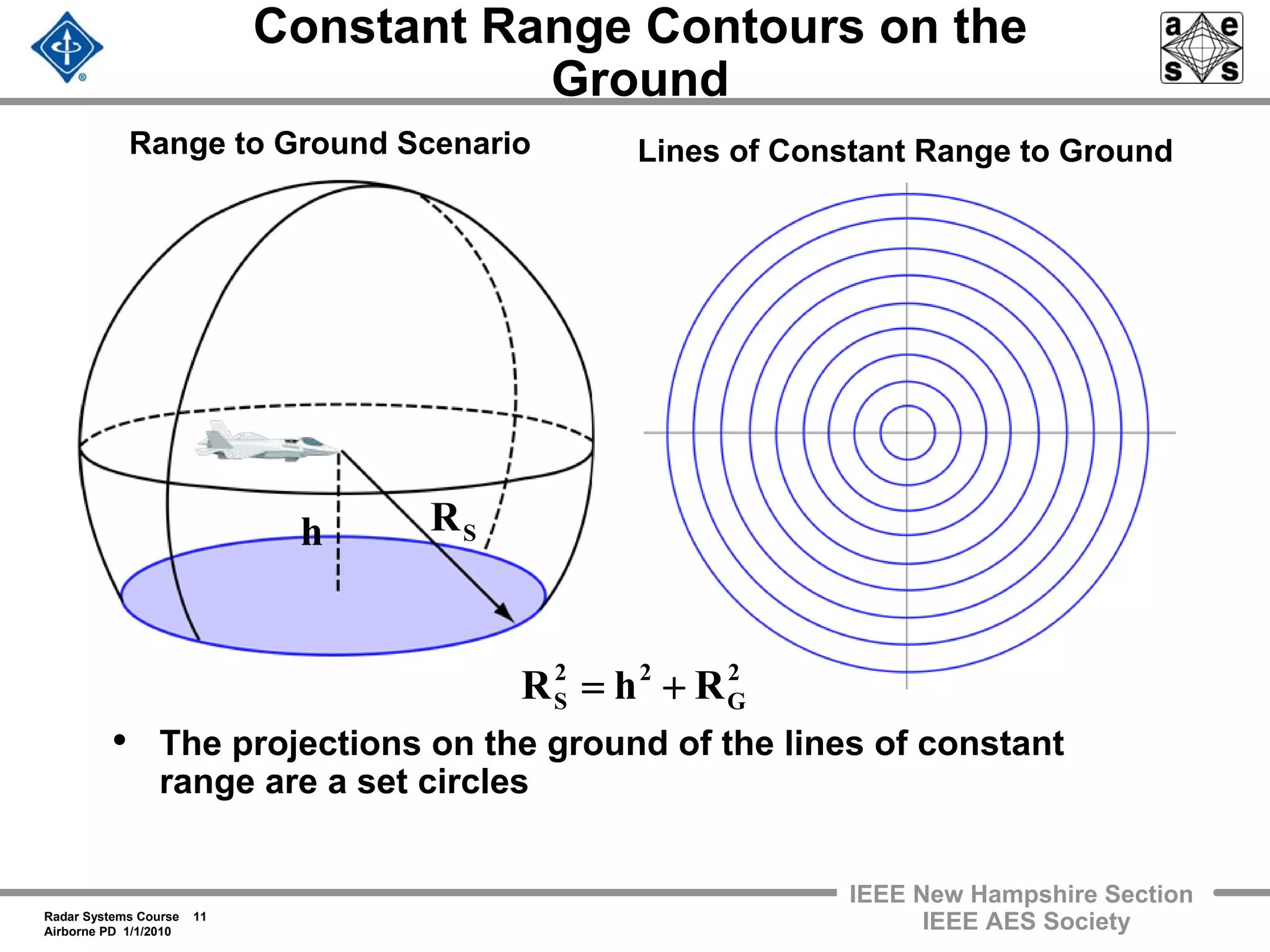
Constant Range Contours on the
Ground
• The projections on the ground of the lines of constant
range are a set circles
Range to Ground Scenario Lines of Constant Range to Ground
2
G
22
S RhR +=
SRh
Radar Systems Course 12
Airborne PD 1/1/2010
IEEE New Hampshire Section
IEEE AES Society
Constant Doppler Velocity Contours on
the Ground
• The projections on the
ground of the lines of
constant Doppler velocity
are a set hyperbolae
α
velocityPlatformV
velocityClutterV
sincosV
cosVV
P
C
P
PC
=
=
φθ=
α=
λ
α
=
cosV2
f C
D
Radar Systems Course 13
Airborne PD 1/1/2010
IEEE New Hampshire Section
IEEE AES Society
Constant Doppler Contours on Ground
• The lines of constant
Doppler
frequency/velocity are
called “Isodops”
• The equation for the
family of hyperbolae
depend on:
– Airborne radar height
above ground
– Angle between airborne
radar velocity and the
point on the ground that
is illuminated
– Wavelength of radar
PC VV −= PC VV +=
0VC =
0VC =
Radar Systems Course 14
Airborne PD 1/1/2010
IEEE New Hampshire Section
IEEE AES Society
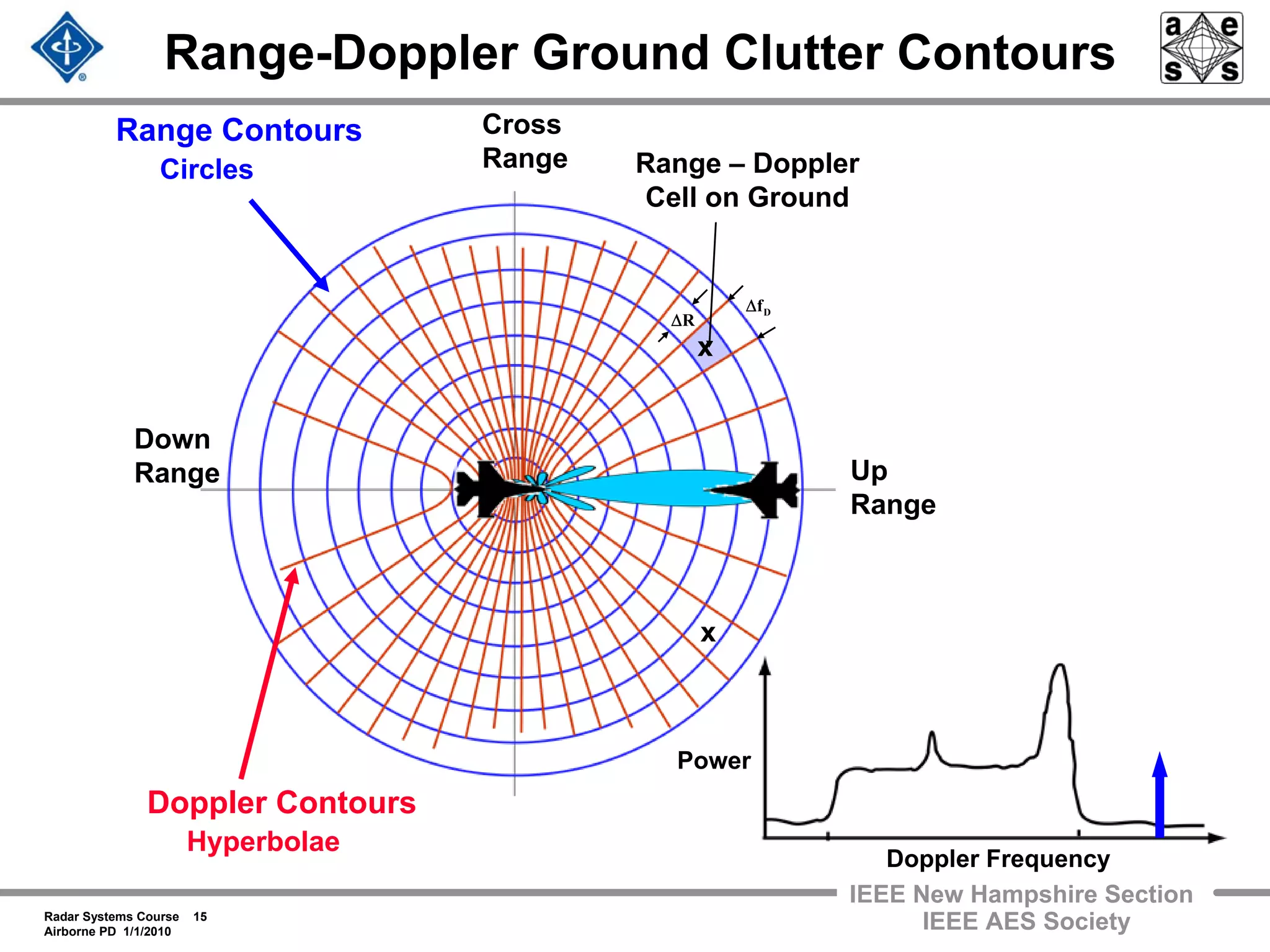
Range-Doppler Ground Clutter Contours
Up
Range
Cross
Range
Down
Range
Range Contours
Circles
Doppler Contours
Hyperbolae
PC VV +=PC VV −=
0VC =
0VC =
Radar Systems Course 15
Airborne PD 1/1/2010
IEEE New Hampshire Section
IEEE AES Society
Range-Doppler Ground Clutter Contours
Up
Range
Cross
Range
Down
Range
Range Contours
Circles
Doppler Contours
Hyperbolae
RΔ
DfΔ
Range – Doppler
Cell on Ground
x
x
Power
Doppler Frequency
Radar Systems Course 16
Airborne PD 1/1/2010
IEEE New Hampshire Section
IEEE AES Society
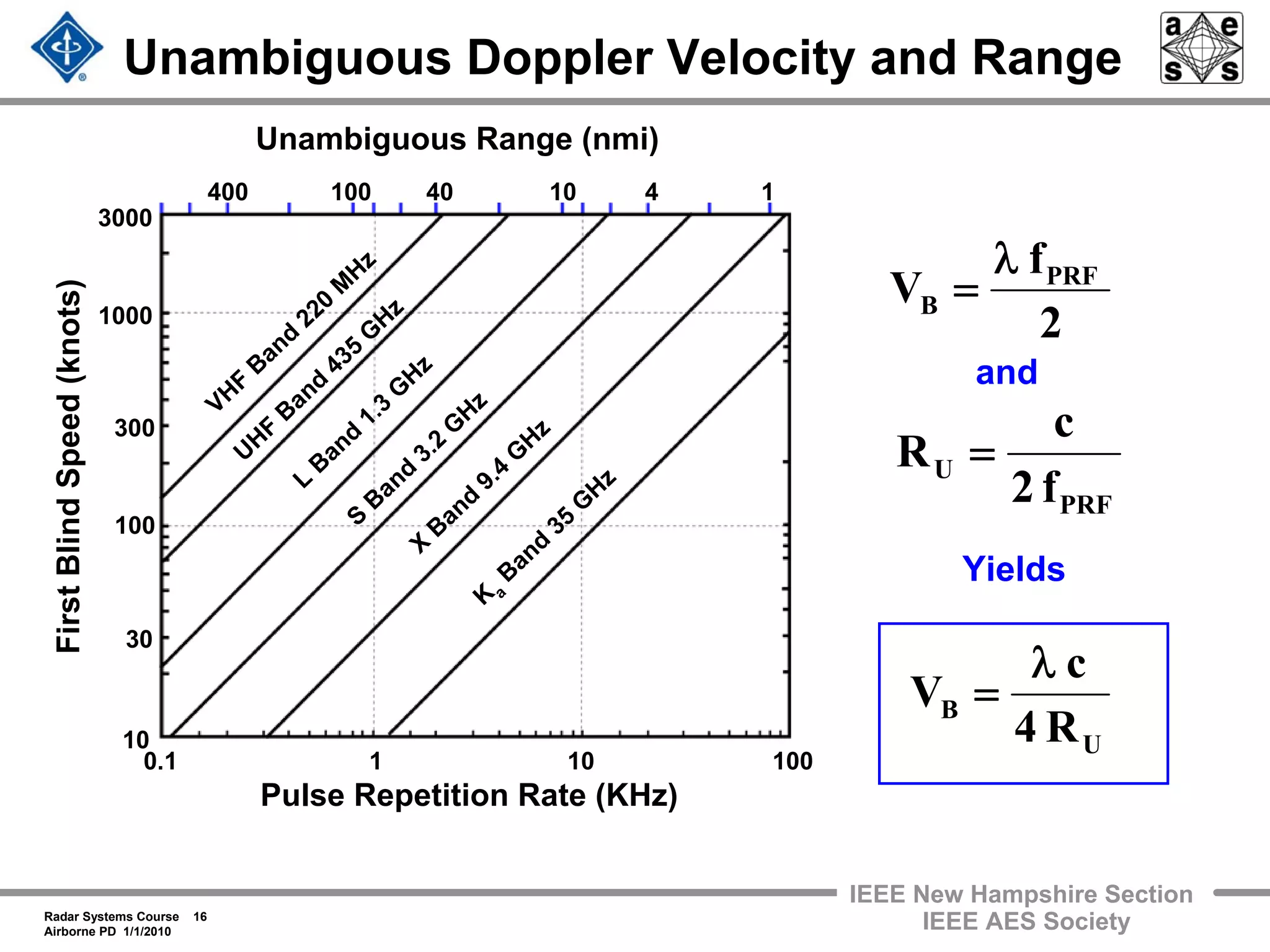
Unambiguous Doppler Velocity and Range
2
f
V PRF
B
λ
=
PRF
U
f2
c
R =
and
FirstBlindSpeed(knots)
10
30
100
1000
3000
300
Pulse Repetition Rate (KHz)
0.1 1 10 100
Unambiguous Range (nmi)
400 100 40 10 4 1
K a
Band
35
G
HzL
Band
1.3
G
Hz
U
HF
Band
435
G
Hz
X
Band
9.4
G
Hz
S
Band
3.2
G
HzVHF
Band
220
M
Hz
Yields
U
B
R4
c
V
λ
=
Radar Systems Course 17
Airborne PD 1/1/2010
IEEE New Hampshire Section
IEEE AES Society
Classes of Pulse Doppler Radars
Highly
Ambiguous
Ambiguous
Highly
Ambiguous
Ambiguous
Unambiguous
Unambiguous
Range
Measurement
Doppler
Measurement
Low PRF
Medium PRF
High PRF
Radar Systems Course 18
Airborne PD 1/1/2010
IEEE New Hampshire Section
IEEE AES Society
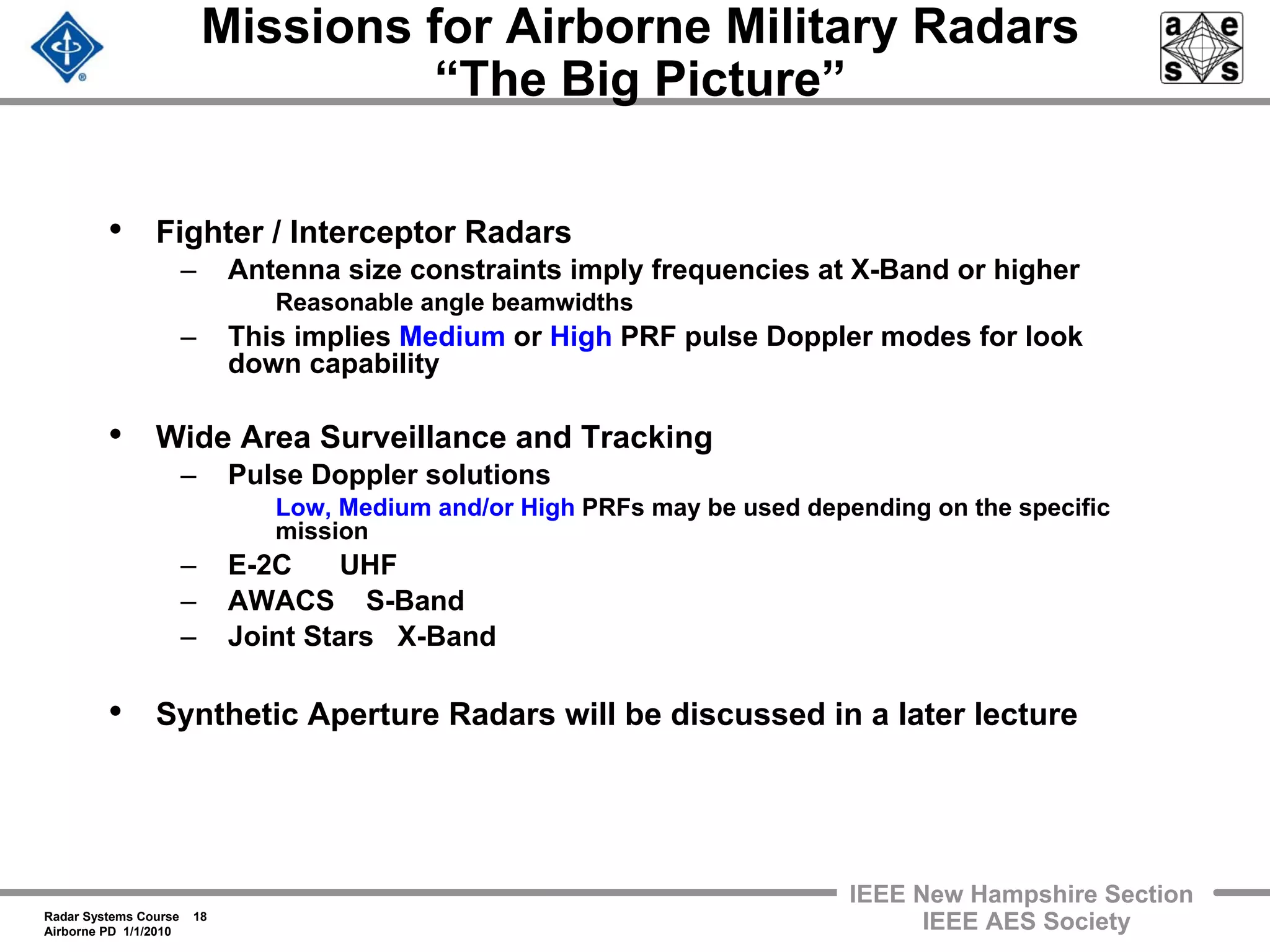
Missions for Airborne Military Radars
“The Big Picture”
• Fighter / Interceptor Radars
– Antenna size constraints imply frequencies at X-Band or higher
Reasonable angle beamwidths
– This implies Medium or High PRF pulse Doppler modes for look
down capability
• Wide Area Surveillance and Tracking
– Pulse Doppler solutions
Low, Medium and/or High PRFs may be used depending on the specific
mission
– E-2C UHF
– AWACS S-Band
– Joint Stars X-Band
• Synthetic Aperture Radars will be discussed in a later lecture
Radar Systems Course 19
Airborne PD 1/1/2010
IEEE New Hampshire Section
IEEE AES Society
Outline
• Introduction
– The airborne radar environment
• Different airborne radar missions
– Pulse Doppler radar in small fighter / interceptor aircraft
F-14, F-15, F-16, F-35
High PRF Modes
Medium PRF Modes
– Airborne, surveillance, early warning radars
E-2C (Hawkeye), E-3 (AWACS), E-8A (JOINT STARS)
– Airborne synthetic aperture radar
Military and civilian remote sensing missions
To be covered in lecture 19, later in the course
• Summary
Radar Systems Course 20
Airborne PD 1/1/2010
IEEE New Hampshire Section
IEEE AES Society
Photographs of Fighter Radars
APG-66
(F-16)
Courtesy of Northrop Grumman
Used with Permission
APG-81 (F-35)
Courtesy of Northrop Grumman
Used with Permission
APG-65
(F-18)
Courtesy of Raytheon
Used with permission
Courtesy of Boeing
Used with permission
APG-63 V(2)
(F-15C)
Active Electronically Scanned Arrays (AESA)
Radar built by
Raytheon
Courtesy of USAF
Radar Systems Course 21
Airborne PD 1/1/2010
IEEE New Hampshire Section
IEEE AES Society
Outline
• Introduction
– The airborne radar environment
• Different airborne radar missions
– Pulse Doppler radar in small fighter / interceptor aircraft
F-14, F-15, F-16, F-35
High PRF Modes
Medium PRF Modes
– Airborne, surveillance, early warning radars
E-2C (Hawkeye), E-3 (AWACS), E-8A (JOINT STARS)
– Airborne synthetic aperture radar
Military and civilian remote sensing missions
To be covered in lecture 19, later in the course
• Summary
Radar Systems Course 22
Airborne PD 1/1/2010
IEEE New Hampshire Section
IEEE AES Society
Pulse Doppler PRFs
• X- Band High PRF 100 - 300 KHz < 50%
• X- Band Medium PRF 10 - 30 KHz ~ 5%
• X- Band Low PRF 1 - 3 KHz ~.5%
• UHF Low PRF 300 Hz Low
Frequency PRF Type PRF Range* Duty Cycle*
* Typical values only; specific radars may vary inside and outside these limits
Radar Systems Course 23
Airborne PD 1/1/2010
IEEE New Hampshire Section
IEEE AES Society
High PRF Mode
• X- Band High PRF 100 - 300 KHz < 50%
• For high PRF mode :
– Range – Highly ambiguous
Range ambiguities resolved using techniques discussed in Lecture
13
– Doppler velocity – Unambiguous
For nose on encounters, detection is clutter free
– High duty cycle implies significant “Eclipsing Loss”
Multiple PRFs, or other techniques required
Frequency PRF Type PRF Range* Duty Cycle*
Example: PRF = 150 KHz Duty Cycle = 35%
PRI= 6.67 μsec Pulsewidth = 2.33 μsec
Unambiguous Range = 1 km
Unambiguous Doppler Velocity = 4,500 knots
Radar Systems Course 24
Airborne PD 1/1/2010
IEEE New Hampshire Section
IEEE AES Society
• High PRF airborne radars tend to have a High Duty cycle to get
high energy on the target
– Pulse compression used
• Eclipsing loss is caused because the receiver cannot be
receiving target echoes when the radar is transmitting
– Can be significant for high duty cycle radars
– Loss can easily be 1-2 dB, if not mitigated
High PRF Mode – Range Eclipsing
Time
Transmit Pulsewidth
PRI
Uneclipsed
Target
Receive Time
Eclipsed
Target
Radar Systems Course 25
Airborne PD 1/1/2010
IEEE New Hampshire Section
IEEE AES Society
High PRF Pulse Doppler Radar
• No Doppler velocity ambiguities, many range ambiguities
– Significant range eclipsing loss
• Range ambiguities can be resolved by transmitting 3
redundant waveforms, each at a different PRF
– Often only a single range gate is employed, but with a large
Doppler filter bank
• The antenna side lobes must be very low to minimize
sidelobe clutter
– Short range sidelobe clutter often masks low radial velocity
targets
• High closing speed aircraft are detected at long range in
clutter free region
• Range accuracy and ability to resolve multiple targets can
be poorer than with other waveforms
Radar Systems Course 26
Airborne PD 1/1/2010
IEEE New Hampshire Section
IEEE AES Society
Outline
• Introduction
– The airborne radar environment
• Different airborne radar missions
– Pulse Doppler radar in small fighter / interceptor aircraft
F-14, F-15, F-16, F-35
High PRF Modes
Medium PRF Modes
– Airborne, surveillance, early warning radars
E-2C (Hawkeye), E-3 (AWACS), E-8A (JOINT STARS)
– Airborne synthetic aperture radar
Military and civilian remote sensing missions
To be covered in lecture 19, later in the course
• Summary
Radar Systems Course 27
Airborne PD 1/1/2010
IEEE New Hampshire Section
IEEE AES Society
• X- Band Medium PRF 10 - 30 KHz ~ 5%
• For the medium PRF mode :
– Clutter and target ambiguities in range and velocity
– Clutter from antenna sidelobes is an significant issue
Medium PRF Mode
Frequency PRF Type PRF Range* Duty Cycle*
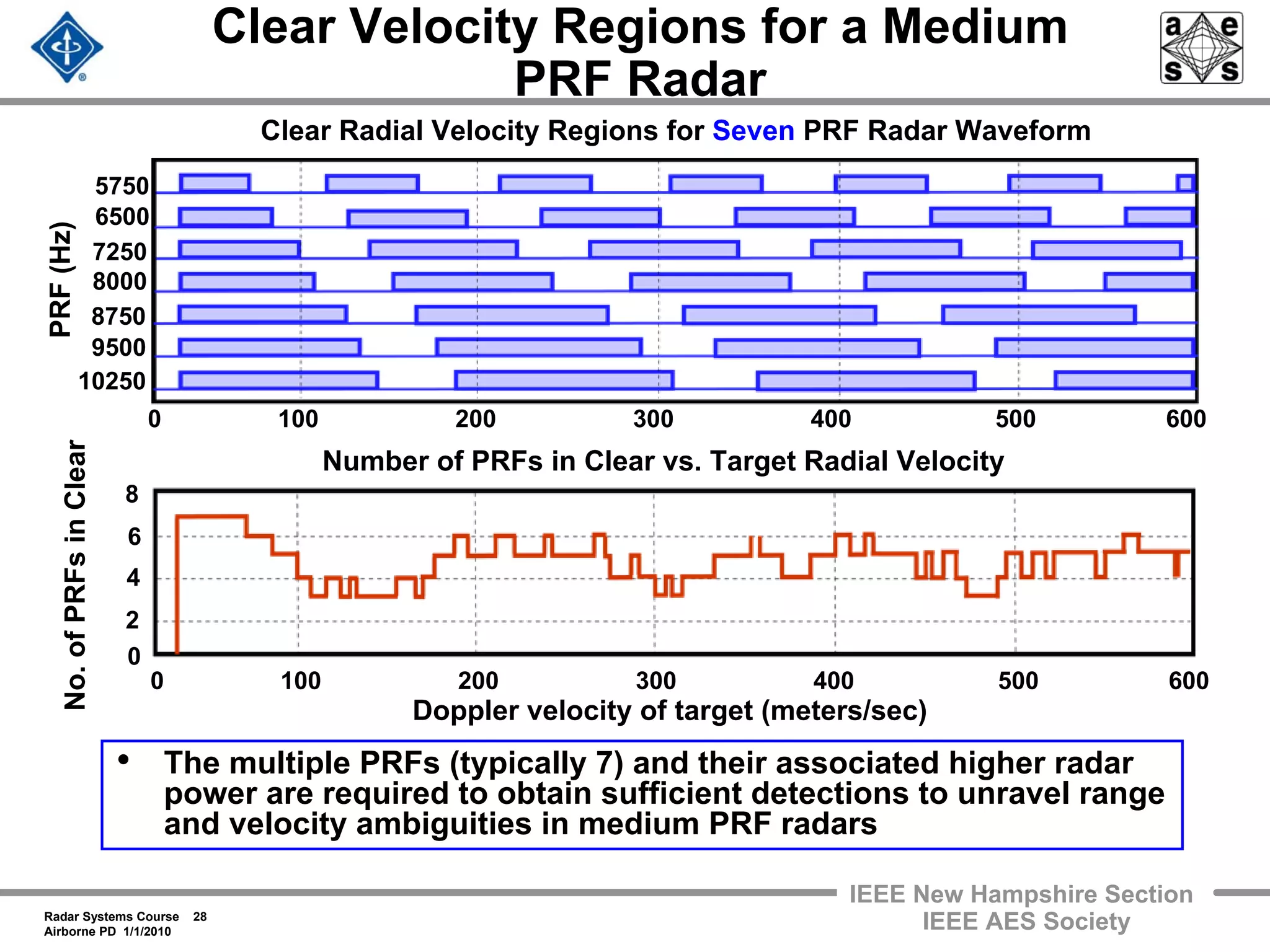
Example : 7 PRF = 5.75, 6.5, 7.25, 8, 8.75, 9.5 & 10.25 KHz
(From Figure 3.44 in text)
Range Ambiguities = ~14 to 26 km
Blind Speeds = ~175 to 310 knots
Radar Systems Course 28
Airborne PD 1/1/2010
IEEE New Hampshire Section
IEEE AES Society
Clear Velocity Regions for a Medium
PRF Radar
• The multiple PRFs (typically 7) and their associated higher radar
power are required to obtain sufficient detections to unravel range
and velocity ambiguities in medium PRF radars
Clear Radial Velocity Regions for Seven PRF Radar Waveform
0 100 200 300 400 500 600
Doppler velocity of target (meters/sec)
0 100 200 300 400 500 600
Number of PRFs in Clear vs. Target Radial Velocity
PRF(Hz)
5750
6500
7250
8000
8750
9500
10250
No.ofPRFsinClear
0
2
4
6
8
Radar Systems Course 29
Airborne PD 1/1/2010
IEEE New Hampshire Section
IEEE AES Society
Medium PRF Mode
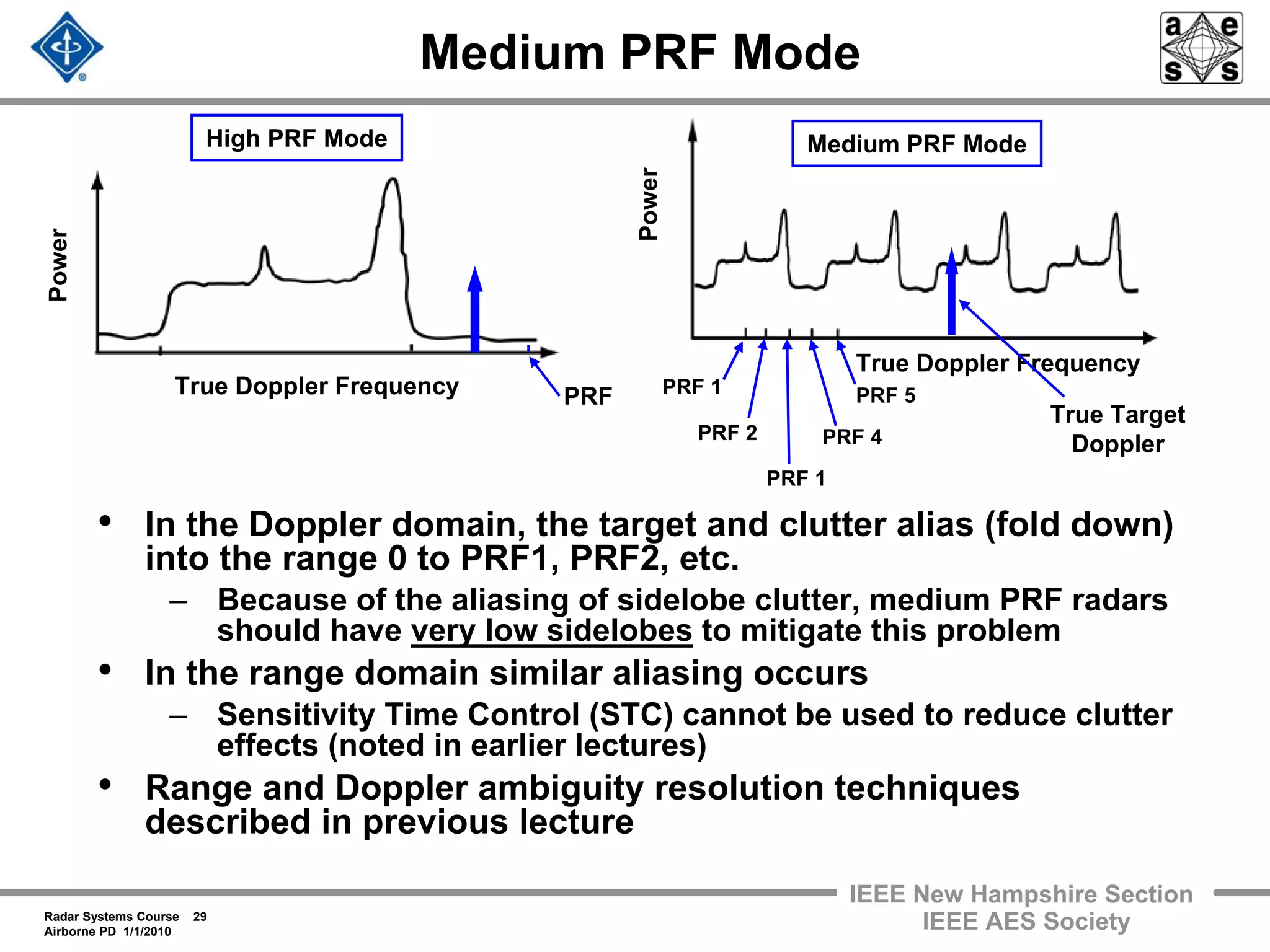
• In the Doppler domain, the target and clutter alias (fold down)
into the range 0 to PRF1, PRF2, etc.
– Because of the aliasing of sidelobe clutter, medium PRF radars
should have very low sidelobes to mitigate this problem
• In the range domain similar aliasing occurs
– Sensitivity Time Control (STC) cannot be used to reduce clutter
effects (noted in earlier lectures)
• Range and Doppler ambiguity resolution techniques
described in previous lecture
High PRF Mode
True Doppler Frequency
Power
PRF
PRF 2
PRF 1
PRF 1
PRF 4
PRF 5
True Doppler Frequency
Medium PRF Mode
Power
True Target
Doppler
Radar Systems Course 30
Airborne PD 1/1/2010
IEEE New Hampshire Section
IEEE AES Society
Medium PRF Pulse Doppler Radar
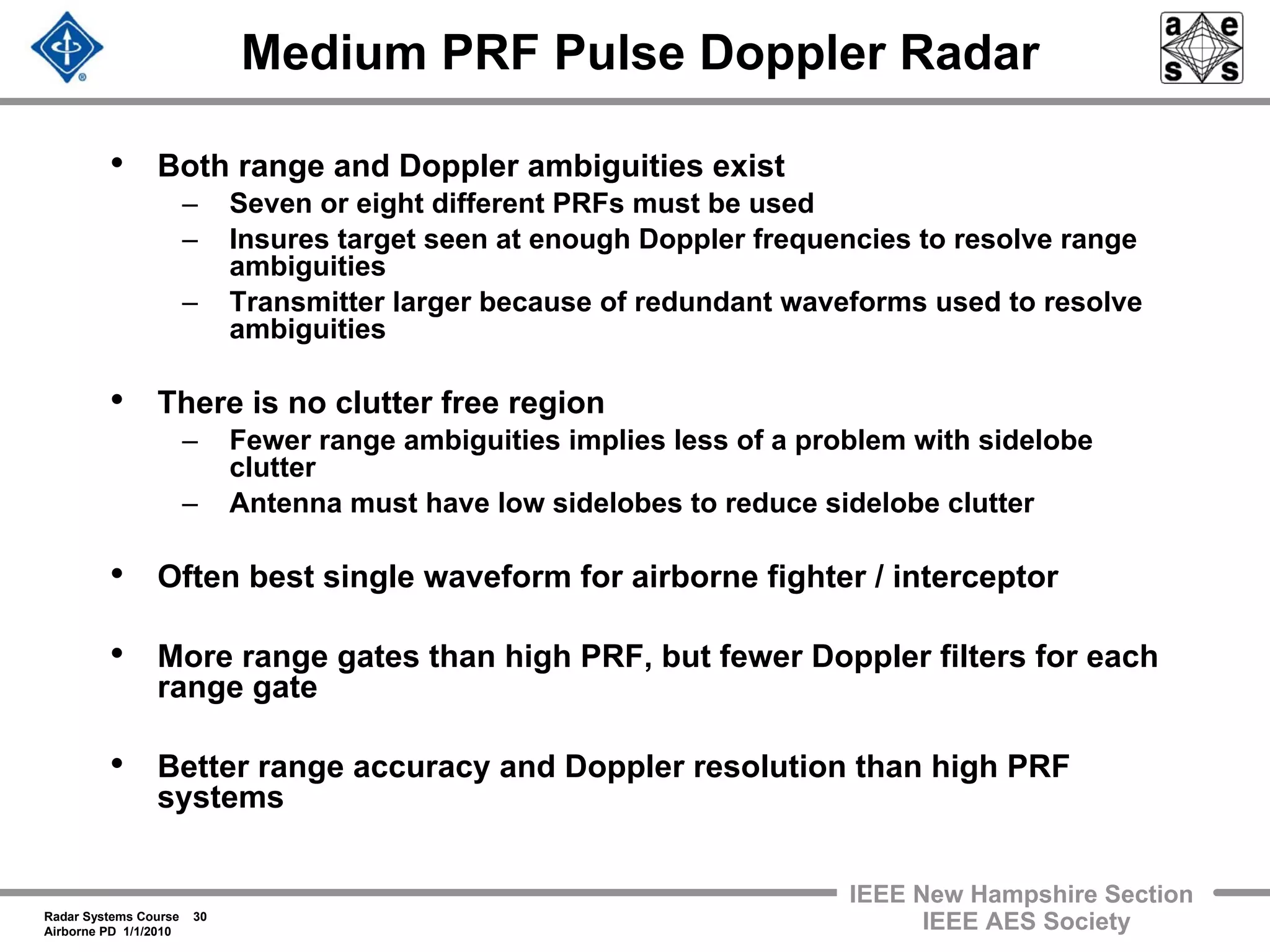
• Both range and Doppler ambiguities exist
– Seven or eight different PRFs must be used
– Insures target seen at enough Doppler frequencies to resolve range
ambiguities
– Transmitter larger because of redundant waveforms used to resolve
ambiguities
• There is no clutter free region
– Fewer range ambiguities implies less of a problem with sidelobe
clutter
– Antenna must have low sidelobes to reduce sidelobe clutter
• Often best single waveform for airborne fighter / interceptor
• More range gates than high PRF, but fewer Doppler filters for each
range gate
• Better range accuracy and Doppler resolution than high PRF
systems
Radar Systems Course 31
Airborne PD 1/1/2010
IEEE New Hampshire Section
IEEE AES Society
Outline
• Introduction
– The airborne radar environment
• Different airborne radar missions
– Pulse Doppler radar in small fighter / interceptor aircraft
F-14, F-15, F-16, F-35
– Airborne, surveillance, early warning radars
E-2C (Hawkeye), E-3 (AWACS), E-8A (JOINT STARS)
– Airborne synthetic aperture radar
Military and civilian remote sensing missions
To be covered in lecture 19, later in the course
• Summary
Radar Systems Course 32
Airborne PD 1/1/2010
IEEE New Hampshire Section
IEEE AES Society
Airborne Surveillance & Tracking
Radars
• Missions and Functions
– Surveillance, Tracking, Fire Control
– Reconnaissance
– Intelligence
• Examples
– Airborne early warning
– Ground target detection and tracking
• Radar modes
– Pulse Doppler radar
– Synthetic Aperture radar
– Displaced Phase Center Antenna (DPCA)
– Other modes/techniques
Elevated radar platforms provide long range and
over the horizon coverage of airborne and ground based targets
Radar Systems Course 33
Airborne PD 1/1/2010
IEEE New Hampshire Section
IEEE AES Society
Examples of Airborne Radars
Courtesy of US Air Force
AWACS
E-3A
APY-1
E-2C
APS-125
Courtesy of US Navy
JOINT STARS E-8A
APY-3
Courtesy of US Air Force
Courtesy of milintelTR
Boeing 737 AEW&C
Courtesy of US Air Force
Global Hawk
Radar Systems Course 34
Airborne PD 1/1/2010
IEEE New Hampshire Section
IEEE AES Society
AEW Radar Coverage
• Elevating the radar can extend radar coverage well out over the
horizon
• Range Coverage -400 km to 800 km
– Ground based radars ~400 km
– Airborne radar ~800 km
• Issues
– High acquisition and operating costs
– Limited Antenna size
– Radar Weight and prime power
– More challenging clutter environment
Ground Based Surveillance Radar Coverage Airborne Surveillance Radar Coverage
Radar Systems Course 35
Airborne PD 1/1/2010
IEEE New Hampshire Section
IEEE AES Society
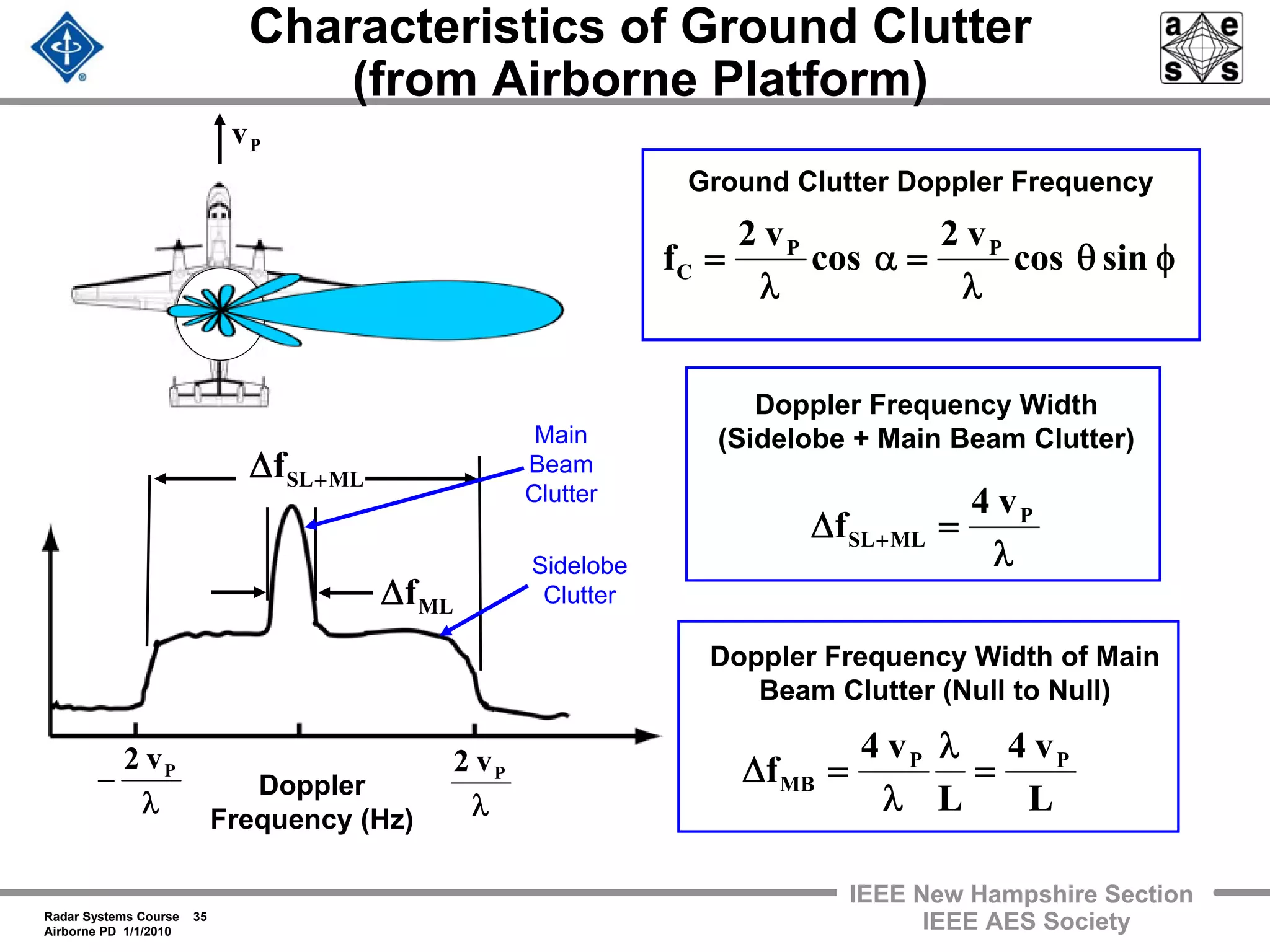
Characteristics of Ground Clutter
(from Airborne Platform)
λ
− Pv2
λ
Pv2
Doppler
Frequency (Hz)
MLfΔ
MLSLf +Δ
Ground Clutter Doppler Frequency
φθ
λ
=α
λ
= sincos
v2
cos
v2
f PP
C
Doppler Frequency Width
(Sidelobe + Main Beam Clutter)
λ
=Δ +
P
MLSL
v4
f
Doppler Frequency Width of Main
Beam Clutter (Null to Null)
L
v4
L
v4
f PP
MB =
λ
λ
=Δ
Pv
Main
Beam
Clutter
Sidelobe
Clutter
Radar Systems Course 36
Airborne PD 1/1/2010
IEEE New Hampshire Section
IEEE AES Society
Spread of Main Beam Clutter
• Doppler frequency of
clutter return depends on
angle of clutter with
velocity vector of aircraft
• Doppler frequency of
clutter return at center of
beam
• Doppler spread of main
beam clutter can be found
by differentiating this
equation
θ
λ
= cos
V2
f P
C
θ
Bθ
α
Beam
CenterIndividual
Clutter
Scatterer
Radar
PV
AircraftVelocityandTrajectory
θθ
λ
=Δ sin
V2
f B
P
C
Spread of Main Beam Clutter
Maximum at = 90°θ
Adapted from
Skolnik Reference 1
Depression angle of beam neglected
Radar Systems Course 37
Airborne PD 1/1/2010
IEEE New Hampshire Section
IEEE AES Society
35Hz
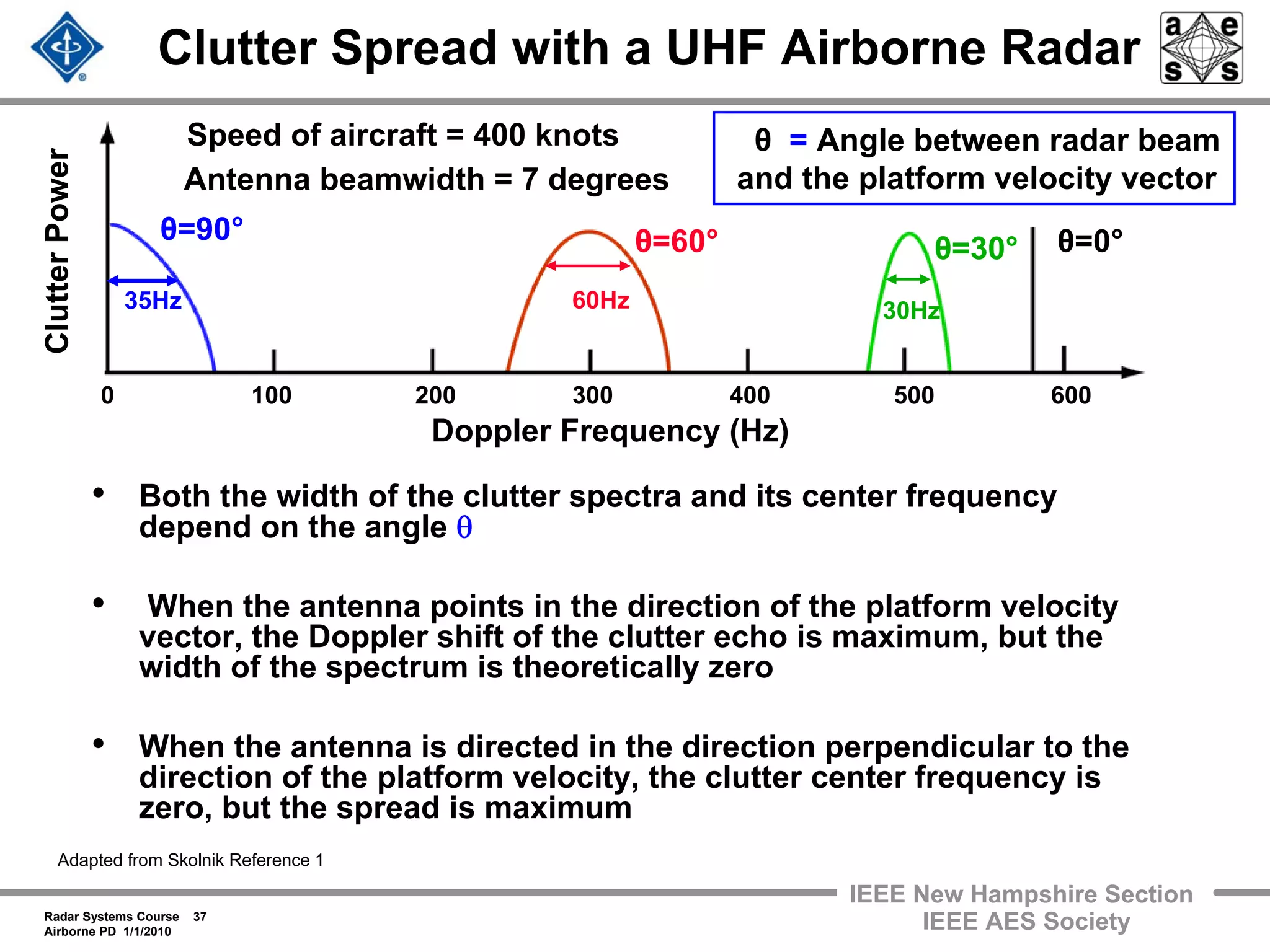
Clutter Spread with a UHF Airborne Radar
• Both the width of the clutter spectra and its center frequency
depend on the angle θ
• When the antenna points in the direction of the platform velocity
vector, the Doppler shift of the clutter echo is maximum, but the
width of the spectrum is theoretically zero
• When the antenna is directed in the direction perpendicular to the
direction of the platform velocity, the clutter center frequency is
zero, but the spread is maximum
θ=90° θ=0°θ=30°θ=60°
Doppler Frequency (Hz)
0 100 200 300 400 500 600
ClutterPower
Speed of aircraft = 400 knots θ = Angle between radar beam
and the platform velocity vectorAntenna beamwidth = 7 degrees
30Hz60Hz
Adapted from Skolnik Reference 1
Radar Systems Course 38
Airborne PD 1/1/2010
IEEE New Hampshire Section
IEEE AES Society
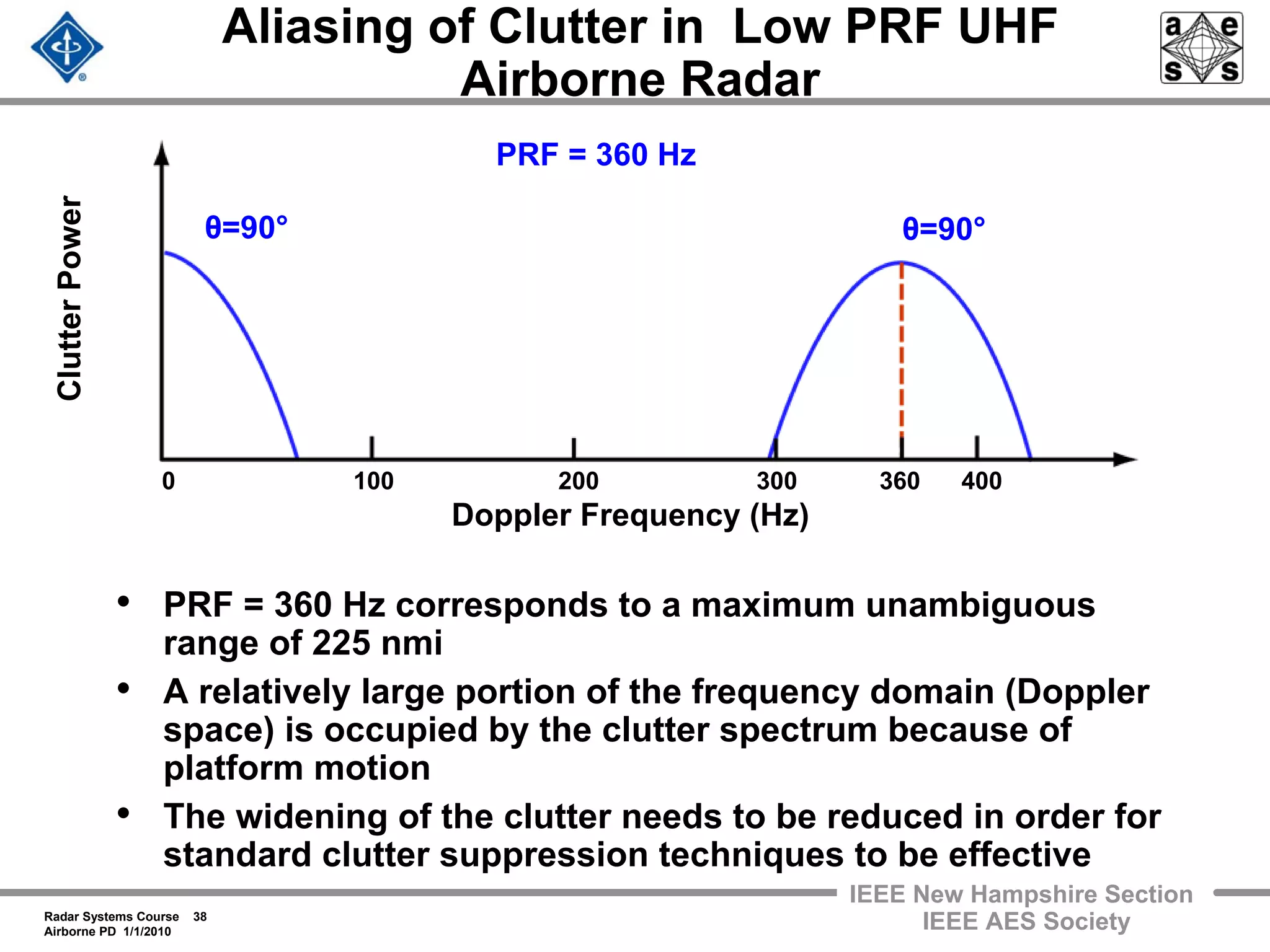
Aliasing of Clutter in Low PRF UHF
Airborne Radar
• PRF = 360 Hz corresponds to a maximum unambiguous
range of 225 nmi
• A relatively large portion of the frequency domain (Doppler
space) is occupied by the clutter spectrum because of
platform motion
• The widening of the clutter needs to be reduced in order for
standard clutter suppression techniques to be effective
θ=90° θ=90°
PRF = 360 Hz
ClutterPower
Doppler Frequency (Hz)
0 100 200 300 360 400
Radar Systems Course 39
Airborne PD 1/1/2010
IEEE New Hampshire Section
IEEE AES Society
AEW Airborne Radar Clutter Rejection
• There are 2 effects that can seriously degrade the
performance of a radar on a moving platform
– A non-zero Doppler clutter shift
– A widening of the clutter spectrum
• These may be compensated for by two different techniques
– TACCAR (Time Averaged Clutter Coherent Airborne Radar)
The change in center frequency of the clutter spectrum
– DPCA (Displaced Phase Center Antenna)
The widening of the clutter spectrum
• Radars which have used these techniques, over the years,
to compensate for platform motion are Airborne Early
Warning radars
Radar Systems Course 40
Airborne PD 1/1/2010
IEEE New Hampshire Section
IEEE AES Society
Compensation for Clutter Doppler Shift
• TACCAR (Time Averaged Clutter Coherent Airborne Radar)
– Also called “Clutter Lock MTI”
• The Doppler frequency shift from ground clutter can be
compensated by using the clutter echo signal itself to set
the frequency of the reference oscillator (or coho)
– This process centers the ground clutter to zero Doppler
frequency
– The standard MTI filter (notch at zero Doppler) attenuates the
ground clutter
• This technique has been used in ground based radars to
mitigate the effect of moving clutter
– Not used after the advent of Doppler filter processing
Radar Systems Course 41
Airborne PD 1/1/2010
IEEE New Hampshire Section
IEEE AES Society
AEW Advances - E-2D and MP-RTIP
• E-2D
– Mechanically Rotating
Active Electronically
Scanned Antenna (AESA)
– Space Time Adaptive
Processing (STAP)
• MP-RTIP
– “Multi-Platform Radar
Technology Insertion
Program”
– Originally Joint Stars
Upgrade Program
Global Hawk and then a
wide area surveillance
aircraft
– Advanced ground target
surveillance capability
E-2D
MP-RTIP mounted on Proteus Aircraft
Courtesy of US Air Force
Courtesy of US Navy
Radar Systems Course 42
Airborne PD 1/1/2010
IEEE New Hampshire Section
IEEE AES Society
E-3A Sentry - AWACS
E-3A Sentry Aircraft
• AWACS Radar (S-Band)
– Mission –Long range Surveillance, Command and Control for
air tactical environment
– Radar System Improvement Program (RSIP)
Advanced pulse Doppler waveforms
Pulse compression added
Detection range doubled (over original radar)
Courtesy of USAF
See reference 1
Radar APY-2
S-Band (10 cm wavelength)
Range >250 miles
High PRF waveform to reject
clutter in look down mode
Long range beyond the
horizon surveillance mode
Maritime surveillance mode
Radar Systems Course 43
Airborne PD 1/1/2010
IEEE New Hampshire Section
IEEE AES Society
AWACS Radar Antenna
• AWACS (APY-1/2) Antenna
– Phased array – 26 ft by 4.5 ft ultralow sidelobe array
Elliptically shaped
– 28 slotted waveguides with a total of over 4000 slots
– Antenna is mechanically scanned 360° in azimuth
– Uses 28 ferrite reciprocal phase shifters to scan in elevation
– 10 sec rotation (data) rate
Radome
Courtesy of martin_julia
Radar Antenna
Courtesy of Northrop Grumman
Used with Permission
See Skolnik reference 1
Radome Diameter 30 ft
Radar Systems Course 44
Airborne PD 1/1/2010
IEEE New Hampshire Section
IEEE AES Society
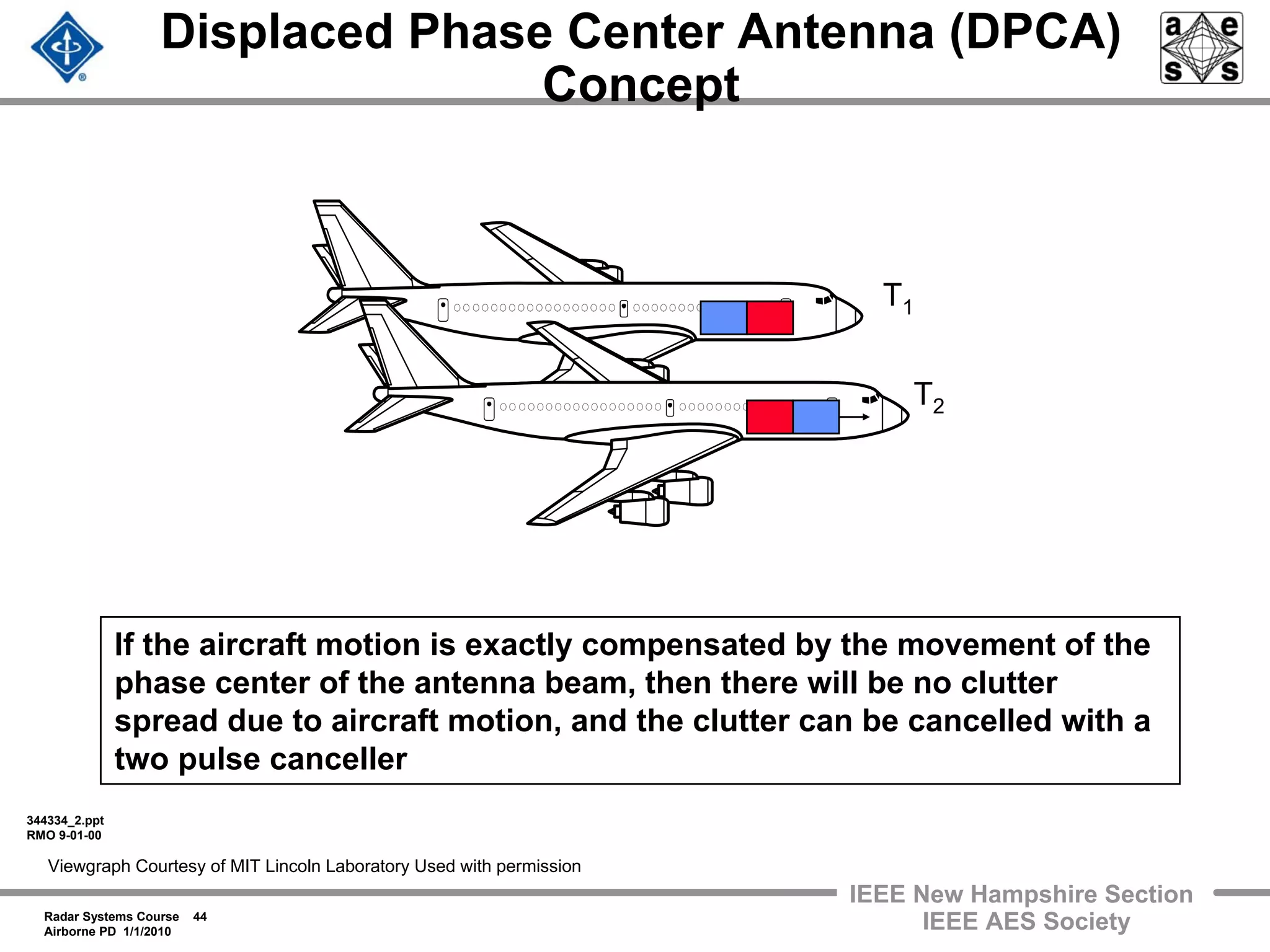
Displaced Phase Center Antenna (DPCA)
Concept
344334_2.ppt
RMO 9-01-00
If the aircraft motion is exactly compensated by the movement of the
phase center of the antenna beam, then there will be no clutter
spread due to aircraft motion, and the clutter can be cancelled with a
two pulse canceller
T1
T2
Viewgraph Courtesy of MIT Lincoln Laboratory Used with permission
Radar Systems Course 45
Airborne PD 1/1/2010
IEEE New Hampshire Section
IEEE AES Society
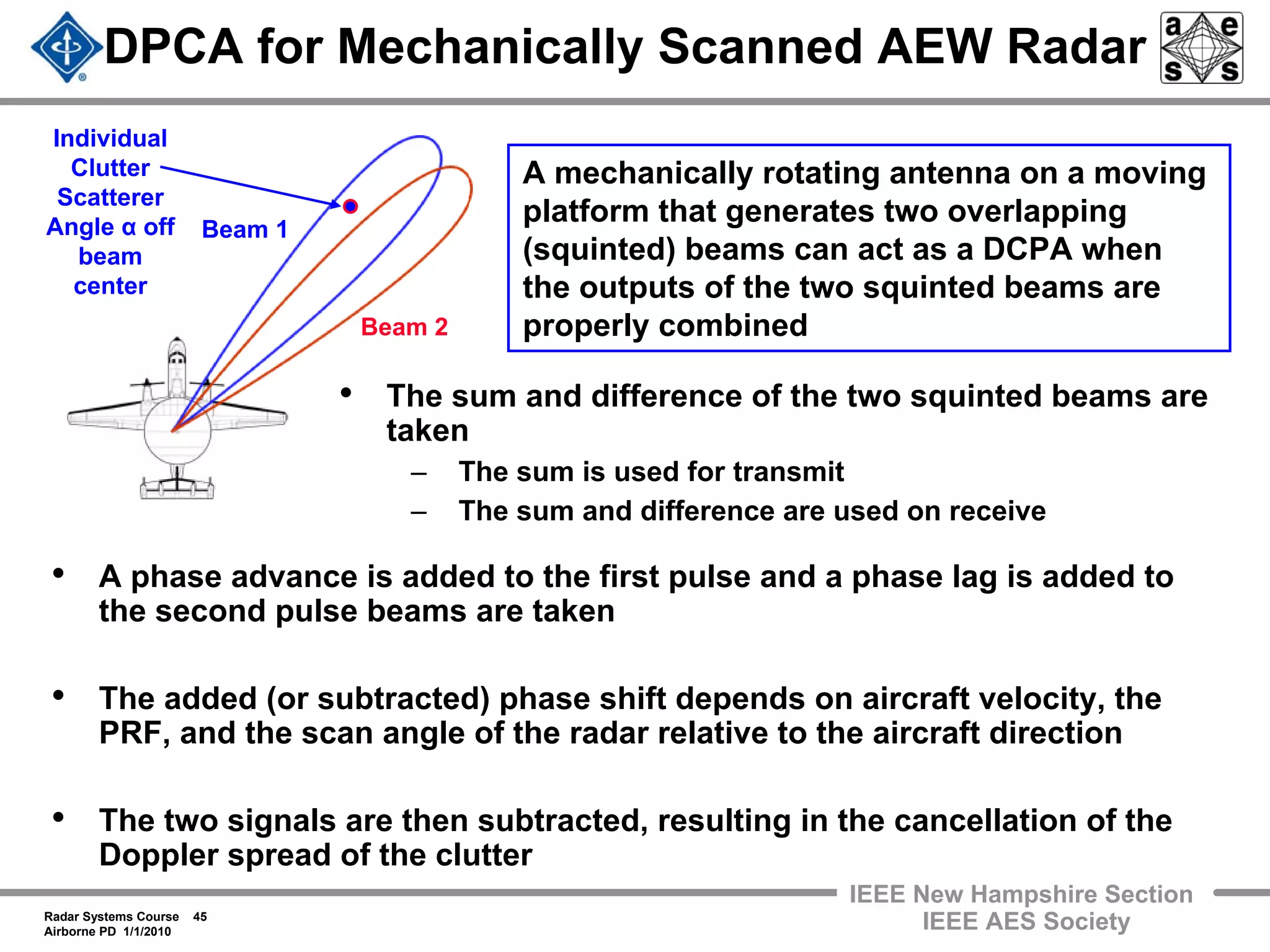
DPCA for Mechanically Scanned AEW Radar
• The sum and difference of the two squinted beams are
taken
– The sum is used for transmit
– The sum and difference are used on receive
Beam 1
Beam 2
A mechanically rotating antenna on a moving
platform that generates two overlapping
(squinted) beams can act as a DCPA when
the outputs of the two squinted beams are
properly combined
• A phase advance is added to the first pulse and a phase lag is added to
the second pulse beams are taken
• The added (or subtracted) phase shift depends on aircraft velocity, the
PRF, and the scan angle of the radar relative to the aircraft direction
• The two signals are then subtracted, resulting in the cancellation of the
Doppler spread of the clutter
Individual
Clutter
Scatterer
Angle α off
beam
center
Radar Systems Course 46
Airborne PD 1/1/2010
IEEE New Hampshire Section
IEEE AES Society
DPCA – The Math- Abbreviated
Beam 1
Beam 2
Corrections
applied to pulses
allowing
cancellation
Phasor
representation of
clutter echoes from
2 successive pulses
1E
2E
2E
1E
η2
η
η
η= tanEje 11
η−= tanEje 22
RΣ
RΔ
= Sum (2 pulses) of receive signal
= Difference (2 pulses) of receive signal
For more detail see Skolnik, Reference 1, pp 166-168
The sum and difference of the two squinted beams
are taken
The sum is used for transmit
The sum and difference are used on
receive
After MUCH manipulation, the corrected
received pulses become:
Pulse 1
Pulse 2
Constant accounts for differences in
and patterns, as well as a factor
Individual
Clutter
Scatterer
Angle α off
beam
center
( ) ( ) ( )αΔθ+αΣ RR sinvkj
( ) ( ) ( )αΔθ−αΣ RR sinvkj
D/T4 P
k
Δ
Σ
Radar Systems Course 47
Airborne PD 1/1/2010
IEEE New Hampshire Section
IEEE AES Society
Multiple Antenna Surveillance Radar
(MASR)
CP130-569
DPCA Off DPCA On
Viewgraph Courtesy of MIT Lincoln Laboratory
Used with permission
Radar Systems Course 48
Airborne PD 1/1/2010
IEEE New Hampshire Section
IEEE AES Society
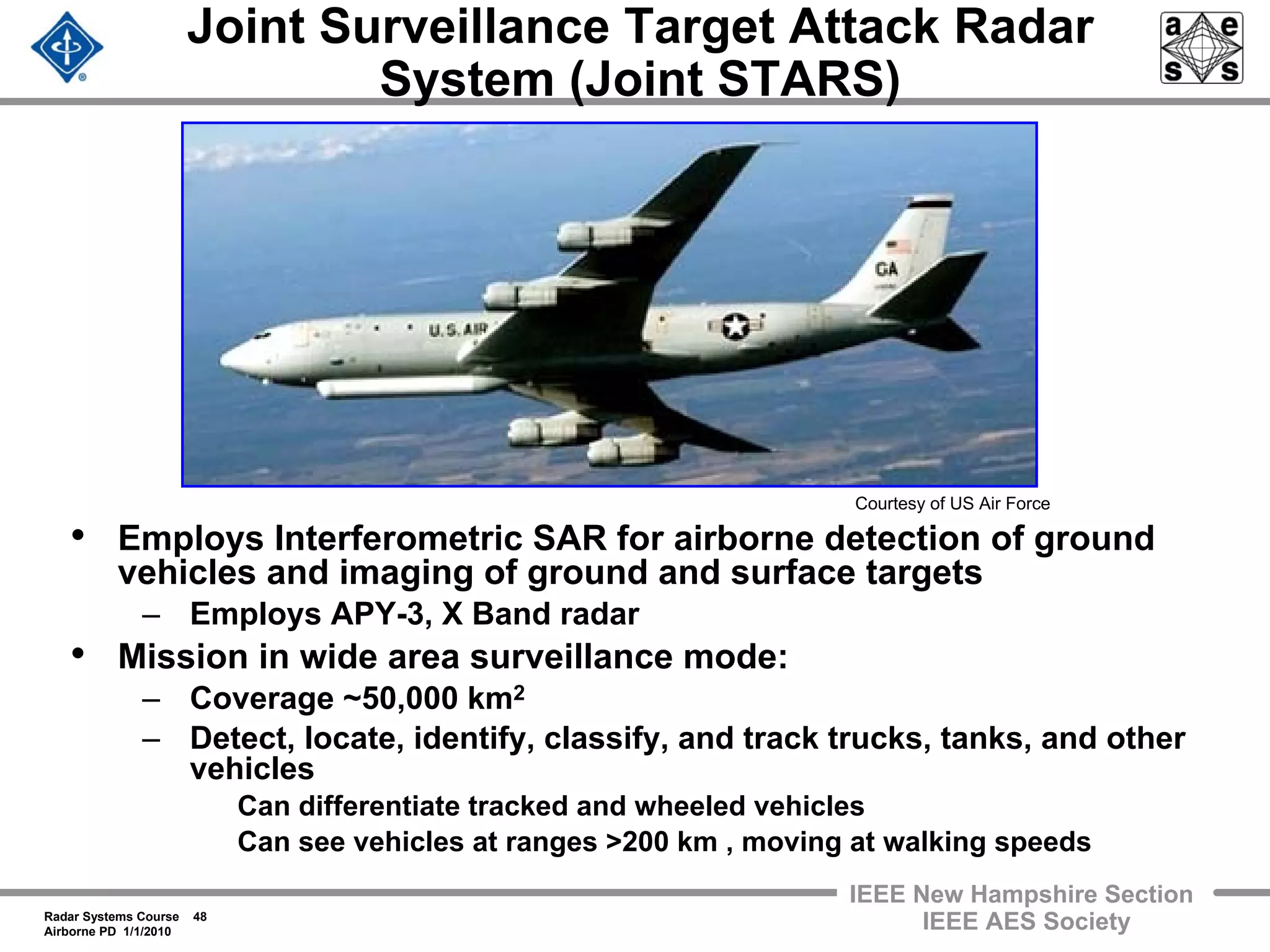
Joint Surveillance Target Attack Radar
System (Joint STARS)
• Employs Interferometric SAR for airborne detection of ground
vehicles and imaging of ground and surface targets
– Employs APY-3, X Band radar
• Mission in wide area surveillance mode:
– Coverage ~50,000 km2
– Detect, locate, identify, classify, and track trucks, tanks, and other
vehicles
Can differentiate tracked and wheeled vehicles
Can see vehicles at ranges >200 km , moving at walking speeds
Courtesy of US Air Force
Radar Systems Course 49
Airborne PD 1/1/2010
IEEE New Hampshire Section
IEEE AES Society
Joint Stars Radar
• Radar employs a slotted array antenna 24 ft by 2 ft
– 456 x 28 horizontally polarized elements
– Beam scans 60° in azimuth; mechanically rotated in elevation
• Aperture can be used as a whole for SAR mapping
• When total aperture is divided into 3 independent apertures in the
interferometric mode, it is used for moving target detection
– Moving targets are separated from clutter by different time of arrivals of
target and clutter in the 3 apertures
– DPCA techniques are used to cancel main beam clutter
±
JSTARS
Antenna
Courtesy of Northrop Grumman
Used with Permission
Radar Systems Course 50
Airborne PD 1/1/2010
IEEE New Hampshire Section
IEEE AES Society
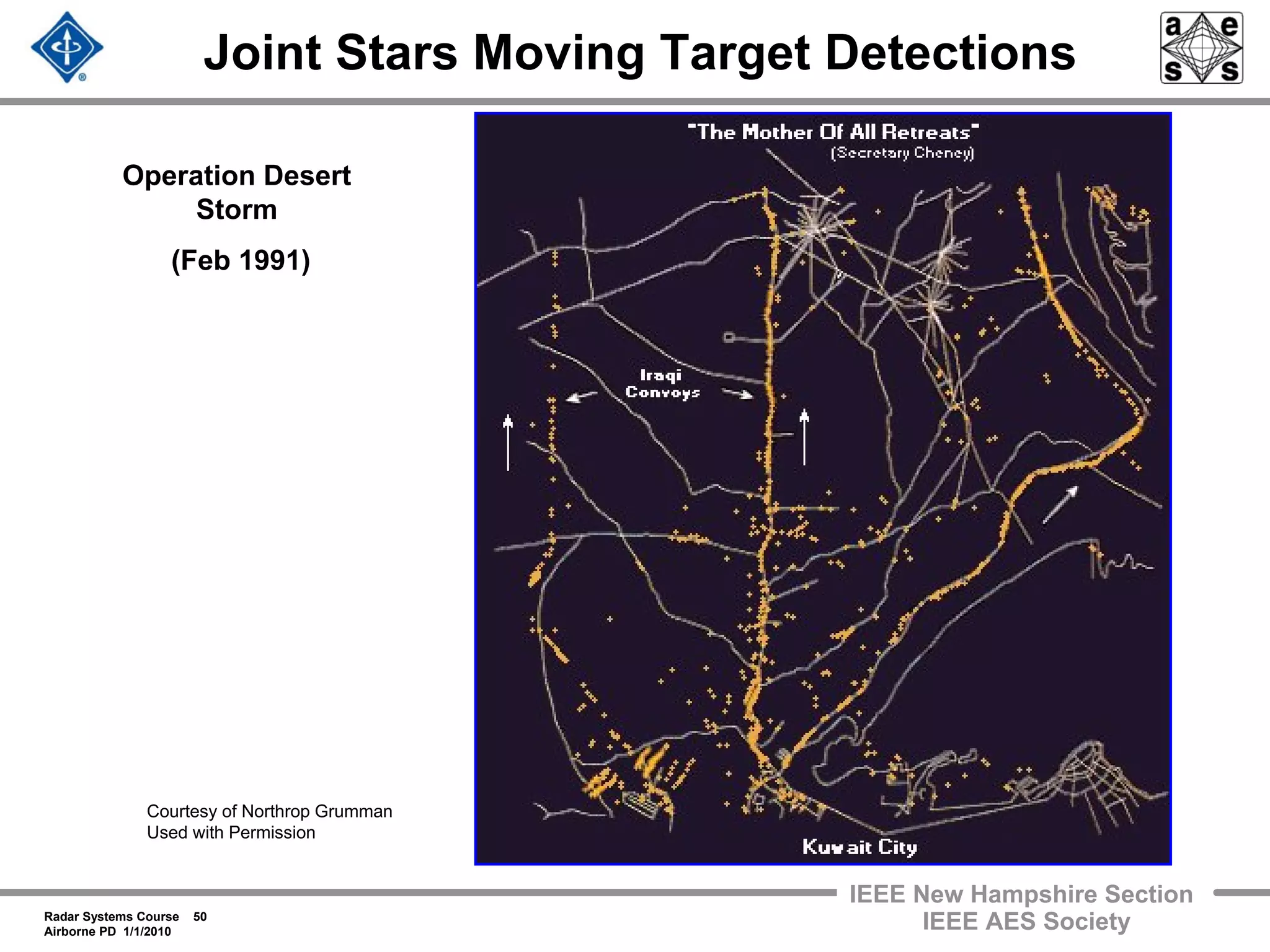
Joint Stars Moving Target Detections
Courtesy of Northrop Grumman
Used with Permission
Operation Desert
Storm
(Feb 1991)
Radar Systems Course 51
Airborne PD 1/1/2010
IEEE New Hampshire Section
IEEE AES Society
Outline
• Introduction
– The airborne radar environment
• Different airborne radar missions
– Pulse Doppler radar in small fighter / interceptor aircraft
F-14, F-15, F-16, F-35
– Airborne, surveillance, early warning radars
E-2C (Hawkeye), E-3 (AWACS), E-8A (JOINT STARS)
– Airborne synthetic aperture radar
SAR basics to be covered in lecture 19
Military and civilian remote sensing missions
To be covered in lecture 19, later in the course
• Summary
Radar Systems Course 52
Airborne PD 1/1/2010
IEEE New Hampshire Section
IEEE AES Society
Detection of Ground Moving Targets
• Ground Moving Target Indication (GMTI)
– Low or medium PRF pulse Doppler radar used
– PRF chosen so that Doppler region of interest is
unambiguous in range and Doppler
– Ku (16 GHz) or Kα (35 GHz) Band often used, since fixed
minimum detectable Doppler frequency will allow detection of
lower velocities than X band
– APG-67 (X-Band) in F-20 fighter has GMTI mode using
medium PRF
– AWACS has low PRF ship detection mode
• Side-Looking Airborne Radar (SLAR)
– Standard airborne radar subtracts sequential conventional
images of terrain ( Non-coherent MTI) to detect moving targets
Radar Systems Course 53
Airborne PD 1/1/2010
IEEE New Hampshire Section
IEEE AES Society
Detection of Ground Moving Targets
• Synthetic Aperture Radar (SAR) with MTI
– SARs (discussed in lecture 19) produce excellent images of
fixed targets on the ground
Good cross range resolution obtain by processing sequential
target echoes as aircraft moves a significant distance L
Cross range resolution inversely proportional to L not antenna size D
– Moving targets distorted and smeared in SAR image
– Can be detected if target Doppler is greater than bandwidth
of clutter echo
– Requires high PRF to avoid aliasing issues
• Joint Stars
– Uses interferometer for clutter suppression processing
Radar Systems Course 54
Airborne PD 1/1/2010
IEEE New Hampshire Section
IEEE AES Society
Summary
• Difficult ground clutter environment is chief radar design driver for
airborne radars
– Elevated radar platform implies ground clutter at long range
– Both Doppler frequency of clutter and its spread depend on radar
platform motion and scan angle
• Clutter challenges with Airborne radars
– Antenna aperture size often limits frequencies, so that ambiguous
range and Doppler velocity issues arise
Low, Medium and High PRF Modes each have unique clutter issues
– Doppler spreading of ground clutter, particularly at broadside, viewing
can degrade performance
• Sophisticated clutter suppression techniques can alleviate some of
these issues
– DPCA techniques
– Medium and High PRF modes often imply higher power
• Active Electronically Scanned arrays and advanced signal
processing techniques (STAP) offer significant new capabilities for
airborne radars
Radar Systems Course 55
Airborne PD 1/1/2010
IEEE New Hampshire Section
IEEE AES Society
Homework Problems
• From Skolnik (Reference 1)
– Problems 3-19, 3-20, 3-21, 3-22, 3-23, and 3-24
– Show that the maximum Doppler frequency of ground clutter as seen
by an airborne radar is
– Show that, for an airborne radar flying at a constant height above the
ground, the lines of constant clutter velocity are a set of hyperbolae
V
Where:
= velocity of airborne radar
= radar wavelength
= height of radar above ground
= slant range
λ
h
R
⎟⎟
⎠
⎞
⎜⎜
⎝
⎛
−
λ
≤ 2
2
D
R
h
1
V2
f
The last problem is from Roger Sullivan’s previously referenced text
Radar Systems Course 56
Airborne PD 1/1/2010
IEEE New Hampshire Section
IEEE AES Society
References
1. Skolnik, M., Introduction to Radar Systems, McGraw-Hill, New
York, 3rd Ed., 2001
2. Barton, D. K., Modern Radar System Analysis, Norwood,
Mass., Artech House, 1988
3. Skolnik, M., Editor in Chief, Radar Handbook, New York,
McGraw-Hill, 3rd Ed., 2008
4. Skolnik, M., Editor in Chief, Radar Handbook, New York,
McGraw-Hill, 2nd Ed., 1990
5. Nathanson, F. E., Radar Design Principles, New York,
McGraw-Hill, 1st Ed., 1969
6. Richards, M., Fundamentals of Radar Signal Processing,
McGraw-Hill, New York, 2005
7. Schleher, D. C., MTI and Pulsed Doppler Radar, Artech,
Boston, 1991
8. Long, W. H., et. al, “Medium PRF for the AN/APG-66 Radar”,
Proceedings of the IEEE, Vol. 73, No 2, pp 301-311, February
1985
Radar Systems Course 57
Airborne PD 1/1/2010
IEEE New Hampshire Section
IEEE AES Society
Acknowledgements
• Niall J. Duffy
• Dr. Allen Hearn
• Mark A. Weiner

Radar 2009 a 14 airborne pulse doppler radar

  • 1.
    IEEE New HampshireSection Radar Systems Course 1 Airborne PD 1/1/2010 IEEE AES Society Radar Systems Engineering Lecture 14 Airborne Pulse Doppler Radar Dr. Robert M. O’Donnell IEEE New Hampshire Section Guest Lecturer
  • 2.
    Radar Systems Course2 Airborne PD 1/1/2010 IEEE New Hampshire Section IEEE AES Society Examples of Airborne Radars Courtesy of US Air Force AWACS E-3A APY-1 F-16 APG-66 , 68 E-2C APS-125 Courtesy of US Navy JOINT STARS E-8A APY-3 Courtesy of US Air Force Courtesy of US Air Force Courtesy of milintelTR Boeing 737 AEW&C
  • 3.
    Radar Systems Course3 Airborne PD 1/1/2010 IEEE New Hampshire Section IEEE AES Society Outline • Introduction – The airborne radar mission and environment Clutter is the main issue • Different airborne radar missions – Pulse Doppler radar in small fighter / interceptor aircraft F-14, F-15, F-16, F-35 – Airborne, surveillance, early warning radars E-2C (Hawkeye), E-3 (AWACS), E-8A (JOINT STARS) – Airborne synthetic aperture radar Military and civilian remote sensing missions To be covered in lecture 19, later in the course • Summary
  • 4.
    Radar Systems Course4 Airborne PD 1/1/2010 IEEE New Hampshire Section IEEE AES Society Pulse Compression Receiver Clutter Rejection (Doppler Filtering) A / D Converter Block Diagram of Radar System Antenna Propagation Medium Target Radar Cross Section Transmitter General Purpose Computer Tracking Data Recording Parameter Estimation Waveform Generation Detection Power Amplifier T / R Switch Signal Processor Computer Thresholding User Displays and Radar Control Photo Image Courtesy of US Air Force Clutter as seen from an airborne platform, Signal waveforms, and Doppler processing will be the focus in this lecture
  • 5.
    Radar Systems Course5 Airborne PD 1/1/2010 IEEE New Hampshire Section IEEE AES Society First Use of Airborne Radars • When they were introduced on airborne platforms during World War II, they were used to detect hostile aircraft at night in either a defensive or an offensive mode US APS-3 Radar with Dish Antenna- 3 cm wavelength German “Lichtenstein” Radar Dipole array – 75 / 90 cm wavelength Courtesy of US Navy Courtesy of Department of Defense
  • 6.
    Radar Systems Course6 Airborne PD 1/1/2010 IEEE New Hampshire Section IEEE AES Society Role of Airborne Military Radars • Missions and Functions – Surveillance, Tracking, Fire Control – Reconnaissance – Intelligence • Examples – Air-to-air fighter combat Aircraft interception (against air breathing targets) – Airborne Early warning – Air to ground missions – Close air support – Ground target detection and tracking • Radar modes – Pulse Doppler radar – Synthetic Aperture radar – Displaced Phase Center Antenna (DPCA) – Ground Moving Target Indication
  • 7.
    Radar Systems Course7 Airborne PD 1/1/2010 IEEE New Hampshire Section IEEE AES Society Geometry of Airborne Clutter • Key components of the ground clutter echo from radar’s on an airborne platform: – Main beam of antenna illuminates the ground – Antenna sidelobes illuminate clutter over a wide range of viewing angles – Altitude return reflects from the ground directly below the radar The Doppler frequency distributions of these effects and how they affect radar performance differ with: 1. radar platform velocity (speed and angle), and 2. the geometry (aspect angle of aircraft relative to ground illumination point) PV
  • 8.
    Radar Systems Course8 Airborne PD 1/1/2010 IEEE New Hampshire Section IEEE AES Society Airborne Radar Clutter Spectrum Antenna Mainlobe Antenna Sidelobes PV Outgoing Target RelativePower(dB) λ PV20 λ − PV2 Outgoing Target Doppler Frequency Noise Noise Clutter Free Clutter FreeSidelobe Clutter Mainlobe Clutter TV No Doppler Ambiguities and in same vertical planePV TV
  • 9.
    Radar Systems Course9 Airborne PD 1/1/2010 IEEE New Hampshire Section IEEE AES Society Airborne Radar Clutter Spectrum Antenna Mainlobe Antenna Sidelobes PV Incoming Target RelativePower(dB) λ PV20 λ − PV2 Doppler Frequency Noise Noise Clutter Free Clutter FreeSidelobe Clutter Mainlobe Clutter Incoming Target No Doppler Ambiguities and in same vertical planePV TV TV−
  • 10.
    Radar Systems Course10 Airborne PD 1/1/2010 IEEE New Hampshire Section IEEE AES Society MIT Lincoln Laboratory Viewgraph Courtesy of MIT Lincoln Laboratory Used with permission
  • 11.
    Radar Systems Course11 Airborne PD 1/1/2010 IEEE New Hampshire Section IEEE AES Society Constant Range Contours on the Ground • The projections on the ground of the lines of constant range are a set circles Range to Ground Scenario Lines of Constant Range to Ground 2 G 22 S RhR += SRh
  • 12.
    Radar Systems Course12 Airborne PD 1/1/2010 IEEE New Hampshire Section IEEE AES Society Constant Doppler Velocity Contours on the Ground • The projections on the ground of the lines of constant Doppler velocity are a set hyperbolae α velocityPlatformV velocityClutterV sincosV cosVV P C P PC = = φθ= α= λ α = cosV2 f C D
  • 13.
    Radar Systems Course13 Airborne PD 1/1/2010 IEEE New Hampshire Section IEEE AES Society Constant Doppler Contours on Ground • The lines of constant Doppler frequency/velocity are called “Isodops” • The equation for the family of hyperbolae depend on: – Airborne radar height above ground – Angle between airborne radar velocity and the point on the ground that is illuminated – Wavelength of radar PC VV −= PC VV += 0VC = 0VC =
  • 14.
    Radar Systems Course14 Airborne PD 1/1/2010 IEEE New Hampshire Section IEEE AES Society Range-Doppler Ground Clutter Contours Up Range Cross Range Down Range Range Contours Circles Doppler Contours Hyperbolae PC VV +=PC VV −= 0VC = 0VC =
  • 15.
    Radar Systems Course15 Airborne PD 1/1/2010 IEEE New Hampshire Section IEEE AES Society Range-Doppler Ground Clutter Contours Up Range Cross Range Down Range Range Contours Circles Doppler Contours Hyperbolae RΔ DfΔ Range – Doppler Cell on Ground x x Power Doppler Frequency
  • 16.
    Radar Systems Course16 Airborne PD 1/1/2010 IEEE New Hampshire Section IEEE AES Society Unambiguous Doppler Velocity and Range 2 f V PRF B λ = PRF U f2 c R = and FirstBlindSpeed(knots) 10 30 100 1000 3000 300 Pulse Repetition Rate (KHz) 0.1 1 10 100 Unambiguous Range (nmi) 400 100 40 10 4 1 K a Band 35 G HzL Band 1.3 G Hz U HF Band 435 G Hz X Band 9.4 G Hz S Band 3.2 G HzVHF Band 220 M Hz Yields U B R4 c V λ =
  • 17.
    Radar Systems Course17 Airborne PD 1/1/2010 IEEE New Hampshire Section IEEE AES Society Classes of Pulse Doppler Radars Highly Ambiguous Ambiguous Highly Ambiguous Ambiguous Unambiguous Unambiguous Range Measurement Doppler Measurement Low PRF Medium PRF High PRF
  • 18.
    Radar Systems Course18 Airborne PD 1/1/2010 IEEE New Hampshire Section IEEE AES Society Missions for Airborne Military Radars “The Big Picture” • Fighter / Interceptor Radars – Antenna size constraints imply frequencies at X-Band or higher Reasonable angle beamwidths – This implies Medium or High PRF pulse Doppler modes for look down capability • Wide Area Surveillance and Tracking – Pulse Doppler solutions Low, Medium and/or High PRFs may be used depending on the specific mission – E-2C UHF – AWACS S-Band – Joint Stars X-Band • Synthetic Aperture Radars will be discussed in a later lecture
  • 19.
    Radar Systems Course19 Airborne PD 1/1/2010 IEEE New Hampshire Section IEEE AES Society Outline • Introduction – The airborne radar environment • Different airborne radar missions – Pulse Doppler radar in small fighter / interceptor aircraft F-14, F-15, F-16, F-35 High PRF Modes Medium PRF Modes – Airborne, surveillance, early warning radars E-2C (Hawkeye), E-3 (AWACS), E-8A (JOINT STARS) – Airborne synthetic aperture radar Military and civilian remote sensing missions To be covered in lecture 19, later in the course • Summary
  • 20.
    Radar Systems Course20 Airborne PD 1/1/2010 IEEE New Hampshire Section IEEE AES Society Photographs of Fighter Radars APG-66 (F-16) Courtesy of Northrop Grumman Used with Permission APG-81 (F-35) Courtesy of Northrop Grumman Used with Permission APG-65 (F-18) Courtesy of Raytheon Used with permission Courtesy of Boeing Used with permission APG-63 V(2) (F-15C) Active Electronically Scanned Arrays (AESA) Radar built by Raytheon Courtesy of USAF
  • 21.
    Radar Systems Course21 Airborne PD 1/1/2010 IEEE New Hampshire Section IEEE AES Society Outline • Introduction – The airborne radar environment • Different airborne radar missions – Pulse Doppler radar in small fighter / interceptor aircraft F-14, F-15, F-16, F-35 High PRF Modes Medium PRF Modes – Airborne, surveillance, early warning radars E-2C (Hawkeye), E-3 (AWACS), E-8A (JOINT STARS) – Airborne synthetic aperture radar Military and civilian remote sensing missions To be covered in lecture 19, later in the course • Summary
  • 22.
    Radar Systems Course22 Airborne PD 1/1/2010 IEEE New Hampshire Section IEEE AES Society Pulse Doppler PRFs • X- Band High PRF 100 - 300 KHz < 50% • X- Band Medium PRF 10 - 30 KHz ~ 5% • X- Band Low PRF 1 - 3 KHz ~.5% • UHF Low PRF 300 Hz Low Frequency PRF Type PRF Range* Duty Cycle* * Typical values only; specific radars may vary inside and outside these limits
  • 23.
    Radar Systems Course23 Airborne PD 1/1/2010 IEEE New Hampshire Section IEEE AES Society High PRF Mode • X- Band High PRF 100 - 300 KHz < 50% • For high PRF mode : – Range – Highly ambiguous Range ambiguities resolved using techniques discussed in Lecture 13 – Doppler velocity – Unambiguous For nose on encounters, detection is clutter free – High duty cycle implies significant “Eclipsing Loss” Multiple PRFs, or other techniques required Frequency PRF Type PRF Range* Duty Cycle* Example: PRF = 150 KHz Duty Cycle = 35% PRI= 6.67 μsec Pulsewidth = 2.33 μsec Unambiguous Range = 1 km Unambiguous Doppler Velocity = 4,500 knots
  • 24.
    Radar Systems Course24 Airborne PD 1/1/2010 IEEE New Hampshire Section IEEE AES Society • High PRF airborne radars tend to have a High Duty cycle to get high energy on the target – Pulse compression used • Eclipsing loss is caused because the receiver cannot be receiving target echoes when the radar is transmitting – Can be significant for high duty cycle radars – Loss can easily be 1-2 dB, if not mitigated High PRF Mode – Range Eclipsing Time Transmit Pulsewidth PRI Uneclipsed Target Receive Time Eclipsed Target
  • 25.
    Radar Systems Course25 Airborne PD 1/1/2010 IEEE New Hampshire Section IEEE AES Society High PRF Pulse Doppler Radar • No Doppler velocity ambiguities, many range ambiguities – Significant range eclipsing loss • Range ambiguities can be resolved by transmitting 3 redundant waveforms, each at a different PRF – Often only a single range gate is employed, but with a large Doppler filter bank • The antenna side lobes must be very low to minimize sidelobe clutter – Short range sidelobe clutter often masks low radial velocity targets • High closing speed aircraft are detected at long range in clutter free region • Range accuracy and ability to resolve multiple targets can be poorer than with other waveforms
  • 26.
    Radar Systems Course26 Airborne PD 1/1/2010 IEEE New Hampshire Section IEEE AES Society Outline • Introduction – The airborne radar environment • Different airborne radar missions – Pulse Doppler radar in small fighter / interceptor aircraft F-14, F-15, F-16, F-35 High PRF Modes Medium PRF Modes – Airborne, surveillance, early warning radars E-2C (Hawkeye), E-3 (AWACS), E-8A (JOINT STARS) – Airborne synthetic aperture radar Military and civilian remote sensing missions To be covered in lecture 19, later in the course • Summary
  • 27.
    Radar Systems Course27 Airborne PD 1/1/2010 IEEE New Hampshire Section IEEE AES Society • X- Band Medium PRF 10 - 30 KHz ~ 5% • For the medium PRF mode : – Clutter and target ambiguities in range and velocity – Clutter from antenna sidelobes is an significant issue Medium PRF Mode Frequency PRF Type PRF Range* Duty Cycle* Example : 7 PRF = 5.75, 6.5, 7.25, 8, 8.75, 9.5 & 10.25 KHz (From Figure 3.44 in text) Range Ambiguities = ~14 to 26 km Blind Speeds = ~175 to 310 knots
  • 28.
    Radar Systems Course28 Airborne PD 1/1/2010 IEEE New Hampshire Section IEEE AES Society Clear Velocity Regions for a Medium PRF Radar • The multiple PRFs (typically 7) and their associated higher radar power are required to obtain sufficient detections to unravel range and velocity ambiguities in medium PRF radars Clear Radial Velocity Regions for Seven PRF Radar Waveform 0 100 200 300 400 500 600 Doppler velocity of target (meters/sec) 0 100 200 300 400 500 600 Number of PRFs in Clear vs. Target Radial Velocity PRF(Hz) 5750 6500 7250 8000 8750 9500 10250 No.ofPRFsinClear 0 2 4 6 8
  • 29.
    Radar Systems Course29 Airborne PD 1/1/2010 IEEE New Hampshire Section IEEE AES Society Medium PRF Mode • In the Doppler domain, the target and clutter alias (fold down) into the range 0 to PRF1, PRF2, etc. – Because of the aliasing of sidelobe clutter, medium PRF radars should have very low sidelobes to mitigate this problem • In the range domain similar aliasing occurs – Sensitivity Time Control (STC) cannot be used to reduce clutter effects (noted in earlier lectures) • Range and Doppler ambiguity resolution techniques described in previous lecture High PRF Mode True Doppler Frequency Power PRF PRF 2 PRF 1 PRF 1 PRF 4 PRF 5 True Doppler Frequency Medium PRF Mode Power True Target Doppler
  • 30.
    Radar Systems Course30 Airborne PD 1/1/2010 IEEE New Hampshire Section IEEE AES Society Medium PRF Pulse Doppler Radar • Both range and Doppler ambiguities exist – Seven or eight different PRFs must be used – Insures target seen at enough Doppler frequencies to resolve range ambiguities – Transmitter larger because of redundant waveforms used to resolve ambiguities • There is no clutter free region – Fewer range ambiguities implies less of a problem with sidelobe clutter – Antenna must have low sidelobes to reduce sidelobe clutter • Often best single waveform for airborne fighter / interceptor • More range gates than high PRF, but fewer Doppler filters for each range gate • Better range accuracy and Doppler resolution than high PRF systems
  • 31.
    Radar Systems Course31 Airborne PD 1/1/2010 IEEE New Hampshire Section IEEE AES Society Outline • Introduction – The airborne radar environment • Different airborne radar missions – Pulse Doppler radar in small fighter / interceptor aircraft F-14, F-15, F-16, F-35 – Airborne, surveillance, early warning radars E-2C (Hawkeye), E-3 (AWACS), E-8A (JOINT STARS) – Airborne synthetic aperture radar Military and civilian remote sensing missions To be covered in lecture 19, later in the course • Summary
  • 32.
    Radar Systems Course32 Airborne PD 1/1/2010 IEEE New Hampshire Section IEEE AES Society Airborne Surveillance & Tracking Radars • Missions and Functions – Surveillance, Tracking, Fire Control – Reconnaissance – Intelligence • Examples – Airborne early warning – Ground target detection and tracking • Radar modes – Pulse Doppler radar – Synthetic Aperture radar – Displaced Phase Center Antenna (DPCA) – Other modes/techniques Elevated radar platforms provide long range and over the horizon coverage of airborne and ground based targets
  • 33.
    Radar Systems Course33 Airborne PD 1/1/2010 IEEE New Hampshire Section IEEE AES Society Examples of Airborne Radars Courtesy of US Air Force AWACS E-3A APY-1 E-2C APS-125 Courtesy of US Navy JOINT STARS E-8A APY-3 Courtesy of US Air Force Courtesy of milintelTR Boeing 737 AEW&C Courtesy of US Air Force Global Hawk
  • 34.
    Radar Systems Course34 Airborne PD 1/1/2010 IEEE New Hampshire Section IEEE AES Society AEW Radar Coverage • Elevating the radar can extend radar coverage well out over the horizon • Range Coverage -400 km to 800 km – Ground based radars ~400 km – Airborne radar ~800 km • Issues – High acquisition and operating costs – Limited Antenna size – Radar Weight and prime power – More challenging clutter environment Ground Based Surveillance Radar Coverage Airborne Surveillance Radar Coverage
  • 35.
    Radar Systems Course35 Airborne PD 1/1/2010 IEEE New Hampshire Section IEEE AES Society Characteristics of Ground Clutter (from Airborne Platform) λ − Pv2 λ Pv2 Doppler Frequency (Hz) MLfΔ MLSLf +Δ Ground Clutter Doppler Frequency φθ λ =α λ = sincos v2 cos v2 f PP C Doppler Frequency Width (Sidelobe + Main Beam Clutter) λ =Δ + P MLSL v4 f Doppler Frequency Width of Main Beam Clutter (Null to Null) L v4 L v4 f PP MB = λ λ =Δ Pv Main Beam Clutter Sidelobe Clutter
  • 36.
    Radar Systems Course36 Airborne PD 1/1/2010 IEEE New Hampshire Section IEEE AES Society Spread of Main Beam Clutter • Doppler frequency of clutter return depends on angle of clutter with velocity vector of aircraft • Doppler frequency of clutter return at center of beam • Doppler spread of main beam clutter can be found by differentiating this equation θ λ = cos V2 f P C θ Bθ α Beam CenterIndividual Clutter Scatterer Radar PV AircraftVelocityandTrajectory θθ λ =Δ sin V2 f B P C Spread of Main Beam Clutter Maximum at = 90°θ Adapted from Skolnik Reference 1 Depression angle of beam neglected
  • 37.
    Radar Systems Course37 Airborne PD 1/1/2010 IEEE New Hampshire Section IEEE AES Society 35Hz Clutter Spread with a UHF Airborne Radar • Both the width of the clutter spectra and its center frequency depend on the angle θ • When the antenna points in the direction of the platform velocity vector, the Doppler shift of the clutter echo is maximum, but the width of the spectrum is theoretically zero • When the antenna is directed in the direction perpendicular to the direction of the platform velocity, the clutter center frequency is zero, but the spread is maximum θ=90° θ=0°θ=30°θ=60° Doppler Frequency (Hz) 0 100 200 300 400 500 600 ClutterPower Speed of aircraft = 400 knots θ = Angle between radar beam and the platform velocity vectorAntenna beamwidth = 7 degrees 30Hz60Hz Adapted from Skolnik Reference 1
  • 38.
    Radar Systems Course38 Airborne PD 1/1/2010 IEEE New Hampshire Section IEEE AES Society Aliasing of Clutter in Low PRF UHF Airborne Radar • PRF = 360 Hz corresponds to a maximum unambiguous range of 225 nmi • A relatively large portion of the frequency domain (Doppler space) is occupied by the clutter spectrum because of platform motion • The widening of the clutter needs to be reduced in order for standard clutter suppression techniques to be effective θ=90° θ=90° PRF = 360 Hz ClutterPower Doppler Frequency (Hz) 0 100 200 300 360 400
  • 39.
    Radar Systems Course39 Airborne PD 1/1/2010 IEEE New Hampshire Section IEEE AES Society AEW Airborne Radar Clutter Rejection • There are 2 effects that can seriously degrade the performance of a radar on a moving platform – A non-zero Doppler clutter shift – A widening of the clutter spectrum • These may be compensated for by two different techniques – TACCAR (Time Averaged Clutter Coherent Airborne Radar) The change in center frequency of the clutter spectrum – DPCA (Displaced Phase Center Antenna) The widening of the clutter spectrum • Radars which have used these techniques, over the years, to compensate for platform motion are Airborne Early Warning radars
  • 40.
    Radar Systems Course40 Airborne PD 1/1/2010 IEEE New Hampshire Section IEEE AES Society Compensation for Clutter Doppler Shift • TACCAR (Time Averaged Clutter Coherent Airborne Radar) – Also called “Clutter Lock MTI” • The Doppler frequency shift from ground clutter can be compensated by using the clutter echo signal itself to set the frequency of the reference oscillator (or coho) – This process centers the ground clutter to zero Doppler frequency – The standard MTI filter (notch at zero Doppler) attenuates the ground clutter • This technique has been used in ground based radars to mitigate the effect of moving clutter – Not used after the advent of Doppler filter processing
  • 41.
    Radar Systems Course41 Airborne PD 1/1/2010 IEEE New Hampshire Section IEEE AES Society AEW Advances - E-2D and MP-RTIP • E-2D – Mechanically Rotating Active Electronically Scanned Antenna (AESA) – Space Time Adaptive Processing (STAP) • MP-RTIP – “Multi-Platform Radar Technology Insertion Program” – Originally Joint Stars Upgrade Program Global Hawk and then a wide area surveillance aircraft – Advanced ground target surveillance capability E-2D MP-RTIP mounted on Proteus Aircraft Courtesy of US Air Force Courtesy of US Navy
  • 42.
    Radar Systems Course42 Airborne PD 1/1/2010 IEEE New Hampshire Section IEEE AES Society E-3A Sentry - AWACS E-3A Sentry Aircraft • AWACS Radar (S-Band) – Mission –Long range Surveillance, Command and Control for air tactical environment – Radar System Improvement Program (RSIP) Advanced pulse Doppler waveforms Pulse compression added Detection range doubled (over original radar) Courtesy of USAF See reference 1 Radar APY-2 S-Band (10 cm wavelength) Range >250 miles High PRF waveform to reject clutter in look down mode Long range beyond the horizon surveillance mode Maritime surveillance mode
  • 43.
    Radar Systems Course43 Airborne PD 1/1/2010 IEEE New Hampshire Section IEEE AES Society AWACS Radar Antenna • AWACS (APY-1/2) Antenna – Phased array – 26 ft by 4.5 ft ultralow sidelobe array Elliptically shaped – 28 slotted waveguides with a total of over 4000 slots – Antenna is mechanically scanned 360° in azimuth – Uses 28 ferrite reciprocal phase shifters to scan in elevation – 10 sec rotation (data) rate Radome Courtesy of martin_julia Radar Antenna Courtesy of Northrop Grumman Used with Permission See Skolnik reference 1 Radome Diameter 30 ft
  • 44.
    Radar Systems Course44 Airborne PD 1/1/2010 IEEE New Hampshire Section IEEE AES Society Displaced Phase Center Antenna (DPCA) Concept 344334_2.ppt RMO 9-01-00 If the aircraft motion is exactly compensated by the movement of the phase center of the antenna beam, then there will be no clutter spread due to aircraft motion, and the clutter can be cancelled with a two pulse canceller T1 T2 Viewgraph Courtesy of MIT Lincoln Laboratory Used with permission
  • 45.
    Radar Systems Course45 Airborne PD 1/1/2010 IEEE New Hampshire Section IEEE AES Society DPCA for Mechanically Scanned AEW Radar • The sum and difference of the two squinted beams are taken – The sum is used for transmit – The sum and difference are used on receive Beam 1 Beam 2 A mechanically rotating antenna on a moving platform that generates two overlapping (squinted) beams can act as a DCPA when the outputs of the two squinted beams are properly combined • A phase advance is added to the first pulse and a phase lag is added to the second pulse beams are taken • The added (or subtracted) phase shift depends on aircraft velocity, the PRF, and the scan angle of the radar relative to the aircraft direction • The two signals are then subtracted, resulting in the cancellation of the Doppler spread of the clutter Individual Clutter Scatterer Angle α off beam center
  • 46.
    Radar Systems Course46 Airborne PD 1/1/2010 IEEE New Hampshire Section IEEE AES Society DPCA – The Math- Abbreviated Beam 1 Beam 2 Corrections applied to pulses allowing cancellation Phasor representation of clutter echoes from 2 successive pulses 1E 2E 2E 1E η2 η η η= tanEje 11 η−= tanEje 22 RΣ RΔ = Sum (2 pulses) of receive signal = Difference (2 pulses) of receive signal For more detail see Skolnik, Reference 1, pp 166-168 The sum and difference of the two squinted beams are taken The sum is used for transmit The sum and difference are used on receive After MUCH manipulation, the corrected received pulses become: Pulse 1 Pulse 2 Constant accounts for differences in and patterns, as well as a factor Individual Clutter Scatterer Angle α off beam center ( ) ( ) ( )αΔθ+αΣ RR sinvkj ( ) ( ) ( )αΔθ−αΣ RR sinvkj D/T4 P k Δ Σ
  • 47.
    Radar Systems Course47 Airborne PD 1/1/2010 IEEE New Hampshire Section IEEE AES Society Multiple Antenna Surveillance Radar (MASR) CP130-569 DPCA Off DPCA On Viewgraph Courtesy of MIT Lincoln Laboratory Used with permission
  • 48.
    Radar Systems Course48 Airborne PD 1/1/2010 IEEE New Hampshire Section IEEE AES Society Joint Surveillance Target Attack Radar System (Joint STARS) • Employs Interferometric SAR for airborne detection of ground vehicles and imaging of ground and surface targets – Employs APY-3, X Band radar • Mission in wide area surveillance mode: – Coverage ~50,000 km2 – Detect, locate, identify, classify, and track trucks, tanks, and other vehicles Can differentiate tracked and wheeled vehicles Can see vehicles at ranges >200 km , moving at walking speeds Courtesy of US Air Force
  • 49.
    Radar Systems Course49 Airborne PD 1/1/2010 IEEE New Hampshire Section IEEE AES Society Joint Stars Radar • Radar employs a slotted array antenna 24 ft by 2 ft – 456 x 28 horizontally polarized elements – Beam scans 60° in azimuth; mechanically rotated in elevation • Aperture can be used as a whole for SAR mapping • When total aperture is divided into 3 independent apertures in the interferometric mode, it is used for moving target detection – Moving targets are separated from clutter by different time of arrivals of target and clutter in the 3 apertures – DPCA techniques are used to cancel main beam clutter ± JSTARS Antenna Courtesy of Northrop Grumman Used with Permission
  • 50.
    Radar Systems Course50 Airborne PD 1/1/2010 IEEE New Hampshire Section IEEE AES Society Joint Stars Moving Target Detections Courtesy of Northrop Grumman Used with Permission Operation Desert Storm (Feb 1991)
  • 51.
    Radar Systems Course51 Airborne PD 1/1/2010 IEEE New Hampshire Section IEEE AES Society Outline • Introduction – The airborne radar environment • Different airborne radar missions – Pulse Doppler radar in small fighter / interceptor aircraft F-14, F-15, F-16, F-35 – Airborne, surveillance, early warning radars E-2C (Hawkeye), E-3 (AWACS), E-8A (JOINT STARS) – Airborne synthetic aperture radar SAR basics to be covered in lecture 19 Military and civilian remote sensing missions To be covered in lecture 19, later in the course • Summary
  • 52.
    Radar Systems Course52 Airborne PD 1/1/2010 IEEE New Hampshire Section IEEE AES Society Detection of Ground Moving Targets • Ground Moving Target Indication (GMTI) – Low or medium PRF pulse Doppler radar used – PRF chosen so that Doppler region of interest is unambiguous in range and Doppler – Ku (16 GHz) or Kα (35 GHz) Band often used, since fixed minimum detectable Doppler frequency will allow detection of lower velocities than X band – APG-67 (X-Band) in F-20 fighter has GMTI mode using medium PRF – AWACS has low PRF ship detection mode • Side-Looking Airborne Radar (SLAR) – Standard airborne radar subtracts sequential conventional images of terrain ( Non-coherent MTI) to detect moving targets
  • 53.
    Radar Systems Course53 Airborne PD 1/1/2010 IEEE New Hampshire Section IEEE AES Society Detection of Ground Moving Targets • Synthetic Aperture Radar (SAR) with MTI – SARs (discussed in lecture 19) produce excellent images of fixed targets on the ground Good cross range resolution obtain by processing sequential target echoes as aircraft moves a significant distance L Cross range resolution inversely proportional to L not antenna size D – Moving targets distorted and smeared in SAR image – Can be detected if target Doppler is greater than bandwidth of clutter echo – Requires high PRF to avoid aliasing issues • Joint Stars – Uses interferometer for clutter suppression processing
  • 54.
    Radar Systems Course54 Airborne PD 1/1/2010 IEEE New Hampshire Section IEEE AES Society Summary • Difficult ground clutter environment is chief radar design driver for airborne radars – Elevated radar platform implies ground clutter at long range – Both Doppler frequency of clutter and its spread depend on radar platform motion and scan angle • Clutter challenges with Airborne radars – Antenna aperture size often limits frequencies, so that ambiguous range and Doppler velocity issues arise Low, Medium and High PRF Modes each have unique clutter issues – Doppler spreading of ground clutter, particularly at broadside, viewing can degrade performance • Sophisticated clutter suppression techniques can alleviate some of these issues – DPCA techniques – Medium and High PRF modes often imply higher power • Active Electronically Scanned arrays and advanced signal processing techniques (STAP) offer significant new capabilities for airborne radars
  • 55.
    Radar Systems Course55 Airborne PD 1/1/2010 IEEE New Hampshire Section IEEE AES Society Homework Problems • From Skolnik (Reference 1) – Problems 3-19, 3-20, 3-21, 3-22, 3-23, and 3-24 – Show that the maximum Doppler frequency of ground clutter as seen by an airborne radar is – Show that, for an airborne radar flying at a constant height above the ground, the lines of constant clutter velocity are a set of hyperbolae V Where: = velocity of airborne radar = radar wavelength = height of radar above ground = slant range λ h R ⎟⎟ ⎠ ⎞ ⎜⎜ ⎝ ⎛ − λ ≤ 2 2 D R h 1 V2 f The last problem is from Roger Sullivan’s previously referenced text
  • 56.
    Radar Systems Course56 Airborne PD 1/1/2010 IEEE New Hampshire Section IEEE AES Society References 1. Skolnik, M., Introduction to Radar Systems, McGraw-Hill, New York, 3rd Ed., 2001 2. Barton, D. K., Modern Radar System Analysis, Norwood, Mass., Artech House, 1988 3. Skolnik, M., Editor in Chief, Radar Handbook, New York, McGraw-Hill, 3rd Ed., 2008 4. Skolnik, M., Editor in Chief, Radar Handbook, New York, McGraw-Hill, 2nd Ed., 1990 5. Nathanson, F. E., Radar Design Principles, New York, McGraw-Hill, 1st Ed., 1969 6. Richards, M., Fundamentals of Radar Signal Processing, McGraw-Hill, New York, 2005 7. Schleher, D. C., MTI and Pulsed Doppler Radar, Artech, Boston, 1991 8. Long, W. H., et. al, “Medium PRF for the AN/APG-66 Radar”, Proceedings of the IEEE, Vol. 73, No 2, pp 301-311, February 1985
  • 57.
    Radar Systems Course57 Airborne PD 1/1/2010 IEEE New Hampshire Section IEEE AES Society Acknowledgements • Niall J. Duffy • Dr. Allen Hearn • Mark A. Weiner