EE 369
POWER SYSTEM ANALYSIS
Lecture 9
Transformers, Per Unit Calculations
Tom Overbye and Ross Baldick
1
Announcements
• For lectures 8 to 10 read Chapter 3
• Homework 7 is 5.8, 5.15, 5.17, 5.24, 5.27,
5.28, 5.29, 5.34, 5.37, 5.38, 5.43, 5.45; due
10/22.
• Homework 8 is 3.1, 3.3, 3.4, 3.7, 3.8, 3.9, 3.10,
3.12, 3.13, 3.14, 3.16, 3.18; due 10/29.
• Homework 9 is 3.20, 3.23, 3.25, 3.27, 3.28,
3.29, 3.35, 3.38, 3.39, 3.41, 3.44, 3.47; due
11/5.
2
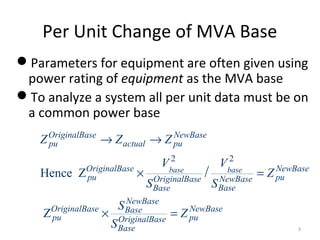
Per Unit Change of MVA Base
Parameters for equipment are often given using
power rating of equipment as the MVA base
To analyze a system all per unit data must be on
a common power base
2 2
Hence Z
Z
/base base
OriginalBase NewBase
pu actual pu
OriginalBase NewBase
pu puOriginalBase NewBase
BaseBase
NewBase
OriginalBase NewBaseBase
pu puOriginalBase
Base
Z Z Z
V V
Z
S S
S
Z
S
→ →
× =
× =
3
Per Unit Change of Base Example
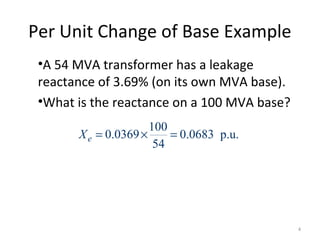
•A 54 MVA transformer has a leakage
reactance of 3.69% (on its own MVA base).
•What is the reactance on a 100 MVA base?
100
0.0369 0.0683 p.u.
54
eX = × =
4
Transformer Reactance
Transformer reactance is often specified as a
percentage, say 10%. This is a per unit value
expressed as a percentage on the power base
of the transformer.
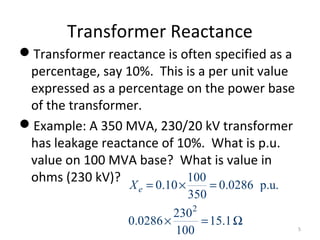
Example: A 350 MVA, 230/20 kV transformer
has leakage reactance of 10%. What is p.u.
value on 100 MVA base? What is value in
ohms (230 kV)?
2
100
0.10 0.0286 p.u.
350
230
0.0286 15.1
100
eX = × =
× = Ω
5
Three Phase Transformers
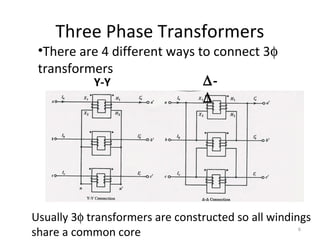
•There are 4 different ways to connect 3φ
transformers
Y-Y ∆-
∆
Usually 3φ transformers are constructed so all windings
share a common core 6
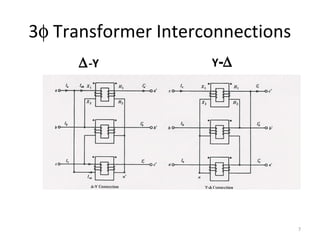
3φ Transformer Interconnections
∆-Y Y-∆
7
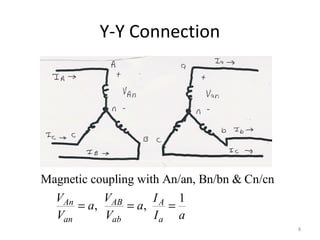
Y-Y Connection
Magnetic coupling with An/an, Bn/bn & Cn/cn
1
, ,An AB A
an ab a
V V I
a a
V V I a
= = =
8
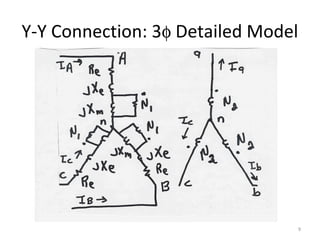
Y-Y Connection: 3φ Detailed Model
9
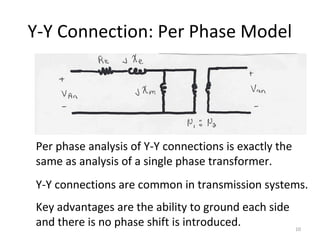
Y-Y Connection: Per Phase Model
Per phase analysis of Y-Y connections is exactly the
same as analysis of a single phase transformer.
Y-Y connections are common in transmission systems.
Key advantages are the ability to ground each side
and there is no phase shift is introduced. 10
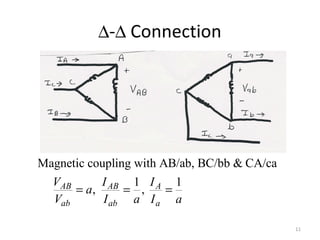
∆-∆ Connection
Magnetic coupling with AB/ab, BC/bb & CA/ca
1 1
, ,AB AB A
ab ab a
V I I
a
V I a I a
= = =
11
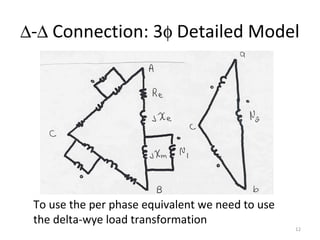
∆-∆ Connection: 3φ Detailed Model
To use the per phase equivalent we need to use
the delta-wye load transformation
12
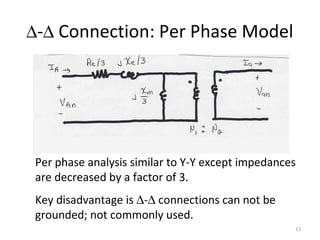
∆-∆ Connection: Per Phase Model
Per phase analysis similar to Y-Y except impedances
are decreased by a factor of 3.
Key disadvantage is ∆-∆ connections can not be
grounded; not commonly used.
13
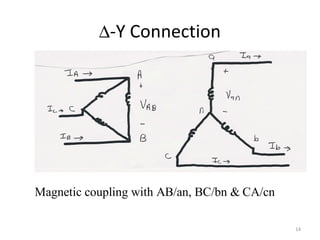
∆-Y Connection
Magnetic coupling with AB/an, BC/bn & CA/cn
14
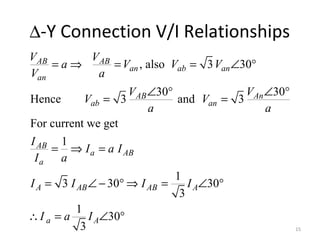
∆-Y Connection V/I Relationships
, also 3 30
3030
Hence 3 and 3
For current we get
1
1
3 30 30
3
1
30
3
AB AB
an ab an
an
AnAB
ab an
AB
a AB
a
A AB AB A
a A
V V
a V V V
V a
VV
V V
a a
I
I a I
I a
I I I I
I a I
= ⇒ = = ∠ °
∠ °∠ °
= =
= ⇒ =
= ∠ − ° ⇒ = ∠ °
∴ = ∠ °
15
∆-Y Connection: Per Phase Model
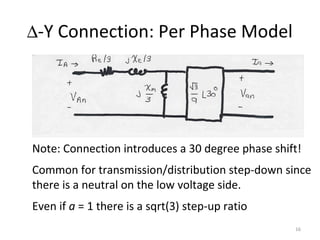
Note: Connection introduces a 30 degree phase shift!
Common for transmission/distribution step-down since
there is a neutral on the low voltage side.
Even if a = 1 there is a sqrt(3) step-up ratio
16
Y-∆ Connection: Per Phase Model
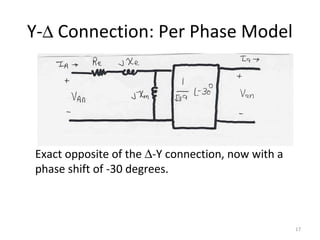
Exact opposite of the ∆-Y connection, now with a
phase shift of -30 degrees.
17

Lecture 9

  • 1.
    EE 369 POWER SYSTEMANALYSIS Lecture 9 Transformers, Per Unit Calculations Tom Overbye and Ross Baldick 1
  • 2.
    Announcements • For lectures8 to 10 read Chapter 3 • Homework 7 is 5.8, 5.15, 5.17, 5.24, 5.27, 5.28, 5.29, 5.34, 5.37, 5.38, 5.43, 5.45; due 10/22. • Homework 8 is 3.1, 3.3, 3.4, 3.7, 3.8, 3.9, 3.10, 3.12, 3.13, 3.14, 3.16, 3.18; due 10/29. • Homework 9 is 3.20, 3.23, 3.25, 3.27, 3.28, 3.29, 3.35, 3.38, 3.39, 3.41, 3.44, 3.47; due 11/5. 2
  • 3.
    Per Unit Changeof MVA Base Parameters for equipment are often given using power rating of equipment as the MVA base To analyze a system all per unit data must be on a common power base 2 2 Hence Z Z /base base OriginalBase NewBase pu actual pu OriginalBase NewBase pu puOriginalBase NewBase BaseBase NewBase OriginalBase NewBaseBase pu puOriginalBase Base Z Z Z V V Z S S S Z S → → × = × = 3
  • 4.
    Per Unit Changeof Base Example •A 54 MVA transformer has a leakage reactance of 3.69% (on its own MVA base). •What is the reactance on a 100 MVA base? 100 0.0369 0.0683 p.u. 54 eX = × = 4
  • 5.
    Transformer Reactance Transformer reactanceis often specified as a percentage, say 10%. This is a per unit value expressed as a percentage on the power base of the transformer. Example: A 350 MVA, 230/20 kV transformer has leakage reactance of 10%. What is p.u. value on 100 MVA base? What is value in ohms (230 kV)? 2 100 0.10 0.0286 p.u. 350 230 0.0286 15.1 100 eX = × = × = Ω 5
  • 6.
    Three Phase Transformers •Thereare 4 different ways to connect 3φ transformers Y-Y ∆- ∆ Usually 3φ transformers are constructed so all windings share a common core 6
  • 7.
  • 8.
    Y-Y Connection Magnetic couplingwith An/an, Bn/bn & Cn/cn 1 , ,An AB A an ab a V V I a a V V I a = = = 8
  • 9.
    Y-Y Connection: 3φDetailed Model 9
  • 10.
    Y-Y Connection: PerPhase Model Per phase analysis of Y-Y connections is exactly the same as analysis of a single phase transformer. Y-Y connections are common in transmission systems. Key advantages are the ability to ground each side and there is no phase shift is introduced. 10
  • 11.
    ∆-∆ Connection Magnetic couplingwith AB/ab, BC/bb & CA/ca 1 1 , ,AB AB A ab ab a V I I a V I a I a = = = 11
  • 12.
    ∆-∆ Connection: 3φDetailed Model To use the per phase equivalent we need to use the delta-wye load transformation 12
  • 13.
    ∆-∆ Connection: PerPhase Model Per phase analysis similar to Y-Y except impedances are decreased by a factor of 3. Key disadvantage is ∆-∆ connections can not be grounded; not commonly used. 13
  • 14.
    ∆-Y Connection Magnetic couplingwith AB/an, BC/bn & CA/cn 14
  • 15.
    ∆-Y Connection V/IRelationships , also 3 30 3030 Hence 3 and 3 For current we get 1 1 3 30 30 3 1 30 3 AB AB an ab an an AnAB ab an AB a AB a A AB AB A a A V V a V V V V a VV V V a a I I a I I a I I I I I a I = ⇒ = = ∠ ° ∠ °∠ ° = = = ⇒ = = ∠ − ° ⇒ = ∠ ° ∴ = ∠ ° 15
  • 16.
    ∆-Y Connection: PerPhase Model Note: Connection introduces a 30 degree phase shift! Common for transmission/distribution step-down since there is a neutral on the low voltage side. Even if a = 1 there is a sqrt(3) step-up ratio 16
  • 17.
    Y-∆ Connection: PerPhase Model Exact opposite of the ∆-Y connection, now with a phase shift of -30 degrees. 17