Optical
amplifiers.
The need, functioning and types.
Introduction :-
An optical amplifier is a device which amplifies the
optical signal directly without ever changing it to
electricity. The light itself is amplified.
Reasons to use optical amplifiers:
Reliability.
Flexibility.
Wavelength Division Multiplexing (WDM).
Low Cost.
Necessity of Optical
amplifiers?
 Optical amplifiers boost up the power level of
multiple light wave signals.
 To Transmit a signals over long distances (>100km),
to compensate attenuation losses.
 Initially this was accomplished with an optoelectronic
module consisting of optical RX, regenerator,
equalizer, & an optical TX to send the data.
.
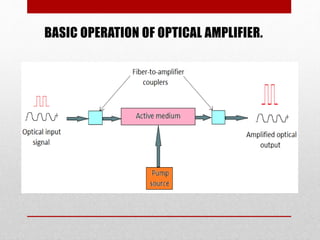
BASIC OPERATION OF OPTICAL AMPLIFIER.
General applications of
optical amplifiers.
oIn line optical amplifiers:-
• In single mode link, the fiber dispersion may be small
so that repeater can be eliminated.
• Instead of regeneration of signal, simple amplification
can be done.
• It is used to increase the distance between regenerative
repeaters.
o Power amplifier:-
• The device which can be placed after the
transmitter to boost the transmitted power is
called as power amplifier.
• This provides increase in distance depending on
the amplifier gain and fiber loss.
o Preamplifier:-
• Optical amplifier being used as a front-end
preamplifier for an optical receiver.
• A weak optical signal is amplified before
photo-detection so that signal to noise ratio
degradation due to noise can be
suppressed in the receiver.
• It provides a larger gain factor and BW.
Basic Concepts
• Most optical amplifiers use stimulated emission.
• An optical amplifier is basically a laser without
feedback.
• Optical gain is realized when the amplifier is pumped
optically (or electrically) to achieve population
inversion.
• Gain depends on wavelength, internal light intensity
and amplifier medium.
• Three types: semiconductor optical amplifiers,
Raman Amplifiers and Er+ doped fibre amplifiers.
ERBIUM-DOPED FIBER
AMPLIFIERS.
o Active medium in an optical fiber amplifier consist 10 to
30 m length of optical fiber that has been lightly doped
with a rare-earth element such as erbium(Er+).
o Erbium's principal involve its pink-colored Er3+ ions,
which have optical fluorescent properties particularly
useful in certain laser applications. silica doped with
erbium is good for long distance communication.
o EDFA operates in the spectral band of 1530 to 1560 nm
region .
A figure of EDFA Device.
Inside an EDFA.
o Amplification mechanism:-
• Optical amplifier uses optical pumping.
• Pumping gives energy to electrons to reach the excited
state.
• After reaching its excited state, the electron must
release some energy and drop to the lower level.
• Here a signal photon can then trigger the excited
electron into stimulated emission. And electron
releases its remaining energy in the form of new
photon.
• EDFAs include the ability:-
• To pump the devices at several different
wavelengths.
• Low coupling loss to the compatible-sized fiber
transmission medium.
• Highly transparent to signal format and bit rate.
• Immune from interference effects( crosstalk and
intermodulation distortion) when wavelength
channels are injected simultaneously into amplifier.
Schematic diagram of EDFA.
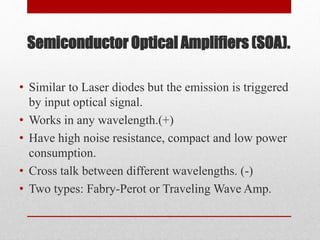
Semiconductor Optical Amplifiers (SOA).
• Similar to Laser diodes but the emission is triggered
by input optical signal.
• Works in any wavelength.(+)
• Have high noise resistance, compact and low power
consumption.
• Cross talk between different wavelengths. (-)
• Two types: Fabry-Perot or Traveling Wave Amp.
SOA .
Semiconductor Amplifier.
• An electrical current passed through
the device that excites the electrons
in the active region.
• When photon(light) travel through
the active region it can cause these
electron to lose some of their extra
energy in the form of more photons
that match the wavelength of the
initial ones.
• Therefore, an optical signal passing
through the active region is
amplified and is said to have
experienced “gain”.
SOA: Amplification Process.
• Semiconductor have valance and
conduction band.
• At thermal equilibrium valance
band has higher population.
• Under population inversion
condition conduction band will
have higher population.
• Population inversion is achieved
by forward biasing the p-n
junction.
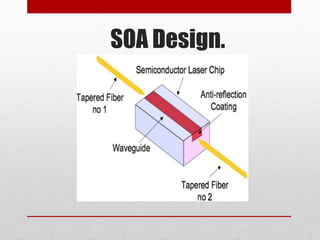
SOA Design.
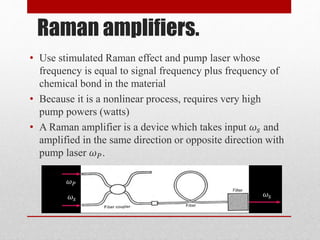
Raman amplifiers.
• Use stimulated Raman effect and pump laser whose
frequency is equal to signal frequency plus frequency of
chemical bond in the material
• Because it is a nonlinear process, requires very high
pump powers (watts)
• A Raman amplifier is a device which takes input 𝜔𝑠 and
amplified in the same direction or opposite direction with
pump laser 𝜔 𝑃.
𝜔 𝑃
𝜔𝑠
𝜔𝑠
Optical Amplifiers (in short).
Advantages
And
Disadvantages.
Er‐Doped Fiber Amplifier EDFA
Advantages:
• High gain (40–50 dB),
• Low noise (3–5 dB),
• Low polarization sensitivity,
• EDFAs are fully compatible with the rest of the fiber
optic transmission link.
Limitations:
• Large size,
• High pump power consumption (efficiency ‐ 10dB/1
mW).
Raman Amplifier (RA)
Advantages:
• Low noise (3–5 dB).
• Wide gain bandwidth (up to 10 nm).
• Distributed amplification within the transmission fiber.
Limitations:
• Low gain (10 dB).
• Requirement of high pump power.
Semiconductor Optical Amplifier.
Advantages:
• Small size.
• Transmission bidirectional.
• Smaller output power then EDFA.
• Less expensive then EDFA.
Limitations:
• Lower gain (20–30 dB) then EDFA.
• Higher noise (7–12 dB) then EDFA.
• Polarization dependence.
• High nonlinearity.
Conclusion
Optical amplifiers perform a critical
function in modern optical networks,
enabling the transmission of many
terabits of data over long distances of up to
thousands of kilometers.

Optical amplifiers- review

  • 1.
  • 2.
    Introduction :- An opticalamplifier is a device which amplifies the optical signal directly without ever changing it to electricity. The light itself is amplified. Reasons to use optical amplifiers: Reliability. Flexibility. Wavelength Division Multiplexing (WDM). Low Cost.
  • 3.
    Necessity of Optical amplifiers? Optical amplifiers boost up the power level of multiple light wave signals.  To Transmit a signals over long distances (>100km), to compensate attenuation losses.  Initially this was accomplished with an optoelectronic module consisting of optical RX, regenerator, equalizer, & an optical TX to send the data. .
  • 4.
    BASIC OPERATION OFOPTICAL AMPLIFIER.
  • 5.
    General applications of opticalamplifiers. oIn line optical amplifiers:- • In single mode link, the fiber dispersion may be small so that repeater can be eliminated. • Instead of regeneration of signal, simple amplification can be done. • It is used to increase the distance between regenerative repeaters.
  • 6.
    o Power amplifier:- •The device which can be placed after the transmitter to boost the transmitted power is called as power amplifier. • This provides increase in distance depending on the amplifier gain and fiber loss.
  • 7.
    o Preamplifier:- • Opticalamplifier being used as a front-end preamplifier for an optical receiver. • A weak optical signal is amplified before photo-detection so that signal to noise ratio degradation due to noise can be suppressed in the receiver. • It provides a larger gain factor and BW.
  • 8.
    Basic Concepts • Mostoptical amplifiers use stimulated emission. • An optical amplifier is basically a laser without feedback. • Optical gain is realized when the amplifier is pumped optically (or electrically) to achieve population inversion. • Gain depends on wavelength, internal light intensity and amplifier medium. • Three types: semiconductor optical amplifiers, Raman Amplifiers and Er+ doped fibre amplifiers.
  • 9.
    ERBIUM-DOPED FIBER AMPLIFIERS. o Activemedium in an optical fiber amplifier consist 10 to 30 m length of optical fiber that has been lightly doped with a rare-earth element such as erbium(Er+). o Erbium's principal involve its pink-colored Er3+ ions, which have optical fluorescent properties particularly useful in certain laser applications. silica doped with erbium is good for long distance communication. o EDFA operates in the spectral band of 1530 to 1560 nm region .
  • 10.
    A figure ofEDFA Device.
  • 11.
  • 12.
    o Amplification mechanism:- •Optical amplifier uses optical pumping. • Pumping gives energy to electrons to reach the excited state. • After reaching its excited state, the electron must release some energy and drop to the lower level. • Here a signal photon can then trigger the excited electron into stimulated emission. And electron releases its remaining energy in the form of new photon.
  • 13.
    • EDFAs includethe ability:- • To pump the devices at several different wavelengths. • Low coupling loss to the compatible-sized fiber transmission medium. • Highly transparent to signal format and bit rate. • Immune from interference effects( crosstalk and intermodulation distortion) when wavelength channels are injected simultaneously into amplifier.
  • 14.
  • 15.
    Semiconductor Optical Amplifiers(SOA). • Similar to Laser diodes but the emission is triggered by input optical signal. • Works in any wavelength.(+) • Have high noise resistance, compact and low power consumption. • Cross talk between different wavelengths. (-) • Two types: Fabry-Perot or Traveling Wave Amp.
  • 16.
  • 17.
    Semiconductor Amplifier. • Anelectrical current passed through the device that excites the electrons in the active region. • When photon(light) travel through the active region it can cause these electron to lose some of their extra energy in the form of more photons that match the wavelength of the initial ones. • Therefore, an optical signal passing through the active region is amplified and is said to have experienced “gain”.
  • 18.
    SOA: Amplification Process. •Semiconductor have valance and conduction band. • At thermal equilibrium valance band has higher population. • Under population inversion condition conduction band will have higher population. • Population inversion is achieved by forward biasing the p-n junction.
  • 19.
  • 20.
    Raman amplifiers. • Usestimulated Raman effect and pump laser whose frequency is equal to signal frequency plus frequency of chemical bond in the material • Because it is a nonlinear process, requires very high pump powers (watts) • A Raman amplifier is a device which takes input 𝜔𝑠 and amplified in the same direction or opposite direction with pump laser 𝜔 𝑃. 𝜔 𝑃 𝜔𝑠 𝜔𝑠
  • 21.
    Optical Amplifiers (inshort). Advantages And Disadvantages.
  • 22.
    Er‐Doped Fiber AmplifierEDFA Advantages: • High gain (40–50 dB), • Low noise (3–5 dB), • Low polarization sensitivity, • EDFAs are fully compatible with the rest of the fiber optic transmission link. Limitations: • Large size, • High pump power consumption (efficiency ‐ 10dB/1 mW).
  • 23.
    Raman Amplifier (RA) Advantages: •Low noise (3–5 dB). • Wide gain bandwidth (up to 10 nm). • Distributed amplification within the transmission fiber. Limitations: • Low gain (10 dB). • Requirement of high pump power.
  • 24.
    Semiconductor Optical Amplifier. Advantages: •Small size. • Transmission bidirectional. • Smaller output power then EDFA. • Less expensive then EDFA. Limitations: • Lower gain (20–30 dB) then EDFA. • Higher noise (7–12 dB) then EDFA. • Polarization dependence. • High nonlinearity.
  • 25.
    Conclusion Optical amplifiers performa critical function in modern optical networks, enabling the transmission of many terabits of data over long distances of up to thousands of kilometers.