H.PMONOPULSERADARPHANI RAHUL G K                                                   CHAITANYA DONEPUDI
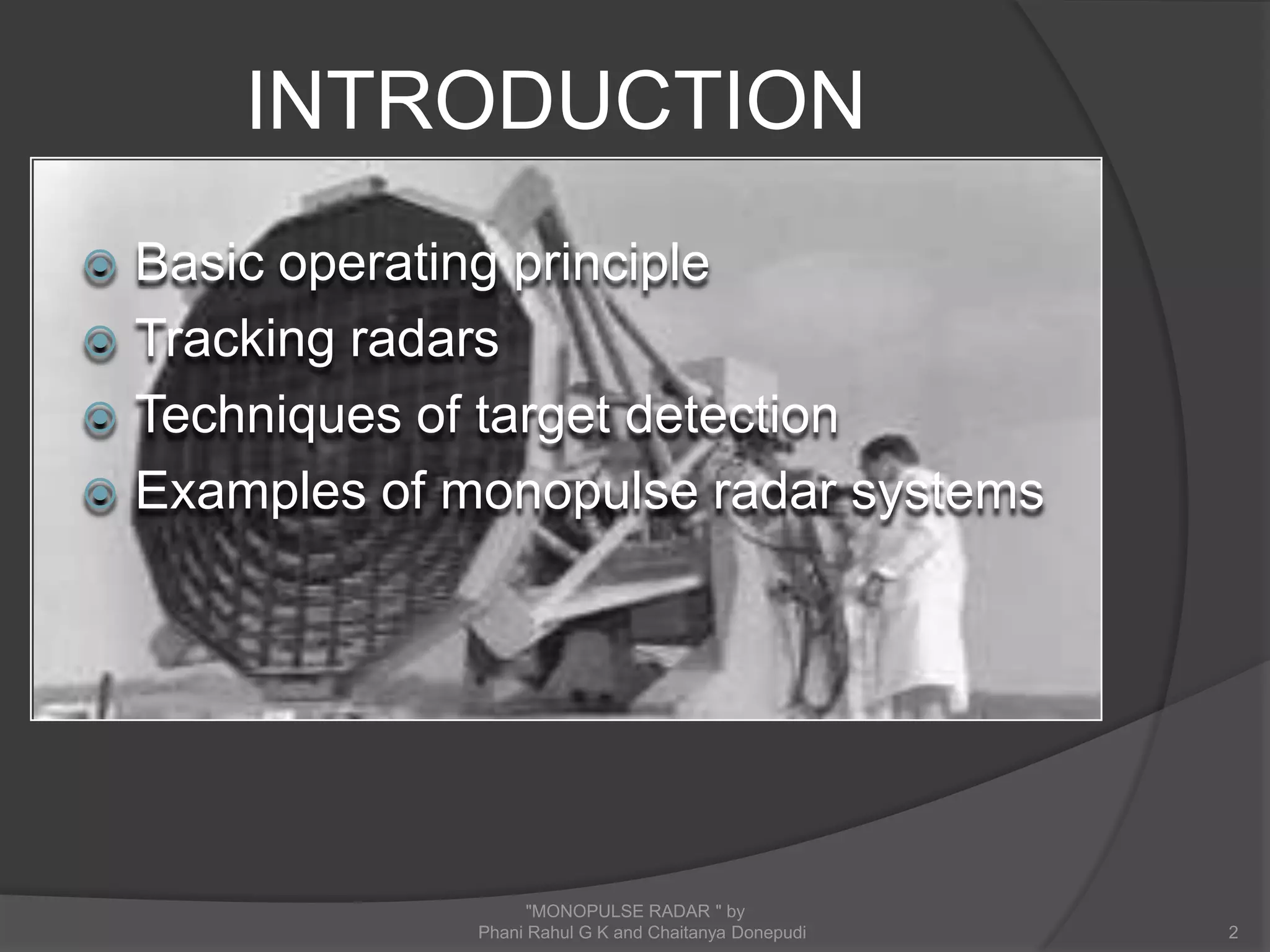
INTRODUCTIONBasic operating principleTracking radarsTechniques of target detectionExamples of monopulse radar systems"MONOPULSE RADAR " by    Phani Rahul G K and Chaitanya Donepudi2
RADIO DETECTION AND RANGING"MONOPULSE RADAR " by    Phani Rahul G K and Chaitanya Donepudi3OBJECT DETECTION SYSTEM
USES ELECTROMAGNETIC WAVES TO IDENTIFY TARGET CHARACTERISTICS
RADAR CAN FUNCTION UNDER CONDITIONS IMPERVIOUS  TO                    OPTICAL AND INFRARED SENSORSRADAR FUNCTIONSNORMAL RADAR FUNCTIONSRange (from pulse delay)Velocity (from Doppler frequency shift)Azimuth and Elevation (from antenna pointing)SIGNATURE ANALYSIS and INVERSE SCATTERINGTarget size (from magnitude of return)Target shape and components (return as a function of direction)Moving parts (modulation of the return)Material composition"MONOPULSE RADAR " by    Phani Rahul G K and Chaitanya Donepudi4
SLANT RANGE5"MONOPULSE RADAR " by    Phani Rahul G K and Chaitanya DonepudiPDISTANCE TO TARGET = DT(SLANT RANGE)DTENANTENNA ROTATIONOSW
AZIMUTH ANGLE6"MONOPULSE RADAR " by    Phani Rahul G K and Chaitanya DonepudiPAZIMUTH ANGLE = ATDTAT =       NOPI  PIETRUENORTHNATANTENNA ROTATIONOSW
ELEVATION ANGLE7"MONOPULSE RADAR " by    Phani Rahul G K and Chaitanya DonepudiH.PPDTANGLE OF ELEVATION = ETPIENET =        0PPI ANTENNA ROTATIONOSW
TRACKING RADARMeasures the coordinates and provides data to determine target pathTracking can be performed in range, angle and dopplerClassified into two typesContinuous tracking radar Track-While-Scan radarAcquisition radar designates targets to the tracking radar"MONOPULSE RADAR " by    Phani Rahul G K and Chaitanya Donepudi8
TRACKINGRADAR"MONOPULSE RADAR " by    Phani Rahul G K and Chaitanya Donepudi9
TRACKING RADARError signal generating methodsSequential lobingConical scanSimultaneous lobing (monopulse)"MONOPULSE RADAR " by   Phani Rahul G K and Chaitanya Donepudi10
SEQUENTIAL LOBINGTwo lobes are required to track in each axis, each lobe must be sequentially switched four pulses are requiredThe radar measures the returned signal levelsThe voltages in the two switched position should be equal"MONOPULSE RADAR " by    Phani Rahul G K and Chaitanya Donepudi11
SEQUENTIAL LOBING  12"MONOPULSE RADAR " by    Phani Rahul G K and Chaitanya Donepudi
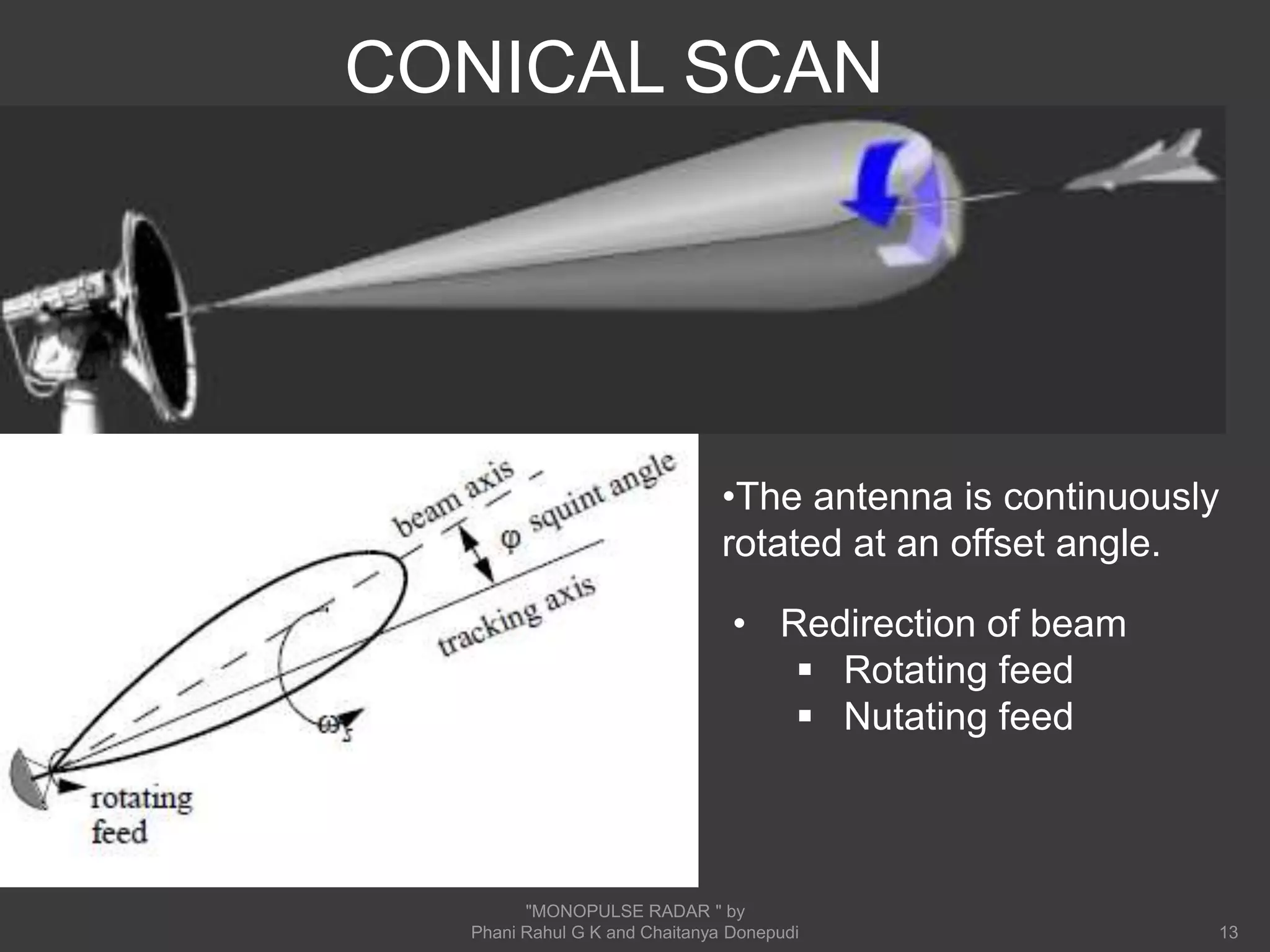
CONICAL SCAN13"MONOPULSE RADAR " by    Phani Rahul G K and Chaitanya DonepudiThe antenna is continuously rotated at an offset angle.
Redirection of beam
Rotating feed
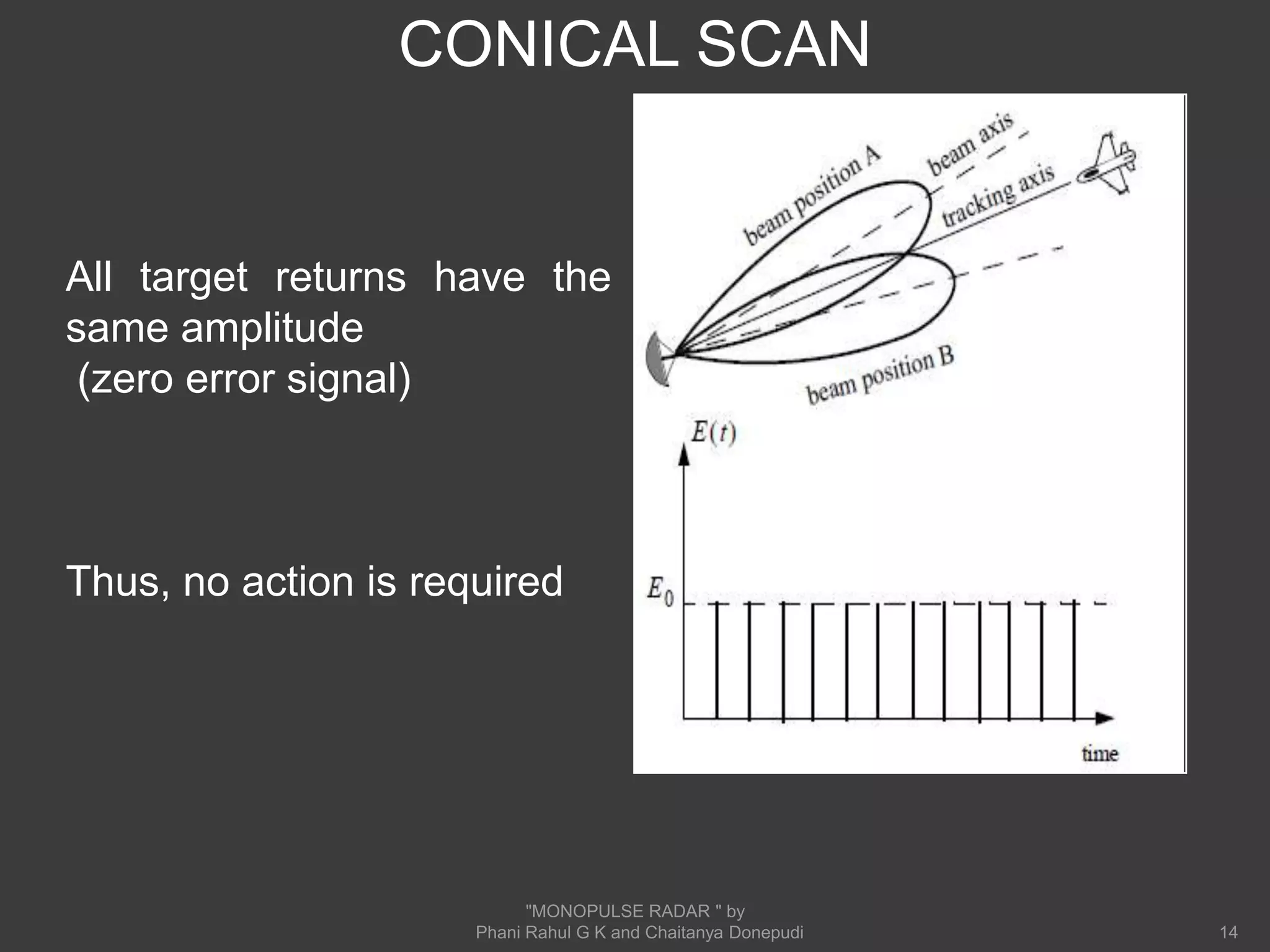
Nutating feedCONICAL SCAN14"MONOPULSE RADAR " by    Phani Rahul G K and Chaitanya DonepudiAll target returns have the same amplitude (zero error signal)Thus, no action is required
CONICAL SCAN15"MONOPULSE RADAR " by    Phani Rahul G K and Chaitanya DonepudiBA
DISADVANTAGES 16"MONOPULSE RADAR " by   Phani Rahul G K and Chaitanya DonepudiSequential lobingAngle accuracy can be no better than the size of the antenna beamwidth. Variation in echo strength on a pulse-by-pulse basis changes the signal level thereby reducing tracking accuracyThe antenna gain is less than the peak gain in beam axis direction, reducing maximum range that can be measuredConical scanThe antenna scan rate is limited by the scanning mechanism (mechanical or electronic)Sensitive to target modulationMechanical vibration and wear and tear due to rotating feed
SIMULTANEOUS LOBINGWith a single pulse angular coordinates can be obtainedMaximum unambiguous range is limited only by PRFMonopulse is free of mechanical vibrationsErrors due to amplitude fluctuation of target echoes are greatly reduced"MONOPULSE RADAR " by    Phani Rahul G K and Chaitanya Donepudi17
MONOPULSE BLOCK DIAGRAM"MONOPULSE RADAR " by    Phani Rahul G K and Chaitanya Donepudi18
SUM AND DIFFERENCE PATTERNS"MONOPULSE RADAR " by    Phani Rahul G K and Chaitanya Donepudi19
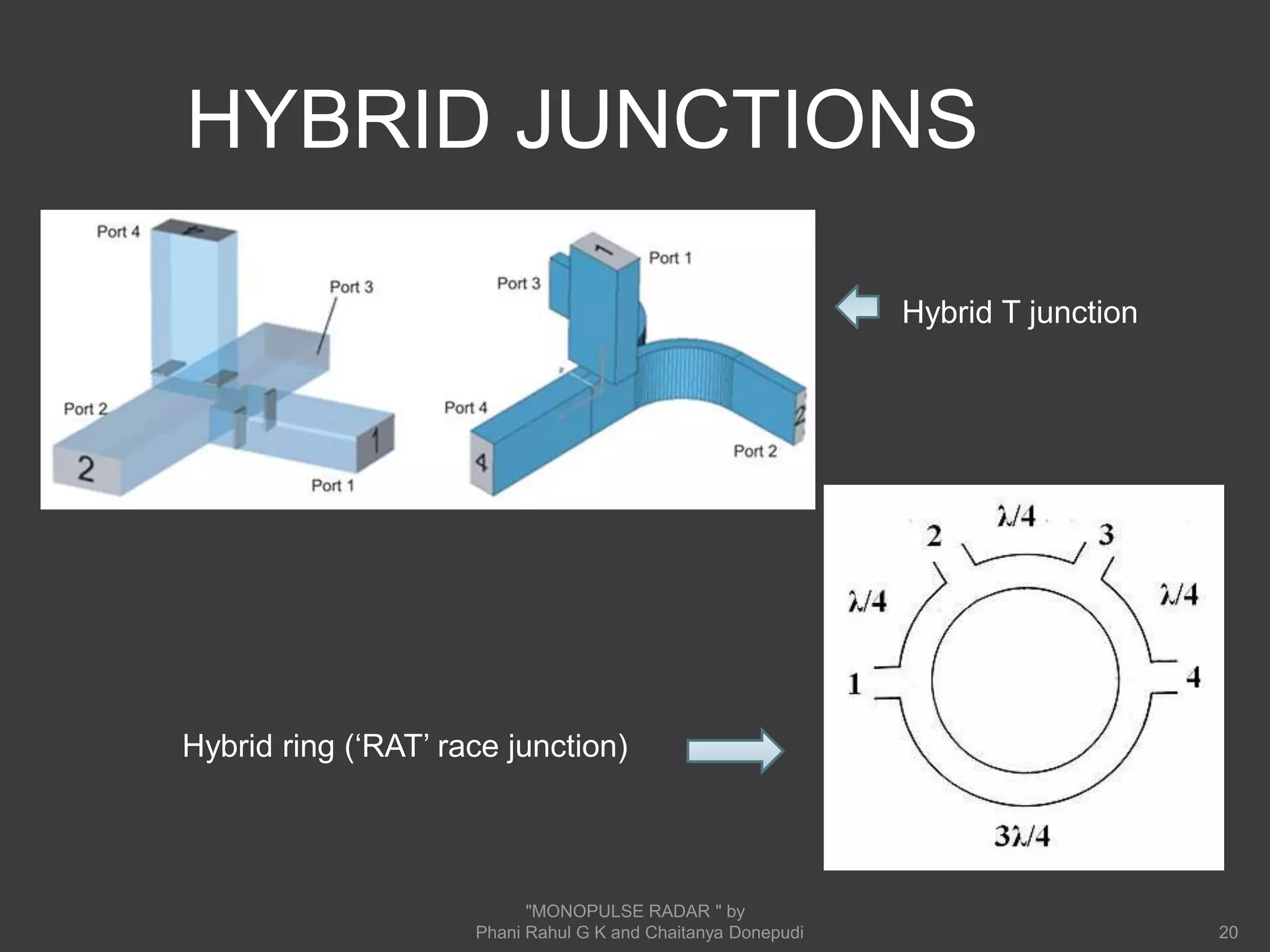
HYBRID JUNCTIONS"MONOPULSE RADAR " by    Phani Rahul G K and Chaitanya Donepudi20Hybrid T junctionHybrid ring (‘RAT’ race junction)
AMPLITUDE AND PHASE COMPARISON MONOPULSEA  total of four hybrid junctions generate sum, azimuth and elevation difference channelRange information is extracted form the output of the sum channel after amplitude detectionThe angular error signal is obtained by comparing echo amplitudes which actuates a servo mechanism to position the antenna The angle of arrival is determined by comparing the phase difference between signals from two separate antennasAntennas of phase comparison are not offset from the axis"MONOPULSE RADAR " by    Phani Rahul G K and Chaitanya Donepudi21
COMPARISON OF TRACKERSIn phase comparison four antennas are placed in awkward direction and its side lobe levels are highSequential lobing suffers more losses with complex antenna and feed systemAmplitude comparison has high SNR It has higher precision in target tracking due to the absence of target amplitude fluctuationsAngle error in two coordinates can be obtained by a single pulseConscan integrates no of pulses and then extracts angle measurement but vice versa in monopulse"MONOPULSE RADAR " by    Phani Rahul G K and Chaitanya Donepudi22

Monopulse Radar

  • 1.
    H.PMONOPULSERADARPHANI RAHUL GK CHAITANYA DONEPUDI
  • 2.
    INTRODUCTIONBasic operating principleTrackingradarsTechniques of target detectionExamples of monopulse radar systems"MONOPULSE RADAR " by Phani Rahul G K and Chaitanya Donepudi2
  • 3.
    RADIO DETECTION ANDRANGING"MONOPULSE RADAR " by Phani Rahul G K and Chaitanya Donepudi3OBJECT DETECTION SYSTEM
  • 4.
    USES ELECTROMAGNETIC WAVESTO IDENTIFY TARGET CHARACTERISTICS
  • 5.
    RADAR CAN FUNCTIONUNDER CONDITIONS IMPERVIOUS TO OPTICAL AND INFRARED SENSORSRADAR FUNCTIONSNORMAL RADAR FUNCTIONSRange (from pulse delay)Velocity (from Doppler frequency shift)Azimuth and Elevation (from antenna pointing)SIGNATURE ANALYSIS and INVERSE SCATTERINGTarget size (from magnitude of return)Target shape and components (return as a function of direction)Moving parts (modulation of the return)Material composition"MONOPULSE RADAR " by Phani Rahul G K and Chaitanya Donepudi4
  • 6.
    SLANT RANGE5"MONOPULSE RADAR" by Phani Rahul G K and Chaitanya DonepudiPDISTANCE TO TARGET = DT(SLANT RANGE)DTENANTENNA ROTATIONOSW
  • 7.
    AZIMUTH ANGLE6"MONOPULSE RADAR" by Phani Rahul G K and Chaitanya DonepudiPAZIMUTH ANGLE = ATDTAT = NOPI PIETRUENORTHNATANTENNA ROTATIONOSW
  • 8.
    ELEVATION ANGLE7"MONOPULSE RADAR" by Phani Rahul G K and Chaitanya DonepudiH.PPDTANGLE OF ELEVATION = ETPIENET = 0PPI ANTENNA ROTATIONOSW
  • 9.
    TRACKING RADARMeasures thecoordinates and provides data to determine target pathTracking can be performed in range, angle and dopplerClassified into two typesContinuous tracking radar Track-While-Scan radarAcquisition radar designates targets to the tracking radar"MONOPULSE RADAR " by Phani Rahul G K and Chaitanya Donepudi8
  • 10.
    TRACKINGRADAR"MONOPULSE RADAR "by Phani Rahul G K and Chaitanya Donepudi9
  • 11.
    TRACKING RADARError signalgenerating methodsSequential lobingConical scanSimultaneous lobing (monopulse)"MONOPULSE RADAR " by Phani Rahul G K and Chaitanya Donepudi10
  • 12.
    SEQUENTIAL LOBINGTwo lobesare required to track in each axis, each lobe must be sequentially switched four pulses are requiredThe radar measures the returned signal levelsThe voltages in the two switched position should be equal"MONOPULSE RADAR " by Phani Rahul G K and Chaitanya Donepudi11
  • 13.
    SEQUENTIAL LOBING 12"MONOPULSE RADAR " by Phani Rahul G K and Chaitanya Donepudi
  • 14.
    CONICAL SCAN13"MONOPULSE RADAR" by Phani Rahul G K and Chaitanya DonepudiThe antenna is continuously rotated at an offset angle.
  • 15.
  • 16.
  • 17.
    Nutating feedCONICAL SCAN14"MONOPULSERADAR " by Phani Rahul G K and Chaitanya DonepudiAll target returns have the same amplitude (zero error signal)Thus, no action is required
  • 18.
    CONICAL SCAN15"MONOPULSE RADAR" by Phani Rahul G K and Chaitanya DonepudiBA
  • 19.
    DISADVANTAGES 16"MONOPULSE RADAR" by Phani Rahul G K and Chaitanya DonepudiSequential lobingAngle accuracy can be no better than the size of the antenna beamwidth. Variation in echo strength on a pulse-by-pulse basis changes the signal level thereby reducing tracking accuracyThe antenna gain is less than the peak gain in beam axis direction, reducing maximum range that can be measuredConical scanThe antenna scan rate is limited by the scanning mechanism (mechanical or electronic)Sensitive to target modulationMechanical vibration and wear and tear due to rotating feed
  • 20.
    SIMULTANEOUS LOBINGWith asingle pulse angular coordinates can be obtainedMaximum unambiguous range is limited only by PRFMonopulse is free of mechanical vibrationsErrors due to amplitude fluctuation of target echoes are greatly reduced"MONOPULSE RADAR " by Phani Rahul G K and Chaitanya Donepudi17
  • 21.
    MONOPULSE BLOCK DIAGRAM"MONOPULSERADAR " by Phani Rahul G K and Chaitanya Donepudi18
  • 22.
    SUM AND DIFFERENCEPATTERNS"MONOPULSE RADAR " by Phani Rahul G K and Chaitanya Donepudi19
  • 23.
    HYBRID JUNCTIONS"MONOPULSE RADAR" by Phani Rahul G K and Chaitanya Donepudi20Hybrid T junctionHybrid ring (‘RAT’ race junction)
  • 24.
    AMPLITUDE AND PHASECOMPARISON MONOPULSEA total of four hybrid junctions generate sum, azimuth and elevation difference channelRange information is extracted form the output of the sum channel after amplitude detectionThe angular error signal is obtained by comparing echo amplitudes which actuates a servo mechanism to position the antenna The angle of arrival is determined by comparing the phase difference between signals from two separate antennasAntennas of phase comparison are not offset from the axis"MONOPULSE RADAR " by Phani Rahul G K and Chaitanya Donepudi21
  • 25.
    COMPARISON OF TRACKERSInphase comparison four antennas are placed in awkward direction and its side lobe levels are highSequential lobing suffers more losses with complex antenna and feed systemAmplitude comparison has high SNR It has higher precision in target tracking due to the absence of target amplitude fluctuationsAngle error in two coordinates can be obtained by a single pulseConscan integrates no of pulses and then extracts angle measurement but vice versa in monopulse"MONOPULSE RADAR " by Phani Rahul G K and Chaitanya Donepudi22
  • 26.
    NIKE AJAX GUIDANCESYSTEMFirst missile guidance system to employ monopulse techniqueDeveloped in 1953"MONOPULSE RADAR " by Phani Rahul G K and Chaitanya Donepudi23
  • 27.
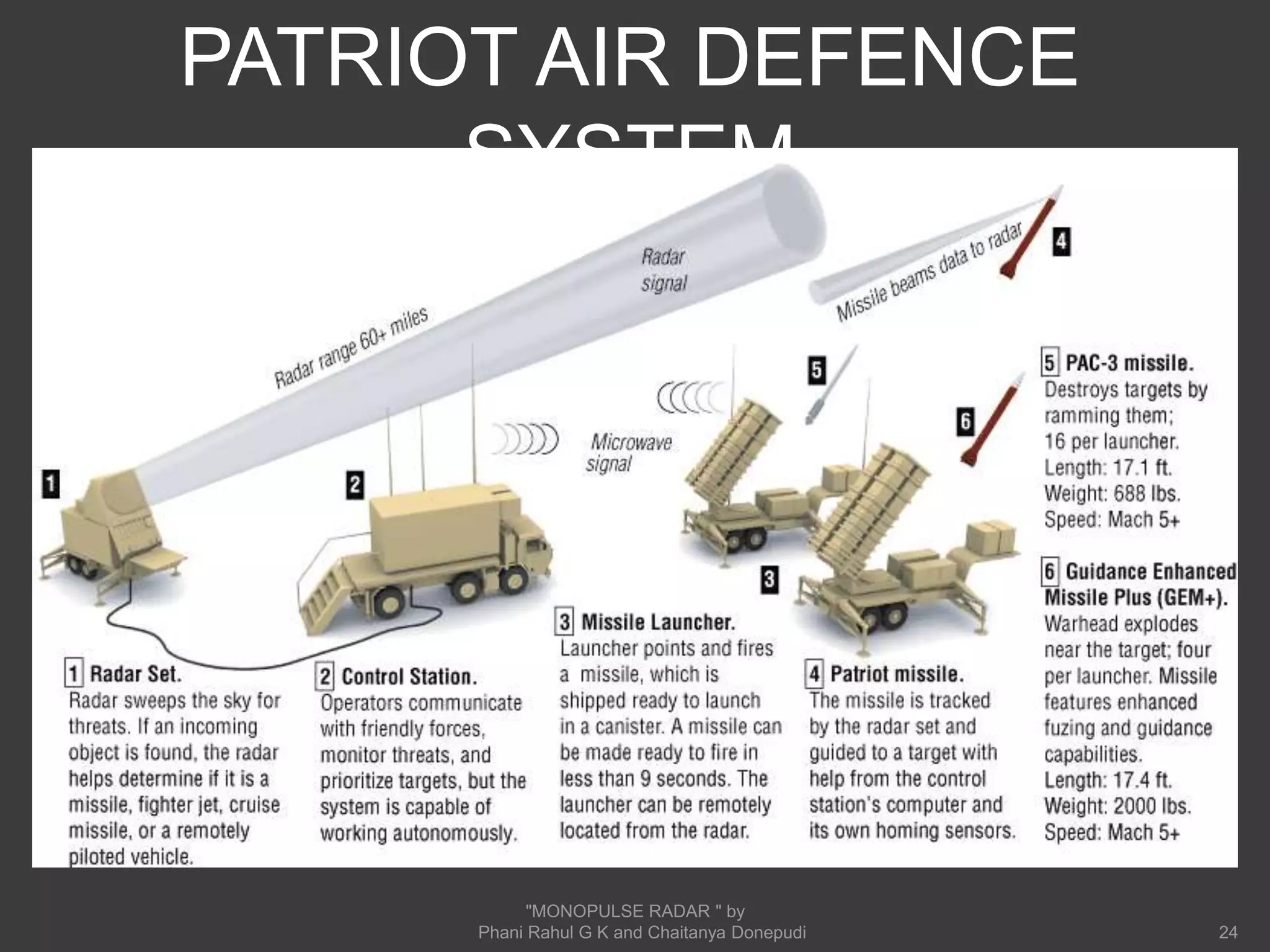
    PATRIOT AIR DEFENCESYSTEM"MONOPULSE RADAR " by Phani Rahul G K and Chaitanya Donepudi24
  • 28.
    CONCLUSIONIt is usedif extreme accuracy is neededIts improved interference immunity, resolution, radar signal processing and angular accuracy made it imperative in all modern missile tracking/guidance systems"MONOPULSE RADAR " by Phani Rahul G K and Chaitanya Donepudi25THANKYOUQUERIES?