Training report on 
Industrial training at 
On the topic:- 
STUDY OF RADAR SYSTEM 
Submitted to:- 
Under:- Mr. Aman Vohra 
Start Date for Internship:-June 16th 2014 
End Date for Internship:-July 26th 2014 
Submitted by:- 
Atul Sharma, B.Tech IV 
year, ECE 
Maharaja Agrasen Institute 
Of Technology, GGSIPU
INTRODUCTION 
 RADAR is an acronym for 
RAdio Detecting And Ranging. 
 First successfully demonstrated 
in 1936. 
 It uses electromagnetic waves. 
 It enjoys wide range of 
application. 
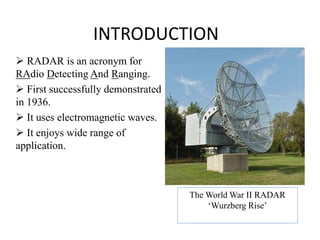
The World War II RADAR 
‘Wurzberg Rise’
Principle Of Working 
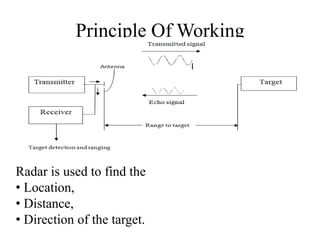
Radar is used to find the 
• Location, 
• Distance, 
• Direction of the target.
Radar Range Equation 
Rmax = [Pt .G.б.Ae / (4П)2Smin]1/4 
G = 4ПAe / λ2 
Ae = G.λ2 / 4П 
Where Smin = Minimum power received 
Pt = Power transmitted 
G = antenna gain 
б = radar cross section of target 
Ae= effective area 
Rmax = Maximum Radar Range
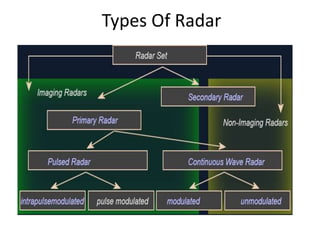
Types Of Radar
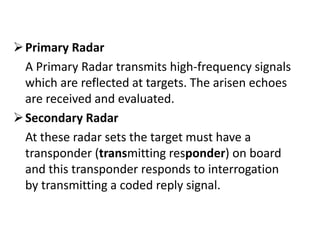
Primary Radar 
A Primary Radar transmits high-frequency signals 
which are reflected at targets. The arisen echoes 
are received and evaluated. 
Secondary Radar 
At these radar sets the target must have a 
transponder (transmitting responder) on board 
and this transponder responds to interrogation 
by transmitting a coded reply signal.
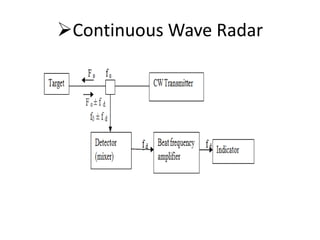
Continuous Wave Radar
Pulse Radar
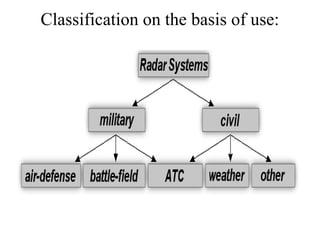
Classification on the basis of use:
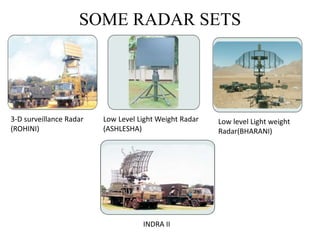
SOME RADAR SETS 
3-D surveillance Radar 
(ROHINI) 
Low Level Light Weight Radar 
(ASHLESHA) 
Low level Light weight 
Radar(BHARANI) 
INDRA II
RADAR DEVICES 
ANTENNA 
TRANSMITTER 
RECEIVER 
RADAR DISPLAY
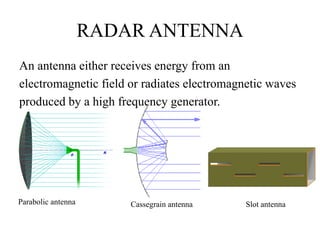
RADAR ANTENNA 
An antenna either receives energy from an 
electromagnetic field or radiates electromagnetic waves 
produced by a high frequency generator. 
Parabolic antenna Cassegrain antenna Slot antenna
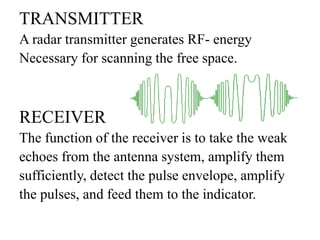
TRANSMITTER 
A radar transmitter generates RF- energy 
Necessary for scanning the free space. 
RECEIVER 
The function of the receiver is to take the weak 
echoes from the antenna system, amplify them 
sufficiently, detect the pulse envelope, amplify 
the pulses, and feed them to the indicator.
RADAR DISPLAY 
A-SCOPE 
B-SCOPE 
PLAN-POSITION INDICATOR(PPI)
A-SCOPE 
Presents only the range to 
the target and the relative 
strength of the echo. 
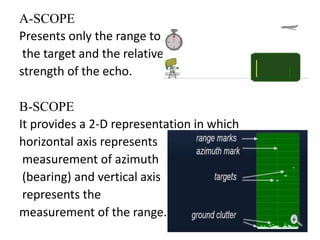
B-SCOPE 
It provides a 2-D representation in which 
horizontal axis represents 
measurement of azimuth 
(bearing) and vertical axis 
represents the 
measurement of the range.
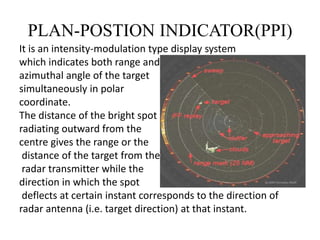
PLAN-POSTION INDICATOR(PPI) 
It is an intensity-modulation type display system 
which indicates both range and 
azimuthal angle of the target 
simultaneously in polar 
coordinate. 
The distance of the bright spot 
radiating outward from the 
centre gives the range or the 
distance of the target from the 
radar transmitter while the 
direction in which the spot 
deflects at certain instant corresponds to the direction of 
radar antenna (i.e. target direction) at that instant.
Thank You

Study of Radar System PPT

  • 1.
    Training report on Industrial training at On the topic:- STUDY OF RADAR SYSTEM Submitted to:- Under:- Mr. Aman Vohra Start Date for Internship:-June 16th 2014 End Date for Internship:-July 26th 2014 Submitted by:- Atul Sharma, B.Tech IV year, ECE Maharaja Agrasen Institute Of Technology, GGSIPU
  • 2.
    INTRODUCTION  RADARis an acronym for RAdio Detecting And Ranging.  First successfully demonstrated in 1936.  It uses electromagnetic waves.  It enjoys wide range of application. The World War II RADAR ‘Wurzberg Rise’
  • 3.
    Principle Of Working Radar is used to find the • Location, • Distance, • Direction of the target.
  • 4.
    Radar Range Equation Rmax = [Pt .G.б.Ae / (4П)2Smin]1/4 G = 4ПAe / λ2 Ae = G.λ2 / 4П Where Smin = Minimum power received Pt = Power transmitted G = antenna gain б = radar cross section of target Ae= effective area Rmax = Maximum Radar Range
  • 5.
  • 6.
    Primary Radar APrimary Radar transmits high-frequency signals which are reflected at targets. The arisen echoes are received and evaluated. Secondary Radar At these radar sets the target must have a transponder (transmitting responder) on board and this transponder responds to interrogation by transmitting a coded reply signal.
  • 7.
  • 8.
  • 9.
    Classification on thebasis of use:
  • 10.
    SOME RADAR SETS 3-D surveillance Radar (ROHINI) Low Level Light Weight Radar (ASHLESHA) Low level Light weight Radar(BHARANI) INDRA II
  • 11.
    RADAR DEVICES ANTENNA TRANSMITTER RECEIVER RADAR DISPLAY
  • 12.
    RADAR ANTENNA Anantenna either receives energy from an electromagnetic field or radiates electromagnetic waves produced by a high frequency generator. Parabolic antenna Cassegrain antenna Slot antenna
  • 13.
    TRANSMITTER A radartransmitter generates RF- energy Necessary for scanning the free space. RECEIVER The function of the receiver is to take the weak echoes from the antenna system, amplify them sufficiently, detect the pulse envelope, amplify the pulses, and feed them to the indicator.
  • 14.
    RADAR DISPLAY A-SCOPE B-SCOPE PLAN-POSITION INDICATOR(PPI)
  • 15.
    A-SCOPE Presents onlythe range to the target and the relative strength of the echo. B-SCOPE It provides a 2-D representation in which horizontal axis represents measurement of azimuth (bearing) and vertical axis represents the measurement of the range.
  • 16.
    PLAN-POSTION INDICATOR(PPI) Itis an intensity-modulation type display system which indicates both range and azimuthal angle of the target simultaneously in polar coordinate. The distance of the bright spot radiating outward from the centre gives the range or the distance of the target from the radar transmitter while the direction in which the spot deflects at certain instant corresponds to the direction of radar antenna (i.e. target direction) at that instant.
  • 17.