RADAR
BY
PRATIBHA SHAKYA
UNDER THE GUIDANCE OF
Ms. SANTOSHI POTE
ROLL NO: 49
Introduction
 RADAR is acronym for Radio Detection
and Ranging.
 First successfully demonstrated in 1936.
 It uses electromagnetic waves.
 It enjoys wide range of application.
Literature Survey
 History
 Future Researches
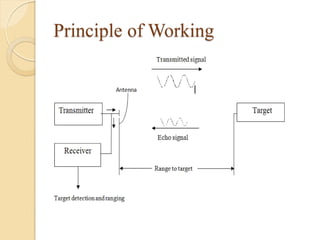
Principle of Working
Radar Range Equation
R max = [P t G б A e /(4П)2Smin]1/4
G = 4ПAe / λ2
A e = Gλ2 / 4П
R max = [Pt Gλ2б / (4П)2 S min]1/4
Where Pr = power received
Pt = power transmitted
G = antenna gain
б = radar cross section of target
A e = effective area
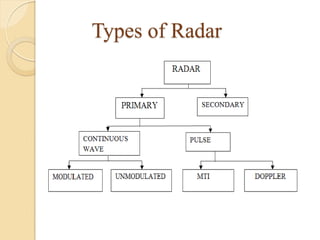
Types of Radar
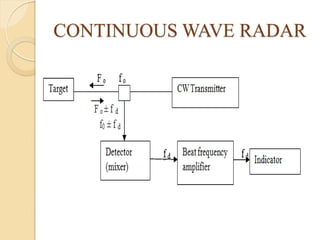
CONTINUOUS WAVE RADAR
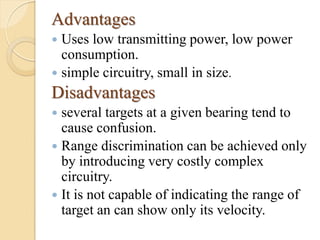
Advantages
 Uses low transmitting power, low power
consumption.
 simple circuitry, small in size.
Disadvantages
 several targets at a given bearing tend to
cause confusion.
 Range discrimination can be achieved only
by introducing very costly complex
circuitry.
 It is not capable of indicating the range of
target an can show only its velocity.
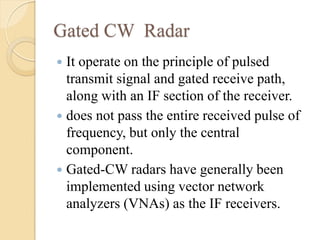
Gated CW Radar
 It operate on the principle of pulsed
transmit signal and gated receive path,
along with an IF section of the receiver.
 does not pass the entire received pulse of
frequency, but only the central
component.
 Gated-CW radars have generally been
implemented using vector network
analyzers (VNAs) as the IF receivers.
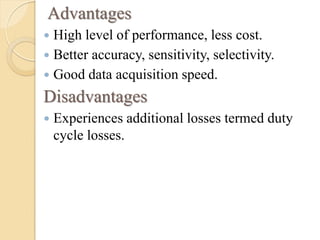
Advantages
 High level of performance, less cost.
 Better accuracy, sensitivity, selectivity.
 Good data acquisition speed.
Disadvantages
 Experiences additional losses termed duty
cycle losses.
Pulse Radar
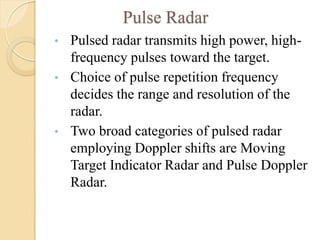
• Pulsed radar transmits high power, high-
frequency pulses toward the target.
• Choice of pulse repetition frequency
decides the range and resolution of the
radar.
• Two broad categories of pulsed radar
employing Doppler shifts are Moving
Target Indicator Radar and Pulse Doppler
Radar.
Moving Target Indicator Radar
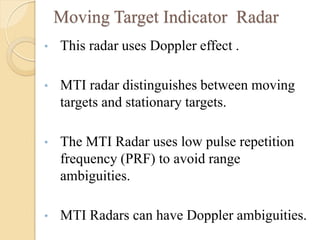
• This radar uses Doppler effect .
• MTI radar distinguishes between moving
targets and stationary targets.
• The MTI Radar uses low pulse repetition
frequency (PRF) to avoid range
ambiguities.
• MTI Radars can have Doppler ambiguities.
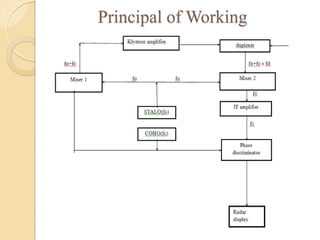
Principal of Working
MTI Application in UAVS
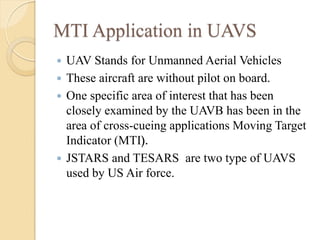
 UAV Stands for Unmanned Aerial Vehicles
 These aircraft are without pilot on board.
 One specific area of interest that has been
closely examined by the UAVB has been in the
area of cross-cueing applications Moving Target
Indicator (MTI).
 JSTARS and TESARS are two type of UAVS
used by US Air force.
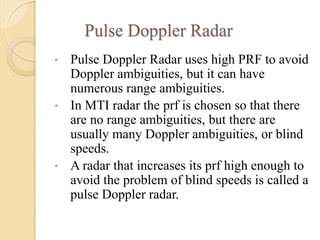
Pulse Doppler Radar
• Pulse Doppler Radar uses high PRF to avoid
Doppler ambiguities, but it can have
numerous range ambiguities.
• In MTI radar the prf is chosen so that there
are no range ambiguities, but there are
usually many Doppler ambiguities, or blind
speeds.
• A radar that increases its prf high enough to
avoid the problem of blind speeds is called a
pulse Doppler radar.
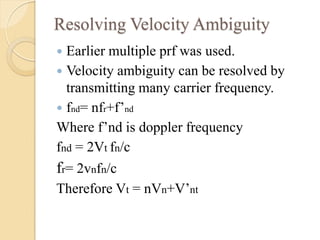
Resolving Velocity Ambiguity
 Earlier multiple prf was used.
 Velocity ambiguity can be resolved by
transmitting many carrier frequency.
 fnd= nfr+f’nd
Where f’nd is doppler frequency
fnd = 2Vt fn/c
fr= 2vnfn/c
Therefore Vt = nVn+V’nt
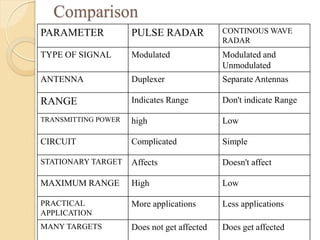
Comparison
PARAMETER PULSE RADAR CONTINOUS WAVE
RADAR
TYPE OF SIGNAL Modulated Modulated and
Unmodulated
ANTENNA Duplexer Separate Antennas
RANGE Indicates Range Don't indicate Range
TRANSMITTING POWER high Low
CIRCUIT Complicated Simple
STATIONARY TARGET Affects Doesn't affect
MAXIMUM RANGE High Low
PRACTICAL
APPLICATION
More applications Less applications
MANY TARGETS Does not get affected Does get affected
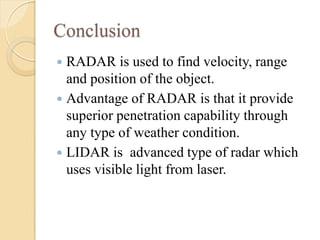
Conclusion
 RADAR is used to find velocity, range
and position of the object.
 Advantage of RADAR is that it provide
superior penetration capability through
any type of weather condition.
 LIDAR is advanced type of radar which
uses visible light from laser.
REFERENCES
 [1] M. Kulkarni, “Microwave and Radar Engineering”, 3rd edition,
Umesh Publication, 2003, pp. 493 – 536
 [2] Merri.I.skolnik, “Intoduction to Radar System”, 3rd edition, Tata
McGraw Hill, 2003
 [3]“Types of Radar”, Engineers Garage,2012[online]. Available:
http://www.engineersgarage.
com/articles/type-of-radars [accessed: September 2012]
 [4] “Types of Radar”, Cristian Wolff, June 10, 2012[online].
Available:http://www.radartutorial.
eu/02.basics/rp05.en.html [accessed: September 2012]
 [5] “Radar Basics”, Infoplease, September 22, 2012 [online].
Available: http://www.infoplease.
com/ce6/sci/A0860616.html [accessed: September 2012]
 [6] John F.Autin, John Caserta, Mark A.Bates, “A New Gated CW
Radar Implementation”
Horsham, 2010.
THANK YOU

Radar ppt

  • 1.
    RADAR BY PRATIBHA SHAKYA UNDER THEGUIDANCE OF Ms. SANTOSHI POTE ROLL NO: 49
  • 2.
    Introduction  RADAR isacronym for Radio Detection and Ranging.  First successfully demonstrated in 1936.  It uses electromagnetic waves.  It enjoys wide range of application.
  • 3.
  • 4.
  • 5.
    Radar Range Equation Rmax = [P t G б A e /(4П)2Smin]1/4 G = 4ПAe / λ2 A e = Gλ2 / 4П R max = [Pt Gλ2б / (4П)2 S min]1/4 Where Pr = power received Pt = power transmitted G = antenna gain б = radar cross section of target A e = effective area
  • 6.
  • 7.
  • 8.
    Advantages  Uses lowtransmitting power, low power consumption.  simple circuitry, small in size. Disadvantages  several targets at a given bearing tend to cause confusion.  Range discrimination can be achieved only by introducing very costly complex circuitry.  It is not capable of indicating the range of target an can show only its velocity.
  • 9.
    Gated CW Radar It operate on the principle of pulsed transmit signal and gated receive path, along with an IF section of the receiver.  does not pass the entire received pulse of frequency, but only the central component.  Gated-CW radars have generally been implemented using vector network analyzers (VNAs) as the IF receivers.
  • 10.
    Advantages  High levelof performance, less cost.  Better accuracy, sensitivity, selectivity.  Good data acquisition speed. Disadvantages  Experiences additional losses termed duty cycle losses.
  • 11.
    Pulse Radar • Pulsedradar transmits high power, high- frequency pulses toward the target. • Choice of pulse repetition frequency decides the range and resolution of the radar. • Two broad categories of pulsed radar employing Doppler shifts are Moving Target Indicator Radar and Pulse Doppler Radar.
  • 12.
    Moving Target IndicatorRadar • This radar uses Doppler effect . • MTI radar distinguishes between moving targets and stationary targets. • The MTI Radar uses low pulse repetition frequency (PRF) to avoid range ambiguities. • MTI Radars can have Doppler ambiguities.
  • 13.
  • 14.
    MTI Application inUAVS  UAV Stands for Unmanned Aerial Vehicles  These aircraft are without pilot on board.  One specific area of interest that has been closely examined by the UAVB has been in the area of cross-cueing applications Moving Target Indicator (MTI).  JSTARS and TESARS are two type of UAVS used by US Air force.
  • 15.
    Pulse Doppler Radar •Pulse Doppler Radar uses high PRF to avoid Doppler ambiguities, but it can have numerous range ambiguities. • In MTI radar the prf is chosen so that there are no range ambiguities, but there are usually many Doppler ambiguities, or blind speeds. • A radar that increases its prf high enough to avoid the problem of blind speeds is called a pulse Doppler radar.
  • 16.
    Resolving Velocity Ambiguity Earlier multiple prf was used.  Velocity ambiguity can be resolved by transmitting many carrier frequency.  fnd= nfr+f’nd Where f’nd is doppler frequency fnd = 2Vt fn/c fr= 2vnfn/c Therefore Vt = nVn+V’nt
  • 17.
    Comparison PARAMETER PULSE RADARCONTINOUS WAVE RADAR TYPE OF SIGNAL Modulated Modulated and Unmodulated ANTENNA Duplexer Separate Antennas RANGE Indicates Range Don't indicate Range TRANSMITTING POWER high Low CIRCUIT Complicated Simple STATIONARY TARGET Affects Doesn't affect MAXIMUM RANGE High Low PRACTICAL APPLICATION More applications Less applications MANY TARGETS Does not get affected Does get affected
  • 18.
    Conclusion  RADAR isused to find velocity, range and position of the object.  Advantage of RADAR is that it provide superior penetration capability through any type of weather condition.  LIDAR is advanced type of radar which uses visible light from laser.
  • 19.
    REFERENCES  [1] M.Kulkarni, “Microwave and Radar Engineering”, 3rd edition, Umesh Publication, 2003, pp. 493 – 536  [2] Merri.I.skolnik, “Intoduction to Radar System”, 3rd edition, Tata McGraw Hill, 2003  [3]“Types of Radar”, Engineers Garage,2012[online]. Available: http://www.engineersgarage. com/articles/type-of-radars [accessed: September 2012]  [4] “Types of Radar”, Cristian Wolff, June 10, 2012[online]. Available:http://www.radartutorial. eu/02.basics/rp05.en.html [accessed: September 2012]  [5] “Radar Basics”, Infoplease, September 22, 2012 [online]. Available: http://www.infoplease. com/ce6/sci/A0860616.html [accessed: September 2012]  [6] John F.Autin, John Caserta, Mark A.Bates, “A New Gated CW Radar Implementation” Horsham, 2010.
  • 20.