Tracking RADAR
Edwin Muriyaden Wilson, M.Tech 2nd Sem
DOE, CUSAT
Introduction
The radar which detects target and determines
location as well as predict its trajectory path is known
as tracking radar.
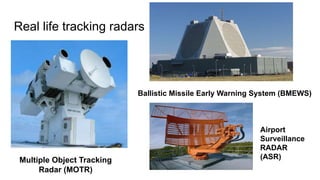
Real life tracking radars
Multiple Object Tracking
Radar (MOTR)
Ballistic Missile Early Warning System (BMEWS)
Airport
Surveillance
RADAR
(ASR)
Types of Tracking RADAR
● Single Target Tracker Radar (STT) designed to
Continuously track a single target at a high data rate • Ex:
Weapon control radar [guided missile targets]
● Automatic Detection and Track Radar (ADT) • Lower
data rate • Ex: Air Surveillance Radar [Military and
Civilian]
-> Next Slide
● Phased Array Radar • High data rate • Electronically
steered phase array antenna • Used on time sharing
basis • Ex: Air-defense weapon radar system [MOTR]
● Track while Scan Radar • Moderate data rate • Ex:
Aircraft Landing Radar (Airborne Radar)
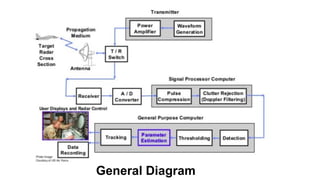
General Diagram
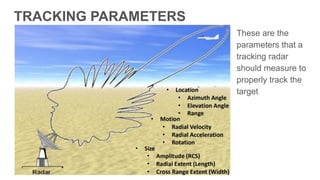
TRACKING PARAMETERS
These are the
parameters that a
tracking radar
should measure to
properly track the
target
ANGLE TRACKING
Tracking RADAR depends upon angular information.
Very narrow pencil beam is used here which will track one target
object at one time.
The Beam can be Lobed up and down or Scanned Conically or we can
have a Monopulse Beam. Here we focus on Conical Scanning and
Monopulse.
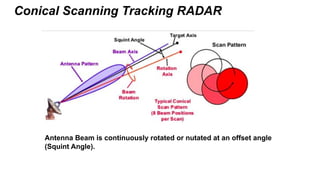
Conical Scanning Tracking RADAR
Antenna Beam is continuously rotated or nutated at an offset angle
(Squint Angle).
Important Theory of Conical Scan RADARs
Target angle :angle between the axis of rotation and the direction to the target. q
Squint angle :angle between the antenna-beam axis and the axis of rotation B
Beamwidth :angular separation between two half power points of the beam
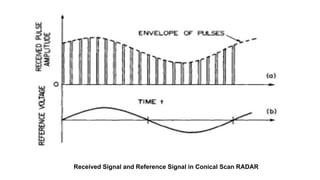
The amplitude of the echo signal will be modulated at a frequency equal to beam
rotation frequency called the Conical Scan frequency. (See next slide)
The Target Angle determines the amplitude of the modulated signal received.
The Angle Error is obtained from the phase of modulation. It is used to adjust the
azimuthal and elevation servos accordingly.
Received Signal and Reference Signal in Conical Scan RADAR
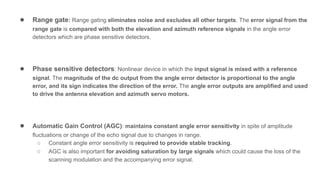
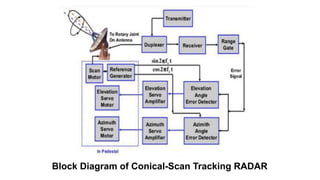
● Range gate: Range gating eliminates noise and excludes all other targets. The error signal from the
range gate is compared with both the elevation and azimuth reference signals in the angle error
detectors which are phase sensitive detectors.
● Phase sensitive detectors: Nonlinear device in which the input signal is mixed with a reference
signal. The magnitude of the dc output from the angle error detector is proportional to the angle
error, and its sign indicates the direction of the error. The angle error outputs are amplified and used
to drive the antenna elevation and azimuth servo motors.
● Automatic Gain Control (AGC): maintains constant angle error sensitivity in spite of amplitude
fluctuations or change of the echo signal due to changes in range.
○ Constant angle error sensitivity is required to provide stable tracking.
○ AGC is also important for avoiding saturation by large signals which could cause the loss of the
scanning modulation and the accompanying error signal.
Block Diagram of Conical-Scan Tracking RADAR
Limitations of Conical Scanned Tracking RADAR
● The conical scanning radar compares the return from two
directions to directly measure the location of the target.
● It creates confusion due to rapid changes in signal strength
Monopulse Tracking RADAR
● Radar in which information concerning the angular location of the target is
obtained by comparing the signal received in two or more simultaneous
beams.
● Two offset antenna beams are combined to obtain both sum and
difference signal .
● This signals are multiplied in a phase sensitive detector to obtain both
magnitude and direction
Two Kinds of Monopulse RADAR
● Amplitude Comparison Monopulse RADAR
● Phase Comparison Monopulse RADAR
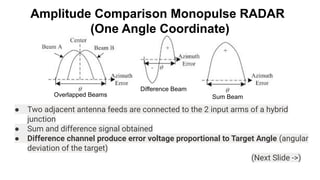
Amplitude Comparison Monopulse RADAR
(One Angle Coordinate)
Overlapped Beams
Difference Beam
Sum Beam
● Two adjacent antenna feeds are connected to the 2 input arms of a hybrid
junction
● Sum and difference signal obtained
● Difference channel produce error voltage proportional to Target Angle (angular
deviation of the target)
(Next Slide ->)
● By comparing the phase of sum and difference signal , angle error is
found
● Depending on these information's the servo meter will drive the
antenna back to the target
● Phase sensitive detector is used to compare the phase of two signals
Amplitude Comparison Monopulse RADAR Diagram
Amplitude Comparison Monopulse RADAR
(Two Angle Coordinate)
Can Find both
Azimuthal and
Elevation
Angle of
Target
● All four feeds are used to generate sum pattern i.e A+B+C+D
● Azimuth difference channel: (A+B) – (C+D)
● Elevation difference channel: (B+D) – (A+C)
● Two angle errors
○ Elevation angle error : o/p of phase comparison b/w sum channel
and Elevation difference channel
○ Azimuth angle error : o/p of phase comparison b/w sum channel and
Azimuth difference channel
Phase Comparison Monopulse RADAR
● Angle of Arrival of target calculated by comparing Phases
● Uses two beams from two antennas looking at same
location
○ Echo on boresight will arrive at both antennas at same time, thus
no phase difference
○ Echo from an angle from boresight arrive at different times at both
antennas, causing phase difference.
● Here length
difference between
received signals is
dsinθ.
● Phase Difference
can be calculated
from this
Δψ = 2πdsinθ/λ
● This Phase is used
to calculate Target
Angle
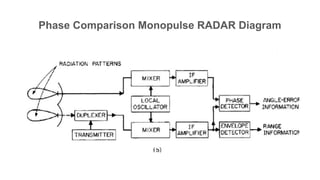
Phase Comparison Monopulse RADAR Diagram
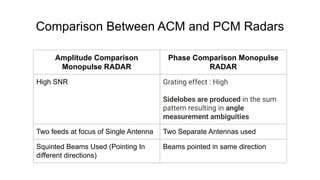
Comparison Between ACM and PCM Radars
Amplitude Comparison
Monopulse RADAR
Phase Comparison Monopulse
RADAR
High SNR Grating effect : High
Sidelobes are produced in the sum
pattern resulting in angle
measurement ambiguities
Two feeds at focus of Single Antenna Two Separate Antennas used
Squinted Beams Used (Pointing In
different directions)
Beams pointed in same direction
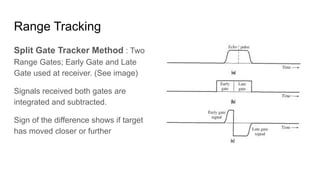
Range Tracking
Split Gate Tracker Method : Two
Range Gates; Early Gate and Late
Gate used at receiver. (See image)
Signals received both gates are
integrated and subtracted.
Sign of the difference shows if target
has moved closer or further
Velocity Tracking
Done by tracking Doppler Frequency Shift to obtain relative velocity of the target.
Used in Missile Trackers and Airborne Pulse Doppler Radar (Used in missiles to
track targets in air)
Doppler tracking filter also reduces clutter and isolates target better
Tracking Accuracy can be degraded if received signal is modulated by moving
parts in target (Engine, Jet Compressor etc)
Factors that affect Tracking Accuracy
● Glint or angle noise or angular scintillation
○ Due to fluctuations in the measured angle of arrival of backscattered waves.
○ Affects all tracking radars especially at short range.
● Receiver noise
○ Affects all radars and mainly determines tracking accuracy at long range.
● RCS scintillation or Amplitude fluctuations of the target echo
○ Present in conical scan and sequential lobing trackers but not monopulse.
● Servo noise

Tracking Radar

  • 1.
    Tracking RADAR Edwin MuriyadenWilson, M.Tech 2nd Sem DOE, CUSAT
  • 2.
    Introduction The radar whichdetects target and determines location as well as predict its trajectory path is known as tracking radar.
  • 3.
    Real life trackingradars Multiple Object Tracking Radar (MOTR) Ballistic Missile Early Warning System (BMEWS) Airport Surveillance RADAR (ASR)
  • 4.
    Types of TrackingRADAR ● Single Target Tracker Radar (STT) designed to Continuously track a single target at a high data rate • Ex: Weapon control radar [guided missile targets] ● Automatic Detection and Track Radar (ADT) • Lower data rate • Ex: Air Surveillance Radar [Military and Civilian] -> Next Slide
  • 5.
    ● Phased ArrayRadar • High data rate • Electronically steered phase array antenna • Used on time sharing basis • Ex: Air-defense weapon radar system [MOTR] ● Track while Scan Radar • Moderate data rate • Ex: Aircraft Landing Radar (Airborne Radar)
  • 6.
  • 7.
    TRACKING PARAMETERS These arethe parameters that a tracking radar should measure to properly track the target
  • 8.
    ANGLE TRACKING Tracking RADARdepends upon angular information. Very narrow pencil beam is used here which will track one target object at one time. The Beam can be Lobed up and down or Scanned Conically or we can have a Monopulse Beam. Here we focus on Conical Scanning and Monopulse.
  • 9.
    Conical Scanning TrackingRADAR Antenna Beam is continuously rotated or nutated at an offset angle (Squint Angle).
  • 10.
    Important Theory ofConical Scan RADARs Target angle :angle between the axis of rotation and the direction to the target. q Squint angle :angle between the antenna-beam axis and the axis of rotation B Beamwidth :angular separation between two half power points of the beam The amplitude of the echo signal will be modulated at a frequency equal to beam rotation frequency called the Conical Scan frequency. (See next slide) The Target Angle determines the amplitude of the modulated signal received. The Angle Error is obtained from the phase of modulation. It is used to adjust the azimuthal and elevation servos accordingly.
  • 11.
    Received Signal andReference Signal in Conical Scan RADAR
  • 12.
    ● Range gate:Range gating eliminates noise and excludes all other targets. The error signal from the range gate is compared with both the elevation and azimuth reference signals in the angle error detectors which are phase sensitive detectors. ● Phase sensitive detectors: Nonlinear device in which the input signal is mixed with a reference signal. The magnitude of the dc output from the angle error detector is proportional to the angle error, and its sign indicates the direction of the error. The angle error outputs are amplified and used to drive the antenna elevation and azimuth servo motors. ● Automatic Gain Control (AGC): maintains constant angle error sensitivity in spite of amplitude fluctuations or change of the echo signal due to changes in range. ○ Constant angle error sensitivity is required to provide stable tracking. ○ AGC is also important for avoiding saturation by large signals which could cause the loss of the scanning modulation and the accompanying error signal.
  • 13.
    Block Diagram ofConical-Scan Tracking RADAR
  • 14.
    Limitations of ConicalScanned Tracking RADAR ● The conical scanning radar compares the return from two directions to directly measure the location of the target. ● It creates confusion due to rapid changes in signal strength
  • 15.
    Monopulse Tracking RADAR ●Radar in which information concerning the angular location of the target is obtained by comparing the signal received in two or more simultaneous beams. ● Two offset antenna beams are combined to obtain both sum and difference signal . ● This signals are multiplied in a phase sensitive detector to obtain both magnitude and direction
  • 16.
    Two Kinds ofMonopulse RADAR ● Amplitude Comparison Monopulse RADAR ● Phase Comparison Monopulse RADAR
  • 17.
    Amplitude Comparison MonopulseRADAR (One Angle Coordinate) Overlapped Beams Difference Beam Sum Beam ● Two adjacent antenna feeds are connected to the 2 input arms of a hybrid junction ● Sum and difference signal obtained ● Difference channel produce error voltage proportional to Target Angle (angular deviation of the target) (Next Slide ->)
  • 18.
    ● By comparingthe phase of sum and difference signal , angle error is found ● Depending on these information's the servo meter will drive the antenna back to the target ● Phase sensitive detector is used to compare the phase of two signals
  • 19.
  • 20.
    Amplitude Comparison MonopulseRADAR (Two Angle Coordinate) Can Find both Azimuthal and Elevation Angle of Target
  • 21.
    ● All fourfeeds are used to generate sum pattern i.e A+B+C+D ● Azimuth difference channel: (A+B) – (C+D) ● Elevation difference channel: (B+D) – (A+C) ● Two angle errors ○ Elevation angle error : o/p of phase comparison b/w sum channel and Elevation difference channel ○ Azimuth angle error : o/p of phase comparison b/w sum channel and Azimuth difference channel
  • 22.
    Phase Comparison MonopulseRADAR ● Angle of Arrival of target calculated by comparing Phases ● Uses two beams from two antennas looking at same location ○ Echo on boresight will arrive at both antennas at same time, thus no phase difference ○ Echo from an angle from boresight arrive at different times at both antennas, causing phase difference.
  • 23.
    ● Here length differencebetween received signals is dsinθ. ● Phase Difference can be calculated from this Δψ = 2πdsinθ/λ ● This Phase is used to calculate Target Angle
  • 24.
  • 25.
    Comparison Between ACMand PCM Radars Amplitude Comparison Monopulse RADAR Phase Comparison Monopulse RADAR High SNR Grating effect : High Sidelobes are produced in the sum pattern resulting in angle measurement ambiguities Two feeds at focus of Single Antenna Two Separate Antennas used Squinted Beams Used (Pointing In different directions) Beams pointed in same direction
  • 26.
    Range Tracking Split GateTracker Method : Two Range Gates; Early Gate and Late Gate used at receiver. (See image) Signals received both gates are integrated and subtracted. Sign of the difference shows if target has moved closer or further
  • 27.
    Velocity Tracking Done bytracking Doppler Frequency Shift to obtain relative velocity of the target. Used in Missile Trackers and Airborne Pulse Doppler Radar (Used in missiles to track targets in air) Doppler tracking filter also reduces clutter and isolates target better Tracking Accuracy can be degraded if received signal is modulated by moving parts in target (Engine, Jet Compressor etc)
  • 28.
    Factors that affectTracking Accuracy ● Glint or angle noise or angular scintillation ○ Due to fluctuations in the measured angle of arrival of backscattered waves. ○ Affects all tracking radars especially at short range. ● Receiver noise ○ Affects all radars and mainly determines tracking accuracy at long range. ● RCS scintillation or Amplitude fluctuations of the target echo ○ Present in conical scan and sequential lobing trackers but not monopulse. ● Servo noise