Radar Fundamentals
Ali Sufyan
Islamia University of Bahawalpur
Bahawalpur, Punjab, Pakistan
ali.sufyan@iub.edu.pk
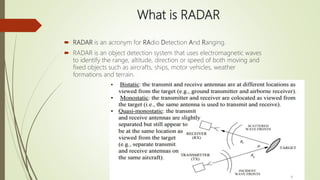
What is RADAR
 RADAR is an acronym for RAdio Detection And Ranging.
 RADAR is an object detection system that uses electromagnetic waves
to identify the range, altitude, direction or speed of both moving and
fixed objects such as aircrafts, ships, motor vehicles, weather
formations and terrain.
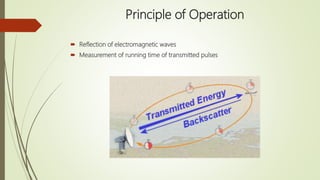
Principle of Operation
 Reflection of electromagnetic waves
 Measurement of running time of transmitted pulses
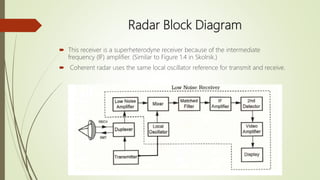
Radar Block Diagram
 This receiver is a superheterodyne receiver because of the intermediate
frequency (IF) amplifier. (Similar to Figure 1.4 in Skolnik.)
 Coherent radar uses the same local oscillator reference for transmit and receive.
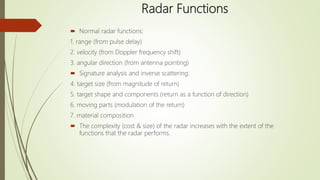
Radar Functions
 Normal radar functions:
1. range (from pulse delay)
2. velocity (from Doppler frequency shift)
3. angular direction (from antenna pointing)
 Signature analysis and inverse scattering:
4. target size (from magnitude of return)
5. target shape and components (return as a function of direction)
6. moving parts (modulation of the return)
7. material composition
 The complexity (cost & size) of the radar increases with the extent of the
functions that the radar performs.
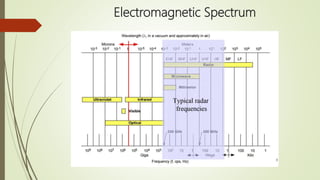
Electromagnetic Spectrum
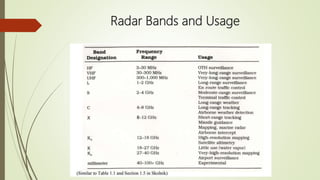
Radar Bands and Usage
Principle of Measurement
 Distance Determination.
 Direction Determination.
 Elevation Angle.
 Range Resolution
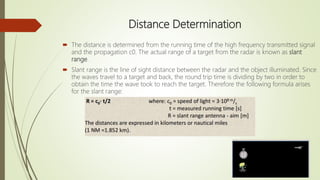
Distance Determination
 The distance is determined from the running time of the high frequency transmitted signal
and the propagation c0. The actual range of a target from the radar is known as slant
range.
 Slant range is the line of sight distance between the radar and the object illuminated. Since
the waves travel to a target and back, the round trip time is dividing by two in order to
obtain the time the wave took to reach the target. Therefore the following formula arises
for the slant range:
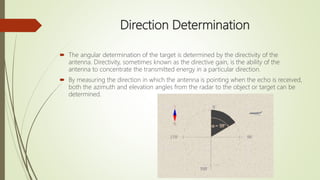
Direction Determination
 The angular determination of the target is determined by the directivity of the
antenna. Directivity, sometimes known as the directive gain, is the ability of the
antenna to concentrate the transmitted energy in a particular direction.
 By measuring the direction in which the antenna is pointing when the echo is received,
both the azimuth and elevation angles from the radar to the object or target can be
determined.
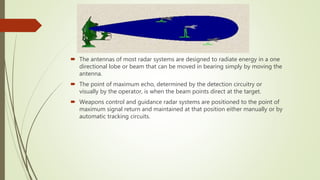
 The antennas of most radar systems are designed to radiate energy in a one
directional lobe or beam that can be moved in bearing simply by moving the
antenna.
 The point of maximum echo, determined by the detection circuitry or
visually by the operator, is when the beam points direct at the target.
 Weapons control and guidance radar systems are positioned to the point of
maximum signal return and maintained at that position either manually or by
automatic tracking circuits.
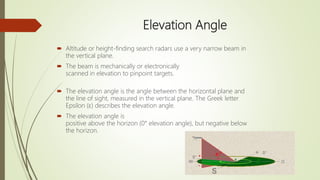
Elevation Angle
 Altitude or height-finding search radars use a very narrow beam in
the vertical plane.
 The beam is mechanically or electronically
scanned in elevation to pinpoint targets.
 The elevation angle is the angle between the horizontal plane and
the line of sight, measured in the vertical plane. The Greek letter
Epsilon (ε) describes the elevation angle.
 The elevation angle is
positive above the horizon (0° elevation angle), but negative below
the horizon.
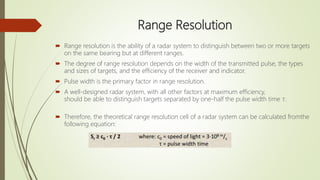
Range Resolution
 Range resolution is the ability of a radar system to distinguish between two or more targets
on the same bearing but at different ranges.
 The degree of range resolution depends on the width of the transmitted pulse, the types
and sizes of targets, and the efficiency of the receiver and indicator.
 Pulse width is the primary factor in range resolution.
 A well-designed radar system, with all other factors at maximum efficiency,
should be able to distinguish targets separated by one-half the pulse width time τ.
 Therefore, the theoretical range resolution cell of a radar system can be calculated fromthe
following equation:
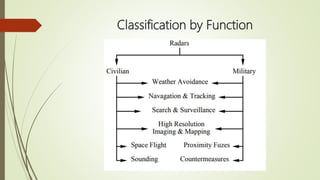
Classification by Function
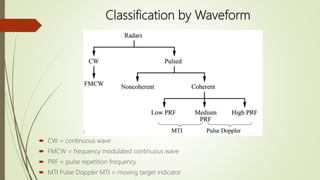
Classification by Waveform
 CW = continuous wave
 FMCW = frequency modulated continuous wave
 PRF = pulse repetition frequency
 MTI Pulse Doppler MTI = moving target indicator
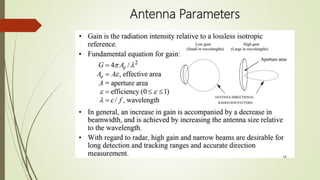
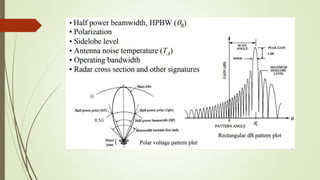
Antenna Parameters
Radar Timing
 Pulse Repetition Frequency.
 Duty Cycle.
 Dwell Time.
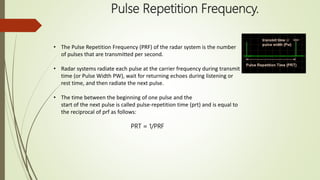
Pulse Repetition Frequency.
• The Pulse Repetition Frequency (PRF) of the radar system is the number
of pulses that are transmitted per second.
• Radar systems radiate each pulse at the carrier frequency during transmit
time (or Pulse Width PW), wait for returning echoes during listening or
rest time, and then radiate the next pulse.
• The time between the beginning of one pulse and the
start of the next pulse is called pulse-repetition time (prt) and is equal to
the reciprocal of prf as follows:
PRT = 1/PRF
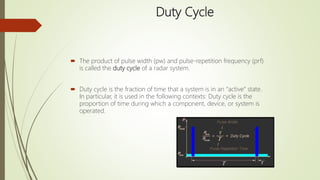
Duty Cycle
 The product of pulse width (pw) and pulse-repetition frequency (prf)
is called the duty cycle of a radar system.
 Duty cycle is the fraction of time that a system is in an “active” state.
In particular, it is used in the following contexts: Duty cycle is the
proportion of time during which a component, device, or system is
operated.
Dwell Time
 The time that an antenna beam spends on a target is called dwell time TD.
The dwell time of a 2D–search radar depends predominantly on:
1) the antennas horizontally beam width AZ
2) the turn speed n of the antenna (rotations per minute).
 The dwell time can be calculated using the following equation:
TD = (ΘAZ · 60)/(360° · n) ; in [seconds]
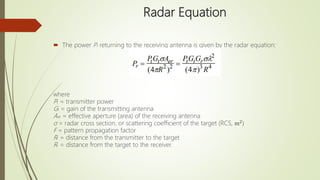
Radar Equation
 The power Pr returning to the receiving antenna is given by the radar equation:
where
Pt = transmitter power
Gt = gain of the transmitting antenna
Aer = effective aperture (area) of the receiving antenna
σ = radar cross section, or scattering coefficient of the target (RCS, m2
)
F = pattern propagation factor
Rt = distance from the transmitter to the target
Rr = distance from the target to the receiver.
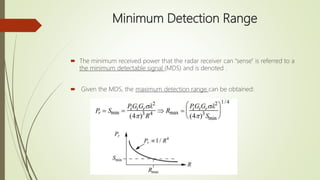
Minimum Detection Range
 The minimum received power that the radar receiver can "sense" is referred to a
the minimum detectable signal (MDS) and is denoted .
 Given the MDS, the maximum detection range can be obtained:
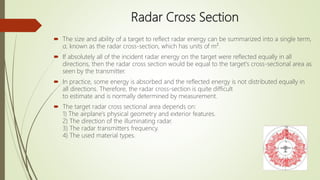
Radar Cross Section
 The size and ability of a target to reflect radar energy can be summarized into a single term,
σ, known as the radar cross-section, which has units of m².
 If absolutely all of the incident radar energy on the target were reflected equally in all
directions, then the radar cross section would be equal to the target's cross-sectional area as
seen by the transmitter.
 In practice, some energy is absorbed and the reflected energy is not distributed equally in
all directions. Therefore, the radar cross-section is quite difficult
to estimate and is normally determined by measurement.
 The target radar cross sectional area depends on:
1) The airplane’s physical geometry and exterior features.
2) The direction of the illuminating radar.
3) The radar transmitters frequency.
4) The used material types.
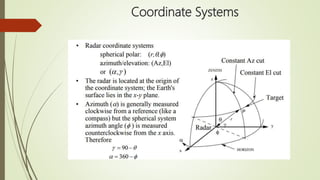
Coordinate Systems
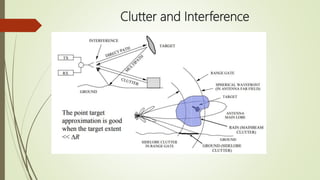
Clutter and Interference
Clutter
 Clutter refers to radio frequency (RF) echoes returned from targets which are
uninteresting to the radar operators.
 Such targets include natural objects such as ground, sea, precipitation (such as rain, snow
or hail), sand storms, animals (especially birds), atmospheric turbulence, and other
atmospheric effects, such as ionosphere reflections, meteor trails, and three body scatter
spike.
 Clutter may also be returned from man-made objects such as buildings and, intentionally,
by radar countermeasures such as chaff.
 Clutter may also originate from multipath echoes from valid targets due to ground
reflection, atmospheric ducting or ionospheric reflection/refraction.
 Clutter may also originate from multipath echoes from valid targets due to ground
reflection, atmospheric ducting or ionospheric reflection/refraction.
Cont….
 The basic types of clutter can be summarized as follows:
 Surface Clutter – Ground or sea returns are typical surface clutter. Returns from
geographical land masses are generally stationary, however, the effect of wind
on trees etc means that the target can introduce a Doppler Shift to the radar
return. This Doppler shift is an important method of removing unwanted
signals in the signal processing part of a radar system. Clutter returned from the
sea generally also has movement associated with the waves.
 Volume Clutter – Weather or chaff are typical volume clutter. In the air, the most
significant problem is weather clutter. This can be produced from rain or snow
and can have a significant Doppler content.
 Point Clutter – Birds, windmills and individual tall buildings are typical point
clutter and are not extended in nature. Moving point clutter is sometimes
described as angels. Birds and insects produce clutter, which can be very
difficult to remove because the characteristics are very much like aircraft.
Jamming
 Radar jamming refers to radio frequency signals originating from
sources outside the radar, transmitting in the radar's frequency and
thereby masking targets of interest.
 Jamming may be intentional, as with an electronic warfare (EW) tactic, or unintentional,
as with friendly forces operating equipment that transmits using the same frequency
range.
 Jamming is considered an active interference source, since it is initiated by elements
outside the radar and in general unrelated to the radar signals.
Losses
 There are three class of losses:
1. System losses
2. Propagation medium losses
3. Ground plane losses
System losses
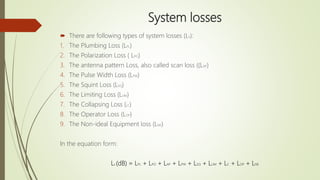
 There are following types of system losses (LS):
1. The Plumbing Loss (LPL)
2. The Polarization Loss ( LPO)
3. The antenna pattern Loss, also called scan loss ((LAP)
4. The Pulse Width Loss (LPW)
5. The Squint Loss (LSQ)
6. The Limiting Loss (LLIM)
7. The Collapsing Loss (LC)
8. The Operator Loss (LOP)
9. The Non-ideal Equipment loss (LNE)
In the equation form:
Ls (dB) = LPL + LPO + LAP + LPW + LSQ + LLIM + LC + LOP + LNE
Propagation medium losse
 There are two types:
1. Absorption loss (by atmospheric gases)
2. Scattering ( by rainfall etc)
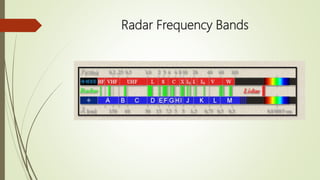
Radar Frequency Bands
Air Defense Radars
 The maximum range of Air-Defense Radar can exceed 300 miles, and
the bearing coverage is a complete 360-degree circle.
 Another function of the Air-Defense Radar is guiding combat air
patrol (CAP) aircraft to a position suitable to intercept an enemy
aircraft.
 Major Air-Defense Radar Applications are:
1) Long-range early warning (including airborne early warning, AEW)
2) Ballistic missile warning and acquisition
3) Height-finding
4) Ground-controlled interception (GCI)
Air Traffic Control Radar
 The following Air Traffic Control (ATC) surveillance, approach and
landing radars are commonly used in Air Traffic Management (ATM):
 1) En-route radar systems,
2) Air Surveillance Radar (ASR) systems,
3) Precision Approach Radar (PAR) systems,
4) surface movement radars and
5) special weather radars.
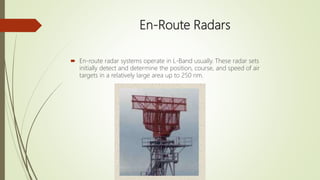
En-Route Radars
 En-route radar systems operate in L-Band usually. These radar sets
initially detect and determine the position, course, and speed of air
targets in a relatively large area up to 250 nm.
Precision Approach Radar
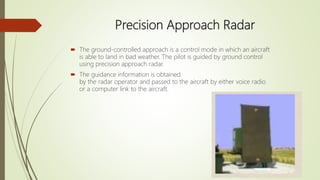
 The ground-controlled approach is a control mode in which an aircraft
is able to land in bad weather. The pilot is guided by ground control
using precision approach radar.
 The guidance information is obtained
by the radar operator and passed to the aircraft by either voice radio
or a computer link to the aircraft.
Surface Movement Radar
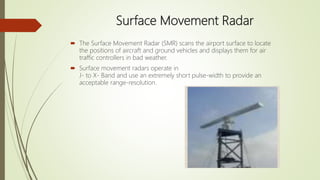
 The Surface Movement Radar (SMR) scans the airport surface to locate
the positions of aircraft and ground vehicles and displays them for air
traffic controllers in bad weather.
 Surface movement radars operate in
J- to X- Band and use an extremely short pulse-width to provide an
acceptable range-resolution.

Radar fundamentals

  • 1.
    Radar Fundamentals Ali Sufyan IslamiaUniversity of Bahawalpur Bahawalpur, Punjab, Pakistan ali.sufyan@iub.edu.pk
  • 2.
    What is RADAR RADAR is an acronym for RAdio Detection And Ranging.  RADAR is an object detection system that uses electromagnetic waves to identify the range, altitude, direction or speed of both moving and fixed objects such as aircrafts, ships, motor vehicles, weather formations and terrain.
  • 3.
    Principle of Operation Reflection of electromagnetic waves  Measurement of running time of transmitted pulses
  • 4.
    Radar Block Diagram This receiver is a superheterodyne receiver because of the intermediate frequency (IF) amplifier. (Similar to Figure 1.4 in Skolnik.)  Coherent radar uses the same local oscillator reference for transmit and receive.
  • 5.
    Radar Functions  Normalradar functions: 1. range (from pulse delay) 2. velocity (from Doppler frequency shift) 3. angular direction (from antenna pointing)  Signature analysis and inverse scattering: 4. target size (from magnitude of return) 5. target shape and components (return as a function of direction) 6. moving parts (modulation of the return) 7. material composition  The complexity (cost & size) of the radar increases with the extent of the functions that the radar performs.
  • 6.
  • 7.
  • 8.
    Principle of Measurement Distance Determination.  Direction Determination.  Elevation Angle.  Range Resolution
  • 9.
    Distance Determination  Thedistance is determined from the running time of the high frequency transmitted signal and the propagation c0. The actual range of a target from the radar is known as slant range.  Slant range is the line of sight distance between the radar and the object illuminated. Since the waves travel to a target and back, the round trip time is dividing by two in order to obtain the time the wave took to reach the target. Therefore the following formula arises for the slant range:
  • 10.
    Direction Determination  Theangular determination of the target is determined by the directivity of the antenna. Directivity, sometimes known as the directive gain, is the ability of the antenna to concentrate the transmitted energy in a particular direction.  By measuring the direction in which the antenna is pointing when the echo is received, both the azimuth and elevation angles from the radar to the object or target can be determined.
  • 11.
     The antennasof most radar systems are designed to radiate energy in a one directional lobe or beam that can be moved in bearing simply by moving the antenna.  The point of maximum echo, determined by the detection circuitry or visually by the operator, is when the beam points direct at the target.  Weapons control and guidance radar systems are positioned to the point of maximum signal return and maintained at that position either manually or by automatic tracking circuits.
  • 12.
    Elevation Angle  Altitudeor height-finding search radars use a very narrow beam in the vertical plane.  The beam is mechanically or electronically scanned in elevation to pinpoint targets.  The elevation angle is the angle between the horizontal plane and the line of sight, measured in the vertical plane. The Greek letter Epsilon (ε) describes the elevation angle.  The elevation angle is positive above the horizon (0° elevation angle), but negative below the horizon.
  • 13.
    Range Resolution  Rangeresolution is the ability of a radar system to distinguish between two or more targets on the same bearing but at different ranges.  The degree of range resolution depends on the width of the transmitted pulse, the types and sizes of targets, and the efficiency of the receiver and indicator.  Pulse width is the primary factor in range resolution.  A well-designed radar system, with all other factors at maximum efficiency, should be able to distinguish targets separated by one-half the pulse width time τ.  Therefore, the theoretical range resolution cell of a radar system can be calculated fromthe following equation:
  • 14.
  • 15.
    Classification by Waveform CW = continuous wave  FMCW = frequency modulated continuous wave  PRF = pulse repetition frequency  MTI Pulse Doppler MTI = moving target indicator
  • 16.
  • 18.
    Radar Timing  PulseRepetition Frequency.  Duty Cycle.  Dwell Time.
  • 19.
    Pulse Repetition Frequency. •The Pulse Repetition Frequency (PRF) of the radar system is the number of pulses that are transmitted per second. • Radar systems radiate each pulse at the carrier frequency during transmit time (or Pulse Width PW), wait for returning echoes during listening or rest time, and then radiate the next pulse. • The time between the beginning of one pulse and the start of the next pulse is called pulse-repetition time (prt) and is equal to the reciprocal of prf as follows: PRT = 1/PRF
  • 20.
    Duty Cycle  Theproduct of pulse width (pw) and pulse-repetition frequency (prf) is called the duty cycle of a radar system.  Duty cycle is the fraction of time that a system is in an “active” state. In particular, it is used in the following contexts: Duty cycle is the proportion of time during which a component, device, or system is operated.
  • 21.
    Dwell Time  Thetime that an antenna beam spends on a target is called dwell time TD. The dwell time of a 2D–search radar depends predominantly on: 1) the antennas horizontally beam width AZ 2) the turn speed n of the antenna (rotations per minute).  The dwell time can be calculated using the following equation: TD = (ΘAZ · 60)/(360° · n) ; in [seconds]
  • 22.
    Radar Equation  Thepower Pr returning to the receiving antenna is given by the radar equation: where Pt = transmitter power Gt = gain of the transmitting antenna Aer = effective aperture (area) of the receiving antenna σ = radar cross section, or scattering coefficient of the target (RCS, m2 ) F = pattern propagation factor Rt = distance from the transmitter to the target Rr = distance from the target to the receiver.
  • 23.
    Minimum Detection Range The minimum received power that the radar receiver can "sense" is referred to a the minimum detectable signal (MDS) and is denoted .  Given the MDS, the maximum detection range can be obtained:
  • 24.
    Radar Cross Section The size and ability of a target to reflect radar energy can be summarized into a single term, σ, known as the radar cross-section, which has units of m².  If absolutely all of the incident radar energy on the target were reflected equally in all directions, then the radar cross section would be equal to the target's cross-sectional area as seen by the transmitter.  In practice, some energy is absorbed and the reflected energy is not distributed equally in all directions. Therefore, the radar cross-section is quite difficult to estimate and is normally determined by measurement.  The target radar cross sectional area depends on: 1) The airplane’s physical geometry and exterior features. 2) The direction of the illuminating radar. 3) The radar transmitters frequency. 4) The used material types.
  • 25.
  • 26.
  • 27.
    Clutter  Clutter refersto radio frequency (RF) echoes returned from targets which are uninteresting to the radar operators.  Such targets include natural objects such as ground, sea, precipitation (such as rain, snow or hail), sand storms, animals (especially birds), atmospheric turbulence, and other atmospheric effects, such as ionosphere reflections, meteor trails, and three body scatter spike.  Clutter may also be returned from man-made objects such as buildings and, intentionally, by radar countermeasures such as chaff.  Clutter may also originate from multipath echoes from valid targets due to ground reflection, atmospheric ducting or ionospheric reflection/refraction.  Clutter may also originate from multipath echoes from valid targets due to ground reflection, atmospheric ducting or ionospheric reflection/refraction.
  • 28.
    Cont….  The basictypes of clutter can be summarized as follows:  Surface Clutter – Ground or sea returns are typical surface clutter. Returns from geographical land masses are generally stationary, however, the effect of wind on trees etc means that the target can introduce a Doppler Shift to the radar return. This Doppler shift is an important method of removing unwanted signals in the signal processing part of a radar system. Clutter returned from the sea generally also has movement associated with the waves.  Volume Clutter – Weather or chaff are typical volume clutter. In the air, the most significant problem is weather clutter. This can be produced from rain or snow and can have a significant Doppler content.  Point Clutter – Birds, windmills and individual tall buildings are typical point clutter and are not extended in nature. Moving point clutter is sometimes described as angels. Birds and insects produce clutter, which can be very difficult to remove because the characteristics are very much like aircraft.
  • 29.
    Jamming  Radar jammingrefers to radio frequency signals originating from sources outside the radar, transmitting in the radar's frequency and thereby masking targets of interest.  Jamming may be intentional, as with an electronic warfare (EW) tactic, or unintentional, as with friendly forces operating equipment that transmits using the same frequency range.  Jamming is considered an active interference source, since it is initiated by elements outside the radar and in general unrelated to the radar signals.
  • 30.
    Losses  There arethree class of losses: 1. System losses 2. Propagation medium losses 3. Ground plane losses
  • 31.
    System losses  Thereare following types of system losses (LS): 1. The Plumbing Loss (LPL) 2. The Polarization Loss ( LPO) 3. The antenna pattern Loss, also called scan loss ((LAP) 4. The Pulse Width Loss (LPW) 5. The Squint Loss (LSQ) 6. The Limiting Loss (LLIM) 7. The Collapsing Loss (LC) 8. The Operator Loss (LOP) 9. The Non-ideal Equipment loss (LNE) In the equation form: Ls (dB) = LPL + LPO + LAP + LPW + LSQ + LLIM + LC + LOP + LNE
  • 32.
    Propagation medium losse There are two types: 1. Absorption loss (by atmospheric gases) 2. Scattering ( by rainfall etc)
  • 33.
  • 34.
    Air Defense Radars The maximum range of Air-Defense Radar can exceed 300 miles, and the bearing coverage is a complete 360-degree circle.  Another function of the Air-Defense Radar is guiding combat air patrol (CAP) aircraft to a position suitable to intercept an enemy aircraft.  Major Air-Defense Radar Applications are: 1) Long-range early warning (including airborne early warning, AEW) 2) Ballistic missile warning and acquisition 3) Height-finding 4) Ground-controlled interception (GCI)
  • 35.
    Air Traffic ControlRadar  The following Air Traffic Control (ATC) surveillance, approach and landing radars are commonly used in Air Traffic Management (ATM):  1) En-route radar systems, 2) Air Surveillance Radar (ASR) systems, 3) Precision Approach Radar (PAR) systems, 4) surface movement radars and 5) special weather radars.
  • 36.
    En-Route Radars  En-routeradar systems operate in L-Band usually. These radar sets initially detect and determine the position, course, and speed of air targets in a relatively large area up to 250 nm.
  • 37.
    Precision Approach Radar The ground-controlled approach is a control mode in which an aircraft is able to land in bad weather. The pilot is guided by ground control using precision approach radar.  The guidance information is obtained by the radar operator and passed to the aircraft by either voice radio or a computer link to the aircraft.
  • 38.
    Surface Movement Radar The Surface Movement Radar (SMR) scans the airport surface to locate the positions of aircraft and ground vehicles and displays them for air traffic controllers in bad weather.  Surface movement radars operate in J- to X- Band and use an extremely short pulse-width to provide an acceptable range-resolution.