QUANTITATIVE
GENETICS
Avjinder Singh Kaler
Introduction
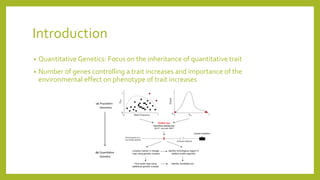
• Quantitative Genetics: Focus on the inheritance of quantitative trait
• Number of genes controlling a trait increases and importance of the
environmental effect on phenotype of trait increases
Single-Gene Model
• Quantitative Genetic theory start with single gene model
• Single locus A with two alleleA and a and have three possible genotypes; AA, Aa, aa in a
population and three assigned genotypic values; a, d and –a
• Two alleles have frequency: p and 1-p =q
• Population mean 𝜇 in terms of allelic frequencies and genotypic values
• 𝜇 = 𝑝2a + 2pqd − 𝑞2a
• Deviation of genotypic value of AA from the population mean
• AA = 𝑎 − 𝜇 = 𝑎 − 𝑝2a + 2pqd − 𝑞2a = 2q(a − pd)
• aa = 𝑑 − 𝜇 = 𝑑 − 𝑝2a + 2pqd − 𝑞2a = −2p(a + qd)
• Aa = 𝑑 − 𝜇 = 𝑑 − 𝑝2a + 2pqd − 𝑞2a = a q − p + d(1 − 2pq)
Average Effect of Gene Substitution
• Average Effect of Gene Substitution α : average effect on the trait of one allele
being replaced by another allele.
• Gamete containing allele A: results in progeny with genotype AA and Aa
• Gamete containing allele a: results in progeny with genotype Aa and aa
• Mean value of genotype produced for two gametes:
• A = pa + qd and a = pd-qa
• α = A-a = (pa + qd) – (pd-qa)= a + (q-p)d
BreedingValue
• Average genotypic value of its progeny
• α =Genetic effect of gametes transferred to progeny
• AA receive two copies of alleleA and genetic effect 2 α
• Aa receive one copy of alleleA and genetic effect α
• Average = 2p α
• Breeding values of three Genotypes:
• AA =2p α
• Aa=(q-p) α
• Aa=-2p α
• Large breeding value important for genetic improvement
BreedingValue
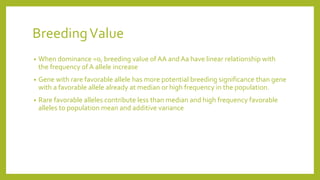
• When dominance =0, breeding value of AA and Aa have linear relationship with
the frequency of A allele increase
• Gene with rare favorable allele has more potential breeding significance than gene
with a favorable allele already at median or high frequency in the population.
• Rare favorable alleles contribute less than median and high frequency favorable
alleles to population mean and additive variance
Dominance Deviation (DD)
• Breeding values for a single locus are additive effects of genotypic values
• Dominance deviation is portion of genotypic values which cannot be explained by
breeding values
• Obtained by subtraction of breeding value from the genotypic value
• DD for AA: 2q(a-pd) -2p[a+ (q-p)d]=-2𝑞2
a, for Aa= 2pqd, and for aa=-2𝑝2
a
Variance
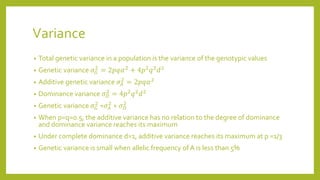
• Total genetic variance in a population is the variance of the genotypic values
• Genetic variance 𝜎 𝐺
2
= 2𝑝𝑞𝛼2
+ 4𝑝2
𝑞2
𝑑2
• Additive genetic variance 𝜎𝐴
2
= 2𝑝𝑞𝛼2
• Dominance variance 𝜎 𝐷
2
= 4𝑝2 𝑞2 𝑑2
• Genetic variance 𝜎 𝐺
2
=𝜎𝐴
2
+ 𝜎 𝐷
2
• When p=q=0.5, the additive variance has no relation to the degree of dominance
and dominance variance reaches its maximum
• Under complete dominance d=1, additive variance reaches its maximum at p =1/3
• Genetic variance is small when allelic frequency of A is less than 5%
Trait Model
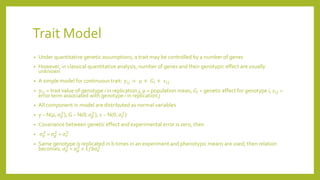
• Under quantitative genetic assumptions, a trait may be controlled by a number of genes
• However, in classical quantitative analysis, number of genes and their genotypic effect are usually
unknown
• A simple model for continuous trait: 𝑦𝑖𝑗 = 𝜇 + 𝐺𝑖 + 𝜀𝑖𝑗
• 𝑦𝑖𝑗 = trait value of genotype i in replication j, μ = population mean, 𝐺𝑖 = genetic effect for genotype i, 𝜀𝑖𝑗 =
error term associated with genotype i in replication j
• All component in model are distributed as normal variables
• y ~ N(𝜇, 𝜎 𝑝
2
), G ~ N(0, 𝜎𝑔
2
), 𝜀 ~ N(0, 𝜎𝑒
2
)
• Covariance between genetic effect and experimental error is zero, then
• 𝜎 𝑝
2
= 𝜎𝑔
2
+ 𝜎𝑒
2
• Same genotype is replicated in b times in an experiment and phenotypic means are used, then relation
becomes: 𝜎 𝑝
2
= 𝜎𝑔
2
+ 1/𝑏𝜎𝑒
2
ANOVA
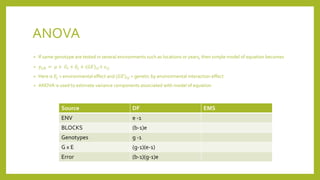
• If same genotype are tested in several environments such as locations or years, then simple model of equation becomes
• 𝑦𝑖𝑗𝑘 = 𝜇 + 𝐺𝑖 + 𝐸𝑗 + (𝐺𝐸)𝑖𝑗+ 𝜀𝑖𝑗
• Here is 𝐸𝑗 = environmental effect and (𝐺𝐸)𝑖𝑗 = genetic by environmental interaction effect
• ANOVA is used to estimate variance components associated with model of equation
Source DF EMS
ENV e -1
BLOCKS (b-1)e
Genotypes g -1
G x E (g-1)(e-1)
Error (b-1)(g-1)e
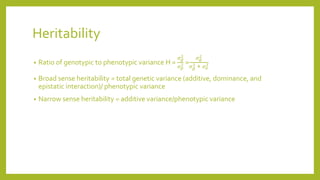
Heritability
• Ratio of genotypic to phenotypic variance H =
𝜎 𝑔
2
𝜎 𝑝
2 =
𝜎 𝑔
2
𝜎 𝑔
2 + 𝜎 𝑒
2
• Broad sense heritability = total genetic variance (additive, dominance, and
epistatic interaction)/ phenotypic variance
• Narrow sense heritability = additive variance/phenotypic variance
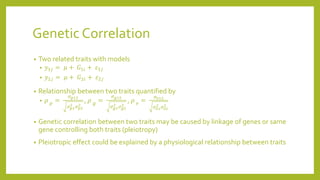
Genetic Correlation
• Two related traits with models
• 𝑦1𝑗 = 𝜇 + 𝐺1𝑖 + 𝜀1𝑗
• 𝑦2𝑗 = 𝜇 + 𝐺2𝑖 + 𝜀2𝑗
• Relationship between two traits quantified by
• 𝜌 𝑝
=
𝜎 𝑝12
𝜎 𝑝1
2 𝜎 𝑝2
2
, 𝜌 𝑔
=
𝜎 𝑔12
𝜎 𝑔1
2 𝜎 𝑔2
2
, 𝜌 𝑒
=
𝜎 𝑒12
𝜎 𝑒1
2 𝜎 𝑒2
2
• Genetic correlation between two traits may be caused by linkage of genes or same
gene controlling both traits (pleiotropy)
• Pleiotropic effect could be explained by a physiological relationship between traits

Quantitative genetics

  • 1.
  • 2.
    Introduction • Quantitative Genetics:Focus on the inheritance of quantitative trait • Number of genes controlling a trait increases and importance of the environmental effect on phenotype of trait increases
  • 3.
    Single-Gene Model • QuantitativeGenetic theory start with single gene model • Single locus A with two alleleA and a and have three possible genotypes; AA, Aa, aa in a population and three assigned genotypic values; a, d and –a • Two alleles have frequency: p and 1-p =q • Population mean 𝜇 in terms of allelic frequencies and genotypic values • 𝜇 = 𝑝2a + 2pqd − 𝑞2a • Deviation of genotypic value of AA from the population mean • AA = 𝑎 − 𝜇 = 𝑎 − 𝑝2a + 2pqd − 𝑞2a = 2q(a − pd) • aa = 𝑑 − 𝜇 = 𝑑 − 𝑝2a + 2pqd − 𝑞2a = −2p(a + qd) • Aa = 𝑑 − 𝜇 = 𝑑 − 𝑝2a + 2pqd − 𝑞2a = a q − p + d(1 − 2pq)
  • 4.
    Average Effect ofGene Substitution • Average Effect of Gene Substitution α : average effect on the trait of one allele being replaced by another allele. • Gamete containing allele A: results in progeny with genotype AA and Aa • Gamete containing allele a: results in progeny with genotype Aa and aa • Mean value of genotype produced for two gametes: • A = pa + qd and a = pd-qa • α = A-a = (pa + qd) – (pd-qa)= a + (q-p)d
  • 5.
    BreedingValue • Average genotypicvalue of its progeny • α =Genetic effect of gametes transferred to progeny • AA receive two copies of alleleA and genetic effect 2 α • Aa receive one copy of alleleA and genetic effect α • Average = 2p α • Breeding values of three Genotypes: • AA =2p α • Aa=(q-p) α • Aa=-2p α • Large breeding value important for genetic improvement
  • 6.
    BreedingValue • When dominance=0, breeding value of AA and Aa have linear relationship with the frequency of A allele increase • Gene with rare favorable allele has more potential breeding significance than gene with a favorable allele already at median or high frequency in the population. • Rare favorable alleles contribute less than median and high frequency favorable alleles to population mean and additive variance
  • 7.
    Dominance Deviation (DD) •Breeding values for a single locus are additive effects of genotypic values • Dominance deviation is portion of genotypic values which cannot be explained by breeding values • Obtained by subtraction of breeding value from the genotypic value • DD for AA: 2q(a-pd) -2p[a+ (q-p)d]=-2𝑞2 a, for Aa= 2pqd, and for aa=-2𝑝2 a
  • 8.
    Variance • Total geneticvariance in a population is the variance of the genotypic values • Genetic variance 𝜎 𝐺 2 = 2𝑝𝑞𝛼2 + 4𝑝2 𝑞2 𝑑2 • Additive genetic variance 𝜎𝐴 2 = 2𝑝𝑞𝛼2 • Dominance variance 𝜎 𝐷 2 = 4𝑝2 𝑞2 𝑑2 • Genetic variance 𝜎 𝐺 2 =𝜎𝐴 2 + 𝜎 𝐷 2 • When p=q=0.5, the additive variance has no relation to the degree of dominance and dominance variance reaches its maximum • Under complete dominance d=1, additive variance reaches its maximum at p =1/3 • Genetic variance is small when allelic frequency of A is less than 5%
  • 9.
    Trait Model • Underquantitative genetic assumptions, a trait may be controlled by a number of genes • However, in classical quantitative analysis, number of genes and their genotypic effect are usually unknown • A simple model for continuous trait: 𝑦𝑖𝑗 = 𝜇 + 𝐺𝑖 + 𝜀𝑖𝑗 • 𝑦𝑖𝑗 = trait value of genotype i in replication j, μ = population mean, 𝐺𝑖 = genetic effect for genotype i, 𝜀𝑖𝑗 = error term associated with genotype i in replication j • All component in model are distributed as normal variables • y ~ N(𝜇, 𝜎 𝑝 2 ), G ~ N(0, 𝜎𝑔 2 ), 𝜀 ~ N(0, 𝜎𝑒 2 ) • Covariance between genetic effect and experimental error is zero, then • 𝜎 𝑝 2 = 𝜎𝑔 2 + 𝜎𝑒 2 • Same genotype is replicated in b times in an experiment and phenotypic means are used, then relation becomes: 𝜎 𝑝 2 = 𝜎𝑔 2 + 1/𝑏𝜎𝑒 2
  • 10.
    ANOVA • If samegenotype are tested in several environments such as locations or years, then simple model of equation becomes • 𝑦𝑖𝑗𝑘 = 𝜇 + 𝐺𝑖 + 𝐸𝑗 + (𝐺𝐸)𝑖𝑗+ 𝜀𝑖𝑗 • Here is 𝐸𝑗 = environmental effect and (𝐺𝐸)𝑖𝑗 = genetic by environmental interaction effect • ANOVA is used to estimate variance components associated with model of equation Source DF EMS ENV e -1 BLOCKS (b-1)e Genotypes g -1 G x E (g-1)(e-1) Error (b-1)(g-1)e
  • 11.
    Heritability • Ratio ofgenotypic to phenotypic variance H = 𝜎 𝑔 2 𝜎 𝑝 2 = 𝜎 𝑔 2 𝜎 𝑔 2 + 𝜎 𝑒 2 • Broad sense heritability = total genetic variance (additive, dominance, and epistatic interaction)/ phenotypic variance • Narrow sense heritability = additive variance/phenotypic variance
  • 12.
    Genetic Correlation • Tworelated traits with models • 𝑦1𝑗 = 𝜇 + 𝐺1𝑖 + 𝜀1𝑗 • 𝑦2𝑗 = 𝜇 + 𝐺2𝑖 + 𝜀2𝑗 • Relationship between two traits quantified by • 𝜌 𝑝 = 𝜎 𝑝12 𝜎 𝑝1 2 𝜎 𝑝2 2 , 𝜌 𝑔 = 𝜎 𝑔12 𝜎 𝑔1 2 𝜎 𝑔2 2 , 𝜌 𝑒 = 𝜎 𝑒12 𝜎 𝑒1 2 𝜎 𝑒2 2 • Genetic correlation between two traits may be caused by linkage of genes or same gene controlling both traits (pleiotropy) • Pleiotropic effect could be explained by a physiological relationship between traits