Effects of FOXP2 Protein on the cortico-basal
ganglia circuits, speech and language.
By
MALVI PRAKASH GOLWALA
14/03/2015
1
 Introduction
14/03/2015
2
 FoxP2 (Forkhead box protein P2) - protein in humans encoded –
FOXP2 (CAGH44, SPCH1, TNRC10)
 Basic function:
Proper development of speech
and language brain .
 Expression: Two copies gene
basal ganglia and inferior
frontal cortex.
 After mutations:
1. Reduced speech
2. Major heart and lung
developmental issues
 Constitutes:
Polyglutamine tracts, a zinc
finger, a leucine zipper motiff and a
forkheaad-box DNA-binding domain
Figure 1. Structure of FOXP2 Protein
(Source: http://en.wikipedia.org/wiki/FOXP2)
14/03/20153
The Basal Ganglia
14/03/20153
 The basal ganglia comprises of the sub-cortical regions of the
brain and it is very strongly connected to the cerebral cortex,
thalamus and brainstem.
 Functions:
1. Eye movements
2. Motivation role
3. Neurotransmitters
4. Motor movements
5. Procedural learning
6. Routine behaviors
7. Habits
8. Cognition, etc. Fig 2: Coronal slices of human brain showing the
basal ganglia
(Source: http://en.wikipedia.org/wiki/Basal_ganglia)
14/03/2015
Fig 3: Anatomy of basal ganglia
(Source : http://www.slideshare.net/WanieyMohdSyah/stroke-basal-
ganglia-bleed-36363705)
4
Discovery
14/03/2015
 KE Family (Myrna Gopnik,1990): exhibit developmental verbal
dyspraxia (Blood, rigidity at lower half of their face, difficulties with
controlling speech organs, breathing, phonation, slow language
development, etc).
5 Fig 4: Symptoms of Developmental Verbal Dyspraxia
(Source:http://en.wikipedia.org/wiki/Developmental_verbal_dyspraxia)
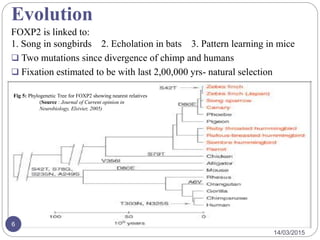
FOXP2 is linked to:
1. Song in songbirds 2. Echolation in bats 3. Pattern learning in mice
 Two mutations since divergence of chimp and humans
 Fixation estimated to be with last 2,00,000 yrs- natural selection
Evolution
14/03/2015
6
Fig 5: Phylogenetic Tree for FOXP2 showing nearest relatives
(Source : Journal of Current opinion in
Neurobiology, Elsivier, 2005)
Molecular Evolution of FoxP2
14/03/2015
7
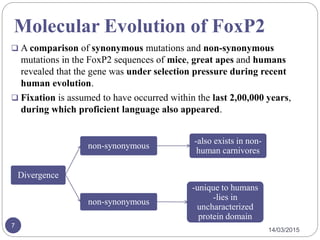
 A comparison of synonymous mutations and non-synonymous
mutations in the FoxP2 sequences of mice, great apes and humans
revealed that the gene was under selection pressure during recent
human evolution.
 Fixation is assumed to have occurred within the last 2,00,000 years,
during which proficient language also appeared.
Divergence
non-synonymous
-also exists in non-
human carnivores
non-synonymous
-unique to humans
-lies in
uncharacterized
protein domain
FACTS ABOUT FOXP2
14/03/20158
 The human genome has undergone 17.5 million single nucleotide
changes and 2.5 million insertions and deletions since we split from the
lineage leading to chimpanzees some 6 million years ago.
 The human capacity for vocal learning, that is to imitate complex
vocalizations… is absent or very limited in primates and mammals, so
the proficiency of all humans to learn vocalizations is very probably a
phenotype that required genetic changes.
 Of the 708 aligned amino acids [in Foxp2] in mouse and human differ at
3 positions. Remarkably, 2 of these changes occurred in the short
timescale of human evolution after the human lineage split from the
lineage leading to chimpanzees.
 Foxp2 ranks among the 5% most conserved proteins.
Introduction contd…
14/03/2015
9
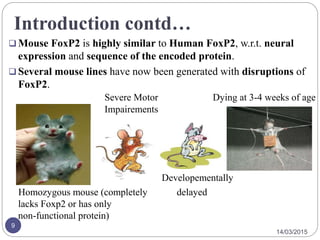
 Mouse FoxP2 is highly similar to Human FoxP2, w.r.t. neural
expression and sequence of the encoded protein.
 Several mouse lines have now been generated with disruptions of
FoxP2.
Severe Motor Dying at 3-4 weeks of age
Impairements
 Developementally
Homozygous mouse (completely delayed
lacks Foxp2 or has only
non-functional protein)
Contd…
14/03/2015
Mice examination:
1. Effects of gene dysfunction
2. Assess potential phenotypic effects of human evolutionary changes.
Foxp2-Hum (partially humanised) mice were engineered to carry the two
amino acids found in humans. In this case, homozygotes and heterozygotes
are all healthy with normal fertility and lifespan .
Mouse Lines with disruptions of FoxP2
Mouse Line Reference Genomic Background Disruption Basic Phenotypes
Foxp2-KO
Foxp2-R552H-
KI
Foxp2-R552H-
Enu
Shu et al.
Fujita et al.
Groszer et al.
Generated on 129 and then
crossed to C57BL/6
resulting in a mixed
background.
Generated on 129 and then
crossed to C57BL/6
resulting in a mixed
background
ENU-mutagenesis on
BALB/ c. Marker-assisted
backcrossing to C3H or
C57BL/6
Exons 12–13 replaced by a neomycin
cassette. Removes the FOXa domain
yielding knockout mice
Point mutation introduced into exon 14
using a knockin strategy resulting in an
Arg-to- His substitution in the FOX
domain of the encoded protein. This
substitution is found in affected
members of the KE family (R553H)
Mice with a point mutation in exon 14
isolated from an ENU-mutagenesis
screenc. Results in the Arg-to-His
substitution seen in the KE family
Homozygotes die by 3 weeks of
age. Heterozygotes show mild
developmental delay
Homozygotes die by 3 weeks of
age. Some heterozygotes show
mild-moderate developmental
delay
Homozygotes die at 3–4 weeks
of age. Heterozygotes are overtly
normal
10
14/03/2015
Table 1: Mouse lines disrupted of FoxP2
(Source : Journal of Current opinion in Neurobiology, Elsivier, 2014)Mouse Lines with disruptions of FoxP2
Mouse Line Reference Genomic Background Disruption Basic Phenotypes
Foxp2-S321X
Foxp2-N549K
Foxp2-Flox
Foxp2-Hum
Groszer et
al
Groszer et
al.
French et al.
Enard et al.
ENU-mutagenesis on
C3H. Marker-assisted
backcrossing to C57BL/6
ENU-mutagenesis on
BALB/ c. Marker-assisted
backcrossing to C3H or
C57BL/6
Generated and maintained
on C57BL/6 (NB. Cre
lines can be of any
background)
Generated and maintained
on C57BL/6
Mice with a point mutation in exon 7
isolated from an ENU-mutagenesis
screen. Results in a premature stop
codon, shown to be equivalent to a
null allele (no protein)
Mice with a point mutation in exon
14 isolated from an ENU-
mutagenesis screen. Results in an
Asn-to-Lys substitution in the FOX
domain
LoxP sites inserted around exons 12–
14 to facilitate Cre-mediated removal
of the FOX domain
Knockin strategy used to modify
exon 7 and to introduce flanking
LoxP sites. Results in 2 changes
(T302N and N324S), where the
amino acids found in the mouse are
substituted for the orthologous
human amino acids, partially
humanizing the encoded protein
Homozygotes die at 3–4
weeks of age. Heterozygotes
are overtly normal
Homozygotes survive into
adulthood (3-5 months age)
with severe motor problems.
Heterozygotes are overtly
normal
When crossed to the global
Sox2-Cre line, homozygotes
die at 3–4 weeks of age and
heterozygotes are overtly
normal
Both homozygous and
heterozygous humanized mice
are overtly normal. Removal
of exon 7 using a global Cre
line results in a knockout
phenotype. Homozygous
knockouts die postnatally and
heterozygous knockouts are
overtly normal
11
Foxp2 and sensory processing
14/03/2015
12
 Expression:
1. Cortical and sub-cortical areas involved in sensory processing and
integration.
2. Olfactory system: glomerular layer of the olfactory bulb, the
accessory olfactory bulb and the olfactory tubercle.
3. The ascending auditory and visual relays as well as thalamic somato-
sensory areas.
4. In the cortex: Layer VI and more restricted expression in layer V,
where it is largely localised to the association and premotor areas.
 To date, work has concentrated mainly on the auditory system,
presumably because of the importance of auditory processing for speech
development.
 Foxp2-R552H heterozygotes (mutation of KE family): Auditory
brainstem responses (ABRs) - longer latencies and smaller amplitudes
than controls - changes in the number or synchrony of activated
neurons.
14/03/2015
13
Fig 6:
(Source : Journal of Current opinion in Neurobiology, Elsivier, 2014)
Disorders (speech & language)
14/03/2015
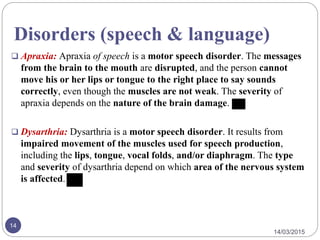
 Apraxia: Apraxia of speech is a motor speech disorder. The messages
from the brain to the mouth are disrupted, and the person cannot
move his or her lips or tongue to the right place to say sounds
correctly, even though the muscles are not weak. The severity of
apraxia depends on the nature of the brain damage.
 Dysarthria: Dysarthria is a motor speech disorder. It results from
impaired movement of the muscles used for speech production,
including the lips, tongue, vocal folds, and/or diaphragm. The type
and severity of dysarthria depend on which area of the nervous system
is affected.
14
14/03/201515
 Stuttering: Stuttering affects the fluency of speech. It begins during
childhood and, in some cases, lasts throughout life (developemental
Stuttering). The disorder is characterized by disruptions in the
production of speech sounds (disfluencies).
 Aphasia: Aphasia is a communication disorder that results from
damage to the parts of the brain that contain language (typically in
the left half of the brain). Individuals who experience damage to the
right side of the brain may have additional difficulties beyond speech
and language issues.
Contd…
14/03/2015Dept. Of Biotechnology, DSCE16
CASE STUDY 1
14/03/2015
17
Background:
 2 amino acid substitutions in humans for development of speech and
language.
 In mice - increased dendrite length and long term depression in medium
spiny neurons of the striatum.
 Non-humanized mice lacked these.
 Thus concluded, that FOXP2 protein in human ancestors specifically
affect brain regions that are connected via cortico-basal ganglia circuits.
14/03/2015
18
METHODS
 Also, a knock-out allele of the same embryonic stem cell was added.
 Mice were housed at 10h/14h dark/light cycle under standard conditions.
 FoxP2 hum/hum, Foxp2 wild type and Foxp2 wt/wt mice were derived
from heterozygous crossings.
 Checked for:
1. Immunohistochemistry: Embryonic heads were obtained from
heterozygous crossings 17.5 days after mating.
Laser scanning microscopy
Incubation: overnight - primary antibodies
: 8hrs - secondary antibodies
Coronal slices (40micro mts – cryomicrotome)
14/03/2015
2. Analysis of dendrite length:
- the brain sections were stained with FD Rapid Golgi stain
- total dendritic trees were tracked in 200micro mts using oil
immersion lense and Neurolucida software.
19
(Source : Journal of Neuroscience, 2011)
Fig 7:
14/03/2015
20
Result
Conclusion
 FoxP2 is expressed in many parts of the brain and has multiple roles during
mammlian development, specifically the regions connected via cortico-
basal ganglia circuits.
Fig 8:
(Source : Journal of Neuroscience, 2011)
CASE STUDY 2
14/03/2015
 Introduction:
 Songbirds, because of the well-established behavioural and
neurobiological parallels between speech learning in human infants and
song learning in birds.
 DNA and protein sequences - brain expression - patterns of FoxP2 -
highly conserved (from crocodile to human) - regardless of their ability to
learn vocally or not.
 Speculation: FoxP2 is involved in the development of brain pathways that
are essential for, but not limited to, the faculty of language.
21
FoxP2 & learned vocalizations
14/03/201522
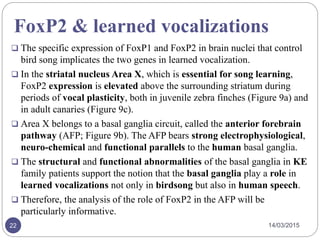
 The specific expression of FoxP1 and FoxP2 in brain nuclei that control
bird song implicates the two genes in learned vocalization.
 In the striatal nucleus Area X, which is essential for song learning,
FoxP2 expression is elevated above the surrounding striatum during
periods of vocal plasticity, both in juvenile zebra finches (Figure 9a) and
in adult canaries (Figure 9c).
 Area X belongs to a basal ganglia circuit, called the anterior forebrain
pathway (AFP; Figure 9b). The AFP bears strong electrophysiological,
neuro-chemical and functional parallels to the human basal ganglia.
 The structural and functional abnormalities of the basal ganglia in KE
family patients support the notion that the basal ganglia play a role in
learned vocalizations not only in birdsong but also in human speech.
 Therefore, the analysis of the role of FoxP2 in the AFP will be
particularly informative.
14/03/2015
 Result
23
Fig 9: Showing FoxP2 expression increase during times of vocal
plasticity
(Source : Journal of Current opinion in Neurobiology, Elsivier, 2005)
Conclusions and Future
Directions
14/03/201524
 The strong expression of FoxP2 in cerebellar and basal ganglia
circuits points towards functions that include sensory–motor
integration important for sequenced behaviors and procedural
learning.
 It is unlikely that Area X in songbirds functions in procedures that
are unrelated to singing.
 By turning to birds to understand the role of FoxP2 in song
learning we might in turn discover something about how language
evolved for the purpose of ‘Humane Understanding’.
Future Perspective
14/03/201525
 To be able to describe key characteristics of major
developmental disorders affecting speech, language and
reading, including speech apraxia, specific language
impairment and dyslexia.
 To understand the relative strengths and weaknesses of
complementary genetic methods of linkage and association,
and how they have been used to identify genes implicated in rare
and common language-related disorders.
 To be able to describe how genetic manipulation in animal
models can trace links between language-related genes and the
development/function of neural circuits.
Questions now to be answered.
14/03/201526
1. Which genes are regulated by FoxP1 and FoxP2?
2. What regulates FoxP2 expression, particularly in Area X?
3. Does FoxP1 play a role in human speech and birdsong?
4. What is the identity of the pallial and/or cortical FoxP1 and
FoxP2 expressing neurons?
5. Is there a causal relationship between FoxP2 expression levels in
Area X and song plasticity?
6. Is the striatum surrounding Area X involved in procedural
learning and memory?
7. Does the cerebellum participate in song learning and production?
References
14/03/201527




14/03/201528
THANK YOU !
14/03/2015
29

FoxP2 and language

  • 1.
    Effects of FOXP2Protein on the cortico-basal ganglia circuits, speech and language. By MALVI PRAKASH GOLWALA 14/03/2015 1
  • 2.
     Introduction 14/03/2015 2  FoxP2(Forkhead box protein P2) - protein in humans encoded – FOXP2 (CAGH44, SPCH1, TNRC10)  Basic function: Proper development of speech and language brain .  Expression: Two copies gene basal ganglia and inferior frontal cortex.  After mutations: 1. Reduced speech 2. Major heart and lung developmental issues  Constitutes: Polyglutamine tracts, a zinc finger, a leucine zipper motiff and a forkheaad-box DNA-binding domain Figure 1. Structure of FOXP2 Protein (Source: http://en.wikipedia.org/wiki/FOXP2)
  • 3.
    14/03/20153 The Basal Ganglia 14/03/20153 The basal ganglia comprises of the sub-cortical regions of the brain and it is very strongly connected to the cerebral cortex, thalamus and brainstem.  Functions: 1. Eye movements 2. Motivation role 3. Neurotransmitters 4. Motor movements 5. Procedural learning 6. Routine behaviors 7. Habits 8. Cognition, etc. Fig 2: Coronal slices of human brain showing the basal ganglia (Source: http://en.wikipedia.org/wiki/Basal_ganglia)
  • 4.
    14/03/2015 Fig 3: Anatomyof basal ganglia (Source : http://www.slideshare.net/WanieyMohdSyah/stroke-basal- ganglia-bleed-36363705) 4
  • 5.
    Discovery 14/03/2015  KE Family(Myrna Gopnik,1990): exhibit developmental verbal dyspraxia (Blood, rigidity at lower half of their face, difficulties with controlling speech organs, breathing, phonation, slow language development, etc). 5 Fig 4: Symptoms of Developmental Verbal Dyspraxia (Source:http://en.wikipedia.org/wiki/Developmental_verbal_dyspraxia)
  • 6.
    FOXP2 is linkedto: 1. Song in songbirds 2. Echolation in bats 3. Pattern learning in mice  Two mutations since divergence of chimp and humans  Fixation estimated to be with last 2,00,000 yrs- natural selection Evolution 14/03/2015 6 Fig 5: Phylogenetic Tree for FOXP2 showing nearest relatives (Source : Journal of Current opinion in Neurobiology, Elsivier, 2005)
  • 7.
    Molecular Evolution ofFoxP2 14/03/2015 7  A comparison of synonymous mutations and non-synonymous mutations in the FoxP2 sequences of mice, great apes and humans revealed that the gene was under selection pressure during recent human evolution.  Fixation is assumed to have occurred within the last 2,00,000 years, during which proficient language also appeared. Divergence non-synonymous -also exists in non- human carnivores non-synonymous -unique to humans -lies in uncharacterized protein domain
  • 8.
    FACTS ABOUT FOXP2 14/03/20158 The human genome has undergone 17.5 million single nucleotide changes and 2.5 million insertions and deletions since we split from the lineage leading to chimpanzees some 6 million years ago.  The human capacity for vocal learning, that is to imitate complex vocalizations… is absent or very limited in primates and mammals, so the proficiency of all humans to learn vocalizations is very probably a phenotype that required genetic changes.  Of the 708 aligned amino acids [in Foxp2] in mouse and human differ at 3 positions. Remarkably, 2 of these changes occurred in the short timescale of human evolution after the human lineage split from the lineage leading to chimpanzees.  Foxp2 ranks among the 5% most conserved proteins.
  • 9.
    Introduction contd… 14/03/2015 9  MouseFoxP2 is highly similar to Human FoxP2, w.r.t. neural expression and sequence of the encoded protein.  Several mouse lines have now been generated with disruptions of FoxP2. Severe Motor Dying at 3-4 weeks of age Impairements  Developementally Homozygous mouse (completely delayed lacks Foxp2 or has only non-functional protein)
  • 10.
    Contd… 14/03/2015 Mice examination: 1. Effectsof gene dysfunction 2. Assess potential phenotypic effects of human evolutionary changes. Foxp2-Hum (partially humanised) mice were engineered to carry the two amino acids found in humans. In this case, homozygotes and heterozygotes are all healthy with normal fertility and lifespan . Mouse Lines with disruptions of FoxP2 Mouse Line Reference Genomic Background Disruption Basic Phenotypes Foxp2-KO Foxp2-R552H- KI Foxp2-R552H- Enu Shu et al. Fujita et al. Groszer et al. Generated on 129 and then crossed to C57BL/6 resulting in a mixed background. Generated on 129 and then crossed to C57BL/6 resulting in a mixed background ENU-mutagenesis on BALB/ c. Marker-assisted backcrossing to C3H or C57BL/6 Exons 12–13 replaced by a neomycin cassette. Removes the FOXa domain yielding knockout mice Point mutation introduced into exon 14 using a knockin strategy resulting in an Arg-to- His substitution in the FOX domain of the encoded protein. This substitution is found in affected members of the KE family (R553H) Mice with a point mutation in exon 14 isolated from an ENU-mutagenesis screenc. Results in the Arg-to-His substitution seen in the KE family Homozygotes die by 3 weeks of age. Heterozygotes show mild developmental delay Homozygotes die by 3 weeks of age. Some heterozygotes show mild-moderate developmental delay Homozygotes die at 3–4 weeks of age. Heterozygotes are overtly normal 10
  • 11.
    14/03/2015 Table 1: Mouselines disrupted of FoxP2 (Source : Journal of Current opinion in Neurobiology, Elsivier, 2014)Mouse Lines with disruptions of FoxP2 Mouse Line Reference Genomic Background Disruption Basic Phenotypes Foxp2-S321X Foxp2-N549K Foxp2-Flox Foxp2-Hum Groszer et al Groszer et al. French et al. Enard et al. ENU-mutagenesis on C3H. Marker-assisted backcrossing to C57BL/6 ENU-mutagenesis on BALB/ c. Marker-assisted backcrossing to C3H or C57BL/6 Generated and maintained on C57BL/6 (NB. Cre lines can be of any background) Generated and maintained on C57BL/6 Mice with a point mutation in exon 7 isolated from an ENU-mutagenesis screen. Results in a premature stop codon, shown to be equivalent to a null allele (no protein) Mice with a point mutation in exon 14 isolated from an ENU- mutagenesis screen. Results in an Asn-to-Lys substitution in the FOX domain LoxP sites inserted around exons 12– 14 to facilitate Cre-mediated removal of the FOX domain Knockin strategy used to modify exon 7 and to introduce flanking LoxP sites. Results in 2 changes (T302N and N324S), where the amino acids found in the mouse are substituted for the orthologous human amino acids, partially humanizing the encoded protein Homozygotes die at 3–4 weeks of age. Heterozygotes are overtly normal Homozygotes survive into adulthood (3-5 months age) with severe motor problems. Heterozygotes are overtly normal When crossed to the global Sox2-Cre line, homozygotes die at 3–4 weeks of age and heterozygotes are overtly normal Both homozygous and heterozygous humanized mice are overtly normal. Removal of exon 7 using a global Cre line results in a knockout phenotype. Homozygous knockouts die postnatally and heterozygous knockouts are overtly normal 11
  • 12.
    Foxp2 and sensoryprocessing 14/03/2015 12  Expression: 1. Cortical and sub-cortical areas involved in sensory processing and integration. 2. Olfactory system: glomerular layer of the olfactory bulb, the accessory olfactory bulb and the olfactory tubercle. 3. The ascending auditory and visual relays as well as thalamic somato- sensory areas. 4. In the cortex: Layer VI and more restricted expression in layer V, where it is largely localised to the association and premotor areas.  To date, work has concentrated mainly on the auditory system, presumably because of the importance of auditory processing for speech development.  Foxp2-R552H heterozygotes (mutation of KE family): Auditory brainstem responses (ABRs) - longer latencies and smaller amplitudes than controls - changes in the number or synchrony of activated neurons.
  • 13.
    14/03/2015 13 Fig 6: (Source :Journal of Current opinion in Neurobiology, Elsivier, 2014)
  • 14.
    Disorders (speech &language) 14/03/2015  Apraxia: Apraxia of speech is a motor speech disorder. The messages from the brain to the mouth are disrupted, and the person cannot move his or her lips or tongue to the right place to say sounds correctly, even though the muscles are not weak. The severity of apraxia depends on the nature of the brain damage.  Dysarthria: Dysarthria is a motor speech disorder. It results from impaired movement of the muscles used for speech production, including the lips, tongue, vocal folds, and/or diaphragm. The type and severity of dysarthria depend on which area of the nervous system is affected. 14
  • 15.
    14/03/201515  Stuttering: Stutteringaffects the fluency of speech. It begins during childhood and, in some cases, lasts throughout life (developemental Stuttering). The disorder is characterized by disruptions in the production of speech sounds (disfluencies).  Aphasia: Aphasia is a communication disorder that results from damage to the parts of the brain that contain language (typically in the left half of the brain). Individuals who experience damage to the right side of the brain may have additional difficulties beyond speech and language issues. Contd…
  • 16.
  • 17.
    CASE STUDY 1 14/03/2015 17 Background: 2 amino acid substitutions in humans for development of speech and language.  In mice - increased dendrite length and long term depression in medium spiny neurons of the striatum.  Non-humanized mice lacked these.  Thus concluded, that FOXP2 protein in human ancestors specifically affect brain regions that are connected via cortico-basal ganglia circuits.
  • 18.
    14/03/2015 18 METHODS  Also, aknock-out allele of the same embryonic stem cell was added.  Mice were housed at 10h/14h dark/light cycle under standard conditions.  FoxP2 hum/hum, Foxp2 wild type and Foxp2 wt/wt mice were derived from heterozygous crossings.  Checked for: 1. Immunohistochemistry: Embryonic heads were obtained from heterozygous crossings 17.5 days after mating. Laser scanning microscopy Incubation: overnight - primary antibodies : 8hrs - secondary antibodies Coronal slices (40micro mts – cryomicrotome)
  • 19.
    14/03/2015 2. Analysis ofdendrite length: - the brain sections were stained with FD Rapid Golgi stain - total dendritic trees were tracked in 200micro mts using oil immersion lense and Neurolucida software. 19 (Source : Journal of Neuroscience, 2011) Fig 7:
  • 20.
    14/03/2015 20 Result Conclusion  FoxP2 isexpressed in many parts of the brain and has multiple roles during mammlian development, specifically the regions connected via cortico- basal ganglia circuits. Fig 8: (Source : Journal of Neuroscience, 2011)
  • 21.
    CASE STUDY 2 14/03/2015 Introduction:  Songbirds, because of the well-established behavioural and neurobiological parallels between speech learning in human infants and song learning in birds.  DNA and protein sequences - brain expression - patterns of FoxP2 - highly conserved (from crocodile to human) - regardless of their ability to learn vocally or not.  Speculation: FoxP2 is involved in the development of brain pathways that are essential for, but not limited to, the faculty of language. 21
  • 22.
    FoxP2 & learnedvocalizations 14/03/201522  The specific expression of FoxP1 and FoxP2 in brain nuclei that control bird song implicates the two genes in learned vocalization.  In the striatal nucleus Area X, which is essential for song learning, FoxP2 expression is elevated above the surrounding striatum during periods of vocal plasticity, both in juvenile zebra finches (Figure 9a) and in adult canaries (Figure 9c).  Area X belongs to a basal ganglia circuit, called the anterior forebrain pathway (AFP; Figure 9b). The AFP bears strong electrophysiological, neuro-chemical and functional parallels to the human basal ganglia.  The structural and functional abnormalities of the basal ganglia in KE family patients support the notion that the basal ganglia play a role in learned vocalizations not only in birdsong but also in human speech.  Therefore, the analysis of the role of FoxP2 in the AFP will be particularly informative.
  • 23.
    14/03/2015  Result 23 Fig 9:Showing FoxP2 expression increase during times of vocal plasticity (Source : Journal of Current opinion in Neurobiology, Elsivier, 2005)
  • 24.
    Conclusions and Future Directions 14/03/201524 The strong expression of FoxP2 in cerebellar and basal ganglia circuits points towards functions that include sensory–motor integration important for sequenced behaviors and procedural learning.  It is unlikely that Area X in songbirds functions in procedures that are unrelated to singing.  By turning to birds to understand the role of FoxP2 in song learning we might in turn discover something about how language evolved for the purpose of ‘Humane Understanding’.
  • 25.
    Future Perspective 14/03/201525  Tobe able to describe key characteristics of major developmental disorders affecting speech, language and reading, including speech apraxia, specific language impairment and dyslexia.  To understand the relative strengths and weaknesses of complementary genetic methods of linkage and association, and how they have been used to identify genes implicated in rare and common language-related disorders.  To be able to describe how genetic manipulation in animal models can trace links between language-related genes and the development/function of neural circuits.
  • 26.
    Questions now tobe answered. 14/03/201526 1. Which genes are regulated by FoxP1 and FoxP2? 2. What regulates FoxP2 expression, particularly in Area X? 3. Does FoxP1 play a role in human speech and birdsong? 4. What is the identity of the pallial and/or cortical FoxP1 and FoxP2 expressing neurons? 5. Is there a causal relationship between FoxP2 expression levels in Area X and song plasticity? 6. Is the striatum surrounding Area X involved in procedural learning and memory? 7. Does the cerebellum participate in song learning and production?
  • 27.
  • 28.
  • 29.

Editor's Notes

  • #3 3rd point:-(used as a highly nutritious livestock feed ) (compressed, and sold for use in other industries) .
  • #5 2nd point:- Reducing cellulolytic and hemicellulolytic enzyme cost production. To improve cellulolytic/ hemicellulolytic enzyme performance (catalytic efficiency, extreme pH and high-temperature resistence/stability) 3rd point:-A facility that integrates biomass conversion processes and equipment to produce fuels, power, and value-added chemicals from biomass.
  • #6 1.made from sugar, starch, vegetable oil, or animal fats using conventional technology. 2.use a variety of non food crops, including waste biomass, use biomass to liquid technology. 3.biofuel from algae
  • #11 2nd point:-because cellulolytic optimum enzyme performances occur at elevated temperature of around 50⁰C. 3rd point:-optimum microbial fermentation occur best at temperature between 28⁰C - 37⁰C. (Jørgensen, Kristensen et al. 2007) 4th point:- As promising as the approach might be, there are, as yet, no wild types microbial strainhas been isolated that perform CBP at the required elevated temperatures 5th point:-Since microbes with these properties have not been found in nature…
  • #14 5th point:- although it was not demonstrated in industrial growth media
  • #15 1st point:-The cellulase expression levels achieved in this study correspond to 4–5% of total cell protein, which meets the calculated levels for growth on cellulose at rates required for an industrial process. 5th point:-(Unpublished results). 3rd point:-(a crystal-line cellulose) by virtue of these expressed enzymes, which to our knowledge is the first report of its kind.