PRESENTATION ON
Genetic variation and role in pharmacology
Presented by-: Under the Guidence of-:
Dr.Anuradha mishraMohd FAHAD
M.pharm, Pharmacology
1st year
INTEGRAL UNIVERSITY,lucknow
session: 2016-2017
Gene and variation
• As darwin developed his theory of evolution he
worked under a serious handicap
• .
• He did not know how heredity worked .
• This lack knowledge left two big gaps in darwins
thinking.
Genetic Variation
• Genetic variation are generally refers to the
differences gene between individual members
of a population which the various types gene
are expressed.
• Genetic variation is important for the survival
and adaptation of a species,as it helps in
terms of natural selection and evolution.
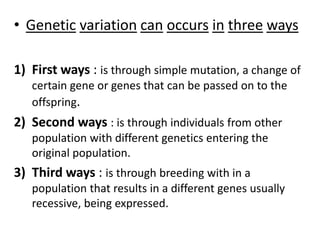
• Genetic variation can occurs in three ways
1) First ways : is through simple mutation, a change of
certain gene or genes that can be passed on to the
offspring.
2) Second ways : is through individuals from other
population with different genetics entering the
original population.
3) Third ways : is through breeding with in a
population that results in a different genes usually
recessive, being expressed.
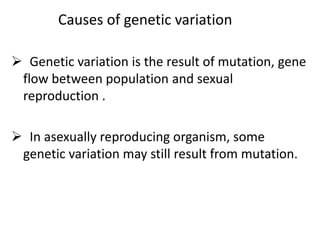
Causes of genetic variation
 Genetic variation is the result of mutation, gene
flow between population and sexual
reproduction .
 In asexually reproducing organism, some
genetic variation may still result from mutation.
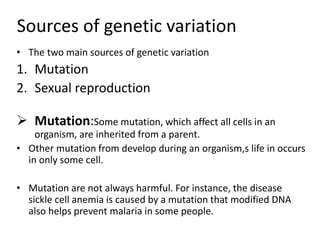
Sources of genetic variation
• The two main sources of genetic variation
1. Mutation
2. Sexual reproduction
 Mutation:Some mutation, which affect all cells in an
organism, are inherited from a parent.
• Other mutation from develop during an organism,s life in occurs
in only some cell.
• Mutation are not always harmful. For instance, the disease
sickle cell anemia is caused by a mutation that modified DNA
also helps prevent malaria in some people.
 Sexual reproduction : Sexual reproduction causes genetic
variation because of three factor,
• During the cell division
• Produced egg
• Produced sprem
• Genetic material is exchanged. When these sex cells are formed,
chromosomes are assorted by chance. In addition, are random
egg and sperm combine during fertilization .
The importance of genetic variation
• As previously discussed, genetic variation is important because it
allow individuals with in a given species to adapt to their
environment.
• Remember we are born with adaptation if do not naturally have
these differences in our DNA we can not obtain them.
• If we are different because of genetic variation and we are able
to adapt this is known as survival of the natural selection.
• Adaptation make organisms different and if it occurs over a long
enough period of time we can get new species.
Role in health/pharmacology
• Gene therapy requirements
• Gene addition therapies
• Gene repair (editing) therapies
• Vectors for gene transfer
11
Gene addition
12
• Add genetic material that produces
ApoE
12
• To deliver DNA to target, vectors or
vehicles are use (think of cars for
transportation purposes)
–Viral vectors
–Non-viral vectors
Gene repair therapies
• Technically feasible and more definitive therapy, but
• Technique usually rely on homologous recombination
– Naturally occurring homologous recombination occurring during
miosis in the cell cycle.
– Homologous recombination repairs cells naturally.
– Deficiency in homologous recombination leads to failure to repair
gene and may lead to some forms of cancer.
13
DNA and RNA targeting and delivery
methods
• Delivery
–Ex vivo
–In vivo
• Targeting
–Receptor-mediated targeting
–Antibody-mediated targeting
14
Ex vivo delivery
• Cells capable of removal
–i.e., capable of surviving ex vivo
»Treated
• Reimplanted SQ or IM OR,
alternatively
• Use patient’s own skin, muscle or bone marrow
“transfected” with selected DNA, e.g.,
– Ex vivo insulin production
– Ex vivo cytokine (IL-4) production
• Then cell implant is delivered SQ
15
Receptor targeting for gene transfer
• Receptors are proteins located on the
surface of the cell
• DNA therapeutic substance is attached to a
ligand (an ion or molecule that binds to
receptor)
• Receptor-mediated endocytosis occurs.
16
Antibody-mediated targeting for gene
transfer
• Antigens are proteins located on the
surface of the cell.
• DNA therapeutic substance is attached to
an antibody or antibody fragment that
binds to an antigen (see abstract)
GENE THERAPY
• Gene therapy is an experimental technique
that uses to treat or prevent disease.
• In the future this technique may allow doctors
to treat a disorder by inserting a gene in to
patients cells instead of using drug or surgery.
• Gene therapy uses technology to change the
genetic composition of a cell.
Approaches of gene therapy
• Researches are testing several appoaches to
gene therapy , including.
• Replacing a mutated gene.
• Inactivating mutated gene.
• Introducing new gene.
Types of gene therapy
1) Germ line gene therapy
2) Somatic gene therapy
Vector used in gene therapy
 Viral vectors
1. Retro viruses
2. Adeno viruses
3. Adeno associated viruses
4. Herpes simplex viruses
Application of gene therapy
1) Parkinson,s diseases.
2) Alzheimer,s diseases.
3) Cyctic fibrosis.
4) Diabetic Neuropathy.
5) Blocking the viral gene.ex:( HIV)
Gene therapy requirements
• Disease candidates
• An identified mutation
• Known molecular/cellular
pathophysiology
• Available gene expression tools
23
 Non-viral vectors
1. Lipid complex
2. Liposomes
3. Peptide/protien
4. Polymers
Viral Vectors or Vehicles used to transfer
DNA or RNA
• Adeno-associated , herpes-associated , and lenti-
associated viruses
– Adeno-associated viruses integrate DNA into
genome of the target cells that are not dividing.
– Herpes simplex-associated viruses enhance delivery
of genes to neurons.
– Lentiviruses are slowly replicating retroviruses that
can infect, unlike other retroviruses, only non-
replicating or non-dividing cells. They have the
capability of delivering large amounts of genetic
material and thus are one of the most efficient
vectors.
25
Purpose of genetic testing
• Detect/confirm rare genetic diseases
• Detect mutations or genetic variations
associated with
–Cancer
–Coagulation disorders
–CV diseases
–Diabetes
–Pharmacogenetics/pharmacokinetics
26
THANK YOU

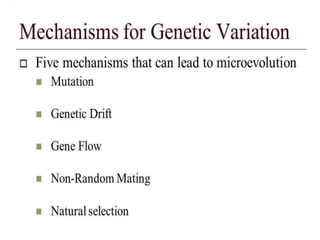
genetic variation

  • 1.
    PRESENTATION ON Genetic variationand role in pharmacology Presented by-: Under the Guidence of-: Dr.Anuradha mishraMohd FAHAD M.pharm, Pharmacology 1st year INTEGRAL UNIVERSITY,lucknow session: 2016-2017
  • 2.
    Gene and variation •As darwin developed his theory of evolution he worked under a serious handicap • . • He did not know how heredity worked . • This lack knowledge left two big gaps in darwins thinking.
  • 4.
    Genetic Variation • Geneticvariation are generally refers to the differences gene between individual members of a population which the various types gene are expressed. • Genetic variation is important for the survival and adaptation of a species,as it helps in terms of natural selection and evolution.
  • 6.
    • Genetic variationcan occurs in three ways 1) First ways : is through simple mutation, a change of certain gene or genes that can be passed on to the offspring. 2) Second ways : is through individuals from other population with different genetics entering the original population. 3) Third ways : is through breeding with in a population that results in a different genes usually recessive, being expressed.
  • 7.
    Causes of geneticvariation  Genetic variation is the result of mutation, gene flow between population and sexual reproduction .  In asexually reproducing organism, some genetic variation may still result from mutation.
  • 8.
    Sources of geneticvariation • The two main sources of genetic variation 1. Mutation 2. Sexual reproduction  Mutation:Some mutation, which affect all cells in an organism, are inherited from a parent. • Other mutation from develop during an organism,s life in occurs in only some cell. • Mutation are not always harmful. For instance, the disease sickle cell anemia is caused by a mutation that modified DNA also helps prevent malaria in some people.
  • 9.
     Sexual reproduction: Sexual reproduction causes genetic variation because of three factor, • During the cell division • Produced egg • Produced sprem • Genetic material is exchanged. When these sex cells are formed, chromosomes are assorted by chance. In addition, are random egg and sperm combine during fertilization .
  • 10.
    The importance ofgenetic variation • As previously discussed, genetic variation is important because it allow individuals with in a given species to adapt to their environment. • Remember we are born with adaptation if do not naturally have these differences in our DNA we can not obtain them. • If we are different because of genetic variation and we are able to adapt this is known as survival of the natural selection. • Adaptation make organisms different and if it occurs over a long enough period of time we can get new species.
  • 11.
    Role in health/pharmacology •Gene therapy requirements • Gene addition therapies • Gene repair (editing) therapies • Vectors for gene transfer 11
  • 12.
    Gene addition 12 • Addgenetic material that produces ApoE 12 • To deliver DNA to target, vectors or vehicles are use (think of cars for transportation purposes) –Viral vectors –Non-viral vectors
  • 13.
    Gene repair therapies •Technically feasible and more definitive therapy, but • Technique usually rely on homologous recombination – Naturally occurring homologous recombination occurring during miosis in the cell cycle. – Homologous recombination repairs cells naturally. – Deficiency in homologous recombination leads to failure to repair gene and may lead to some forms of cancer. 13
  • 14.
    DNA and RNAtargeting and delivery methods • Delivery –Ex vivo –In vivo • Targeting –Receptor-mediated targeting –Antibody-mediated targeting 14
  • 15.
    Ex vivo delivery •Cells capable of removal –i.e., capable of surviving ex vivo »Treated • Reimplanted SQ or IM OR, alternatively • Use patient’s own skin, muscle or bone marrow “transfected” with selected DNA, e.g., – Ex vivo insulin production – Ex vivo cytokine (IL-4) production • Then cell implant is delivered SQ 15
  • 16.
    Receptor targeting forgene transfer • Receptors are proteins located on the surface of the cell • DNA therapeutic substance is attached to a ligand (an ion or molecule that binds to receptor) • Receptor-mediated endocytosis occurs. 16
  • 17.
    Antibody-mediated targeting forgene transfer • Antigens are proteins located on the surface of the cell. • DNA therapeutic substance is attached to an antibody or antibody fragment that binds to an antigen (see abstract)
  • 18.
    GENE THERAPY • Genetherapy is an experimental technique that uses to treat or prevent disease. • In the future this technique may allow doctors to treat a disorder by inserting a gene in to patients cells instead of using drug or surgery. • Gene therapy uses technology to change the genetic composition of a cell.
  • 19.
    Approaches of genetherapy • Researches are testing several appoaches to gene therapy , including. • Replacing a mutated gene. • Inactivating mutated gene. • Introducing new gene.
  • 20.
    Types of genetherapy 1) Germ line gene therapy 2) Somatic gene therapy
  • 21.
    Vector used ingene therapy  Viral vectors 1. Retro viruses 2. Adeno viruses 3. Adeno associated viruses 4. Herpes simplex viruses
  • 22.
    Application of genetherapy 1) Parkinson,s diseases. 2) Alzheimer,s diseases. 3) Cyctic fibrosis. 4) Diabetic Neuropathy. 5) Blocking the viral gene.ex:( HIV)
  • 23.
    Gene therapy requirements •Disease candidates • An identified mutation • Known molecular/cellular pathophysiology • Available gene expression tools 23
  • 24.
     Non-viral vectors 1.Lipid complex 2. Liposomes 3. Peptide/protien 4. Polymers
  • 25.
    Viral Vectors orVehicles used to transfer DNA or RNA • Adeno-associated , herpes-associated , and lenti- associated viruses – Adeno-associated viruses integrate DNA into genome of the target cells that are not dividing. – Herpes simplex-associated viruses enhance delivery of genes to neurons. – Lentiviruses are slowly replicating retroviruses that can infect, unlike other retroviruses, only non- replicating or non-dividing cells. They have the capability of delivering large amounts of genetic material and thus are one of the most efficient vectors. 25
  • 26.
    Purpose of genetictesting • Detect/confirm rare genetic diseases • Detect mutations or genetic variations associated with –Cancer –Coagulation disorders –CV diseases –Diabetes –Pharmacogenetics/pharmacokinetics 26
  • 27.