BIO 106
LECTURE 1
CONTENTS
A. Definition of Genetics
B. History of Genetics
C. Scope of Genetics
D. Application of Genetics
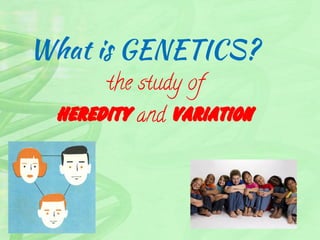
the study of
HEREDITY and VARIATION
1858: Theory of Natural Selection
Charles Darwin
Alfred Russell Wallace
1859
Charles Darwin
1866
Publication of results on
inheritance of factors
in garden peas
Gregor Mendel
1900: independent discovery
and verification of
Mendel’s principles
Carl Correns
Hugo de Vries
Erich von Tschermak
1902: noticed relationships of
Mendel’s factors with
chromosome behavior
Walter S. Sutton
WS Sutton and Theodor Boveri (studying sea
urchins) independently propose the
chromosome theory of heredity
1901 Hugo de Vries adopts the term mutation
coined the terms genetics, allele,
homozygous, heterozygous
1905:
explained how
gender is
determined by
special
chromosomes;
William Bateson
: Proposed that some human diseases are
due to "inborn errors of metabolism"
that result from the lack of a
specific enzyme.
Archibald Garrod
independently formulated the
Hardy-Weinberg principle
of population genetics
Godfrey Hardy & Wilhelm Weinberg
1908
discovery of how genes are
transmitted by chromosomes;
sex linkage in Drosophila
1910
1927:
X-rays caused
artificial gene
mutations in
Drosophila
Herman J. Muller
1928: Proposed
that some unknown
"principle" had
transformed the
harmless R strain of
Diplococcus to the
virulent S strain.
Frederick Griffith
1931: cytological proof for
crossing-over in maize
with Harriet B. Creighton
1941: Irradiated the red bread mold, Neurospora,
and proved that the gene produces its effect by
regulating particular enzymes;
- proposed 1 gene-1 enzyme concept
Reported that they
had purified the
transforming
principle in
Griffith's
experiment and
that it was DNA.
Carl Correns
1944
Oswald Avery
Colin MacLeod
Maclyn McCarty
Developed the hypothesis of transposable elements to
explain color variations in corn.
Late 1940s - 1950
1950: Discovered a one-to-one
ratio of A to T and G to C in
DNA samples from a variety
of organisms.
Erwin Chargaff
1951: show by X-ray crystallography that DNA exists as
two strands wound together in a spiral or helical shape
Rosalind Franklin Maurice H.F. Wilkins
1952: Used phages
in which the
protein was
labeled with 35S
and the DNA
with 32P for the
final proof that
DNA is the
molecule of
heredity.
Martha Chase Alfred Hershey
1953: Solved the three-dimensional structure
of the DNA molecule.
Francis Crick James Watson
1956: showed that the diploid chromosome
number for humans is 46
Joe Hin Tijo Albert Levan
1958: Used isotopes of nitrogen
to prove the semiconservative
replication of DNA.
Matthew Meselson &
Frank Stahl
1958: Purified DNA polymerase I
from E. coli, the first
enzyme that made DNA in a
test tube.
Arthur Kornberg
his work in DNA synthesis
led to creating recombinant
DNA and genetic engineering.
1966: Led teams that cracked the genetic code-
that triplet mRNA codons specify each of the
twenty amino acids.
H. Gobind Khorana Marshall Nirenberg
1972
Stanley Cohen
Herb Boyer
Paul Berg
1973: Led the team at Cold
Spring Harbor Laboratory that
refined DNA electrophoresis by
using agarose gel and staining
with ethidium bromide.
Joseph
Sambrook
1973: Showed that a
recombinant DNA molecule
can be maintained and
replicated in E. coli.
Stanley Cohen
(with Annie Chang)
Developed the chain
termination
(dideoxy) method
for sequencing DNA.
Fred Sanger
1977
The first genetic engineering
company (Genentech) is
founded, using recombinant
DNA methods to make
medically important drugs.
1978: Somatostatin became the first human
hormone produced using recombinant DNA
technology;
Walter Gilbert coins the terms INTRON
and EXON
1981: Three independent research teams
announced the discovery of human oncogenes
(cancer genes).
1983: Used blood samples
collected by Nancy Wexler
and her co-workers to
demonstrate that the
Huntington's disease gene
is on chromosome 4.James Gusella
1985: Published a paper
describing the
polymerase chain
reaction (PCR), the
most sensitive assay
for DNA yet
devised.
Kary B. Mullis
1988: the Human Genome
Project began with the goal of
determining the entire
sequence of DNA composing
human chromosomes.
Alec Jeffreys
1989: Coined the term DNA fingerprinting
and was the first to use DNA
polymorphisms in paternity, immigration,
and murder cases;
-birth of 1st American test tube baby
Identified the gene coding for the cystic fibrosis
transmembrane conductance regulator protein
(CFTR) on chromosome 7 that, when mutant,
causes cystic fibrosis.
Francis Collins Lap-Chee Tsui
1989
1990: First gene replacement therapy-T cells of a
four-year old girl were exposed outside of her
body to retroviruses containing an RNA copy of a
normal ADA gene. This allowed her immune
system to begin functioning.
1993: FlavrSavr tomatoes, genetically
engineered for longer shelf life, were
marketed.
1997 : Complete Saccharomyces cerevisiae
genome is sequenced; complete E. coli genome
is sequenced
1998 Caenorhabditis elegans becomes the first
animal whose genome is totally sequenced
1999 A human MHC (HLA-DR52) haplotype is
totally sequenced (October).
Human chromosome 22 becomes the first one
to be sequenced completely (November)
2003 Complete sequence of human Y-chromosome
was published
3 major fields of Genetics:
1. Transmission genetics
2. Molecular and biochemical
genetics
3. Population and biometrical
genetics
TRANSMISSION GENETICS/CLASSICAL GENETICS
Studies:
- Basic principles of genetics
- transmission of genetic material from one generation
to the other
- Focus: individual organism
- emphasis:
Relationship between chromosomes and heredity
 Arrangement of genes on the chromosomes
 Gene mapping
MOLECULAR AND BIOCHEMICAL GENETICS
- study of the chemical nature (structure and function)
of genes
- Emphasis:
 How genetic information is encoded, replicated and
processed.
 The cellular processes of
replication, transcription and translation
 Gene regulation, the process that controls the
expression of genetic information.
POPULATION AND BIOMETRICAL GENETICS
- study of the behavior and effects of genes in population, often
using mathematical models
- Focus: the group of genes found in a population.
- emphasis: How the genetic composition of a group changes over
time.
- Can include quantitative genetics (predict the response to
selection given data on the phenotype and relationships of
individuals) and ecological genetics (wild populations of
organisms, and attempts to collect data on the ecological
aspects of individuals as well as molecular markers from those
individuals)
Other Fields:
1. Behavioral genetics
- studies the influence of varying genetics on animal
behavior, the effects of human disorders as well as
its causes; has yielded some very interesting
questions about the evolution of various behaviors,
and even some fundamental principles of evolution in
general.
2. Clinical genetics
- diagnosis, treatment, and counseling of patients with
genetic disorders or syndromes
AGRICULTURE
Selective breeding:
cross-breeding of two
parents, each with some
good traits, to produce
offspring with the good
traits of both parents
BENEFITS OF Selective Breeding
better resistance to pests and diseases
improved nutritional value (superior quality)
fruits with longer shelf life
bigger animal, more meat, more milk production
Increase food production
Disadvantage:
removal of some genes from the gene pool
TRANSGENIC ORGANISMS:
Transgenic plants: resistant to pests, diseases
Transgenic animals: chickens with
HGH to make them grow large and
very fast
Transgenic bacteria: for mass production of
insulin, HGH, blood clotting factor
MEDICINE
Accurate diagnosis of diseases
Preventing use of medicine or disease prevention
Inherited drug sensitivities
Chromosomal abnormalities
Production of vaccines, antibodies, vitamins, insulin
Gene therapy
Future: personalized medicine
LEGAL (genetic fingerprinting)
Crimes (forensic science)
Parentage
INDUSTRIES
- Provide some synthetically produced raw materials
for industries
Brewing industry
INDUSTRIES
The pharmaceutical industry has developed strains of
molds, bacteria, and other microorganisms high in
antibiotic yield. (examples: Penicillin and cyclosporin
from fungi, streptomycin and ampicillin from
bacteria)
HUMANS:
possibility of making children with only the desirable
traits
Babies who have deficiency could be treated with
additions being done to their genetic structure.
Those who cannot reproduce due to medical
complications have also seen positive results with
surrogate parent's concept becoming available.
Increasing life span (vaccination, medications,
vitamins)
ENVIRONMENT
Oil spills
Polluted waterways
BIOREMEDIATION
ENVIRONMENT
- Protection of
valuable wild
populations
(genetic monitoring
using genetic
markers) thus
probably solving
problems causing
reduction of
population
Distribution of elephant in Tanzania

General Genetics Lec 1

  • 1.
  • 2.
    CONTENTS A. Definition ofGenetics B. History of Genetics C. Scope of Genetics D. Application of Genetics
  • 3.
    the study of HEREDITYand VARIATION
  • 5.
    1858: Theory ofNatural Selection Charles Darwin Alfred Russell Wallace
  • 6.
  • 7.
    1866 Publication of resultson inheritance of factors in garden peas Gregor Mendel
  • 8.
    1900: independent discovery andverification of Mendel’s principles Carl Correns Hugo de Vries Erich von Tschermak
  • 9.
    1902: noticed relationshipsof Mendel’s factors with chromosome behavior Walter S. Sutton WS Sutton and Theodor Boveri (studying sea urchins) independently propose the chromosome theory of heredity 1901 Hugo de Vries adopts the term mutation
  • 10.
    coined the termsgenetics, allele, homozygous, heterozygous 1905: explained how gender is determined by special chromosomes; William Bateson
  • 11.
    : Proposed thatsome human diseases are due to "inborn errors of metabolism" that result from the lack of a specific enzyme. Archibald Garrod independently formulated the Hardy-Weinberg principle of population genetics Godfrey Hardy & Wilhelm Weinberg 1908
  • 12.
    discovery of howgenes are transmitted by chromosomes; sex linkage in Drosophila 1910
  • 13.
    1927: X-rays caused artificial gene mutationsin Drosophila Herman J. Muller
  • 14.
    1928: Proposed that someunknown "principle" had transformed the harmless R strain of Diplococcus to the virulent S strain. Frederick Griffith
  • 15.
    1931: cytological prooffor crossing-over in maize with Harriet B. Creighton
  • 16.
    1941: Irradiated thered bread mold, Neurospora, and proved that the gene produces its effect by regulating particular enzymes; - proposed 1 gene-1 enzyme concept
  • 17.
    Reported that they hadpurified the transforming principle in Griffith's experiment and that it was DNA. Carl Correns 1944 Oswald Avery Colin MacLeod Maclyn McCarty
  • 18.
    Developed the hypothesisof transposable elements to explain color variations in corn. Late 1940s - 1950
  • 19.
    1950: Discovered aone-to-one ratio of A to T and G to C in DNA samples from a variety of organisms. Erwin Chargaff
  • 20.
    1951: show byX-ray crystallography that DNA exists as two strands wound together in a spiral or helical shape Rosalind Franklin Maurice H.F. Wilkins
  • 21.
    1952: Used phages inwhich the protein was labeled with 35S and the DNA with 32P for the final proof that DNA is the molecule of heredity. Martha Chase Alfred Hershey
  • 22.
    1953: Solved thethree-dimensional structure of the DNA molecule. Francis Crick James Watson
  • 23.
    1956: showed thatthe diploid chromosome number for humans is 46 Joe Hin Tijo Albert Levan
  • 24.
    1958: Used isotopesof nitrogen to prove the semiconservative replication of DNA. Matthew Meselson & Frank Stahl
  • 25.
    1958: Purified DNApolymerase I from E. coli, the first enzyme that made DNA in a test tube. Arthur Kornberg his work in DNA synthesis led to creating recombinant DNA and genetic engineering.
  • 26.
    1966: Led teamsthat cracked the genetic code- that triplet mRNA codons specify each of the twenty amino acids. H. Gobind Khorana Marshall Nirenberg
  • 27.
  • 28.
    1973: Led theteam at Cold Spring Harbor Laboratory that refined DNA electrophoresis by using agarose gel and staining with ethidium bromide. Joseph Sambrook
  • 29.
    1973: Showed thata recombinant DNA molecule can be maintained and replicated in E. coli. Stanley Cohen (with Annie Chang)
  • 30.
    Developed the chain termination (dideoxy)method for sequencing DNA. Fred Sanger 1977 The first genetic engineering company (Genentech) is founded, using recombinant DNA methods to make medically important drugs.
  • 31.
    1978: Somatostatin becamethe first human hormone produced using recombinant DNA technology; Walter Gilbert coins the terms INTRON and EXON 1981: Three independent research teams announced the discovery of human oncogenes (cancer genes).
  • 32.
    1983: Used bloodsamples collected by Nancy Wexler and her co-workers to demonstrate that the Huntington's disease gene is on chromosome 4.James Gusella
  • 33.
    1985: Published apaper describing the polymerase chain reaction (PCR), the most sensitive assay for DNA yet devised. Kary B. Mullis
  • 34.
    1988: the HumanGenome Project began with the goal of determining the entire sequence of DNA composing human chromosomes. Alec Jeffreys 1989: Coined the term DNA fingerprinting and was the first to use DNA polymorphisms in paternity, immigration, and murder cases; -birth of 1st American test tube baby
  • 35.
    Identified the genecoding for the cystic fibrosis transmembrane conductance regulator protein (CFTR) on chromosome 7 that, when mutant, causes cystic fibrosis. Francis Collins Lap-Chee Tsui 1989
  • 36.
    1990: First genereplacement therapy-T cells of a four-year old girl were exposed outside of her body to retroviruses containing an RNA copy of a normal ADA gene. This allowed her immune system to begin functioning. 1993: FlavrSavr tomatoes, genetically engineered for longer shelf life, were marketed. 1997 : Complete Saccharomyces cerevisiae genome is sequenced; complete E. coli genome is sequenced
  • 37.
    1998 Caenorhabditis elegansbecomes the first animal whose genome is totally sequenced 1999 A human MHC (HLA-DR52) haplotype is totally sequenced (October). Human chromosome 22 becomes the first one to be sequenced completely (November) 2003 Complete sequence of human Y-chromosome was published
  • 39.
    3 major fieldsof Genetics: 1. Transmission genetics 2. Molecular and biochemical genetics 3. Population and biometrical genetics
  • 40.
    TRANSMISSION GENETICS/CLASSICAL GENETICS Studies: -Basic principles of genetics - transmission of genetic material from one generation to the other - Focus: individual organism - emphasis: Relationship between chromosomes and heredity  Arrangement of genes on the chromosomes  Gene mapping
  • 41.
    MOLECULAR AND BIOCHEMICALGENETICS - study of the chemical nature (structure and function) of genes - Emphasis:  How genetic information is encoded, replicated and processed.  The cellular processes of replication, transcription and translation  Gene regulation, the process that controls the expression of genetic information.
  • 42.
    POPULATION AND BIOMETRICALGENETICS - study of the behavior and effects of genes in population, often using mathematical models - Focus: the group of genes found in a population. - emphasis: How the genetic composition of a group changes over time. - Can include quantitative genetics (predict the response to selection given data on the phenotype and relationships of individuals) and ecological genetics (wild populations of organisms, and attempts to collect data on the ecological aspects of individuals as well as molecular markers from those individuals)
  • 43.
    Other Fields: 1. Behavioralgenetics - studies the influence of varying genetics on animal behavior, the effects of human disorders as well as its causes; has yielded some very interesting questions about the evolution of various behaviors, and even some fundamental principles of evolution in general. 2. Clinical genetics - diagnosis, treatment, and counseling of patients with genetic disorders or syndromes
  • 45.
    AGRICULTURE Selective breeding: cross-breeding oftwo parents, each with some good traits, to produce offspring with the good traits of both parents
  • 48.
    BENEFITS OF SelectiveBreeding better resistance to pests and diseases improved nutritional value (superior quality) fruits with longer shelf life bigger animal, more meat, more milk production Increase food production Disadvantage: removal of some genes from the gene pool
  • 49.
    TRANSGENIC ORGANISMS: Transgenic plants:resistant to pests, diseases Transgenic animals: chickens with HGH to make them grow large and very fast Transgenic bacteria: for mass production of insulin, HGH, blood clotting factor
  • 50.
    MEDICINE Accurate diagnosis ofdiseases Preventing use of medicine or disease prevention Inherited drug sensitivities Chromosomal abnormalities Production of vaccines, antibodies, vitamins, insulin Gene therapy Future: personalized medicine
  • 51.
    LEGAL (genetic fingerprinting) Crimes(forensic science) Parentage
  • 52.
    INDUSTRIES - Provide somesynthetically produced raw materials for industries Brewing industry
  • 53.
    INDUSTRIES The pharmaceutical industryhas developed strains of molds, bacteria, and other microorganisms high in antibiotic yield. (examples: Penicillin and cyclosporin from fungi, streptomycin and ampicillin from bacteria)
  • 54.
    HUMANS: possibility of makingchildren with only the desirable traits Babies who have deficiency could be treated with additions being done to their genetic structure. Those who cannot reproduce due to medical complications have also seen positive results with surrogate parent's concept becoming available. Increasing life span (vaccination, medications, vitamins)
  • 55.
  • 56.
    ENVIRONMENT - Protection of valuablewild populations (genetic monitoring using genetic markers) thus probably solving problems causing reduction of population Distribution of elephant in Tanzania