Components of Genetic variation: Heritability and Genetic advance
Dr. NAVEENKUMAR K.L
Assistant professor
Dept. Genetics and Plant Breeding
 Components of variation
 Heritability
 Types of heritability
 Genetic advance
 Environment
 Genotype x Environment interaction
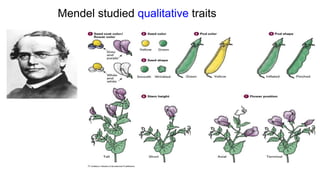
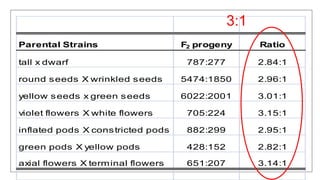
Mendel studied qualitative traits
Parental Strains F2 progeny Ratio
tall x dwarf 787:277 2.84:1
round seeds X wrinkled seeds 5474:1850 2.96:1
yellow seeds x green seeds 6022:2001 3.01:1
violet flowers X white flowers 705:224 3.15:1
inflated pods X constricted pods 882:299 2.95:1
green pods X yellow pods 428:152 2.82:1
axial flowers X terminal flowers 651:207 3.14:1
3:1
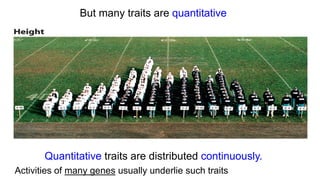
But many traits are quantitative
Quantitative traits are distributed continuously.
Activities of many genes usually underlie such traits
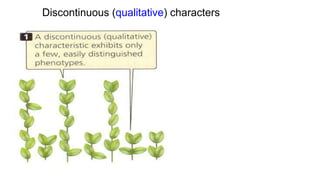
Discontinuous (qualitative) characters
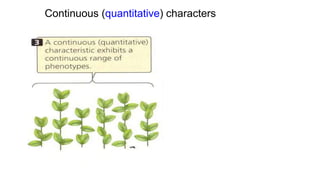
Continuous (quantitative) characters
Inheritance of Quantitative traits
Francis Galton – Mendel’s laws of inheritance could not explain the continuous variation.
Hugo de Vries – Continuous variations are non-heritable
Yule (1906) – Many genes with small and similar effects produce continuous variation.
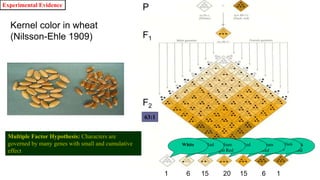
Kernel color in wheat
(Nilsson-Ehle 1909)
Three loci
1 6 15 20 15 6 1
P
F1
F2
Experimental Evidence
63:1
Multiple Factor Hypothesis: Characters are
governed by many genes with small and cumulative
effect
Dark
Red
Medium Dark
Red
Medium
Red
Red
Medium
Light Red
Light Red
White
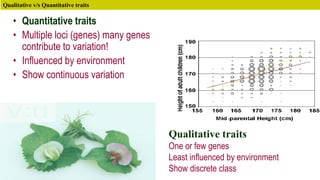
• Quantitative traits
• Multiple loci (genes) many genes
contribute to variation!
• Influenced by environment
• Show continuous variation
Qualitative traits
One or few genes
Least influenced by environment
Show discrete class
Qualitative v/s Quantitative traits
BIOMETRICS IN PLANT BREEDING - QUALITATIVE TRAIT
A qualitative trait is expressed qualitatively, which means that the phenotype falls into different
categories.
Qualitative traits can be defined in terms of kinds or classes of distinct nature (phenotype), ie.,
without assigning any value.
Such characters are generally simply inherited under the control of one or two so called major
genes (oligogenes) and are insensitive to environments.
Therefore, their genetic behaviour can be wholly accounted for on the principles of Mendelian
genetics
Substantial evidences on record indicate that qualitative traits are, by and large, highly heritable.
Therefore, they are highly amenable to improvement by simple plant breeding methods, like
selection, backcrossing or mutation, which requires no complicated programmes
 Many traits are genetically influenced, but do not show single-gene (Mendelian) patterns of
inheritance.
 They are influenced by the combined action of many genes and are characterized by continuous
variation.
 These are called polygenic traits.
 Continuously variable characteristics that are both polygenic and influenced by environmental
factors are called multifactorial traits. Examples of quantitative characteristics are height,
weight.
 A quantitative trait shows continuous variation. If several gene effects are present, the
phenotype values for a population will typically have a normal distribution.
• The genes ALSO follow Mendelian laws of inheritance; however, multifactorial traits have
numerous possible phenotypic categories.
BIOMETRICS IN PLANT BREEDING - QUANTITATIVE TRAIT
 Biometry or biometrics is the science that deals with the application of statistical
concepts and procedure to the study of biological problems.
 Biometrical genetics is that branch of genetics, which attempts to unravel the inheritance
of quantitative traits using statistical concepts and procedures. It is also known as
quantitative genetics.
 Biometrical techniques: Various statistical procedures employed in biometrical genetics
are known as biometrical techniques.
BIOMETRICS IN PLANT BREEDING
BIOMETRICAL GENETICS
BIOMETRICS IN PLANT BREEDING
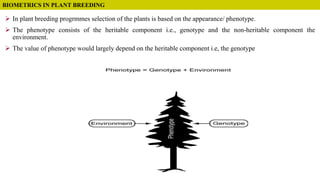
 In plant breeding progrmmes selection of the plants is based on the appearance/ phenotype.
 The phenotype consists of the heritable component i.e., genotype and the non-heritable component the
environment.
 The value of phenotype would largely depend on the heritable component i.e, the genotype
Phenotypic variation
 It is the total variability, which is observable.
 It includes both genotypic and environmental conditions. Such variation is measured in terms of phenotypic
variance.
Genotypic variation
 It is the inherent or genetic variability, which remains unaltered by environmental conditions.
 This type of variability is more useful to a plant breeder for exploitation in selection or hybridization. Such variation
is measured in terms of genotypic variance.
 The genotypic variance consists of additive, dominance and epistatic components.
Environmental variation
 It refers to non-heritable variation, which is entirely due to environmental effects and varies under different
environmental conditions.
 This uncontrolled variation is measured in terms of error mean variance. The variation in true breeding parental line
and their F1 is non-heritable.
BIOMETRICS IN PLANT BREEDING – COMPONENTS OF VARIATION
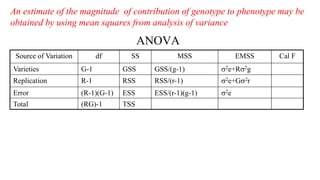
An estimate of the magnitude of contribution of genotype to phenotype may be
obtained by using mean squares from analysis of variance
Source of Variation df SS MSS EMSS Cal F
Varieties G-1 GSS GSS/(g-1) 2e+R2g
Replication R-1 RSS RSS/(r-1) 2e+G2r
Error (R-1)(G-1) ESS ESS/(r-1)(g-1) 2e
Total (RG)-1 TSS
ANOVA
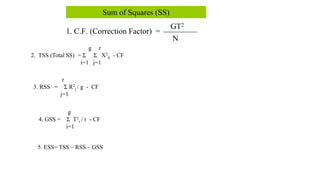
1. C.F. (Correction Factor) =
GT2
N
g r
2. TSS (Total SS) = Σ Σ X2
ij - CF
i=1 j=1
r
3. RSS = Σ R2
j / g - CF
j=1
g
4. GSS = Σ T2
i / r - CF
i=1
5. ESS= TSS – RSS – GSS
Sum of Squares (SS)
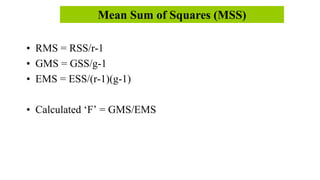
• RMS = RSS/r-1
• GMS = GSS/g-1
• EMS = ESS/(r-1)(g-1)
• Calculated ‘F’ = GMS/EMS
Mean Sum of Squares (MSS)
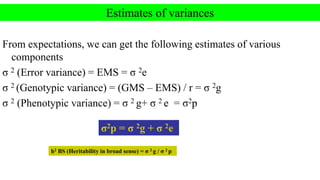
From expectations, we can get the following estimates of various
components
σ 2 (Error variance) = EMS = σ 2e
σ 2 (Genotypic variance) = (GMS – EMS) / r = σ 2g
σ 2 (Phenotypic variance) = σ 2 g+ σ 2 e = σ2p
Estimates of variances
σ2p = σ 2g + σ 2e
h2 BS (Heritability in broad sense) = σ 2 g / σ 2 p
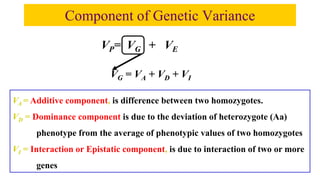
Component of Genetic Variance
VG = VA + VD + VI
VP= VG + VE
VA = Additive component, is difference between two homozygotes.
VD = Dominance component is due to the deviation of heterozygote (Aa)
phenotype from the average of phenotypic values of two homozygotes
VI = Interaction or Epistatic component, is due to interaction of two or more
genes
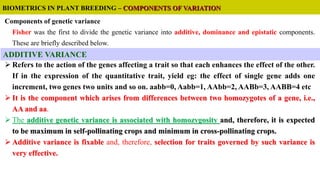
Components of genetic variance
Fisher was the first to divide the genetic variance into additive, dominance and epistatic components.
These are briefly described below.
 Refers to the action of the genes affecting a trait so that each enhances the effect of the other.
If in the expression of the quantitative trait, yield eg: the effect of single gene adds one
increment, two genes two units and so on. aabb=0, Aabb=1, AAbb=2, AABb=3, AABB=4 etc
 It is the component which arises from differences between two homozygotes of a gene, i.e.,
AA and aa.
 The additive genetic variance is associated with homozygosity and, therefore, it is expected
to be maximum in self-pollinating crops and minimum in cross-pollinating crops.
 Additive variance is fixable and, therefore, selection for traits governed by such variance is
very effective.
BIOMETRICS IN PLANT BREEDING – COMPONENTS OF VARIATION
ADDITIVE VARIANCE
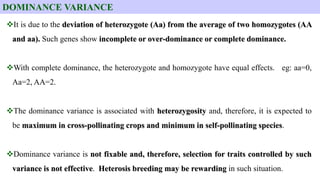
It is due to the deviation of heterozygote (Aa) from the average of two homozygotes (AA
and aa). Such genes show incomplete or over-dominance or complete dominance.
With complete dominance, the heterozygote and homozygote have equal effects. eg: aa=0,
Aa=2, AA=2.
The dominance variance is associated with heterozygosity and, therefore, it is expected to
be maximum in cross-pollinating crops and minimum in self-pollinating species.
Dominance variance is not fixable and, therefore, selection for traits controlled by such
variance is not effective. Heterosis breeding may be rewarding in such situation.
DOMINANCE VARIANCE
EPISTATIC VARIANCE
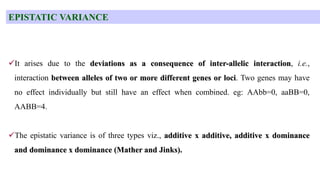
It arises due to the deviations as a consequence of inter-allelic interaction, i.e.,
interaction between alleles of two or more different genes or loci. Two genes may have
no effect individually but still have an effect when combined. eg: AAbb=0, aaBB=0,
AABB=4.
The epistatic variance is of three types viz., additive x additive, additive x dominance
and dominance x dominance (Mather and Jinks).
 In crop improvement only the genetic component of variation is important since only
this component is transmitted to the next generation.
 Heritability is the ratio of genotypic variance to the phenotypic variance.
 Heritability denotes the proportion of phenotypic variance that is due to genotype i.e.,
heritable .
 It is generally expressed in percent (%)
 It is a good index of transmission of characters from parents to their offspring
TYPES OF HERITABILITY
Depending upon the components of variance used as numerator in the
calculation ,there are 2 definitions of Heritability
1. 1.Broad sense heritability
2. Narrow sense heritability
Broad sense heritability
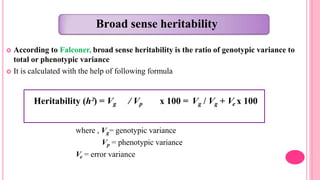
 According to Falconer, broad sense heritability is the ratio of genotypic variance to
total or phenotypic variance
 It is calculated with the help of following formula
where , Vg= genotypic variance
Vp = phenotypic variance
Ve = error variance
Heritability (h²) = Vg / Vp x 100 = Vg / Vg + Ve x 100
Broad sense heritability
 Broad heritability (h2) separates genotypic from environmentally induced variance:
h2 = Vg / Vp
 It can be estimated from both parental as well as segregating populations
 It express the extent to which the phenotype is determined by the genotype , so called
degree of genetic determination
 It is most useful in clonal or highly selfing species in which genotypes are passed from
parents to offspring more or less intact
 It is useful in selection of superior lines from homozygous lines
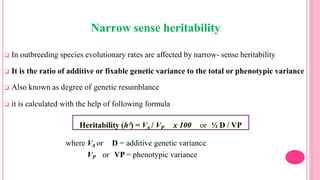
Narrow sense heritability
 In outbreeding species evolutionary rates are affected by narrow- sense heritability
 It is the ratio of additive or fixable genetic variance to the total or phenotypic variance
 Also known as degree of genetic resumblance
 it is calculated with the help of following formula
where VA or D = additive genetic variance
VP or VP = phenotypic variance
Heritability (h²) = VA / VP x 100 or ½ D / VP
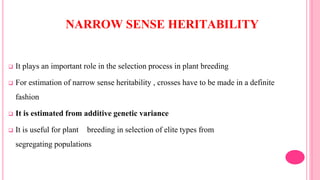
NARROW SENSE HERITABILITY
 It plays an important role in the selection process in plant breeding
 For estimation of narrow sense heritability , crosses have to be made in a definite
fashion
 It is estimated from additive genetic variance
 It is useful for plant breeding in selection of elite types from
segregating populations
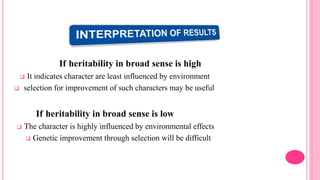
If heritability in broad sense is high
 It indicates character are least influenced by environment
 selection for improvement of such characters may be useful
If heritability in broad sense is low
 The character is highly influenced by environmental effects
 Genetic improvement through selection will be difficult
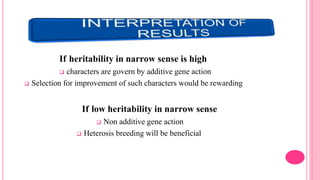
If heritability in narrow sense is high
 characters are govern by additive gene action
 Selection for improvement of such characters would be rewarding
If low heritability in narrow sense
 Non additive gene action
 Heterosis breeding will be beneficial
 H2 varies from 0 (all environment) to 1 (all genetic)
 Heritability of 0 are found in highly inbred populations with no
genetic variation.
 Heritability of 1 are expected for characters with no environmental variance in an
outbred population if all genetic variance is additive.
 Heritability are specific to particular populations living under specific
environmental conditions
 Heritability (h²) and Additive Variance (VA ) are fundamentally measures of how
well quantitative traits are transmitted from one generation to the next
 Type of genetic material : the magnitude of heritability is largely
governed by the amount of genetic variance present in a population for the
character under study
 Sample size : Large sample is necessary for accurate estimates
 Sampling methods : 2 sampling methods , Random and Biased
. The random sampling methods provide true estimates of genetic variance and
hence of heritability
 Layout or conduct of experiment : Increasing the plot size and no. of
replications we can reduce experimental error and get reliable estimates
 Method of calculation : heritability is estimated by several methods
 Effect of linkage : high frequency of coupling phase (AB/ab)
causes upward bias in estimates of additive and dominance variances
 Excess of repulsion phase linkage (Ab/aB ) leads to upward bias in dominance
variance and downward bias in additive variances
 It is useful in predicting the effectiveness of selection.
 It is also helpful for deciding breeding methods to be followed for effective selection.
 It gives us an idea about the response of various characters to selection pressure.
 It is useful in predicting the performance under different degree of intensity of
selection.
 It helps for construction of selection index.
 Estimates of heritability serve as a useful guide to the breeder, to appreciate the proportion
of variation that is due to genotypic or additive effects.
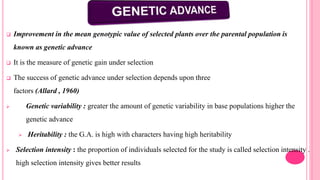
 Improvement in the mean genotypic value of selected plants over the parental population is
known as genetic advance
 It is the measure of genetic gain under selection
 The success of genetic advance under selection depends upon three
factors (Allard , 1960)
 Genetic variability : greater the amount of genetic variability in base populations higher the
genetic advance
 Heritability : the G.A. is high with characters having high heritability
 Selection intensity : the proportion of individuals selected for the study is called selection intensity .
high selection intensity gives better results
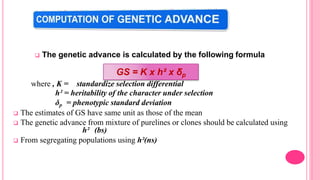
 The genetic advance is calculated by the following formula
where , K = standardize selection differential
h² = heritability of the character under selection
δp = phenotypic standard deviation
 The estimates of GS have same unit as those of the mean
 The genetic advance from mixture of purelines or clones should be calculated using
h² (bs)
 From segregating populations using h²(ns)
GS = K x h² x δp
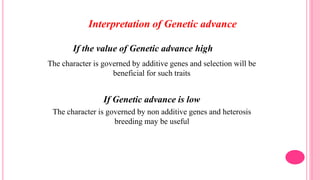
If the value of Genetic advance high
The character is governed by additive genes and selection will be
beneficial for such traits
If Genetic advance is low
The character is governed by non additive genes and heterosis
breeding may be useful
Interpretation of Genetic advance
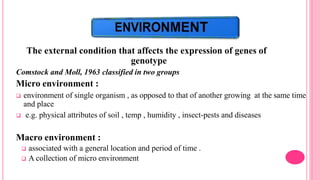
The external condition that affects the expression of genes of
genotype
Comstock and Moll, 1963 classified in two groups
Micro environment :
 environment of single organism , as opposed to that of another growing at the same time
and place
 e.g. physical attributes of soil , temp , humidity , insect-pests and diseases
Macro environment :
 associated with a general location and period of time .
 A collection of micro environment
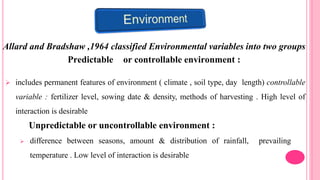
Allard and Bradshaw ,1964 classified Environmental variables into two groups
Predictable or controllable environment :
 includes permanent features of environment ( climate , soil type, day length) controllable
variable : fertilizer level, sowing date & density, methods of harvesting . High level of
interaction is desirable
Unpredictable or uncontrollable environment :
 difference between seasons, amount & distribution of rainfall, prevailing
temperature . Low level of interaction is desirable
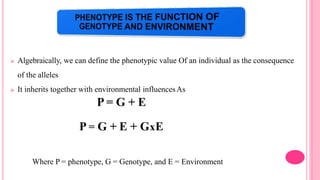
 Algebraically, we can define the phenotypic value Of an individual as the consequence
of the alleles
 It inherits together with environmental influencesAs
P = G + E
P = G + E + GxE
Where P = phenotype, G = Genotype, and E = Environment
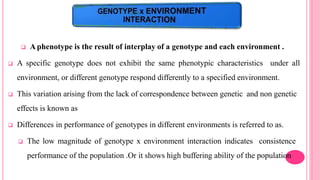
 A phenotype is the result of interplay of a genotype and each environment .
 A specific genotype does not exhibit the same phenotypic characteristics under all
environment, or different genotype respond differently to a specified environment.
 This variation arising from the lack of correspondence between genetic and non genetic
effects is known as
 Differences in performance of genotypes in different environments is referred to as.
 The low magnitude of genotype x environment interaction indicates consistence
performance of the population .Or it shows high buffering ability of the population

14. components of genetic variation

  • 1.
    Components of Geneticvariation: Heritability and Genetic advance Dr. NAVEENKUMAR K.L Assistant professor Dept. Genetics and Plant Breeding
  • 2.
     Components ofvariation  Heritability  Types of heritability  Genetic advance  Environment  Genotype x Environment interaction
  • 3.
  • 4.
    Parental Strains F2progeny Ratio tall x dwarf 787:277 2.84:1 round seeds X wrinkled seeds 5474:1850 2.96:1 yellow seeds x green seeds 6022:2001 3.01:1 violet flowers X white flowers 705:224 3.15:1 inflated pods X constricted pods 882:299 2.95:1 green pods X yellow pods 428:152 2.82:1 axial flowers X terminal flowers 651:207 3.14:1 3:1
  • 5.
    But many traitsare quantitative Quantitative traits are distributed continuously. Activities of many genes usually underlie such traits
  • 6.
  • 7.
  • 8.
    Inheritance of Quantitativetraits Francis Galton – Mendel’s laws of inheritance could not explain the continuous variation. Hugo de Vries – Continuous variations are non-heritable Yule (1906) – Many genes with small and similar effects produce continuous variation.
  • 9.
    Kernel color inwheat (Nilsson-Ehle 1909) Three loci 1 6 15 20 15 6 1 P F1 F2 Experimental Evidence 63:1 Multiple Factor Hypothesis: Characters are governed by many genes with small and cumulative effect Dark Red Medium Dark Red Medium Red Red Medium Light Red Light Red White
  • 10.
    • Quantitative traits •Multiple loci (genes) many genes contribute to variation! • Influenced by environment • Show continuous variation Qualitative traits One or few genes Least influenced by environment Show discrete class Qualitative v/s Quantitative traits
  • 11.
    BIOMETRICS IN PLANTBREEDING - QUALITATIVE TRAIT A qualitative trait is expressed qualitatively, which means that the phenotype falls into different categories. Qualitative traits can be defined in terms of kinds or classes of distinct nature (phenotype), ie., without assigning any value. Such characters are generally simply inherited under the control of one or two so called major genes (oligogenes) and are insensitive to environments. Therefore, their genetic behaviour can be wholly accounted for on the principles of Mendelian genetics Substantial evidences on record indicate that qualitative traits are, by and large, highly heritable. Therefore, they are highly amenable to improvement by simple plant breeding methods, like selection, backcrossing or mutation, which requires no complicated programmes
  • 12.
     Many traitsare genetically influenced, but do not show single-gene (Mendelian) patterns of inheritance.  They are influenced by the combined action of many genes and are characterized by continuous variation.  These are called polygenic traits.  Continuously variable characteristics that are both polygenic and influenced by environmental factors are called multifactorial traits. Examples of quantitative characteristics are height, weight.  A quantitative trait shows continuous variation. If several gene effects are present, the phenotype values for a population will typically have a normal distribution. • The genes ALSO follow Mendelian laws of inheritance; however, multifactorial traits have numerous possible phenotypic categories. BIOMETRICS IN PLANT BREEDING - QUANTITATIVE TRAIT
  • 13.
     Biometry orbiometrics is the science that deals with the application of statistical concepts and procedure to the study of biological problems.  Biometrical genetics is that branch of genetics, which attempts to unravel the inheritance of quantitative traits using statistical concepts and procedures. It is also known as quantitative genetics.  Biometrical techniques: Various statistical procedures employed in biometrical genetics are known as biometrical techniques. BIOMETRICS IN PLANT BREEDING BIOMETRICAL GENETICS
  • 14.
    BIOMETRICS IN PLANTBREEDING  In plant breeding progrmmes selection of the plants is based on the appearance/ phenotype.  The phenotype consists of the heritable component i.e., genotype and the non-heritable component the environment.  The value of phenotype would largely depend on the heritable component i.e, the genotype
  • 15.
    Phenotypic variation  Itis the total variability, which is observable.  It includes both genotypic and environmental conditions. Such variation is measured in terms of phenotypic variance. Genotypic variation  It is the inherent or genetic variability, which remains unaltered by environmental conditions.  This type of variability is more useful to a plant breeder for exploitation in selection or hybridization. Such variation is measured in terms of genotypic variance.  The genotypic variance consists of additive, dominance and epistatic components. Environmental variation  It refers to non-heritable variation, which is entirely due to environmental effects and varies under different environmental conditions.  This uncontrolled variation is measured in terms of error mean variance. The variation in true breeding parental line and their F1 is non-heritable. BIOMETRICS IN PLANT BREEDING – COMPONENTS OF VARIATION
  • 16.
    An estimate ofthe magnitude of contribution of genotype to phenotype may be obtained by using mean squares from analysis of variance Source of Variation df SS MSS EMSS Cal F Varieties G-1 GSS GSS/(g-1) 2e+R2g Replication R-1 RSS RSS/(r-1) 2e+G2r Error (R-1)(G-1) ESS ESS/(r-1)(g-1) 2e Total (RG)-1 TSS ANOVA
  • 17.
    1. C.F. (CorrectionFactor) = GT2 N g r 2. TSS (Total SS) = Σ Σ X2 ij - CF i=1 j=1 r 3. RSS = Σ R2 j / g - CF j=1 g 4. GSS = Σ T2 i / r - CF i=1 5. ESS= TSS – RSS – GSS Sum of Squares (SS)
  • 18.
    • RMS =RSS/r-1 • GMS = GSS/g-1 • EMS = ESS/(r-1)(g-1) • Calculated ‘F’ = GMS/EMS Mean Sum of Squares (MSS)
  • 19.
    From expectations, wecan get the following estimates of various components σ 2 (Error variance) = EMS = σ 2e σ 2 (Genotypic variance) = (GMS – EMS) / r = σ 2g σ 2 (Phenotypic variance) = σ 2 g+ σ 2 e = σ2p Estimates of variances σ2p = σ 2g + σ 2e h2 BS (Heritability in broad sense) = σ 2 g / σ 2 p
  • 20.
    Component of GeneticVariance VG = VA + VD + VI VP= VG + VE VA = Additive component, is difference between two homozygotes. VD = Dominance component is due to the deviation of heterozygote (Aa) phenotype from the average of phenotypic values of two homozygotes VI = Interaction or Epistatic component, is due to interaction of two or more genes
  • 21.
    Components of geneticvariance Fisher was the first to divide the genetic variance into additive, dominance and epistatic components. These are briefly described below.  Refers to the action of the genes affecting a trait so that each enhances the effect of the other. If in the expression of the quantitative trait, yield eg: the effect of single gene adds one increment, two genes two units and so on. aabb=0, Aabb=1, AAbb=2, AABb=3, AABB=4 etc  It is the component which arises from differences between two homozygotes of a gene, i.e., AA and aa.  The additive genetic variance is associated with homozygosity and, therefore, it is expected to be maximum in self-pollinating crops and minimum in cross-pollinating crops.  Additive variance is fixable and, therefore, selection for traits governed by such variance is very effective. BIOMETRICS IN PLANT BREEDING – COMPONENTS OF VARIATION ADDITIVE VARIANCE
  • 22.
    It is dueto the deviation of heterozygote (Aa) from the average of two homozygotes (AA and aa). Such genes show incomplete or over-dominance or complete dominance. With complete dominance, the heterozygote and homozygote have equal effects. eg: aa=0, Aa=2, AA=2. The dominance variance is associated with heterozygosity and, therefore, it is expected to be maximum in cross-pollinating crops and minimum in self-pollinating species. Dominance variance is not fixable and, therefore, selection for traits controlled by such variance is not effective. Heterosis breeding may be rewarding in such situation. DOMINANCE VARIANCE
  • 23.
    EPISTATIC VARIANCE It arisesdue to the deviations as a consequence of inter-allelic interaction, i.e., interaction between alleles of two or more different genes or loci. Two genes may have no effect individually but still have an effect when combined. eg: AAbb=0, aaBB=0, AABB=4. The epistatic variance is of three types viz., additive x additive, additive x dominance and dominance x dominance (Mather and Jinks).
  • 24.
     In cropimprovement only the genetic component of variation is important since only this component is transmitted to the next generation.  Heritability is the ratio of genotypic variance to the phenotypic variance.  Heritability denotes the proportion of phenotypic variance that is due to genotype i.e., heritable .  It is generally expressed in percent (%)  It is a good index of transmission of characters from parents to their offspring
  • 25.
    TYPES OF HERITABILITY Dependingupon the components of variance used as numerator in the calculation ,there are 2 definitions of Heritability 1. 1.Broad sense heritability 2. Narrow sense heritability
  • 26.
    Broad sense heritability According to Falconer, broad sense heritability is the ratio of genotypic variance to total or phenotypic variance  It is calculated with the help of following formula where , Vg= genotypic variance Vp = phenotypic variance Ve = error variance Heritability (h²) = Vg / Vp x 100 = Vg / Vg + Ve x 100
  • 27.
    Broad sense heritability Broad heritability (h2) separates genotypic from environmentally induced variance: h2 = Vg / Vp  It can be estimated from both parental as well as segregating populations  It express the extent to which the phenotype is determined by the genotype , so called degree of genetic determination  It is most useful in clonal or highly selfing species in which genotypes are passed from parents to offspring more or less intact  It is useful in selection of superior lines from homozygous lines
  • 28.
    Narrow sense heritability In outbreeding species evolutionary rates are affected by narrow- sense heritability  It is the ratio of additive or fixable genetic variance to the total or phenotypic variance  Also known as degree of genetic resumblance  it is calculated with the help of following formula where VA or D = additive genetic variance VP or VP = phenotypic variance Heritability (h²) = VA / VP x 100 or ½ D / VP
  • 29.
    NARROW SENSE HERITABILITY It plays an important role in the selection process in plant breeding  For estimation of narrow sense heritability , crosses have to be made in a definite fashion  It is estimated from additive genetic variance  It is useful for plant breeding in selection of elite types from segregating populations
  • 30.
    If heritability inbroad sense is high  It indicates character are least influenced by environment  selection for improvement of such characters may be useful If heritability in broad sense is low  The character is highly influenced by environmental effects  Genetic improvement through selection will be difficult
  • 31.
    If heritability innarrow sense is high  characters are govern by additive gene action  Selection for improvement of such characters would be rewarding If low heritability in narrow sense  Non additive gene action  Heterosis breeding will be beneficial
  • 32.
     H2 variesfrom 0 (all environment) to 1 (all genetic)  Heritability of 0 are found in highly inbred populations with no genetic variation.  Heritability of 1 are expected for characters with no environmental variance in an outbred population if all genetic variance is additive.  Heritability are specific to particular populations living under specific environmental conditions  Heritability (h²) and Additive Variance (VA ) are fundamentally measures of how well quantitative traits are transmitted from one generation to the next
  • 33.
     Type ofgenetic material : the magnitude of heritability is largely governed by the amount of genetic variance present in a population for the character under study  Sample size : Large sample is necessary for accurate estimates  Sampling methods : 2 sampling methods , Random and Biased . The random sampling methods provide true estimates of genetic variance and hence of heritability
  • 34.
     Layout orconduct of experiment : Increasing the plot size and no. of replications we can reduce experimental error and get reliable estimates  Method of calculation : heritability is estimated by several methods  Effect of linkage : high frequency of coupling phase (AB/ab) causes upward bias in estimates of additive and dominance variances  Excess of repulsion phase linkage (Ab/aB ) leads to upward bias in dominance variance and downward bias in additive variances
  • 35.
     It isuseful in predicting the effectiveness of selection.  It is also helpful for deciding breeding methods to be followed for effective selection.  It gives us an idea about the response of various characters to selection pressure.  It is useful in predicting the performance under different degree of intensity of selection.  It helps for construction of selection index.  Estimates of heritability serve as a useful guide to the breeder, to appreciate the proportion of variation that is due to genotypic or additive effects.
  • 36.
     Improvement inthe mean genotypic value of selected plants over the parental population is known as genetic advance  It is the measure of genetic gain under selection  The success of genetic advance under selection depends upon three factors (Allard , 1960)  Genetic variability : greater the amount of genetic variability in base populations higher the genetic advance  Heritability : the G.A. is high with characters having high heritability  Selection intensity : the proportion of individuals selected for the study is called selection intensity . high selection intensity gives better results
  • 37.
     The geneticadvance is calculated by the following formula where , K = standardize selection differential h² = heritability of the character under selection δp = phenotypic standard deviation  The estimates of GS have same unit as those of the mean  The genetic advance from mixture of purelines or clones should be calculated using h² (bs)  From segregating populations using h²(ns) GS = K x h² x δp
  • 38.
    If the valueof Genetic advance high The character is governed by additive genes and selection will be beneficial for such traits If Genetic advance is low The character is governed by non additive genes and heterosis breeding may be useful Interpretation of Genetic advance
  • 39.
    The external conditionthat affects the expression of genes of genotype Comstock and Moll, 1963 classified in two groups Micro environment :  environment of single organism , as opposed to that of another growing at the same time and place  e.g. physical attributes of soil , temp , humidity , insect-pests and diseases Macro environment :  associated with a general location and period of time .  A collection of micro environment
  • 40.
    Allard and Bradshaw,1964 classified Environmental variables into two groups Predictable or controllable environment :  includes permanent features of environment ( climate , soil type, day length) controllable variable : fertilizer level, sowing date & density, methods of harvesting . High level of interaction is desirable Unpredictable or uncontrollable environment :  difference between seasons, amount & distribution of rainfall, prevailing temperature . Low level of interaction is desirable
  • 41.
     Algebraically, wecan define the phenotypic value Of an individual as the consequence of the alleles  It inherits together with environmental influencesAs P = G + E P = G + E + GxE Where P = phenotype, G = Genotype, and E = Environment
  • 42.
     A phenotypeis the result of interplay of a genotype and each environment .  A specific genotype does not exhibit the same phenotypic characteristics under all environment, or different genotype respond differently to a specified environment.  This variation arising from the lack of correspondence between genetic and non genetic effects is known as  Differences in performance of genotypes in different environments is referred to as.  The low magnitude of genotype x environment interaction indicates consistence performance of the population .Or it shows high buffering ability of the population