WELCOME…
…
GENETIC
LINKAGE
AND
GENE MAPPING
INTRODUCTION
After detail study of meiosis we came to
know that not all traits are independtly
assorted,there are few traits which are
responsible to stay gether generation to
generation,this trait governed by traits is
known as linked gene. Set of genes present
in whole chromosome is known as Linkage
group.
And mapping of this genes is know as
gene mapping.
HISTORY
In 1906 Bateson and Punnet first evidently
discovered effect of linkage in dihybrid cross in pea
plant using traits like flower color and pollen
shape but they did not interpret their result in
terms of gene behaviour.
In 1910 T.H.Morgan had successful in
discovery of phenomenon of linkage using
Drosophila traits like mutants yellow body with
white eye and wild type grey body with red eye.
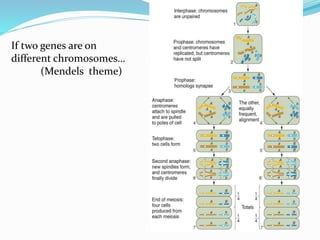
If two genes are on
different chromosomes…
(Mendels theme)
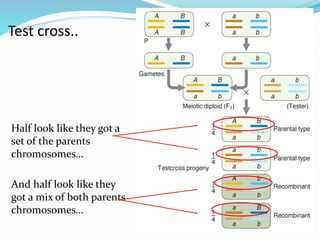
Test cross..
Half look like they got a
set of the parents
chromosomes…
And half look like they
got a mix of both parents
chromosomes…
6
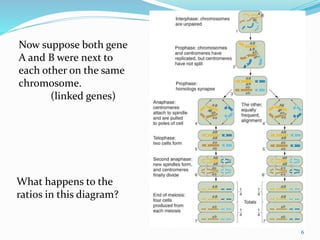
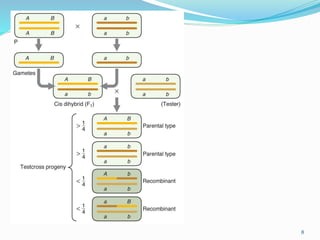
Now suppose both gene
A and B were next to
each other on the same
chromosome.
(linked genes)
What happens to the
ratios in this diagram?
7
8
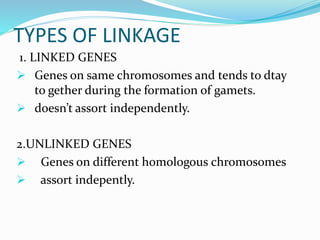
TYPES OF LINKAGE
1. LINKED GENES
 Genes on same chromosomes and tends to dtay
to gether during the formation of gamets.
 doesn’t assort independently.
2.UNLINKED GENES
 Genes on different homologous chromosomes
 assort indepently.
COUPLING AND REPULSION HYPOTHESIS.
This concept was given by Bateson
and Punnet to explain the lack of
independent assortment in the result of
their experiment.but they couldn’t explain
exact reason.
later re-explained by T.H.Morgan.
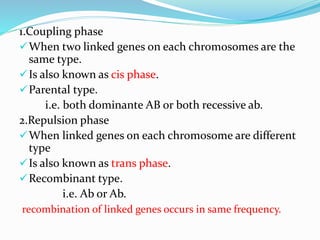
1.Coupling phase
When two linked genes on each chromosomes are the
same type.
Is also known as cis phase.
Parental type.
i.e. both dominante AB or both recessive ab.
2.Repulsion phase
When linked genes on each chromosome are different
type
Is also known as trans phase.
Recombinant type.
i.e. Ab or Ab.
recombination of linked genes occurs in same frequency.
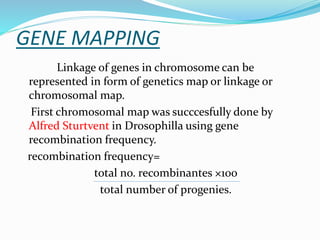
GENE MAPPING
Linkage of genes in chromosome can be
represented in form of genetics map or linkage or
chromosomal map.
First chromosomal map was succcesfully done by
Alfred Sturtvent in Drosophilla using gene
recombination frequency.
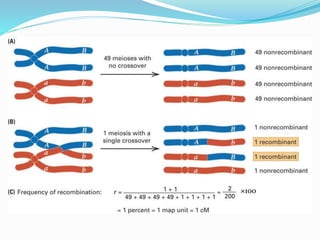
recombination frequency=
total no. recombinantes ×100
total number of progenies.
×100
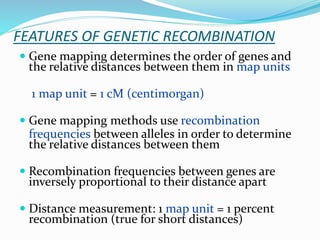
FEATURES OF GENETIC RECOMBINATION
 Gene mapping determines the order of genes and
the relative distances between them in map units
1 map unit = 1 cM (centimorgan)
 Gene mapping methods use recombination
frequencies between alleles in order to determine
the relative distances between them
 Recombination frequencies between genes are
inversely proportional to their distance apart
 Distance measurement: 1 map unit = 1 percent
recombination (true for short distances)
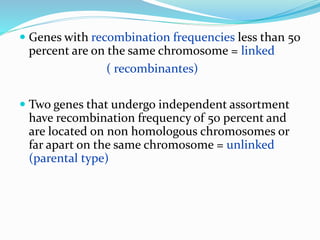
 Genes with recombination frequencies less than 50
percent are on the same chromosome = linked
( recombinantes)
 Two genes that undergo independent assortment
have recombination frequency of 50 percent and
are located on non homologous chromosomes or
far apart on the same chromosome = unlinked
(parental type)
16
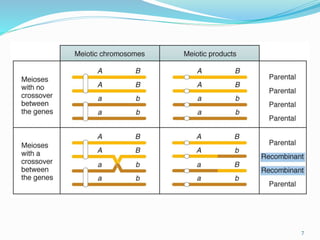
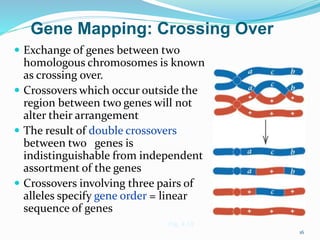
Gene Mapping: Crossing Over
 Exchange of genes between two
homologous chromosomes is known
as crossing over.
 Crossovers which occur outside the
region between two genes will not
alter their arrangement
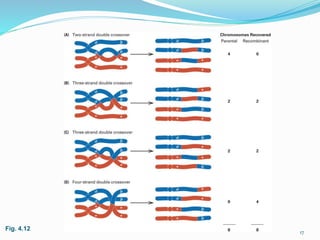
 The result of double crossovers
between two genes is
indistinguishable from independent
assortment of the genes
 Crossovers involving three pairs of
alleles specify gene order = linear
sequence of genes
Fig. 4.13
17
Fig. 4.12
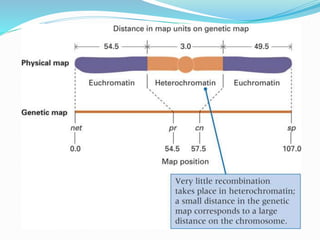
GENETIC V/S PHYSICAL DISTANCE
 Map distances based on recombination frequencies are not
a direct measurement of physical distance along a
chromosome
 Recombination “hot spots” overestimate physical length
 Low rates in heterochromatin and centromeres
underestimate actual physical length
 Physical mapping depends on base pairs(bps)
 ex:- in humans 1cM=1×10⁻⁶bps.
 In 1992 genetic mapping of s.cerevisiae chromosome 3,
it determines that physical mapping and genetic
mapping are not same.
Gene mapping for two point cross
A cross involving two loci ussually refered as
two point cross.
STEPS:-
1. genes are linked are unlinked.
2.parental combination.
3.recombination frequency calculation.
4.genetic distance.
21
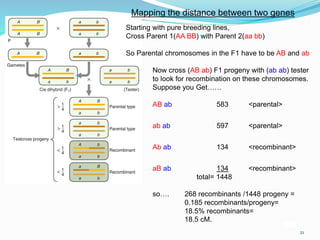
Now cross (AB ab) F1 progeny with (ab ab) tester
to look for recombination on these chromosomes.
Suppose you Get……
AB ab 583 <parental>
ab ab 597 <parental>
Ab ab 134 <recombinant>
aB ab 134 <recombinant>
total= 1448
so…. 268 recombinants /1448 progeny =
0.185 recombinants/progeny=
18.5% recombinants=
18.5 cM.
Starting with pure breeding lines,
Cross Parent 1(AA BB) with Parent 2(aa bb)
So Parental chromosomes in the F1 have to be AB and ab
Mapping the distance between two genes
Gene mapping for three point cross
A cross involving three loci ussually refered as three
point cross.
STEPS:-
1. genes are linked are unlinked.
2.parental combination.
3.gene ordering.
4.recombination frequency calculation.
5.genetic distance.
23
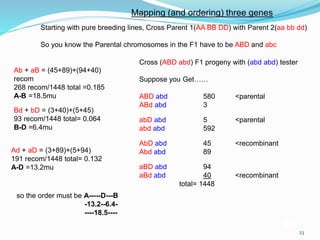
Cross (ABD abd) F1 progeny with (abd abd) tester
Suppose you Get……
ABD abd 580 <parental
ABd abd 3
abD abd 5 <parental
abd abd 592
AbD abd 45 <recombinant
Abd abd 89
aBD abd 94
aBd abd 40 <recombinant
total= 1448
Mapping (and ordering) three genes
Starting with pure breeding lines, Cross Parent 1(AA BB DD) with Parent 2(aa bb dd)
So you know the Parental chromosomes in the F1 have to be ABD and abc
Ab + aB = (45+89)+(94+40)
recom
268 recom/1448 total =0.185
A-B =18.5mu
Bd + bD = (3+40)+(5+45)
93 recom/1448 total= 0.064
B-D =6.4mu
Ad + aD = (3+89)+(5+94)
191 recom/1448 total= 0.132
A-D =13.2mu
so the order must be A-----D---B
-13.2--6.4-
----18.5----
24
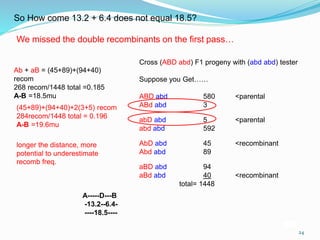
Cross (ABD abd) F1 progeny with (abd abd) tester
Suppose you Get……
ABD abd 580 <parental
ABd abd 3
abD abd 5 <parental
abd abd 592
AbD abd 45 <recombinant
Abd abd 89
aBD abd 94
aBd abd 40 <recombinant
total= 1448
Ab + aB = (45+89)+(94+40)
recom
268 recom/1448 total =0.185
A-B =18.5mu
A-----D---B
-13.2--6.4-
----18.5----
So How come 13.2 + 6.4 does not equal 18.5?
We missed the double recombinants on the first pass…
longer the distance, more
potential to underestimate
recomb freq.
(45+89)+(94+40)+2(3+5) recom
284recom/1448 total = 0.196
A-B =19.6mu
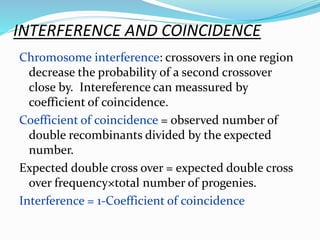
INTERFERENCE AND COINCIDENCE
Chromosome interference: crossovers in one region
decrease the probability of a second crossover
close by. Intereference can meassured by
coefficient of coincidence.
Coefficient of coincidence = observed number of
double recombinants divided by the expected
number.
Expected double cross over = expected double cross
over frequency×total number of progenies.
Interference = 1-Coefficient of coincidence
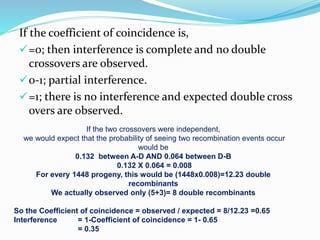
If the coefficient of coincidence is,
=0; then interference is complete and no double
crossovers are observed.
0-1; partial interference.
=1; there is no interference and expected double cross
overs are observed.
If the two crossovers were independent,
we would expect that the probability of seeing two recombination events occur
would be
0.132 between A-D AND 0.064 between D-B
0.132 X 0.064 = 0.008
For every 1448 progeny, this would be (1448x0.008)=12.23 double
recombinants
We actually observed only (5+3)= 8 double recombinants
So the Coefficient of coincidence = observed / expected = 8/12.23 =0.65
Interference = 1-Coefficient of coincidence = 1- 0.65
= 0.35
27
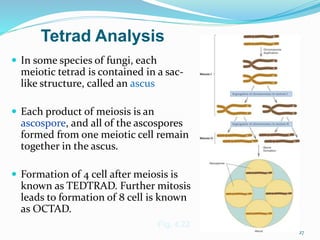
Tetrad Analysis
 In some species of fungi, each
meiotic tetrad is contained in a sac-
like structure, called an ascus
 Each product of meiosis is an
ascospore, and all of the ascospores
formed from one meiotic cell remain
together in the ascus.
 Formation of 4 cell after meiosis is
known as TEDTRAD. Further mitosis
leads to formation of 8 cell is known
as OCTAD.
Fig. 4.22
28
Features Of Tetrad Analysis
 Several features of ascus-producing organisms are
especially useful for genetic analysis:
 They are haploid, so the genotype is expressed directly in the
phenotype
 They produce very large numbers of progeny
 Their life cycles tend to be short
29
Ordered and Unordered Tetrads
 Organisms like Saccharomyces cerevisiae,
produce unordered tetrads: the meiotic products
are not arranged in any particular order in the
ascus.
 Unordered tetrads have no relation to the
geometry of meiosis.
 Bread molds of the genus Neurospora have the
meiotic products arranged in a definite order
directly related to the planes of the meiotic
divisions—ordered tetrads.
 The geometry of meiosis is revealed in ordered
tetrads.
30
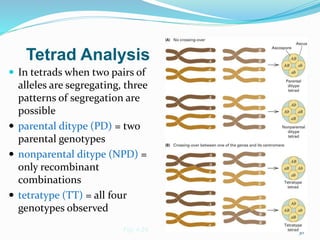
Tetrad Analysis
 In tetrads when two pairs of
alleles are segregating, three
patterns of segregation are
possible
 parental ditype (PD) = two
parental genotypes
 nonparental ditype (NPD) =
only recombinant
combinations
 tetratype (TT) = all four
genotypes observed
Fig. 4.24
31
 The existence of TT for linked genes demonstrates
two important features of crossing-over.
 The exchange of segments between parental
chromatids takes place in prophase I, after the
chromosomes have duplicated.
 The exchange process consists of the breaking and
rejoining of the two chromatids, resulting in the
reciprocal exchange of equal and corresponding
segments.
32
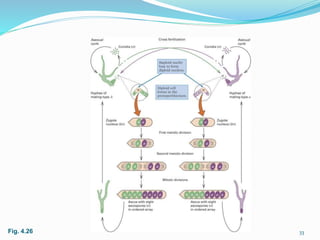
Neurospora: Ordered Tetrads
 Ordered asci also can be classified as PD, NPD, or TT with
respect to two pairs of alleles, which makes it possible to
assess the degree of linkage between the genes
 The fact that the arrangement of meiotic products is
ordered also makes it possible to determine
the recombination frequency between any particular
gene and its centromere
33Fig. 4.26
34
Tetrad Analysis: Ordered Tetrads
 Homologous centromeres of parental chromosomes
separate at the first meiotic division
 The centromeres of sister chromatids separate at the second
meiotic division
 When there is no crossover between the gene and
centromere, the alleles segregate in meiosis I
 A crossover between the gene and the centromere delays
segregation alleles until meiosis II
35
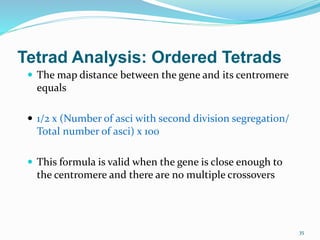
Tetrad Analysis: Ordered Tetrads
 The map distance between the gene and its centromere
equals
 1/2 x (Number of asci with second division segregation/
Total number of asci) x 100
 This formula is valid when the gene is close enough to
the centromere and there are no multiple crossovers
36Fig. 4.27 top
37Fig. 4.27 bottom
Tetrad analysis:- unordered type
 It contain spores that are randomly arranged.
 Estimation involves dihybrid cross.
 Mapping can done based on wether the genes are
linked or not.
 Three types of segregation are possible.
parental ditype (PD) = two parental genotypes
nonparental ditype (NPD) = only recombinant
combinations
tetratype (TT) = all four genotypes observed
39
Tetrad Analysis unordered types.
 When genes are unlinked, the parental ditype tetrads
and the nonparental ditype tetrads are expected in equal
frequencies: PD = NPD
 Linkage is indicated when nonparental ditype tetrads
appear with a much lower frequency than parental
ditype tetrads: PD » NPD
 Map distance between two genes that are sufficiently
close that double and higher levels of crossing-over can
be neglected, equals
1/2 x (Number TT / Total number of tetrads) x 100
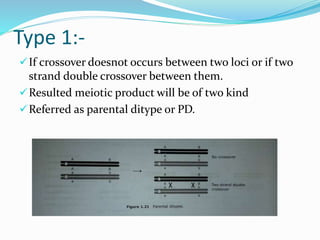
Type 1:-
If crossover doesnot occurs between two loci or if two
strand double crossover between them.
Resulted meiotic product will be of two kind
Referred as parental ditype or PD.
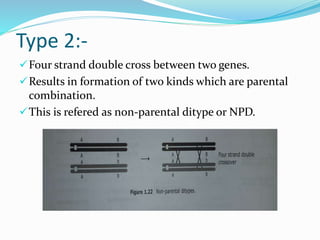
Type 2:-
Four strand double cross between two genes.
Results in formation of two kinds which are parental
combination.
This is refered as non-parental ditype or NPD.
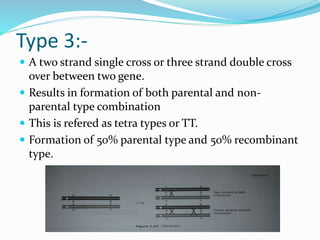
Type 3:-
 A two strand single cross or three strand double cross
over between two gene.
 Results in formation of both parental and non-
parental type combination
 This is refered as tetra types or TT.
 Formation of 50% parental type and 50% recombinant
type.
REFERENCES:-
 Life science,fundamentals and practices-2,pranav
kumar and usha mina,5th edition,2016.
 Fumdamentals of genetics,B.D.singh,4th edition,2001.
 Principles of genetics,Eldon Jhon Gardner,Michael
J.simmon,D.Peter Snustad,8th edition,2015.
 Slideshare.com
THANK YOU……
Presented by,
MAHAMMED FAIZAN
MH2TAG0165
Jr.M.Sc(HORT) in GPB
COLLEGE OF HORTICULTURE
MUDIGERE.

genetic linkage and gene mapping

  • 1.
  • 2.
    INTRODUCTION After detail studyof meiosis we came to know that not all traits are independtly assorted,there are few traits which are responsible to stay gether generation to generation,this trait governed by traits is known as linked gene. Set of genes present in whole chromosome is known as Linkage group. And mapping of this genes is know as gene mapping.
  • 3.
    HISTORY In 1906 Batesonand Punnet first evidently discovered effect of linkage in dihybrid cross in pea plant using traits like flower color and pollen shape but they did not interpret their result in terms of gene behaviour. In 1910 T.H.Morgan had successful in discovery of phenomenon of linkage using Drosophila traits like mutants yellow body with white eye and wild type grey body with red eye.
  • 4.
    If two genesare on different chromosomes… (Mendels theme)
  • 5.
    Test cross.. Half looklike they got a set of the parents chromosomes… And half look like they got a mix of both parents chromosomes…
  • 6.
    6 Now suppose bothgene A and B were next to each other on the same chromosome. (linked genes) What happens to the ratios in this diagram?
  • 7.
  • 8.
  • 9.
    TYPES OF LINKAGE 1.LINKED GENES  Genes on same chromosomes and tends to dtay to gether during the formation of gamets.  doesn’t assort independently. 2.UNLINKED GENES  Genes on different homologous chromosomes  assort indepently.
  • 10.
    COUPLING AND REPULSIONHYPOTHESIS. This concept was given by Bateson and Punnet to explain the lack of independent assortment in the result of their experiment.but they couldn’t explain exact reason. later re-explained by T.H.Morgan.
  • 11.
    1.Coupling phase When twolinked genes on each chromosomes are the same type. Is also known as cis phase. Parental type. i.e. both dominante AB or both recessive ab. 2.Repulsion phase When linked genes on each chromosome are different type Is also known as trans phase. Recombinant type. i.e. Ab or Ab. recombination of linked genes occurs in same frequency.
  • 12.
    GENE MAPPING Linkage ofgenes in chromosome can be represented in form of genetics map or linkage or chromosomal map. First chromosomal map was succcesfully done by Alfred Sturtvent in Drosophilla using gene recombination frequency. recombination frequency= total no. recombinantes ×100 total number of progenies.
  • 13.
  • 14.
    FEATURES OF GENETICRECOMBINATION  Gene mapping determines the order of genes and the relative distances between them in map units 1 map unit = 1 cM (centimorgan)  Gene mapping methods use recombination frequencies between alleles in order to determine the relative distances between them  Recombination frequencies between genes are inversely proportional to their distance apart  Distance measurement: 1 map unit = 1 percent recombination (true for short distances)
  • 15.
     Genes withrecombination frequencies less than 50 percent are on the same chromosome = linked ( recombinantes)  Two genes that undergo independent assortment have recombination frequency of 50 percent and are located on non homologous chromosomes or far apart on the same chromosome = unlinked (parental type)
  • 16.
    16 Gene Mapping: CrossingOver  Exchange of genes between two homologous chromosomes is known as crossing over.  Crossovers which occur outside the region between two genes will not alter their arrangement  The result of double crossovers between two genes is indistinguishable from independent assortment of the genes  Crossovers involving three pairs of alleles specify gene order = linear sequence of genes Fig. 4.13
  • 17.
  • 18.
    GENETIC V/S PHYSICALDISTANCE  Map distances based on recombination frequencies are not a direct measurement of physical distance along a chromosome  Recombination “hot spots” overestimate physical length  Low rates in heterochromatin and centromeres underestimate actual physical length  Physical mapping depends on base pairs(bps)  ex:- in humans 1cM=1×10⁻⁶bps.  In 1992 genetic mapping of s.cerevisiae chromosome 3, it determines that physical mapping and genetic mapping are not same.
  • 20.
    Gene mapping fortwo point cross A cross involving two loci ussually refered as two point cross. STEPS:- 1. genes are linked are unlinked. 2.parental combination. 3.recombination frequency calculation. 4.genetic distance.
  • 21.
    21 Now cross (ABab) F1 progeny with (ab ab) tester to look for recombination on these chromosomes. Suppose you Get…… AB ab 583 <parental> ab ab 597 <parental> Ab ab 134 <recombinant> aB ab 134 <recombinant> total= 1448 so…. 268 recombinants /1448 progeny = 0.185 recombinants/progeny= 18.5% recombinants= 18.5 cM. Starting with pure breeding lines, Cross Parent 1(AA BB) with Parent 2(aa bb) So Parental chromosomes in the F1 have to be AB and ab Mapping the distance between two genes
  • 22.
    Gene mapping forthree point cross A cross involving three loci ussually refered as three point cross. STEPS:- 1. genes are linked are unlinked. 2.parental combination. 3.gene ordering. 4.recombination frequency calculation. 5.genetic distance.
  • 23.
    23 Cross (ABD abd)F1 progeny with (abd abd) tester Suppose you Get…… ABD abd 580 <parental ABd abd 3 abD abd 5 <parental abd abd 592 AbD abd 45 <recombinant Abd abd 89 aBD abd 94 aBd abd 40 <recombinant total= 1448 Mapping (and ordering) three genes Starting with pure breeding lines, Cross Parent 1(AA BB DD) with Parent 2(aa bb dd) So you know the Parental chromosomes in the F1 have to be ABD and abc Ab + aB = (45+89)+(94+40) recom 268 recom/1448 total =0.185 A-B =18.5mu Bd + bD = (3+40)+(5+45) 93 recom/1448 total= 0.064 B-D =6.4mu Ad + aD = (3+89)+(5+94) 191 recom/1448 total= 0.132 A-D =13.2mu so the order must be A-----D---B -13.2--6.4- ----18.5----
  • 24.
    24 Cross (ABD abd)F1 progeny with (abd abd) tester Suppose you Get…… ABD abd 580 <parental ABd abd 3 abD abd 5 <parental abd abd 592 AbD abd 45 <recombinant Abd abd 89 aBD abd 94 aBd abd 40 <recombinant total= 1448 Ab + aB = (45+89)+(94+40) recom 268 recom/1448 total =0.185 A-B =18.5mu A-----D---B -13.2--6.4- ----18.5---- So How come 13.2 + 6.4 does not equal 18.5? We missed the double recombinants on the first pass… longer the distance, more potential to underestimate recomb freq. (45+89)+(94+40)+2(3+5) recom 284recom/1448 total = 0.196 A-B =19.6mu
  • 25.
    INTERFERENCE AND COINCIDENCE Chromosomeinterference: crossovers in one region decrease the probability of a second crossover close by. Intereference can meassured by coefficient of coincidence. Coefficient of coincidence = observed number of double recombinants divided by the expected number. Expected double cross over = expected double cross over frequency×total number of progenies. Interference = 1-Coefficient of coincidence
  • 26.
    If the coefficientof coincidence is, =0; then interference is complete and no double crossovers are observed. 0-1; partial interference. =1; there is no interference and expected double cross overs are observed. If the two crossovers were independent, we would expect that the probability of seeing two recombination events occur would be 0.132 between A-D AND 0.064 between D-B 0.132 X 0.064 = 0.008 For every 1448 progeny, this would be (1448x0.008)=12.23 double recombinants We actually observed only (5+3)= 8 double recombinants So the Coefficient of coincidence = observed / expected = 8/12.23 =0.65 Interference = 1-Coefficient of coincidence = 1- 0.65 = 0.35
  • 27.
    27 Tetrad Analysis  Insome species of fungi, each meiotic tetrad is contained in a sac- like structure, called an ascus  Each product of meiosis is an ascospore, and all of the ascospores formed from one meiotic cell remain together in the ascus.  Formation of 4 cell after meiosis is known as TEDTRAD. Further mitosis leads to formation of 8 cell is known as OCTAD. Fig. 4.22
  • 28.
    28 Features Of TetradAnalysis  Several features of ascus-producing organisms are especially useful for genetic analysis:  They are haploid, so the genotype is expressed directly in the phenotype  They produce very large numbers of progeny  Their life cycles tend to be short
  • 29.
    29 Ordered and UnorderedTetrads  Organisms like Saccharomyces cerevisiae, produce unordered tetrads: the meiotic products are not arranged in any particular order in the ascus.  Unordered tetrads have no relation to the geometry of meiosis.  Bread molds of the genus Neurospora have the meiotic products arranged in a definite order directly related to the planes of the meiotic divisions—ordered tetrads.  The geometry of meiosis is revealed in ordered tetrads.
  • 30.
    30 Tetrad Analysis  Intetrads when two pairs of alleles are segregating, three patterns of segregation are possible  parental ditype (PD) = two parental genotypes  nonparental ditype (NPD) = only recombinant combinations  tetratype (TT) = all four genotypes observed Fig. 4.24
  • 31.
    31  The existenceof TT for linked genes demonstrates two important features of crossing-over.  The exchange of segments between parental chromatids takes place in prophase I, after the chromosomes have duplicated.  The exchange process consists of the breaking and rejoining of the two chromatids, resulting in the reciprocal exchange of equal and corresponding segments.
  • 32.
    32 Neurospora: Ordered Tetrads Ordered asci also can be classified as PD, NPD, or TT with respect to two pairs of alleles, which makes it possible to assess the degree of linkage between the genes  The fact that the arrangement of meiotic products is ordered also makes it possible to determine the recombination frequency between any particular gene and its centromere
  • 33.
  • 34.
    34 Tetrad Analysis: OrderedTetrads  Homologous centromeres of parental chromosomes separate at the first meiotic division  The centromeres of sister chromatids separate at the second meiotic division  When there is no crossover between the gene and centromere, the alleles segregate in meiosis I  A crossover between the gene and the centromere delays segregation alleles until meiosis II
  • 35.
    35 Tetrad Analysis: OrderedTetrads  The map distance between the gene and its centromere equals  1/2 x (Number of asci with second division segregation/ Total number of asci) x 100  This formula is valid when the gene is close enough to the centromere and there are no multiple crossovers
  • 36.
  • 37.
  • 38.
    Tetrad analysis:- unorderedtype  It contain spores that are randomly arranged.  Estimation involves dihybrid cross.  Mapping can done based on wether the genes are linked or not.  Three types of segregation are possible. parental ditype (PD) = two parental genotypes nonparental ditype (NPD) = only recombinant combinations tetratype (TT) = all four genotypes observed
  • 39.
    39 Tetrad Analysis unorderedtypes.  When genes are unlinked, the parental ditype tetrads and the nonparental ditype tetrads are expected in equal frequencies: PD = NPD  Linkage is indicated when nonparental ditype tetrads appear with a much lower frequency than parental ditype tetrads: PD » NPD  Map distance between two genes that are sufficiently close that double and higher levels of crossing-over can be neglected, equals 1/2 x (Number TT / Total number of tetrads) x 100
  • 40.
    Type 1:- If crossoverdoesnot occurs between two loci or if two strand double crossover between them. Resulted meiotic product will be of two kind Referred as parental ditype or PD.
  • 41.
    Type 2:- Four stranddouble cross between two genes. Results in formation of two kinds which are parental combination. This is refered as non-parental ditype or NPD.
  • 42.
    Type 3:-  Atwo strand single cross or three strand double cross over between two gene.  Results in formation of both parental and non- parental type combination  This is refered as tetra types or TT.  Formation of 50% parental type and 50% recombinant type.
  • 43.
    REFERENCES:-  Life science,fundamentalsand practices-2,pranav kumar and usha mina,5th edition,2016.  Fumdamentals of genetics,B.D.singh,4th edition,2001.  Principles of genetics,Eldon Jhon Gardner,Michael J.simmon,D.Peter Snustad,8th edition,2015.  Slideshare.com
  • 44.
    THANK YOU…… Presented by, MAHAMMEDFAIZAN MH2TAG0165 Jr.M.Sc(HORT) in GPB COLLEGE OF HORTICULTURE MUDIGERE.