BIO 106
Lecture 10
Quantitative Inheritance
A. Inheritance of Quantitative Characters
1. Multiple Genes
2. Number of Genes in polygene Systems
3. Regression to the Mean
4. Effects of Dominance and Gene Interactions
5. Effects of Genes in Multiplying Effects
B. Analysis of Quantitative Characteristics
C. Components of Phenotypic Variance
D. Heredity
1. Heritability in the Narrow Sense
2. Heritability in the Broad Sense
2ccex2015
QuantitativeInheritanceTypes of Quantitative Trait:
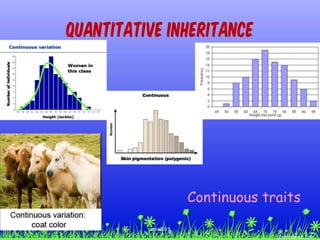
1. continuous trait
- continuous gradation from one phenotype to the
next; continuum of phenotypes
example: growth rate, crop yield, weight
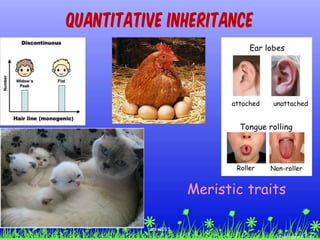
2. meristic trait
- phenotype falls into discrete, integral categories;
discontinuous
example: ability to roll tongue, litter size in cats
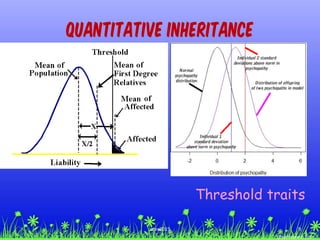
3. threshold trait
- only 2 or a few phenotypic classes, but their
inheritance is determined by multiple genes and
environment
- expression implies affected individuals has liability
over the threshold
example: diabetes, schizophrenia, certain cancers
3ccex2015
Continuous traits
Quantitative Inheritance
4ccex2015
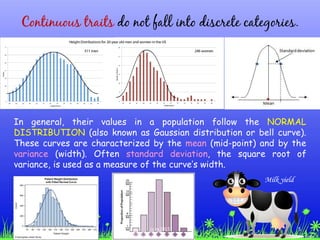
Continuous traits do not fall into discrete categories.
In general, their values in a population follow the NORMAL
DISTRIBUTION (also known as Gaussian distribution or bell curve).
These curves are characterized by the mean (mid-point) and by the
variance (width). Often standard deviation, the square root of
variance, is used as a measure of the curve’s width.
Milk yield
5ccex2015
Meristic traits
Quantitative Inheritance
6ccex2015
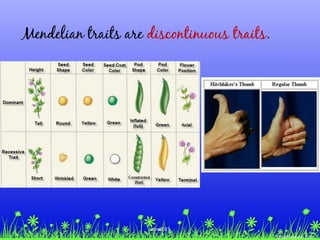
Mendelian traits are discontinuous traits.
7ccex2015
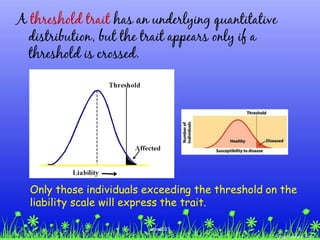
A threshold trait has an underlying quantitative
distribution, but the trait appears only if a
threshold is crossed.
Only those individuals exceeding the threshold on the
liability scale will express the trait.
8ccex2015
Threshold traits
Quantitative Inheritance
9ccex2015
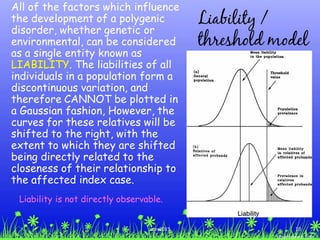
All of the factors which influence
the development of a polygenic
disorder, whether genetic or
environmental, can be considered
as a single entity known as
LIABILITY. The liabilities of all
individuals in a population form a
discontinuous variation, and
therefore CANNOT be plotted in
a Gaussian fashion, However, the
curves for these relatives will be
shifted to the right, with the
extent to which they are shifted
being directly related to the
closeness of their relationship to
the affected index case.
Liability /
threshold model
Liability is not directly observable.
10ccex2015
Quantitative Inheritance
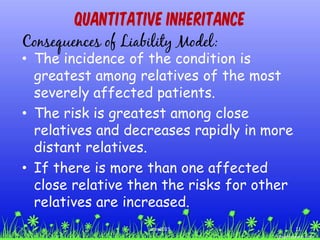
Consequences of Liability Model:
• The incidence of the condition is
greatest among relatives of the most
severely affected patients.
• The risk is greatest among close
relatives and decreases rapidly in more
distant relatives.
• If there is more than one affected
close relative then the risks for other
relatives are increased.
11ccex2015
Quantitative Inheritance
Multiple genes
polygenic trait is one whose phenotype is
influenced by more than one gene
Polygene – any group of non-allelic genes,
each having a small quantitative effect,
that together produce a wide range of
phenotypic variation;
- also called
multiple factor, quantitative gene.
12ccex2015
Quantitative Inheritance
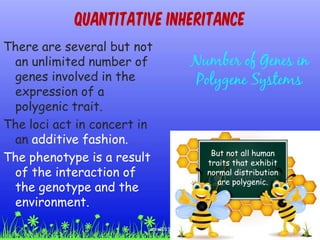
There are several but not
an unlimited number of
genes involved in the
expression of a
polygenic trait.
The loci act in concert in
an additive fashion.
The phenotype is a result
of the interaction of
the genotype and the
environment.
But not all human
traits that exhibit
normal distribution
are polygenic.
Number of Genes in
Polygene Systems
13ccex2015
Quantitative Inheritance
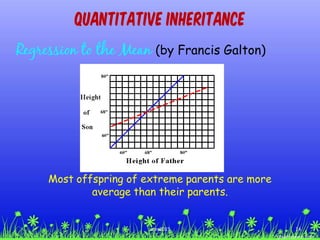
Regression to the Mean (by Francis Galton)
Most offspring of extreme parents are more
average than their parents.
14ccex2015
Quantitative Inheritance
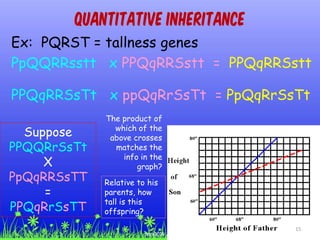
Ex: PQRST = tallness genes
PpQQRRsstt x PPQqRRSstt = PPQqRRSstt
PPQqRRSsTt x ppQqRrSsTt = PpQqRrSsTt
Suppose
PPQQRrSsTt
X
PpQqRRSsTT
=
PPQqRrSsTT
Relative to his
parents, how
tall is this
offspring?
The product of
which of the
above crosses
matches the
info in the
graph?
15
ccex2015
Quantitative Inheritance
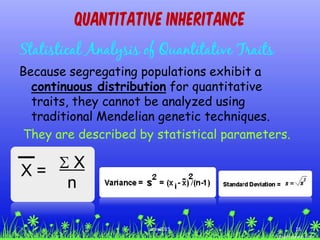
Statistical Analysis of Quantitative Traits
Because segregating populations exhibit a
continuous distribution for quantitative
traits, they cannot be analyzed using
traditional Mendelian genetic techniques.
They are described by statistical parameters.
16ccex2015
Quantitative Inheritance
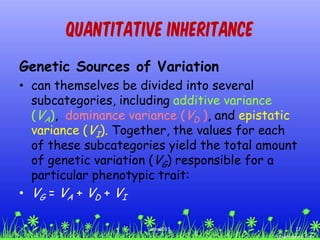
Genetic Sources of Variation
• can themselves be divided into several
subcategories, including additive variance
(VA), dominance variance (VD ), and epistatic
variance (VI). Together, the values for each
of these subcategories yield the total amount
of genetic variation (VG) responsible for a
particular phenotypic trait:
• VG = VA + VD + VI
17ccex2015
Quantitative Inheritance
Additive variation represents the cumulative
effect of individual loci, therefore the
overall mean is equal to the summed
contribution of these loci.
Dominance variation represents interaction
between alleles. If a trait is controlled by
a dominant allele, then both homozygous
and heterozygous individuals will display
the same phenotypic value.
18ccex2015
Quantitative Inheritance
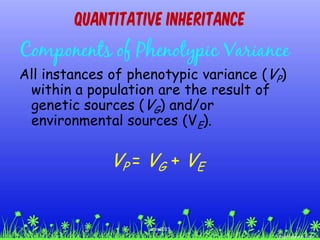
Components of Phenotypic Variance
All instances of phenotypic variance (VP)
within a population are the result of
genetic sources (VG) and/or
environmental sources (VE).
VP = VG + VE
19ccex2015
Quantitative Inheritance
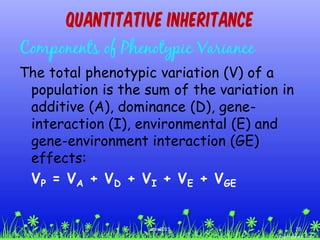
Components of Phenotypic Variance
The total phenotypic variation (V) of a
population is the sum of the variation in
additive (A), dominance (D), gene-
interaction (I), environmental (E) and
gene-environment interaction (GE)
effects:
VP = VA + VD + VI + VE + VGE
20ccex2015
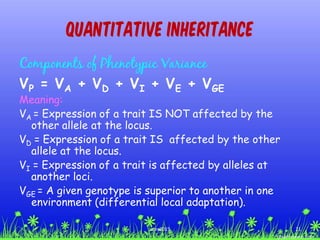
Components of Phenotypic Variance
VP = VA + VD + VI + VE + VGE
Meaning:
VA = Expression of a trait IS NOT affected by the
other allele at the locus.
VD = Expression of a trait IS affected by the other
allele at the locus.
VI = Expression of a trait is affected by alleles at
another loci.
VGE = A given genotype is superior to another in one
environment (differential local adaptation).
Quantitative Inheritance
21ccex2015
Quantitative Inheritance
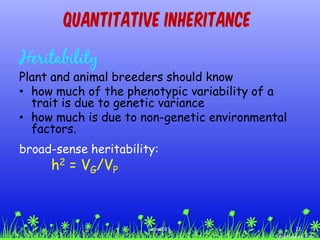
Heritability
Plant and animal breeders should know
• how much of the phenotypic variability of a
trait is due to genetic variance
• how much is due to non-genetic environmental
factors.
broad-sense heritability:
h2 = VG/VP
22ccex2015
Quantitative Inheritance
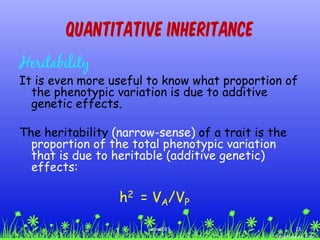
Heritability
It is even more useful to know what proportion of
the phenotypic variation is due to additive
genetic effects.
The heritability (narrow-sense) of a trait is the
proportion of the total phenotypic variation
that is due to heritable (additive genetic)
effects:
h2 = VA/VP
23ccex2015
Quantitative Inheritance
Heritability
h2 is the proportion of variability that can be
passed on from parent to offspring.
h2 = 0 means that none of the phenotypic
variance among individuals is due to
additive genetic differences (VA=0)
SO offspring will NOT closely resemble
their parents for the trait of interest for
genetic reasons.
24ccex2015
Quantitative Inheritance
Heritability
• When h2 = 1, all the variation among
individuals is due to heritable genetic
differences (VP=VA) and offspring will
resemble their parents very closely.
25ccex2015
Some HERITABILITY facts:
Its value can range from 0 (no genetic
contribution) to 1 (all differences on a
trait reflect genetic variation).
It does NOT apply to individuals but to
populations (reflects the fact that all
individuals in any species of living
things differ in many ways among each
other.)
Quantitative Inheritance
26ccex2015
Some HERITABILITY facts:
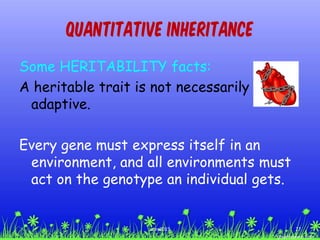
A heritable trait is not necessarily
adaptive.
Every gene must express itself in an
environment, and all environments must
act on the genotype an individual gets.
Quantitative Inheritance
27ccex2015
Quantitative Inheritance
Some HERITABILITY facts:
Finding no heritability for the trait is not a
demonstration that genes are irrelevant;
rather, it demonstrates that, in the
particular population studied, there is no
genetic variation at the relevant loci or
that the environments in which the
population developed were such that
different genotypes had the
same phenotype.
28ccex2015
Quantitative Inheritance
Some HERITABILITY facts:
A high heritability does not mean that a
trait is unaffected by its environment.
In general, the heritability of a trait is
different in each population and in each
set of environments; it cannot be
extrapolated from one population and
set of environments to another.
29ccex2015
Quantitative Inheritance
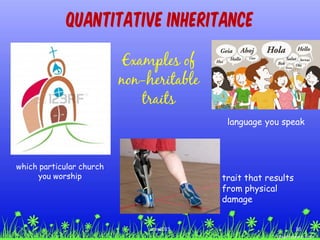
language you speak
which particular church
you worship
Examples of
non-heritable
traits
trait that results
from physical
damage
30ccex2015
Quantitative Inheritance
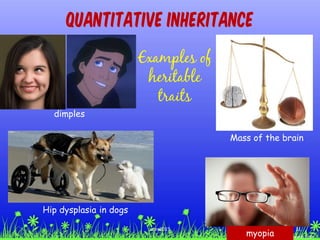
Examples of
heritable
traits
myopia
Mass of the brain
Hip dysplasia in dogs
dimples
31ccex2015
Quantitative Inheritance
Twin studies
Theoretically, any phenotypic differences
between identical twins are
environmental.
Phenotypic differences between fraternal
twins can be due to both environmental
and genetic differences.
32ccex2015
Quantitative Inheritance
If the heritability is high,
• identical twins will normally be very similar for a
trait
• fraternal twins will be less similar
If the heritability is low,
• identical twins may not be much more similar than
fraternal twins.
If variation for a trait is completely heritable,
• identical twins should be have a correlation near 1
• fraternal twins should have a correlation near 0.5
33ccex2015

Genetics: Quantitative Inheritance

  • 1.
  • 2.
    Quantitative Inheritance A. Inheritanceof Quantitative Characters 1. Multiple Genes 2. Number of Genes in polygene Systems 3. Regression to the Mean 4. Effects of Dominance and Gene Interactions 5. Effects of Genes in Multiplying Effects B. Analysis of Quantitative Characteristics C. Components of Phenotypic Variance D. Heredity 1. Heritability in the Narrow Sense 2. Heritability in the Broad Sense 2ccex2015
  • 3.
    QuantitativeInheritanceTypes of QuantitativeTrait: 1. continuous trait - continuous gradation from one phenotype to the next; continuum of phenotypes example: growth rate, crop yield, weight 2. meristic trait - phenotype falls into discrete, integral categories; discontinuous example: ability to roll tongue, litter size in cats 3. threshold trait - only 2 or a few phenotypic classes, but their inheritance is determined by multiple genes and environment - expression implies affected individuals has liability over the threshold example: diabetes, schizophrenia, certain cancers 3ccex2015
  • 4.
  • 5.
    Continuous traits donot fall into discrete categories. In general, their values in a population follow the NORMAL DISTRIBUTION (also known as Gaussian distribution or bell curve). These curves are characterized by the mean (mid-point) and by the variance (width). Often standard deviation, the square root of variance, is used as a measure of the curve’s width. Milk yield 5ccex2015
  • 6.
  • 7.
    Mendelian traits arediscontinuous traits. 7ccex2015
  • 8.
    A threshold traithas an underlying quantitative distribution, but the trait appears only if a threshold is crossed. Only those individuals exceeding the threshold on the liability scale will express the trait. 8ccex2015
  • 9.
  • 10.
    All of thefactors which influence the development of a polygenic disorder, whether genetic or environmental, can be considered as a single entity known as LIABILITY. The liabilities of all individuals in a population form a discontinuous variation, and therefore CANNOT be plotted in a Gaussian fashion, However, the curves for these relatives will be shifted to the right, with the extent to which they are shifted being directly related to the closeness of their relationship to the affected index case. Liability / threshold model Liability is not directly observable. 10ccex2015
  • 11.
    Quantitative Inheritance Consequences ofLiability Model: • The incidence of the condition is greatest among relatives of the most severely affected patients. • The risk is greatest among close relatives and decreases rapidly in more distant relatives. • If there is more than one affected close relative then the risks for other relatives are increased. 11ccex2015
  • 12.
    Quantitative Inheritance Multiple genes polygenictrait is one whose phenotype is influenced by more than one gene Polygene – any group of non-allelic genes, each having a small quantitative effect, that together produce a wide range of phenotypic variation; - also called multiple factor, quantitative gene. 12ccex2015
  • 13.
    Quantitative Inheritance There areseveral but not an unlimited number of genes involved in the expression of a polygenic trait. The loci act in concert in an additive fashion. The phenotype is a result of the interaction of the genotype and the environment. But not all human traits that exhibit normal distribution are polygenic. Number of Genes in Polygene Systems 13ccex2015
  • 14.
    Quantitative Inheritance Regression tothe Mean (by Francis Galton) Most offspring of extreme parents are more average than their parents. 14ccex2015
  • 15.
    Quantitative Inheritance Ex: PQRST= tallness genes PpQQRRsstt x PPQqRRSstt = PPQqRRSstt PPQqRRSsTt x ppQqRrSsTt = PpQqRrSsTt Suppose PPQQRrSsTt X PpQqRRSsTT = PPQqRrSsTT Relative to his parents, how tall is this offspring? The product of which of the above crosses matches the info in the graph? 15 ccex2015
  • 16.
    Quantitative Inheritance Statistical Analysisof Quantitative Traits Because segregating populations exhibit a continuous distribution for quantitative traits, they cannot be analyzed using traditional Mendelian genetic techniques. They are described by statistical parameters. 16ccex2015
  • 17.
    Quantitative Inheritance Genetic Sourcesof Variation • can themselves be divided into several subcategories, including additive variance (VA), dominance variance (VD ), and epistatic variance (VI). Together, the values for each of these subcategories yield the total amount of genetic variation (VG) responsible for a particular phenotypic trait: • VG = VA + VD + VI 17ccex2015
  • 18.
    Quantitative Inheritance Additive variationrepresents the cumulative effect of individual loci, therefore the overall mean is equal to the summed contribution of these loci. Dominance variation represents interaction between alleles. If a trait is controlled by a dominant allele, then both homozygous and heterozygous individuals will display the same phenotypic value. 18ccex2015
  • 19.
    Quantitative Inheritance Components ofPhenotypic Variance All instances of phenotypic variance (VP) within a population are the result of genetic sources (VG) and/or environmental sources (VE). VP = VG + VE 19ccex2015
  • 20.
    Quantitative Inheritance Components ofPhenotypic Variance The total phenotypic variation (V) of a population is the sum of the variation in additive (A), dominance (D), gene- interaction (I), environmental (E) and gene-environment interaction (GE) effects: VP = VA + VD + VI + VE + VGE 20ccex2015
  • 21.
    Components of PhenotypicVariance VP = VA + VD + VI + VE + VGE Meaning: VA = Expression of a trait IS NOT affected by the other allele at the locus. VD = Expression of a trait IS affected by the other allele at the locus. VI = Expression of a trait is affected by alleles at another loci. VGE = A given genotype is superior to another in one environment (differential local adaptation). Quantitative Inheritance 21ccex2015
  • 22.
    Quantitative Inheritance Heritability Plant andanimal breeders should know • how much of the phenotypic variability of a trait is due to genetic variance • how much is due to non-genetic environmental factors. broad-sense heritability: h2 = VG/VP 22ccex2015
  • 23.
    Quantitative Inheritance Heritability It iseven more useful to know what proportion of the phenotypic variation is due to additive genetic effects. The heritability (narrow-sense) of a trait is the proportion of the total phenotypic variation that is due to heritable (additive genetic) effects: h2 = VA/VP 23ccex2015
  • 24.
    Quantitative Inheritance Heritability h2 isthe proportion of variability that can be passed on from parent to offspring. h2 = 0 means that none of the phenotypic variance among individuals is due to additive genetic differences (VA=0) SO offspring will NOT closely resemble their parents for the trait of interest for genetic reasons. 24ccex2015
  • 25.
    Quantitative Inheritance Heritability • Whenh2 = 1, all the variation among individuals is due to heritable genetic differences (VP=VA) and offspring will resemble their parents very closely. 25ccex2015
  • 26.
    Some HERITABILITY facts: Itsvalue can range from 0 (no genetic contribution) to 1 (all differences on a trait reflect genetic variation). It does NOT apply to individuals but to populations (reflects the fact that all individuals in any species of living things differ in many ways among each other.) Quantitative Inheritance 26ccex2015
  • 27.
    Some HERITABILITY facts: Aheritable trait is not necessarily adaptive. Every gene must express itself in an environment, and all environments must act on the genotype an individual gets. Quantitative Inheritance 27ccex2015
  • 28.
    Quantitative Inheritance Some HERITABILITYfacts: Finding no heritability for the trait is not a demonstration that genes are irrelevant; rather, it demonstrates that, in the particular population studied, there is no genetic variation at the relevant loci or that the environments in which the population developed were such that different genotypes had the same phenotype. 28ccex2015
  • 29.
    Quantitative Inheritance Some HERITABILITYfacts: A high heritability does not mean that a trait is unaffected by its environment. In general, the heritability of a trait is different in each population and in each set of environments; it cannot be extrapolated from one population and set of environments to another. 29ccex2015
  • 30.
    Quantitative Inheritance language youspeak which particular church you worship Examples of non-heritable traits trait that results from physical damage 30ccex2015
  • 31.
    Quantitative Inheritance Examples of heritable traits myopia Massof the brain Hip dysplasia in dogs dimples 31ccex2015
  • 32.
    Quantitative Inheritance Twin studies Theoretically,any phenotypic differences between identical twins are environmental. Phenotypic differences between fraternal twins can be due to both environmental and genetic differences. 32ccex2015
  • 33.
    Quantitative Inheritance If theheritability is high, • identical twins will normally be very similar for a trait • fraternal twins will be less similar If the heritability is low, • identical twins may not be much more similar than fraternal twins. If variation for a trait is completely heritable, • identical twins should be have a correlation near 1 • fraternal twins should have a correlation near 0.5 33ccex2015