Tutorial for Classification Machine Learning
using Python programming
Avjinder Singh Kaler
What is Classification?
Definition: Classification is a type of supervised machine learning where the goal is to categorize input data
into predefined classes or labels.
Use cases: Spam detection, image recognition, sentiment analysis.
Types of Classification Algorithms
1. Linear Classifiers:
• Logistic Regression
• Support Vector Machines (SVM)
2. Nearest Neighbor Classifiers:
• k-Nearest Neighbors (k-NN)
3. Tree-Based Classifiers:
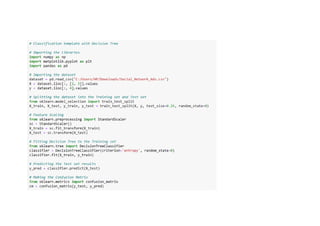
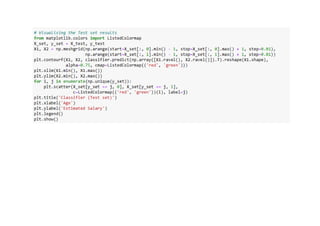
• Decision Trees
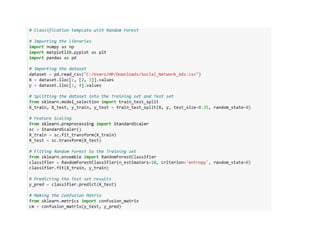
• Random Forests
• Gradient Boosting Machines (e.g., XGBoost)
4. Naive Bayes Classifiers:
• Gaussian Naive Bayes
• Multinomial Naive Bayes
Key Metrics for Evaluation
• Accuracy
• Precision
• Recall
• F1 Score
• Confusion Matrix
Applications of Classification
• Fraud Detection
• Medical Diagnosis
• Email Spam Filtering
• Image Recognition
• Sentiment Analysis
Case Studies
• Brief overview of successful classification projects.
• Highlight key results and improvements.
Challenges in Classification
• Overfitting and Underfitting
• Imbalanced Datasets
• Feature Engineering
Future Trends
• Deep Learning for Classification
• Explainable AI in Classification Models
• Automation in Model Selection and Hyperparameter Tuning
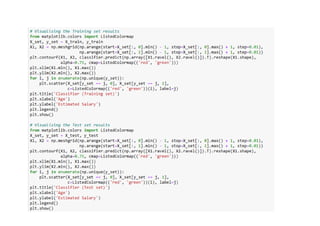
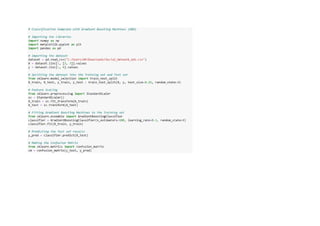
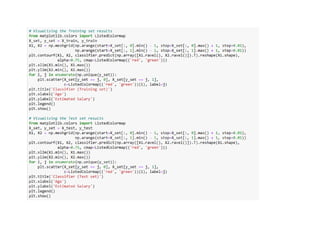
Below is the Python and R code for different Classification Machine Learning models:
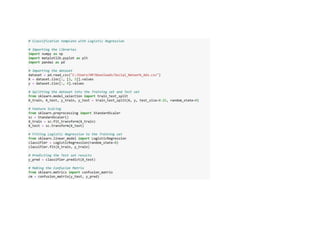
1.Logistic Regression
• Logistic Regression is a statistical method used for binary classification, predicting the probability of
an instance belonging to one of two classes. Unlike linear regression, which predicts a continuous
outcome, logistic regression employs the logistic function to squash the predicted values into the
range of [0, 1]. This makes it particularly well-suited for problems where the dependent variable is
binary, such as spam detection or medical diagnosis. The model estimates coefficients for input
features, which represent the log-odds of the target class. Through a process called logistic
transformation, these log-odds are converted into probabilities. Logistic Regression is widely
employed due to its simplicity, interpretability, and efficiency in handling linear relationships between
features and the log-odds of the target class.
Data is from the social network ads.
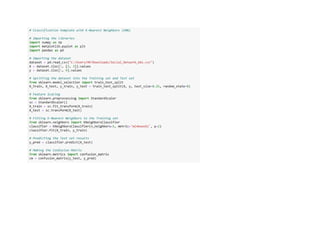
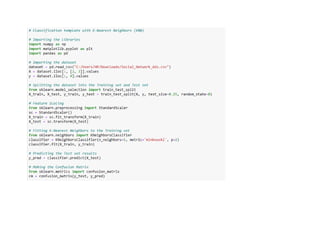
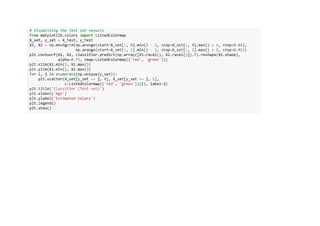
2.K-Nearest Neighbors (KNN)
• K-Nearest Neighbors (KNN) is a simple and intuitive machine learning algorithm used for both
classification and regression tasks. In KNN, the prediction for a new data point is determined by the
majority class or average value of its k nearest neighbors in the feature space. The "k" represents the
number of neighbors considered, and the algorithm relies on the assumption that similar instances in
the input space have similar output values. KNN is a non-parametric method, meaning it doesn't
make strong assumptions about the underlying data distribution. While KNN is straightforward to
understand and implement, its computational efficiency may be a concern for large datasets, and the
choice of the optimal value for "k" can significantly impact its performance.
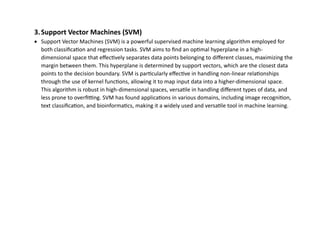
3.Support Vector Machines (SVM)
• Support Vector Machines (SVM) is a powerful supervised machine learning algorithm employed for
both classification and regression tasks. SVM aims to find an optimal hyperplane in a high-
dimensional space that effectively separates data points belonging to different classes, maximizing the
margin between them. This hyperplane is determined by support vectors, which are the closest data
points to the decision boundary. SVM is particularly effective in handling non-linear relationships
through the use of kernel functions, allowing it to map input data into a higher-dimensional space.
This algorithm is robust in high-dimensional spaces, versatile in handling different types of data, and
less prone to overfitting. SVM has found applications in various domains, including image recognition,
text classification, and bioinformatics, making it a widely used and versatile tool in machine learning.
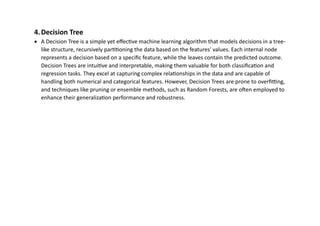
4.Decision Tree
• A Decision Tree is a simple yet effective machine learning algorithm that models decisions in a tree-
like structure, recursively partitioning the data based on the features' values. Each internal node
represents a decision based on a specific feature, while the leaves contain the predicted outcome.
Decision Trees are intuitive and interpretable, making them valuable for both classification and
regression tasks. They excel at capturing complex relationships in the data and are capable of
handling both numerical and categorical features. However, Decision Trees are prone to overfitting,
and techniques like pruning or ensemble methods, such as Random Forests, are often employed to
enhance their generalization performance and robustness.
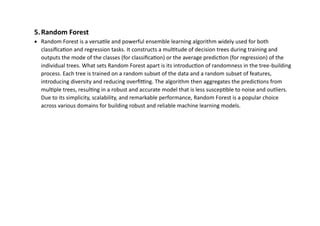
5.Random Forest
• Random Forest is a versatile and powerful ensemble learning algorithm widely used for both
classification and regression tasks. It constructs a multitude of decision trees during training and
outputs the mode of the classes (for classification) or the average prediction (for regression) of the
individual trees. What sets Random Forest apart is its introduction of randomness in the tree-building
process. Each tree is trained on a random subset of the data and a random subset of features,
introducing diversity and reducing overfitting. The algorithm then aggregates the predictions from
multiple trees, resulting in a robust and accurate model that is less susceptible to noise and outliers.
Due to its simplicity, scalability, and remarkable performance, Random Forest is a popular choice
across various domains for building robust and reliable machine learning models.
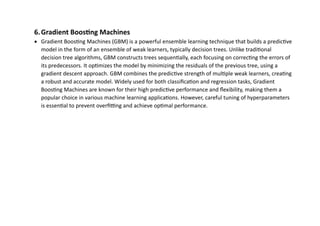
6.Gradient Boosting Machines
• Gradient Boosting Machines (GBM) is a powerful ensemble learning technique that builds a predictive
model in the form of an ensemble of weak learners, typically decision trees. Unlike traditional
decision tree algorithms, GBM constructs trees sequentially, each focusing on correcting the errors of
its predecessors. It optimizes the model by minimizing the residuals of the previous tree, using a
gradient descent approach. GBM combines the predictive strength of multiple weak learners, creating
a robust and accurate model. Widely used for both classification and regression tasks, Gradient
Boosting Machines are known for their high predictive performance and flexibility, making them a
popular choice in various machine learning applications. However, careful tuning of hyperparameters
is essential to prevent overfitting and achieve optimal performance.
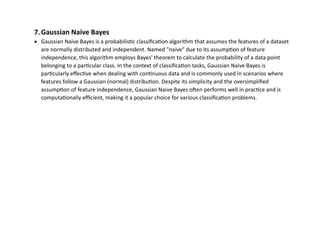
7.Gaussian Naive Bayes
• Gaussian Naive Bayes is a probabilistic classification algorithm that assumes the features of a dataset
are normally distributed and independent. Named "naive" due to its assumption of feature
independence, this algorithm employs Bayes' theorem to calculate the probability of a data point
belonging to a particular class. In the context of classification tasks, Gaussian Naive Bayes is
particularly effective when dealing with continuous data and is commonly used in scenarios where
features follow a Gaussian (normal) distribution. Despite its simplicity and the oversimplified
assumption of feature independence, Gaussian Naive Bayes often performs well in practice and is
computationally efficient, making it a popular choice for various classification problems.
8.Multinomial Naive Bayes
• Multinomial Naive Bayes is a classification algorithm specifically designed for datasets with discrete
features, commonly applied in text classification and document categorization tasks. Unlike its
Gaussian counterpart, Multinomial Naive Bayes handles count data, such as word occurrences in
documents. It models the likelihood of observing a particular feature given a class and assumes
feature independence, making it "naive." Despite its simplifying assumptions, Multinomial Naive
Bayes is efficient, computationally lightweight, and well-suited for situations where the term
frequencies or word counts in documents are relevant features for classification. While primarily
associated with natural language processing applications, Multinomial Naive Bayes has found success
in various other domains with discrete feature sets.
Python Code for Classification Supervised Machine Learning.pdf

Python Code for Classification Supervised Machine Learning.pdf

  • 1.
    Tutorial for ClassificationMachine Learning using Python programming Avjinder Singh Kaler
  • 2.
    What is Classification? Definition:Classification is a type of supervised machine learning where the goal is to categorize input data into predefined classes or labels. Use cases: Spam detection, image recognition, sentiment analysis. Types of Classification Algorithms 1. Linear Classifiers: • Logistic Regression • Support Vector Machines (SVM) 2. Nearest Neighbor Classifiers: • k-Nearest Neighbors (k-NN) 3. Tree-Based Classifiers: • Decision Trees • Random Forests • Gradient Boosting Machines (e.g., XGBoost) 4. Naive Bayes Classifiers:
  • 3.
    • Gaussian NaiveBayes • Multinomial Naive Bayes Key Metrics for Evaluation • Accuracy • Precision • Recall • F1 Score • Confusion Matrix Applications of Classification • Fraud Detection • Medical Diagnosis • Email Spam Filtering • Image Recognition • Sentiment Analysis Case Studies • Brief overview of successful classification projects.
  • 4.
    • Highlight keyresults and improvements. Challenges in Classification • Overfitting and Underfitting • Imbalanced Datasets • Feature Engineering Future Trends • Deep Learning for Classification • Explainable AI in Classification Models • Automation in Model Selection and Hyperparameter Tuning Below is the Python and R code for different Classification Machine Learning models:
  • 5.
    1.Logistic Regression • LogisticRegression is a statistical method used for binary classification, predicting the probability of an instance belonging to one of two classes. Unlike linear regression, which predicts a continuous outcome, logistic regression employs the logistic function to squash the predicted values into the range of [0, 1]. This makes it particularly well-suited for problems where the dependent variable is binary, such as spam detection or medical diagnosis. The model estimates coefficients for input features, which represent the log-odds of the target class. Through a process called logistic transformation, these log-odds are converted into probabilities. Logistic Regression is widely employed due to its simplicity, interpretability, and efficiency in handling linear relationships between features and the log-odds of the target class. Data is from the social network ads.
  • 8.
    2.K-Nearest Neighbors (KNN) •K-Nearest Neighbors (KNN) is a simple and intuitive machine learning algorithm used for both classification and regression tasks. In KNN, the prediction for a new data point is determined by the majority class or average value of its k nearest neighbors in the feature space. The "k" represents the number of neighbors considered, and the algorithm relies on the assumption that similar instances in the input space have similar output values. KNN is a non-parametric method, meaning it doesn't make strong assumptions about the underlying data distribution. While KNN is straightforward to understand and implement, its computational efficiency may be a concern for large datasets, and the choice of the optimal value for "k" can significantly impact its performance.
  • 11.
    3.Support Vector Machines(SVM) • Support Vector Machines (SVM) is a powerful supervised machine learning algorithm employed for both classification and regression tasks. SVM aims to find an optimal hyperplane in a high- dimensional space that effectively separates data points belonging to different classes, maximizing the margin between them. This hyperplane is determined by support vectors, which are the closest data points to the decision boundary. SVM is particularly effective in handling non-linear relationships through the use of kernel functions, allowing it to map input data into a higher-dimensional space. This algorithm is robust in high-dimensional spaces, versatile in handling different types of data, and less prone to overfitting. SVM has found applications in various domains, including image recognition, text classification, and bioinformatics, making it a widely used and versatile tool in machine learning.
  • 14.
    4.Decision Tree • ADecision Tree is a simple yet effective machine learning algorithm that models decisions in a tree- like structure, recursively partitioning the data based on the features' values. Each internal node represents a decision based on a specific feature, while the leaves contain the predicted outcome. Decision Trees are intuitive and interpretable, making them valuable for both classification and regression tasks. They excel at capturing complex relationships in the data and are capable of handling both numerical and categorical features. However, Decision Trees are prone to overfitting, and techniques like pruning or ensemble methods, such as Random Forests, are often employed to enhance their generalization performance and robustness.
  • 17.
    5.Random Forest • RandomForest is a versatile and powerful ensemble learning algorithm widely used for both classification and regression tasks. It constructs a multitude of decision trees during training and outputs the mode of the classes (for classification) or the average prediction (for regression) of the individual trees. What sets Random Forest apart is its introduction of randomness in the tree-building process. Each tree is trained on a random subset of the data and a random subset of features, introducing diversity and reducing overfitting. The algorithm then aggregates the predictions from multiple trees, resulting in a robust and accurate model that is less susceptible to noise and outliers. Due to its simplicity, scalability, and remarkable performance, Random Forest is a popular choice across various domains for building robust and reliable machine learning models.
  • 20.
    6.Gradient Boosting Machines •Gradient Boosting Machines (GBM) is a powerful ensemble learning technique that builds a predictive model in the form of an ensemble of weak learners, typically decision trees. Unlike traditional decision tree algorithms, GBM constructs trees sequentially, each focusing on correcting the errors of its predecessors. It optimizes the model by minimizing the residuals of the previous tree, using a gradient descent approach. GBM combines the predictive strength of multiple weak learners, creating a robust and accurate model. Widely used for both classification and regression tasks, Gradient Boosting Machines are known for their high predictive performance and flexibility, making them a popular choice in various machine learning applications. However, careful tuning of hyperparameters is essential to prevent overfitting and achieve optimal performance.
  • 23.
    7.Gaussian Naive Bayes •Gaussian Naive Bayes is a probabilistic classification algorithm that assumes the features of a dataset are normally distributed and independent. Named "naive" due to its assumption of feature independence, this algorithm employs Bayes' theorem to calculate the probability of a data point belonging to a particular class. In the context of classification tasks, Gaussian Naive Bayes is particularly effective when dealing with continuous data and is commonly used in scenarios where features follow a Gaussian (normal) distribution. Despite its simplicity and the oversimplified assumption of feature independence, Gaussian Naive Bayes often performs well in practice and is computationally efficient, making it a popular choice for various classification problems.
  • 26.
    8.Multinomial Naive Bayes •Multinomial Naive Bayes is a classification algorithm specifically designed for datasets with discrete features, commonly applied in text classification and document categorization tasks. Unlike its Gaussian counterpart, Multinomial Naive Bayes handles count data, such as word occurrences in documents. It models the likelihood of observing a particular feature given a class and assumes feature independence, making it "naive." Despite its simplifying assumptions, Multinomial Naive Bayes is efficient, computationally lightweight, and well-suited for situations where the term frequencies or word counts in documents are relevant features for classification. While primarily associated with natural language processing applications, Multinomial Naive Bayes has found success in various other domains with discrete feature sets.