1/10/2017 1Department of Plant Biotechnology
Genetic Markers
 A genetic marker is a gene or DNA sequence with a known location on
a chromosome that can be used to identify individuals or species. It can be
described as a variation (which may arise due to mutation or alteration in the
genomic loci) that can be observed.
 Generally, they do not represent the target genes themselves but act as
‘signs’ or ‘flags’.
 Genetic markers that are located in close proximity to genes (i.e. tightly
linked) may be referred to as gene ‘tags’.
 Such markers themselves do not affect the phenotype of the trait of interest
because they are located only near or ‘linked’ to genes controlling the trait.
 All genetic markers occupy specific genomic positions within chromosomes
(like genes) called ‘loci’ (singular ‘locus’).
1/10/2017 2
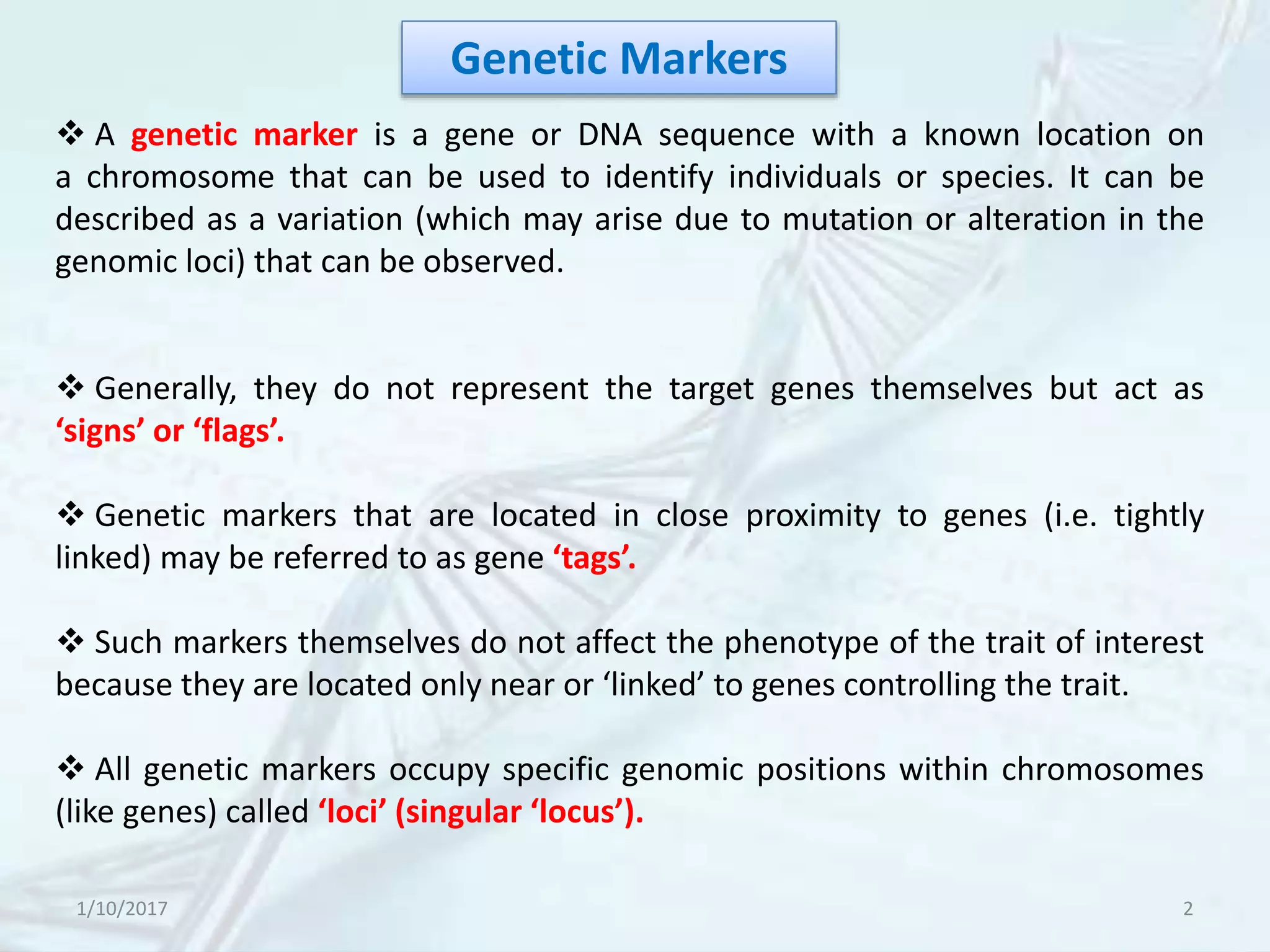
Types of Genetic Markers
Morphological Molecular
Biochemical
Isoenzymes
Non PCR
RFLP
Based on PCR
RAPD SSR AFLP STS ISSR SCAR SNP EST
1/10/2017 3
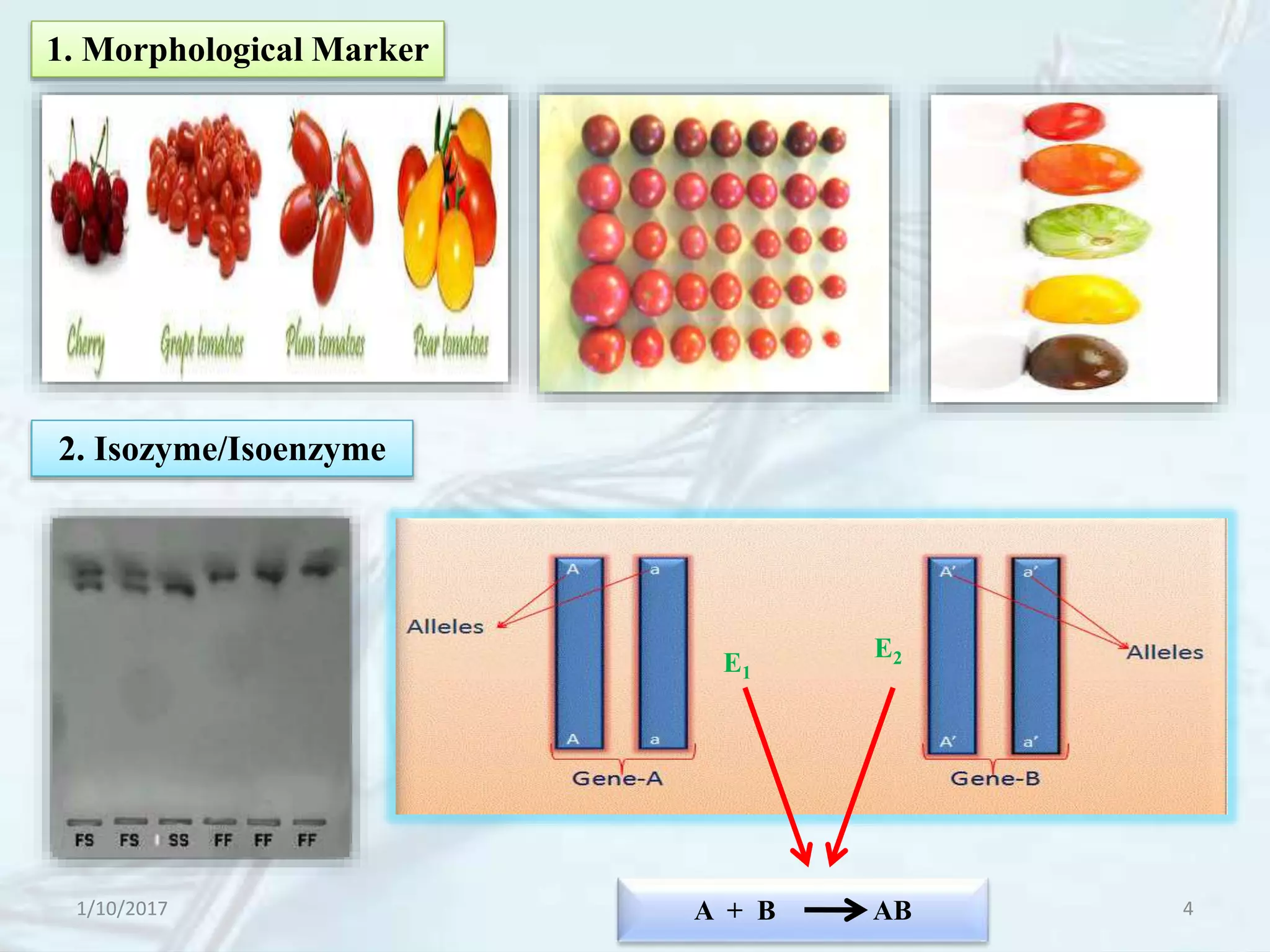
E1
E2
A + B AB
2. Isozyme/Isoenzyme
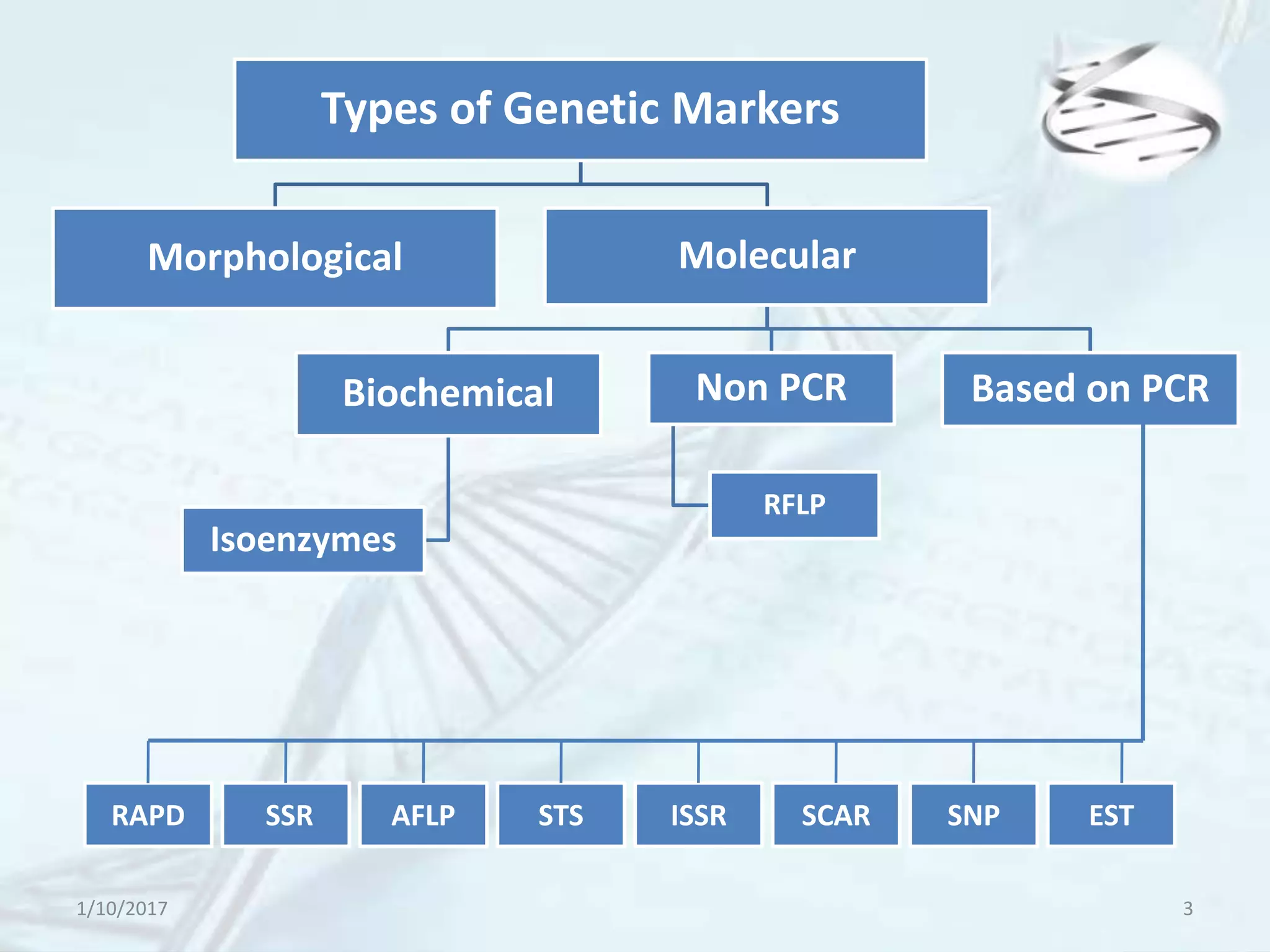
1. Morphological Marker
1/10/2017 4
3. Molecular Marker
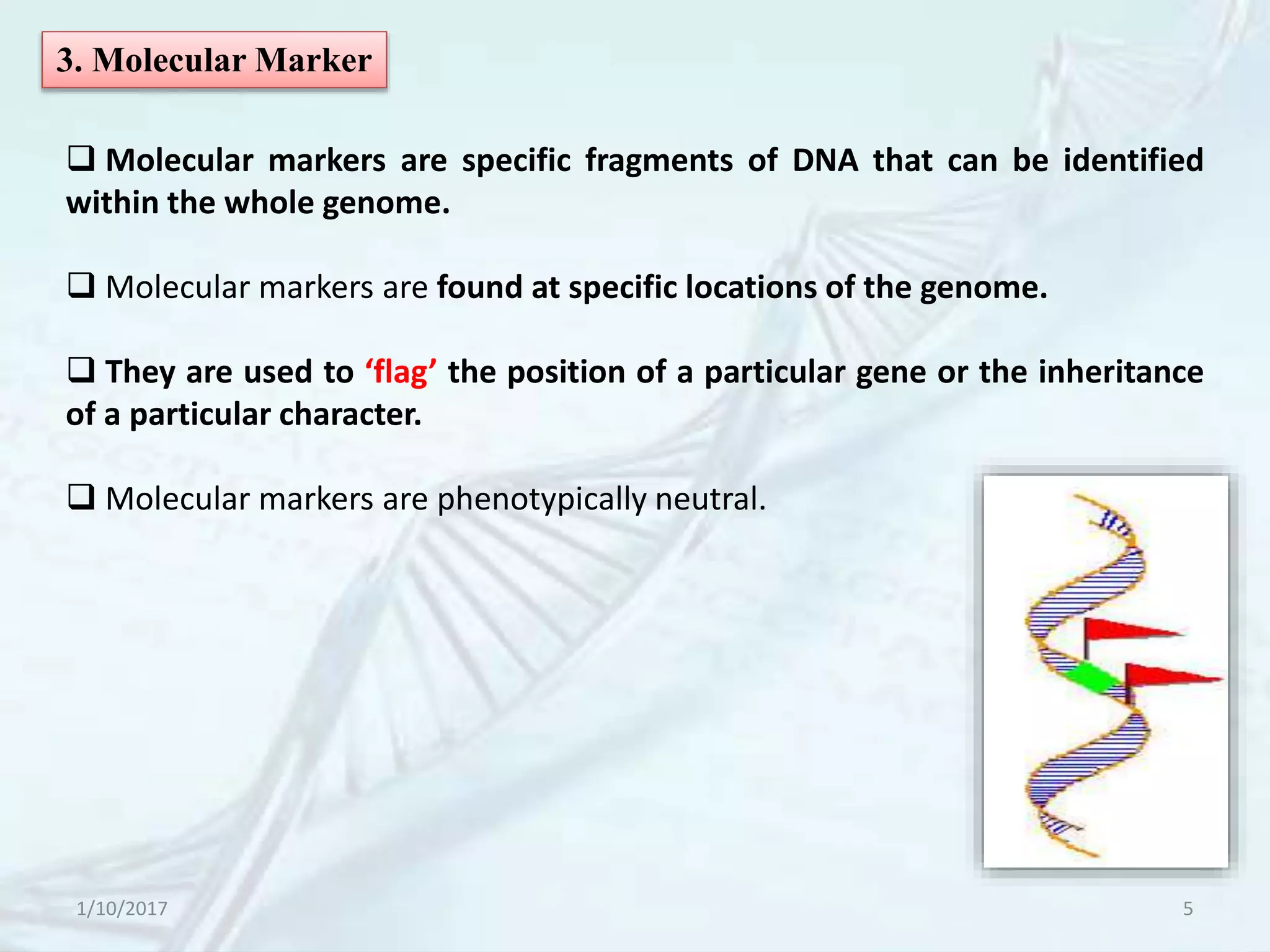
 Molecular markers are specific fragments of DNA that can be identified
within the whole genome.
 Molecular markers are found at specific locations of the genome.
 They are used to ‘flag’ the position of a particular gene or the inheritance
of a particular character.
 Molecular markers are phenotypically neutral.
1/10/2017 5
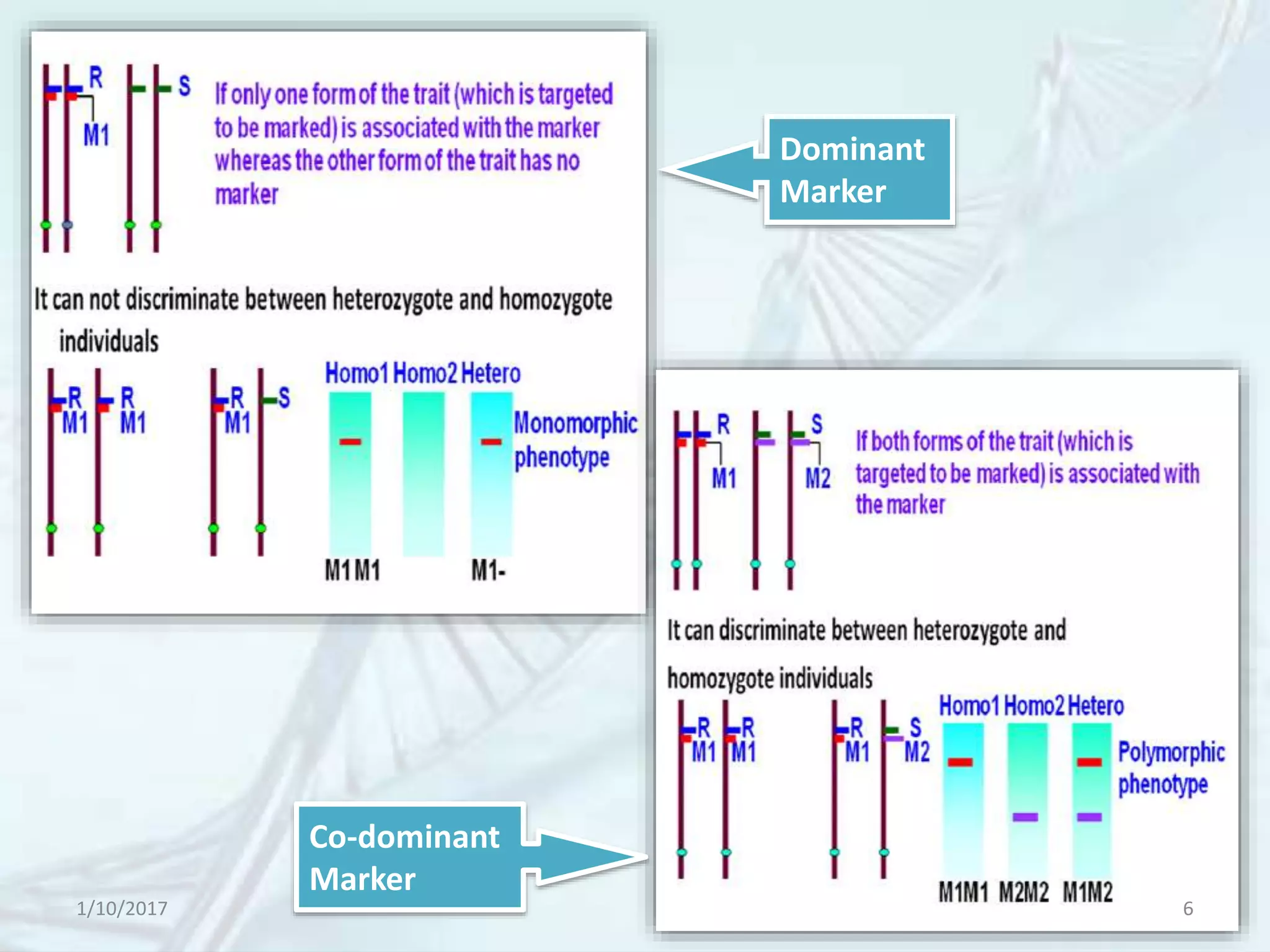
Co-dominant
Marker
Dominant
Marker
1/10/2017 6
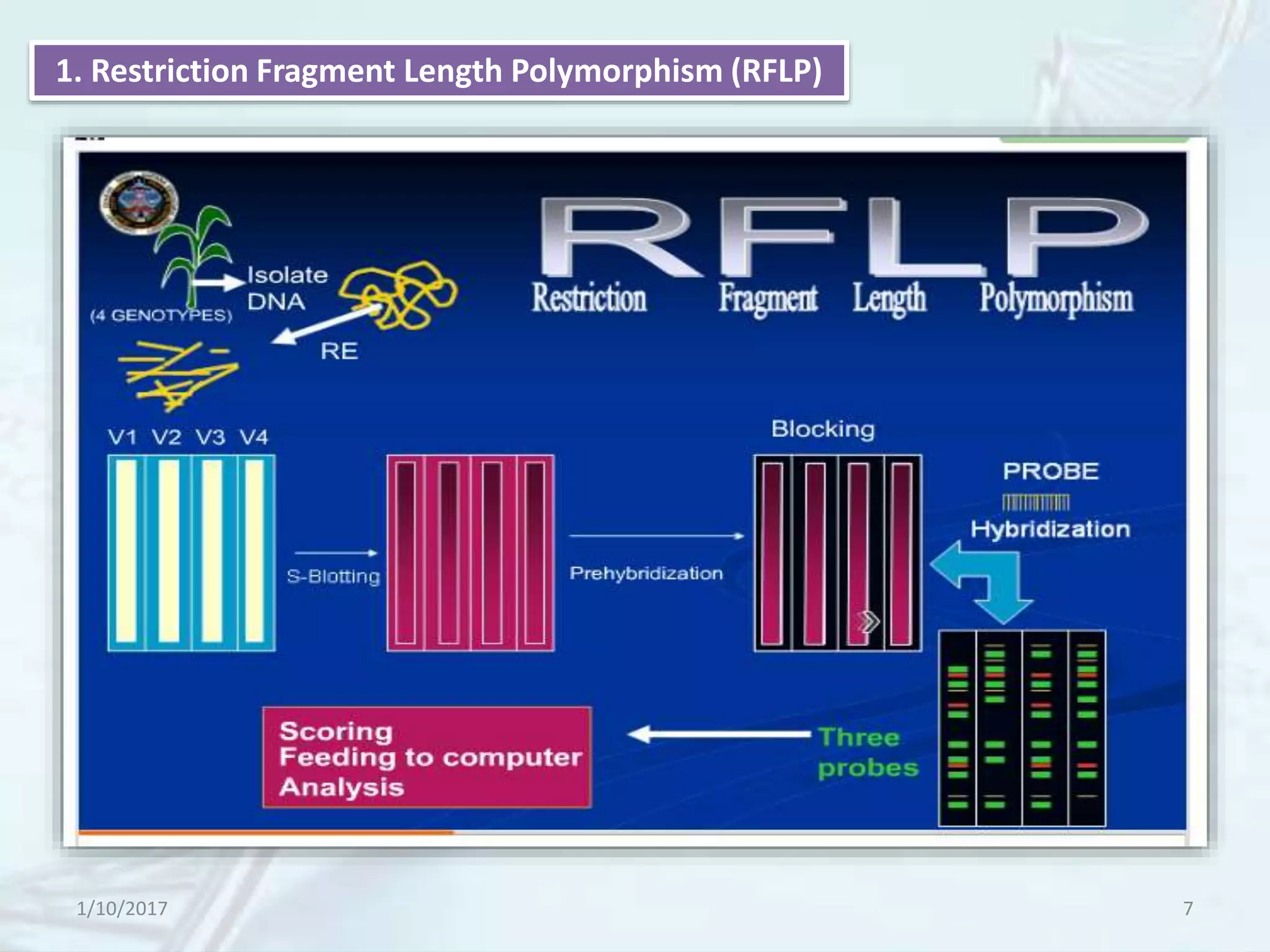
1. Restriction Fragment Length Polymorphism (RFLP)
1/10/2017 7
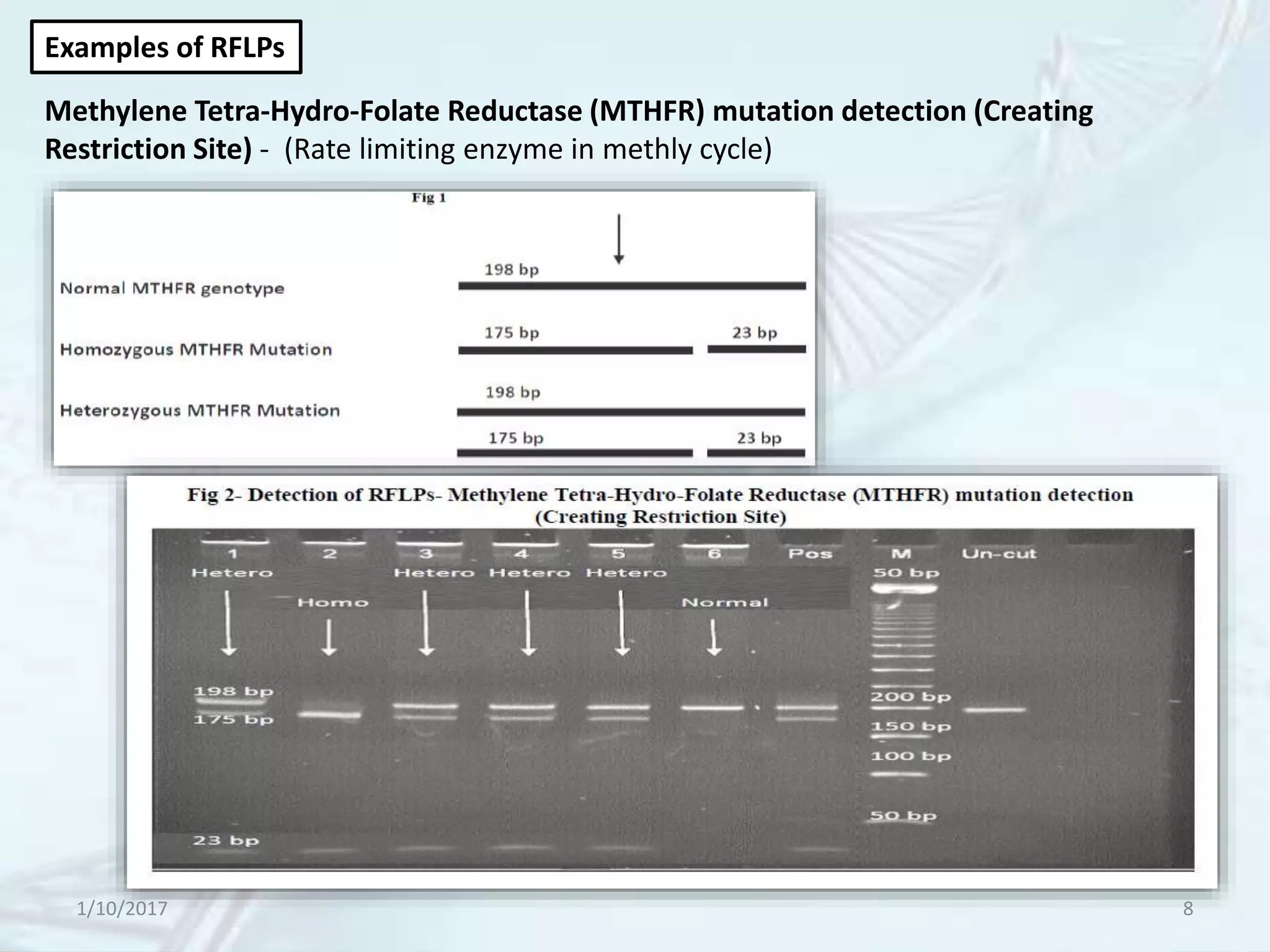
Methylene Tetra-Hydro-Folate Reductase (MTHFR) mutation detection (Creating
Restriction Site) - (Rate limiting enzyme in methly cycle)
Examples of RFLPs
1/10/2017 8
1/10/2017 9
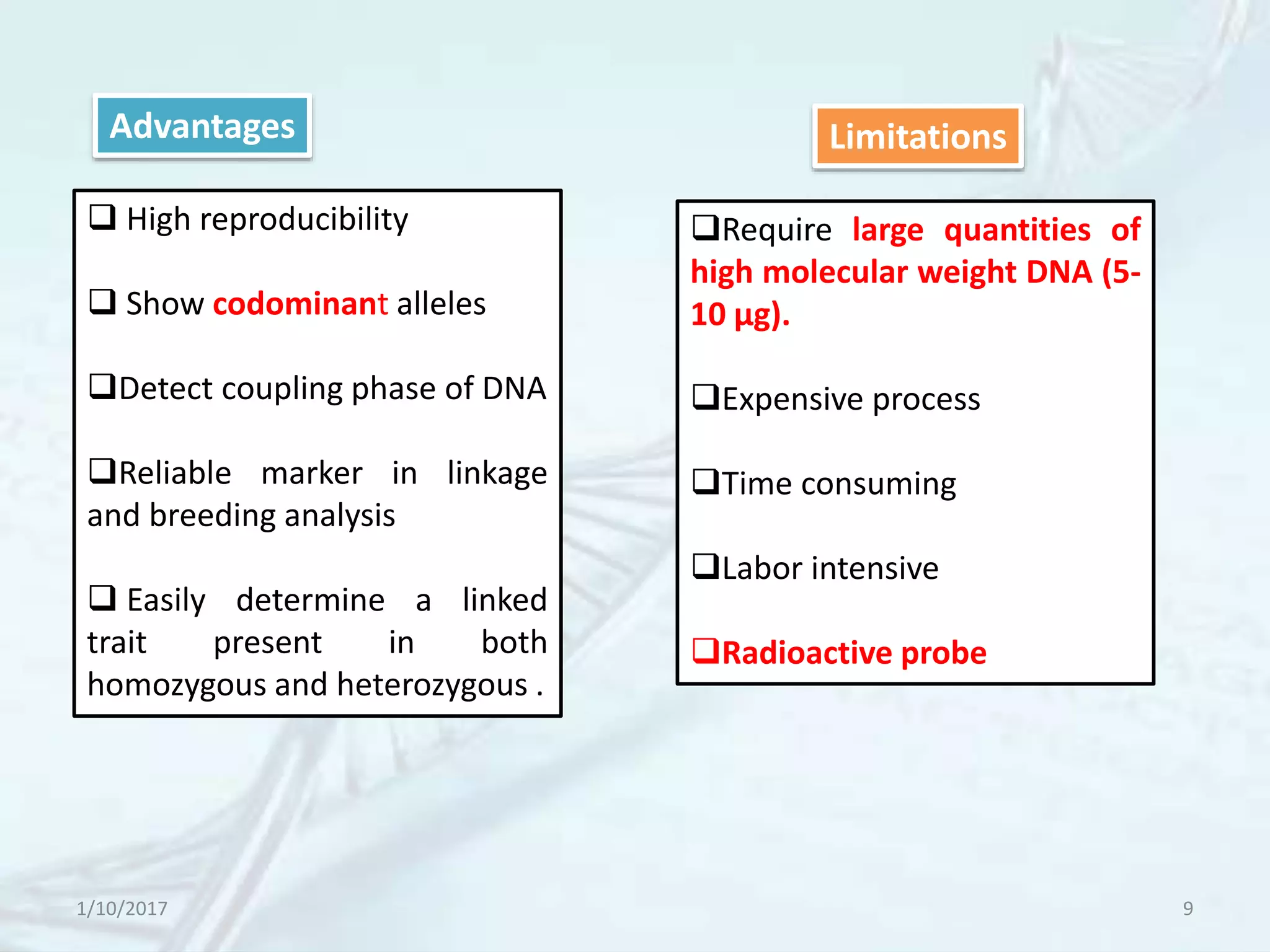
Advantages
 High reproducibility
 Show codominant alleles
Detect coupling phase of DNA
Reliable marker in linkage
and breeding analysis
 Easily determine a linked
trait present in both
homozygous and heterozygous .
Require large quantities of
high molecular weight DNA (5-
10 µg).
Expensive process
Time consuming
Labor intensive
Radioactive probe
Limitations
1/10/2017 10
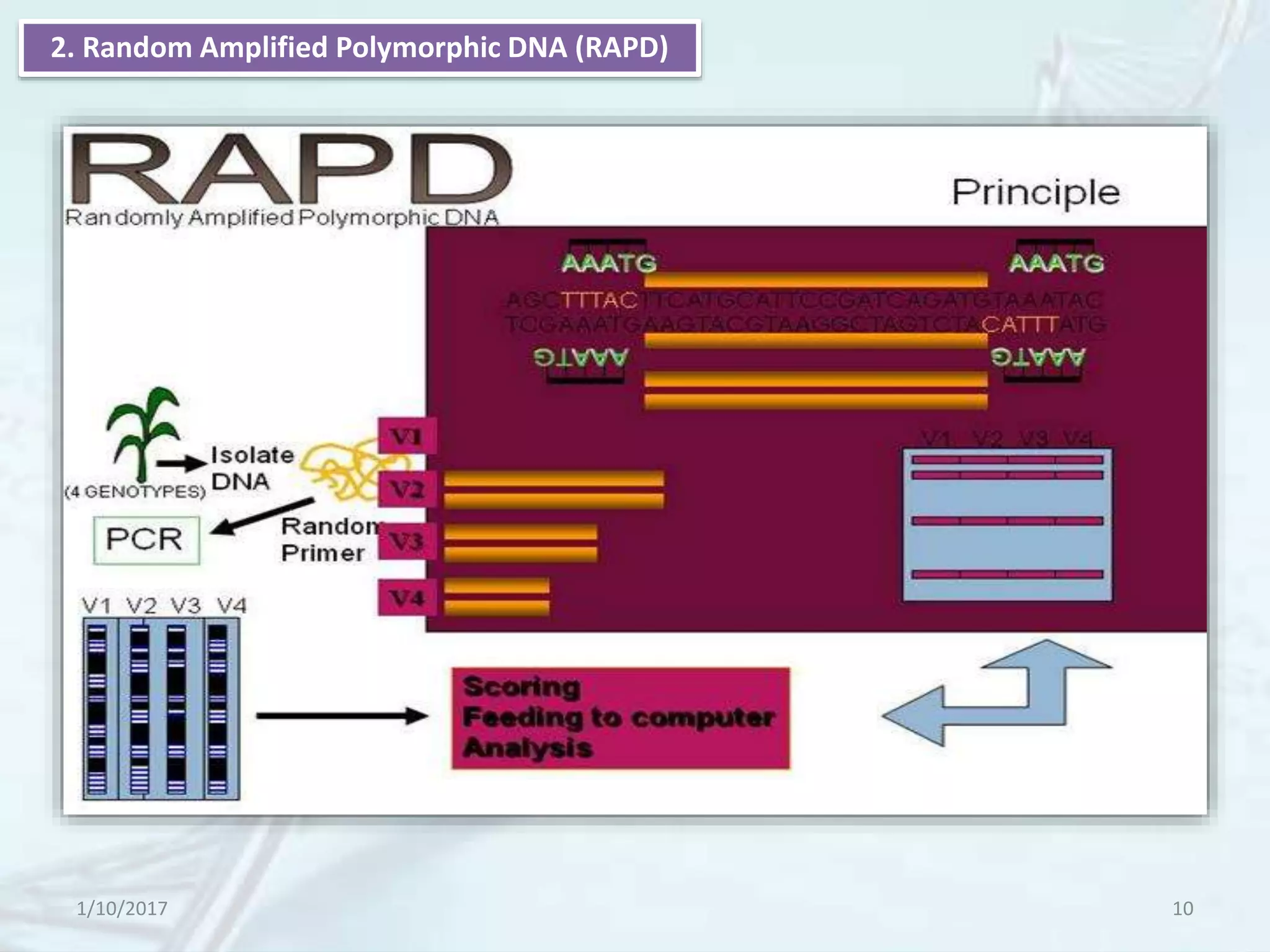
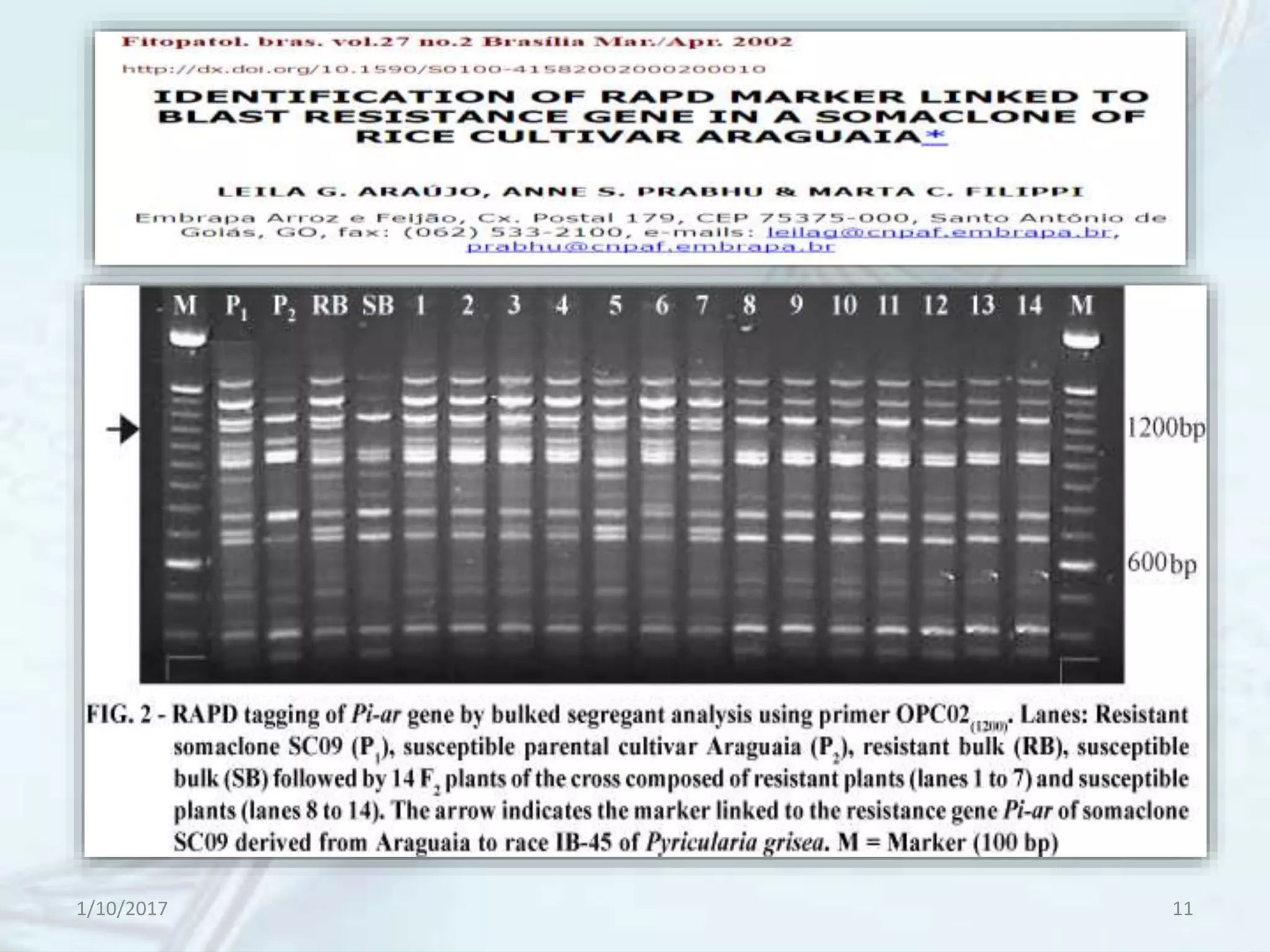
2. Random Amplified Polymorphic DNA (RAPD)
1/10/2017 11
1/10/2017 12
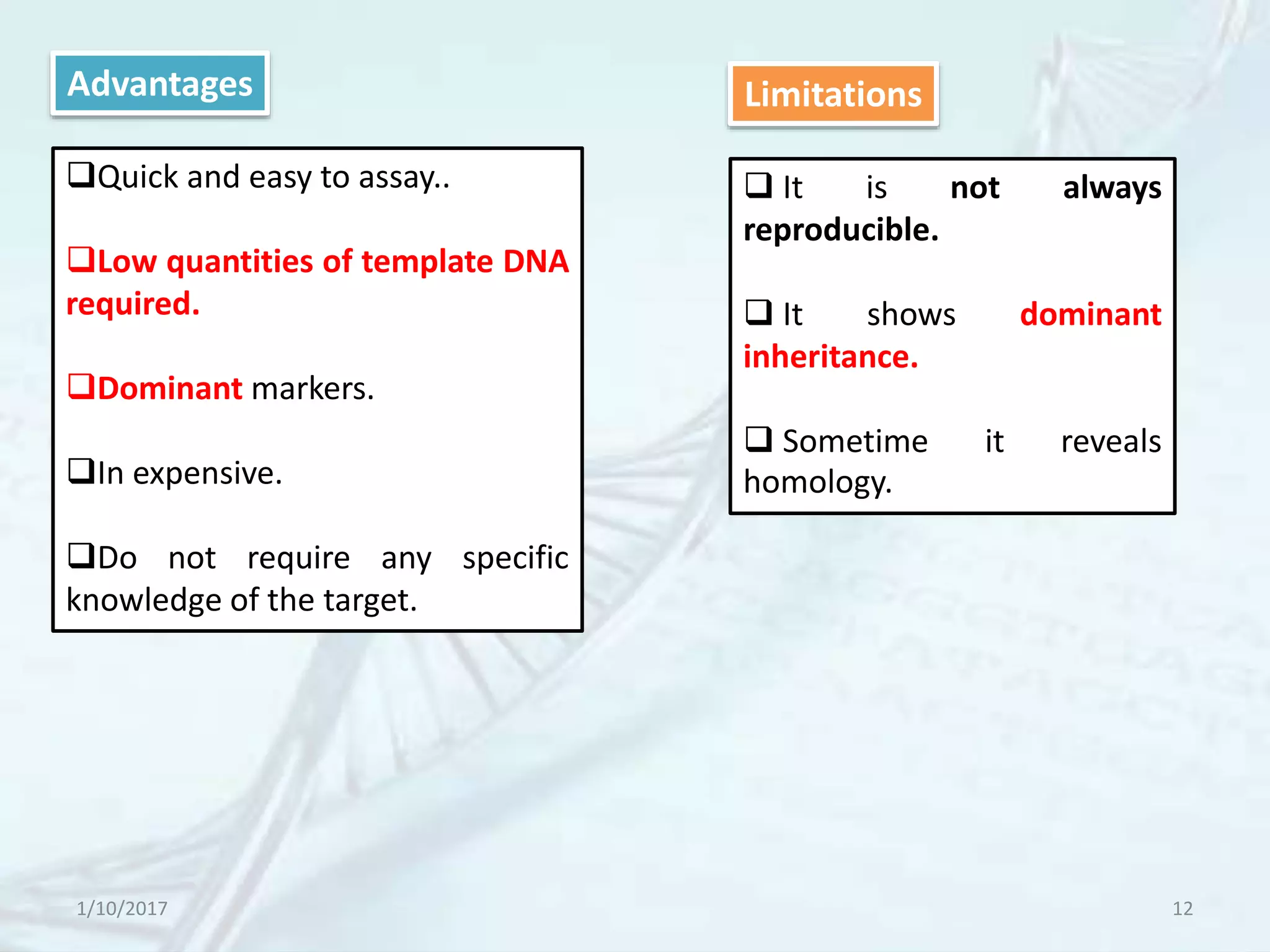
Advantages
Quick and easy to assay..
Low quantities of template DNA
required.
Dominant markers.
In expensive.
Do not require any specific
knowledge of the target.
Limitations
 It is not always
reproducible.
 It shows dominant
inheritance.
 Sometime it reveals
homology.
1/10/2017 13
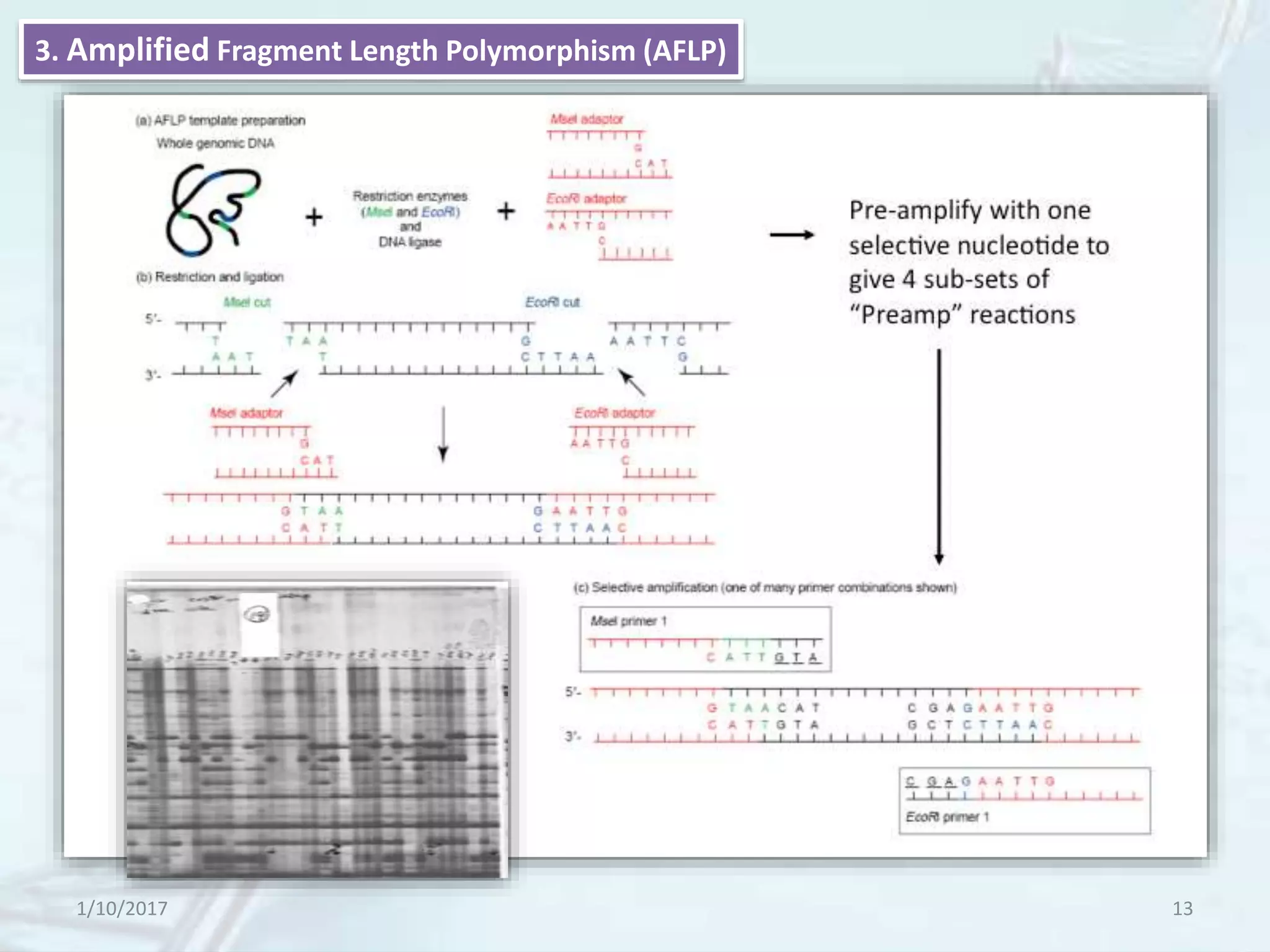
3. Amplified Fragment Length Polymorphism (AFLP)
1/10/2017 14
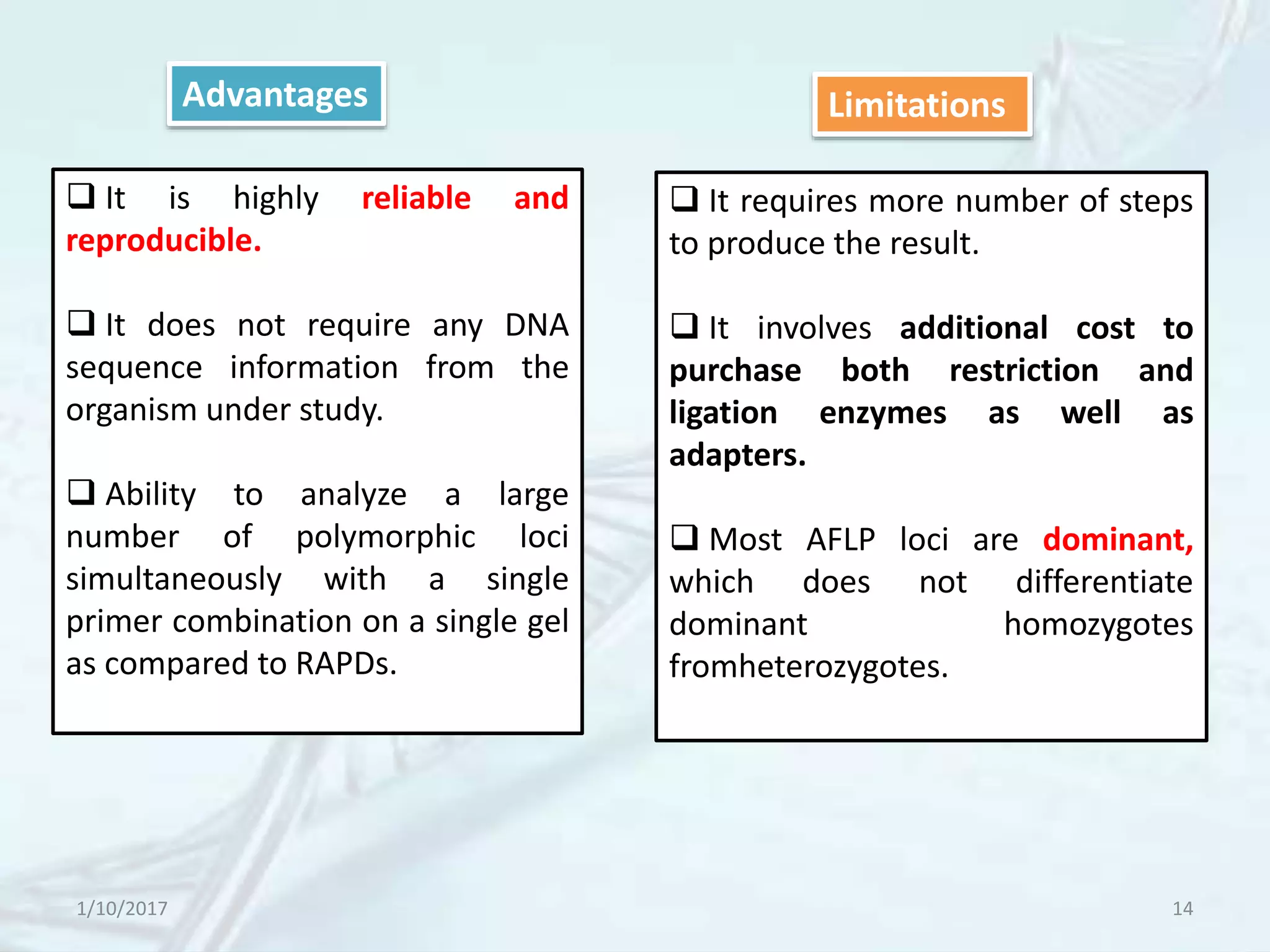
Advantages
 It is highly reliable and
reproducible.
 It does not require any DNA
sequence information from the
organism under study.
 Ability to analyze a large
number of polymorphic loci
simultaneously with a single
primer combination on a single gel
as compared to RAPDs.
Limitations
 It requires more number of steps
to produce the result.
 It involves additional cost to
purchase both restriction and
ligation enzymes as well as
adapters.
 Most AFLP loci are dominant,
which does not differentiate
dominant homozygotes
fromheterozygotes.
1/10/2017 15
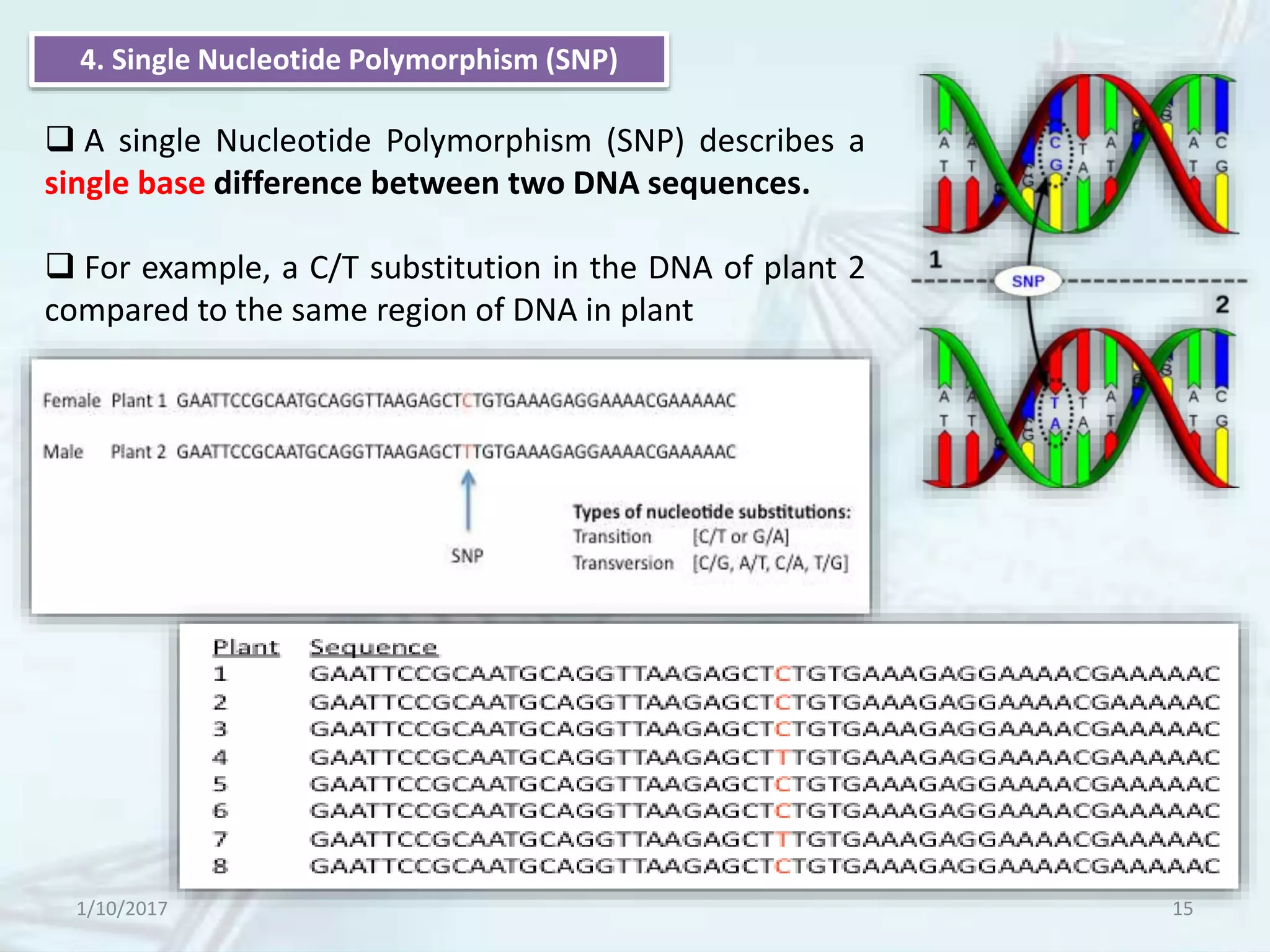
 A single Nucleotide Polymorphism (SNP) describes a
single base difference between two DNA sequences.
 For example, a C/T substitution in the DNA of plant 2
compared to the same region of DNA in plant
4. Single Nucleotide Polymorphism (SNP)
1/10/2017 16
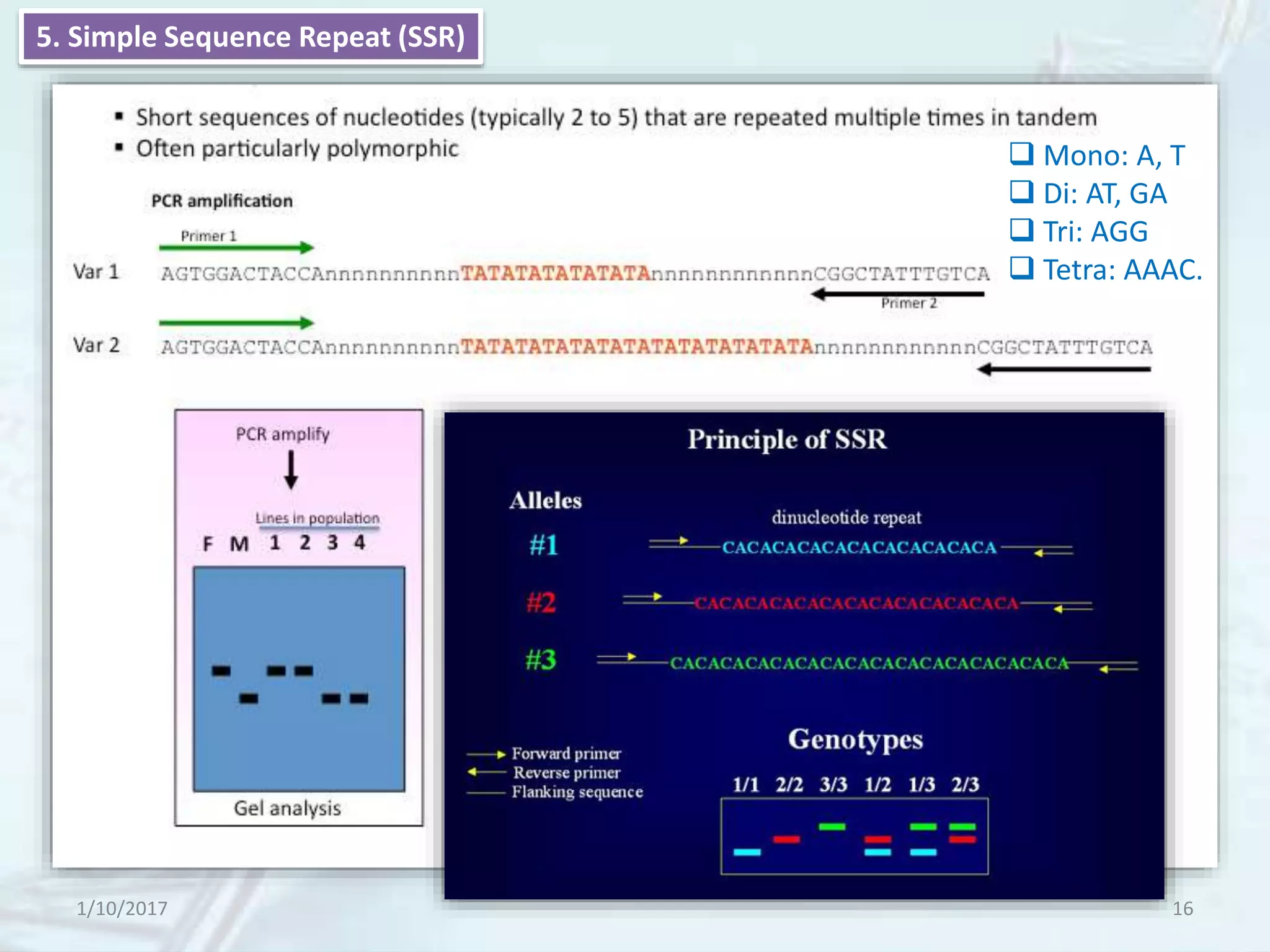
5. Simple Sequence Repeat (SSR)
 Mono: A, T
 Di: AT, GA
 Tri: AGG
 Tetra: AAAC.
1/10/2017 17
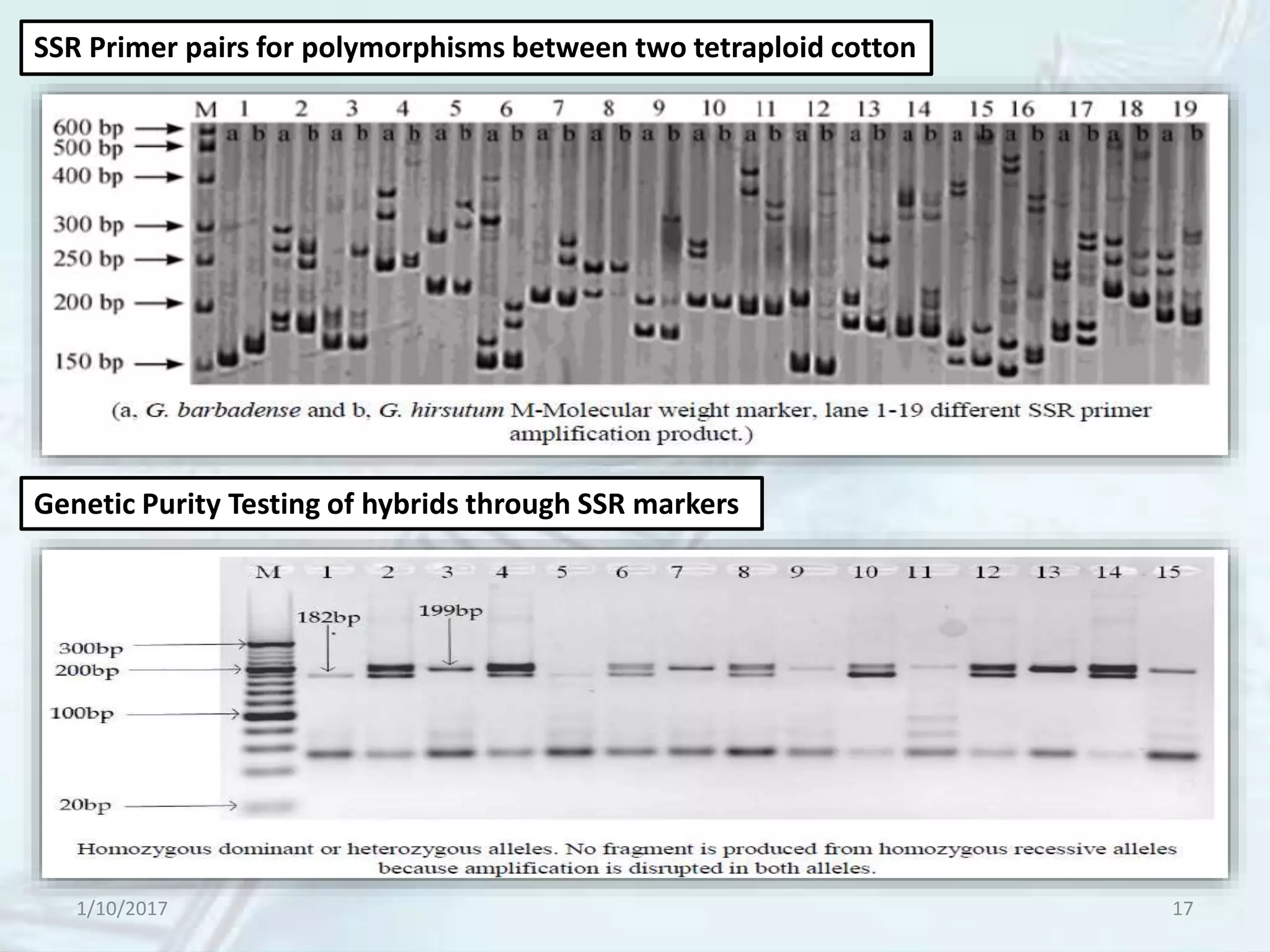
SSR Primer pairs for polymorphisms between two tetraploid cotton
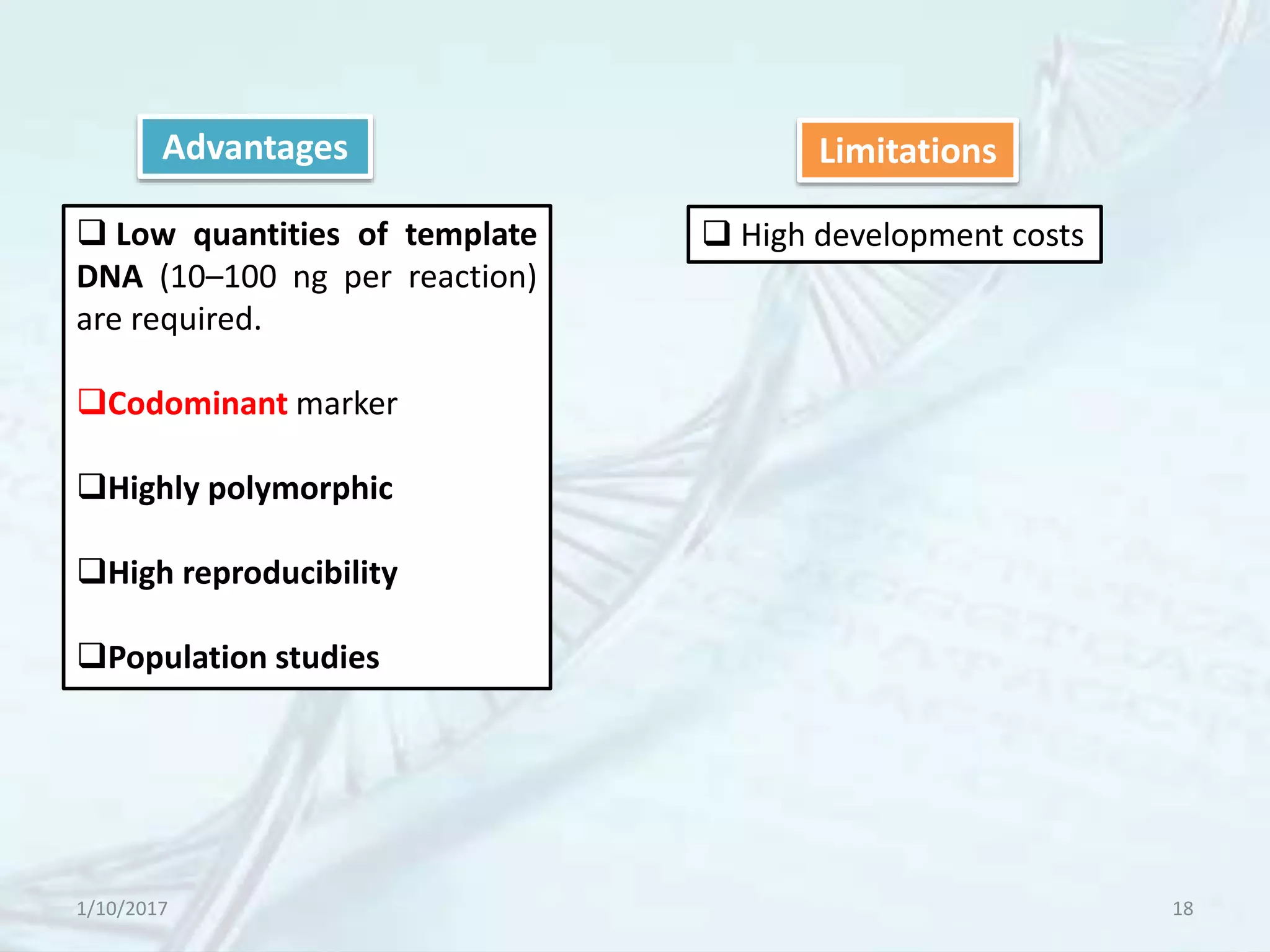
Genetic Purity Testing of hybrids through SSR markers
1/10/2017 18
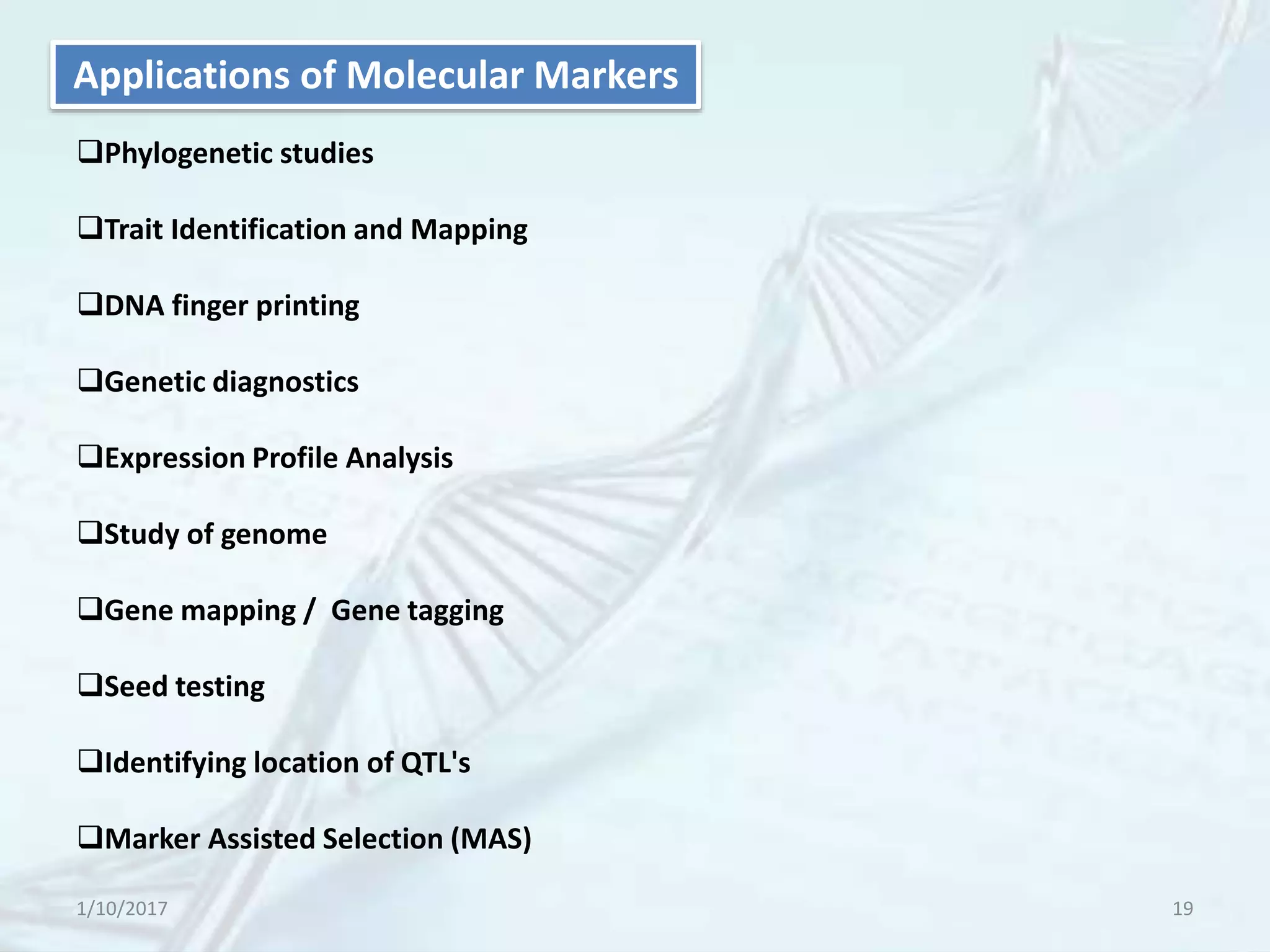
Advantages
 Low quantities of template
DNA (10–100 ng per reaction)
are required.
Codominant marker
Highly polymorphic
High reproducibility
Population studies
Limitations
 High development costs
1/10/2017 19
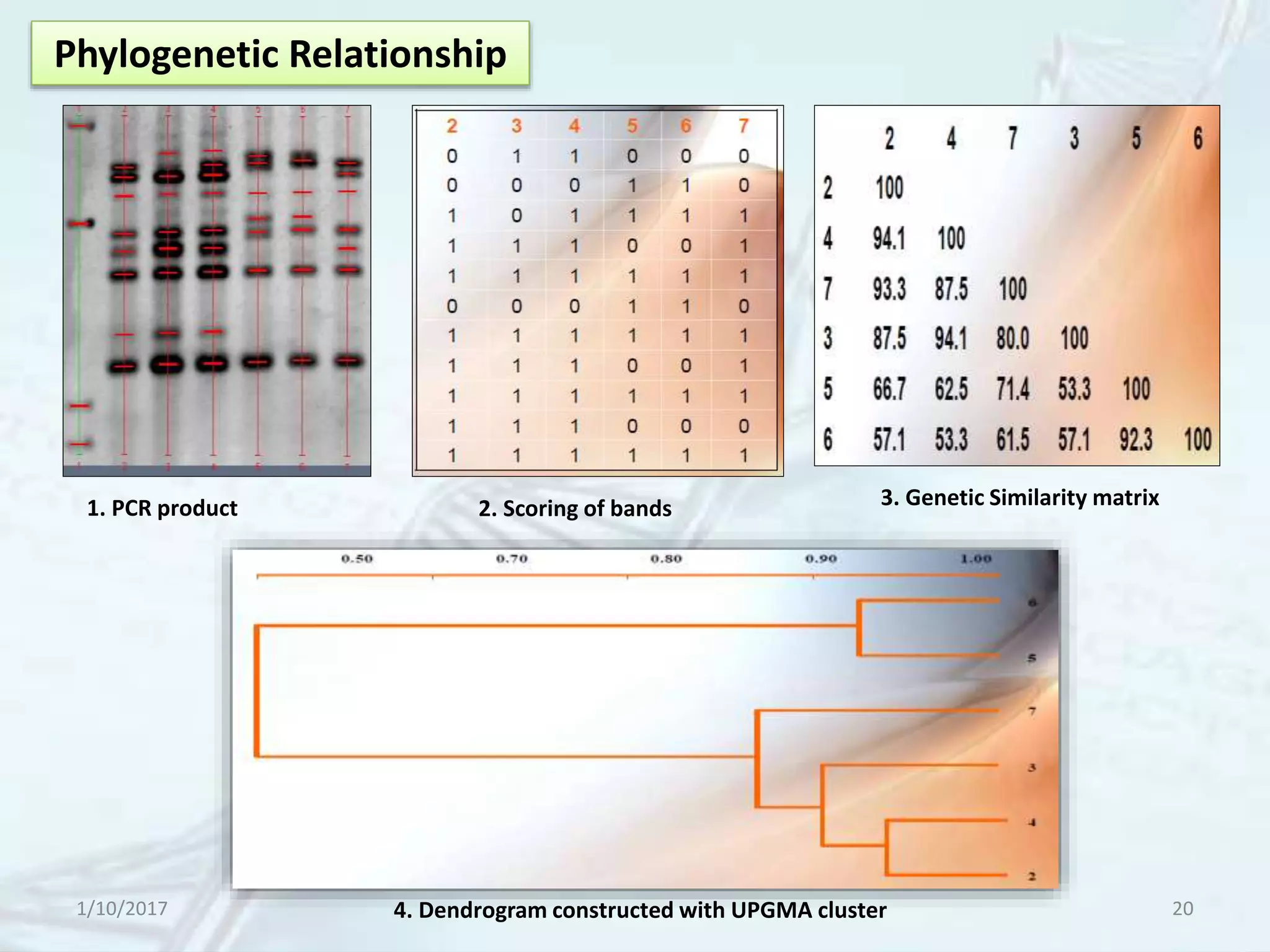
Phylogenetic studies
Trait Identification and Mapping
DNA finger printing
Genetic diagnostics
Expression Profile Analysis
Study of genome
Gene mapping / Gene tagging
Seed testing
Identifying location of QTL's
Marker Assisted Selection (MAS)
Applications of Molecular Markers
1/10/2017 20
Phylogenetic Relationship
3. Genetic Similarity matrix1. PCR product 2. Scoring of bands
4. Dendrogram constructed with UPGMA cluster
1/10/2017 21
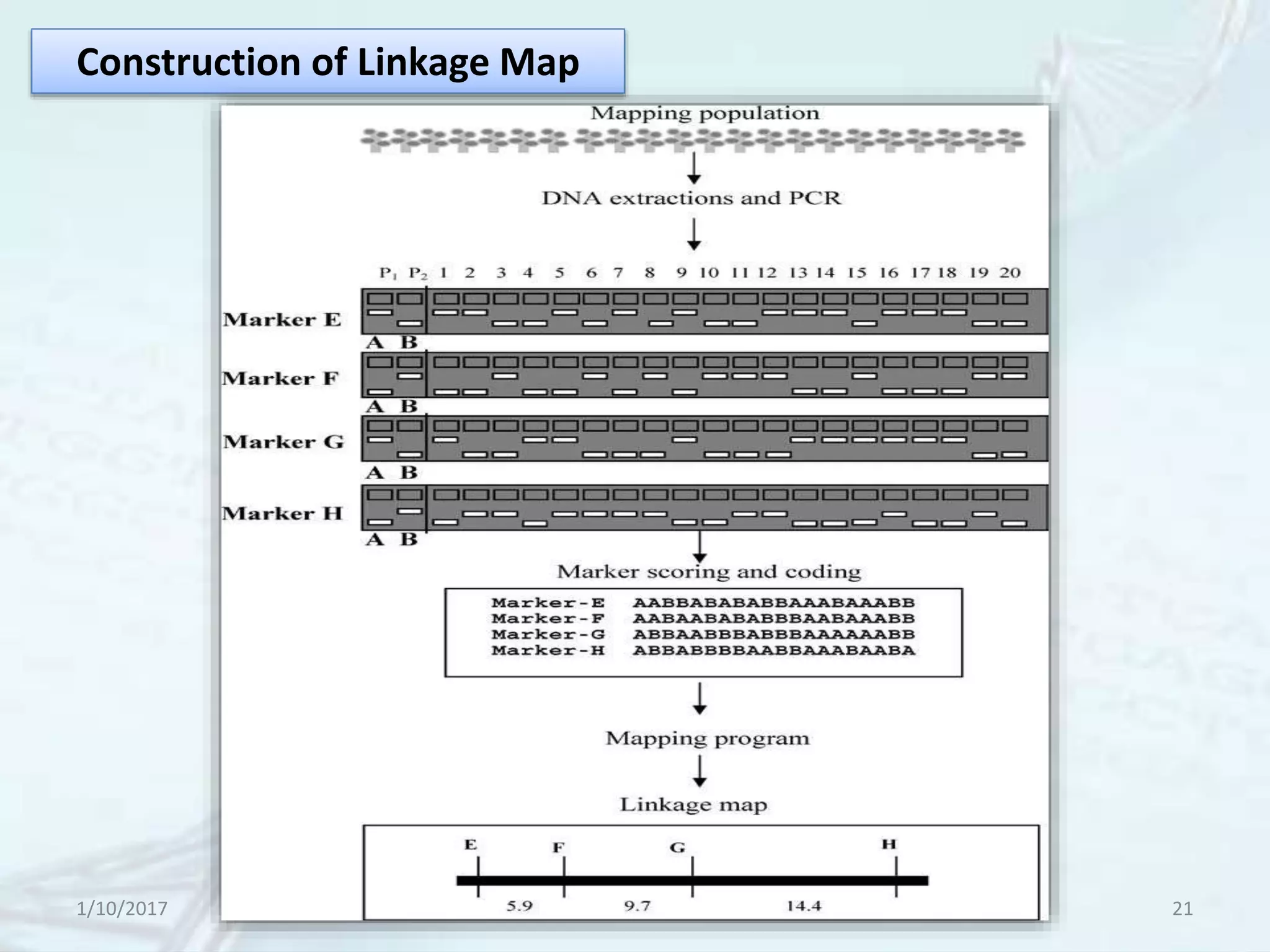
Construction of Linkage Map
1/10/2017 22
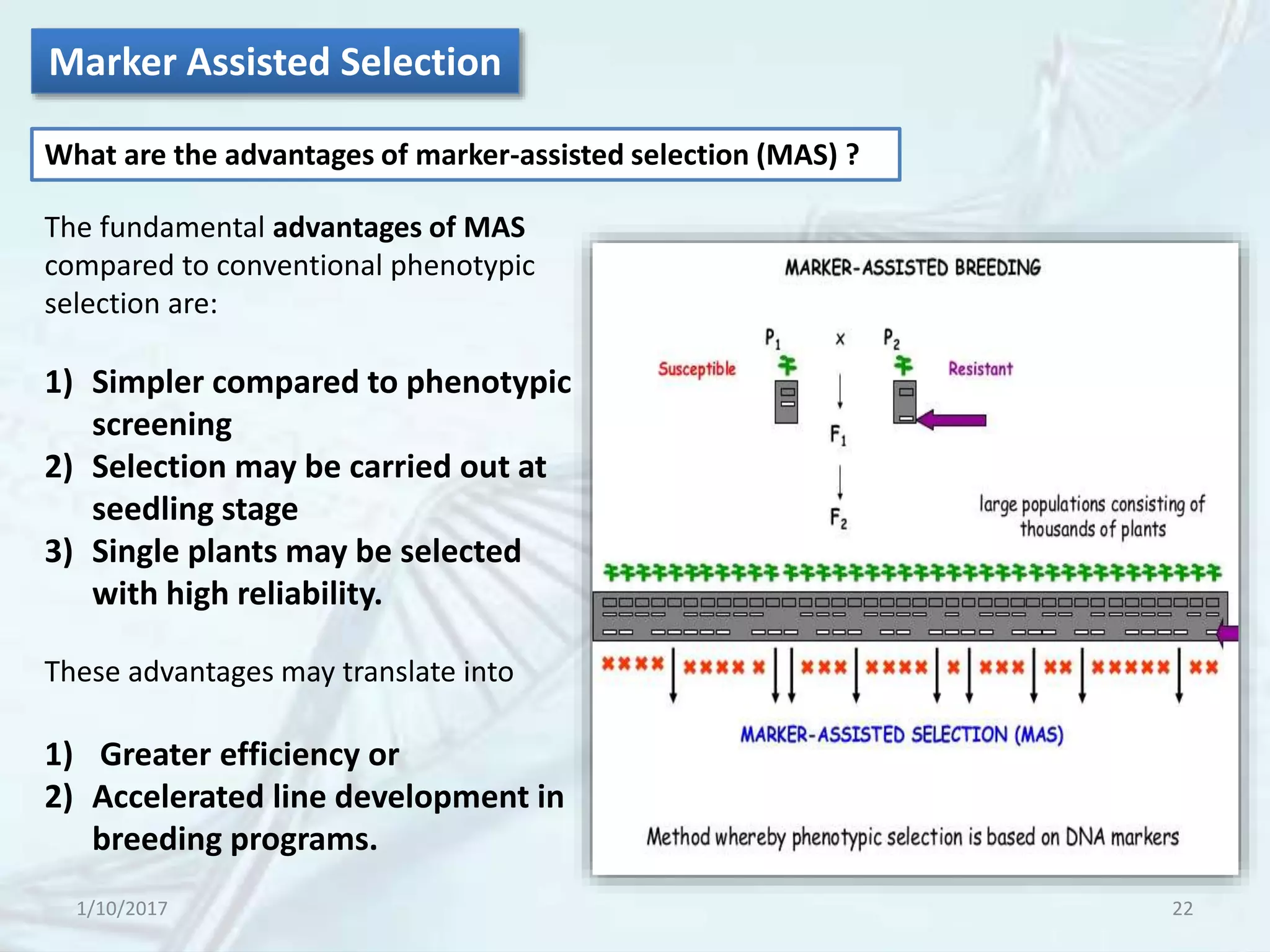
The fundamental advantages of MAS
compared to conventional phenotypic
selection are:
1) Simpler compared to phenotypic
screening
2) Selection may be carried out at
seedling stage
3) Single plants may be selected
with high reliability.
These advantages may translate into
1) Greater efficiency or
2) Accelerated line development in
breeding programs.
What are the advantages of marker-assisted selection (MAS) ?
Marker Assisted Selection
1/10/2017 23
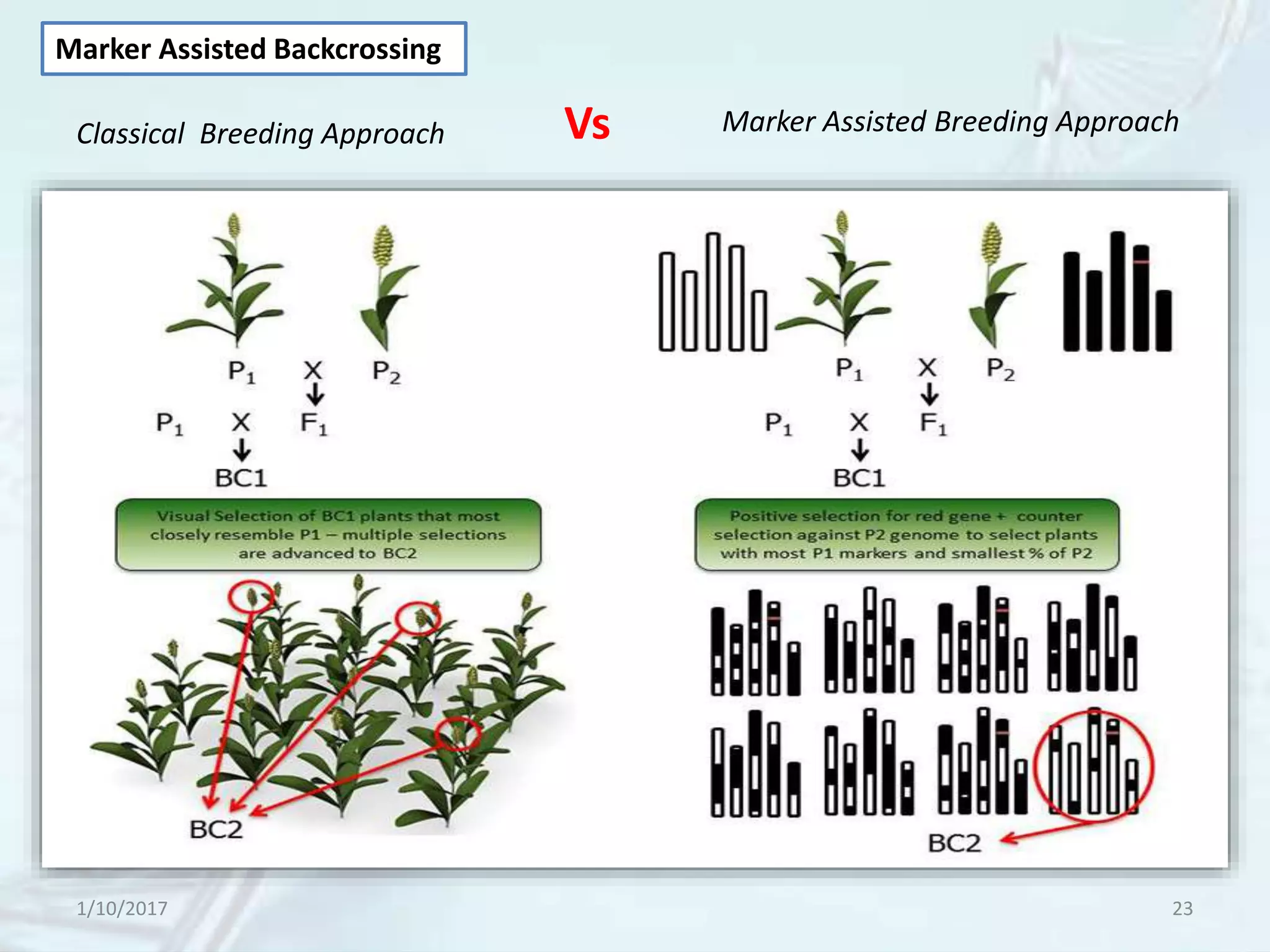
Classical Breeding Approach Marker Assisted Breeding ApproachVs
Marker Assisted Backcrossing
Selection of ideal molecular markers
 Highly polymorphic nature: It must be polymorphic as it is polymorphism that
is measured for genetic diversity studies.
 Codominant inheritance: determination of homozygous and heterozygous
states of diploid organisms.
 Frequent occurrence in genome: A marker should be evenly and frequently
distributed throughout the genome.
 Selective neutral behaviours: The DNA sequences of any organism are neutral
to environmental conditions or management practices.
 Easy access (availability): It should be easy, fast and cheap to detect.
 Easy and fast assay
 High reproducibility
1/10/2017 24
Conclusion
1/10/2017 25
References
 Datta, D., Gupta, Sanjeev, Chaturvedi, S.K. and Nadarajan, N. (2011):
Molecular Markers in Crop Improvement. Indian Institute of Pulses Research,
Kanpur - 208 024.
 B.C.Y. Collard, M.Z.Z. Jahufer, J.B. Brouwer and E.C.K. Pang (2005): An
introduction to markers, quantitative trait loci (QTL) mapping and marker-
assisted selection for crop improvement: The basic concepts Euphytica, 142:
169–196.
 Mishra Kundan K, Fougat R. S., Ballani A., Thakur Vinita., Jha Yachana and Bora
Madhumati. (2014): Potential and application of molecular markers techniques
for plant genome analysis. Int. J. Pure App. Biosci. 2 (1): 169-188.
1/10/2017 26

Molecular Marker and It's Applications

  • 1.
    1/10/2017 1Department ofPlant Biotechnology
  • 2.
    Genetic Markers  Agenetic marker is a gene or DNA sequence with a known location on a chromosome that can be used to identify individuals or species. It can be described as a variation (which may arise due to mutation or alteration in the genomic loci) that can be observed.  Generally, they do not represent the target genes themselves but act as ‘signs’ or ‘flags’.  Genetic markers that are located in close proximity to genes (i.e. tightly linked) may be referred to as gene ‘tags’.  Such markers themselves do not affect the phenotype of the trait of interest because they are located only near or ‘linked’ to genes controlling the trait.  All genetic markers occupy specific genomic positions within chromosomes (like genes) called ‘loci’ (singular ‘locus’). 1/10/2017 2
  • 3.
    Types of GeneticMarkers Morphological Molecular Biochemical Isoenzymes Non PCR RFLP Based on PCR RAPD SSR AFLP STS ISSR SCAR SNP EST 1/10/2017 3
  • 4.
    E1 E2 A + BAB 2. Isozyme/Isoenzyme 1. Morphological Marker 1/10/2017 4
  • 5.
    3. Molecular Marker Molecular markers are specific fragments of DNA that can be identified within the whole genome.  Molecular markers are found at specific locations of the genome.  They are used to ‘flag’ the position of a particular gene or the inheritance of a particular character.  Molecular markers are phenotypically neutral. 1/10/2017 5
  • 6.
  • 7.
    1. Restriction FragmentLength Polymorphism (RFLP) 1/10/2017 7
  • 8.
    Methylene Tetra-Hydro-Folate Reductase(MTHFR) mutation detection (Creating Restriction Site) - (Rate limiting enzyme in methly cycle) Examples of RFLPs 1/10/2017 8
  • 9.
    1/10/2017 9 Advantages  Highreproducibility  Show codominant alleles Detect coupling phase of DNA Reliable marker in linkage and breeding analysis  Easily determine a linked trait present in both homozygous and heterozygous . Require large quantities of high molecular weight DNA (5- 10 µg). Expensive process Time consuming Labor intensive Radioactive probe Limitations
  • 10.
    1/10/2017 10 2. RandomAmplified Polymorphic DNA (RAPD)
  • 11.
  • 12.
    1/10/2017 12 Advantages Quick andeasy to assay.. Low quantities of template DNA required. Dominant markers. In expensive. Do not require any specific knowledge of the target. Limitations  It is not always reproducible.  It shows dominant inheritance.  Sometime it reveals homology.
  • 13.
    1/10/2017 13 3. AmplifiedFragment Length Polymorphism (AFLP)
  • 14.
    1/10/2017 14 Advantages  Itis highly reliable and reproducible.  It does not require any DNA sequence information from the organism under study.  Ability to analyze a large number of polymorphic loci simultaneously with a single primer combination on a single gel as compared to RAPDs. Limitations  It requires more number of steps to produce the result.  It involves additional cost to purchase both restriction and ligation enzymes as well as adapters.  Most AFLP loci are dominant, which does not differentiate dominant homozygotes fromheterozygotes.
  • 15.
    1/10/2017 15  Asingle Nucleotide Polymorphism (SNP) describes a single base difference between two DNA sequences.  For example, a C/T substitution in the DNA of plant 2 compared to the same region of DNA in plant 4. Single Nucleotide Polymorphism (SNP)
  • 16.
    1/10/2017 16 5. SimpleSequence Repeat (SSR)  Mono: A, T  Di: AT, GA  Tri: AGG  Tetra: AAAC.
  • 17.
    1/10/2017 17 SSR Primerpairs for polymorphisms between two tetraploid cotton Genetic Purity Testing of hybrids through SSR markers
  • 18.
    1/10/2017 18 Advantages  Lowquantities of template DNA (10–100 ng per reaction) are required. Codominant marker Highly polymorphic High reproducibility Population studies Limitations  High development costs
  • 19.
    1/10/2017 19 Phylogenetic studies TraitIdentification and Mapping DNA finger printing Genetic diagnostics Expression Profile Analysis Study of genome Gene mapping / Gene tagging Seed testing Identifying location of QTL's Marker Assisted Selection (MAS) Applications of Molecular Markers
  • 20.
    1/10/2017 20 Phylogenetic Relationship 3.Genetic Similarity matrix1. PCR product 2. Scoring of bands 4. Dendrogram constructed with UPGMA cluster
  • 21.
  • 22.
    1/10/2017 22 The fundamentaladvantages of MAS compared to conventional phenotypic selection are: 1) Simpler compared to phenotypic screening 2) Selection may be carried out at seedling stage 3) Single plants may be selected with high reliability. These advantages may translate into 1) Greater efficiency or 2) Accelerated line development in breeding programs. What are the advantages of marker-assisted selection (MAS) ? Marker Assisted Selection
  • 23.
    1/10/2017 23 Classical BreedingApproach Marker Assisted Breeding ApproachVs Marker Assisted Backcrossing
  • 24.
    Selection of idealmolecular markers  Highly polymorphic nature: It must be polymorphic as it is polymorphism that is measured for genetic diversity studies.  Codominant inheritance: determination of homozygous and heterozygous states of diploid organisms.  Frequent occurrence in genome: A marker should be evenly and frequently distributed throughout the genome.  Selective neutral behaviours: The DNA sequences of any organism are neutral to environmental conditions or management practices.  Easy access (availability): It should be easy, fast and cheap to detect.  Easy and fast assay  High reproducibility 1/10/2017 24 Conclusion
  • 25.
    1/10/2017 25 References  Datta,D., Gupta, Sanjeev, Chaturvedi, S.K. and Nadarajan, N. (2011): Molecular Markers in Crop Improvement. Indian Institute of Pulses Research, Kanpur - 208 024.  B.C.Y. Collard, M.Z.Z. Jahufer, J.B. Brouwer and E.C.K. Pang (2005): An introduction to markers, quantitative trait loci (QTL) mapping and marker- assisted selection for crop improvement: The basic concepts Euphytica, 142: 169–196.  Mishra Kundan K, Fougat R. S., Ballani A., Thakur Vinita., Jha Yachana and Bora Madhumati. (2014): Potential and application of molecular markers techniques for plant genome analysis. Int. J. Pure App. Biosci. 2 (1): 169-188.
  • 26.