By; -
Nahom Ephrem
and
Selamawit Demeke
Introduction
 Blood, fluid pumped by the heart that circulates
throughout the body via the arteries, veins, and
capillaries
 An adult man of average size normally has about 5.6
liters of blood
 Although blood appears to be red liquid it is actually
composed of yellowish liquid called plasma and
billions of cells.
Cont’d…
 Blood = Cells + plasma
 Plasma is a clear, straw-colored liquid portion of the
blood in which the other cells are suspended.
 Serum is the undiluted, extracellular portion of blood
after adequate coagulation is complete.
 In laboratory they can be separated and measured in
order to help with the diagnosis and monitoring of
diseases.
What is plasma?
 Plasma is a clear, straw-colored liquid portion of the
blood in which the other cells are suspended.
Or
 Plasma = water + proteins + dissolved substances
 It is 90-92 percent water
 Plasma is a transporting medium for cells and a
variety of substances vital to the human/animals body.
 Importantly, plasma contains proteins for blood
clotting and defending the body against infection.
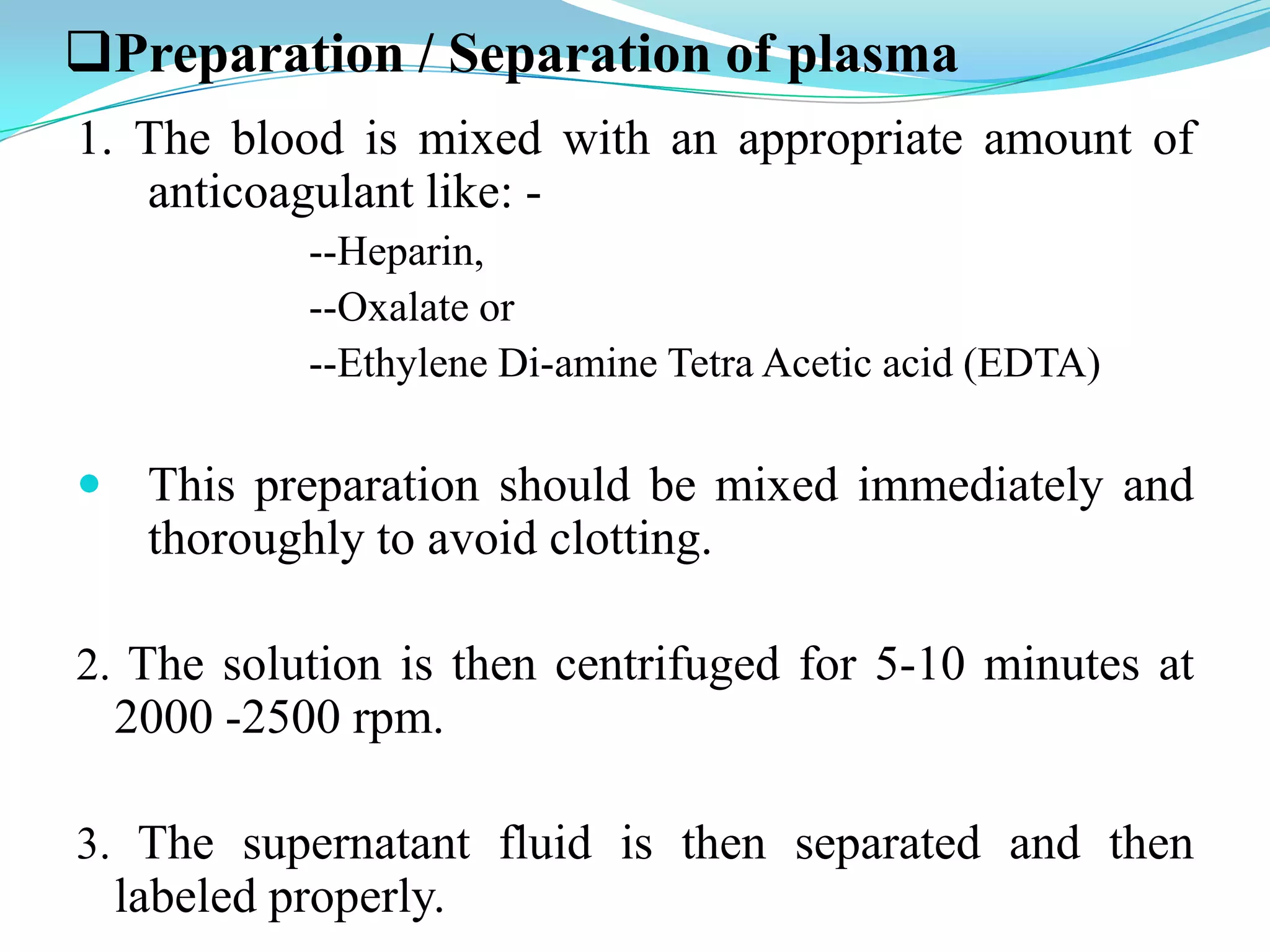
Preparation / Separation of plasma
1. The blood is mixed with an appropriate amount of
anticoagulant like: -
--Heparin,
--Oxalate or
--Ethylene Di-amine Tetra Acetic acid (EDTA)
 This preparation should be mixed immediately and
thoroughly to avoid clotting.
2. The solution is then centrifuged for 5-10 minutes at
2000 -2500 rpm.
3. The supernatant fluid is then separated and then
labeled properly.
Cont’d…
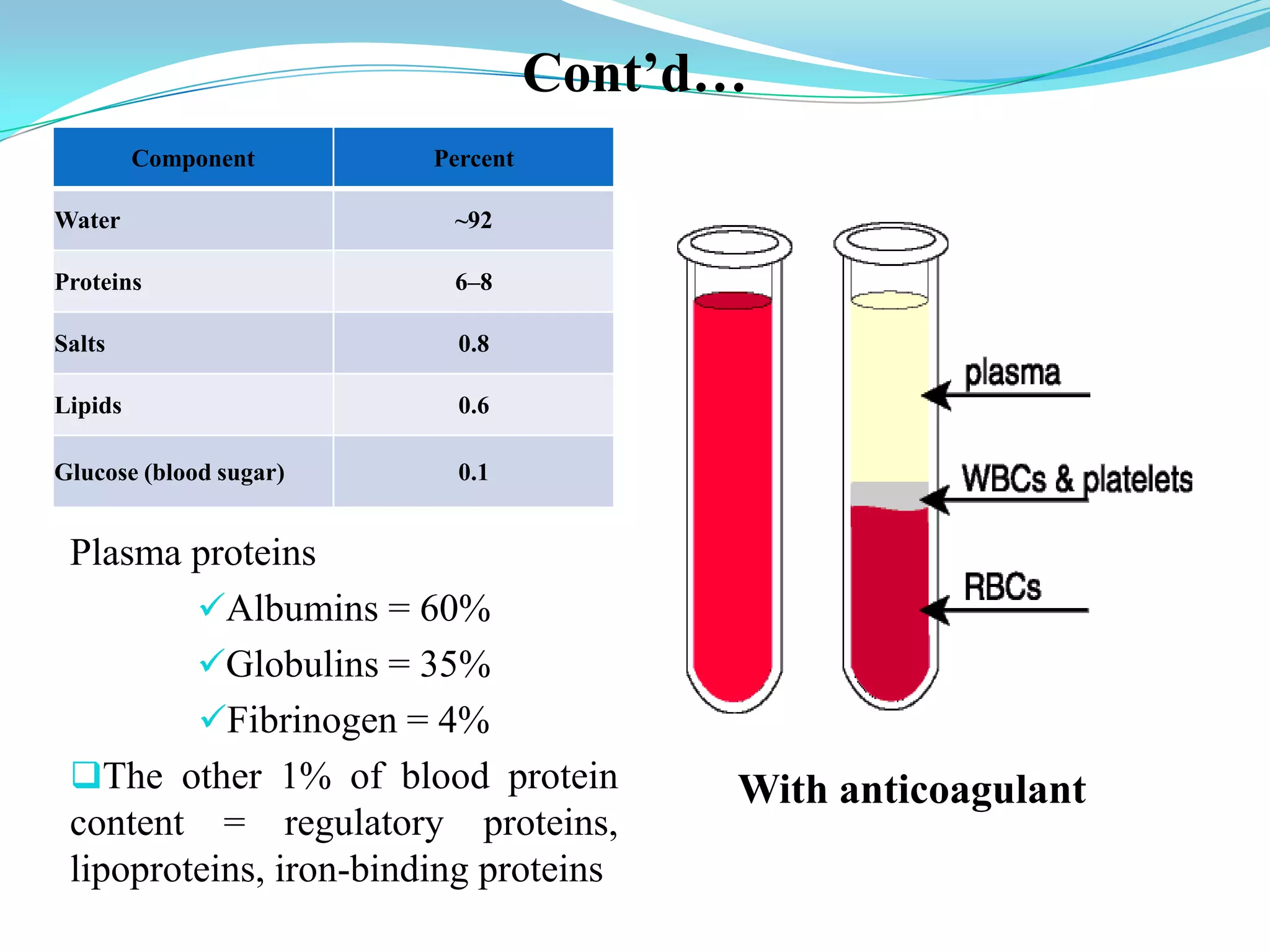
Plasma proteins
Albumins = 60%
Globulins = 35%
Fibrinogen = 4%
The other 1% of blood protein
content = regulatory proteins,
lipoproteins, iron-binding proteins
With anticoagulant
Component Percent
Water ~92
Proteins 6–8
Salts 0.8
Lipids 0.6
Glucose (blood sugar) 0.1
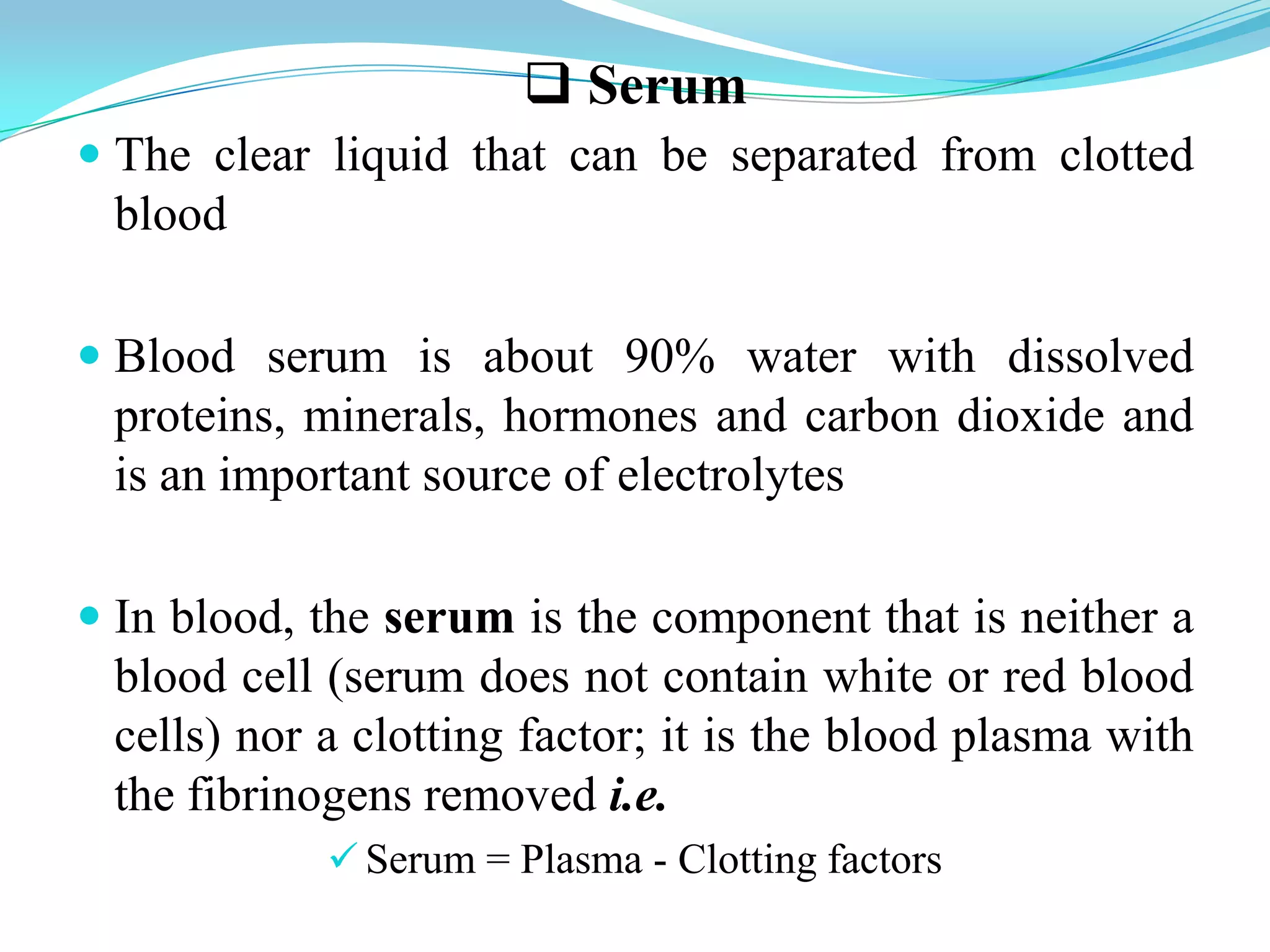
 Serum
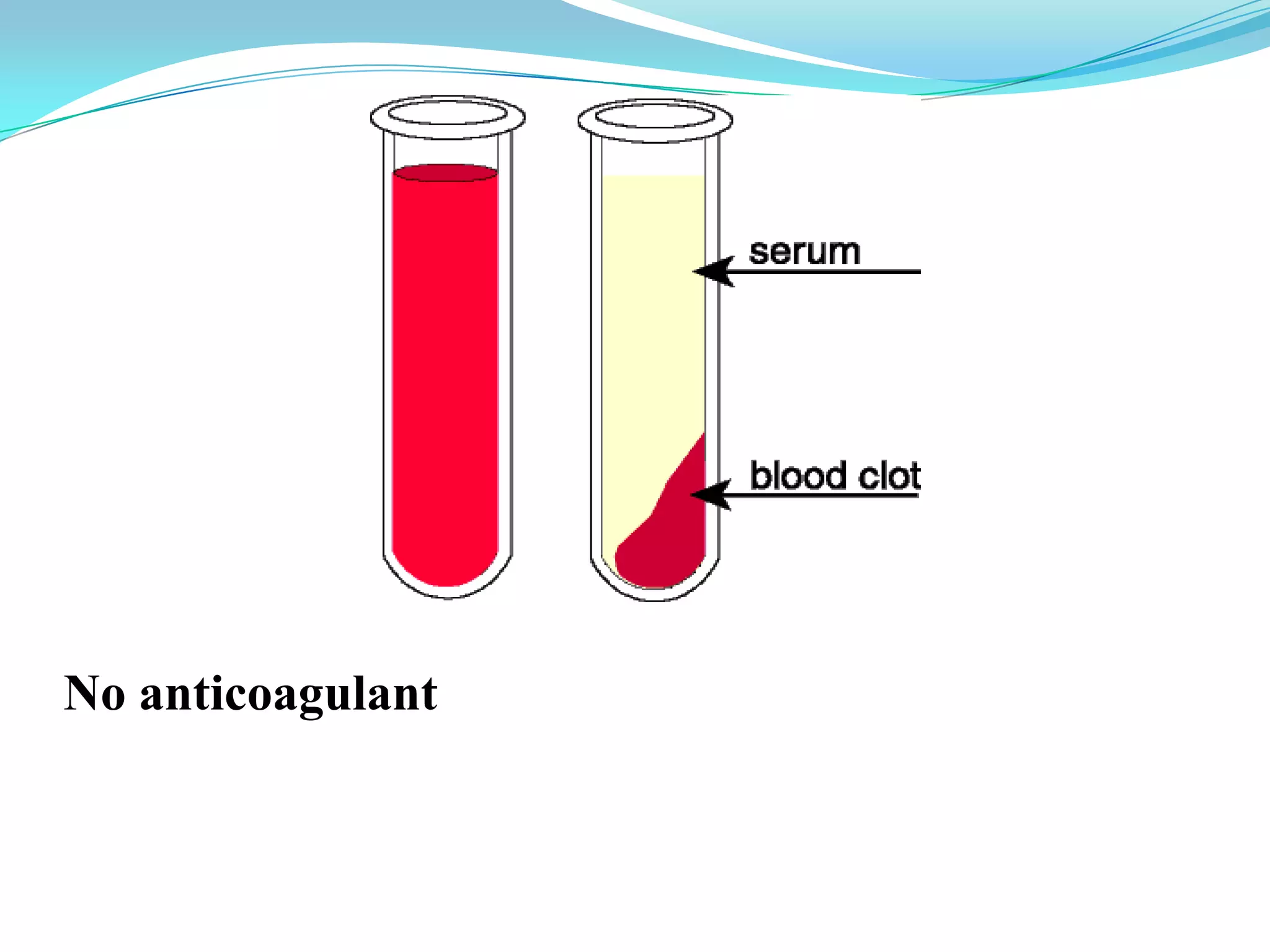
 The clear liquid that can be separated from clotted
blood
 Blood serum is about 90% water with dissolved
proteins, minerals, hormones and carbon dioxide and
is an important source of electrolytes
 In blood, the serum is the component that is neither a
blood cell (serum does not contain white or red blood
cells) nor a clotting factor; it is the blood plasma with
the fibrinogens removed i.e.
 Serum = Plasma - Clotting factors
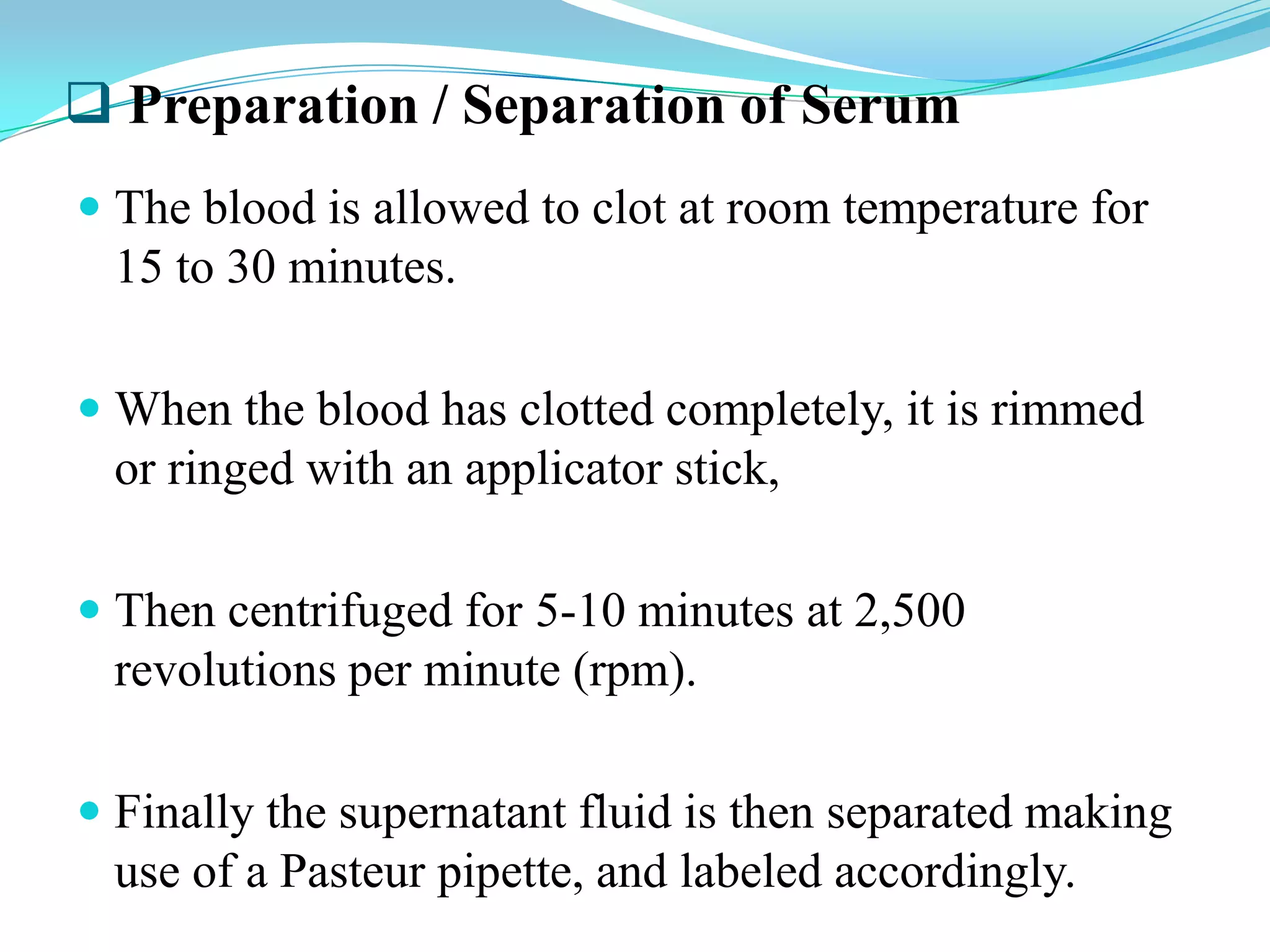
 Preparation / Separation of Serum
 The blood is allowed to clot at room temperature for
15 to 30 minutes.
 When the blood has clotted completely, it is rimmed
or ringed with an applicator stick,
 Then centrifuged for 5-10 minutes at 2,500
revolutions per minute (rpm).
 Finally the supernatant fluid is then separated making
use of a Pasteur pipette, and labeled accordingly.
No anticoagulant
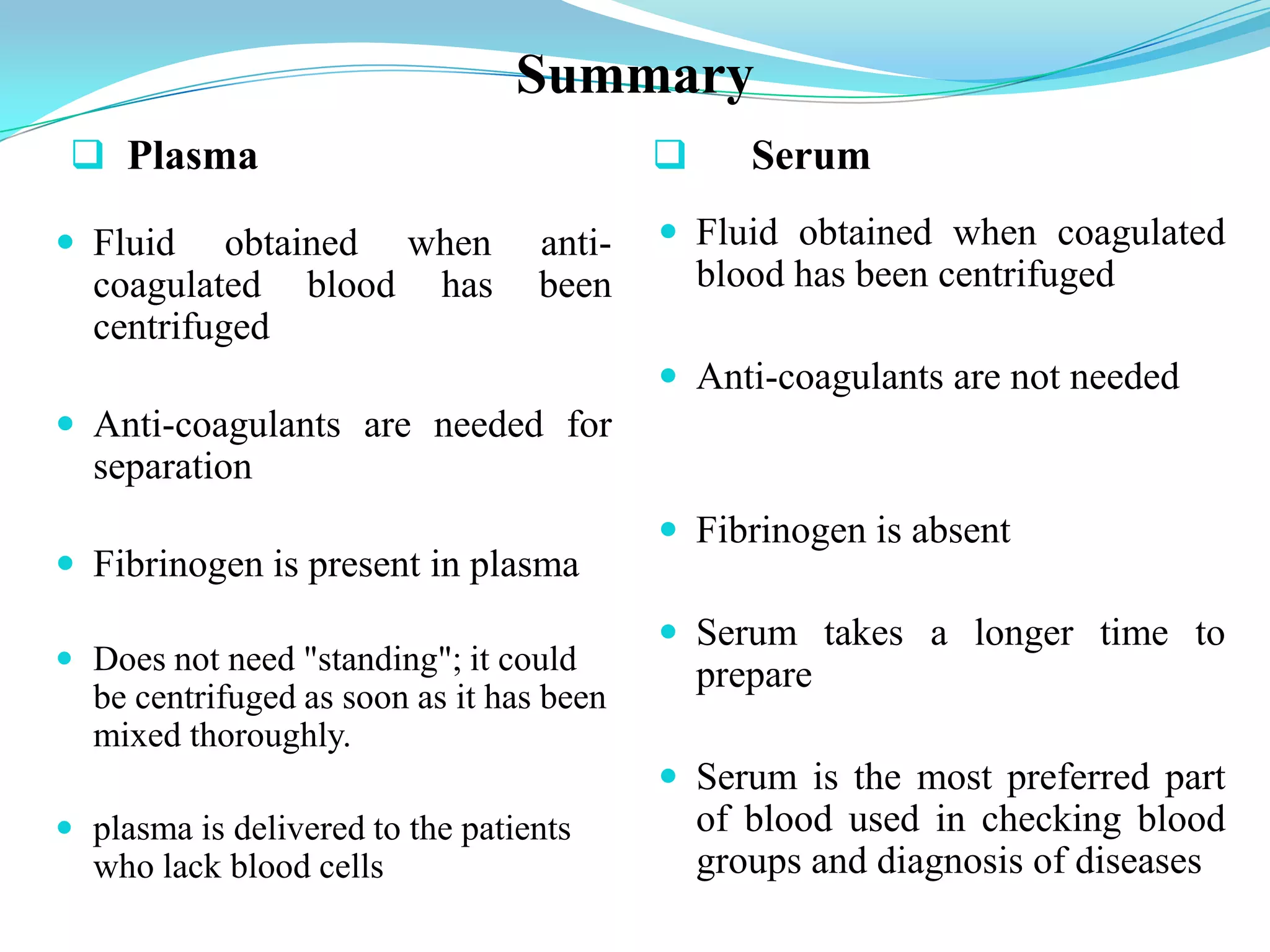
Summary
 Plasma  Serum
 Fluid obtained when anti-
coagulated blood has been
centrifuged
 Anti-coagulants are needed for
separation
 Fibrinogen is present in plasma
 Does not need "standing"; it could
be centrifuged as soon as it has been
mixed thoroughly.
 plasma is delivered to the patients
who lack blood cells
 Fluid obtained when coagulated
blood has been centrifuged
 Anti-coagulants are not needed
 Fibrinogen is absent
 Serum takes a longer time to
prepare
 Serum is the most preferred part
of blood used in checking blood
groups and diagnosis of diseases
the diiference between serum and plasma

the diiference between serum and plasma

  • 1.
  • 2.
    Introduction  Blood, fluidpumped by the heart that circulates throughout the body via the arteries, veins, and capillaries  An adult man of average size normally has about 5.6 liters of blood  Although blood appears to be red liquid it is actually composed of yellowish liquid called plasma and billions of cells.
  • 3.
    Cont’d…  Blood =Cells + plasma  Plasma is a clear, straw-colored liquid portion of the blood in which the other cells are suspended.  Serum is the undiluted, extracellular portion of blood after adequate coagulation is complete.  In laboratory they can be separated and measured in order to help with the diagnosis and monitoring of diseases.
  • 4.
    What is plasma? Plasma is a clear, straw-colored liquid portion of the blood in which the other cells are suspended. Or  Plasma = water + proteins + dissolved substances  It is 90-92 percent water  Plasma is a transporting medium for cells and a variety of substances vital to the human/animals body.  Importantly, plasma contains proteins for blood clotting and defending the body against infection.
  • 5.
    Preparation / Separationof plasma 1. The blood is mixed with an appropriate amount of anticoagulant like: - --Heparin, --Oxalate or --Ethylene Di-amine Tetra Acetic acid (EDTA)  This preparation should be mixed immediately and thoroughly to avoid clotting. 2. The solution is then centrifuged for 5-10 minutes at 2000 -2500 rpm. 3. The supernatant fluid is then separated and then labeled properly.
  • 6.
    Cont’d… Plasma proteins Albumins =60% Globulins = 35% Fibrinogen = 4% The other 1% of blood protein content = regulatory proteins, lipoproteins, iron-binding proteins With anticoagulant Component Percent Water ~92 Proteins 6–8 Salts 0.8 Lipids 0.6 Glucose (blood sugar) 0.1
  • 7.
     Serum  Theclear liquid that can be separated from clotted blood  Blood serum is about 90% water with dissolved proteins, minerals, hormones and carbon dioxide and is an important source of electrolytes  In blood, the serum is the component that is neither a blood cell (serum does not contain white or red blood cells) nor a clotting factor; it is the blood plasma with the fibrinogens removed i.e.  Serum = Plasma - Clotting factors
  • 8.
     Preparation /Separation of Serum  The blood is allowed to clot at room temperature for 15 to 30 minutes.  When the blood has clotted completely, it is rimmed or ringed with an applicator stick,  Then centrifuged for 5-10 minutes at 2,500 revolutions per minute (rpm).  Finally the supernatant fluid is then separated making use of a Pasteur pipette, and labeled accordingly.
  • 9.
  • 10.
    Summary  Plasma Serum  Fluid obtained when anti- coagulated blood has been centrifuged  Anti-coagulants are needed for separation  Fibrinogen is present in plasma  Does not need "standing"; it could be centrifuged as soon as it has been mixed thoroughly.  plasma is delivered to the patients who lack blood cells  Fluid obtained when coagulated blood has been centrifuged  Anti-coagulants are not needed  Fibrinogen is absent  Serum takes a longer time to prepare  Serum is the most preferred part of blood used in checking blood groups and diagnosis of diseases