
DIPESH YADAV 
BIOCHEMISTRY 
1st year laboratory test and their mechanism
CARBOHYDRATE 
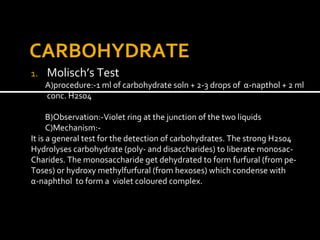
1. Molisch’s Test 
A)procedure:-1 ml of carbohydrate soln + 2-3 drops of α-napthol + 2 ml 
conc. H2so4 
B)Observation:-Violet ring at the junction of the two liquids 
C)Mechanism:- 
It is a general test for the detection of carbohydrates. The strong H2so4 
Hydrolyses carbohydrate (poly- and disaccharides) to liberate monosac- 
Charides. The monosaccharide get dehydrated to form furfural (from pe- 
Toses) or hydroxy methylfurfural (from hexoses) which condense with 
α-naphthol to form a violet coloured complex.
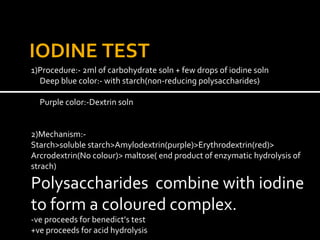
IODINE TEST 
1)Procedure:- 2ml of carbohydrate soln + few drops of iodine soln 
Deep blue color:- with starch(non-reducing polysaccharides) 
Purple color:-Dextrin soln 
2)Mechanism:- 
Starch>soluble starch>Amylodextrin(purple)>Erythrodextrin(red)> 
Arcrodextrin(No colour)> maltose( end product of enzymatic hydrolysis of 
strach) 
Polysaccharides combine with iodine 
to form a coloured complex. 
-ve proceeds for benedict’s test 
+ve proceeds for acid hydrolysis
Benedict’s test 
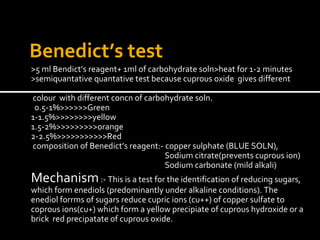
>5 ml Bendict’s reagent+ 1ml of carbohydrate soln>heat for 1-2 minutes 
>semiquantative quantative test because cuprous oxide gives different 
colour with different concn of carbohydrate soln. 
0.5-1%>>>>>>Green 
1-1.5%>>>>>>>>yellow 
1.5-2%>>>>>>>>>orange 
2-2.5%>>>>>>>>>>>Red 
composition of Benedict’s reagent:- copper sulphate (BLUE SOLN), 
Sodium citrate(prevents cuprous ion) 
Sodium carbonate (mild alkali) 
Mechanism :- This is a test for the identification of reducing sugars, 
which form enediols (predominantly under alkaline conditions). The 
enediol forrms of sugars reduce cupric ions (cu++) of copper sulfate to 
coprous ions(cu+) which form a yellow precipiate of cuprous hydroxide or a 
brick red precipatate of cuprous oxide.
Barfoed’s Test 
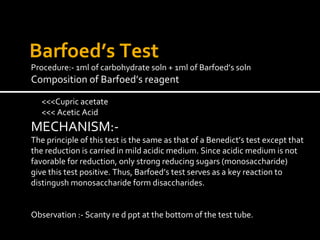
Procedure:- 1ml of carbohydrate soln + 1ml of Barfoed’s soln 
Composition of Barfoed’s reagent 
<<<Cupric acetate 
<<< Acetic Acid 
MECHANISM:- 
The principle of this test is the same as that of a Benedict’s test except that 
the reduction is carried in mild acidic medium. Since acidic medium is not 
favorable for reduction, only strong reducing sugars (monosaccharide) 
give this test positive. Thus, Barfoed’s test serves as a key reaction to 
distingush monosaccharide form disaccharides. 
Observation :- Scanty re d ppt at the bottom of the test tube.
Seliwanoff’s test 
CLINICAL SIGNIFICANCE :- 
Thrombosis ,Degeneration, Necrosis 
Composition of Seliwanoff’s reagent:- 
Resor cinol(ALDEHYDE COMPOUND) 
HCL(Dehydrates Ketohexose more rapidally to form furfural 
derivatives) 
Fructose-+VE 
Glucose—VE 
Procedure:-1ml of carbohydrate soln+ 3ml of Seliwanoff reagent heat for 
30 sec. 
MECHANISM:- This is a specific test for ketohexoses. 
Concentrated HCL dehydrates Ketohexoses to form furfural derivatives 
which condense with resorcinol to give a cherry red complex.
OSAZONE TEST 
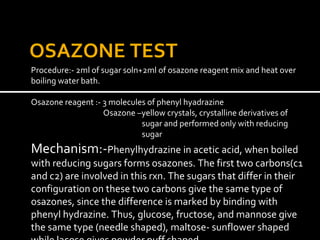
Procedure:- 2ml of sugar soln+2ml of osazone reagent mix and heat over 
boiling water bath. 
Osazone reagent :- 3 molecules of phenyl hyadrazine 
Osazone –yellow crystals, crystalline derivatives of 
sugar and performed only with reducing 
sugar 
Mechanism:-Phenylhydrazine in acetic acid, when boiled 
with reducing sugars forms osazones. The first two carbons(c1 
and c2) are involved in this rxn. The sugars that differ in their 
configuration on these two carbons give the same type of 
osazones, since the difference is marked by binding with 
phenyl hydrazine. Thus, glucose, fructose, and mannose give 
the same type (needle shaped), maltose- sunflower shaped 
while lacose gives powder puff shaped
Sucrose hydrolysis Test 
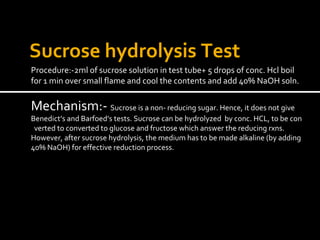
Procedure:-2ml of sucrose solution in test tube+ 5 drops of conc. Hcl boil 
for 1 min over small flame and cool the contents and add 40% NaOH soln. 
Mechanism:- Sucrose is a non- reducing sugar. Hence, it does not give 
Benedict’s and Barfoed’s tests. Sucrose can be hydrolyzed by conc. HCL, to be con 
verted to converted to glucose and fructose which answer the reducing rxns. 
However, after sucrose hydrolysis, the medium has to be made alkaline (by adding 
40% NaOH) for effective reduction process.
PROTEIN 
BIOCHEMISTRY LAB TEST 
-Dipesh yadav (NEPALGUNG MEDICAL COLLEGE,MBBS-1)
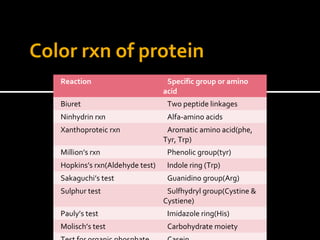
Color rxn of protein 
Reaction Specific group or amino 
acid 
Biuret Two peptide linkages 
Ninhydrin rxn Alfa-amino acids 
Xanthoproteic rxn Aromatic amino acid(phe, 
Tyr, Trp) 
Million’s rxn Phenolic group(tyr) 
Hopkins’s rxn(Aldehyde test) Indole ring (Trp) 
Sakaguchi’s test Guanidino group(Arg) 
Sulphur test Sulfhydryl group(Cystine & 
Cystiene) 
Pauly’s test Imidazole ring(His) 
Molisch’s test Carbohydrate moiety 
Test for organic phosphate Casein
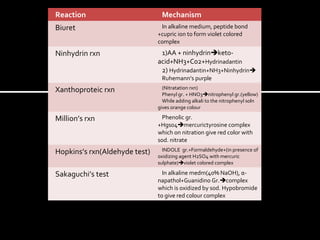
Reaction Mechanism 
Biuret In alkaline medium, peptide bond 
+cupric ion to form violet colored 
complex 
Ninhydrin rxn 1)AA + ninhydrinketo-acid+ 
NH3+Co2+Hydrinadantin 
2) Hydrinadantin+NH3+Ninhydrin 
Ruhemann’s purple 
Xanthoproteic rxn (Nitratation rxn) 
Phenyl gr. + HNO3nitrophenyl gr.(yellow) 
While adding alkali to the nitrophenyl soln 
gives orange colour 
Million’s rxn Phenolic gr. 
+Hgso4mercurictyrosine complex 
which on nitration give red color with 
sod. nitrate 
Hopkins’s rxn(Aldehyde test) INDOLE gr.+Formaldehyde+(in presence of 
oxidizing agent H2SO4 with mercuric 
sulphate)violet colored complex 
Sakaguchi’s test In alkaline medm(40% NaOH), α- 
napathol+Guanidino Gr.complex 
which is oxidized by sod. Hypobromide 
to give red colour complex
Sulphur test When cysteine and cystine are 
boiled with NaOH, organic sulfur is 
converted to inorganic sodium 
sulfide. This reacts with lead 
aceatate to form black ppt. of lead 
sulfide. Methionine doesnot give this 
test, since sulfur of methionine isnot 
split by alkali 
Pauly’s test Diazotised sulfanilic acid 
reacts with imidazole ring om 
alkaline medium to form a red 
colored complex. 
Molish’s test The proteins containing 
carbohydrate(Glycoprotein ) 
give +ve to this test. 
(ALBUMIN) 
Test for organic 
phosphate
TTTHANK YOU!!!!!!!!!!!!!!!!!!

Biochemistry Basic Lab procedures

  • 1.
    DIPESH YADAV BIOCHEMISTRY 1st year laboratory test and their mechanism
  • 2.
    CARBOHYDRATE 1. Molisch’sTest A)procedure:-1 ml of carbohydrate soln + 2-3 drops of α-napthol + 2 ml conc. H2so4 B)Observation:-Violet ring at the junction of the two liquids C)Mechanism:- It is a general test for the detection of carbohydrates. The strong H2so4 Hydrolyses carbohydrate (poly- and disaccharides) to liberate monosac- Charides. The monosaccharide get dehydrated to form furfural (from pe- Toses) or hydroxy methylfurfural (from hexoses) which condense with α-naphthol to form a violet coloured complex.
  • 3.
    IODINE TEST 1)Procedure:-2ml of carbohydrate soln + few drops of iodine soln Deep blue color:- with starch(non-reducing polysaccharides) Purple color:-Dextrin soln 2)Mechanism:- Starch>soluble starch>Amylodextrin(purple)>Erythrodextrin(red)> Arcrodextrin(No colour)> maltose( end product of enzymatic hydrolysis of strach) Polysaccharides combine with iodine to form a coloured complex. -ve proceeds for benedict’s test +ve proceeds for acid hydrolysis
  • 4.
    Benedict’s test >5ml Bendict’s reagent+ 1ml of carbohydrate soln>heat for 1-2 minutes >semiquantative quantative test because cuprous oxide gives different colour with different concn of carbohydrate soln. 0.5-1%>>>>>>Green 1-1.5%>>>>>>>>yellow 1.5-2%>>>>>>>>>orange 2-2.5%>>>>>>>>>>>Red composition of Benedict’s reagent:- copper sulphate (BLUE SOLN), Sodium citrate(prevents cuprous ion) Sodium carbonate (mild alkali) Mechanism :- This is a test for the identification of reducing sugars, which form enediols (predominantly under alkaline conditions). The enediol forrms of sugars reduce cupric ions (cu++) of copper sulfate to coprous ions(cu+) which form a yellow precipiate of cuprous hydroxide or a brick red precipatate of cuprous oxide.
  • 5.
    Barfoed’s Test Procedure:-1ml of carbohydrate soln + 1ml of Barfoed’s soln Composition of Barfoed’s reagent <<<Cupric acetate <<< Acetic Acid MECHANISM:- The principle of this test is the same as that of a Benedict’s test except that the reduction is carried in mild acidic medium. Since acidic medium is not favorable for reduction, only strong reducing sugars (monosaccharide) give this test positive. Thus, Barfoed’s test serves as a key reaction to distingush monosaccharide form disaccharides. Observation :- Scanty re d ppt at the bottom of the test tube.
  • 6.
    Seliwanoff’s test CLINICALSIGNIFICANCE :- Thrombosis ,Degeneration, Necrosis Composition of Seliwanoff’s reagent:- Resor cinol(ALDEHYDE COMPOUND) HCL(Dehydrates Ketohexose more rapidally to form furfural derivatives) Fructose-+VE Glucose—VE Procedure:-1ml of carbohydrate soln+ 3ml of Seliwanoff reagent heat for 30 sec. MECHANISM:- This is a specific test for ketohexoses. Concentrated HCL dehydrates Ketohexoses to form furfural derivatives which condense with resorcinol to give a cherry red complex.
  • 7.
    OSAZONE TEST Procedure:-2ml of sugar soln+2ml of osazone reagent mix and heat over boiling water bath. Osazone reagent :- 3 molecules of phenyl hyadrazine Osazone –yellow crystals, crystalline derivatives of sugar and performed only with reducing sugar Mechanism:-Phenylhydrazine in acetic acid, when boiled with reducing sugars forms osazones. The first two carbons(c1 and c2) are involved in this rxn. The sugars that differ in their configuration on these two carbons give the same type of osazones, since the difference is marked by binding with phenyl hydrazine. Thus, glucose, fructose, and mannose give the same type (needle shaped), maltose- sunflower shaped while lacose gives powder puff shaped
  • 8.
    Sucrose hydrolysis Test Procedure:-2ml of sucrose solution in test tube+ 5 drops of conc. Hcl boil for 1 min over small flame and cool the contents and add 40% NaOH soln. Mechanism:- Sucrose is a non- reducing sugar. Hence, it does not give Benedict’s and Barfoed’s tests. Sucrose can be hydrolyzed by conc. HCL, to be con verted to converted to glucose and fructose which answer the reducing rxns. However, after sucrose hydrolysis, the medium has to be made alkaline (by adding 40% NaOH) for effective reduction process.
  • 9.
    PROTEIN BIOCHEMISTRY LABTEST -Dipesh yadav (NEPALGUNG MEDICAL COLLEGE,MBBS-1)
  • 10.
    Color rxn ofprotein Reaction Specific group or amino acid Biuret Two peptide linkages Ninhydrin rxn Alfa-amino acids Xanthoproteic rxn Aromatic amino acid(phe, Tyr, Trp) Million’s rxn Phenolic group(tyr) Hopkins’s rxn(Aldehyde test) Indole ring (Trp) Sakaguchi’s test Guanidino group(Arg) Sulphur test Sulfhydryl group(Cystine & Cystiene) Pauly’s test Imidazole ring(His) Molisch’s test Carbohydrate moiety Test for organic phosphate Casein
  • 11.
    Reaction Mechanism BiuretIn alkaline medium, peptide bond +cupric ion to form violet colored complex Ninhydrin rxn 1)AA + ninhydrinketo-acid+ NH3+Co2+Hydrinadantin 2) Hydrinadantin+NH3+Ninhydrin Ruhemann’s purple Xanthoproteic rxn (Nitratation rxn) Phenyl gr. + HNO3nitrophenyl gr.(yellow) While adding alkali to the nitrophenyl soln gives orange colour Million’s rxn Phenolic gr. +Hgso4mercurictyrosine complex which on nitration give red color with sod. nitrate Hopkins’s rxn(Aldehyde test) INDOLE gr.+Formaldehyde+(in presence of oxidizing agent H2SO4 with mercuric sulphate)violet colored complex Sakaguchi’s test In alkaline medm(40% NaOH), α- napathol+Guanidino Gr.complex which is oxidized by sod. Hypobromide to give red colour complex
  • 12.
    Sulphur test Whencysteine and cystine are boiled with NaOH, organic sulfur is converted to inorganic sodium sulfide. This reacts with lead aceatate to form black ppt. of lead sulfide. Methionine doesnot give this test, since sulfur of methionine isnot split by alkali Pauly’s test Diazotised sulfanilic acid reacts with imidazole ring om alkaline medium to form a red colored complex. Molish’s test The proteins containing carbohydrate(Glycoprotein ) give +ve to this test. (ALBUMIN) Test for organic phosphate
  • 13.