SERUM
CREATININE:
Dr.Ghulam Murtaza
Resident Chemical Pathology
Out lines
Biochemistry & physiology
Sample collection
Analytical methods
Reference intervals & biological variability
What is creatine & creatinine
Creatine & creatinine are not same substances
Creatine is found in muscle …….
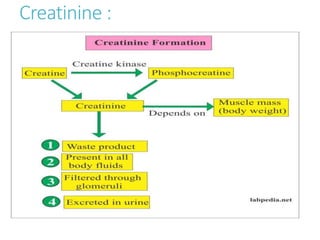
Creatinine is break down product ( waste product ) of creatine
phosphate & creatine in muscle
Amount of creatinine produced each day is fairly constant &
related to muscle mass
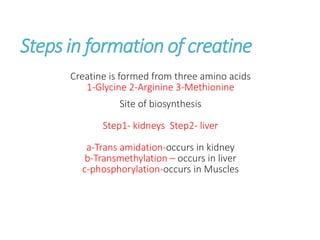
Steps in formation of creatine
Creatine is formed from three amino acids
1-Glycine 2-Arginine 3-Methionine
Site of biosynthesis
Step1- kidneys Step2- liver
a-Trans amidation-occurs in kidney
b-Transmethylation – occurs in liver
c-phosphorylation-occurs in Muscles
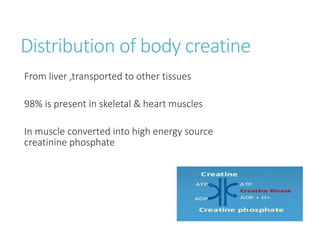
Distribution of body creatine
From liver ,transported to other tissues
98% is present in skeletal & heart muscles
In muscle converted into high energy source
creatinine phosphate
Relationship between creatine &
phosphocreatine
Creatine & creatinine phosphate exits in a reversible equilibrium
skeletal muscle
In skeletal muscle approximately one fourth of creatine exists as
free creatine & three fourth as creatinine phosphate
Creatine phosphate
High energy phosphate compound .
Act as storage form of energy in muscle
Provides a small, but ready source of energy
during first few minutes of energy contraction
The amount of creatine phosphate present in body is directly
proportional to muscle mass
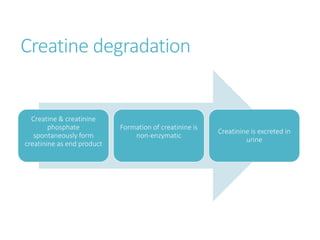
Creatine degradation
Creatine & creatinine
phosphate
spontaneously form
creatinine as end product
Formation of creatinine is
non-enzymatic
Creatinine is excreted in
urine
Creatinine :
Sample collection & storage :
Serum, plasma (lithium heparin) and urine are the
recommended sample types for this assay.
Separated serum and plasma specimens may be stored for up
to 24 hours at room temperature (18–26°C) or for up to 7 days
at 2–8°C or stored frozen for up to 3 months at -20°C or colder.
Urine specimens (random or 24-hour collections) are stable for
up to 4 days at 2–8°C or are frozen for storage longer than 4
days.
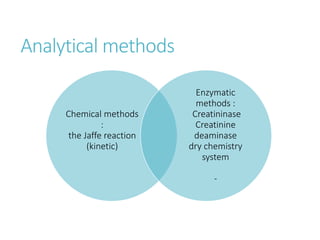
Analytical methods
Chemical methods
:
the Jaffe reaction
(kinetic)
Enzymatic
methods :
Creatininase
Creatinine
deaminase
dry chemistry
system
-
Enzymatic method : Creatininase
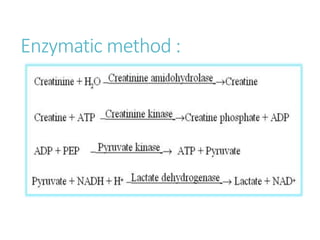
This enzymes catalyzes conversion of creatinine to creatine ,
creatine is then detected with series of enzymes mediated
reaction involving creatine kinase ,pyruvate kinase , & lactate
dehydrogenase ,with monitoring of decrease in absorbance of
at 340nm.
Having poor precision, sensitivity, & high cost of reagent, high
incubation period 30minutes .
Enzymatic method :
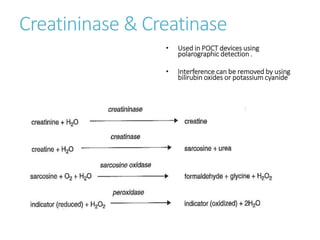
Creatininase & Creatinase
• Used in POCT devices using
polarographic detection .
• Interference can be removed by using
bilirubin oxides or potassium cyanide
CHEMICAL METHOD :
The Jaffe Reaction (most commonly used method).
Jaffe reaction is not specific for creatinine
Because many substances produce Jaffe like chromogenic effect
including proteins ,glucose, ascorbic acid,& ketone bodies
Non-creatinine chromogenic do not generate interference with
urinary creatinine measurement
Principles of the Procedure
Creatinine reacts with picric acid in an alkaline medium to
produce a red colored creatinine picrate complex .
OH
Creatinine + Picric acid Creatinine-Picrate
The rate of complex formation is measured at 505/571 nm and
is directly proportional. to the creatinine concentration
In automated analyzer first reading is recorded during 20
seconds after mixing sample & reagent .(acetoacetate)
2nd reading is noted between 20 & 80 seconds ,b/c creatinine
& picrate react slowly.
Window period – 20 to 80 seconds
Reagent 1 -Sodium hydroxide
Reagent 2 - Picric acid
Interference
oPositive interference:
oTotal Protein at 12.0 mg/dL increases the creatinine result in serum/plasma at
1.71 mg/dL.
oGlucoseat 332 mg/dL increases the creatinine result in serum/plasma at 1.61
mg/dL
oDopamineat 100 mg/dL increases the creatinine result in serum/plasma at 1.53 mg/dL
oNegative interference :
Unconjugated bilirubin at 15 mg/dL decreases the creatinine result in serum/plasma at
1.62 mg/dL
Unconjugated bilirubin at 20 mg/dL decreases the creatinine result in serum/plasma at
5.32 mg/dL
Creatinine clearance :
Clearance is defined as volume of plasma cleared of that substances
in one minutes/s
Expressed in ml/min or ml/sec
Its is directly proportional to body surface area
A 24 hours urine collection is required .
Height & weight of patient is noted
A blood sample is drawn between urine collection
Time = 24×60 = 1140
Urine volume = 1000-2000ml
Serum/plasma creatinine= 1.0mg/dl
Problems associated with Ccr :
Timed 24 hours urine specimen is burdensome
Incomplete emptying of bladder
Failure to collect entire specimen
Creatinine secretion increase with as GFR dec
Wide inter & intra individual variation
In our lab :
The Atellica CH Crea_2 assay is a modification of the Jaffe
method, using rate blanking and intercept correction.
Rate blanking is used to minimize bilirubin interference.
Also, because non-specific serum/plasma protein interactions
with this reagent have been found to produce a positive bias of
approximately 0.3 mg/dL (26.5 µmol/L), serum/plasma
measurements are automatically corrected by subtracting 0.3
mg/dL (26.5 µmol/L) from each result
References :
Chemical pathology for beginners
Tietz 6th edition volume 1 chapter 32
kidney function tests
Thank you ……..
Serum creatinine
Serum creatinine

Serum creatinine

  • 1.
  • 2.
    Out lines Biochemistry &physiology Sample collection Analytical methods Reference intervals & biological variability
  • 3.
    What is creatine& creatinine Creatine & creatinine are not same substances Creatine is found in muscle ……. Creatinine is break down product ( waste product ) of creatine phosphate & creatine in muscle Amount of creatinine produced each day is fairly constant & related to muscle mass
  • 4.
    Steps in formationof creatine Creatine is formed from three amino acids 1-Glycine 2-Arginine 3-Methionine Site of biosynthesis Step1- kidneys Step2- liver a-Trans amidation-occurs in kidney b-Transmethylation – occurs in liver c-phosphorylation-occurs in Muscles
  • 7.
    Distribution of bodycreatine From liver ,transported to other tissues 98% is present in skeletal & heart muscles In muscle converted into high energy source creatinine phosphate
  • 8.
    Relationship between creatine& phosphocreatine Creatine & creatinine phosphate exits in a reversible equilibrium skeletal muscle In skeletal muscle approximately one fourth of creatine exists as free creatine & three fourth as creatinine phosphate
  • 9.
    Creatine phosphate High energyphosphate compound . Act as storage form of energy in muscle Provides a small, but ready source of energy during first few minutes of energy contraction The amount of creatine phosphate present in body is directly proportional to muscle mass
  • 10.
    Creatine degradation Creatine &creatinine phosphate spontaneously form creatinine as end product Formation of creatinine is non-enzymatic Creatinine is excreted in urine
  • 12.
  • 13.
    Sample collection &storage : Serum, plasma (lithium heparin) and urine are the recommended sample types for this assay. Separated serum and plasma specimens may be stored for up to 24 hours at room temperature (18–26°C) or for up to 7 days at 2–8°C or stored frozen for up to 3 months at -20°C or colder. Urine specimens (random or 24-hour collections) are stable for up to 4 days at 2–8°C or are frozen for storage longer than 4 days.
  • 14.
    Analytical methods Chemical methods : theJaffe reaction (kinetic) Enzymatic methods : Creatininase Creatinine deaminase dry chemistry system -
  • 15.
    Enzymatic method :Creatininase This enzymes catalyzes conversion of creatinine to creatine , creatine is then detected with series of enzymes mediated reaction involving creatine kinase ,pyruvate kinase , & lactate dehydrogenase ,with monitoring of decrease in absorbance of at 340nm. Having poor precision, sensitivity, & high cost of reagent, high incubation period 30minutes .
  • 16.
  • 17.
    Creatininase & Creatinase •Used in POCT devices using polarographic detection . • Interference can be removed by using bilirubin oxides or potassium cyanide
  • 18.
    CHEMICAL METHOD : TheJaffe Reaction (most commonly used method). Jaffe reaction is not specific for creatinine Because many substances produce Jaffe like chromogenic effect including proteins ,glucose, ascorbic acid,& ketone bodies Non-creatinine chromogenic do not generate interference with urinary creatinine measurement
  • 19.
    Principles of theProcedure Creatinine reacts with picric acid in an alkaline medium to produce a red colored creatinine picrate complex . OH Creatinine + Picric acid Creatinine-Picrate The rate of complex formation is measured at 505/571 nm and is directly proportional. to the creatinine concentration
  • 20.
    In automated analyzerfirst reading is recorded during 20 seconds after mixing sample & reagent .(acetoacetate) 2nd reading is noted between 20 & 80 seconds ,b/c creatinine & picrate react slowly. Window period – 20 to 80 seconds Reagent 1 -Sodium hydroxide Reagent 2 - Picric acid
  • 21.
    Interference oPositive interference: oTotal Proteinat 12.0 mg/dL increases the creatinine result in serum/plasma at 1.71 mg/dL. oGlucoseat 332 mg/dL increases the creatinine result in serum/plasma at 1.61 mg/dL oDopamineat 100 mg/dL increases the creatinine result in serum/plasma at 1.53 mg/dL oNegative interference : Unconjugated bilirubin at 15 mg/dL decreases the creatinine result in serum/plasma at 1.62 mg/dL Unconjugated bilirubin at 20 mg/dL decreases the creatinine result in serum/plasma at 5.32 mg/dL
  • 22.
    Creatinine clearance : Clearanceis defined as volume of plasma cleared of that substances in one minutes/s Expressed in ml/min or ml/sec Its is directly proportional to body surface area A 24 hours urine collection is required . Height & weight of patient is noted A blood sample is drawn between urine collection
  • 23.
    Time = 24×60= 1140 Urine volume = 1000-2000ml Serum/plasma creatinine= 1.0mg/dl
  • 24.
    Problems associated withCcr : Timed 24 hours urine specimen is burdensome Incomplete emptying of bladder Failure to collect entire specimen Creatinine secretion increase with as GFR dec Wide inter & intra individual variation
  • 25.
    In our lab: The Atellica CH Crea_2 assay is a modification of the Jaffe method, using rate blanking and intercept correction. Rate blanking is used to minimize bilirubin interference. Also, because non-specific serum/plasma protein interactions with this reagent have been found to produce a positive bias of approximately 0.3 mg/dL (26.5 µmol/L), serum/plasma measurements are automatically corrected by subtracting 0.3 mg/dL (26.5 µmol/L) from each result
  • 26.
    References : Chemical pathologyfor beginners Tietz 6th edition volume 1 chapter 32 kidney function tests
  • 27.