‘Comedy of Errors’
in Clinical Laboratory
Dr. Diganta Dey
Quality Manager
Ashok Laboratory Clinical Testing Centre Pvt. Ltd.
Laboratory Errors
Non-conforming results with “statistical
meaning”.
Error Classification
Pre-analytical/ Pre-examination
–errors before the sample reaches the laboratory
Analytical/ Examination
–errors during the analysis of the sample
Post-analytical/ Post-examination
–errors occurring after the analysis
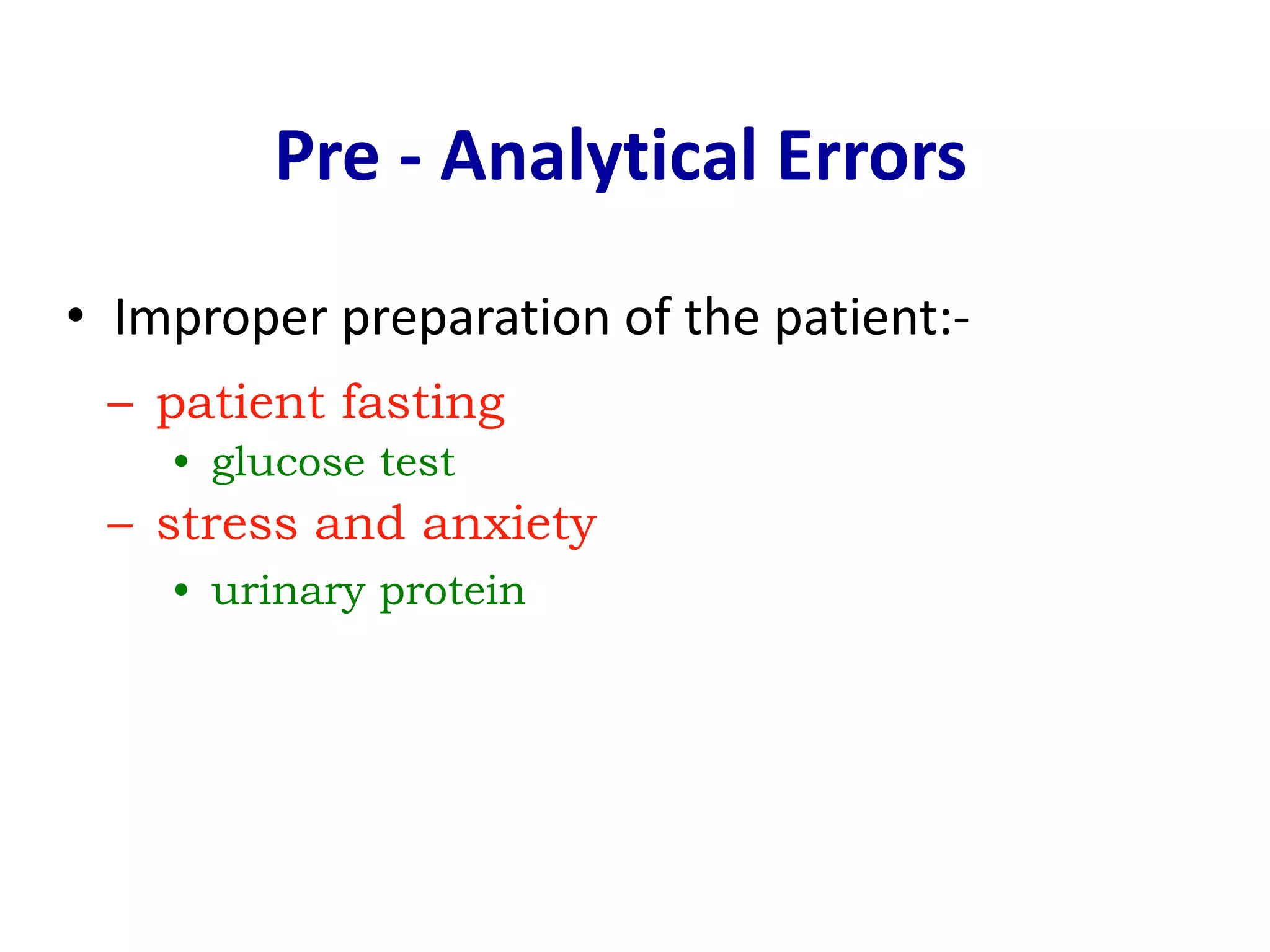
Pre - Analytical Errors
• Improper preparation of the patient:-
– patient fasting
• glucose test
– stress and anxiety
• urinary protein
Pre - Analytical Errors
• Improper preparation of the patient
• Improper collection of the blood sample:-
– sample haemolysis
• LDH, potassium or inorganic phosphate
– insufficient sample volume
• unable to carry out all requested tests
– collection timing
• 24 hour urine
Pre - Analytical Errors
• Improper preparation of the patient
• Improper collection of the blood sample
• Incorrect specimen container:-
– serum or plasma
– fluoride tubes for glucose
• to inhibit glycolysis
– EDTA unsuitable anti-coagulant for calcium
• Improper preparation of the patient
• Improper collection of the blood sample
• Incorrect specimen container
• Incorrect specimen storage:-
– sample left overnight at room temperature
• falsely elevated K, Pi and red cell enzymes
– delay in sample delivery
• falsely lowered levels of unstable analytes
Pre - Analytical Errors
• The sex of the patient
– male or female
• The age of the patient
– new born / juvenile / adult / geriatric
• Dietary effects
– low carbohydrate / fat
– high protein / fat
• When the sample was taken
– early morning urine collection pregnancy testing
• Patient posture
– urinary protein in bed-ridden patients
Other Factors
• Effects of exercise
– creatine kinase / CRP
• Medical history
– heart disease / diabetes / existing medication
• Pregnancy
– hormonal effects
• Effects of drugs and alcohol
– liver enzymes / dehydration
Other Factors
• The sample:
Analytical Errors
– labelling
• barcoding / aliquoting
– preparation
• centrifugation / aspiration
– storage temperature
• short –term refrigeration
• medium term freezing at –20oC
• long term freezing at -80oC
– correct test selection
• Laboratory Information Management System (LIMS)
• The sample:
• Glassware / pipettes / balances:
Analytical Errors
– used incorrectly
– contaminated
– poorly calibrated
– reuse of pipette tips
• The sample:
• Glassware / pipettes / balances:
• Reagents / calibrators / controls:
Analytical Errors
– poor quality
– inappropriate storage
• correct temperature
• badly maintained fridges or freezers
– stability
• shelf-life / working reagent
– incorrect preparation
• The sample:
• Glassware / pipettes / balances:
• Reagents / calibrators / controls:
• The application:
Analytical Errors
– incorrect analytical procedures
– poorly optimised instrument settings
• The sample:
• Glassware / pipettes / balances:
• Reagents / calibrators / controls:
• The application:
• The instrument:
Analytical Errors
– operational limitations
• temperature control/read times/mixing/carry-over
– lack of maintenance
• worn tubing / optics / cuvettes / probes
Other Factors
• Calculation errors:
– incorrect factor / wrong calibration values
• Transcription errors:
• Dilutions errors:
– incorrect dilution or dilution factor used
• Lack of training:
• The human factor:
– tiredness / carelessness / stress
• The prompt and correct delivery of the correct
report on the correct patient to the correct
Doctor.
• How the Clinician interprets the data to the full
benefit of the patient.
Post - Analytical Errors
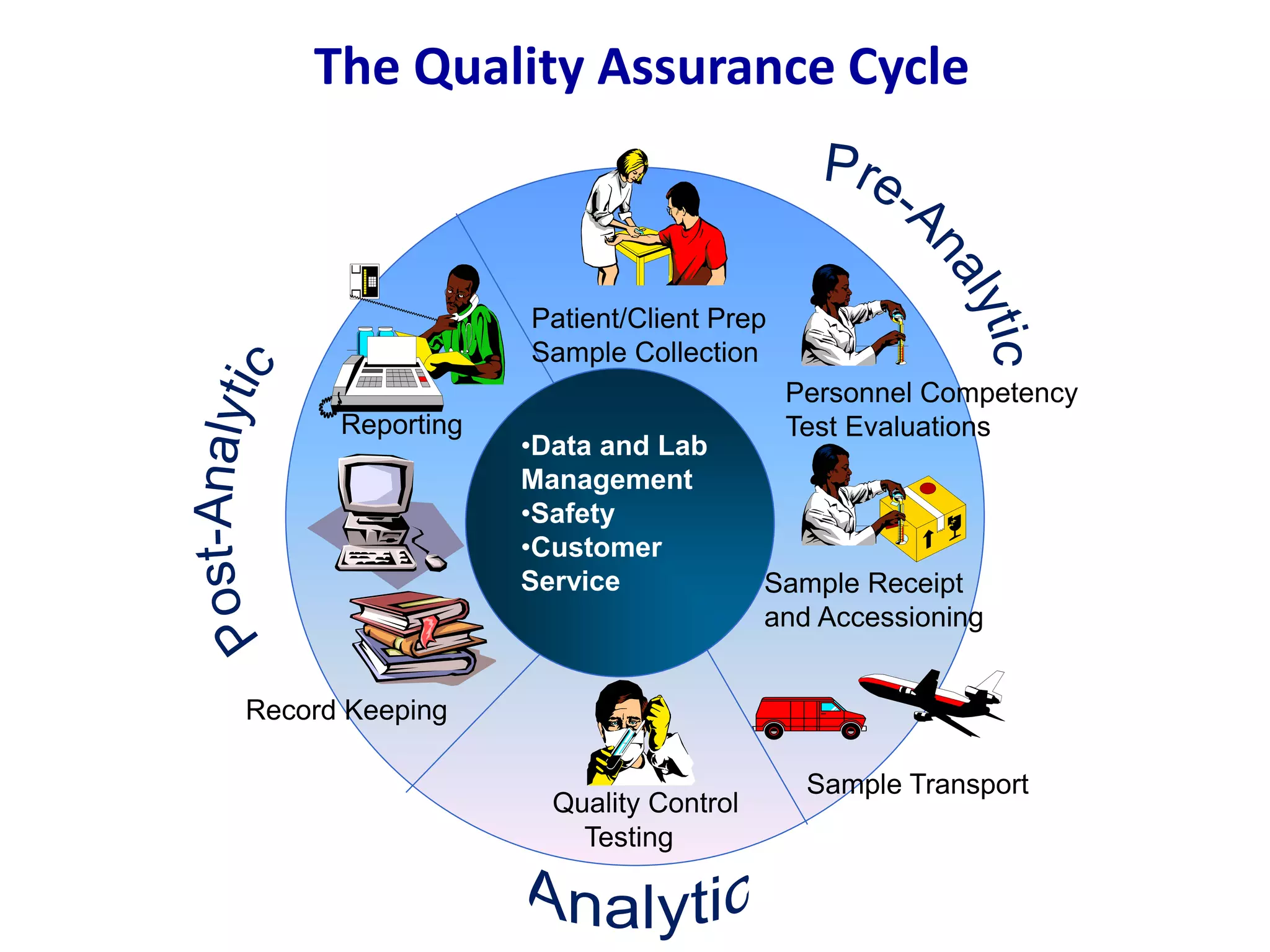
The Quality Assurance Cycle
•Data and Lab
Management
•Safety
•Customer
Service
Patient/Client Prep
Sample Collection
Sample Receipt
and Accessioning
Sample Transport
Quality Control
Record Keeping
Reporting
Personnel Competency
Test Evaluations
Testing
Definitions
• Quality Assurance (QA):-
– all those planned and systematic actions
necessary to provide adequate confidence that
a product, process or service will satisfy given
requirements for quality
• Quality:-
– totality of features and characteristic of a
product, process or service that bear on its
ability to satisfy stated or implied needs
• Quality Control (QC):-
– operational techniques and activities that are
used to fulfil given requirements for quality
Reference: Quality management and quality assurance - Vocabulary. ISO 8402.
Geneva: ISO, 1994
Quality is a Lousy Idea-
If it’s Only an Idea
QC Decisions are based on
Cost
Lab Credibility
Patient Care
Goal of Quality Control:
Evaluate and minimize analytical error
Use a system approach
• Minimize error through following operating
protocols
– Calibration, maintenance, etc.
• Assess daily performance
– Internal statistical quality control
• Validate accuracy and precision periodically
– EQA (proficiency testing)
Standards and Calibration
ndard:
– Standards are samples that contain a specific quantity of a single analyte.
They provide an accurate determination of a single value.
– Standards normally can be traced to a primary standard.
– Calibrators are samples that are used to adjust the recovery values to the
standard curve at a point in time based on the reagents, temp., etc.
– Calibrators “Fine-Tune” or adjust the recovery values to the standard
curve.
– Peak Area, Beer’s Law:
– Graphical representation of the relationship between the concentration of
the analyte and The analytical signal
• Long Shelf-Life and Open Vial Stability
• Clinically Relevant Levels
• Human Based Matrix
• Extensive Assayed Values Provided
• Comprehensive Range of Products
Properties of a QC Material
Types of QC Material
• First party control: Patient pools
– Levels may not be appropriate
– Stability not validated (no expiration date)
– Risk of infection may be greater
– Time consuming to prepare
– Limited long-term supply
• Second party control: QC materials may be
provided by the instrument and calibrator
manufacturer
• Third party: Independent to control
manufacturer of the test or analyzer
• Mean
• Standard deviation (SD)
• A high standard deviation can be attributed to:
• Inherent variability in the test, which represents expected error
• Analytical system malfunction, which represents unexpected
error that the laboratory must investigate and correct
Basic QC Statistics
Bias
• Where Mlab is your lab's mean and Mgroup is the
reference value (i.e. proficiency or interlaboratory
value)
Coefficient of Variation
• The CV is a more accurate comparator than the
standard deviation because the standard deviation
typically increases as the concentration of the
analyte increases.
General Requirements of
QC Materials
• The QC material used must cover the analytical
concentrations encountered.
• Low/normal/high, normal/abnormal controls, as
appropriate for the test, must be performed.
• Controls independent of those produced by the
manufacturer of the test or analyzer should be used.
Source: The AS 4633 (ISO 15189) Field Application Document -
“Supplementary Requirements for accreditation in the field of Medical
Testing, NATA, July 2009”
Single Level Only
Two Levels of Control
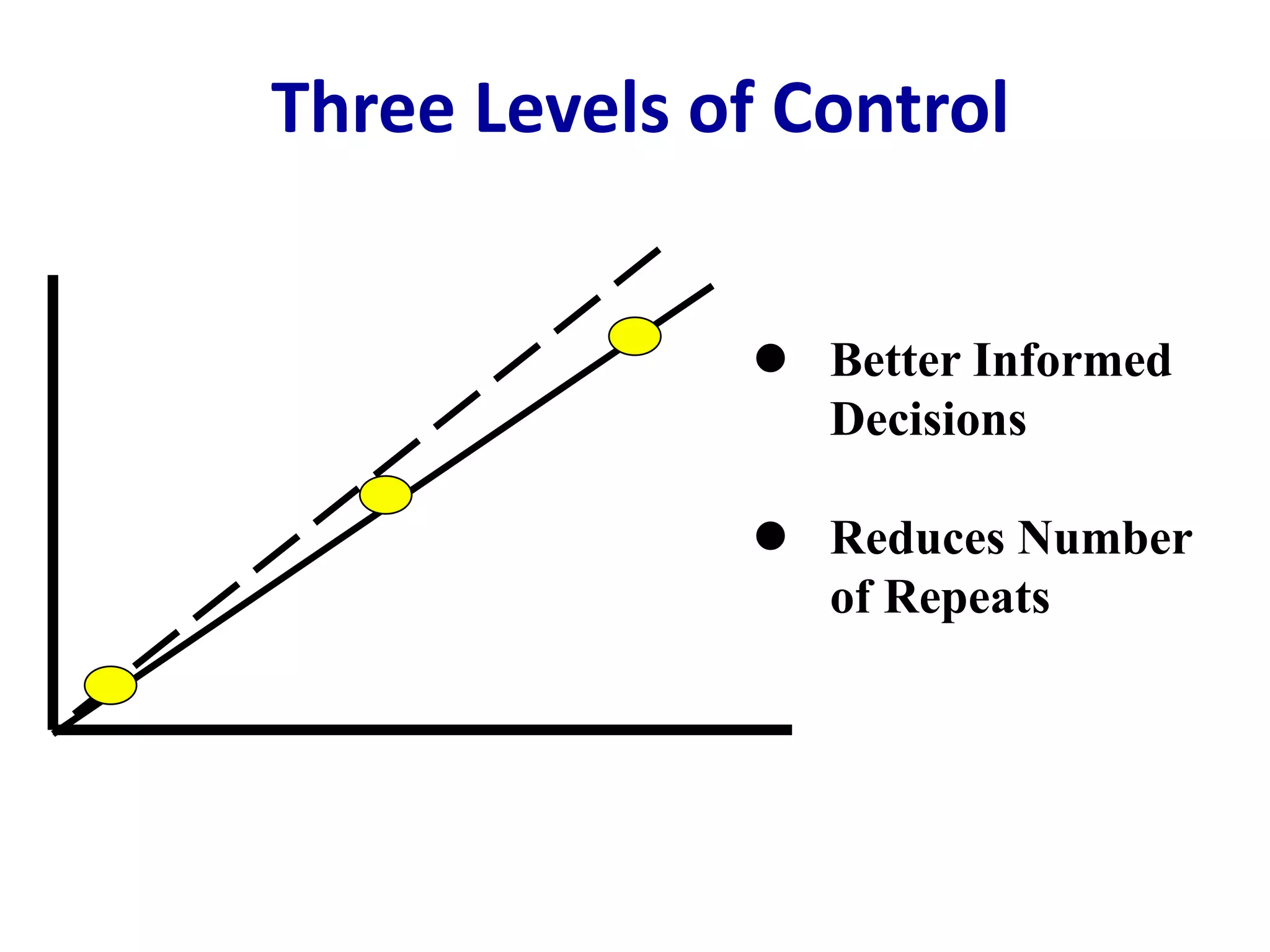
Three Levels of Control
l Better Informed
Decisions
l Reduces Number
of Repeats
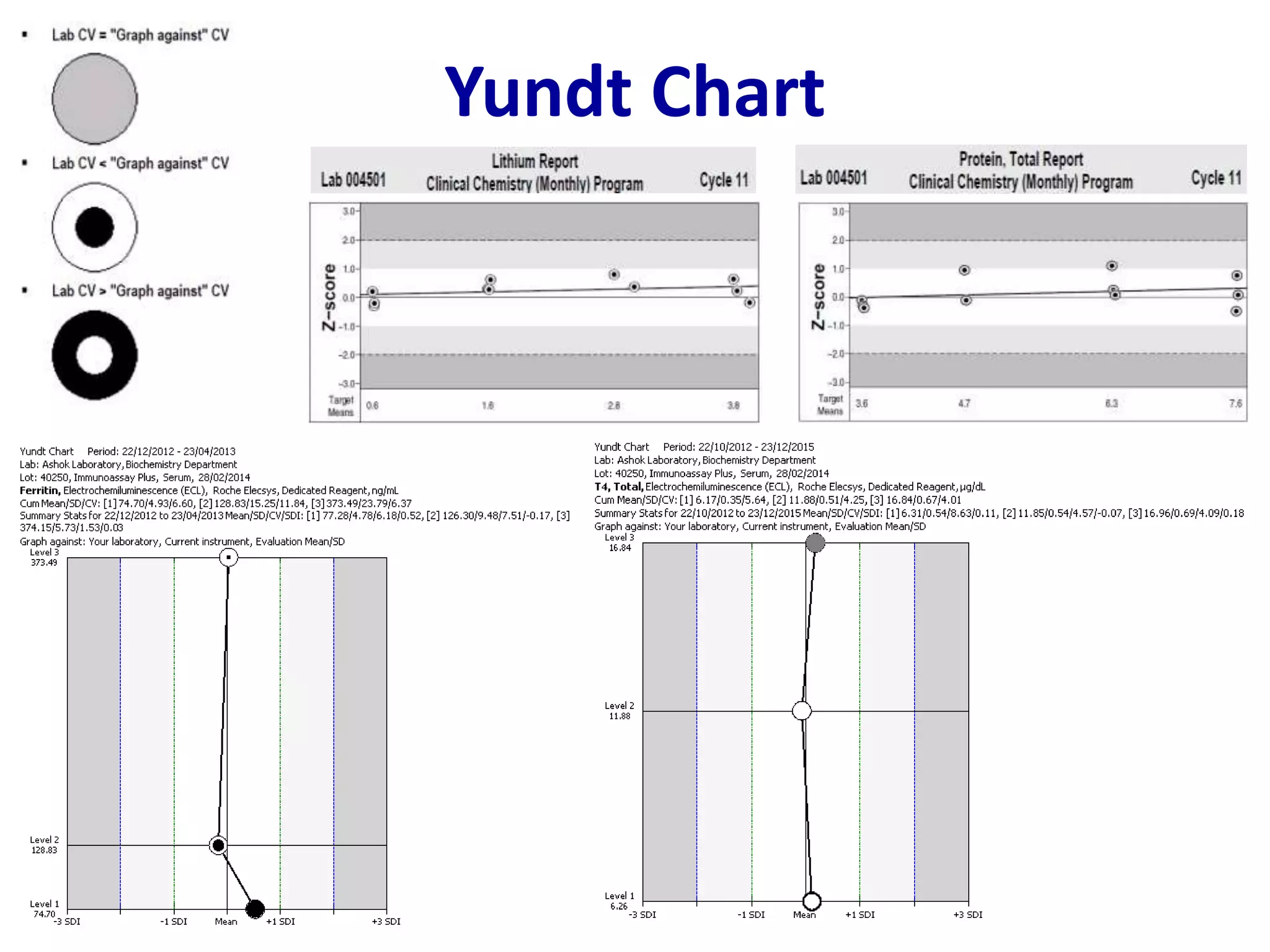
Yundt Chart
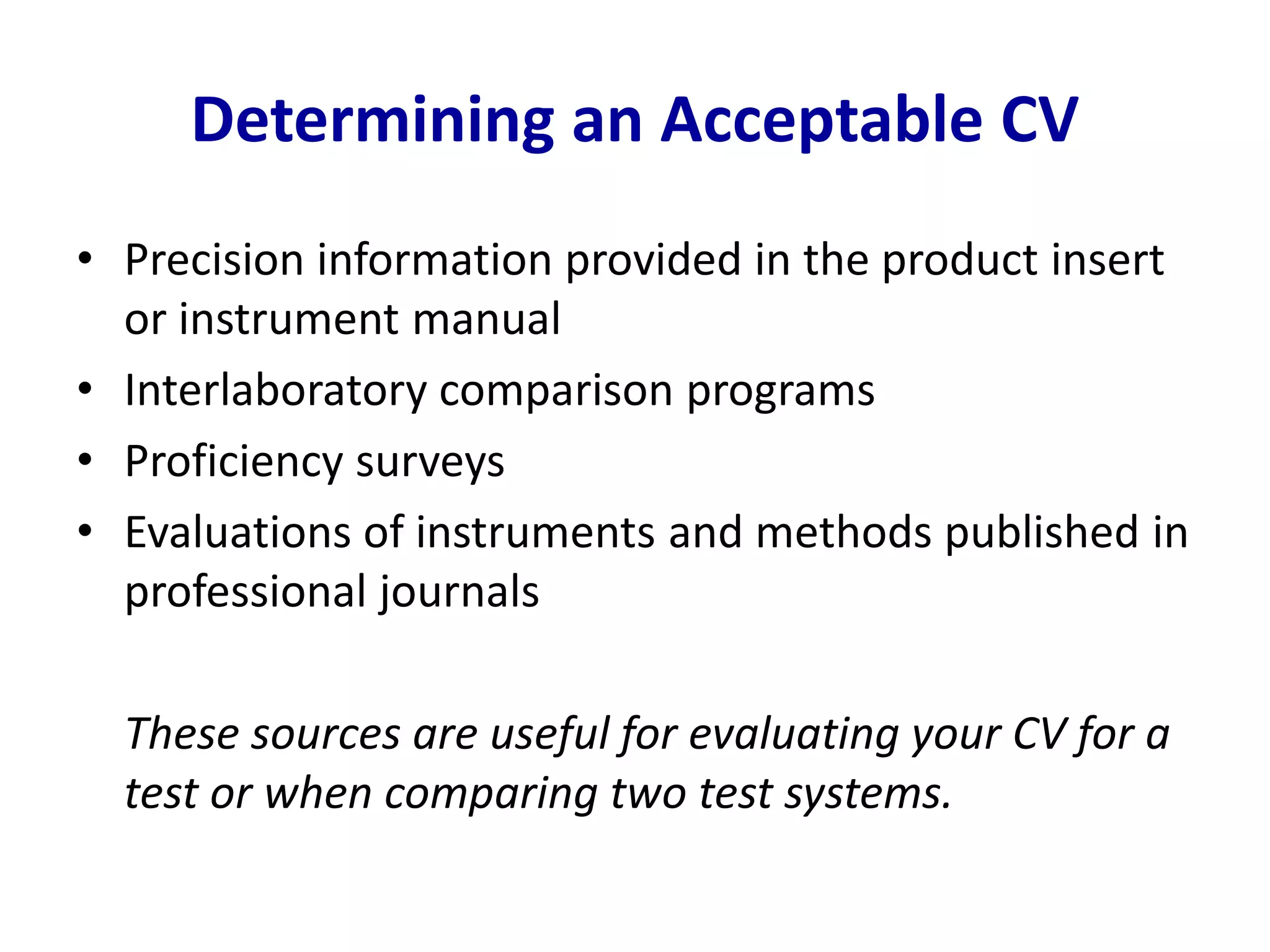
Determining an Acceptable CV
• Precision information provided in the product insert
or instrument manual
• Interlaboratory comparison programs
• Proficiency surveys
• Evaluations of instruments and methods published in
professional journals
These sources are useful for evaluating your CV for a
test or when comparing two test systems.
Multirule QC
Random Error Systematic Error
Sources of Random Error
1. Power supply and power fluctuations
2. Double pipetting of control sample
3. Pipette tips not fitting properly
4. A clog in the pipettor/ imprecise pipettor
5. Air bubbles in water supply
6. Occasional air bubbles in sample cups or syringes
7. Random air bubbles in reagent or sample pipette system
8. Incorrect reconstitution of control product
9. Use of non reagent grade water in the test system
10. Operator technique
11. improperly mixed/dissolved reagent
Sources of Systematic Error
1. change in sample or reagent volumes due to pipettor misadjustments or
misalignment
2. Drift or shift in temperature of incubator chamber and reaction block
3. In appropriate temperature / humidity levels of testing area
4. Change of reagent / calibrator lot
5. Deterioration of reagent / calibrator/ control while in use, strange or
shipment
6. Incorrect handling of control product (freezing when not recommended)
7. Inappropriate storage of control products in frost free freezers
8. Deterioration of a photometric light source
9. Use of non reagent grade water in the test system
10. Recent calibration
11. Change in test operators
12. Specimen carryover
13. Obstruction of tubing
Calculating a Control Mean and Range
• Collect a minimum of twenty data points (in
duplicates for 20 days’ i.e. 40 measurements) for each
level of control
(CLSI approved guideline C24-A3: Statistical Quality Control for Quantitative
Measurement procedures: Principles and Definitions)
• Calculate the mean and standard deviation
• Calculate the statistical control limits from the mean ±
2s and the mean ± 3s.
Gaussian Distribution Curve
Gaussian Distribution and
Levey-Jennings Chart
Levey-Jennings chart that
demonstrates a shift
• Down-shift
• Partial electric failure in the
instrument.
• Over diluted new standard
• Reagent that undergoes
some degree of
deterioration then stabilizes
• Contaminated reagent(s)
• Inaccurate timer (yielding
slower times)
• Over heating of reaction
mixtures
• Up-shift
• Evaporation of reagents causing a
concentrated effect.
• Contamination of reagent(s).
• Inaccurate timer (yielding faster times).
• Under heating of the reaction mixture.
• Standard is too concentrated
• Contaminated glassware.
Levey-Jennings chart that
demonstrates a trend
• Slowly deteriorating
reagents
• Problems with the
instrument tubing
• A weakening in the
light detector
component of the
photometer unit.
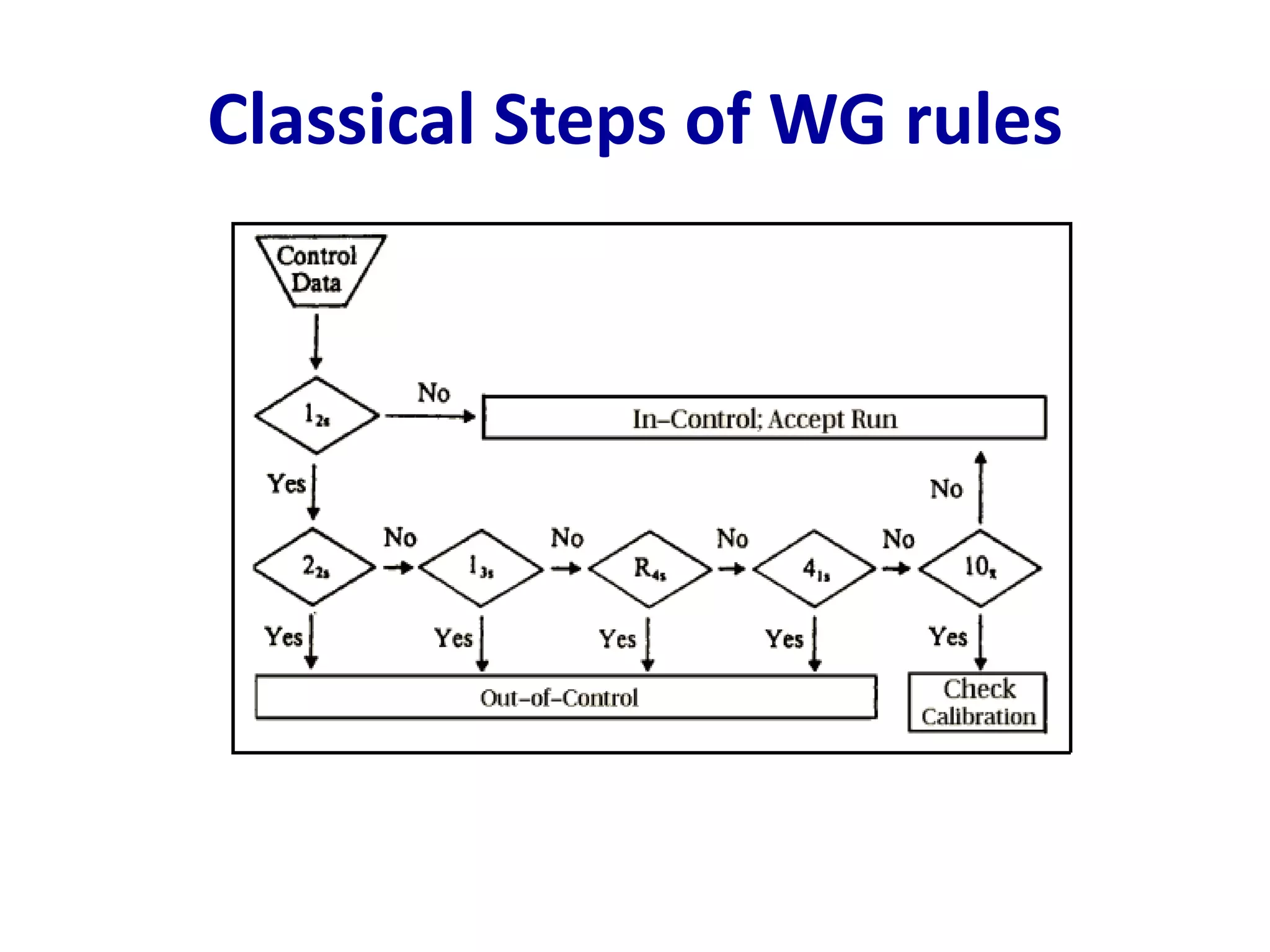
Classical Steps of WG rules
Troubleshooting and
Westgard Rules
Problem identified by Westgard rule violated
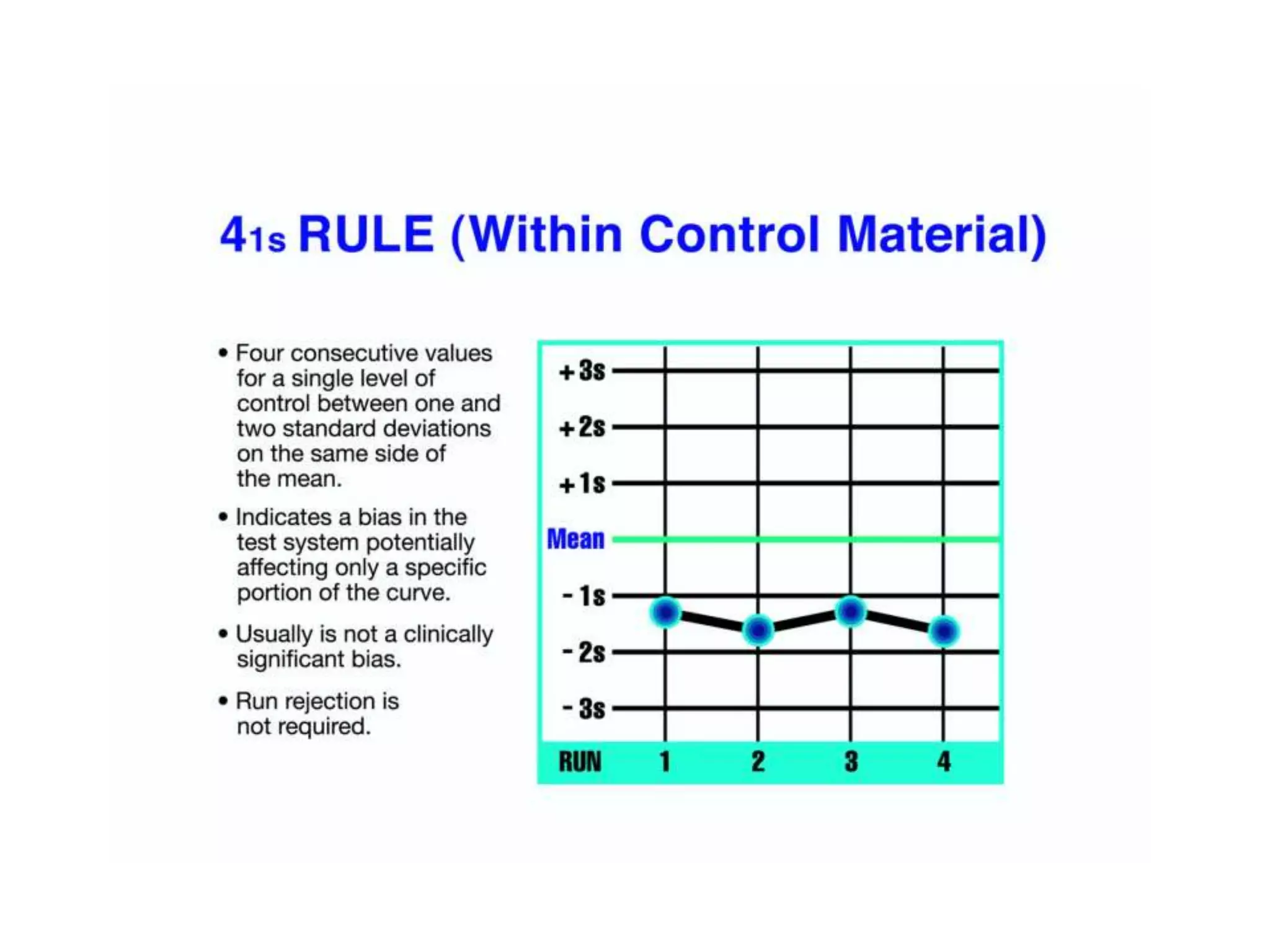
Systematic Error (bias): 1-3s, 2-2s, 4-1s, 10x
Shifts, drifts, or trends
Calibration failure
Random Error (imprecision): 1-3s, R-4s
Poor reproducibility / Outliers
Standard Deviation Index
SDI value Interpretation
0.0 Perfect comparison with consensus group
≤1.25 Acceptable
1.25 – 1.49 Acceptable to marginal performance
Some investigation of the test system may be required
1.5 – 1.99 Marginal performance
Investigation of the test system is recommended
≥2.0 Unacceptable performance
Remedial action usually required
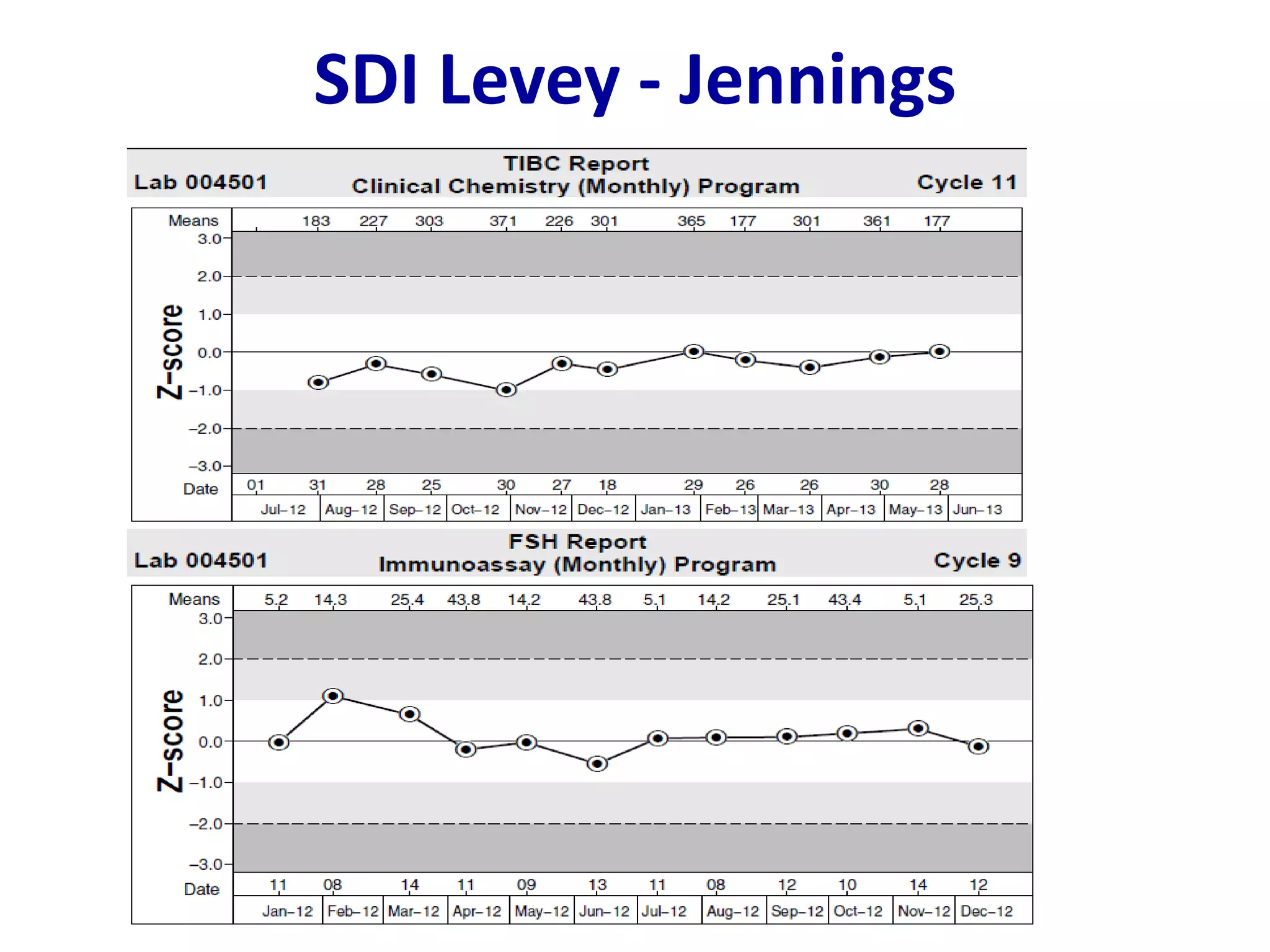
SDI Levey - Jennings
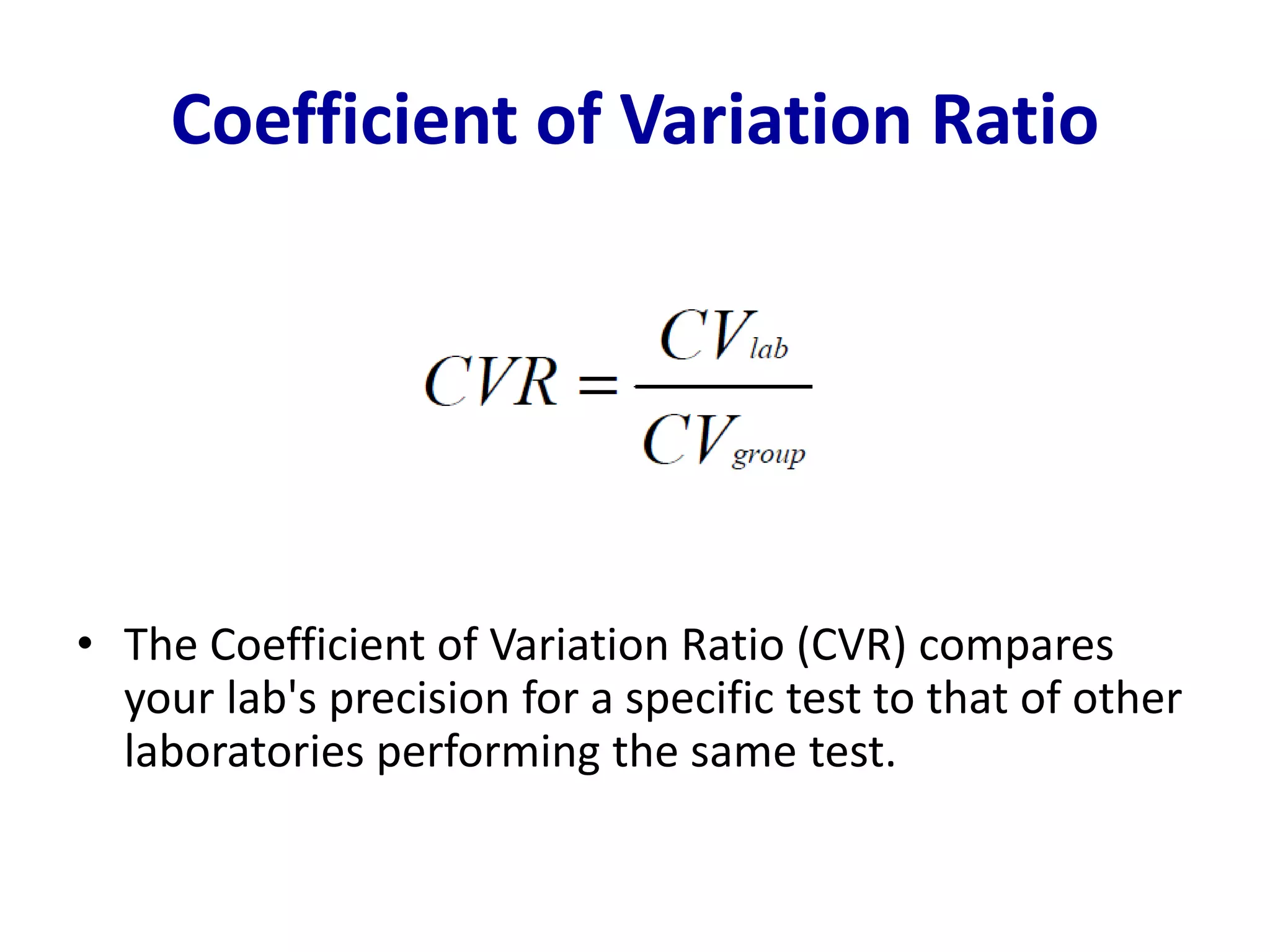
Coefficient of Variation Ratio
• The Coefficient of Variation Ratio (CVR) compares
your lab's precision for a specific test to that of other
laboratories performing the same test.
z-score
• A z-score of 2.3 indicates that the observed value is
2.3 SD away from the expected mean.
Total Error
• Total error for a test includes both bias and
imprecision as shown by the following formula:
• TE = |bias,%| + Z x (Imprecision)
• (The Z = 2.33 at 99% confidence level, and 1.65
at 95% confidence level, p<0.01)
Allowable Total Error (TEa)
• Minimum uses 0.75 CVw
• TEa < z 0.75 CVw + 0.375 (CVw
2 + CVg
2)1/2
• Desirable uses 0.50 CVw
• TEa < z 0.50 CVw + 0.250 (CVw
2 + CVg
2)1/2
• Optimum uses 0.25 CVw
• TEa < z 0.25 CVw + 0.125 (CVw
2 + CVg
2)1/2
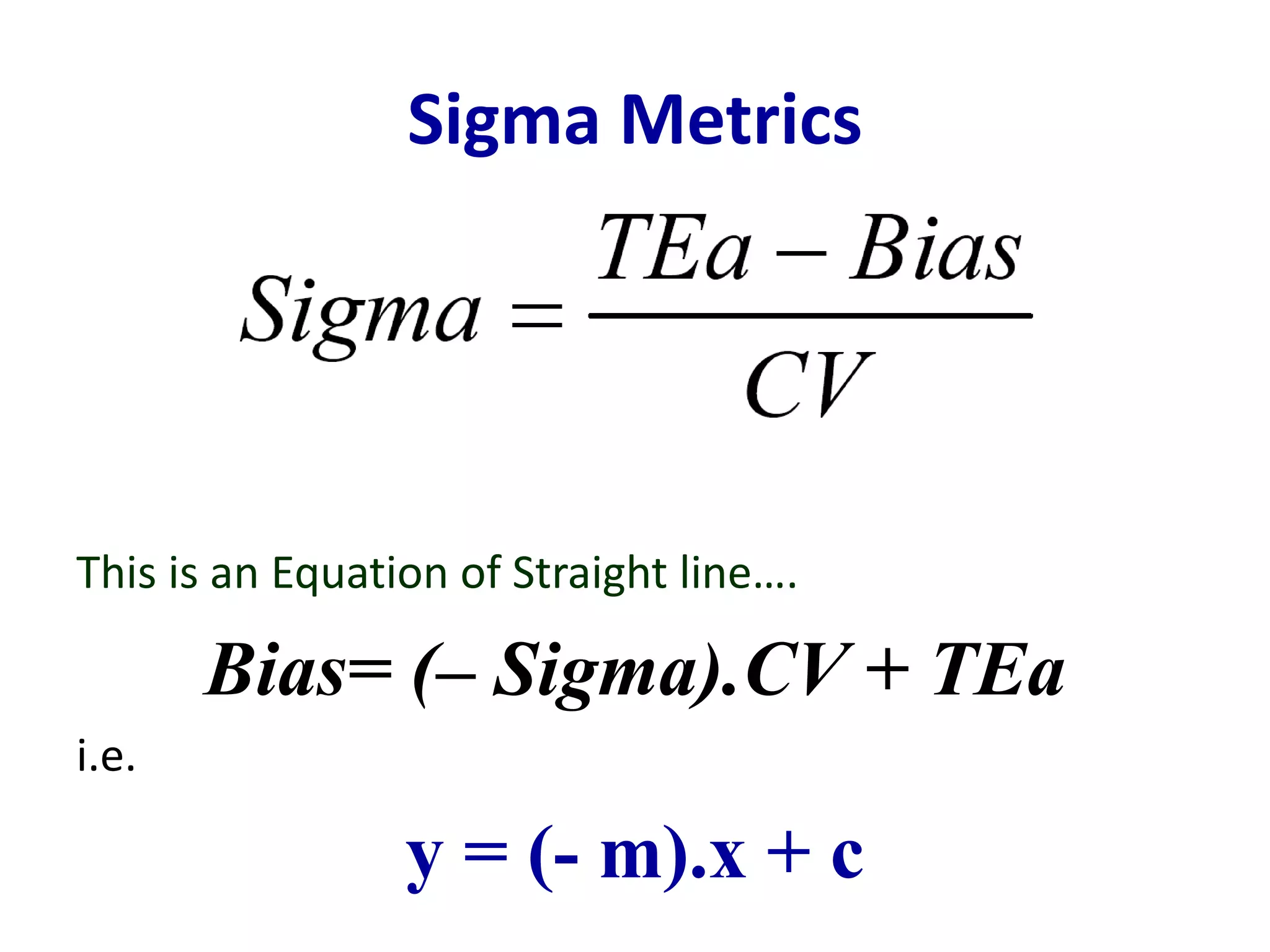
Sigma Metrics
This is an Equation of Straight line….
Bias= (– Sigma).CV + TEa
i.e.
y = (- m).x + c
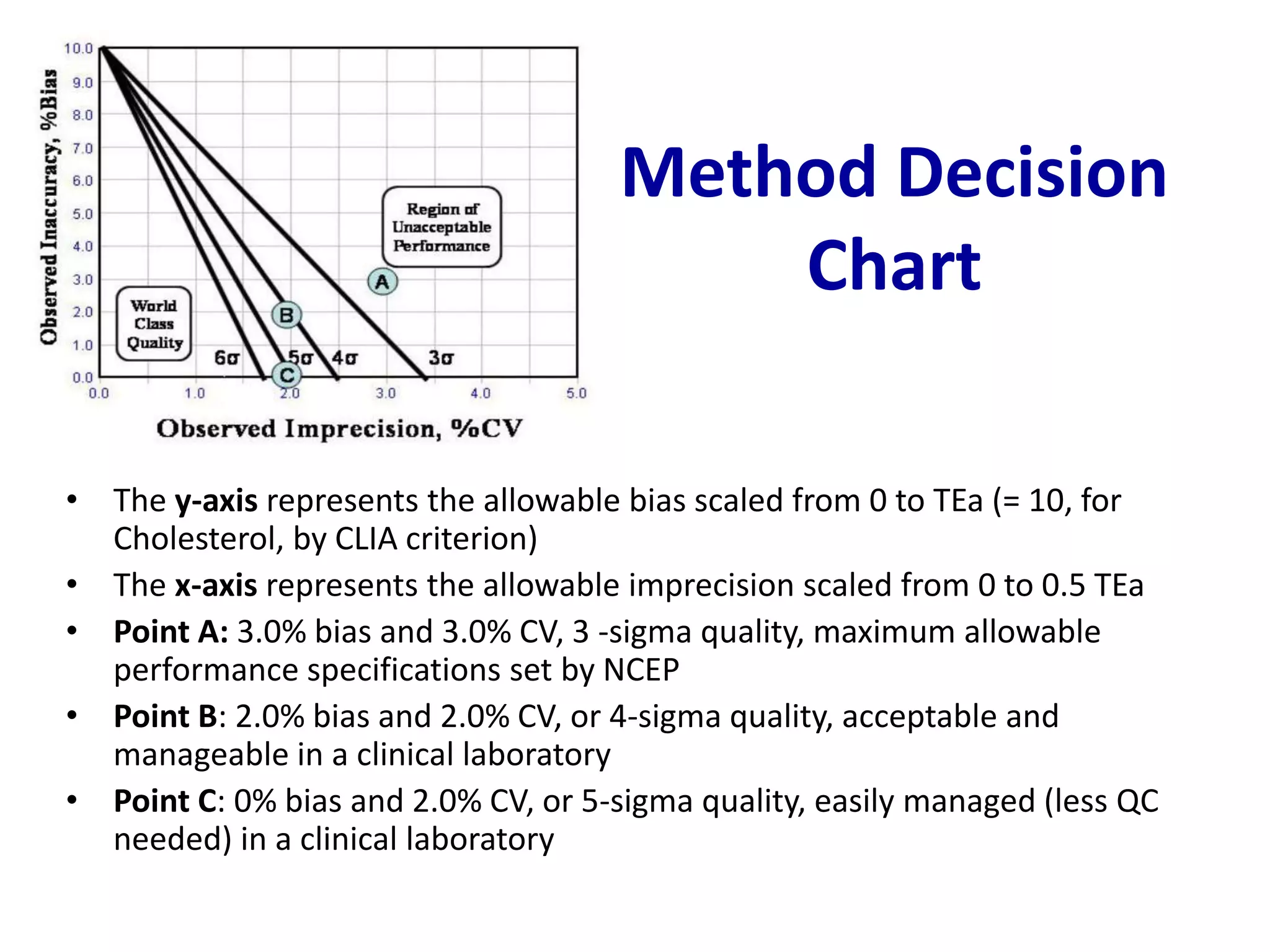
Method Decision Chart
Method Decision
Chart
• The y-axis represents the allowable bias scaled from 0 to TEa (= 10, for
Cholesterol, by CLIA criterion)
• The x-axis represents the allowable imprecision scaled from 0 to 0.5 TEa
• Point A: 3.0% bias and 3.0% CV, 3 -sigma quality, maximum allowable
performance specifications set by NCEP
• Point B: 2.0% bias and 2.0% CV, or 4-sigma quality, acceptable and
manageable in a clinical laboratory
• Point C: 0% bias and 2.0% CV, or 5-sigma quality, easily managed (less QC
needed) in a clinical laboratory
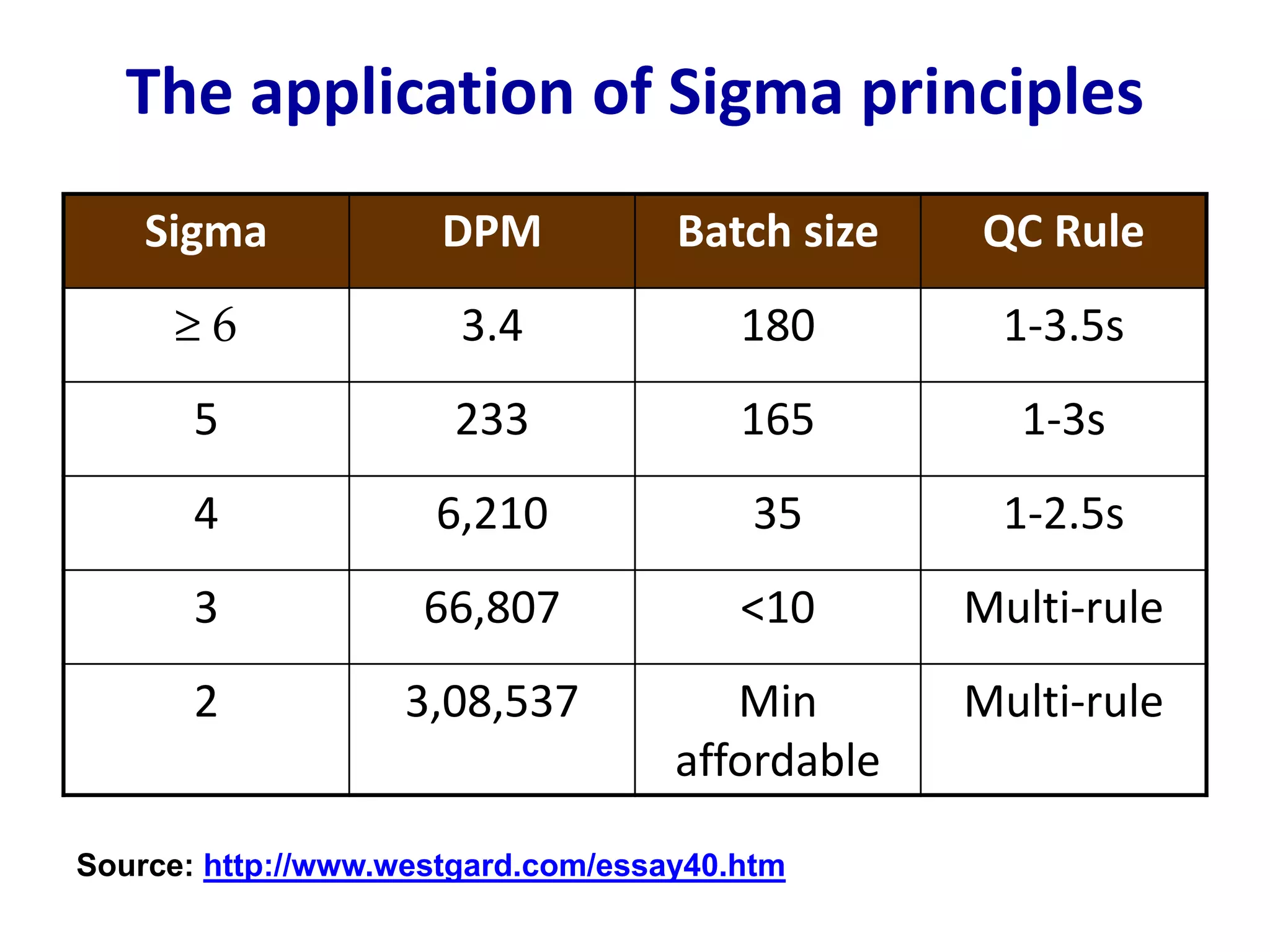
The application of Sigma principles
Sigma DPM Batch size QC Rule
≥ 6 3.4 180 1-3.5s
5 233 165 1-3s
4 6,210 35 1-2.5s
3 66,807 <10 Multi-rule
2 3,08,537 Min
affordable
Multi-rule
Source: http://www.westgard.com/essay40.htm
Critical-size error
• ∆SEcrit = [(TEa - biasmeas) / smeas] - z
= Sigma – z
∆SEcrit = 2, means that a systematic shift equivalent to 2 times of the CV of the method
needs to be detected by the QC procedure.
• ∆REcrit = (TEa - biasmeas) / z smeas
= Sigma / z
∆REcrit = 2, means a 2-fold increase in the CV needs to be detected by the QC procedure.
z defines the tail of the distribution that is allowed to exceed the quality requirement
and is often chosen as 1.65 to set a maximum defect rate of 0.05 or 5%.
Typical response curve for a detector
• A power function graph
shows the probability of
rejection on the y-axis
versus the size of error on
the x-axis.
• Power curves for the 1-2s,
1-3s, and 1-4s control rules
with N=1 are shown here.
• These are the control rules
that would result if the
control limits on a Levey-
Jennings chart were set as
the mean plus/minus 2s, 3s,
or 4s
Power function graph
Rejection characteristics
• Pfr: The probability for false rejection, is the probability of a
rejection occurring when there is no error except for the
inherent imprecision of the measurement procedure. In
practice, a Pfr of 0.01 is considered ideal and values up to 0.05
or 5% may be practical.
• Ped: The probability for error detection, i.e., the probability of
rejection when an error is present in addition to the inherent
imprecision of the measurement procedure. In practice, a Ped
of 0.90, or 90%, can be considered ideal performance because
it will generally be much more costly to achieve higher values
of 0.95, 0.99, or 1.00.
How do you use a power function graph?
• The chance of detecting a 3s shift would be 83% by a 1-2s
rule, 50% by a 1-3s rule and 16% by a 1-4s rule.
• False rejections approximately 5% for the 1-2s rule and would
be nearly zero for the 1-3s and 1-4s rules.
Rejection characteristics of single-rule QC
procedures, all having a total N of 2
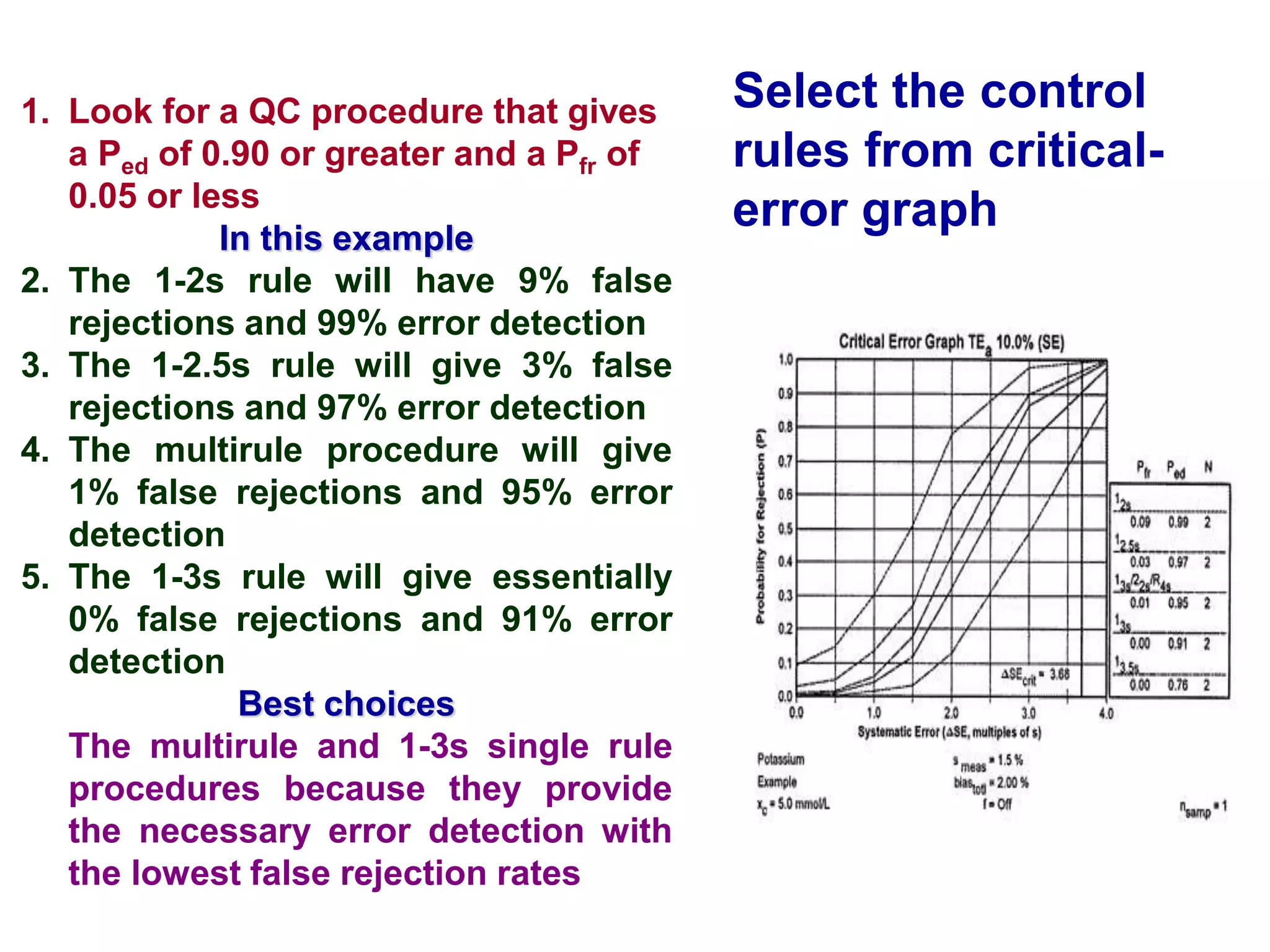
Select the control
rules from critical-
error graph
1. Look for a QC procedure that gives
a Ped of 0.90 or greater and a Pfr of
0.05 or less
In this example
2. The 1-2s rule will have 9% false
rejections and 99% error detection
3. The 1-2.5s rule will give 3% false
rejections and 97% error detection
4. The multirule procedure will give
1% false rejections and 95% error
detection
5. The 1-3s rule will give essentially
0% false rejections and 91% error
detection
Best choices
The multirule and 1-3s single rule
procedures because they provide
the necessary error detection with
the lowest false rejection rates
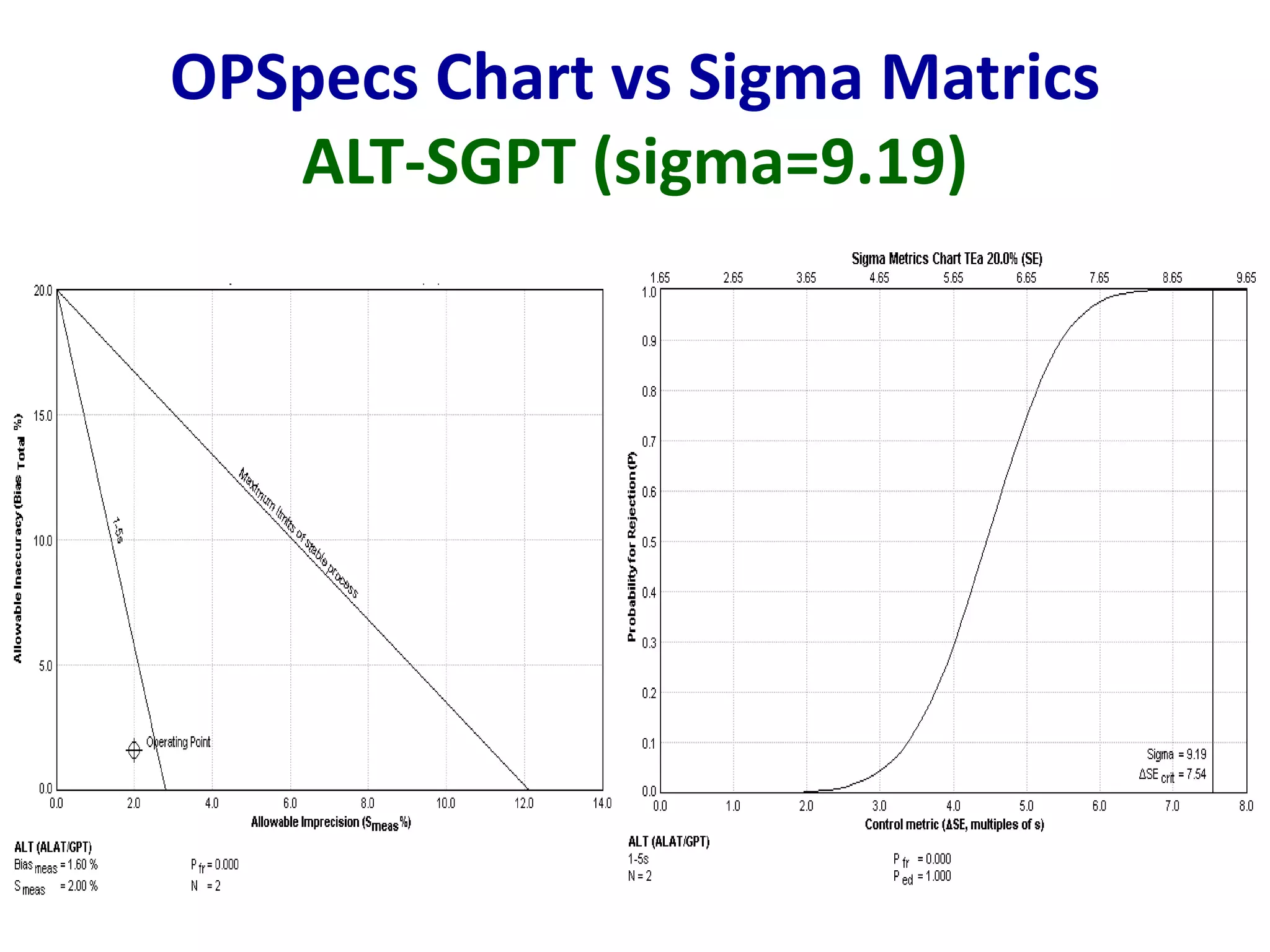
OPSpecs Chart vs Sigma Matrics
ALT-SGPT (sigma=9.19)
OPSpecs Chart vs Sigma Matrics
Glucose (sigma=3.73)
OPSpecs Chart vs Sigma Matrics
Calcium (sigma=1.42)
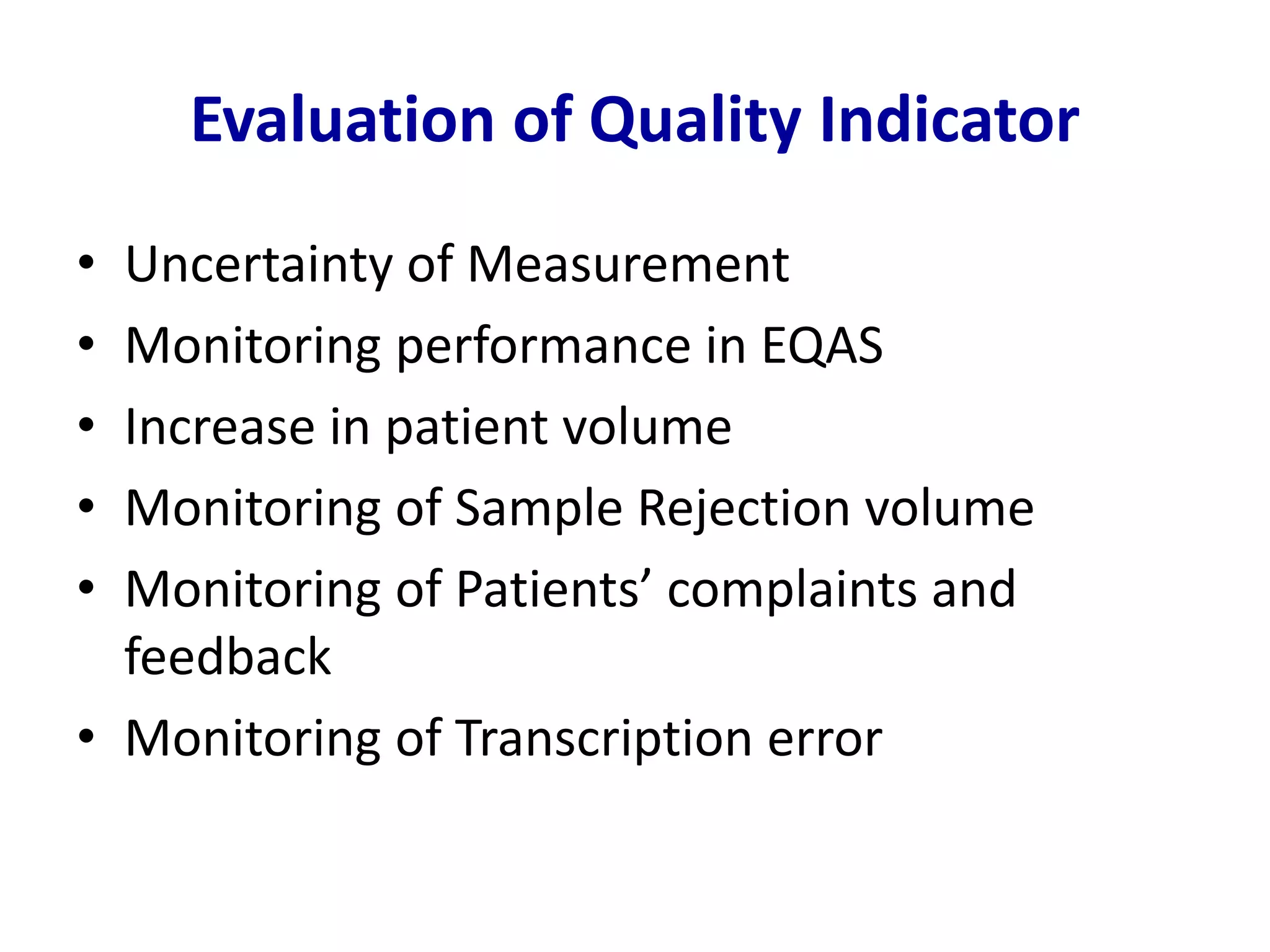
Evaluation of Quality Indicator
• Uncertainty of Measurement
• Monitoring performance in EQAS
• Increase in patient volume
• Monitoring of Sample Rejection volume
• Monitoring of Patients’ complaints and
feedback
• Monitoring of Transcription error
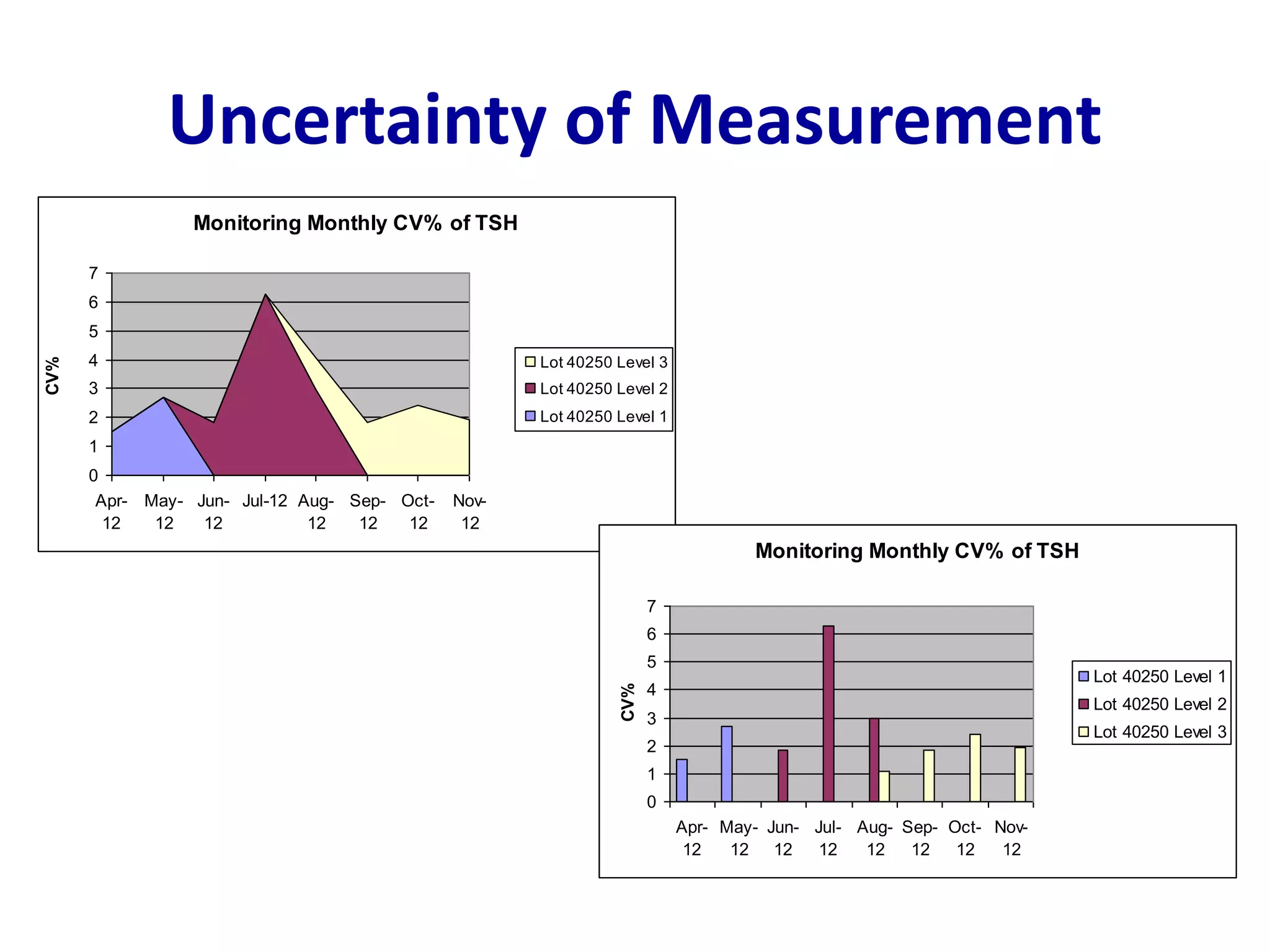
Uncertainty of Measurement
Monitoring Monthly CV% of Creatinine kinase
0
1
2
3
4
5
6
7
Jan-12
Feb-12
Mar-12
Apr-12
May-12
Jun-12
Jul-12
Aug-12
Sep-12
Oct-12
Nov-12
CV%
Lot 14410 Level 1
Monitoring Monthly CV% of Creatinine kinase
0
1
2
3
4
5
Jan-12
Feb-12
Mar-12
Apr-12
May-12
Jun-12
Jul-12
Aug-12
Sep-12
Oct-12
Nov-12
CV%
Lot 14410 Level 2
Monitoring Monthly CV% of Creatinine kinase
0
1
2
3
4
5
6
7
Jan-12
Feb-12
Mar-12
Apr-12
May-12
Jun-12
Jul-12
Aug-12
Sep-12
Oct-12
Nov-12
CV%
Lot 14410 Level 1
Lot 14410 Level 2
Uncertainty of Measurement
Monitoring Monthly CV% of TSH
0
1
2
3
4
5
6
7
Apr-
12
May-
12
Jun-
12
Jul-12 Aug-
12
Sep-
12
Oct-
12
Nov-
12
CV%
Lot 40250 Level 3
Lot 40250 Level 2
Lot 40250 Level 1
Monitoring Monthly CV% of TSH
0
1
2
3
4
5
6
7
Apr-
12
May-
12
Jun-
12
Jul-
12
Aug-
12
Sep-
12
Oct-
12
Nov-
12
CV%
Lot 40250 Level 1
Lot 40250 Level 2
Lot 40250 Level 3
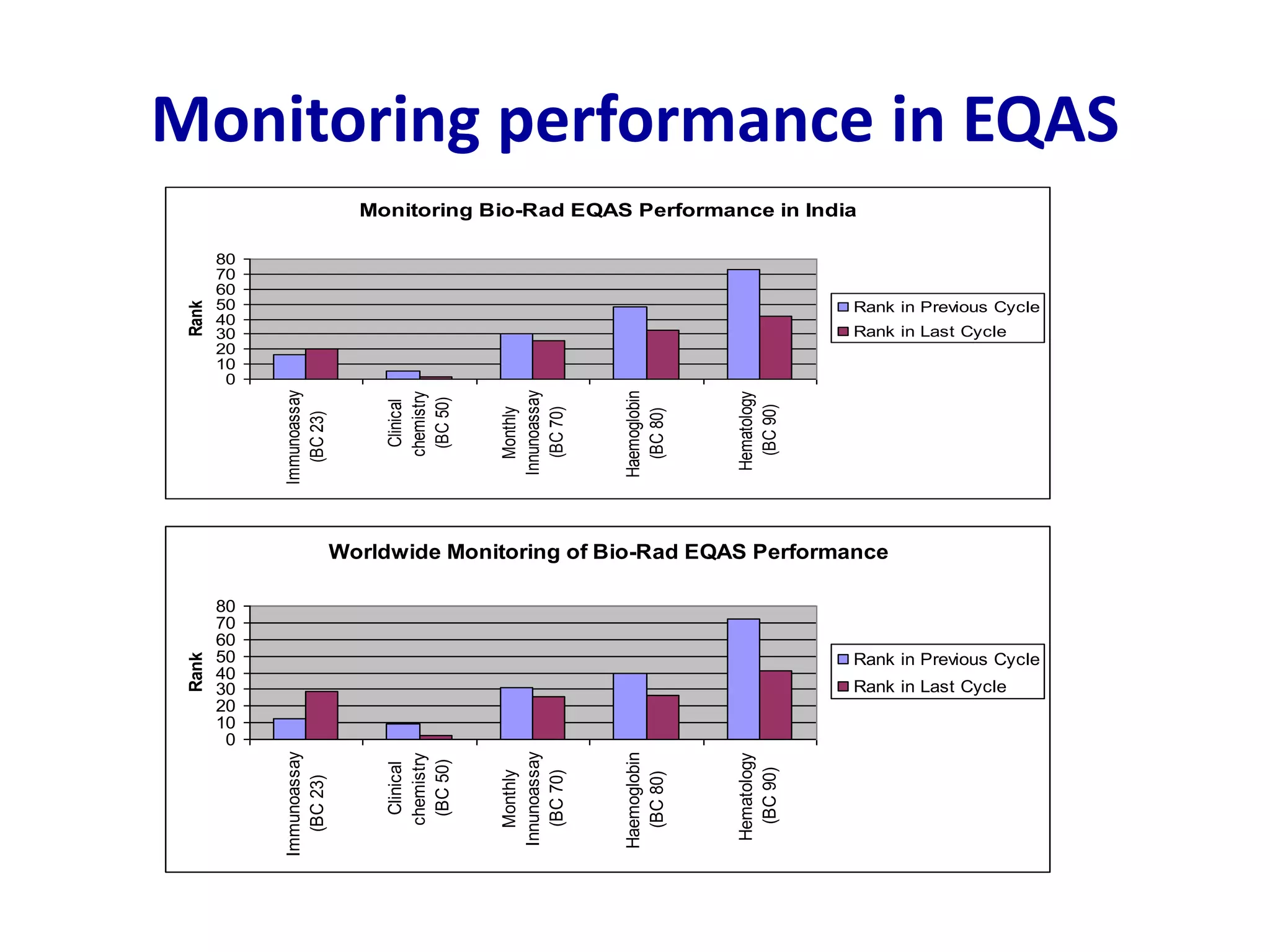
Monitoring performance in EQAS
Monitoring Bio-Rad EQAS Performance in India
0
10
20
30
40
50
60
70
80
Immunoassay
(BC
23)
Clinical
chemistry
(BC
50)
Monthly
Innunoassay
(BC
70)
Haemoglobin
(BC
80)
Hematology
(BC
90)
Rank
Rank in Previous Cycle
Rank in Last Cycle
Worldwide Monitoring of Bio-Rad EQAS Performance
0
10
20
30
40
50
60
70
80
Immunoassay
(BC
23)
Clinical
chemistry
(BC
50)
Monthly
Innunoassay
(BC
70)
Haemoglobin
(BC
80)
Hematology
(BC
90)
Rank
Rank in Previous Cycle
Rank in Last Cycle
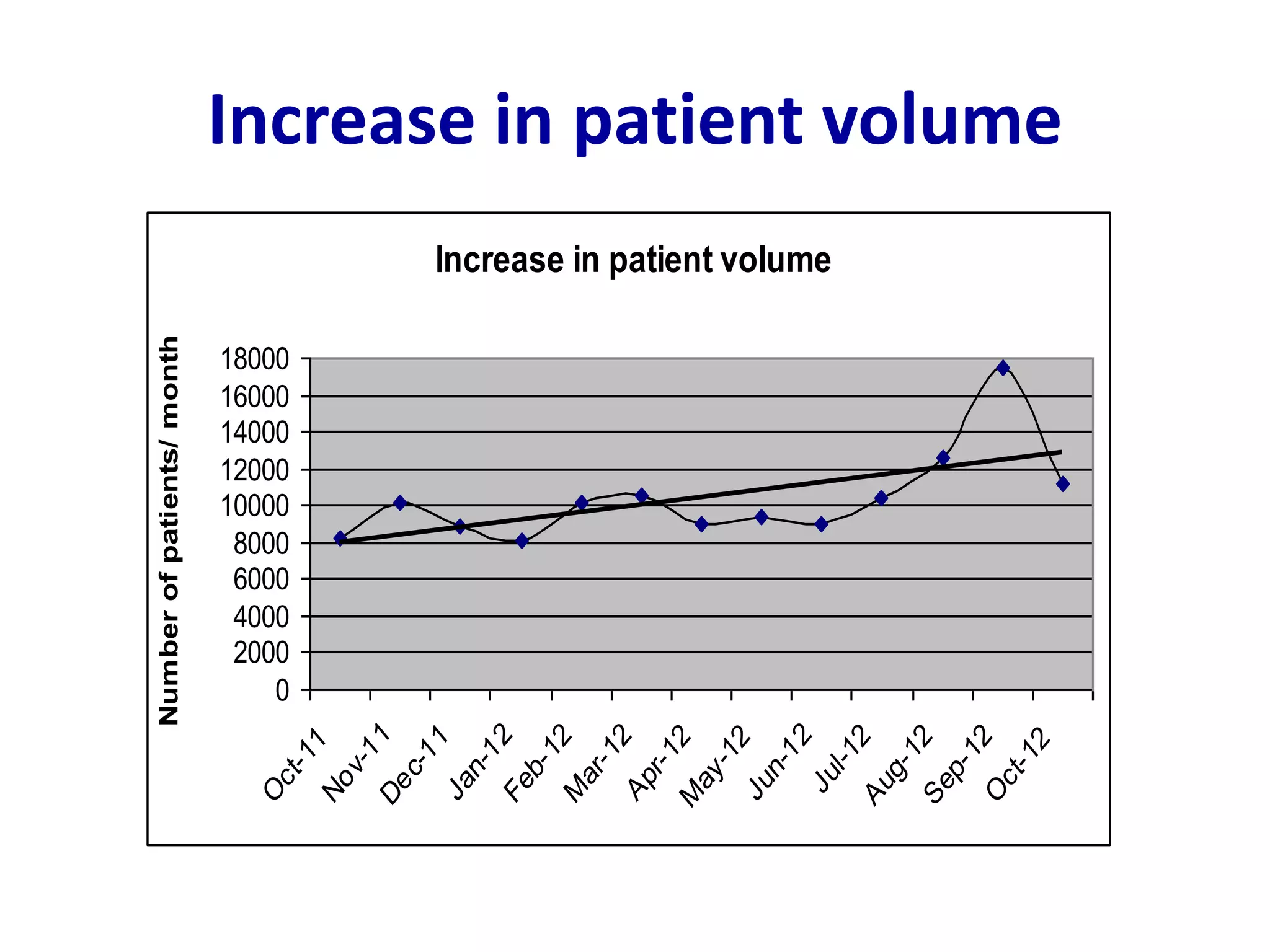
Increase in patient volume
0
2000
4000
6000
8000
10000
12000
14000
16000
18000
O
c
t
-
1
1
N
o
v
-
1
1
D
e
c
-
1
1
J
a
n
-
1
2
F
e
b
-
1
2
M
a
r
-
1
2
A
p
r
-
1
2
M
a
y
-
1
2
J
u
n
-
1
2
J
u
l
-
1
2
A
u
g
-
1
2
S
e
p
-
1
2
O
c
t
-
1
2
Number
of
patients/
month
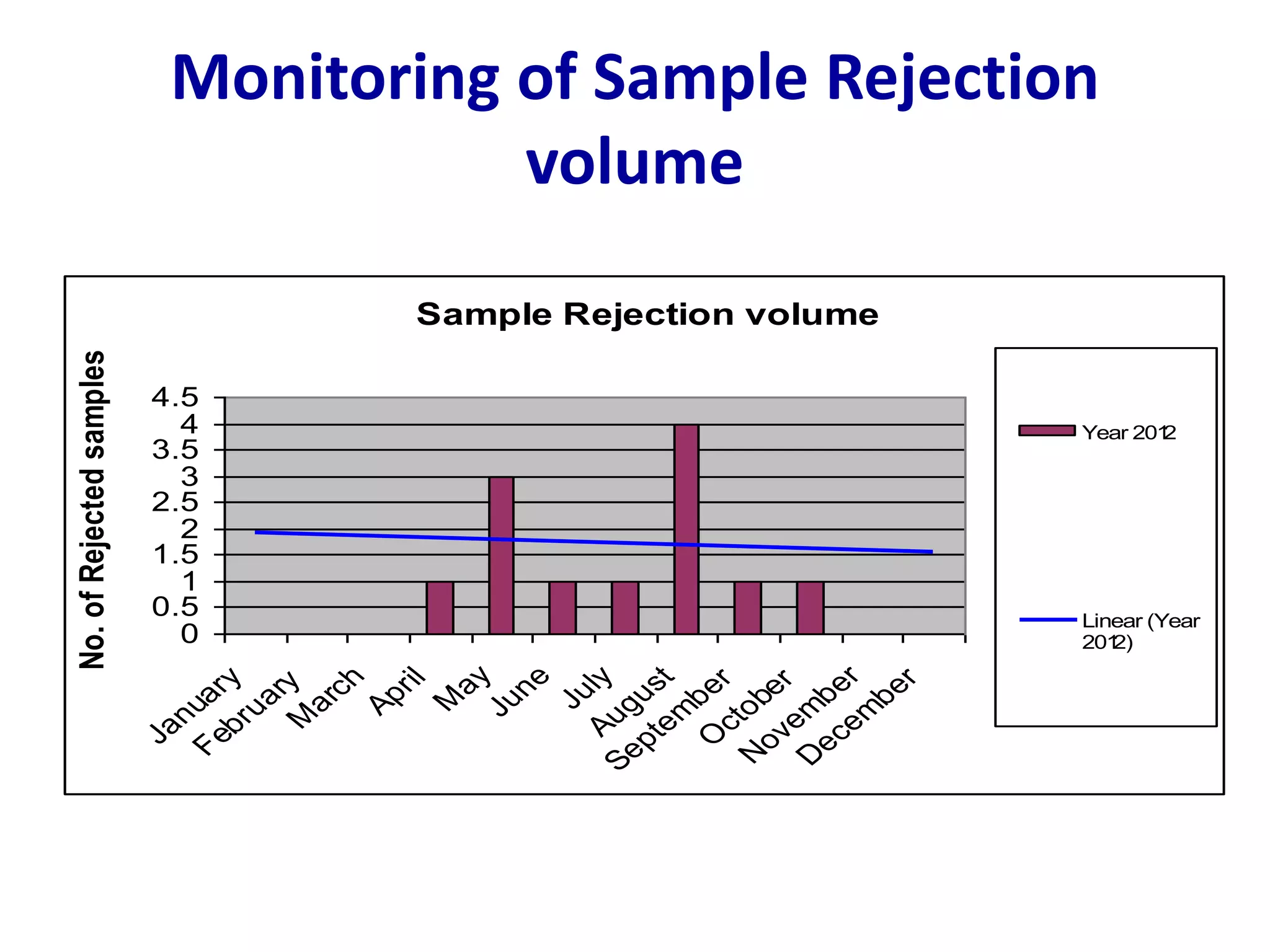
Monitoring of Sample Rejection
volume
Sample Rejection volume
0
0.5
1
1.5
2
2.5
3
3.5
4
4.5
J
a
n
u
a
r
y
F
e
b
r
u
a
r
y
M
a
r
c
h
A
p
r
i
l
M
a
y
J
u
n
e
J
u
l
y
A
u
g
u
s
t
S
e
p
t
e
m
b
e
r
O
c
t
o
b
e
r
N
o
v
e
m
b
e
r
D
e
c
e
m
b
e
r
No.
of
Rejected
samples
Year 201
2
Linear (Year
201
2)
Monitoring of Patients’ complaints
and feedback
Patient Complaints and Feedback
0
0.5
1
1.5
2
2.5
3
3.5
4
4.5
January
February
M
arch
April
M
ay
June
July
August
Septem
ber
O
ctober
Novem
ber
Decem
ber
No.
of
Complaints
and
Feedback
Year 2011 Year 2012
Monitoring of Transcription error
Monitoring of Trainscription Error
0
0.5
1
1.5
2
2.5
J
a
n
u
a
r
y
F
e
b
r
u
a
r
y
M
a
r
c
h
A
p
r
i
l
M
a
y
J
u
n
e
J
u
l
y
A
u
g
u
s
t
S
e
p
t
e
m
b
e
r
O
c
t
o
b
e
r
N
o
v
e
m
b
e
r
D
e
c
e
m
b
e
r
No.
of
Errors
Year 2012
Linear (Year 2012)
Thank You for
Listening
Comments and
Questions

Quality Control in Clinical Chemistry

  • 1.
    ‘Comedy of Errors’ inClinical Laboratory Dr. Diganta Dey Quality Manager Ashok Laboratory Clinical Testing Centre Pvt. Ltd.
  • 2.
    Laboratory Errors Non-conforming resultswith “statistical meaning”. Error Classification Pre-analytical/ Pre-examination –errors before the sample reaches the laboratory Analytical/ Examination –errors during the analysis of the sample Post-analytical/ Post-examination –errors occurring after the analysis
  • 3.
    Pre - AnalyticalErrors • Improper preparation of the patient:- – patient fasting • glucose test – stress and anxiety • urinary protein
  • 4.
    Pre - AnalyticalErrors • Improper preparation of the patient • Improper collection of the blood sample:- – sample haemolysis • LDH, potassium or inorganic phosphate – insufficient sample volume • unable to carry out all requested tests – collection timing • 24 hour urine
  • 5.
    Pre - AnalyticalErrors • Improper preparation of the patient • Improper collection of the blood sample • Incorrect specimen container:- – serum or plasma – fluoride tubes for glucose • to inhibit glycolysis – EDTA unsuitable anti-coagulant for calcium
  • 6.
    • Improper preparationof the patient • Improper collection of the blood sample • Incorrect specimen container • Incorrect specimen storage:- – sample left overnight at room temperature • falsely elevated K, Pi and red cell enzymes – delay in sample delivery • falsely lowered levels of unstable analytes Pre - Analytical Errors
  • 7.
    • The sexof the patient – male or female • The age of the patient – new born / juvenile / adult / geriatric • Dietary effects – low carbohydrate / fat – high protein / fat • When the sample was taken – early morning urine collection pregnancy testing • Patient posture – urinary protein in bed-ridden patients Other Factors
  • 8.
    • Effects ofexercise – creatine kinase / CRP • Medical history – heart disease / diabetes / existing medication • Pregnancy – hormonal effects • Effects of drugs and alcohol – liver enzymes / dehydration Other Factors
  • 9.
    • The sample: AnalyticalErrors – labelling • barcoding / aliquoting – preparation • centrifugation / aspiration – storage temperature • short –term refrigeration • medium term freezing at –20oC • long term freezing at -80oC – correct test selection • Laboratory Information Management System (LIMS)
  • 10.
    • The sample: •Glassware / pipettes / balances: Analytical Errors – used incorrectly – contaminated – poorly calibrated – reuse of pipette tips
  • 11.
    • The sample: •Glassware / pipettes / balances: • Reagents / calibrators / controls: Analytical Errors – poor quality – inappropriate storage • correct temperature • badly maintained fridges or freezers – stability • shelf-life / working reagent – incorrect preparation
  • 12.
    • The sample: •Glassware / pipettes / balances: • Reagents / calibrators / controls: • The application: Analytical Errors – incorrect analytical procedures – poorly optimised instrument settings
  • 13.
    • The sample: •Glassware / pipettes / balances: • Reagents / calibrators / controls: • The application: • The instrument: Analytical Errors – operational limitations • temperature control/read times/mixing/carry-over – lack of maintenance • worn tubing / optics / cuvettes / probes
  • 14.
    Other Factors • Calculationerrors: – incorrect factor / wrong calibration values • Transcription errors: • Dilutions errors: – incorrect dilution or dilution factor used • Lack of training: • The human factor: – tiredness / carelessness / stress
  • 15.
    • The promptand correct delivery of the correct report on the correct patient to the correct Doctor. • How the Clinician interprets the data to the full benefit of the patient. Post - Analytical Errors
  • 16.
    The Quality AssuranceCycle •Data and Lab Management •Safety •Customer Service Patient/Client Prep Sample Collection Sample Receipt and Accessioning Sample Transport Quality Control Record Keeping Reporting Personnel Competency Test Evaluations Testing
  • 17.
    Definitions • Quality Assurance(QA):- – all those planned and systematic actions necessary to provide adequate confidence that a product, process or service will satisfy given requirements for quality • Quality:- – totality of features and characteristic of a product, process or service that bear on its ability to satisfy stated or implied needs • Quality Control (QC):- – operational techniques and activities that are used to fulfil given requirements for quality Reference: Quality management and quality assurance - Vocabulary. ISO 8402. Geneva: ISO, 1994
  • 18.
    Quality is aLousy Idea- If it’s Only an Idea
  • 19.
    QC Decisions arebased on Cost Lab Credibility Patient Care
  • 20.
    Goal of QualityControl: Evaluate and minimize analytical error Use a system approach • Minimize error through following operating protocols – Calibration, maintenance, etc. • Assess daily performance – Internal statistical quality control • Validate accuracy and precision periodically – EQA (proficiency testing)
  • 21.
    Standards and Calibration ndard: –Standards are samples that contain a specific quantity of a single analyte. They provide an accurate determination of a single value. – Standards normally can be traced to a primary standard. – Calibrators are samples that are used to adjust the recovery values to the standard curve at a point in time based on the reagents, temp., etc. – Calibrators “Fine-Tune” or adjust the recovery values to the standard curve. – Peak Area, Beer’s Law: – Graphical representation of the relationship between the concentration of the analyte and The analytical signal
  • 22.
    • Long Shelf-Lifeand Open Vial Stability • Clinically Relevant Levels • Human Based Matrix • Extensive Assayed Values Provided • Comprehensive Range of Products Properties of a QC Material
  • 23.
    Types of QCMaterial • First party control: Patient pools – Levels may not be appropriate – Stability not validated (no expiration date) – Risk of infection may be greater – Time consuming to prepare – Limited long-term supply • Second party control: QC materials may be provided by the instrument and calibrator manufacturer • Third party: Independent to control manufacturer of the test or analyzer
  • 24.
    • Mean • Standarddeviation (SD) • A high standard deviation can be attributed to: • Inherent variability in the test, which represents expected error • Analytical system malfunction, which represents unexpected error that the laboratory must investigate and correct Basic QC Statistics
  • 25.
    Bias • Where Mlabis your lab's mean and Mgroup is the reference value (i.e. proficiency or interlaboratory value)
  • 26.
    Coefficient of Variation •The CV is a more accurate comparator than the standard deviation because the standard deviation typically increases as the concentration of the analyte increases.
  • 27.
    General Requirements of QCMaterials • The QC material used must cover the analytical concentrations encountered. • Low/normal/high, normal/abnormal controls, as appropriate for the test, must be performed. • Controls independent of those produced by the manufacturer of the test or analyzer should be used. Source: The AS 4633 (ISO 15189) Field Application Document - “Supplementary Requirements for accreditation in the field of Medical Testing, NATA, July 2009”
  • 28.
  • 29.
  • 30.
    Three Levels ofControl l Better Informed Decisions l Reduces Number of Repeats
  • 31.
  • 32.
    Determining an AcceptableCV • Precision information provided in the product insert or instrument manual • Interlaboratory comparison programs • Proficiency surveys • Evaluations of instruments and methods published in professional journals These sources are useful for evaluating your CV for a test or when comparing two test systems.
  • 33.
    Multirule QC Random ErrorSystematic Error
  • 34.
    Sources of RandomError 1. Power supply and power fluctuations 2. Double pipetting of control sample 3. Pipette tips not fitting properly 4. A clog in the pipettor/ imprecise pipettor 5. Air bubbles in water supply 6. Occasional air bubbles in sample cups or syringes 7. Random air bubbles in reagent or sample pipette system 8. Incorrect reconstitution of control product 9. Use of non reagent grade water in the test system 10. Operator technique 11. improperly mixed/dissolved reagent
  • 35.
    Sources of SystematicError 1. change in sample or reagent volumes due to pipettor misadjustments or misalignment 2. Drift or shift in temperature of incubator chamber and reaction block 3. In appropriate temperature / humidity levels of testing area 4. Change of reagent / calibrator lot 5. Deterioration of reagent / calibrator/ control while in use, strange or shipment 6. Incorrect handling of control product (freezing when not recommended) 7. Inappropriate storage of control products in frost free freezers 8. Deterioration of a photometric light source 9. Use of non reagent grade water in the test system 10. Recent calibration 11. Change in test operators 12. Specimen carryover 13. Obstruction of tubing
  • 36.
    Calculating a ControlMean and Range • Collect a minimum of twenty data points (in duplicates for 20 days’ i.e. 40 measurements) for each level of control (CLSI approved guideline C24-A3: Statistical Quality Control for Quantitative Measurement procedures: Principles and Definitions) • Calculate the mean and standard deviation • Calculate the statistical control limits from the mean ± 2s and the mean ± 3s.
  • 37.
  • 38.
  • 48.
    Levey-Jennings chart that demonstratesa shift • Down-shift • Partial electric failure in the instrument. • Over diluted new standard • Reagent that undergoes some degree of deterioration then stabilizes • Contaminated reagent(s) • Inaccurate timer (yielding slower times) • Over heating of reaction mixtures • Up-shift • Evaporation of reagents causing a concentrated effect. • Contamination of reagent(s). • Inaccurate timer (yielding faster times). • Under heating of the reaction mixture. • Standard is too concentrated • Contaminated glassware.
  • 49.
    Levey-Jennings chart that demonstratesa trend • Slowly deteriorating reagents • Problems with the instrument tubing • A weakening in the light detector component of the photometer unit.
  • 50.
  • 51.
    Troubleshooting and Westgard Rules Problemidentified by Westgard rule violated Systematic Error (bias): 1-3s, 2-2s, 4-1s, 10x Shifts, drifts, or trends Calibration failure Random Error (imprecision): 1-3s, R-4s Poor reproducibility / Outliers
  • 52.
    Standard Deviation Index SDIvalue Interpretation 0.0 Perfect comparison with consensus group ≤1.25 Acceptable 1.25 – 1.49 Acceptable to marginal performance Some investigation of the test system may be required 1.5 – 1.99 Marginal performance Investigation of the test system is recommended ≥2.0 Unacceptable performance Remedial action usually required
  • 53.
    SDI Levey -Jennings
  • 54.
    Coefficient of VariationRatio • The Coefficient of Variation Ratio (CVR) compares your lab's precision for a specific test to that of other laboratories performing the same test.
  • 55.
    z-score • A z-scoreof 2.3 indicates that the observed value is 2.3 SD away from the expected mean.
  • 56.
    Total Error • Totalerror for a test includes both bias and imprecision as shown by the following formula: • TE = |bias,%| + Z x (Imprecision) • (The Z = 2.33 at 99% confidence level, and 1.65 at 95% confidence level, p<0.01)
  • 57.
    Allowable Total Error(TEa) • Minimum uses 0.75 CVw • TEa < z 0.75 CVw + 0.375 (CVw 2 + CVg 2)1/2 • Desirable uses 0.50 CVw • TEa < z 0.50 CVw + 0.250 (CVw 2 + CVg 2)1/2 • Optimum uses 0.25 CVw • TEa < z 0.25 CVw + 0.125 (CVw 2 + CVg 2)1/2
  • 59.
    Sigma Metrics This isan Equation of Straight line…. Bias= (– Sigma).CV + TEa i.e. y = (- m).x + c
  • 60.
  • 61.
    Method Decision Chart • They-axis represents the allowable bias scaled from 0 to TEa (= 10, for Cholesterol, by CLIA criterion) • The x-axis represents the allowable imprecision scaled from 0 to 0.5 TEa • Point A: 3.0% bias and 3.0% CV, 3 -sigma quality, maximum allowable performance specifications set by NCEP • Point B: 2.0% bias and 2.0% CV, or 4-sigma quality, acceptable and manageable in a clinical laboratory • Point C: 0% bias and 2.0% CV, or 5-sigma quality, easily managed (less QC needed) in a clinical laboratory
  • 62.
    The application ofSigma principles Sigma DPM Batch size QC Rule ≥ 6 3.4 180 1-3.5s 5 233 165 1-3s 4 6,210 35 1-2.5s 3 66,807 <10 Multi-rule 2 3,08,537 Min affordable Multi-rule Source: http://www.westgard.com/essay40.htm
  • 63.
    Critical-size error • ∆SEcrit= [(TEa - biasmeas) / smeas] - z = Sigma – z ∆SEcrit = 2, means that a systematic shift equivalent to 2 times of the CV of the method needs to be detected by the QC procedure. • ∆REcrit = (TEa - biasmeas) / z smeas = Sigma / z ∆REcrit = 2, means a 2-fold increase in the CV needs to be detected by the QC procedure. z defines the tail of the distribution that is allowed to exceed the quality requirement and is often chosen as 1.65 to set a maximum defect rate of 0.05 or 5%.
  • 64.
    Typical response curvefor a detector
  • 65.
    • A powerfunction graph shows the probability of rejection on the y-axis versus the size of error on the x-axis. • Power curves for the 1-2s, 1-3s, and 1-4s control rules with N=1 are shown here. • These are the control rules that would result if the control limits on a Levey- Jennings chart were set as the mean plus/minus 2s, 3s, or 4s Power function graph
  • 66.
    Rejection characteristics • Pfr:The probability for false rejection, is the probability of a rejection occurring when there is no error except for the inherent imprecision of the measurement procedure. In practice, a Pfr of 0.01 is considered ideal and values up to 0.05 or 5% may be practical. • Ped: The probability for error detection, i.e., the probability of rejection when an error is present in addition to the inherent imprecision of the measurement procedure. In practice, a Ped of 0.90, or 90%, can be considered ideal performance because it will generally be much more costly to achieve higher values of 0.95, 0.99, or 1.00.
  • 67.
    How do youuse a power function graph? • The chance of detecting a 3s shift would be 83% by a 1-2s rule, 50% by a 1-3s rule and 16% by a 1-4s rule. • False rejections approximately 5% for the 1-2s rule and would be nearly zero for the 1-3s and 1-4s rules.
  • 68.
    Rejection characteristics ofsingle-rule QC procedures, all having a total N of 2
  • 69.
    Select the control rulesfrom critical- error graph 1. Look for a QC procedure that gives a Ped of 0.90 or greater and a Pfr of 0.05 or less In this example 2. The 1-2s rule will have 9% false rejections and 99% error detection 3. The 1-2.5s rule will give 3% false rejections and 97% error detection 4. The multirule procedure will give 1% false rejections and 95% error detection 5. The 1-3s rule will give essentially 0% false rejections and 91% error detection Best choices The multirule and 1-3s single rule procedures because they provide the necessary error detection with the lowest false rejection rates
  • 70.
    OPSpecs Chart vsSigma Matrics ALT-SGPT (sigma=9.19)
  • 71.
    OPSpecs Chart vsSigma Matrics Glucose (sigma=3.73)
  • 72.
    OPSpecs Chart vsSigma Matrics Calcium (sigma=1.42)
  • 73.
    Evaluation of QualityIndicator • Uncertainty of Measurement • Monitoring performance in EQAS • Increase in patient volume • Monitoring of Sample Rejection volume • Monitoring of Patients’ complaints and feedback • Monitoring of Transcription error
  • 74.
    Uncertainty of Measurement MonitoringMonthly CV% of Creatinine kinase 0 1 2 3 4 5 6 7 Jan-12 Feb-12 Mar-12 Apr-12 May-12 Jun-12 Jul-12 Aug-12 Sep-12 Oct-12 Nov-12 CV% Lot 14410 Level 1 Monitoring Monthly CV% of Creatinine kinase 0 1 2 3 4 5 Jan-12 Feb-12 Mar-12 Apr-12 May-12 Jun-12 Jul-12 Aug-12 Sep-12 Oct-12 Nov-12 CV% Lot 14410 Level 2 Monitoring Monthly CV% of Creatinine kinase 0 1 2 3 4 5 6 7 Jan-12 Feb-12 Mar-12 Apr-12 May-12 Jun-12 Jul-12 Aug-12 Sep-12 Oct-12 Nov-12 CV% Lot 14410 Level 1 Lot 14410 Level 2
  • 75.
    Uncertainty of Measurement MonitoringMonthly CV% of TSH 0 1 2 3 4 5 6 7 Apr- 12 May- 12 Jun- 12 Jul-12 Aug- 12 Sep- 12 Oct- 12 Nov- 12 CV% Lot 40250 Level 3 Lot 40250 Level 2 Lot 40250 Level 1 Monitoring Monthly CV% of TSH 0 1 2 3 4 5 6 7 Apr- 12 May- 12 Jun- 12 Jul- 12 Aug- 12 Sep- 12 Oct- 12 Nov- 12 CV% Lot 40250 Level 1 Lot 40250 Level 2 Lot 40250 Level 3
  • 76.
    Monitoring performance inEQAS Monitoring Bio-Rad EQAS Performance in India 0 10 20 30 40 50 60 70 80 Immunoassay (BC 23) Clinical chemistry (BC 50) Monthly Innunoassay (BC 70) Haemoglobin (BC 80) Hematology (BC 90) Rank Rank in Previous Cycle Rank in Last Cycle Worldwide Monitoring of Bio-Rad EQAS Performance 0 10 20 30 40 50 60 70 80 Immunoassay (BC 23) Clinical chemistry (BC 50) Monthly Innunoassay (BC 70) Haemoglobin (BC 80) Hematology (BC 90) Rank Rank in Previous Cycle Rank in Last Cycle
  • 77.
    Increase in patientvolume Increase in patient volume 0 2000 4000 6000 8000 10000 12000 14000 16000 18000 O c t - 1 1 N o v - 1 1 D e c - 1 1 J a n - 1 2 F e b - 1 2 M a r - 1 2 A p r - 1 2 M a y - 1 2 J u n - 1 2 J u l - 1 2 A u g - 1 2 S e p - 1 2 O c t - 1 2 Number of patients/ month
  • 78.
    Monitoring of SampleRejection volume Sample Rejection volume 0 0.5 1 1.5 2 2.5 3 3.5 4 4.5 J a n u a r y F e b r u a r y M a r c h A p r i l M a y J u n e J u l y A u g u s t S e p t e m b e r O c t o b e r N o v e m b e r D e c e m b e r No. of Rejected samples Year 201 2 Linear (Year 201 2)
  • 79.
    Monitoring of Patients’complaints and feedback Patient Complaints and Feedback 0 0.5 1 1.5 2 2.5 3 3.5 4 4.5 January February M arch April M ay June July August Septem ber O ctober Novem ber Decem ber No. of Complaints and Feedback Year 2011 Year 2012
  • 80.
    Monitoring of Transcriptionerror Monitoring of Trainscription Error 0 0.5 1 1.5 2 2.5 J a n u a r y F e b r u a r y M a r c h A p r i l M a y J u n e J u l y A u g u s t S e p t e m b e r O c t o b e r N o v e m b e r D e c e m b e r No. of Errors Year 2012 Linear (Year 2012)
  • 81.