

PHARMACOVIGILANCE
SUDESHNA BANERJEE DUTTA
SAION
PHARMACOVIGILANCE
➢ “Pharmacovigilance" Pharmakon (Greek for DRUG)
Vigilare (Latin for TO KEEP WATCH)
➢ Pharmacovigilance is the same as ‘DRUG MONITORING’.
DEFINITION
 WHO: The science & activities relating to the detection, assessment,
understanding & prevention of adverse effects or any other medicine
related problem
BIRTH OF PHARMACOVIGILANCE
➢ Collection of data of ADR dates back to early 19th century especially for vaccines
but systematic and stringent system for collection of ADR started only after the
Thalidomide Tragedy in 1960s.
➢ It compelled health agencies and regulators worldwide to deliberate on drug safety
issues.
THALIDOMIDE TRAGEDY
 Thalidomide was a widely used drug in the late 1950s and early 1960s for the
treatment of nausea in pregnant women. It became apparent in the 1960s that
thalidomide treatment resulted in severe birth defects in thousands of children.
 In November 1961, thalidomide was taken off the market due to massive
pressure from the press and public. Experts estimate that thalidomide led
to the death of approximately 2,000 children and serious birth defects in more
than 10,000 children.
Why is pharmacovigilance important?
➢ To protect patients from unnecessary harm
➢ Medicines are supposed to save lives
➢ To reduce healthcare expenses
➢ To improve patient care & safety
TERMINOLOGY
Adverse Drug Reaction
✓ A response which is noxious and unintended effect of drug which occurs at
doses normally used in man for the prophylaxis, diagnosis or therapy of
disease or for the modification of physiological functions.
INDIAN EXPERIENCE
 3.7% of patients in hospitals experienced ADRs
 0.7% of admissions occur due to ADRs
 1.8% fatal ADRs
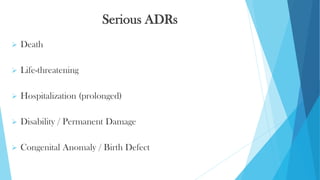
Serious ADRs
➢ Death
➢ Life-threatening
➢ Hospitalization (prolonged)
➢ Disability / Permanent Damage
➢ Congenital Anomaly / Birth Defect
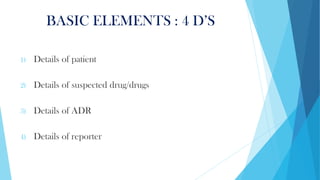
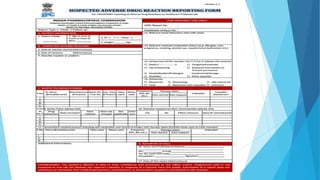
BASIC ELEMENTS : 4 D’S
1) Details of patient
2) Details of suspected drug/drugs
3) Details of ADR
4) Details of reporter
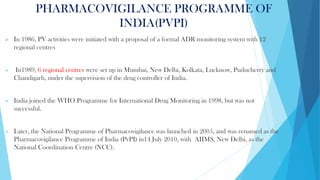
PHARMACOVIGILANCE PROGRAMME OF
INDIA(PVPI)
➢ In 1986, PV activities were initiated with a proposal of a formal ADR monitoring system with 12
regional centres
➢ In1989, 6 regional centres were set up in Mumbai, New Delhi, Kolkata, Lucknow, Puducherry and
Chandigarh, under the supervision of the drug controller of India.
➢ India joined the WHO Programme for International Drug Monitoring in 1998, but was not
successful.
➢ Later, the National Programme of Pharmacovigilance was launched in 2005, and was renamed as the
Pharmacovigilance Programme of India (PvPI) in14 July 2010, with AIIMS, New Delhi, as the
National Coordination Centre (NCC).
➢ The NCC was later shifted from AIIMS to the Indian Pharmacopoeia
Commission (IPC), Ghaziabad, on 15 April 2011, for effective implementation of
the programme.
➢ MoHFW, Government of India through its two inter-collaborative Departments
Central Drug Standard Control Organization (CDSCO) New Delhi &
Indian Pharmacopeia commission(IPC), Ghaziabad
➢ The culture of reporting of ADRs has achieved remarkable success, with 272
PvPI-established AMC all over India and provision of training to healthcare
professionals.
FUNCTIONS OF THE STAKEHOLDERS
ADR Monitoring Centre in Medical College(PvPI AMCs)
 Collection of ADR reports
 Check completeness as per SOPs
 Data entry into Vigiflow
 Reporting to PvPI National Coordinating Centre through Vigiflow with the
source data (original) attached with each ADR case
 Training/ sensitization/ feedback to physicians through newsletters circulated
by the PvPI NCC
ADR Monitoring Centre other than medical colleges
 Collection of ADR reports
 Perform follow up with the complaint to check completeness as per SOP
 Report the data to CDSCO HQ
National Coordinating Centre (IPC GHAZIABAD)
 Preparation of SOPs, guidance documents & training manuals
 Data collection, Cross-check completeness etc as per SOPs
 Conduct Training workshops of all enrolled centers
 Publication of Medicines Safety Newsletter
 Reporting to CDSCO Headquarters
CDSCO, HQ, New Delhi
 Take appropriate regulatory decision & actions on the basis of recommendations
of PvPI NCC at IPC Ghaziabad
 Propagation of medicine safety related decisions to stakeholders
 Collaboration with WHO-Uppsala Monitoring Center – Sweden
 Provide for budgetary provisions & administrative support to run National PvPI
WHO Uppsala Monitoring Centre
➢ WHO started International Drug Monitoring Programme in response to
Thalidomide Disaster
➢ UMC which collects the data from all member countries and mines it to
generate the signal for decision – making on the fate of marketed drugs.
➢ UMC providing tools for data entry, management, retrieval and research.
What to Report?
➢ All known, expected and unexpected ADR (of any severity) with all new or old
drugs
➢ All ADRs either serious or non serious.
➢ Frequent/rare.
➢ Drugs/vaccines/herbal medicines, medical devices, contrast media
➢ Any abnormal laboratory investigation (known/unknown) following drug use.
Who can Report?
➢ Any health care professionals( Doctors including Dentists, nurses
and Pharmacists) & even patient/consumers can report ADRs to
NCC or AMCs
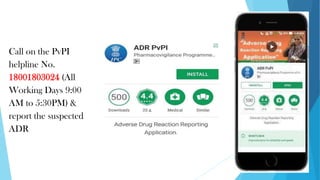
Call on the PvPI
helpline No.
18001803024 (All
Working Days 9:00
AM to 5:30PM) &
report the suspected
ADR
REPORT ADRS
 https://www.ipc.gov.in/PvPI/adr.html
PHARMACOVIGILANCE

PHARMACOVIGILANCE

  • 1.
  • 2.
    PHARMACOVIGILANCE ➢ “Pharmacovigilance" Pharmakon(Greek for DRUG) Vigilare (Latin for TO KEEP WATCH) ➢ Pharmacovigilance is the same as ‘DRUG MONITORING’.
  • 3.
    DEFINITION  WHO: Thescience & activities relating to the detection, assessment, understanding & prevention of adverse effects or any other medicine related problem
  • 4.
    BIRTH OF PHARMACOVIGILANCE ➢Collection of data of ADR dates back to early 19th century especially for vaccines but systematic and stringent system for collection of ADR started only after the Thalidomide Tragedy in 1960s. ➢ It compelled health agencies and regulators worldwide to deliberate on drug safety issues.
  • 5.
    THALIDOMIDE TRAGEDY  Thalidomidewas a widely used drug in the late 1950s and early 1960s for the treatment of nausea in pregnant women. It became apparent in the 1960s that thalidomide treatment resulted in severe birth defects in thousands of children.  In November 1961, thalidomide was taken off the market due to massive pressure from the press and public. Experts estimate that thalidomide led to the death of approximately 2,000 children and serious birth defects in more than 10,000 children.
  • 6.
    Why is pharmacovigilanceimportant? ➢ To protect patients from unnecessary harm ➢ Medicines are supposed to save lives ➢ To reduce healthcare expenses ➢ To improve patient care & safety
  • 7.
    TERMINOLOGY Adverse Drug Reaction ✓A response which is noxious and unintended effect of drug which occurs at doses normally used in man for the prophylaxis, diagnosis or therapy of disease or for the modification of physiological functions.
  • 8.
    INDIAN EXPERIENCE  3.7%of patients in hospitals experienced ADRs  0.7% of admissions occur due to ADRs  1.8% fatal ADRs
  • 9.
    Serious ADRs ➢ Death ➢Life-threatening ➢ Hospitalization (prolonged) ➢ Disability / Permanent Damage ➢ Congenital Anomaly / Birth Defect
  • 10.
    BASIC ELEMENTS :4 D’S 1) Details of patient 2) Details of suspected drug/drugs 3) Details of ADR 4) Details of reporter
  • 12.
    PHARMACOVIGILANCE PROGRAMME OF INDIA(PVPI) ➢In 1986, PV activities were initiated with a proposal of a formal ADR monitoring system with 12 regional centres ➢ In1989, 6 regional centres were set up in Mumbai, New Delhi, Kolkata, Lucknow, Puducherry and Chandigarh, under the supervision of the drug controller of India. ➢ India joined the WHO Programme for International Drug Monitoring in 1998, but was not successful. ➢ Later, the National Programme of Pharmacovigilance was launched in 2005, and was renamed as the Pharmacovigilance Programme of India (PvPI) in14 July 2010, with AIIMS, New Delhi, as the National Coordination Centre (NCC).
  • 13.
    ➢ The NCCwas later shifted from AIIMS to the Indian Pharmacopoeia Commission (IPC), Ghaziabad, on 15 April 2011, for effective implementation of the programme. ➢ MoHFW, Government of India through its two inter-collaborative Departments Central Drug Standard Control Organization (CDSCO) New Delhi & Indian Pharmacopeia commission(IPC), Ghaziabad ➢ The culture of reporting of ADRs has achieved remarkable success, with 272 PvPI-established AMC all over India and provision of training to healthcare professionals.
  • 14.
    FUNCTIONS OF THESTAKEHOLDERS ADR Monitoring Centre in Medical College(PvPI AMCs)  Collection of ADR reports  Check completeness as per SOPs  Data entry into Vigiflow  Reporting to PvPI National Coordinating Centre through Vigiflow with the source data (original) attached with each ADR case  Training/ sensitization/ feedback to physicians through newsletters circulated by the PvPI NCC
  • 15.
    ADR Monitoring Centreother than medical colleges  Collection of ADR reports  Perform follow up with the complaint to check completeness as per SOP  Report the data to CDSCO HQ National Coordinating Centre (IPC GHAZIABAD)  Preparation of SOPs, guidance documents & training manuals  Data collection, Cross-check completeness etc as per SOPs  Conduct Training workshops of all enrolled centers  Publication of Medicines Safety Newsletter  Reporting to CDSCO Headquarters
  • 16.
    CDSCO, HQ, NewDelhi  Take appropriate regulatory decision & actions on the basis of recommendations of PvPI NCC at IPC Ghaziabad  Propagation of medicine safety related decisions to stakeholders  Collaboration with WHO-Uppsala Monitoring Center – Sweden  Provide for budgetary provisions & administrative support to run National PvPI
  • 17.
    WHO Uppsala MonitoringCentre ➢ WHO started International Drug Monitoring Programme in response to Thalidomide Disaster ➢ UMC which collects the data from all member countries and mines it to generate the signal for decision – making on the fate of marketed drugs. ➢ UMC providing tools for data entry, management, retrieval and research.
  • 18.
    What to Report? ➢All known, expected and unexpected ADR (of any severity) with all new or old drugs ➢ All ADRs either serious or non serious. ➢ Frequent/rare. ➢ Drugs/vaccines/herbal medicines, medical devices, contrast media ➢ Any abnormal laboratory investigation (known/unknown) following drug use.
  • 19.
    Who can Report? ➢Any health care professionals( Doctors including Dentists, nurses and Pharmacists) & even patient/consumers can report ADRs to NCC or AMCs
  • 21.
    Call on thePvPI helpline No. 18001803024 (All Working Days 9:00 AM to 5:30PM) & report the suspected ADR
  • 22.