HEAD INJURY
SUDESHNA BANERJEE DUTTA
LECTURER
S.R.S.V.M B.SC NURSING COLLEGE
HEAD INJURY
 Traumatic brain injury (TBI) is a noncongenital insult to
the brain from an external mechanical force, possibly
leading to permanent or temporary impairment of
cognitive, physical, and psychosocial functions, with an
associated diminished or altered state of consciousness
ETIOLOGY
 Motor vehicle accidents
 Falls
 Assaults
 Sports-related injuries
 Fire-related injuries
MECHANISM OF INJURY
 COUP-CONTRECOUP INJURY: The French word “coup”
means “blow”.
 The client sustained a combined injury at the point of
impact & an injury on the site of the brain opposite from
the movement of the brain within the skull.
 Contrecoup: Means opposite side away from the injury.
COUP-CONTRECOUP INJURY
MECHANISM OF INJURY cont…
 PENETRATING TRAUMA: A form of primary injury
include injury to the skull by any foreign body such as
knife, bullets or those made by bone fragments from a
skull fracture.
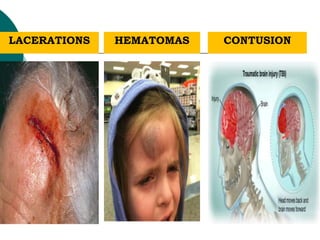
 SCALP INJURIES:
 Lacerations: A deep cut or tear on the skin
 Hematomas: Localized collection of blood outside the
blood vessels
 Contusion: Bleeding & swelling inside brain around the
area where the head was struck.
PENETRATING TRAUMA
LACERATIONS HEMATOMAS CONTUSION
MECHANISM OF INJURY cont…
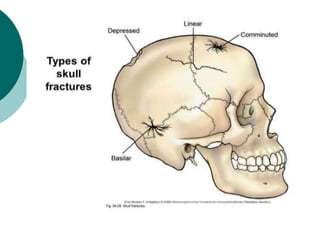
 SKULL FRACTURES:
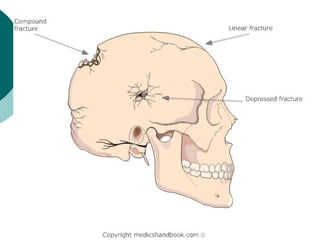
 Linear SF : Appear as thin lines on X-Ray & don’t require
treatment, they are important only if there is significant
underlying brain damage.
 Depressed SF: May be palpated & are seen on X-Ray.
 A Compound fracture involves a break in, or loss of, skin
and splintering of the bone
SKULL FRACTURES cont…
 Comminuted fractures in which broken bones displace
inward
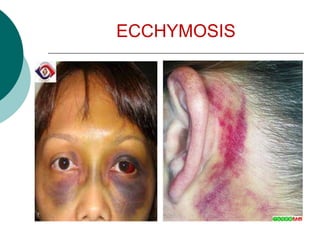
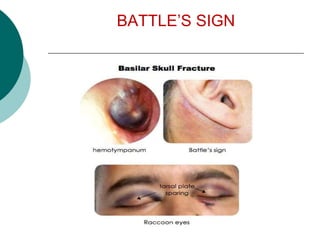
 Basilar SF: Occur in bones over the base of frontal &
temporal lobes. Not observable on X-ray but,
manifested as “Ecchymosis” around the eyes or behind
the ears by leakage of blood or CSF from ears.
ECCHYMOSIS
MECHANISM OF INJURY cont…
 BRAIN INJURIES:
 Concussion: A head trauma that may result in loss of
consciousness from 5mins or less & retrograde amnesia
there is no break in skull & no damage is visible on CT or
MRI scan.
 Contusion: A contusion is a bleeding bruise to the brain
caused by a direct impact to the head.
SIGN AND SYMPTOMS
 CSF or other fluids draining from the ear or nose
 Blood behind the tympanic membrane
 Battle’s sign
 Vision changes & damage of optic nerve
 Hearing loss
 Loss of sense of smell
 Loss of eye movement
 Nystagmus
BATTLE’S SIGN
SIGN AND SYMPTOMS cont…
 Loss of consciousness
 Retrograde amnesia
 Post traumatic amnesia
 Headache
 Vomiting
 Seizures
 Unilateral facial paresis
 Vertigo
DIAGNOSTIC INVESTIGATIONS
 History collection and physical examination
 Complete blood count
 CT SCAN
 MRI
 Electroencephalography (EEG)
 Positron emission tomography
 X-RAY
MANAGEMENT
 INITIAL MANAGEMENT
 A: Airway control including cervical spine
immobilization with a stiff collar.
 B: Breathing
 C: Circulation
MANAGEMENT cont…
 CONTROL OF INTRACRANIAL PRESSURE:
 Position head up 30º
 Diuretics: Furosemide,
 Mannitol
 Seizure control: Barbiturates
 CALCIUM CHANNEL BLOCKERS
 OXYGENATION
SURGICAL MANAGEMENT
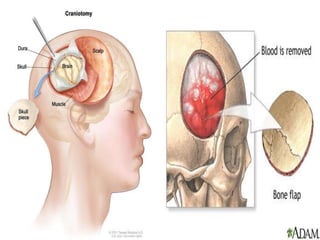
 Craniotomy: Bone flap is temporarily removed
from the skull to access the brain
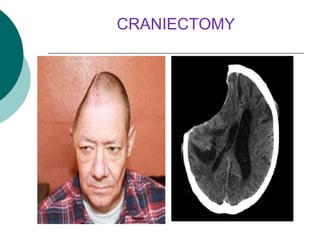
 Craniectomy : Excision into the cranium to cut
away a bone flap
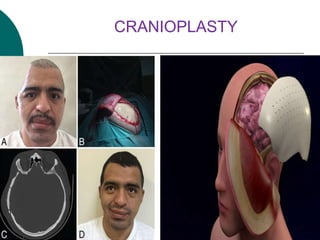
 Cranioplasty : Surgical repair of a defect or
deformity of a skull
CRANIECTOMY
CRANIOPLASTY
NURSING DIAGNOSIS
 Ineffective tissue perfusion (cerebral)
 Acute pain (headache) related to trauma and cerebral
edema
 Hyperthermia related to loss of cerebral integrative
function secondary to possible hypothalamus injury
 Impaired physical mobility related to decreased LOC and
treatment –imposed bed rest
NURSING DIAGNOSIS
 Fluid volume deficit related to decrease LOC and
hormonal dysfunction.
 Risk for injury related to decreased level of
consciousness.
 Knowledge deficit regarding the treatment modalities and
current situation.
 Anxiety related to abrupt change in health status,
hospital environment and uncertain future
Head injury

Head injury

  • 1.
    HEAD INJURY SUDESHNA BANERJEEDUTTA LECTURER S.R.S.V.M B.SC NURSING COLLEGE
  • 2.
    HEAD INJURY  Traumaticbrain injury (TBI) is a noncongenital insult to the brain from an external mechanical force, possibly leading to permanent or temporary impairment of cognitive, physical, and psychosocial functions, with an associated diminished or altered state of consciousness
  • 3.
    ETIOLOGY  Motor vehicleaccidents  Falls  Assaults  Sports-related injuries  Fire-related injuries
  • 4.
    MECHANISM OF INJURY COUP-CONTRECOUP INJURY: The French word “coup” means “blow”.  The client sustained a combined injury at the point of impact & an injury on the site of the brain opposite from the movement of the brain within the skull.  Contrecoup: Means opposite side away from the injury.
  • 5.
  • 6.
    MECHANISM OF INJURYcont…  PENETRATING TRAUMA: A form of primary injury include injury to the skull by any foreign body such as knife, bullets or those made by bone fragments from a skull fracture.  SCALP INJURIES:  Lacerations: A deep cut or tear on the skin  Hematomas: Localized collection of blood outside the blood vessels  Contusion: Bleeding & swelling inside brain around the area where the head was struck.
  • 7.
  • 8.
  • 9.
    MECHANISM OF INJURYcont…  SKULL FRACTURES:  Linear SF : Appear as thin lines on X-Ray & don’t require treatment, they are important only if there is significant underlying brain damage.  Depressed SF: May be palpated & are seen on X-Ray.  A Compound fracture involves a break in, or loss of, skin and splintering of the bone
  • 11.
    SKULL FRACTURES cont… Comminuted fractures in which broken bones displace inward  Basilar SF: Occur in bones over the base of frontal & temporal lobes. Not observable on X-ray but, manifested as “Ecchymosis” around the eyes or behind the ears by leakage of blood or CSF from ears.
  • 13.
  • 14.
    MECHANISM OF INJURYcont…  BRAIN INJURIES:  Concussion: A head trauma that may result in loss of consciousness from 5mins or less & retrograde amnesia there is no break in skull & no damage is visible on CT or MRI scan.  Contusion: A contusion is a bleeding bruise to the brain caused by a direct impact to the head.
  • 15.
    SIGN AND SYMPTOMS CSF or other fluids draining from the ear or nose  Blood behind the tympanic membrane  Battle’s sign  Vision changes & damage of optic nerve  Hearing loss  Loss of sense of smell  Loss of eye movement  Nystagmus
  • 16.
  • 17.
    SIGN AND SYMPTOMScont…  Loss of consciousness  Retrograde amnesia  Post traumatic amnesia  Headache  Vomiting  Seizures  Unilateral facial paresis  Vertigo
  • 18.
    DIAGNOSTIC INVESTIGATIONS  Historycollection and physical examination  Complete blood count  CT SCAN  MRI  Electroencephalography (EEG)  Positron emission tomography  X-RAY
  • 19.
    MANAGEMENT  INITIAL MANAGEMENT A: Airway control including cervical spine immobilization with a stiff collar.  B: Breathing  C: Circulation
  • 20.
    MANAGEMENT cont…  CONTROLOF INTRACRANIAL PRESSURE:  Position head up 30º  Diuretics: Furosemide,  Mannitol  Seizure control: Barbiturates  CALCIUM CHANNEL BLOCKERS  OXYGENATION
  • 21.
    SURGICAL MANAGEMENT  Craniotomy:Bone flap is temporarily removed from the skull to access the brain  Craniectomy : Excision into the cranium to cut away a bone flap  Cranioplasty : Surgical repair of a defect or deformity of a skull
  • 23.
  • 24.
  • 25.
    NURSING DIAGNOSIS  Ineffectivetissue perfusion (cerebral)  Acute pain (headache) related to trauma and cerebral edema  Hyperthermia related to loss of cerebral integrative function secondary to possible hypothalamus injury  Impaired physical mobility related to decreased LOC and treatment –imposed bed rest
  • 26.
    NURSING DIAGNOSIS  Fluidvolume deficit related to decrease LOC and hormonal dysfunction.  Risk for injury related to decreased level of consciousness.  Knowledge deficit regarding the treatment modalities and current situation.  Anxiety related to abrupt change in health status, hospital environment and uncertain future