AneurysmAneurysm
Prepared by:
Anupama Pradhan
Lecturer, SCMS,
Nepal
AneurysmAneurysm
An aneurysm is a distention of an artery brought by a
weakening/ destruction of the arterial wall.
An aneurysm is a balloon-like bulge in an artery.
Types of AneurysmsTypes of Aneurysms
There are two main types of aneurysms:
1. Aortic aneurysm - There are two types
of aortic aneurysm
- Abdominal aortic aneurysm and
- Thoracic aortic aneurysm
2. Cerebral aneurysm - occurs in an artery
in the brain.
3. Others: Peripheral Aneurysm
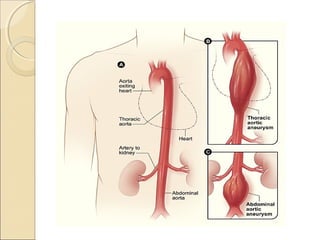
Abdominal Aortic Aneurysms
An aneurysm that occurs in the abdominal
portion of the aorta is called an abdominal
aortic aneurysm (AAA). Most aortic
aneurysms are AAAs.
Thoracic Aortic Aneurysms
An aneurysm that occurs in the chest
portion of the aorta (above the diaphragm)
is called a thoracic aortic aneurysm (TAA).
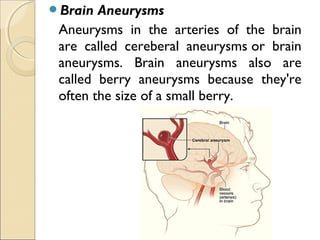
Brain Aneurysms
Aneurysms in the arteries of the brain
are called cereberal aneurysms or brain
aneurysms. Brain aneurysms also are
called berry aneurysms because they're
often the size of a small berry.
Peripheral Aneurysms
◦ Aneurysms that occur in arteries other than
the aorta and the brain arteries are called
peripheral aneurysms.
◦ Common locations for peripheral
aneurysms include the popliteal, femoral
and carotid arteries.
Causes:Causes:
Abdominal aortic aneurysm causes:
 Atherosclerosis
Smoking
Hypertension -
Vasculitis (infection in the aorta) -
Cocaine use
Genetic factors
Thoracic aortic aneurysm causes: 
About 1 in 4 aortic aneurysms occur in the
thoracic area of the aorta (higher up in the
chest). Causes are the same as with aortic
aneurysms, plus the following below:
Marfan Syndrome - this is a genetic
disorder of the connective tissue; it is a much
less common cause of aortic aneurysm.
 Previous aorta injury
Traumatic injury - cause by a vehicle
accident or a bad fall.
Brain (cerebral) aneurysm causes:
Weakness in the artery wall (usually present
since birth)
Hypertension
Arteriosclerosis (plaques of cholestrol,
platelets, fibrin, and other substance form on the
arterial wall)
Most cerebral aneurysms develop at the forks or
branches in arteries because the walls in these
sections are weaker. They most commonly form
at the base of the brain - but can form anywhere
in the brain. 
Clinical manifestation:Clinical manifestation:
Abdominal Aortic Aneurysms
A throbbing feeling in the abdomen
Deep pain in back or the side of the abdomen
Steady, gnawing pain in the abdomen that lasts for
hours or days
If an AAA ruptures, symptoms may include :
Sudden, severe pain in lower abdomen and back;
Nausea and vomiting;
Constipation
Problems with urination
Clammy, sweaty skin
Light-headedness
Rapid heart rate when standing up
Shock
Thoracic Aortic Aneurysms
Pain in jaw, neck, back, or chest 
Coughing and/or hoarseness
Shortness of breath and/or trouble breathing
or swallowing
Loss of voice
If a TAA ruptures or dissects
Sudden, severe, sharp or stabbing pain
starting in the upper back and moving down
into the abdomen.
Pain in chest and arms, and pt. can quickly go
into shock.
Cerebral (brain) aneurysm symptoms
The following symptoms may be experienced
before a cerebral aneurysm ruptures:
Very severe headache that occurs suddenly
Nausea
Vomiting
Eyesight problems
Seizures (fits)
Loss of consciousness
Confusion
A drooping eyelid
Stiff neck
Light sensitivity
If the cerebral aneurism bursts it will cause bleeding
in the brain and a hemorrhagic stroke - it can also
cause intracranial hematoma
Risk factors:Risk factors:
 Male gender - Men are more likely than women to have
aortic aneurysms.
 Age - Abdominal aortic aneurysms are more likely to occur in
people who are aged 65 or older.
 Smoking - Smoking can damage and weaken the walls of the
aorta.
 Family history - People who have family histories of aortic
aneurysms are at higher risk for the condition, and they may
have aneurysms before the age of 65.
 History of aneurysms in the arteries of the legs.
 Certain diseases and conditions that weaken the walls of the
aorta. Such as high BP and atherosclerosis
 Having a bicuspid aortic valve - can raise the risk of
having a thoracic aortic aneurysm. A bicuspid aortic valve has
two leaflets instead of the typical three.
 Car accidents or trauma - also can injure the arteries and
increase the risk for aneurysms.
Diagnostic test:Diagnostic test:
Abdominal or chest X-ray may show calcification
that outline aneurysm
Ultrasound and Echocardiography: These tests
can show the size of an aortic aneurysm
Computed Tomography Scan
A computed tomography scan, or CT scan : CT
scan can show the size and shape of an aneurysm.
Magnetic Resonance Imaging: detect
aneurysms and pinpointing their size and exact
location.
Angiography: This test shows the amount of
damage and blockage in blood vessels.
Management:Management:
The goals of management may include:
Preventing the aneurysm from growing
Preventing or reversing damage to other
body structures
Preventing or treating a rupture or
dissection
Allowing the pt. to continue doing their
normal daily activities
Medical management:Medical management:
In aortic aneurysm: Medicines are used
to lower blood pressure, relax blood
vessels, and lower the risk that the
aneurysm will rupture (burst).
Beta blockers and calcium channel
blockers are the medicines most
commonly used.
Cerebral aneurysm treatmentsCerebral aneurysm treatments
It help to relieve symptoms as well as managing
complications:
 Painkillers - usually for headaches.
 Calcium channel blockers - these stop calcium for entering
cells of the blood vessel walls. They reduce the amount of
widening and narrowing of blood vessels; often a
complication of a ruptured aneurysm.
 A vassopressor - this is an injected drug which raises
blood pressure; widens blood vessels which have remained
stubbornly narrowed. The aim is to prevent stroke.
 Anti-seizure drugs - seizures may occur after an aneurysm
has ruptures. Examples include levetiracetam (Keppra),
phenytoin (Dilantin, Phenytek, others) and valproic acid
A ventricular catheter - this can reduce the pressure
on the brain caused by hydrocephalus (excess
cerebrospinal fluid). The catheter, which is placed in
the spaces filled with fluid inside the brain, drains the
excess liquid into an external bag. It may be necessary
to place a shunt system - a shunt (flexible silicone
rubber tube) and a valve. The shunt system is a
drainage channel that starts in the brain and ends in
the patient's abdominal cavity.
Rehabilitation therapy - sometimes a subarachnoid
hemorrhage causes brain damage, resulting in impaired
speech and bodily movements. Rehabilitation therapy
helps the patient relearn vital skills.
Surgical management:Surgical management:
The two main types of surgery to repair aortic aneurysms are:
1. Open Abdominal or Open Chest Repair
 In aortic aneurysms, open abdominal or open chest repair. This surgery
involves a major incision (cut) in the abdomen or chest.
 General anesthesia is used during this procedure. During the surgery, the
aneurysm is removed. Then, the section of aorta is replaced with a graft
made of material such as Dacronor Teflon
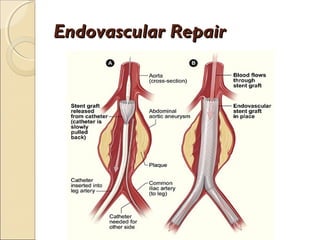
2. Endovascular Repair
 In endovascular repair, the aneurysm isn't removed. Instead, a graft is
inserted into the aorta to strengthen it.
 The surgeon first inserts a catheter into an artery in the groin (upper thigh)
and threads it to the aneurysm. Then, using an x ray to see the artery, the
surgeon threads the graft (also called a stent graft) into the aorta to the
aneurysm.
 The graft is then expanded inside the aorta and fastened in place to form a
stable channel for blood flow. The graft reinforces the weakened section of
the aorta. This helps prevent the aneurysm from rupturing.
Brain aneurysms:Brain aneurysms:
Brain aneurysms have two options if the
aneurysm has ruptured:
Surgical clipping - the aneurysm is
closed off. The surgeon removes a
section of the skull to get to the
aneurysm and finds the blood vessel that
feeds it. A tiny metal clip is placed on the
neck of the aneurysm to block off the
blood flow to it.
Endovascular Repair
Endovascular RepairEndovascular Repair
PreventionPrevention
A large percentage of aneurysms are caused by
arteriosclerosis. The following steps will help prevent
the development of arteriosclerosis and aneurysms:
Quit smoking
Keep blood pressure under control
Keep blood cholesterol levels under control
Eat a healthy, well balanced diet, rich in fruit and
vegetables, unrefined carbohydrate, dietary fiber,
good quality fats, and lean protein
Keep bodyweight within the ideal limits for height
Get at least 7 hours of good quality sleep each night
Keep yourself physically active (check with your
doctor that this is OK for you)
ComplicationsComplications
Haemorrhage leading to shock and even death
Myocardial ischemia
Stroke
Paraplegia due to interruption of anterior spinal
artery
Abdominal ischemia
Graft occlusion
Graft infection
Acute renal failure
Lower extremity ischemia A cerebral aneurysm
rupture causes :
Nursing management:Nursing management:
Nursing assessment:Nursing assessment:
1. In pt. with thoracoabdominal aortic aneurysm,
be alert for sudden onset of sharp, ripping or
tearing pain located in anterior chest,
epigastric area, shoulders or back, indicating
acute dissection or rupture.
2. In pt. with abdominal aortic aneurysm, assess
for abdominal (particular left lower quadrant)
pain and intense lower back pain caused by
rapid expansion. Ne alert for syncope,
tachycardia, and hypotension which may be
followed by fatal haemorrhage due to rupture
Nursing Dx:Nursing Dx:
Ineffective tissue perfusion (Vital organs)
r/t aneurysm or aneurysm rupture
Risk for infection r/t surgery
Acute pain r/t pressure of aneurysm on
nerves and postoperatively
Nursing interventions:Nursing interventions:
Maintaining perfusion of vital organs:Maintaining perfusion of vital organs:
Preoperatively:
1. Assess for chest pain and abdominal pain
2. Prepare patient for diagnostic studies or
surgery as indicated
3. Monitor for s/s of hypovolemic shock
4. Examine neurovascular distal extremities
Postoperatively
1. Monitor vital signs frequently
2. Assess for s/s of bleeding
- Hypotension, tachycardia, tachypnea,
daiphoresis
3. Monitor laboratory values as ordered
4. Monitor urine output hourly
5. If throracoabdominal aneurysm repair
has been performed , monitor for s/s of
spinal cord ischemia:
- pain, numbness, paresthesia, weakness
Preventing infection:Preventing infection:
Monitor temperature
Monitor changes in WBC count
Monitor incision for signs of infection
Administer antibiotics as ordered
Relieving pain:Relieving pain:
Provide diversional therapy like listening
music, reading newspaper etc.
Place the patient in comfortable position
Administer pain medication as ordered
Keep head of bed elevated no more than
45 degrees for the first 3 days
postoperatively to prevent pressure on
incision site
Assess abdomen for bowel sounds and
distention.
Patient education:Patient education:
Instruct pt. about medications to control
BP and the importance of taking them
Discuss disease process and s/s of
expanding aneurysm or impending
rupture, or rupture to be reported
For postsurgical pt. discuss warning signs
of postoperative complicaitons (fever,
inflammation of operative site, bleeding
and swelling)
Encourage adequate balanced intake for
wound healing
Encourage patient to maintain an
exercise schedule postoperatively

Anuerysm

  • 1.
  • 2.
    AneurysmAneurysm An aneurysm isa distention of an artery brought by a weakening/ destruction of the arterial wall. An aneurysm is a balloon-like bulge in an artery.
  • 3.
    Types of AneurysmsTypesof Aneurysms There are two main types of aneurysms: 1. Aortic aneurysm - There are two types of aortic aneurysm - Abdominal aortic aneurysm and - Thoracic aortic aneurysm 2. Cerebral aneurysm - occurs in an artery in the brain. 3. Others: Peripheral Aneurysm
  • 5.
    Abdominal Aortic Aneurysms Ananeurysm that occurs in the abdominal portion of the aorta is called an abdominal aortic aneurysm (AAA). Most aortic aneurysms are AAAs. Thoracic Aortic Aneurysms An aneurysm that occurs in the chest portion of the aorta (above the diaphragm) is called a thoracic aortic aneurysm (TAA).
  • 6.
    Brain Aneurysms Aneurysms inthe arteries of the brain are called cereberal aneurysms or brain aneurysms. Brain aneurysms also are called berry aneurysms because they're often the size of a small berry.
  • 7.
    Peripheral Aneurysms ◦ Aneurysmsthat occur in arteries other than the aorta and the brain arteries are called peripheral aneurysms. ◦ Common locations for peripheral aneurysms include the popliteal, femoral and carotid arteries.
  • 8.
    Causes:Causes: Abdominal aortic aneurysmcauses:  Atherosclerosis Smoking Hypertension - Vasculitis (infection in the aorta) - Cocaine use Genetic factors
  • 9.
    Thoracic aortic aneurysmcauses:  About 1 in 4 aortic aneurysms occur in the thoracic area of the aorta (higher up in the chest). Causes are the same as with aortic aneurysms, plus the following below: Marfan Syndrome - this is a genetic disorder of the connective tissue; it is a much less common cause of aortic aneurysm.  Previous aorta injury Traumatic injury - cause by a vehicle accident or a bad fall.
  • 10.
    Brain (cerebral) aneurysmcauses: Weakness in the artery wall (usually present since birth) Hypertension Arteriosclerosis (plaques of cholestrol, platelets, fibrin, and other substance form on the arterial wall) Most cerebral aneurysms develop at the forks or branches in arteries because the walls in these sections are weaker. They most commonly form at the base of the brain - but can form anywhere in the brain. 
  • 11.
    Clinical manifestation:Clinical manifestation: AbdominalAortic Aneurysms A throbbing feeling in the abdomen Deep pain in back or the side of the abdomen Steady, gnawing pain in the abdomen that lasts for hours or days If an AAA ruptures, symptoms may include : Sudden, severe pain in lower abdomen and back; Nausea and vomiting; Constipation Problems with urination Clammy, sweaty skin Light-headedness Rapid heart rate when standing up Shock
  • 12.
    Thoracic Aortic Aneurysms Painin jaw, neck, back, or chest  Coughing and/or hoarseness Shortness of breath and/or trouble breathing or swallowing Loss of voice If a TAA ruptures or dissects Sudden, severe, sharp or stabbing pain starting in the upper back and moving down into the abdomen. Pain in chest and arms, and pt. can quickly go into shock.
  • 13.
    Cerebral (brain) aneurysmsymptoms The following symptoms may be experienced before a cerebral aneurysm ruptures: Very severe headache that occurs suddenly Nausea Vomiting Eyesight problems Seizures (fits) Loss of consciousness Confusion A drooping eyelid Stiff neck Light sensitivity If the cerebral aneurism bursts it will cause bleeding in the brain and a hemorrhagic stroke - it can also cause intracranial hematoma
  • 14.
    Risk factors:Risk factors: Male gender - Men are more likely than women to have aortic aneurysms.  Age - Abdominal aortic aneurysms are more likely to occur in people who are aged 65 or older.  Smoking - Smoking can damage and weaken the walls of the aorta.  Family history - People who have family histories of aortic aneurysms are at higher risk for the condition, and they may have aneurysms before the age of 65.  History of aneurysms in the arteries of the legs.  Certain diseases and conditions that weaken the walls of the aorta. Such as high BP and atherosclerosis  Having a bicuspid aortic valve - can raise the risk of having a thoracic aortic aneurysm. A bicuspid aortic valve has two leaflets instead of the typical three.  Car accidents or trauma - also can injure the arteries and increase the risk for aneurysms.
  • 15.
    Diagnostic test:Diagnostic test: Abdominalor chest X-ray may show calcification that outline aneurysm Ultrasound and Echocardiography: These tests can show the size of an aortic aneurysm Computed Tomography Scan A computed tomography scan, or CT scan : CT scan can show the size and shape of an aneurysm. Magnetic Resonance Imaging: detect aneurysms and pinpointing their size and exact location. Angiography: This test shows the amount of damage and blockage in blood vessels.
  • 16.
    Management:Management: The goals ofmanagement may include: Preventing the aneurysm from growing Preventing or reversing damage to other body structures Preventing or treating a rupture or dissection Allowing the pt. to continue doing their normal daily activities
  • 17.
    Medical management:Medical management: Inaortic aneurysm: Medicines are used to lower blood pressure, relax blood vessels, and lower the risk that the aneurysm will rupture (burst). Beta blockers and calcium channel blockers are the medicines most commonly used.
  • 18.
    Cerebral aneurysm treatmentsCerebralaneurysm treatments It help to relieve symptoms as well as managing complications:  Painkillers - usually for headaches.  Calcium channel blockers - these stop calcium for entering cells of the blood vessel walls. They reduce the amount of widening and narrowing of blood vessels; often a complication of a ruptured aneurysm.  A vassopressor - this is an injected drug which raises blood pressure; widens blood vessels which have remained stubbornly narrowed. The aim is to prevent stroke.  Anti-seizure drugs - seizures may occur after an aneurysm has ruptures. Examples include levetiracetam (Keppra), phenytoin (Dilantin, Phenytek, others) and valproic acid
  • 19.
    A ventricular catheter- this can reduce the pressure on the brain caused by hydrocephalus (excess cerebrospinal fluid). The catheter, which is placed in the spaces filled with fluid inside the brain, drains the excess liquid into an external bag. It may be necessary to place a shunt system - a shunt (flexible silicone rubber tube) and a valve. The shunt system is a drainage channel that starts in the brain and ends in the patient's abdominal cavity. Rehabilitation therapy - sometimes a subarachnoid hemorrhage causes brain damage, resulting in impaired speech and bodily movements. Rehabilitation therapy helps the patient relearn vital skills.
  • 20.
    Surgical management:Surgical management: Thetwo main types of surgery to repair aortic aneurysms are: 1. Open Abdominal or Open Chest Repair  In aortic aneurysms, open abdominal or open chest repair. This surgery involves a major incision (cut) in the abdomen or chest.  General anesthesia is used during this procedure. During the surgery, the aneurysm is removed. Then, the section of aorta is replaced with a graft made of material such as Dacronor Teflon 2. Endovascular Repair  In endovascular repair, the aneurysm isn't removed. Instead, a graft is inserted into the aorta to strengthen it.  The surgeon first inserts a catheter into an artery in the groin (upper thigh) and threads it to the aneurysm. Then, using an x ray to see the artery, the surgeon threads the graft (also called a stent graft) into the aorta to the aneurysm.  The graft is then expanded inside the aorta and fastened in place to form a stable channel for blood flow. The graft reinforces the weakened section of the aorta. This helps prevent the aneurysm from rupturing.
  • 21.
    Brain aneurysms:Brain aneurysms: Brainaneurysms have two options if the aneurysm has ruptured: Surgical clipping - the aneurysm is closed off. The surgeon removes a section of the skull to get to the aneurysm and finds the blood vessel that feeds it. A tiny metal clip is placed on the neck of the aneurysm to block off the blood flow to it. Endovascular Repair
  • 22.
  • 23.
    PreventionPrevention A large percentageof aneurysms are caused by arteriosclerosis. The following steps will help prevent the development of arteriosclerosis and aneurysms: Quit smoking Keep blood pressure under control Keep blood cholesterol levels under control Eat a healthy, well balanced diet, rich in fruit and vegetables, unrefined carbohydrate, dietary fiber, good quality fats, and lean protein Keep bodyweight within the ideal limits for height Get at least 7 hours of good quality sleep each night Keep yourself physically active (check with your doctor that this is OK for you)
  • 24.
    ComplicationsComplications Haemorrhage leading toshock and even death Myocardial ischemia Stroke Paraplegia due to interruption of anterior spinal artery Abdominal ischemia Graft occlusion Graft infection Acute renal failure Lower extremity ischemia A cerebral aneurysm rupture causes :
  • 25.
    Nursing management:Nursing management: Nursingassessment:Nursing assessment: 1. In pt. with thoracoabdominal aortic aneurysm, be alert for sudden onset of sharp, ripping or tearing pain located in anterior chest, epigastric area, shoulders or back, indicating acute dissection or rupture. 2. In pt. with abdominal aortic aneurysm, assess for abdominal (particular left lower quadrant) pain and intense lower back pain caused by rapid expansion. Ne alert for syncope, tachycardia, and hypotension which may be followed by fatal haemorrhage due to rupture
  • 26.
    Nursing Dx:Nursing Dx: Ineffectivetissue perfusion (Vital organs) r/t aneurysm or aneurysm rupture Risk for infection r/t surgery Acute pain r/t pressure of aneurysm on nerves and postoperatively
  • 27.
    Nursing interventions:Nursing interventions: Maintainingperfusion of vital organs:Maintaining perfusion of vital organs: Preoperatively: 1. Assess for chest pain and abdominal pain 2. Prepare patient for diagnostic studies or surgery as indicated 3. Monitor for s/s of hypovolemic shock 4. Examine neurovascular distal extremities Postoperatively 1. Monitor vital signs frequently 2. Assess for s/s of bleeding - Hypotension, tachycardia, tachypnea, daiphoresis
  • 28.
    3. Monitor laboratoryvalues as ordered 4. Monitor urine output hourly 5. If throracoabdominal aneurysm repair has been performed , monitor for s/s of spinal cord ischemia: - pain, numbness, paresthesia, weakness
  • 29.
    Preventing infection:Preventing infection: Monitortemperature Monitor changes in WBC count Monitor incision for signs of infection Administer antibiotics as ordered
  • 30.
    Relieving pain:Relieving pain: Providediversional therapy like listening music, reading newspaper etc. Place the patient in comfortable position Administer pain medication as ordered Keep head of bed elevated no more than 45 degrees for the first 3 days postoperatively to prevent pressure on incision site Assess abdomen for bowel sounds and distention.
  • 31.
    Patient education:Patient education: Instructpt. about medications to control BP and the importance of taking them Discuss disease process and s/s of expanding aneurysm or impending rupture, or rupture to be reported For postsurgical pt. discuss warning signs of postoperative complicaitons (fever, inflammation of operative site, bleeding and swelling)
  • 32.
    Encourage adequate balancedintake for wound healing Encourage patient to maintain an exercise schedule postoperatively