OTOSCLEROSIS
SUDESHNA BANERJEE DUTTA; SENIOR LECTURER
OTOSCLEROSIS
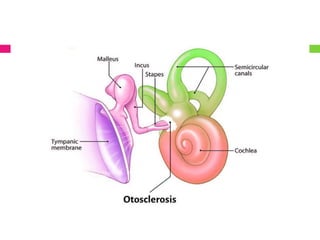
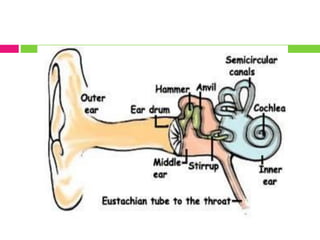
❖ Otosclerosis or “hardening of the ear” result from
the formation of an abnormal bone growth along
the stapes in the middle ear
❖ With the new bone growth , the stapes become
immobile prevents transmission as sound
vibration into the ear, leading to conductive
hearing loss
❖ Otosclerosis usually affect the both ears
CLASSIFICATION
There are mainly two types of classification:-
➢ Histological otosclerosis
➢ Clinical otosclerosis
CLASSIFICATION
Histological otosclerosis:- This type of
otosclerosis does not produce any
symptoms during life but is revealed only at
postmortem
Clinical otosclerosis There are three sub types
✓ Stapedial otosclerosis
✓ Cochlear otosclerosis
✓ Mixed otosclerosis
CLASSIFICATION
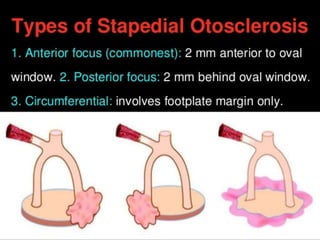
❖ Stapedial otosclerosis:- The otosclerosis focus
may produce ankylosis of the membraneous
labyrinth
❖ Cochlear otosclerosis:- The otosclerotic process
proceeds upon the membraneous labyrinth
producing sensory-neural deafness
❖ Mixed otosclerosis:- Otosclerosis causes both
fixation of the stapes as well as in involvement of
the labyrinth so that is mixed hearing loss
CAUSES
❑ Exact cause is not known
❑ Heredity: Family history of deafness is present
in 50% of cases
❑ Viral infection(Measles etc.)
❑ Other ear conditions
CLINICAL
MANIFESTATIONS
➢ Hearing loss(progressive deafness which is
painless and is insidious)
➢ Dizziness
➢ Tinnitus
➢ Buzzing in the ear
➢ Vertigo
➢ Headache & otalgia
DIAGNOSTIC EVALUATION
❖ History
❖ Physical examination
❖ Tuning fork test
❖ Audiometry test
❖ Tympanocentesis –send the fluid of middle ear for
culture
❖ CT scan – collection of fluid in ear & mastoid
region , abscess formation
❖ MRI – evaluation of tumor & soft tissue
❖ Audiography – to assess hearing capability
MANAGEMENT
❑ Otosclerosis may slowly get worse. The
condition may not require treatment until one
having severe hearing problems
❑ Administer analgesics such as –
• IBUPROFEN
• OXYCODONE
• ACETAMENOPHEN (PCM)
❑ Hearing aid may be used to treat the hearing
loss
SURGICAL MANAGEMENT
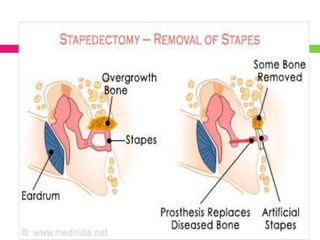
➢ Stapedectomy:- The removal of portion of the
sclerotic stepes footplate of stapes or complete
removal of the stapes and the implant with
prosthesis to maintain suitable conduction.
➢ Stapedotomy:- Modern surgery called
stapedotomy is performed by drilling a small hole
in the stapes footplate with micro drill or laser,
and the insertion of a piston like prosthesis
COMPLICATIONS
➢ Complete deafness
➢ Infection
➢ Dizziness
➢ Pain
➢ Blood clot in the ear after surgery
SELF CARE AT HOME (POST-
OPERATIVE)
➢ Take medicine as prescribed
➢ Blow nose gently
➢ Sneeze and cough with mouth open for few weeks after surgery
➢ Avoid heavy lifting, straining and bending
➢ Popping and crackling sensation are normal for 3-5 weeks after
surgery
➢ Temporary hearing loss is normal in operative ear
➢ Change cotton ball in the ear as needed
➢ Avoid getting in water for 2 weeks after surgery
Otosclerosis

Otosclerosis

  • 1.
  • 2.
    OTOSCLEROSIS ❖ Otosclerosis or“hardening of the ear” result from the formation of an abnormal bone growth along the stapes in the middle ear ❖ With the new bone growth , the stapes become immobile prevents transmission as sound vibration into the ear, leading to conductive hearing loss ❖ Otosclerosis usually affect the both ears
  • 4.
    CLASSIFICATION There are mainlytwo types of classification:- ➢ Histological otosclerosis ➢ Clinical otosclerosis
  • 5.
    CLASSIFICATION Histological otosclerosis:- Thistype of otosclerosis does not produce any symptoms during life but is revealed only at postmortem Clinical otosclerosis There are three sub types ✓ Stapedial otosclerosis ✓ Cochlear otosclerosis ✓ Mixed otosclerosis
  • 6.
    CLASSIFICATION ❖ Stapedial otosclerosis:-The otosclerosis focus may produce ankylosis of the membraneous labyrinth ❖ Cochlear otosclerosis:- The otosclerotic process proceeds upon the membraneous labyrinth producing sensory-neural deafness ❖ Mixed otosclerosis:- Otosclerosis causes both fixation of the stapes as well as in involvement of the labyrinth so that is mixed hearing loss
  • 9.
    CAUSES ❑ Exact causeis not known ❑ Heredity: Family history of deafness is present in 50% of cases ❑ Viral infection(Measles etc.) ❑ Other ear conditions
  • 10.
    CLINICAL MANIFESTATIONS ➢ Hearing loss(progressivedeafness which is painless and is insidious) ➢ Dizziness ➢ Tinnitus ➢ Buzzing in the ear ➢ Vertigo ➢ Headache & otalgia
  • 11.
    DIAGNOSTIC EVALUATION ❖ History ❖Physical examination ❖ Tuning fork test ❖ Audiometry test ❖ Tympanocentesis –send the fluid of middle ear for culture ❖ CT scan – collection of fluid in ear & mastoid region , abscess formation ❖ MRI – evaluation of tumor & soft tissue ❖ Audiography – to assess hearing capability
  • 12.
    MANAGEMENT ❑ Otosclerosis mayslowly get worse. The condition may not require treatment until one having severe hearing problems ❑ Administer analgesics such as – • IBUPROFEN • OXYCODONE • ACETAMENOPHEN (PCM) ❑ Hearing aid may be used to treat the hearing loss
  • 13.
    SURGICAL MANAGEMENT ➢ Stapedectomy:-The removal of portion of the sclerotic stepes footplate of stapes or complete removal of the stapes and the implant with prosthesis to maintain suitable conduction. ➢ Stapedotomy:- Modern surgery called stapedotomy is performed by drilling a small hole in the stapes footplate with micro drill or laser, and the insertion of a piston like prosthesis
  • 15.
    COMPLICATIONS ➢ Complete deafness ➢Infection ➢ Dizziness ➢ Pain ➢ Blood clot in the ear after surgery
  • 16.
    SELF CARE ATHOME (POST- OPERATIVE) ➢ Take medicine as prescribed ➢ Blow nose gently ➢ Sneeze and cough with mouth open for few weeks after surgery ➢ Avoid heavy lifting, straining and bending ➢ Popping and crackling sensation are normal for 3-5 weeks after surgery ➢ Temporary hearing loss is normal in operative ear ➢ Change cotton ball in the ear as needed ➢ Avoid getting in water for 2 weeks after surgery