Peripheral
Vascular Disease
- Santa Gurung , CT1
General Surgery
Causeway Hospital
Contents
1. Definition
2. Spectrum
3. Pathogenesis of atherosclerosis
4. Contributory factors
5. Clinical features
6. Vascular investigations
7. Non surgical management
8. Surgical interventions
9. Venous disorders
10. Case presentation
- In general, peripheral vascular disease (PVD) refers to all the disorders affecting the
affecting the arteries, vein and lymphatics of the peripheral vasculature.
- More commonly, we refer to those diseases only affecting the arteries such as
atherosclerosis, aortic aneurysm, Beurger’s disease, Raynaud’s syndrome, etc.
- Depending on the location of the disease, conditions that affect the arteries serving
the lower limbs, sometimes the upper limbs, and less commonly the carotid and
renal
Definition
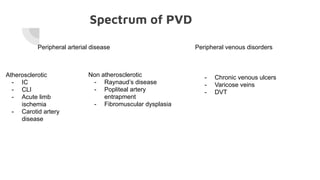
Spectrum of PVD
Peripheral arterial disease Peripheral venous disorders
Atherosclerotic
- IC
- CLI
- Acute limb
ischemia
- Carotid artery
disease
Non atherosclerotic
- Raynaud’s disease
- Popliteal artery
entrapment
- Fibromuscular dysplasia
- Chronic venous ulcers
- Varicose veins
- DVT
Pathophysiology
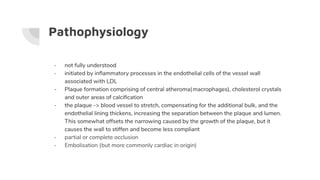
- not fully understood
- initiated by inflammatory processes in the endothelial cells of the vessel wall
associated with LDL
- Plaque formation comprising of central atheroma(macrophages), cholesterol crystals
and outer areas of calcification
- the plaque -> blood vessel to stretch, compensating for the additional bulk, and the
endothelial lining thickens, increasing the separation between the plaque and lumen.
This somewhat offsets the narrowing caused by the growth of the plaque, but it
causes the wall to stiffen and become less compliant
- partial or complete occlusion
- Embolisation (but more commonly cardiac in origin)
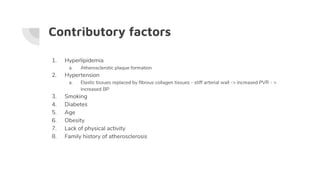
1. Hyperlipidemia
a. Atherosclerotic plaque formation
2. Hypertension
a. Elastic tissues replaced by fibrous collagen tissues - stiff arterial wall -> increased PVR - >
increased BP
3. Smoking
4. Diabetes
5. Age
6. Obesity
7. Lack of physical activity
8. Family history of atherosclerosis
Contributory factors
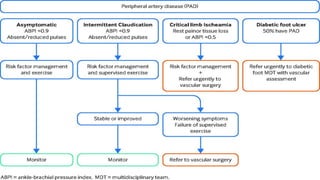
Clinical manifestations
- Asymptomatic
- Intermittent claudication
- Critical limb ischemia
- Acute limb ischemia
Lower limb ischemia
1. Intermittent claudication (IC) – Ischaemic muscle discomfort in the lower limb
reproducibly produced by exercise and relieved by rest within 10 min6
2. Critical limb ischaemia (CLI) – Ulcers, gangrene or ischaemic rest pain for more
than 2 weeks attributable to objectively proven arterial occlusive disease6
3. Acute limb ischaemia (ALI) – A sudden decrease in limb perfusion that threatens
viability of the limb6
Assessment
- History : onset, duration, progressions, associated symptoms, aggravating and
relieving factors
- Claudication
- Rest pain ? able to sleep at night
- Tendency to hang the symptomatic leg out of bed whilst sleeping?
- History of smoking
- Medical history
- Medications
..cont(Assessment)
General / systemic examination
Physical examination
- Overlying skin
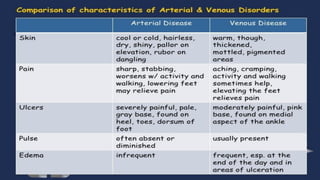
- ? ulcers - characteristics
- Associated findings : edema
- Pulses
- CRT
- Beurger’s test ( assess for elevation pallor in arterial insufficiency)
..cont(Assessment)
NB : 6 Ps(perishingly cold, pulseless, pain, pallor, paraesthesia, power)
Acute limb ischemia
- < 6 hrs : mild sensorimotor deficit
- 6 - 12 hrs : signs of skin mottling and calf tenderness +/- tense fascial compartments
- > 12 hrs : fixed skin mottling with sensorimotor deficit
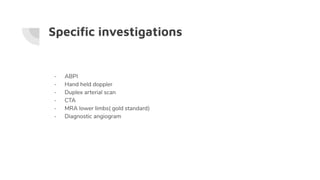
Specific investigations
- ABPI
- Hand held doppler
- Duplex arterial scan
- CTA
- MRA lower limbs( gold standard)
- Diagnostic angiogram
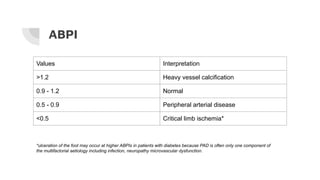
ABPI
Values Interpretation
>1.2 Heavy vessel calcification
0.9 - 1.2 Normal
0.5 - 0.9 Peripheral arterial disease
<0.5 Critical limb ischemia*
*ulceration of the foot may occur at higher ABPIs in patients with diabetes because PAD is often only one component of
the multifactorial aetiology including infection, neuropathy microvascular dysfunction.
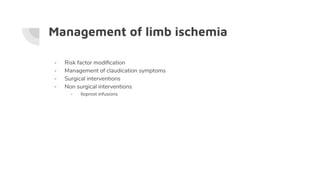
Management of limb ischemia
- Risk factor modification
- Management of claudication symptoms
- Surgical interventions
- Non surgical interventions
- Iloprost infusions
Management of limb ischemia
- Risk factor modification
- About 65% will also have associated significant cerebral or coronary artery disease
- 6 fold risk of death due to stroke, MI
- >10% with stroke or MI or death within 2 years of follow up
- Smoking cessation
- Group counselling sessions
- NRT
- Diabetes
- glycemic control is very important
- ~1% increase in HbA1C is associated with 26% increase in the risk of PAD accelerates the
progression of the disease
- 5 - 10 times more likely to end up with major amputation
- Hypertension control reduces the risk of cardiovascular events
-
..cont(Management)
- Treatment with statins to lower cholesterol levels (cardiac related mortality is reduced
by approximately 20% with every 1 mmol/L reduction in LDL cholesterol irrespective of
the initial levels)
- Antiplatelet therapy
- Clopidogrel is preferred for simple PAD
- DAPT in prosthetic bypass graft
Management of claudication symptoms
- Exercise
- Structured or supervised exercise programmes
- Vasoactive drugs
- 2 drugs used in the UK
- Cilostazol( antiplatelet + vasodilator)
- Naftidrofuryl oxalate/ Nafronyl(vasodilator)
..cont (Management)
- Surgical interventions
- Angioplasty
- Endarterectomy
- Arterial bypass
- Embolectomy
- Amputation
- Catheter directed thrombolysis
Angioplasty
- Ususally if stenotic segments are <3 cm
- Unsuitable for significant multifocal disease
- Long term outcomes inferior to endarterectomies
- Suitable for patients unable to undergo endarterectomy
Peripheral arterial bypass
- Commonly performed vascular interventions for PAD
- Depending where the bypass is done can be as follows :
- Aorto-bifemoral bypass
- Axillofemoral bypass
- Fem-fem crossover
- Fem-pop bypass
- Popliteal-pedal bypass
Chronic venous insufficiency
- Results from obstruction of venous valves in legs or reflux of blood through the valves
- Venous ulceration is a common and serious complication
- Management
- Elevate the limb, regular exercise, stop smoking, improve nutrition
- Antibiotics for superimposed infection
- Multilayer graduated compression bandaging therapy(40mmHg @ ankle and 17mmHg @
midcalf)
- Debridement may be need to promote healing
Varicose veins
- Abnormally dilated, tortuous veins with incompetent valves
- Causes
- Congenital absence of valves
- Incompetent valves due to external pressure on the veins from increased intra-abdominal
pressure
- Prevention
- Moderate exercise, elevation of legs
- Compression stockings
- Surgery
- Ligation and stripping
- Sclerotherapy
- RFA, EVLA, Cryoablation
DVT
- Blood clot within a deep vein
- More commonly in the lower limbs , less so in the upper venous system
- Pathology : Virchow’s triad - hypercoagulability, hemodynamic changes, endothelial
injury
- Clinical features : calf pain/swelling, unilateral pitting edema, pyrexia, Homan’s sign
- Well’s scoring system
- Investigations : D dimers, USS
- Prevention : TEDS, Prophylactic LMWH(clexane, fragmin)
- Treatment : LMWH + Vit K anticoagulants/NOAC(duration depending upon provoked
or unprovoked)
- Consideration for IVC filters
Case discussion
55F, presented to ED with
C/C - left thigh/calf pain , sudden onset , worsening on the evening of the DOA
Hx of mechanical fall after slipping in the bathroom 2/7 prior to attendance in ED, reduced
mobility
Non smoker
Normally fit and well
No anticoagulants/no previous medications
..cont
Clinical examination -
- Pelvis/ L hip : no gross deformity, pain on movements
- Femoral pulse +, Popliteal/PT/DPA -
- Pale
- Reduced power
- Sensation intact
- Beurger’s test : positive
XR pelvis/Lt hip - unremarkable
ECG sinus rhythm
cont..
- ABPI < 0.5
- Handheld doppler : biphasic signals femoral +, no signals Popliteal/Peroneal
trunk/PT/DPA -
- CTA lower limbs - moderate to severe disease of the SFA, occlusion at popliteal artery,
no evidences of DVT
- Underwent femoral endarterectomy + Fogarty catheter embolectomy
- ECHO : no sources of emboli
- Antiplatelet therapy + NOAC
- For follow up in Vascular OP clinic
Any questions ???
Thank you……...

Peripheral vascular disease

  • 1.
    Peripheral Vascular Disease - SantaGurung , CT1 General Surgery Causeway Hospital
  • 2.
    Contents 1. Definition 2. Spectrum 3.Pathogenesis of atherosclerosis 4. Contributory factors 5. Clinical features 6. Vascular investigations 7. Non surgical management 8. Surgical interventions 9. Venous disorders 10. Case presentation
  • 3.
    - In general,peripheral vascular disease (PVD) refers to all the disorders affecting the affecting the arteries, vein and lymphatics of the peripheral vasculature. - More commonly, we refer to those diseases only affecting the arteries such as atherosclerosis, aortic aneurysm, Beurger’s disease, Raynaud’s syndrome, etc. - Depending on the location of the disease, conditions that affect the arteries serving the lower limbs, sometimes the upper limbs, and less commonly the carotid and renal Definition
  • 4.
    Spectrum of PVD Peripheralarterial disease Peripheral venous disorders Atherosclerotic - IC - CLI - Acute limb ischemia - Carotid artery disease Non atherosclerotic - Raynaud’s disease - Popliteal artery entrapment - Fibromuscular dysplasia - Chronic venous ulcers - Varicose veins - DVT
  • 6.
    Pathophysiology - not fullyunderstood - initiated by inflammatory processes in the endothelial cells of the vessel wall associated with LDL - Plaque formation comprising of central atheroma(macrophages), cholesterol crystals and outer areas of calcification - the plaque -> blood vessel to stretch, compensating for the additional bulk, and the endothelial lining thickens, increasing the separation between the plaque and lumen. This somewhat offsets the narrowing caused by the growth of the plaque, but it causes the wall to stiffen and become less compliant - partial or complete occlusion - Embolisation (but more commonly cardiac in origin)
  • 7.
    1. Hyperlipidemia a. Atheroscleroticplaque formation 2. Hypertension a. Elastic tissues replaced by fibrous collagen tissues - stiff arterial wall -> increased PVR - > increased BP 3. Smoking 4. Diabetes 5. Age 6. Obesity 7. Lack of physical activity 8. Family history of atherosclerosis Contributory factors
  • 8.
    Clinical manifestations - Asymptomatic -Intermittent claudication - Critical limb ischemia - Acute limb ischemia
  • 9.
    Lower limb ischemia 1.Intermittent claudication (IC) – Ischaemic muscle discomfort in the lower limb reproducibly produced by exercise and relieved by rest within 10 min6 2. Critical limb ischaemia (CLI) – Ulcers, gangrene or ischaemic rest pain for more than 2 weeks attributable to objectively proven arterial occlusive disease6 3. Acute limb ischaemia (ALI) – A sudden decrease in limb perfusion that threatens viability of the limb6
  • 10.
    Assessment - History :onset, duration, progressions, associated symptoms, aggravating and relieving factors - Claudication - Rest pain ? able to sleep at night - Tendency to hang the symptomatic leg out of bed whilst sleeping? - History of smoking - Medical history - Medications
  • 11.
    ..cont(Assessment) General / systemicexamination Physical examination - Overlying skin - ? ulcers - characteristics - Associated findings : edema - Pulses - CRT - Beurger’s test ( assess for elevation pallor in arterial insufficiency)
  • 12.
    ..cont(Assessment) NB : 6Ps(perishingly cold, pulseless, pain, pallor, paraesthesia, power) Acute limb ischemia - < 6 hrs : mild sensorimotor deficit - 6 - 12 hrs : signs of skin mottling and calf tenderness +/- tense fascial compartments - > 12 hrs : fixed skin mottling with sensorimotor deficit
  • 13.
    Specific investigations - ABPI -Hand held doppler - Duplex arterial scan - CTA - MRA lower limbs( gold standard) - Diagnostic angiogram
  • 14.
    ABPI Values Interpretation >1.2 Heavyvessel calcification 0.9 - 1.2 Normal 0.5 - 0.9 Peripheral arterial disease <0.5 Critical limb ischemia* *ulceration of the foot may occur at higher ABPIs in patients with diabetes because PAD is often only one component of the multifactorial aetiology including infection, neuropathy microvascular dysfunction.
  • 16.
    Management of limbischemia - Risk factor modification - Management of claudication symptoms - Surgical interventions - Non surgical interventions - Iloprost infusions
  • 17.
    Management of limbischemia - Risk factor modification - About 65% will also have associated significant cerebral or coronary artery disease - 6 fold risk of death due to stroke, MI - >10% with stroke or MI or death within 2 years of follow up - Smoking cessation - Group counselling sessions - NRT - Diabetes - glycemic control is very important - ~1% increase in HbA1C is associated with 26% increase in the risk of PAD accelerates the progression of the disease - 5 - 10 times more likely to end up with major amputation - Hypertension control reduces the risk of cardiovascular events -
  • 18.
    ..cont(Management) - Treatment withstatins to lower cholesterol levels (cardiac related mortality is reduced by approximately 20% with every 1 mmol/L reduction in LDL cholesterol irrespective of the initial levels) - Antiplatelet therapy - Clopidogrel is preferred for simple PAD - DAPT in prosthetic bypass graft
  • 19.
    Management of claudicationsymptoms - Exercise - Structured or supervised exercise programmes - Vasoactive drugs - 2 drugs used in the UK - Cilostazol( antiplatelet + vasodilator) - Naftidrofuryl oxalate/ Nafronyl(vasodilator)
  • 20.
    ..cont (Management) - Surgicalinterventions - Angioplasty - Endarterectomy - Arterial bypass - Embolectomy - Amputation - Catheter directed thrombolysis
  • 21.
    Angioplasty - Ususally ifstenotic segments are <3 cm - Unsuitable for significant multifocal disease - Long term outcomes inferior to endarterectomies - Suitable for patients unable to undergo endarterectomy
  • 22.
    Peripheral arterial bypass -Commonly performed vascular interventions for PAD - Depending where the bypass is done can be as follows : - Aorto-bifemoral bypass - Axillofemoral bypass - Fem-fem crossover - Fem-pop bypass - Popliteal-pedal bypass
  • 23.
    Chronic venous insufficiency -Results from obstruction of venous valves in legs or reflux of blood through the valves - Venous ulceration is a common and serious complication - Management - Elevate the limb, regular exercise, stop smoking, improve nutrition - Antibiotics for superimposed infection - Multilayer graduated compression bandaging therapy(40mmHg @ ankle and 17mmHg @ midcalf) - Debridement may be need to promote healing
  • 24.
    Varicose veins - Abnormallydilated, tortuous veins with incompetent valves - Causes - Congenital absence of valves - Incompetent valves due to external pressure on the veins from increased intra-abdominal pressure - Prevention - Moderate exercise, elevation of legs - Compression stockings - Surgery - Ligation and stripping - Sclerotherapy - RFA, EVLA, Cryoablation
  • 25.
    DVT - Blood clotwithin a deep vein - More commonly in the lower limbs , less so in the upper venous system - Pathology : Virchow’s triad - hypercoagulability, hemodynamic changes, endothelial injury - Clinical features : calf pain/swelling, unilateral pitting edema, pyrexia, Homan’s sign - Well’s scoring system - Investigations : D dimers, USS - Prevention : TEDS, Prophylactic LMWH(clexane, fragmin) - Treatment : LMWH + Vit K anticoagulants/NOAC(duration depending upon provoked or unprovoked) - Consideration for IVC filters
  • 26.
    Case discussion 55F, presentedto ED with C/C - left thigh/calf pain , sudden onset , worsening on the evening of the DOA Hx of mechanical fall after slipping in the bathroom 2/7 prior to attendance in ED, reduced mobility Non smoker Normally fit and well No anticoagulants/no previous medications
  • 27.
    ..cont Clinical examination - -Pelvis/ L hip : no gross deformity, pain on movements - Femoral pulse +, Popliteal/PT/DPA - - Pale - Reduced power - Sensation intact - Beurger’s test : positive XR pelvis/Lt hip - unremarkable ECG sinus rhythm
  • 28.
    cont.. - ABPI <0.5 - Handheld doppler : biphasic signals femoral +, no signals Popliteal/Peroneal trunk/PT/DPA - - CTA lower limbs - moderate to severe disease of the SFA, occlusion at popliteal artery, no evidences of DVT - Underwent femoral endarterectomy + Fogarty catheter embolectomy - ECHO : no sources of emboli - Antiplatelet therapy + NOAC - For follow up in Vascular OP clinic
  • 29.