CATARACT
SUDESHNA BANERJEE DUTTA
LECTURER
S.R.S.V.M B.SC NURSING COLLEGE
INTRODUCTION
A cataract is the opacity of the lens or cloudiness.
The most common cataract is the age related or senile
type. Senile cataracts usually begin around the age of 50
years
DEFINITION:
An opacification of sufficient severity to impair the vision
RISK FACTORS
Aging
Associated ocular conditions
Myopia (It is when the eye is not able to focus properly on
objects in the distance)
Retinal detachment (the retina separates from the
layer underneath)
Infection
Toxic factors
Ionizing radiation
Aspirin
Corticosteroids
Cigarette smoking
Chemical burns
Nutritional factors
Poor nutrition
Physical factors
Blunt trauma
Ultraviolet radiations in sunlight and x-ray
Systemic Disease and syndromes
Diabetes
Renal disorders
Musculoskeletal disorders
TYPES
CONGENITAL CATARACT:
➢ 33% of the cases it’s idiopathic
➢ Hereditary causes: Chromosomal disorder (trisomy
21), sticker syndrome, lowe’s syndrome
➢ Maternal factors (DRIM): Drugs like corticosteroids,
Infections such as rubella, toxoplasmosis, Radiation,
Malnutrition etc. may lead to congenital cataract
➢ Foetal factors: Oxygen deficiency, birth trauma,
malnutrition & sometimes may be associated with
other congenital factors
TYPES
ACQUIRED
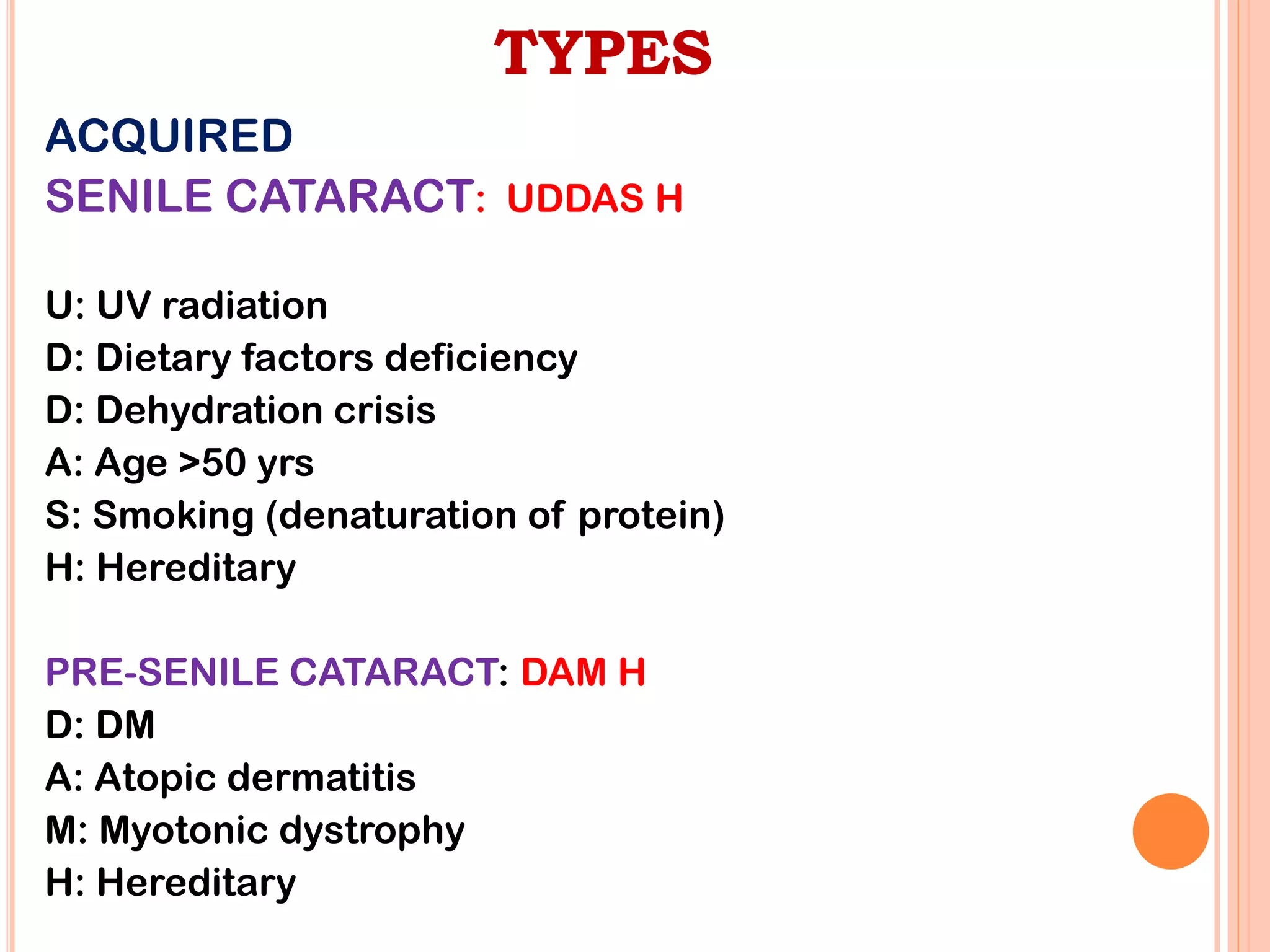
SENILE CATARACT: UDDAS H
U: UV radiation
D: Dietary factors deficiency
D: Dehydration crisis
A: Age >50 yrs
S: Smoking (denaturation of protein)
H: Hereditary
PRE-SENILE CATARACT: DAM H
D: DM
A: Atopic dermatitis
M: Myotonic dystrophy
H: Hereditary
TYPE OF SENILE CATARACT
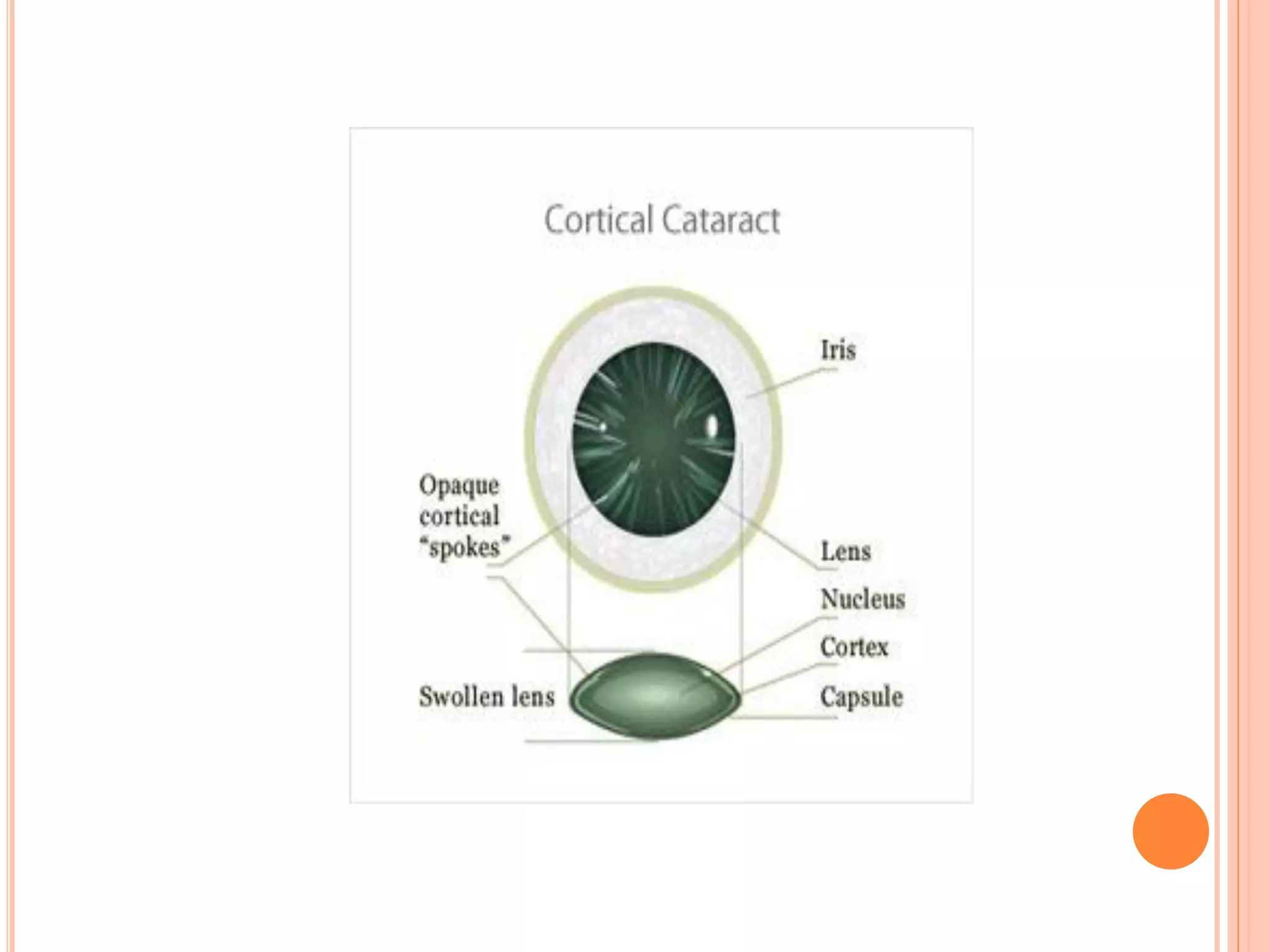
1. Cortical Senile cataracts
➢ It’s characterized by white, wedge-like opacities
that start in the periphery of the lens and work their
way to the center in a spoke-like fashion. They
progress slowly and often do not cause severe loss
of vision.
➢ Sunlight exposure is the risk factor for cortical
cataracts.
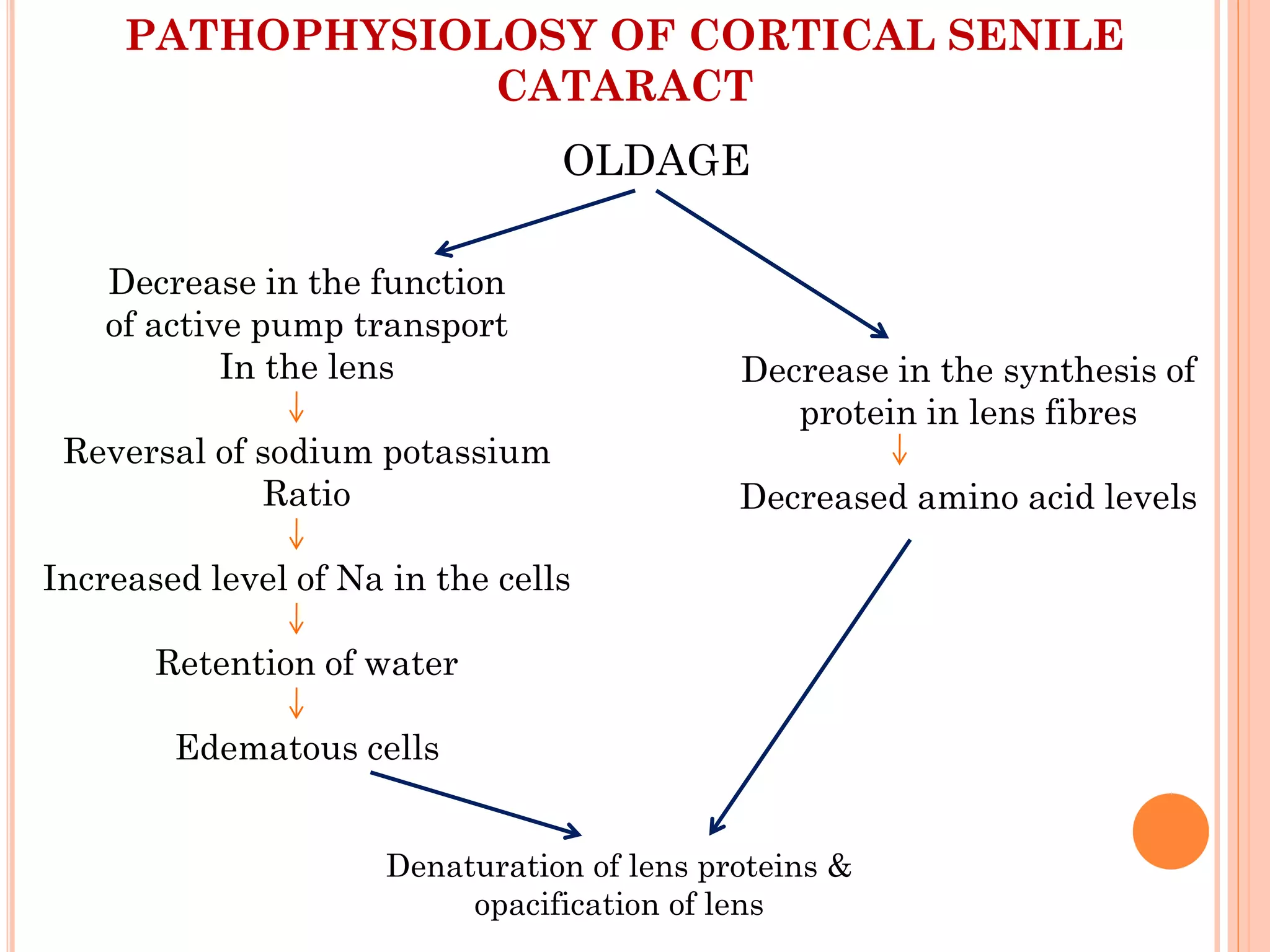
PATHOPHYSIOLOSY OF CORTICAL SENILE
CATARACT
OLDAGE
Decrease in the function
of active pump transport
In the lens
Reversal of sodium potassium
Ratio
Increased level of Na in the cells
Retention of water
Edematous cells
Decrease in the synthesis of
protein in lens fibres
Decreased amino acid levels
Denaturation of lens proteins &
opacification of lens
TYPE OF SENILE CATARACT
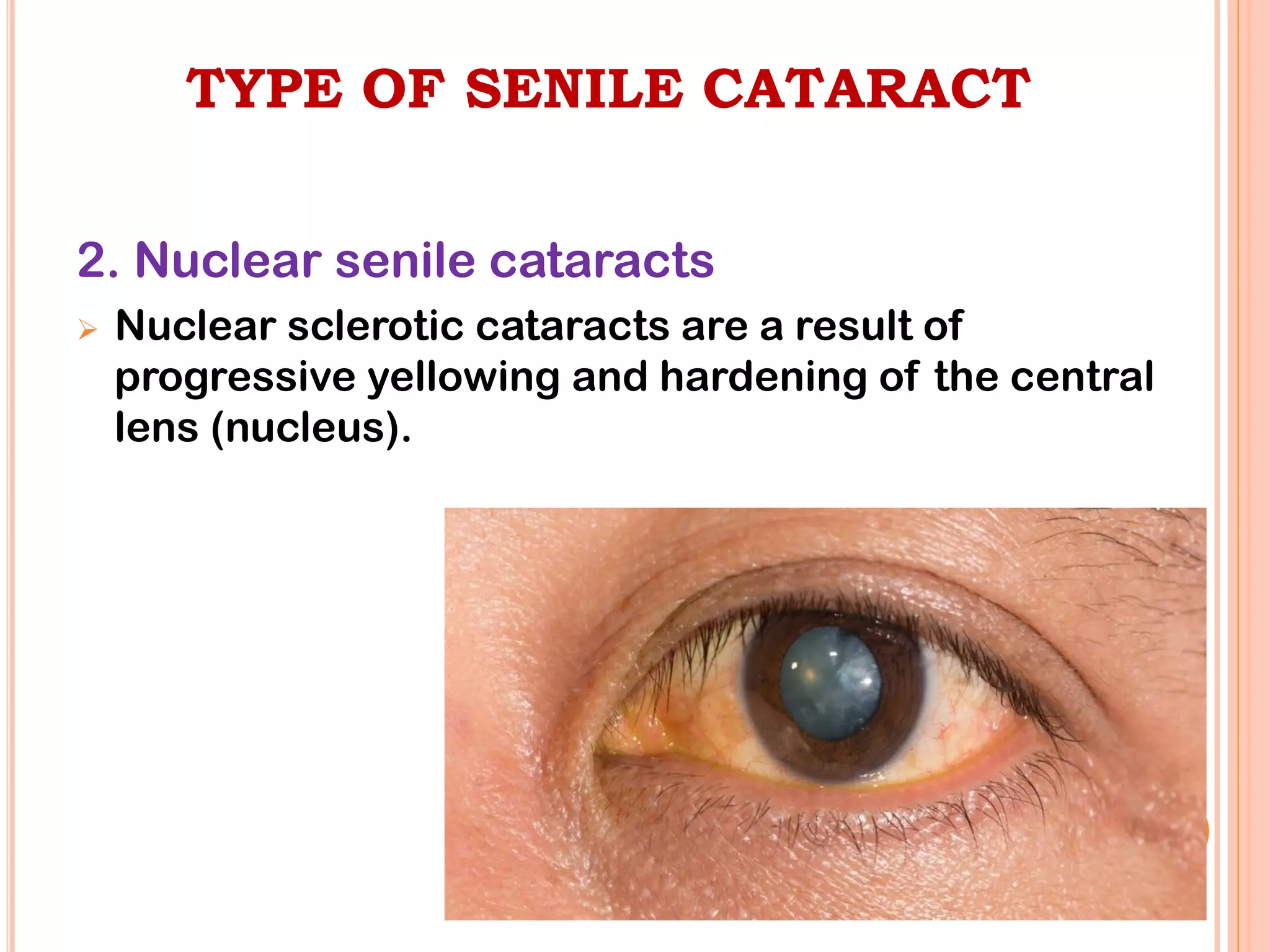
2. Nuclear senile cataracts
➢ Nuclear sclerotic cataracts are a result of
progressive yellowing and hardening of the central
lens (nucleus).
PATHOPHYSIOLOSY OF
CORTICAL SENILE CATARACT
Age related changes (nuclear sclerosis)+dehydration
Hardening of the lens
Degeneration of lens fibres
Posterior sub-capsular Cataract
➢ Posterior sub-capsular is cloudy area at the back of
the lens capsule and cause visual loss.
➢ This type typically develops in younger people and is
associated with prolonged corticosteroid use,
diabetes, or ocular trauma.
TYPE OF SENILE CATARACT
CLINICAL MANIFESTATIONS
Painless, blurry vision
The person experiences reduced contrast sensitivity, and
reduced visual acuity
Astigmatism (It occurs when the cornea is irregularly shaped
or sometimes because of the curvature of the lens inside the
eye)
Monocular diplopia (double vision in only one eye)
DIAGNOSTIC TESTS
Snellen visual acuity test
Opthalmoscopy
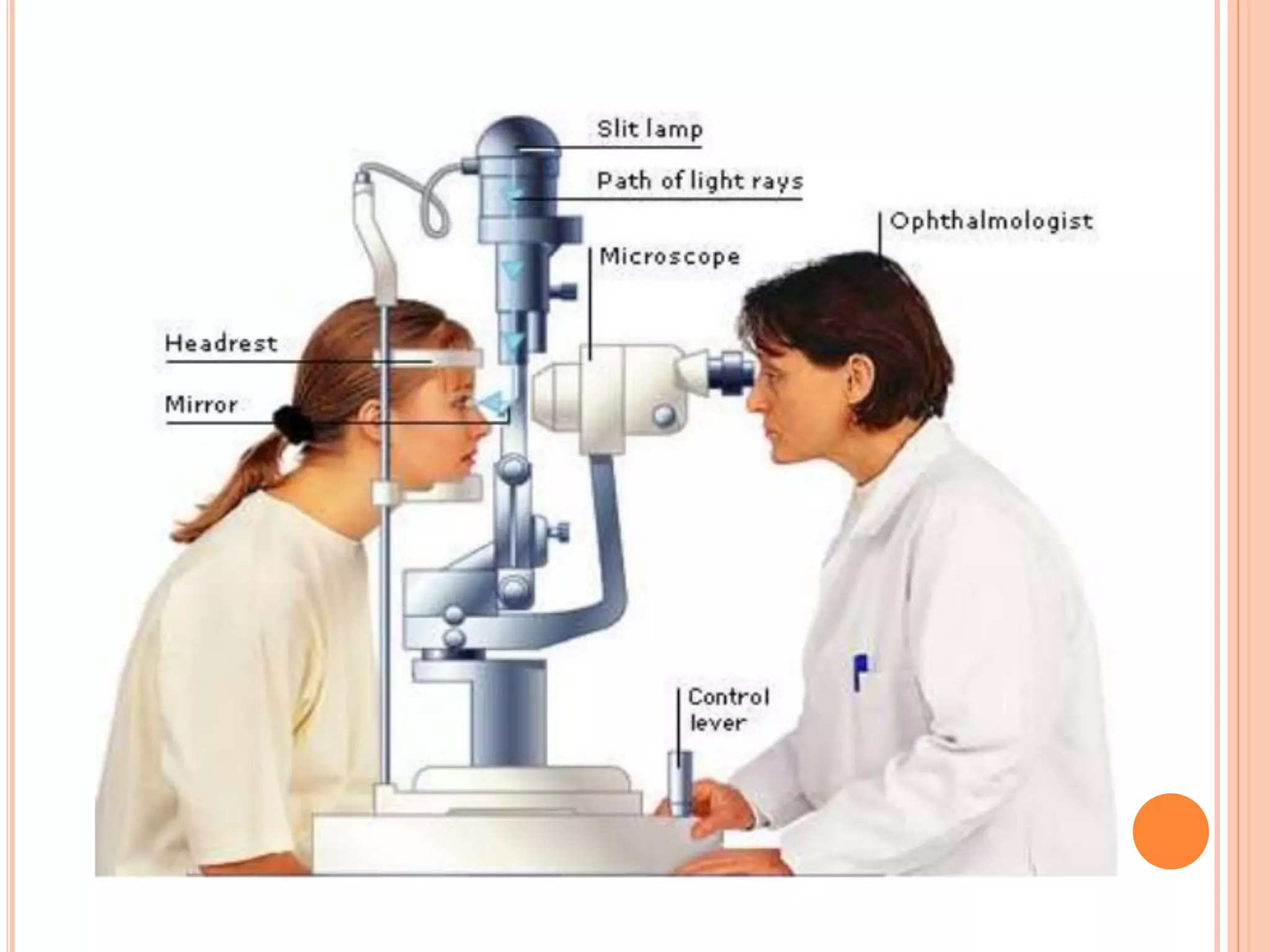
Slit lamp examination
SNELLEN VISUAL ACUITY TEST
MANAGEMENT
When both eyes have cataracts, one eye is treated first,
with at least several weeks, preferably months, separating
the two procedures.
The surgeon may order preoperative antibiotic eyedrops.
The patient should not have food or fluids for
approximately 6 to 8 hours before surgery.
The nurse will instill dilating eyedrops [mydriatics
(Phenylephrine HCL) and cycloplegics (Tropicamide,
Atropine)] and a non-steroidal anti-inflammatory eyedrop
to reduce inflammation and to help maintain pupil dilation.
PHACOEMULSIFICATION
In this method, a portion of the anterior capsule is
removed, allowing extraction of the lens nucleus and
cortex while the posterior capsule is left intact.
An ultrasonic device is used to liquefy the nucleus and
cortex, which are then suctioned out through a tube.
The pupil is dilated to 7 mm or greater. The surgeon makes
a small incision on the upper edge of the cornea and a
viscoelastic substance (clear gel) is injected into the
space between the cornea and the lens.
This prevents space from collapsing and facilitates
insertion of IOL. Because the incision is smaller, the
wound heals more rapidly, and there is stabilization of
refractive error and less astigmatism.
LENS REPLACEMENT
After removal of the crystalline lens, the patient is referred
to as aphakic. There are three lens replacement options:
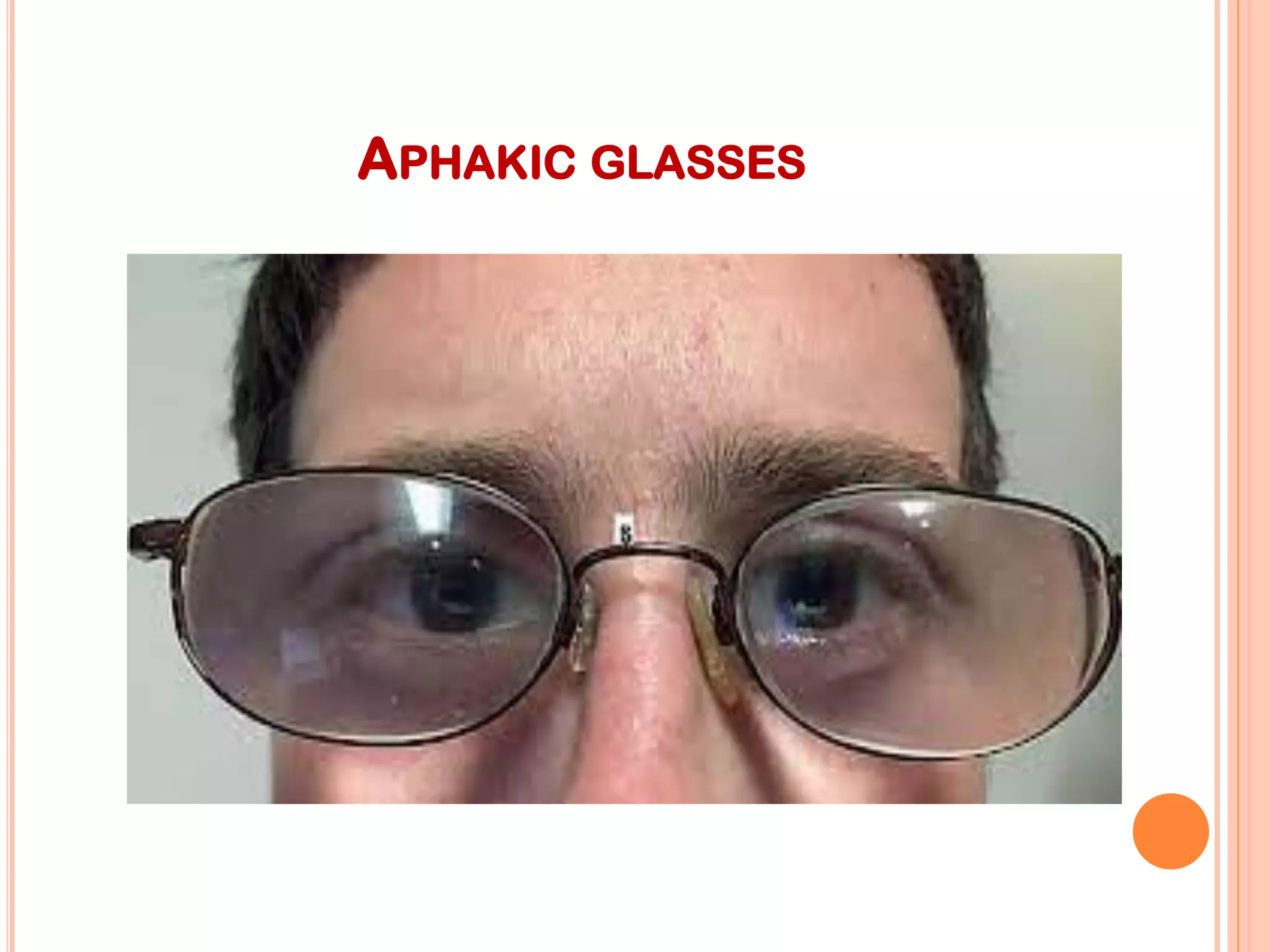
aphakic eyeglasses, contact lenses and IOL implants.
Aphakic glasses, are rarely used. Peripheral vision is also
limted.
Contact lenses provide patients with almost normal vision,
but because contact lenses need to be removed
occasionally, the patient also needs a pair of aphakic
glasses.
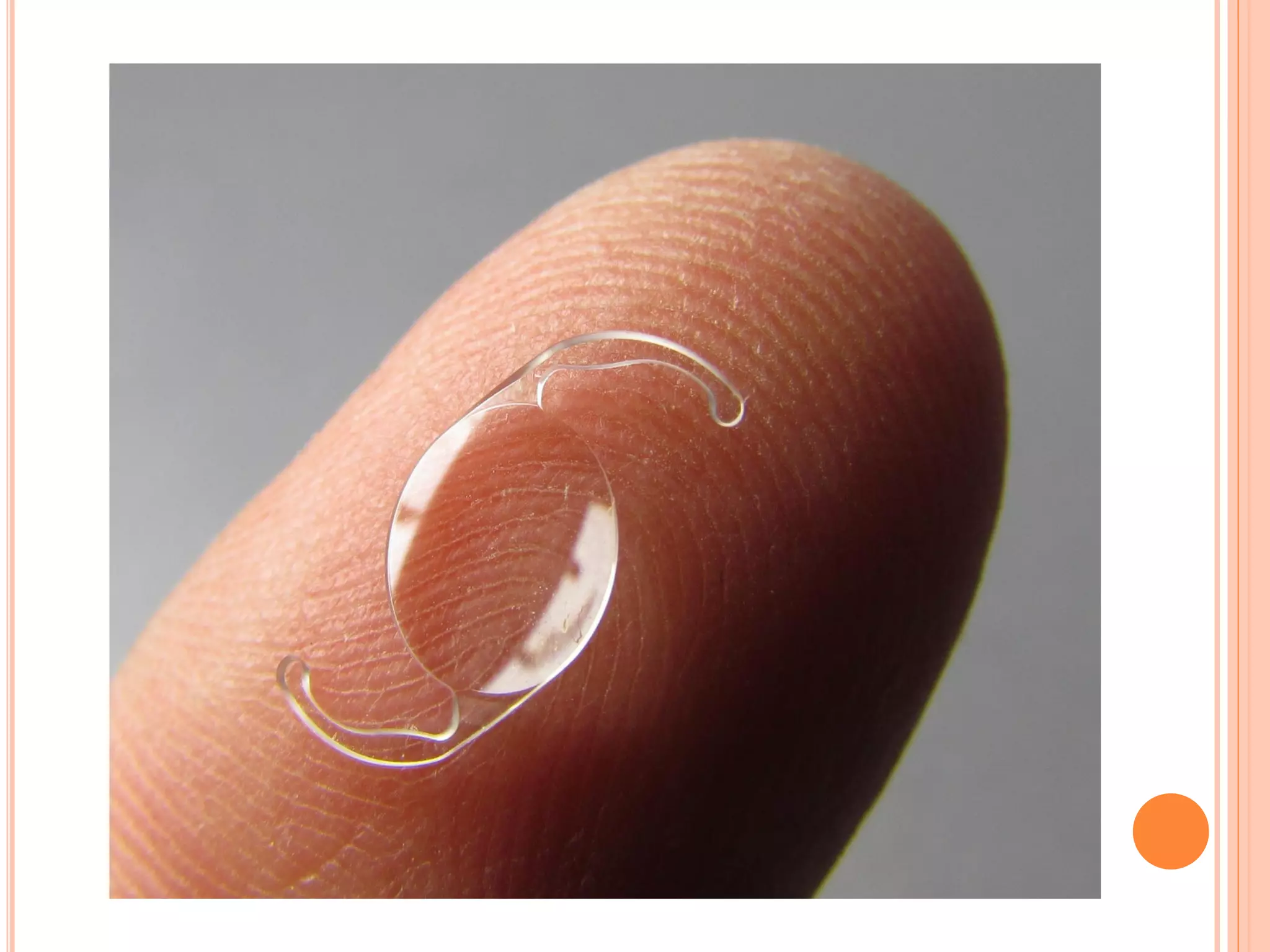
Insertion of IOLs during cataract surgery is the most
common approach to lens replacement. After cataract
extraction, or phacoemulsification, the surgeon implants
an IOL.
APHAKIC GLASSES
COMPLICATIONS OF CATARACT
SURGERY
Immediate Preoperative
 Retrobulbar hemorrhage can result from retrobulbar
infiltration of anesthetic agents. It can manifests as
increased IOP, proptosis, lid tightness and subconjunctival
hemorrhage with or without edema.
Intraoperative
 Rupture of the posterior capsule
Early postoperative
 Acute bacterial endophthalmitis characterized by marked
visual loss, pain, lid edema.
RETROBULBAR HEMORRHAGE
Late postoperative
 Suture related problems
 Malposition of the IOL
 Chronic endophthalmitis
 Opacifiation of the posterior capsule
Cataract

Cataract

  • 1.
  • 2.
    INTRODUCTION A cataract isthe opacity of the lens or cloudiness. The most common cataract is the age related or senile type. Senile cataracts usually begin around the age of 50 years DEFINITION: An opacification of sufficient severity to impair the vision
  • 4.
    RISK FACTORS Aging Associated ocularconditions Myopia (It is when the eye is not able to focus properly on objects in the distance) Retinal detachment (the retina separates from the layer underneath) Infection Toxic factors Ionizing radiation Aspirin Corticosteroids Cigarette smoking Chemical burns
  • 5.
    Nutritional factors Poor nutrition Physicalfactors Blunt trauma Ultraviolet radiations in sunlight and x-ray Systemic Disease and syndromes Diabetes Renal disorders Musculoskeletal disorders
  • 6.
    TYPES CONGENITAL CATARACT: ➢ 33%of the cases it’s idiopathic ➢ Hereditary causes: Chromosomal disorder (trisomy 21), sticker syndrome, lowe’s syndrome ➢ Maternal factors (DRIM): Drugs like corticosteroids, Infections such as rubella, toxoplasmosis, Radiation, Malnutrition etc. may lead to congenital cataract ➢ Foetal factors: Oxygen deficiency, birth trauma, malnutrition & sometimes may be associated with other congenital factors
  • 7.
    TYPES ACQUIRED SENILE CATARACT: UDDASH U: UV radiation D: Dietary factors deficiency D: Dehydration crisis A: Age >50 yrs S: Smoking (denaturation of protein) H: Hereditary PRE-SENILE CATARACT: DAM H D: DM A: Atopic dermatitis M: Myotonic dystrophy H: Hereditary
  • 8.
    TYPE OF SENILECATARACT 1. Cortical Senile cataracts ➢ It’s characterized by white, wedge-like opacities that start in the periphery of the lens and work their way to the center in a spoke-like fashion. They progress slowly and often do not cause severe loss of vision. ➢ Sunlight exposure is the risk factor for cortical cataracts.
  • 9.
    PATHOPHYSIOLOSY OF CORTICALSENILE CATARACT OLDAGE Decrease in the function of active pump transport In the lens Reversal of sodium potassium Ratio Increased level of Na in the cells Retention of water Edematous cells Decrease in the synthesis of protein in lens fibres Decreased amino acid levels Denaturation of lens proteins & opacification of lens
  • 11.
    TYPE OF SENILECATARACT 2. Nuclear senile cataracts ➢ Nuclear sclerotic cataracts are a result of progressive yellowing and hardening of the central lens (nucleus).
  • 12.
    PATHOPHYSIOLOSY OF CORTICAL SENILECATARACT Age related changes (nuclear sclerosis)+dehydration Hardening of the lens Degeneration of lens fibres
  • 13.
    Posterior sub-capsular Cataract ➢Posterior sub-capsular is cloudy area at the back of the lens capsule and cause visual loss. ➢ This type typically develops in younger people and is associated with prolonged corticosteroid use, diabetes, or ocular trauma. TYPE OF SENILE CATARACT
  • 14.
    CLINICAL MANIFESTATIONS Painless, blurryvision The person experiences reduced contrast sensitivity, and reduced visual acuity Astigmatism (It occurs when the cornea is irregularly shaped or sometimes because of the curvature of the lens inside the eye) Monocular diplopia (double vision in only one eye)
  • 16.
    DIAGNOSTIC TESTS Snellen visualacuity test Opthalmoscopy Slit lamp examination
  • 17.
  • 19.
    MANAGEMENT When both eyeshave cataracts, one eye is treated first, with at least several weeks, preferably months, separating the two procedures. The surgeon may order preoperative antibiotic eyedrops. The patient should not have food or fluids for approximately 6 to 8 hours before surgery. The nurse will instill dilating eyedrops [mydriatics (Phenylephrine HCL) and cycloplegics (Tropicamide, Atropine)] and a non-steroidal anti-inflammatory eyedrop to reduce inflammation and to help maintain pupil dilation.
  • 20.
    PHACOEMULSIFICATION In this method,a portion of the anterior capsule is removed, allowing extraction of the lens nucleus and cortex while the posterior capsule is left intact. An ultrasonic device is used to liquefy the nucleus and cortex, which are then suctioned out through a tube. The pupil is dilated to 7 mm or greater. The surgeon makes a small incision on the upper edge of the cornea and a viscoelastic substance (clear gel) is injected into the space between the cornea and the lens. This prevents space from collapsing and facilitates insertion of IOL. Because the incision is smaller, the wound heals more rapidly, and there is stabilization of refractive error and less astigmatism.
  • 22.
    LENS REPLACEMENT After removalof the crystalline lens, the patient is referred to as aphakic. There are three lens replacement options: aphakic eyeglasses, contact lenses and IOL implants. Aphakic glasses, are rarely used. Peripheral vision is also limted. Contact lenses provide patients with almost normal vision, but because contact lenses need to be removed occasionally, the patient also needs a pair of aphakic glasses. Insertion of IOLs during cataract surgery is the most common approach to lens replacement. After cataract extraction, or phacoemulsification, the surgeon implants an IOL.
  • 23.
  • 24.
    COMPLICATIONS OF CATARACT SURGERY ImmediatePreoperative  Retrobulbar hemorrhage can result from retrobulbar infiltration of anesthetic agents. It can manifests as increased IOP, proptosis, lid tightness and subconjunctival hemorrhage with or without edema. Intraoperative  Rupture of the posterior capsule Early postoperative  Acute bacterial endophthalmitis characterized by marked visual loss, pain, lid edema.
  • 25.
  • 26.
    Late postoperative  Suturerelated problems  Malposition of the IOL  Chronic endophthalmitis  Opacifiation of the posterior capsule