Vascular Disorders
Vascular Disorders
Peripheral Arterial Disease of
the Lower Extremities
 Aortoiliac, femoral, popliteal, tibial, or peroneal arteries
Aortoiliac, femoral, popliteal, tibial, or peroneal arteries
 Classic symptom: Intermittent Claudication
Classic symptom: Intermittent Claudication
 Ischemic muscle ache precipitated by a consistent level
Ischemic muscle ache precipitated by a consistent level
of exercise
of exercise
 Paresthesia – numbness / tingling in toes & feet
Paresthesia – numbness / tingling in toes & feet
 Trophic changes: reactive hyperemia
Trophic changes: reactive hyperemia
dependent rubor
dependent rubor
 Rest pain – nocturnal
Rest pain – nocturnal
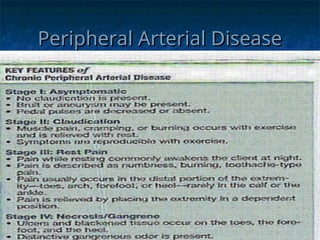
Peripheral Arterial Disease
Peripheral Arterial Disease of
the Lower Extremities
 Diagnostics:
Diagnostics:
 Non-invasive: Doppler Studies
Non-invasive: Doppler Studies
 Invasive: Angiography
Invasive: Angiography
Peripheral Arterial Disease of
the Lower Extremities
 Treatment:
Treatment:
 Risk Factor Modification –
Risk Factor Modification –
 HTN – Stepped Approach to Control
HTN – Stepped Approach to Control
 Smoking - Cessation
Smoking - Cessation
 Treatment of hyperlipidemia - Nutrition
Treatment of hyperlipidemia - Nutrition
 Exercise – slow progressive walking
Exercise – slow progressive walking
 Medication –
Medication –
 Antiplatelet Therapy – Plavix / ASA
Antiplatelet Therapy – Plavix / ASA
 < blood viscosity / >erythrocyte flexibility – Trental
< blood viscosity / >erythrocyte flexibility – Trental
 < platelet aggregation & promote vasodilation - Pletal
< platelet aggregation & promote vasodilation - Pletal
P
Peripheral Arterial Disease of
eripheral Arterial Disease of
the Lower Extremities
 Critical Limb Ischemia
Critical Limb Ischemia
 Interventional Radiology
Interventional Radiology
 Percutaneous transluminal balloon angioplasty
Percutaneous transluminal balloon angioplasty
 Atherectomy
Atherectomy
 Surgical Revascularization
Surgical Revascularization
 Endarterectomy
Endarterectomy
 Graft angioplasty
Graft angioplasty
 Peripheral artery bypass surgery
Peripheral artery bypass surgery
 End-stage surgery - amputation
End-stage surgery - amputation
Vascular Disorders
Vascular Disorders
Peripheral Arterial Disease of
the Lower Extremities
 Nursing Diagnoses
Nursing Diagnoses
 Ineffective tissue perfusion
Ineffective tissue perfusion
 Impaired skin integrity
Impaired skin integrity
 Acute pain
Acute pain
 Activity intolerance
Activity intolerance
 Ineffective therapeutic management
Ineffective therapeutic management
Peripheral Arterial Disease of
the Lower Extremities
 Assess
Assess: Peripheral pulses, pallor, blanching,
: Peripheral pulses, pallor, blanching,
hyperemia, warmth, capillary refill, ability to
bear weight and walk, pain, risk factors
 Nsg Action
Nsg Action: Medication administration,
: Medication administration,
prepare for tests, treatment, surgery, prevent
injury, skin care, community referrals
 Pt/Family Education
Pt/Family Education: Skin care, Medications,
: Skin care, Medications,
risk factor modification, exercise
Peripheral Vascular Disease
Thromboangiitis Obliterans
Buerger’s Disease
Buerger’s Disease
 Nonathersclerotic, segmental
Nonathersclerotic, segmental
inflammation of arteries, veins & nerves of
upper and lower extremities
 More common in men 25-40 years of age
More common in men 25-40 years of age
 Correlates with cigarette smoking
Correlates with cigarette smoking
 Rest pain, ischemic ulcerations
Rest pain, ischemic ulcerations
 Tx: smoking cessation / medications –
Tx: smoking cessation / medications –
anti-platelets, vasodilators
 Surgical: Amputation
Surgical: Amputation
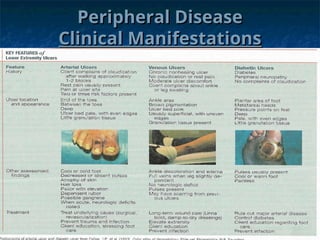
Peripheral Disease
Peripheral Disease
Clinical Manifestations
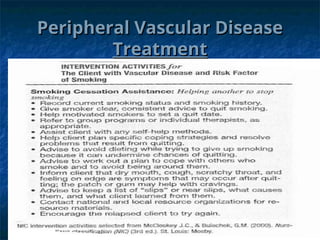
Peripheral Vascular Disease
Treatment
Treatment
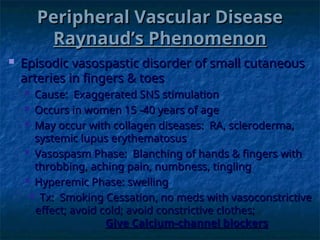
Peripheral Vascular Disease
Raynaud’s Phenomenon
 Episodic vasospastic disorder of small cutaneous
Episodic vasospastic disorder of small cutaneous
arteries in fingers & toes
 Cause: Exaggerated SNS stimulation
Cause: Exaggerated SNS stimulation
 Occurs in women 15 -40 years of age
Occurs in women 15 -40 years of age
 May occur with collagen diseases: RA, scleroderma,
May occur with collagen diseases: RA, scleroderma,
systemic lupus erythematosus
 Vasospasm Phase: Blanching of hands & fingers with
Vasospasm Phase: Blanching of hands & fingers with
throbbing, aching pain, numbness, tingling
 Hyperemic Phase: swelling
Hyperemic Phase: swelling
 Tx: Smoking Cessation, no meds with vasoconstrictive
Tx: Smoking Cessation, no meds with vasoconstrictive
effect; avoid cold; avoid constrictive clothes;
Give Calcium-channel blockers

PVD peripheral vascular disease management.ppt

  • 1.
    Vascular Disorders Vascular Disorders PeripheralArterial Disease of Peripheral Arterial Disease of the Lower Extremities the Lower Extremities  Aortoiliac, femoral, popliteal, tibial, or peroneal arteries Aortoiliac, femoral, popliteal, tibial, or peroneal arteries  Classic symptom: Intermittent Claudication Classic symptom: Intermittent Claudication  Ischemic muscle ache precipitated by a consistent level Ischemic muscle ache precipitated by a consistent level of exercise of exercise  Paresthesia – numbness / tingling in toes & feet Paresthesia – numbness / tingling in toes & feet  Trophic changes: reactive hyperemia Trophic changes: reactive hyperemia dependent rubor dependent rubor  Rest pain – nocturnal Rest pain – nocturnal
  • 2.
  • 3.
    Peripheral Arterial Diseaseof Peripheral Arterial Disease of the Lower Extremities the Lower Extremities  Diagnostics: Diagnostics:  Non-invasive: Doppler Studies Non-invasive: Doppler Studies  Invasive: Angiography Invasive: Angiography
  • 4.
    Peripheral Arterial Diseaseof Peripheral Arterial Disease of the Lower Extremities the Lower Extremities  Treatment: Treatment:  Risk Factor Modification – Risk Factor Modification –  HTN – Stepped Approach to Control HTN – Stepped Approach to Control  Smoking - Cessation Smoking - Cessation  Treatment of hyperlipidemia - Nutrition Treatment of hyperlipidemia - Nutrition  Exercise – slow progressive walking Exercise – slow progressive walking  Medication – Medication –  Antiplatelet Therapy – Plavix / ASA Antiplatelet Therapy – Plavix / ASA  < blood viscosity / >erythrocyte flexibility – Trental < blood viscosity / >erythrocyte flexibility – Trental  < platelet aggregation & promote vasodilation - Pletal < platelet aggregation & promote vasodilation - Pletal
  • 5.
    P Peripheral Arterial Diseaseof eripheral Arterial Disease of the Lower Extremities the Lower Extremities  Critical Limb Ischemia Critical Limb Ischemia  Interventional Radiology Interventional Radiology  Percutaneous transluminal balloon angioplasty Percutaneous transluminal balloon angioplasty  Atherectomy Atherectomy  Surgical Revascularization Surgical Revascularization  Endarterectomy Endarterectomy  Graft angioplasty Graft angioplasty  Peripheral artery bypass surgery Peripheral artery bypass surgery  End-stage surgery - amputation End-stage surgery - amputation
  • 6.
    Vascular Disorders Vascular Disorders PeripheralArterial Disease of Peripheral Arterial Disease of the Lower Extremities the Lower Extremities  Nursing Diagnoses Nursing Diagnoses  Ineffective tissue perfusion Ineffective tissue perfusion  Impaired skin integrity Impaired skin integrity  Acute pain Acute pain  Activity intolerance Activity intolerance  Ineffective therapeutic management Ineffective therapeutic management
  • 7.
    Peripheral Arterial Diseaseof Peripheral Arterial Disease of the Lower Extremities the Lower Extremities  Assess Assess: Peripheral pulses, pallor, blanching, : Peripheral pulses, pallor, blanching, hyperemia, warmth, capillary refill, ability to hyperemia, warmth, capillary refill, ability to bear weight and walk, pain, risk factors bear weight and walk, pain, risk factors  Nsg Action Nsg Action: Medication administration, : Medication administration, prepare for tests, treatment, surgery, prevent prepare for tests, treatment, surgery, prevent injury, skin care, community referrals injury, skin care, community referrals  Pt/Family Education Pt/Family Education: Skin care, Medications, : Skin care, Medications, risk factor modification, exercise risk factor modification, exercise
  • 8.
    Peripheral Vascular Disease PeripheralVascular Disease Thromboangiitis Obliterans Thromboangiitis Obliterans Buerger’s Disease Buerger’s Disease  Nonathersclerotic, segmental Nonathersclerotic, segmental inflammation of arteries, veins & nerves of inflammation of arteries, veins & nerves of upper and lower extremities upper and lower extremities  More common in men 25-40 years of age More common in men 25-40 years of age  Correlates with cigarette smoking Correlates with cigarette smoking  Rest pain, ischemic ulcerations Rest pain, ischemic ulcerations  Tx: smoking cessation / medications – Tx: smoking cessation / medications – anti-platelets, vasodilators anti-platelets, vasodilators  Surgical: Amputation Surgical: Amputation
  • 9.
    Peripheral Disease Peripheral Disease ClinicalManifestations Clinical Manifestations
  • 10.
    Peripheral Vascular Disease PeripheralVascular Disease Treatment Treatment
  • 11.
    Peripheral Vascular Disease PeripheralVascular Disease Raynaud’s Phenomenon Raynaud’s Phenomenon  Episodic vasospastic disorder of small cutaneous Episodic vasospastic disorder of small cutaneous arteries in fingers & toes arteries in fingers & toes  Cause: Exaggerated SNS stimulation Cause: Exaggerated SNS stimulation  Occurs in women 15 -40 years of age Occurs in women 15 -40 years of age  May occur with collagen diseases: RA, scleroderma, May occur with collagen diseases: RA, scleroderma, systemic lupus erythematosus systemic lupus erythematosus  Vasospasm Phase: Blanching of hands & fingers with Vasospasm Phase: Blanching of hands & fingers with throbbing, aching pain, numbness, tingling throbbing, aching pain, numbness, tingling  Hyperemic Phase: swelling Hyperemic Phase: swelling  Tx: Smoking Cessation, no meds with vasoconstrictive Tx: Smoking Cessation, no meds with vasoconstrictive effect; avoid cold; avoid constrictive clothes; effect; avoid cold; avoid constrictive clothes; Give Calcium-channel blockers Give Calcium-channel blockers