




Benign & malignant
cells pathology
SUDESHNA BANERJEE DUTTA
NEOPLASIA
 The term “neoplasia” means new growth; the new growth produced is called
“neoplasm” or “tumor”.
 The branch of science dealing with the study of neoplasms or tumors is called oncology
(oncus=tumor, logos=study).
 Neoplasm may be ‘benign’ when they are slow-growing and localized without causing
much difficulty to the host
 Or ‘malignant’ when they proliferate rapidly, spread throughout the body and may
eventually cause death of the host.
 The common term used for all malignant tumors is cancer.
DEFINITION
 “A neoplasm is an abnormal mass of tissue, the growth of which exceeds
and is uncoordinated with that of normal tissue and persist in the same
excessive manner after cessation of the stimuli which evoke the change”.
-Willis
TYPES OF NEOPLASMS (TUMORS)
 Benign tumors - They remain localized cannot spread to other sites and are
amenable to local surgical removal and patient survives.
 Oma as a suffix indicates to tumor
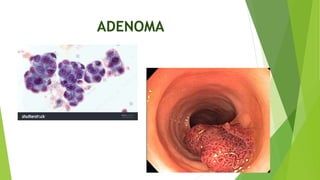
 Epithelial: Adenoma, cystadenoma (cystic tumors of epithelial origin),
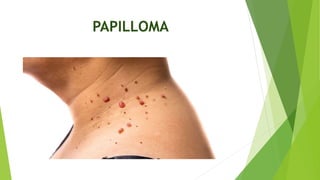
 Papilloma
ADENOMA
PAPILLOMA
TYPES OF NEOPLASMS (TUMORS)
 Malignant tumors - They invade and destroy adjacent structures and spread
to distant sites to cause death of patient.
 Sarcoma (sar= fleshy) -mesenchymal tissue origin
 Carcinoma --- epithelial cell origin.
 Squamous cell carcinoma, Adenocarcinoma
Degree of cellular differentiation
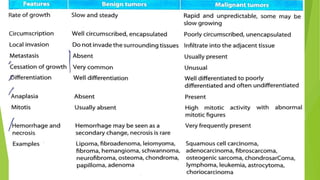
 Differentiation refers to the extent to which the tumor cell resembles its normal counterpart or cell of
origin.
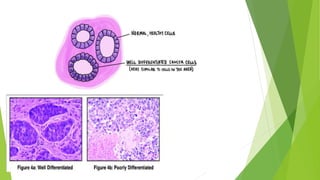
 Benign tumors are very well differentiated & closely resemble their normal counterparts
 Malignant cells show a wide range of differentiation. Can be very well differentiated or absolutely
undifferentiated (anaplastic)
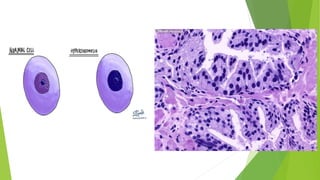
 Pleomorphism: Variation in shape & size of cells & nuclei
 Hyperchromasia: Nuclei contain dark stained chromatin
 Nuclear enlargement
 Increased mitosis
 Formation of tumor giant cells
Rate of growth
 Benign tumors are slow growing grow gradually
 Malignant tumor grow rapidly
Circumscription
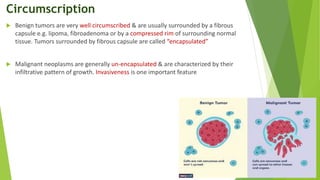
 Benign tumors are very well circumscribed & are usually surrounded by a fibrous
capsule e.g. lipoma, fibroadenoma or by a compressed rim of surrounding normal
tissue. Tumors surrounded by fibrous capsule are called “encapsulated”
 Malignant neoplasms are generally un-encapsulated & are characterized by their
infiltrative pattern of growth. Invasiveness is one important feature
WELL CIRCUMSCRIBED POORLY CIRCUMSCRIBED
Metastasis
 Spread of tumor cells from one part of the body to another part. From its site of
origin to any distant organ.
 Invasion of blood vessels (hematogenous spread), lymphatics (lymphatic spread) or
body cavity (seeding)
 Cells may spread by bloodstream or lymphatic channels
Implantation
 Transfer of neoplastic cells from one serous or mucous surface to another by direct
contact
 Body cavities are commonly involved
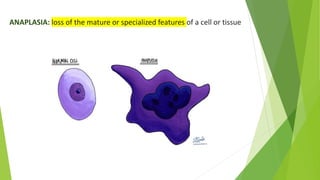
ANAPLASIA: loss of the mature or specialized features of a cell or tissue
Factors predisposing for neoplasia
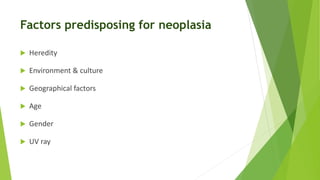
 Heredity
 Environment & culture
 Geographical factors
 Age
 Gender
 UV ray
Factors predisposing for neoplasia: Carcinogenic
agents
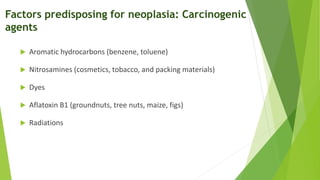
 Aromatic hydrocarbons (benzene, toluene)
 Nitrosamines (cosmetics, tobacco, and packing materials)
 Dyes
 Aflatoxin B1 (groundnuts, tree nuts, maize, figs)
 Radiations
Diagnostic tests
 Histopathological sampling
 Hematological exam
 Cytologic diagnostic study
 Immunohistochemistry (tissue distribution of an antigen)
 Genetic testing
NEOPLASMS

NEOPLASMS

  • 1.
    Benign & malignant cellspathology SUDESHNA BANERJEE DUTTA
  • 2.
    NEOPLASIA  The term“neoplasia” means new growth; the new growth produced is called “neoplasm” or “tumor”.  The branch of science dealing with the study of neoplasms or tumors is called oncology (oncus=tumor, logos=study).  Neoplasm may be ‘benign’ when they are slow-growing and localized without causing much difficulty to the host  Or ‘malignant’ when they proliferate rapidly, spread throughout the body and may eventually cause death of the host.  The common term used for all malignant tumors is cancer.
  • 3.
    DEFINITION  “A neoplasmis an abnormal mass of tissue, the growth of which exceeds and is uncoordinated with that of normal tissue and persist in the same excessive manner after cessation of the stimuli which evoke the change”. -Willis
  • 4.
    TYPES OF NEOPLASMS(TUMORS)  Benign tumors - They remain localized cannot spread to other sites and are amenable to local surgical removal and patient survives.  Oma as a suffix indicates to tumor  Epithelial: Adenoma, cystadenoma (cystic tumors of epithelial origin),  Papilloma
  • 5.
  • 6.
  • 7.
    TYPES OF NEOPLASMS(TUMORS)  Malignant tumors - They invade and destroy adjacent structures and spread to distant sites to cause death of patient.  Sarcoma (sar= fleshy) -mesenchymal tissue origin  Carcinoma --- epithelial cell origin.  Squamous cell carcinoma, Adenocarcinoma
  • 8.
    Degree of cellulardifferentiation  Differentiation refers to the extent to which the tumor cell resembles its normal counterpart or cell of origin.  Benign tumors are very well differentiated & closely resemble their normal counterparts  Malignant cells show a wide range of differentiation. Can be very well differentiated or absolutely undifferentiated (anaplastic)  Pleomorphism: Variation in shape & size of cells & nuclei  Hyperchromasia: Nuclei contain dark stained chromatin  Nuclear enlargement  Increased mitosis  Formation of tumor giant cells
  • 11.
    Rate of growth Benign tumors are slow growing grow gradually  Malignant tumor grow rapidly
  • 12.
    Circumscription  Benign tumorsare very well circumscribed & are usually surrounded by a fibrous capsule e.g. lipoma, fibroadenoma or by a compressed rim of surrounding normal tissue. Tumors surrounded by fibrous capsule are called “encapsulated”  Malignant neoplasms are generally un-encapsulated & are characterized by their infiltrative pattern of growth. Invasiveness is one important feature
  • 13.
  • 14.
    Metastasis  Spread oftumor cells from one part of the body to another part. From its site of origin to any distant organ.  Invasion of blood vessels (hematogenous spread), lymphatics (lymphatic spread) or body cavity (seeding)  Cells may spread by bloodstream or lymphatic channels
  • 15.
    Implantation  Transfer ofneoplastic cells from one serous or mucous surface to another by direct contact  Body cavities are commonly involved
  • 17.
    ANAPLASIA: loss ofthe mature or specialized features of a cell or tissue
  • 18.
    Factors predisposing forneoplasia  Heredity  Environment & culture  Geographical factors  Age  Gender  UV ray
  • 19.
    Factors predisposing forneoplasia: Carcinogenic agents  Aromatic hydrocarbons (benzene, toluene)  Nitrosamines (cosmetics, tobacco, and packing materials)  Dyes  Aflatoxin B1 (groundnuts, tree nuts, maize, figs)  Radiations
  • 22.
    Diagnostic tests  Histopathologicalsampling  Hematological exam  Cytologic diagnostic study  Immunohistochemistry (tissue distribution of an antigen)  Genetic testing