REFRACTIVE
ERRORS
SUDESHNA BANERJEE DUTTA
SENIOR LECTURER
S.R.S.V.M B.SC NURSING COLLEGE
INTRODUCTION
✓Refractive errors means that the shape of eye doesn’t
bend light correctly resulting in a blurred image .
✓The main types of refractive errors are
1. Myopia ( near sightedness )
2. Hyperopia (hypermetropia ) ( far sightedness ) ( long
sightedness )
3. Presbyopia ( loss of near vision with age )
4. Astigmatisms ( both) ( near sightedness ) ( long
sightedness )
❑ Emetropia (optically normal eye) can be defined as a
state of refraction, when the parallel rays of light coming
from infinity are focused at the sensitive layer of retina
with the accommodation being at rest
❑ Ametropia (a condition of refractive error) is defined as
a state of refraction, when the parallel rays of light coming
from infinity, (with accommodation at rest), are focused
either in front or behind the sensitive layer of retina
ERRORS
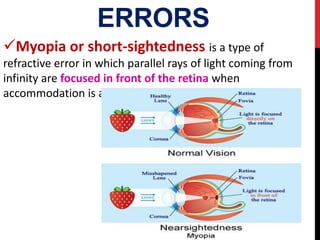
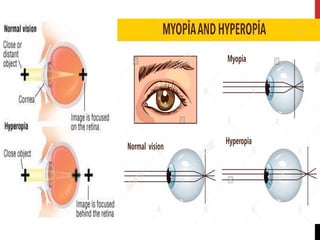
✓Myopia or short-sightedness is a type of
refractive error in which parallel rays of light coming from
infinity are focused in front of the retina when
accommodation is at rest
ETIOLOGY
Axial myopia results from increase in the antero-
posterior length of the eyeball
Curvatural myopia occurs due to increased curvature of
the cornea, lens or both.
Index myopia results from increase in the refractive
index of the crystalline lens associated with nuclear
sclerosis.
ETIOLOGY
Infection adenovirus
Injury due to optic nerve damage
Ultraviolet radiation
eye disease
Inherited
Aging ( above 45year )
Environmental factors
Previous corneal injury
Previous eye surgery
Optic nerve hypoplasia
TYPES OF MYOPIA
Congenital Myopia is present since birth. Usually the error is of
about -8 to -10 diopters, which mostly remains constant. It may be
associated with other ocular congenital anomalies
Simple Myopia It is the commonest variety, which results from
biological variation in the development of eye. simple myopia starts
at school age and very slowly progresses till adult age. Usually the
error does not exceed -6 to -8 diopters
Pathological Myopia or Degenerative Myopia is a rapidly
progressive error resulting in high myopia. (more than -8 D) during
early adult life, which is usually associated with degenerative
changes in the retina Genetic factors play major role in the etiology
of pathological myopia.
HYPEROPIA
Far-sightedness also known as long sightedness
Hyperopia is a condition of the eye in which light is
focused behind the retina , instead of on the retina.
Resulting in an inability to seen near objects clear .
Causes: Abnormal shape of cornea
HYPEROPIA
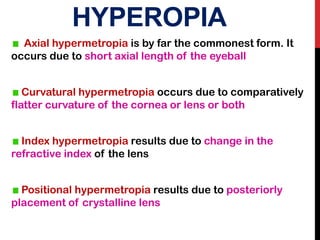
Axial hypermetropia is by far the commonest form. It
occurs due to short axial length of the eyeball
Curvatural hypermetropia occurs due to comparatively
flatter curvature of the cornea or lens or both
Index hypermetropia results due to change in the
refractive index of the lens
Positional hypermetropia results due to posteriorly
placement of crystalline lens
HYPEROPIA
Absence of the lens (aphakia) either congenital or
acquired (following surgical removal of the lens) leads
to high hypermetropia.
CLINICAL
FEATURES
Tiredness of Eyes
Frontal Or Fronto-temporal Headache
Watering
Mild Photophobia
Asthenopia (Straining of eyes)
MANAGEMENT
Appropriate convex lenses in the form of spectacles or
contact lenses
SURGICAL MANAGEMENT
Refractive corneal surgery
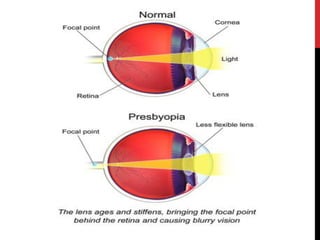
PRESBYOPIA
Presbyopia is a common type of vision
disorder that occurs as you age. It is often
referred to as the aging eye condition . Result in
the inability to focus up close , a problem
associated with refraction in the eye
ETIOLOGY OF
PRESBYOPIA
Decrease in the accommodative power of crystalline
lens with increasing age, leading to presbyopia occur
due to:
Decrease in the elasticity and plasticity of the
crystalline lens
Age related decrease in the power of ciliary muscle.
CLINICAL
FEATURES
Typically patient complains of slowly
progressive difficulty in focusing the near objects,
while distant vision is not affected.
MANAGEMENT
Convex glasses of an appropriate power
ASTIGMATIS
M
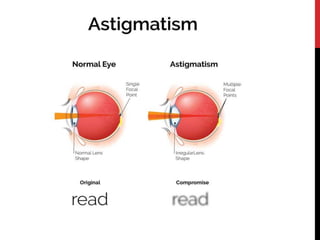
It is a condition in which an abnormal
curvature of the cornea occurs .
Astigmatisms may cause eye strain and may
be combined with nearsightedness or long-
sightedness .
ASTIGMATISM
Usually occurs due to unequal curvature of cornea
Rarely it may occur due to subluxation abnormalities
of the curvature of the lens.
MANAGEMENT
Cylindrical lenses in the form of
spectacles or contact lenses
SURGICAL MANAGEMENT
Keratoplasty
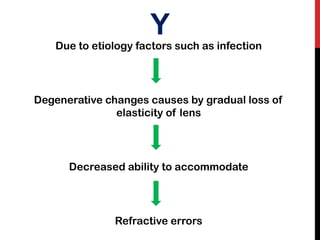
Y
Due to etiology factors such as infection
Degenerative changes causes by gradual loss of
elasticity of lens
Decreased ability to accommodate
Refractive errors
DIAGNOSTIC EVALUATION
HISTORY TAKING
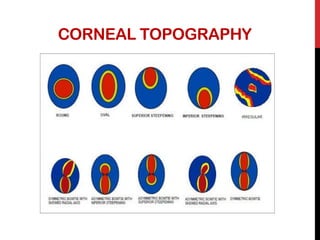
CORNEAL TOPOGRAPHY: This computerized test
maps the curve of your eye cornea , it can show problem
with eye surface like swelling or scarring
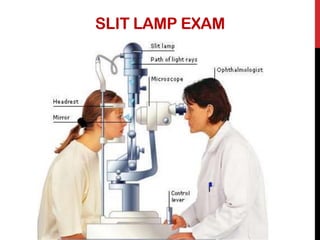
SLIT LAMP EXAM: The doctor uses this microscope to
shine a beam of light shaped like a small slit on effected
eye .he may dilated pupils during the test it help
diagnose .
CORNEAL TOPOGRAPHY
SLIT LAMP EXAM
DIAGNOSTIC EVALUATION
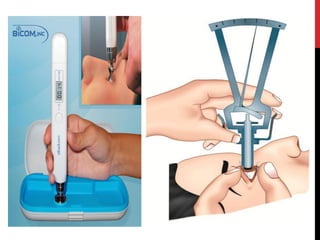
TONOMETRY: Test measures the pressure inside eye
.which is called intra ocular pressure
RETINOSCOPY: Is a technique obtain an objective
measurement of the refractive error of a patients eye
PHARMACOLOGICAL
MANAGEMENT
Cycloplegic drugs are used to refraction ( to paralyze
the ciliary muscle in order to determine the true
refractive error of eye )
Cholinergics (Miotics): Pilocarpine, Carbachol - It
increases aqueous fluid outflow by contracting the
ciliary muscles
Beta blockers : Betaxolol, Timolol
Decreases aqueous humor production
SURGICAL MANAGEMENT
Keratomileusis: Is a method of reshaping the cornea surface to
change its optical power.
LASIK- laser eye surgery : ( laser assisted in situ kereto-
mileusis )
✓This procedure used to treat nearsightedness ,farsightedness
✓A laser is used to reshape the cornea – the clear ,round dome at
the front of the eye
✓To improve the way the eye focuses light rays onto the retina at the
back of the eye.
SURGICAL MANAGEMENT
AUTOMATIC LAME -LLAR KERATOPLASTY (ALK)
✓Keratoplasty is the procedure where by abnormal
corneal tissue is replaced by a healthy donor cornea
✓Is a older type of vision surgery carried out by making a
flap in the cornea to help correct severe short
sightedness and long sightedness.
SURGICAL MANAGEMENT
LASEK LASSER ASSISTED SUB EPITHELIAL
KERATOMILEUSIS : The hinged flap made in laser
assisted epithelial kerato-mileusis surgery is created in
the epithelial layer of eye . Inserted of creating a thicker
corneal flap as in laser assisted epithelial kereto-
mileusis surgery
PHOTO REFRACTIVE KERETOTOMY (PRK) : To correct
myopia The eye surgeon then gently remove the surface
of corneal cells ( epithelium )
NURSING MANAGEMENT
Safe administration of the prescribed fluid
Right documentation
Monitor the hemodynamic pressure, vital sign, arterial
blood gas
Assess the patient for any previous allergy to medicine,
fruits etc
When we administer any new medicine we have to
observe the side effect of it
We must have the knowledge about the sign symptoms of
shock
Observe the response to the treatment
Refractive errors

Refractive errors

  • 1.
    REFRACTIVE ERRORS SUDESHNA BANERJEE DUTTA SENIORLECTURER S.R.S.V.M B.SC NURSING COLLEGE
  • 2.
    INTRODUCTION ✓Refractive errors meansthat the shape of eye doesn’t bend light correctly resulting in a blurred image . ✓The main types of refractive errors are 1. Myopia ( near sightedness ) 2. Hyperopia (hypermetropia ) ( far sightedness ) ( long sightedness ) 3. Presbyopia ( loss of near vision with age ) 4. Astigmatisms ( both) ( near sightedness ) ( long sightedness )
  • 3.
    ❑ Emetropia (opticallynormal eye) can be defined as a state of refraction, when the parallel rays of light coming from infinity are focused at the sensitive layer of retina with the accommodation being at rest ❑ Ametropia (a condition of refractive error) is defined as a state of refraction, when the parallel rays of light coming from infinity, (with accommodation at rest), are focused either in front or behind the sensitive layer of retina
  • 4.
    ERRORS ✓Myopia or short-sightednessis a type of refractive error in which parallel rays of light coming from infinity are focused in front of the retina when accommodation is at rest
  • 5.
    ETIOLOGY Axial myopia resultsfrom increase in the antero- posterior length of the eyeball Curvatural myopia occurs due to increased curvature of the cornea, lens or both. Index myopia results from increase in the refractive index of the crystalline lens associated with nuclear sclerosis.
  • 6.
    ETIOLOGY Infection adenovirus Injury dueto optic nerve damage Ultraviolet radiation eye disease Inherited Aging ( above 45year ) Environmental factors Previous corneal injury Previous eye surgery Optic nerve hypoplasia
  • 7.
    TYPES OF MYOPIA CongenitalMyopia is present since birth. Usually the error is of about -8 to -10 diopters, which mostly remains constant. It may be associated with other ocular congenital anomalies Simple Myopia It is the commonest variety, which results from biological variation in the development of eye. simple myopia starts at school age and very slowly progresses till adult age. Usually the error does not exceed -6 to -8 diopters Pathological Myopia or Degenerative Myopia is a rapidly progressive error resulting in high myopia. (more than -8 D) during early adult life, which is usually associated with degenerative changes in the retina Genetic factors play major role in the etiology of pathological myopia.
  • 8.
    HYPEROPIA Far-sightedness also knownas long sightedness Hyperopia is a condition of the eye in which light is focused behind the retina , instead of on the retina. Resulting in an inability to seen near objects clear . Causes: Abnormal shape of cornea
  • 10.
    HYPEROPIA Axial hypermetropia isby far the commonest form. It occurs due to short axial length of the eyeball Curvatural hypermetropia occurs due to comparatively flatter curvature of the cornea or lens or both Index hypermetropia results due to change in the refractive index of the lens Positional hypermetropia results due to posteriorly placement of crystalline lens
  • 11.
    HYPEROPIA Absence of thelens (aphakia) either congenital or acquired (following surgical removal of the lens) leads to high hypermetropia.
  • 12.
    CLINICAL FEATURES Tiredness of Eyes FrontalOr Fronto-temporal Headache Watering Mild Photophobia Asthenopia (Straining of eyes)
  • 13.
    MANAGEMENT Appropriate convex lensesin the form of spectacles or contact lenses SURGICAL MANAGEMENT Refractive corneal surgery
  • 14.
    PRESBYOPIA Presbyopia is acommon type of vision disorder that occurs as you age. It is often referred to as the aging eye condition . Result in the inability to focus up close , a problem associated with refraction in the eye
  • 16.
    ETIOLOGY OF PRESBYOPIA Decrease inthe accommodative power of crystalline lens with increasing age, leading to presbyopia occur due to: Decrease in the elasticity and plasticity of the crystalline lens Age related decrease in the power of ciliary muscle.
  • 17.
    CLINICAL FEATURES Typically patient complainsof slowly progressive difficulty in focusing the near objects, while distant vision is not affected.
  • 18.
    MANAGEMENT Convex glasses ofan appropriate power
  • 19.
    ASTIGMATIS M It is acondition in which an abnormal curvature of the cornea occurs . Astigmatisms may cause eye strain and may be combined with nearsightedness or long- sightedness .
  • 21.
    ASTIGMATISM Usually occurs dueto unequal curvature of cornea Rarely it may occur due to subluxation abnormalities of the curvature of the lens.
  • 22.
    MANAGEMENT Cylindrical lenses inthe form of spectacles or contact lenses SURGICAL MANAGEMENT Keratoplasty
  • 23.
    Y Due to etiologyfactors such as infection Degenerative changes causes by gradual loss of elasticity of lens Decreased ability to accommodate Refractive errors
  • 24.
    DIAGNOSTIC EVALUATION HISTORY TAKING CORNEALTOPOGRAPHY: This computerized test maps the curve of your eye cornea , it can show problem with eye surface like swelling or scarring SLIT LAMP EXAM: The doctor uses this microscope to shine a beam of light shaped like a small slit on effected eye .he may dilated pupils during the test it help diagnose .
  • 25.
  • 26.
  • 27.
    DIAGNOSTIC EVALUATION TONOMETRY: Testmeasures the pressure inside eye .which is called intra ocular pressure RETINOSCOPY: Is a technique obtain an objective measurement of the refractive error of a patients eye
  • 29.
    PHARMACOLOGICAL MANAGEMENT Cycloplegic drugs areused to refraction ( to paralyze the ciliary muscle in order to determine the true refractive error of eye ) Cholinergics (Miotics): Pilocarpine, Carbachol - It increases aqueous fluid outflow by contracting the ciliary muscles Beta blockers : Betaxolol, Timolol Decreases aqueous humor production
  • 30.
    SURGICAL MANAGEMENT Keratomileusis: Isa method of reshaping the cornea surface to change its optical power. LASIK- laser eye surgery : ( laser assisted in situ kereto- mileusis ) ✓This procedure used to treat nearsightedness ,farsightedness ✓A laser is used to reshape the cornea – the clear ,round dome at the front of the eye ✓To improve the way the eye focuses light rays onto the retina at the back of the eye.
  • 31.
    SURGICAL MANAGEMENT AUTOMATIC LAME-LLAR KERATOPLASTY (ALK) ✓Keratoplasty is the procedure where by abnormal corneal tissue is replaced by a healthy donor cornea ✓Is a older type of vision surgery carried out by making a flap in the cornea to help correct severe short sightedness and long sightedness.
  • 32.
    SURGICAL MANAGEMENT LASEK LASSERASSISTED SUB EPITHELIAL KERATOMILEUSIS : The hinged flap made in laser assisted epithelial kerato-mileusis surgery is created in the epithelial layer of eye . Inserted of creating a thicker corneal flap as in laser assisted epithelial kereto- mileusis surgery PHOTO REFRACTIVE KERETOTOMY (PRK) : To correct myopia The eye surgeon then gently remove the surface of corneal cells ( epithelium )
  • 33.
    NURSING MANAGEMENT Safe administrationof the prescribed fluid Right documentation Monitor the hemodynamic pressure, vital sign, arterial blood gas Assess the patient for any previous allergy to medicine, fruits etc When we administer any new medicine we have to observe the side effect of it We must have the knowledge about the sign symptoms of shock Observe the response to the treatment