PATHOLOGICAL
CHANGES IN CARDIO-
VASCULAR DISEASE
CONDITIONS
Pericardial effusion
Definition
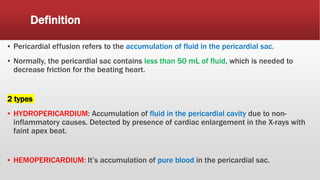
▪ Pericardial effusion refers to the accumulation of fluid in the pericardial sac.
▪ Normally, the pericardial sac contains less than 50 mL of fluid, which is needed to
decrease friction for the beating heart.
2 types
▪ HYDROPERICARDIUM: Accumulation of fluid in the pericardial cavity due to non-
inflammatory causes. Detected by presence of cardiac enlargement in the X-rays with
faint apex beat.
▪ HEMOPERICARDIUM: It’s accumulation of pure blood in the pericardial sac.
Pathological Changes
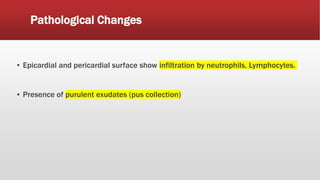
▪ Epicardial and pericardial surface show infiltration by neutrophils, Lymphocytes.
▪ Presence of purulent exudates (pus collection)
Rheumatic heart
disease
Definition
▪ Cases of group A beta-hemolytic streptococcus (GABHS)
▪ Rheumatic heart disease is a condition in which the heart valves have been
permanently damaged by GABHS
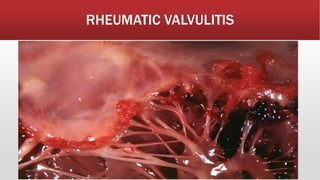
Pathological Changes: RHEUMATIC VALVULITIS
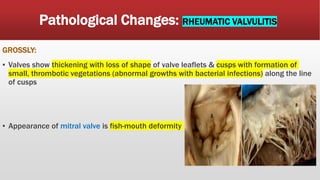
GROSSLY:
▪ Valves show thickening with loss of shape of valve leaflets & cusps with formation of
small, thrombotic vegetations (abnormal growths with bacterial infections) along the line
of cusps
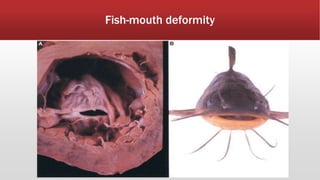
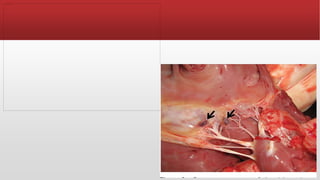
▪ Appearance of mitral valve is fish-mouth deformity
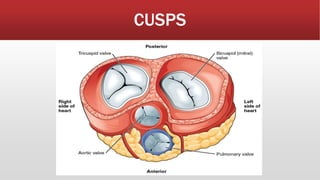
CUSPS
RHEUMATIC VALVULITIS
Fish-mouth deformity
Pathological Changes: RHEUMATIC VALVULITIS
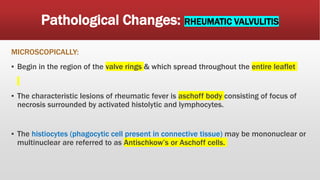
MICROSCOPICALLY:
▪ Begin in the region of the valve rings & which spread throughout the entire leaflet
▪ The characteristic lesions of rheumatic fever is aschoff body consisting of focus of
necrosis surrounded by activated histolytic and lymphocytes.
▪ The histiocytes (phagocytic cell present in connective tissue) may be mononuclear or
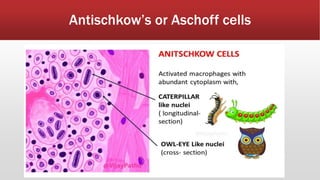
multinuclear are referred to as Antischkow’s or Aschoff cells.
Antischkow’s or Aschoff cells
RHEUMATIC MURAL ENDOCARDITIS
GROSSLY
▪ Lesions are seen most commonly as MacCallum’s PATCH (THICKENED, ROUGHENED &
WRINKLED PART) in the posterior leaflet of the mitral valve
MICROSCOPICALLY
▪ Affected area shows edema, fibrinoid change ( Alteration in connective tissues in
response to immune reactions. The tissue becomes swollen and bandlike) in the
collagen
MacCallum’s PATCH
RHEUMATIC MYOCARDITIS
GROSSLY
▪ In early stages, myocardium is soft & flabby & in intermediate stage, small foci of
necrosis & aschkoff bodies can be seen.
MICROSCOPICALLY
▪ Presence of aschkoff cells
RHEUMATIC PERICARDITIS
GROSSLY
▪ Accumulation of slight amount of fibrinous exudates in the pericardial sac.
▪ Parietal & visceral pericardium appears shaggy due to thick covering of fibrin on them
(bread & butter appearance)
MICROSCOPICALLY
▪ Fibrin deposition can be seen along with infiltration of lymphocytes, plasma cells,
neutrophils on the connective tissue
INFECTIVE
ENDOCARDITIS
Pathological Changes
MACROSCOPICALLY :
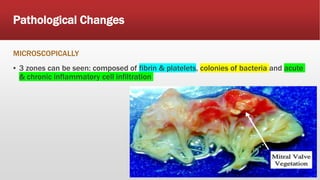
▪ Typical vegetations of valves can be seen deposited on the valve cusps and leaflets
▪ The vegetation may vary in sizes from few millimeters to several centimeters, grey to
greenish, irregular, single or multiple and typical friable (easily crumbled). Mitral and
aortic valve are most commonly involved
▪ The adjoining myocardium shows abscess formation. The vegetations appear bulkier
and globular.
Pathological Changes
MICROSCOPICALLY
▪ 3 zones can be seen: composed of fibrin & platelets, colonies of bacteria and acute
& chronic inflammatory cell infiltration
ATHEROSCLEROSIS
Pathological changes
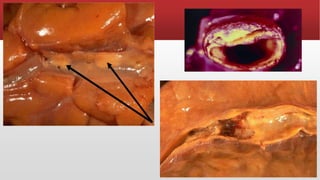
Grossly : lesions appears yellowish (may be flat or elevated)
▪ Gelatinous lesions : They are round or oval lesions with circumscribed grey elevations
about 1 cm in diameter which usually develop in the intima of aorta.
▪ Atheromatous plaque: White to yellowish lesions (1-2 cm) cut section shows firm
surface with white fibrous cap & a central core composed of yellow-white porridge
like material
Atheromatous plaque
Microscopically :
▪ Superficial part of fibrous cap is covered by endothelium, which is composed of
smooth muscle cells, dense connective tissue, proteoglycans & collagen
▪ Cellular area under fibrous cap composed of macrophages, foam cells, lymphocytes,
smooth muscle cells & lipid
▪ Deeper core consist of extracellular lipid material, cholesterol, fibrin, necrotic debris
INFARCTION
Definition
▪ Infarction, death of tissue resulting from a failure of blood supply,
commonly due to obstruction of a blood vessel by a blood clot or
narrowing of the blood-vessel channel. The dead tissue is called an
infarct.
Morphology of infarction
According to the amount of blood present
▪ White infarction (anemic infarct): Affects the solid organs such as spleen, kidneys
where the solidity of tissue limits the amount of nutrients (blood, O2, glucose) that
can flow into the area of ischaemic necrosis
▪ Red infarction (haemorrhagic infarct): Affects the lungs of other loose organs like
testes, intestines & ovary. Occlusion consist more of fibrin strands & RBCs
ANEURYSM
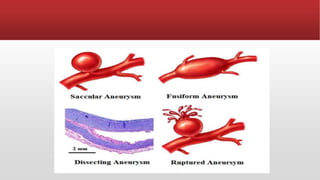
Atherosclerotic aneurysm
Pathological changes
MACROSCOPICALLY:
Lesions can be variable in size , usually larger than 5 – 6 cm in diameter.
MICROSCOPICALLY:
Fibrous tissue can be seen in media and adventitia with mild inflammatory reaction.
Dissecting anerurysm
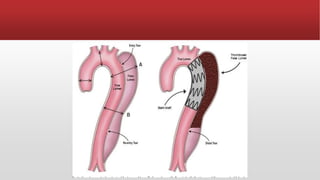
Tear in the intima, blood goes to the space between intima and media.
Pathological changes
MACROSCOPICALLY:
▪ Dissection is usually seen between the outer & middle third of the aortic media, as a result the column of
blood separates the intima & inner two-third of the media on one side & outer one-third of the media &
adventitia on other
▪ In few cases, the blood that enters into the media re-enters into the lumina due to second tear on the
intima, which leads to a change called ‘double barrel aorta’
Pathological changes
MICROSCOPICALLY:
▪ Elastic tissue fragmentation can be seen.
▪ Increased fibrosis of media.
CARDIAC DISORDERS

CARDIAC DISORDERS

  • 1.
  • 2.
  • 3.
    Definition ▪ Pericardial effusionrefers to the accumulation of fluid in the pericardial sac. ▪ Normally, the pericardial sac contains less than 50 mL of fluid, which is needed to decrease friction for the beating heart. 2 types ▪ HYDROPERICARDIUM: Accumulation of fluid in the pericardial cavity due to non- inflammatory causes. Detected by presence of cardiac enlargement in the X-rays with faint apex beat. ▪ HEMOPERICARDIUM: It’s accumulation of pure blood in the pericardial sac.
  • 5.
    Pathological Changes ▪ Epicardialand pericardial surface show infiltration by neutrophils, Lymphocytes. ▪ Presence of purulent exudates (pus collection)
  • 6.
  • 7.
    Definition ▪ Cases ofgroup A beta-hemolytic streptococcus (GABHS) ▪ Rheumatic heart disease is a condition in which the heart valves have been permanently damaged by GABHS
  • 8.
    Pathological Changes: RHEUMATICVALVULITIS GROSSLY: ▪ Valves show thickening with loss of shape of valve leaflets & cusps with formation of small, thrombotic vegetations (abnormal growths with bacterial infections) along the line of cusps ▪ Appearance of mitral valve is fish-mouth deformity
  • 9.
  • 10.
  • 11.
  • 12.
    Pathological Changes: RHEUMATICVALVULITIS MICROSCOPICALLY: ▪ Begin in the region of the valve rings & which spread throughout the entire leaflet ▪ The characteristic lesions of rheumatic fever is aschoff body consisting of focus of necrosis surrounded by activated histolytic and lymphocytes. ▪ The histiocytes (phagocytic cell present in connective tissue) may be mononuclear or multinuclear are referred to as Antischkow’s or Aschoff cells.
  • 13.
  • 14.
    RHEUMATIC MURAL ENDOCARDITIS GROSSLY ▪Lesions are seen most commonly as MacCallum’s PATCH (THICKENED, ROUGHENED & WRINKLED PART) in the posterior leaflet of the mitral valve MICROSCOPICALLY ▪ Affected area shows edema, fibrinoid change ( Alteration in connective tissues in response to immune reactions. The tissue becomes swollen and bandlike) in the collagen

  • 15.
  • 16.
    RHEUMATIC MYOCARDITIS GROSSLY ▪ Inearly stages, myocardium is soft & flabby & in intermediate stage, small foci of necrosis & aschkoff bodies can be seen. MICROSCOPICALLY ▪ Presence of aschkoff cells
  • 17.
    RHEUMATIC PERICARDITIS GROSSLY ▪ Accumulationof slight amount of fibrinous exudates in the pericardial sac. ▪ Parietal & visceral pericardium appears shaggy due to thick covering of fibrin on them (bread & butter appearance) MICROSCOPICALLY ▪ Fibrin deposition can be seen along with infiltration of lymphocytes, plasma cells, neutrophils on the connective tissue
  • 19.
  • 20.
    Pathological Changes MACROSCOPICALLY : ▪Typical vegetations of valves can be seen deposited on the valve cusps and leaflets ▪ The vegetation may vary in sizes from few millimeters to several centimeters, grey to greenish, irregular, single or multiple and typical friable (easily crumbled). Mitral and aortic valve are most commonly involved ▪ The adjoining myocardium shows abscess formation. The vegetations appear bulkier and globular.
  • 22.
    Pathological Changes MICROSCOPICALLY ▪ 3zones can be seen: composed of fibrin & platelets, colonies of bacteria and acute & chronic inflammatory cell infiltration
  • 23.
  • 24.
    Pathological changes Grossly :lesions appears yellowish (may be flat or elevated) ▪ Gelatinous lesions : They are round or oval lesions with circumscribed grey elevations about 1 cm in diameter which usually develop in the intima of aorta. ▪ Atheromatous plaque: White to yellowish lesions (1-2 cm) cut section shows firm surface with white fibrous cap & a central core composed of yellow-white porridge like material
  • 26.
    Atheromatous plaque Microscopically : ▪Superficial part of fibrous cap is covered by endothelium, which is composed of smooth muscle cells, dense connective tissue, proteoglycans & collagen ▪ Cellular area under fibrous cap composed of macrophages, foam cells, lymphocytes, smooth muscle cells & lipid ▪ Deeper core consist of extracellular lipid material, cholesterol, fibrin, necrotic debris
  • 28.
  • 29.
    Definition ▪ Infarction, deathof tissue resulting from a failure of blood supply, commonly due to obstruction of a blood vessel by a blood clot or narrowing of the blood-vessel channel. The dead tissue is called an infarct.
  • 30.
    Morphology of infarction Accordingto the amount of blood present ▪ White infarction (anemic infarct): Affects the solid organs such as spleen, kidneys where the solidity of tissue limits the amount of nutrients (blood, O2, glucose) that can flow into the area of ischaemic necrosis ▪ Red infarction (haemorrhagic infarct): Affects the lungs of other loose organs like testes, intestines & ovary. Occlusion consist more of fibrin strands & RBCs
  • 31.
  • 32.
    Atherosclerotic aneurysm Pathological changes MACROSCOPICALLY: Lesionscan be variable in size , usually larger than 5 – 6 cm in diameter. MICROSCOPICALLY: Fibrous tissue can be seen in media and adventitia with mild inflammatory reaction.
  • 33.
    Dissecting anerurysm Tear inthe intima, blood goes to the space between intima and media. Pathological changes MACROSCOPICALLY: ▪ Dissection is usually seen between the outer & middle third of the aortic media, as a result the column of blood separates the intima & inner two-third of the media on one side & outer one-third of the media & adventitia on other ▪ In few cases, the blood that enters into the media re-enters into the lumina due to second tear on the intima, which leads to a change called ‘double barrel aorta’
  • 36.
    Pathological changes MICROSCOPICALLY: ▪ Elastictissue fragmentation can be seen. ▪ Increased fibrosis of media.