Critical Path
Vazi Okhandiar, PMP, MCT, MBA, MSCS, BSEE
NR Computer Learning
Center
1835 W. Orangewood, #200
Orange . CA 92868
(714) 505-3475
www.nrclc.com
Critical Path Method (CPM)
 The critical path method is a project modeling

technique developed in the late 1950s by Morgan
R. Walker of DuPont and James E. Kelley, Jr. of
Remington Rand. - Wikipedia
Critical Path
 The critical path method was examined by the

United States Navy, and established a version in
1958 called a PERT (Program Evaluation and
Review Technique) analysis. PERT claimed to
reduce project management time by up to 42
percent, and was first used in the development of
the Polaris missile.
Ref: http://www.ehow.com/about_4703555_whatcritical-path.html#ixzz2igTEV3Q7
Critical Path
 A Critical Path is the path with the least amount of

float or slack time. A float time is the amount of
time that an activity can be delayed without
delaying the project.
 A Critical Path is the longest amount of time it will
take to complete the project.
 A Critical Path usually has 0 float but may have
negative float if the end task is constrained to an
early finish date.
 If any of the task identified in the critical path is
late, then the project will be late.
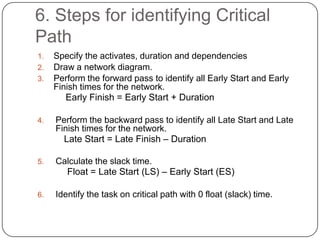
6. Steps for identifying Critical
Path
1.
2.
3.

Specify the activates, duration and dependencies
Draw a network diagram.
Perform the forward pass to identify all Early Start and Early
Finish times for the network.
Early Finish = Early Start + Duration

4.

Perform the backward pass to identify all Late Start and Late
Finish times for the network.
Late Start = Late Finish – Duration

5.

Calculate the slack time.
Float = Late Start (LS) – Early Start (ES)

6.

Identify the task on critical path with 0 float (slack) time.
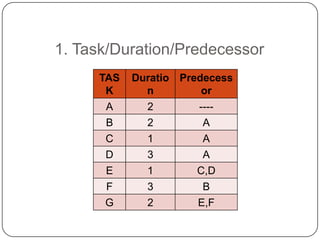
1. Task/Duration/Predecessor
TAS
K
A
B
C
D
E
F
G

Duratio Predecess
n
or
2
---2
A
1
A
3
A
1
C,D
3
B
2
E,F
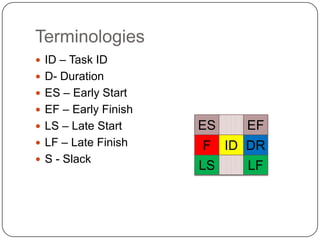
Terminologies
 ID – Task ID
 D- Duration
 ES – Early Start
 EF – Early Finish
 LS – Late Start

ES

 LF – Late Finish

F ID DR
LS
LF

 S - Slack

EF
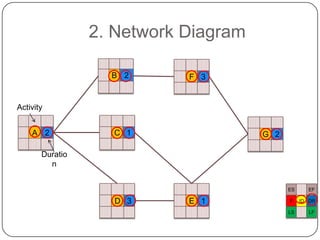
2. Network Diagram
B 2

F 3

Activity
A 2

C 1

G 2

Duratio
n
ES

D 3

E 1

F
LS

EF
ID DR
LF
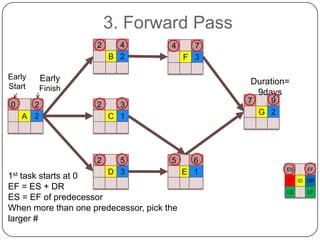
3. Forward Pass
2

Early
Start

4
B 2

1st

2
A 2

7
F 3

Early

Duration=
9days

Finish
2

5
D 3

7

3
C 1

2

0

4

5

task starts at 0
EF = ES + DR
ES = EF of predecessor
When more than one predecessor, pick the
larger #

6
E 1

9
G 2

ES
F
LS

EF
ID DR
LF
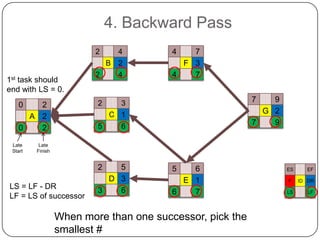
4. Backward Pass
2

4
B 2

1st task should
end with LS = 0.

2

0

2
A 2
0
2
Late
Start

2

4

4

7
F 3
4
7
7

9
G 2
7
9

3

C 1
5

6

Late
Finish

2

LS = LF - DR
LF = LS of successor

5
D 3
3
6

5

6
E 1
6
7

When more than one successor, pick the
smallest #

ES
F
LS

EF
ID DR
LF
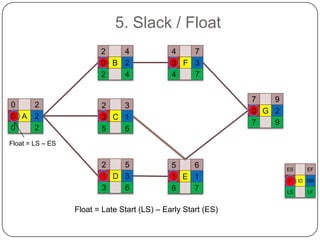
5. Slack / Float
2
4
0 B 2
2
4

0
2
0 A 2
0
2

4
7
0 F 3
4
7
7
9
0 G 2
7
9

2
3
3 C 1
5
6

Float = LS – ES

2
5
1 D 3
3
6

5
6
1 E 1
6
7

Float = Late Start (LS) – Early Start (ES)

ES
F
LS

EF
ID DR
LF
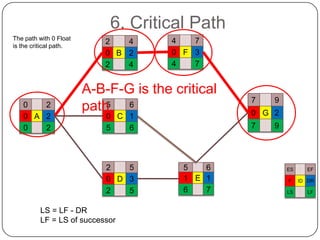
6. Critical Path
The path with 0 Float
is the critical path.

0
2
0 A 2
0
2

2
4
0 B 2
2
4

4
7
0 F 3
4
7

A-B-F-G is the critical
5
path. 6
0 C 1
5
6

2
5
0 D 3
2
5
LS = LF - DR
LF = LS of successor

7

0 G 2
7

5
6
1 E 1
6
7

9
9

ES
F
LS

EF
ID DR
LF
Thank You!
Vazi Okhandiar, PMP, MCT, MBA, MSCS, BSEE
NR Computer Learning Center
1835 W. Orangewood, Suite 200
Orange, CA 92868
www.nrclc.com . (714) 505. 3475
info@nrclc.com

Project Management - Critical path method

  • 1.
    Critical Path Vazi Okhandiar,PMP, MCT, MBA, MSCS, BSEE NR Computer Learning Center 1835 W. Orangewood, #200 Orange . CA 92868 (714) 505-3475 www.nrclc.com
  • 2.
    Critical Path Method(CPM)  The critical path method is a project modeling technique developed in the late 1950s by Morgan R. Walker of DuPont and James E. Kelley, Jr. of Remington Rand. - Wikipedia
  • 3.
    Critical Path  Thecritical path method was examined by the United States Navy, and established a version in 1958 called a PERT (Program Evaluation and Review Technique) analysis. PERT claimed to reduce project management time by up to 42 percent, and was first used in the development of the Polaris missile. Ref: http://www.ehow.com/about_4703555_whatcritical-path.html#ixzz2igTEV3Q7
  • 4.
    Critical Path  ACritical Path is the path with the least amount of float or slack time. A float time is the amount of time that an activity can be delayed without delaying the project.  A Critical Path is the longest amount of time it will take to complete the project.  A Critical Path usually has 0 float but may have negative float if the end task is constrained to an early finish date.  If any of the task identified in the critical path is late, then the project will be late.
  • 5.
    6. Steps foridentifying Critical Path 1. 2. 3. Specify the activates, duration and dependencies Draw a network diagram. Perform the forward pass to identify all Early Start and Early Finish times for the network. Early Finish = Early Start + Duration 4. Perform the backward pass to identify all Late Start and Late Finish times for the network. Late Start = Late Finish – Duration 5. Calculate the slack time. Float = Late Start (LS) – Early Start (ES) 6. Identify the task on critical path with 0 float (slack) time.
  • 6.
  • 7.
    Terminologies  ID –Task ID  D- Duration  ES – Early Start  EF – Early Finish  LS – Late Start ES  LF – Late Finish F ID DR LS LF  S - Slack EF
  • 8.
    2. Network Diagram B2 F 3 Activity A 2 C 1 G 2 Duratio n ES D 3 E 1 F LS EF ID DR LF
  • 9.
    3. Forward Pass 2 Early Start 4 B2 1st 2 A 2 7 F 3 Early Duration= 9days Finish 2 5 D 3 7 3 C 1 2 0 4 5 task starts at 0 EF = ES + DR ES = EF of predecessor When more than one predecessor, pick the larger # 6 E 1 9 G 2 ES F LS EF ID DR LF
  • 10.
    4. Backward Pass 2 4 B2 1st task should end with LS = 0. 2 0 2 A 2 0 2 Late Start 2 4 4 7 F 3 4 7 7 9 G 2 7 9 3 C 1 5 6 Late Finish 2 LS = LF - DR LF = LS of successor 5 D 3 3 6 5 6 E 1 6 7 When more than one successor, pick the smallest # ES F LS EF ID DR LF
  • 11.
    5. Slack /Float 2 4 0 B 2 2 4 0 2 0 A 2 0 2 4 7 0 F 3 4 7 7 9 0 G 2 7 9 2 3 3 C 1 5 6 Float = LS – ES 2 5 1 D 3 3 6 5 6 1 E 1 6 7 Float = Late Start (LS) – Early Start (ES) ES F LS EF ID DR LF
  • 12.
    6. Critical Path Thepath with 0 Float is the critical path. 0 2 0 A 2 0 2 2 4 0 B 2 2 4 4 7 0 F 3 4 7 A-B-F-G is the critical 5 path. 6 0 C 1 5 6 2 5 0 D 3 2 5 LS = LF - DR LF = LS of successor 7 0 G 2 7 5 6 1 E 1 6 7 9 9 ES F LS EF ID DR LF
  • 13.
    Thank You! Vazi Okhandiar,PMP, MCT, MBA, MSCS, BSEE NR Computer Learning Center 1835 W. Orangewood, Suite 200 Orange, CA 92868 www.nrclc.com . (714) 505. 3475 info@nrclc.com

Editor's Notes

  • #3 https://www.wyzant.com/Tutor/mail?eid=OK90XlU3Y%2BjE9p4CLHNjsQ%3D%3D&act=Sent
  • #5 http://hadm.sph.sc.edu/courses/J716/CPM/CPM.html