Operations Management Project Management Chapter 10 OPM 533 10-
Project  A project is a one short of related activities with a definite beginning and ending time directed toward a unique goal Project Management  Project Management is planning, scheduling and controlling of resources such as equipment, workforce and materials so that they meet the time, costs and technical constraint of the project.  Introduction
Single unit Many related activities Difficult production planning and inventory control General purpose equipment High labor skills Project Characteristics OPM 533 10-
To ensure that the project will be completed on time. To manage the project cost so that the cost is minimized and within the expected budget. To meet the predetermined quality standard. Objective  of Project Mgt.
Management of Large Projects Planning  - goal setting, project definition, team organization Scheduling  - relating people, money, and supplies to specific activities and activities to one and other Controlling  - monitoring resources, costs, quality, and budgets; revising plans and shifting resources to meet time and cost demands OPM 533 10-
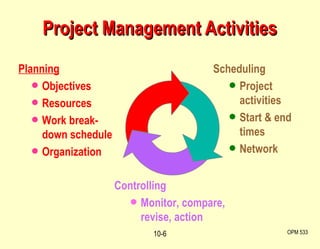
Project Management Activities OPM 533 10- Planning Objectives Resources Work break-down schedule Organization Scheduling Project activities Start & end times Network Controlling Monitor, compare, revise, action
Establishing objectives Defining project Creating work breakdown structure  Determining resources Forming organization Project Planning OPM 533 10- © 1995 Corel Corp.
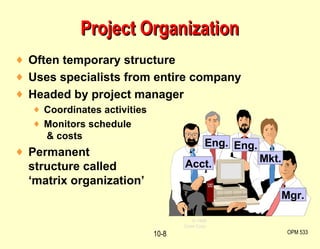
Often temporary structure Uses specialists from entire company Headed by project manager Coordinates activities  Monitors schedule  & costs Permanent  structure called  ‘matrix organization’ Project Organization OPM 533 10- © 1995 Corel Corp. Acct. Eng. Eng. Mkt. Mgr.
The Role of  the Project Manager Highly visible Responsible for making sure that: All necessary activities are finished in order and on time The project comes in within budget The project meets quality goals The people assigned to the project receive motivation, direction, and information
The Role of  the Project Manager Highly visible Responsible for making sure that: All necessary activities are finished in order and on time The project comes in within budget The project meets quality goals The people assigned to the project receive motivation, direction, and information Project managers should be: Good coaches Good communicators Able to organize activities from a variety of disciplines
Ethical Issues Bid rigging – divulging confidential information to give some bidders an unfair advantage “ Low balling” contractors – try to “buy” the project by bidding low and hope to renegotiate or cut corners Bribery – particularly on international projects Expense account padding Use of substandard materials Compromising health and safety standards Withholding needed information Failure to admit project failure at close
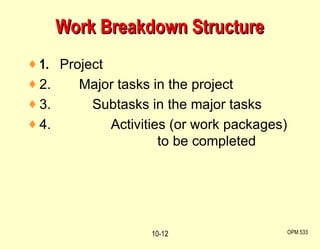
Work Breakdown Structure 1. Project 2.   Major tasks in the project 3. Subtasks in the major tasks 4.   Activities (or work packages)  to be completed OPM 533 10-
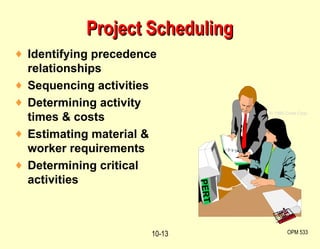
Identifying precedence relationships  Sequencing activities Determining activity times & costs Estimating material & worker requirements Determining critical activities Project Scheduling OPM 533 10- © 1995 Corel Corp. J F M A M J J Month Activity Design Build Test PERT
Purposes of Project Scheduling Shows the relationship of each activity to others and to the whole project. Identifies the precedence relationships among activities. Encourages the setting of realistic time and cost estimates for each activity. Helps make better use of people, money, and material resources by identifying critical bottlenecks in the project. OPM 533 10-
Gantt chart Critical Path Method (CPM) Program Evaluation & Review Technique (PERT) Project Management Techniques OPM 533 10- © 1984-1994 T/Maker Co.
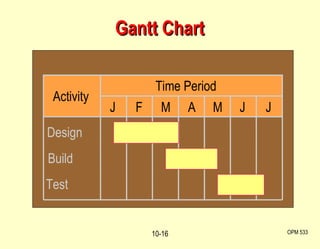
Gantt Chart OPM 533 10- J F M A M J J Time Period Activity Design Build Test
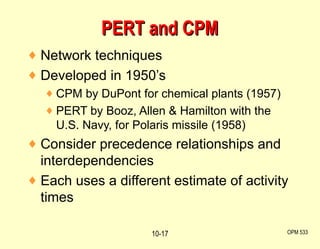
Network techniques Developed in 1950’s CPM by DuPont for chemical plants (1957) PERT by Booz, Allen & Hamilton with the U.S. Navy, for Polaris missile (1958) Consider precedence relationships and interdependencies Each uses a different estimate of activity times PERT and CPM OPM 533 10-
Questions Which May Be Addressed by PERT & CPM OPM 533 10- Is the project on schedule, ahead of schedule, or behind schedule? Is the project over or under cost budget? Are there enough resources available to finish the project on time? If the project must be finished in less than the scheduled amount of time, what is the way to accomplish this at least cost?
The Six Steps Common to PERT & CPM Define the project and prepare the work breakdown structure, Develop relationships among the activities.  (Decide which activities must precede and which must follow others.) Draw the network connecting all of the activities Assign time and/or cost estimates to each activity Compute the longest time path through the network.  This is called the  critical path Use the network to help plan, schedule, monitor, and control the project OPM 533 10-
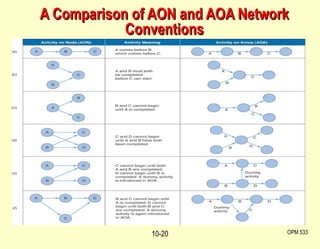
A Comparison of AON and AOA Network Conventions OPM 533 10-
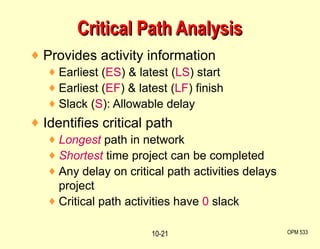
Provides activity information Earliest ( ES ) & latest ( LS ) start Earliest ( EF ) & latest ( LF ) finish Slack ( S ): Allowable delay Identifies critical path Longest   path in network Shortest   time project can be completed Any delay on critical path activities delays project Critical path activities have  0  slack Critical Path Analysis OPM 533 10-
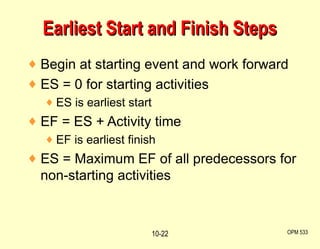
Begin at starting event and work forward ES = 0 for starting activities ES is earliest start EF = ES + Activity time EF is earliest finish ES = Maximum EF of all predecessors for non-starting activities Earliest Start and Finish Steps OPM 533 10-
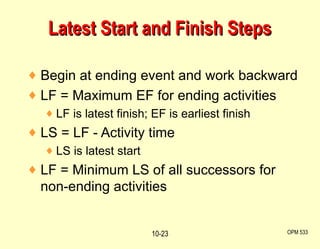
Begin at ending event and work backward LF = Maximum EF for ending activities LF is latest finish; EF is earliest finish LS = LF - Activity time LS is latest start LF = Minimum LS of all successors for non-ending activities Latest Start and Finish Steps OPM 533 10-
Advantages of PERT/CPM Especially useful when scheduling and controlling large projects. Straightforward concept and not mathematically complex. Graphical networks aid perception of relationships among project activities. Critical path & slack time analyses help pinpoint activities that need to be closely watched. Project documentation and graphics point out who is responsible for various activities. Applicable to a wide variety of projects. Useful in monitoring schedules and costs. OPM 533 10-
Project activities have to be clearly defined, independent, and stable in their relationships Precedence relationships must be specified and networked together Time estimates tend to be subjective and are subject to fudging by managers There is an inherent danger of too much emphasis being placed on the longest, or critical, path Limitations of PERT/CPM
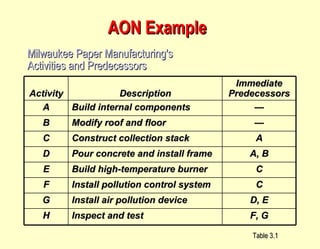
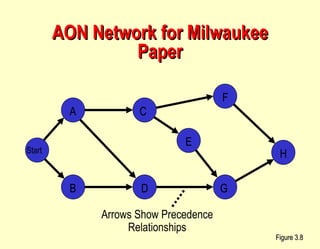
AON Example  Milwaukee Paper Manufacturing's Activities and Predecessors Table 3.1 Activity Description Immediate Predecessors A Build internal components — B Modify roof and floor — C Construct collection stack A D Pour concrete and install frame A, B E Build high-temperature burner C F Install pollution control system C G Install air pollution device D, E H Inspect and test F, G
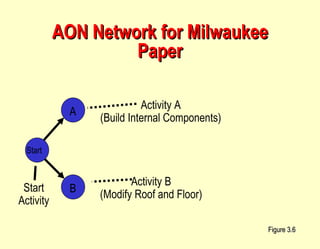
AON Network for Milwaukee Paper Figure 3.6 A Start B Start Activity Activity A (Build Internal Components) Activity B (Modify Roof and Floor)
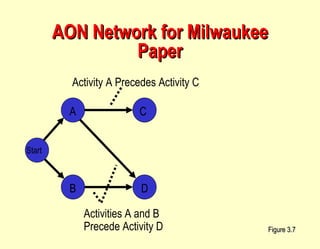
AON Network for Milwaukee Paper Figure 3.7 C D A Start B Activity A Precedes Activity C Activities A and B Precede Activity D
AON Network for Milwaukee Paper Figure 3.8 G E F H C A Start D B Arrows Show Precedence Relationships
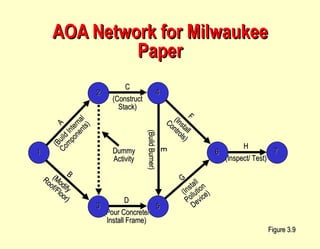
AOA Network for Milwaukee Paper Figure 3.9 H (Inspect/ Test) 7 Dummy Activity 6 F (Install Controls) E (Build Burner) G (Install Pollution Device) 5 D (Pour Concrete/ Install Frame) 4 C (Construct Stack) 1 3 2 B (Modify Roof/Floor) A (Build Internal Components)
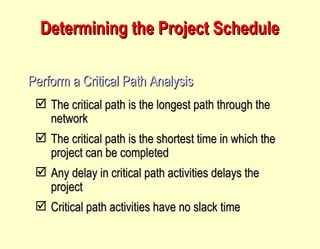
Determining the Project Schedule Perform a Critical Path Analysis The critical path is the longest path through the network The critical path is the shortest time in which the project can be completed Any delay in critical path activities delays the project Critical path activities have no slack time
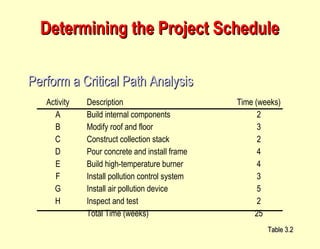
Determining the Project Schedule Perform a Critical Path Analysis Table 3.2 Activity Description Time (weeks) A Build internal components 2 B Modify roof and floor 3 C Construct collection stack 2 D Pour concrete and install frame 4 E Build high-temperature burner 4 F Install pollution control system  3 G Install air pollution device 5 H Inspect and test 2 Total Time (weeks) 25
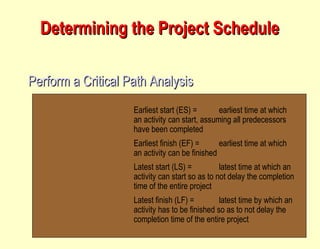
Determining the Project Schedule Perform a Critical Path Analysis Table 3.2 Activity Description Time (weeks) A Build internal components 2 B Modify roof and floor 3 C Construct collection stack 2 D Pour concrete and install frame 4 E Build high-temperature burner 4 F Install pollution control system  3 G Install air pollution device 5 H Inspect and test 2 Total Time (weeks) 25 Earliest start (ES) = earliest time at which an activity can start, assuming all predecessors have been completed Earliest finish (EF) = earliest time at which an activity can be finished Latest start (LS) = latest time at which an activity can start so as to not delay the completion time of the entire project Latest finish (LF) = latest time by which an activity has to be finished so as to not delay the completion time of the entire project
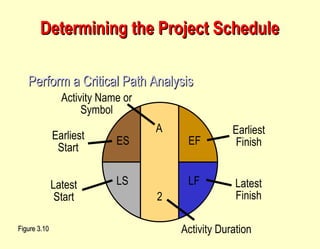
Determining the Project Schedule Perform a Critical Path Analysis Figure 3.10 A Activity Name or Symbol Earliest Start ES Earliest Finish EF Latest Start LS Latest Finish LF Activity Duration 2
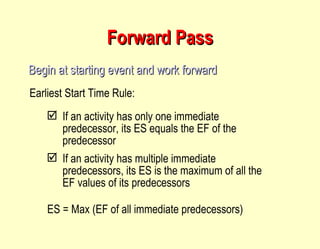
Forward Pass Begin at starting event and work forward Earliest Start Time Rule: If an activity has only one immediate predecessor, its ES equals the EF of the predecessor If an activity has multiple immediate predecessors, its ES is the maximum of all the EF values of its predecessors ES = Max (EF of all immediate predecessors)
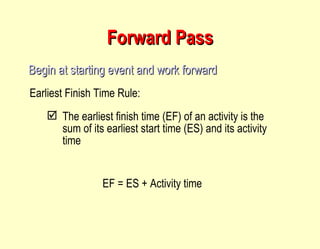
Forward Pass Begin at starting event and work forward Earliest Finish Time Rule: The earliest finish time (EF) of an activity is the sum of its earliest start time (ES) and its activity time EF = ES + Activity time
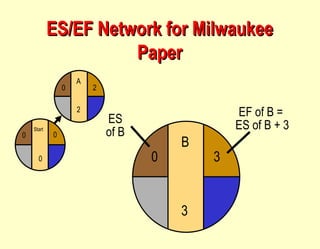
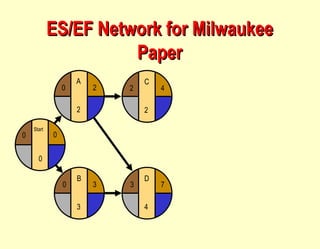
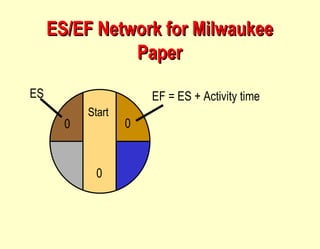
ES/EF Network for Milwaukee Paper Start 0 0 ES 0 EF = ES + Activity time
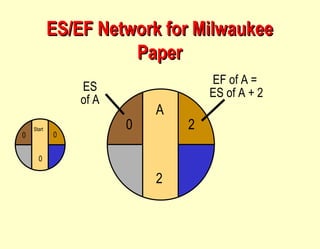
ES/EF Network for Milwaukee Paper Start 0 0 0 A 2 2 EF of A =  ES of A + 2 0 ES of A
ES/EF Network for Milwaukee Paper B 3 Start 0 0 0 A 2 2 0 3 EF of B =  ES of B + 3 0 ES of B
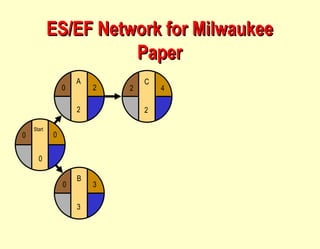
ES/EF Network for Milwaukee Paper C 2 2 4 B 3 0 3 Start 0 0 0 A 2 2 0
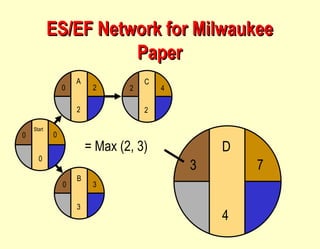
ES/EF Network for Milwaukee Paper 7 C 2 2 4 B 3 0 3 Start 0 0 0 A 2 2 0 D 4 3 = Max (2, 3)
ES/EF Network for Milwaukee Paper D 4 3 7 C 2 2 4 B 3 0 3 Start 0 0 0 A 2 2 0
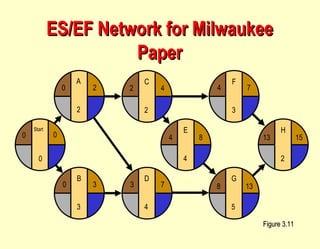
ES/EF Network for Milwaukee Paper Figure 3.11 E 4 F 3 G 5 H 2 4 8 13 15 4 8 13 7 D 4 3 7 C 2 2 4 B 3 0 3 Start 0 0 0 A 2 2 0
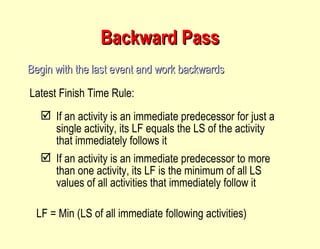
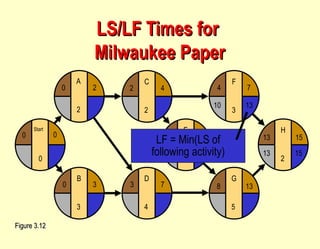
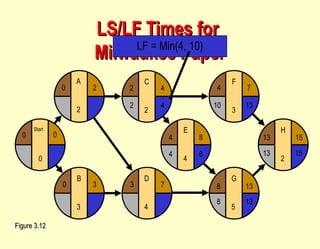
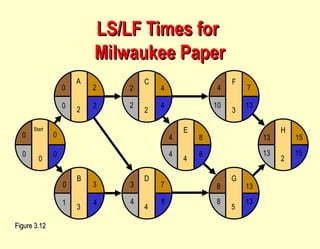
Backward Pass Begin with the last event and work backwards Latest Finish Time Rule: If an activity is an immediate predecessor for just a single activity, its LF equals the LS of the activity that immediately follows it If an activity is an immediate predecessor to more than one activity, its LF is the minimum of all LS values of all activities that immediately follow it LF = Min (LS of all immediate following activities)
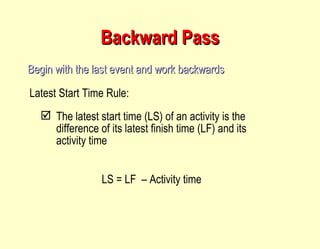
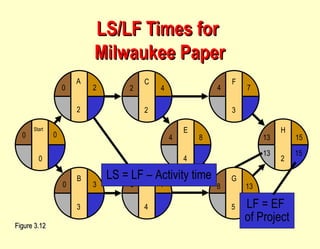
Backward Pass Begin with the last event and work backwards Latest Start Time Rule: The latest start time (LS) of an activity is the difference of its latest finish time (LF) and its activity time LS = LF  –  Activity time
LS/LF Times for  Milwaukee Paper Figure 3.12 E 4 F 3 G 5 H 2 4 8 13 15 4 8 13 7 D 4 3 7 C 2 2 4 B 3 0 3 Start 0 0 0 A 2 2 0 LF = EF  of Project 15 13 LS = LF  –  Activity time
LS/LF Times for  Milwaukee Paper Figure 3.12 E 4 F 3 G 5 H 2 4 8 13 15 4 8 13 7 13 15 D 4 3 7 C 2 2 4 B 3 0 3 Start 0 0 0 A 2 2 0 LF = Min(LS of following activity) 10 13
LS/LF Times for  Milwaukee Paper Figure 3.12 E 4 F 3 G 5 H 2 4 8 13 15 4 8 13 7 13 15 10 13 8 13 4 8 D 4 3 7 C 2 2 4 B 3 0 3 Start 0 0 0 A 2 2 0 LF = Min(4, 10) 4 2
LS/LF Times for  Milwaukee Paper Figure 3.12 E 4 F 3 G 5 H 2 4 8 13 15 4 8 13 7 13 15 10 13 8 13 4 8 D 4 3 7 C 2 2 4 B 3 0 3 Start 0 0 0 A 2 2 0 4 2 8 4 2 0 4 1 0 0
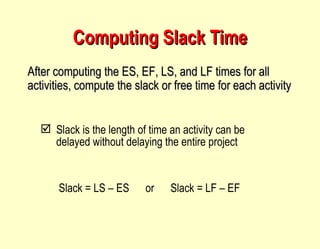
Computing Slack Time After computing the ES, EF, LS, and LF times for all activities, compute the slack or free time for each activity Slack is the length of time an activity can be delayed without delaying the entire project Slack = LS  –  ES  or  Slack = LF  –  EF
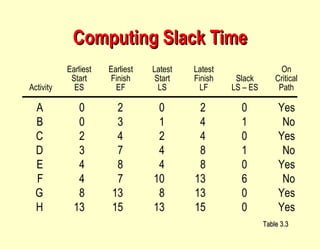
Computing Slack Time Table 3.3 Earliest Earliest Latest Latest On Start Finish Start Finish Slack Critical Activity ES EF LS LF LS – ES Path A 0 2 0 2 0 Yes B 0 3 1 4 1 No C 2 4 2 4 0 Yes D 3 7 4 8 1 No E 4 8 4 8 0 Yes F 4 7 10 13 6 No G 8 13 8 13 0 Yes H 13 15 13 15 0 Yes
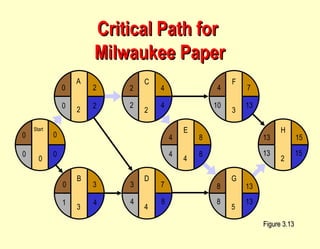
Critical Path for  Milwaukee Paper Figure 3.13 E 4 F 3 G 5 H 2 4 8 13 15 4 8 13 7 13 15 10 13 8 13 4 8 D 4 3 7 C 2 2 4 B 3 0 3 Start 0 0 0 A 2 2 0 4 2 8 4 2 0 4 1 0 0

C10 project management

  • 1.
    Operations Management ProjectManagement Chapter 10 OPM 533 10-
  • 2.
    Project Aproject is a one short of related activities with a definite beginning and ending time directed toward a unique goal Project Management Project Management is planning, scheduling and controlling of resources such as equipment, workforce and materials so that they meet the time, costs and technical constraint of the project. Introduction
  • 3.
    Single unit Manyrelated activities Difficult production planning and inventory control General purpose equipment High labor skills Project Characteristics OPM 533 10-
  • 4.
    To ensure thatthe project will be completed on time. To manage the project cost so that the cost is minimized and within the expected budget. To meet the predetermined quality standard. Objective of Project Mgt.
  • 5.
    Management of LargeProjects Planning - goal setting, project definition, team organization Scheduling - relating people, money, and supplies to specific activities and activities to one and other Controlling - monitoring resources, costs, quality, and budgets; revising plans and shifting resources to meet time and cost demands OPM 533 10-
  • 6.
    Project Management ActivitiesOPM 533 10- Planning Objectives Resources Work break-down schedule Organization Scheduling Project activities Start & end times Network Controlling Monitor, compare, revise, action
  • 7.
    Establishing objectives Definingproject Creating work breakdown structure Determining resources Forming organization Project Planning OPM 533 10- © 1995 Corel Corp.
  • 8.
    Often temporary structureUses specialists from entire company Headed by project manager Coordinates activities Monitors schedule & costs Permanent structure called ‘matrix organization’ Project Organization OPM 533 10- © 1995 Corel Corp. Acct. Eng. Eng. Mkt. Mgr.
  • 9.
    The Role of the Project Manager Highly visible Responsible for making sure that: All necessary activities are finished in order and on time The project comes in within budget The project meets quality goals The people assigned to the project receive motivation, direction, and information
  • 10.
    The Role of the Project Manager Highly visible Responsible for making sure that: All necessary activities are finished in order and on time The project comes in within budget The project meets quality goals The people assigned to the project receive motivation, direction, and information Project managers should be: Good coaches Good communicators Able to organize activities from a variety of disciplines
  • 11.
    Ethical Issues Bidrigging – divulging confidential information to give some bidders an unfair advantage “ Low balling” contractors – try to “buy” the project by bidding low and hope to renegotiate or cut corners Bribery – particularly on international projects Expense account padding Use of substandard materials Compromising health and safety standards Withholding needed information Failure to admit project failure at close
  • 12.
    Work Breakdown Structure1. Project 2. Major tasks in the project 3. Subtasks in the major tasks 4. Activities (or work packages) to be completed OPM 533 10-
  • 13.
    Identifying precedence relationships Sequencing activities Determining activity times & costs Estimating material & worker requirements Determining critical activities Project Scheduling OPM 533 10- © 1995 Corel Corp. J F M A M J J Month Activity Design Build Test PERT
  • 14.
    Purposes of ProjectScheduling Shows the relationship of each activity to others and to the whole project. Identifies the precedence relationships among activities. Encourages the setting of realistic time and cost estimates for each activity. Helps make better use of people, money, and material resources by identifying critical bottlenecks in the project. OPM 533 10-
  • 15.
    Gantt chart CriticalPath Method (CPM) Program Evaluation & Review Technique (PERT) Project Management Techniques OPM 533 10- © 1984-1994 T/Maker Co.
  • 16.
    Gantt Chart OPM533 10- J F M A M J J Time Period Activity Design Build Test
  • 17.
    Network techniques Developedin 1950’s CPM by DuPont for chemical plants (1957) PERT by Booz, Allen & Hamilton with the U.S. Navy, for Polaris missile (1958) Consider precedence relationships and interdependencies Each uses a different estimate of activity times PERT and CPM OPM 533 10-
  • 18.
    Questions Which MayBe Addressed by PERT & CPM OPM 533 10- Is the project on schedule, ahead of schedule, or behind schedule? Is the project over or under cost budget? Are there enough resources available to finish the project on time? If the project must be finished in less than the scheduled amount of time, what is the way to accomplish this at least cost?
  • 19.
    The Six StepsCommon to PERT & CPM Define the project and prepare the work breakdown structure, Develop relationships among the activities. (Decide which activities must precede and which must follow others.) Draw the network connecting all of the activities Assign time and/or cost estimates to each activity Compute the longest time path through the network. This is called the critical path Use the network to help plan, schedule, monitor, and control the project OPM 533 10-
  • 20.
    A Comparison ofAON and AOA Network Conventions OPM 533 10-
  • 21.
    Provides activity informationEarliest ( ES ) & latest ( LS ) start Earliest ( EF ) & latest ( LF ) finish Slack ( S ): Allowable delay Identifies critical path Longest path in network Shortest time project can be completed Any delay on critical path activities delays project Critical path activities have 0 slack Critical Path Analysis OPM 533 10-
  • 22.
    Begin at startingevent and work forward ES = 0 for starting activities ES is earliest start EF = ES + Activity time EF is earliest finish ES = Maximum EF of all predecessors for non-starting activities Earliest Start and Finish Steps OPM 533 10-
  • 23.
    Begin at endingevent and work backward LF = Maximum EF for ending activities LF is latest finish; EF is earliest finish LS = LF - Activity time LS is latest start LF = Minimum LS of all successors for non-ending activities Latest Start and Finish Steps OPM 533 10-
  • 24.
    Advantages of PERT/CPMEspecially useful when scheduling and controlling large projects. Straightforward concept and not mathematically complex. Graphical networks aid perception of relationships among project activities. Critical path & slack time analyses help pinpoint activities that need to be closely watched. Project documentation and graphics point out who is responsible for various activities. Applicable to a wide variety of projects. Useful in monitoring schedules and costs. OPM 533 10-
  • 25.
    Project activities haveto be clearly defined, independent, and stable in their relationships Precedence relationships must be specified and networked together Time estimates tend to be subjective and are subject to fudging by managers There is an inherent danger of too much emphasis being placed on the longest, or critical, path Limitations of PERT/CPM
  • 26.
    AON Example Milwaukee Paper Manufacturing's Activities and Predecessors Table 3.1 Activity Description Immediate Predecessors A Build internal components — B Modify roof and floor — C Construct collection stack A D Pour concrete and install frame A, B E Build high-temperature burner C F Install pollution control system C G Install air pollution device D, E H Inspect and test F, G
  • 27.
    AON Network forMilwaukee Paper Figure 3.6 A Start B Start Activity Activity A (Build Internal Components) Activity B (Modify Roof and Floor)
  • 28.
    AON Network forMilwaukee Paper Figure 3.7 C D A Start B Activity A Precedes Activity C Activities A and B Precede Activity D
  • 29.
    AON Network forMilwaukee Paper Figure 3.8 G E F H C A Start D B Arrows Show Precedence Relationships
  • 30.
    AOA Network forMilwaukee Paper Figure 3.9 H (Inspect/ Test) 7 Dummy Activity 6 F (Install Controls) E (Build Burner) G (Install Pollution Device) 5 D (Pour Concrete/ Install Frame) 4 C (Construct Stack) 1 3 2 B (Modify Roof/Floor) A (Build Internal Components)
  • 31.
    Determining the ProjectSchedule Perform a Critical Path Analysis The critical path is the longest path through the network The critical path is the shortest time in which the project can be completed Any delay in critical path activities delays the project Critical path activities have no slack time
  • 32.
    Determining the ProjectSchedule Perform a Critical Path Analysis Table 3.2 Activity Description Time (weeks) A Build internal components 2 B Modify roof and floor 3 C Construct collection stack 2 D Pour concrete and install frame 4 E Build high-temperature burner 4 F Install pollution control system 3 G Install air pollution device 5 H Inspect and test 2 Total Time (weeks) 25
  • 33.
    Determining the ProjectSchedule Perform a Critical Path Analysis Table 3.2 Activity Description Time (weeks) A Build internal components 2 B Modify roof and floor 3 C Construct collection stack 2 D Pour concrete and install frame 4 E Build high-temperature burner 4 F Install pollution control system 3 G Install air pollution device 5 H Inspect and test 2 Total Time (weeks) 25 Earliest start (ES) = earliest time at which an activity can start, assuming all predecessors have been completed Earliest finish (EF) = earliest time at which an activity can be finished Latest start (LS) = latest time at which an activity can start so as to not delay the completion time of the entire project Latest finish (LF) = latest time by which an activity has to be finished so as to not delay the completion time of the entire project
  • 34.
    Determining the ProjectSchedule Perform a Critical Path Analysis Figure 3.10 A Activity Name or Symbol Earliest Start ES Earliest Finish EF Latest Start LS Latest Finish LF Activity Duration 2
  • 35.
    Forward Pass Beginat starting event and work forward Earliest Start Time Rule: If an activity has only one immediate predecessor, its ES equals the EF of the predecessor If an activity has multiple immediate predecessors, its ES is the maximum of all the EF values of its predecessors ES = Max (EF of all immediate predecessors)
  • 36.
    Forward Pass Beginat starting event and work forward Earliest Finish Time Rule: The earliest finish time (EF) of an activity is the sum of its earliest start time (ES) and its activity time EF = ES + Activity time
  • 37.
    ES/EF Network forMilwaukee Paper Start 0 0 ES 0 EF = ES + Activity time
  • 38.
    ES/EF Network forMilwaukee Paper Start 0 0 0 A 2 2 EF of A = ES of A + 2 0 ES of A
  • 39.
    ES/EF Network forMilwaukee Paper B 3 Start 0 0 0 A 2 2 0 3 EF of B = ES of B + 3 0 ES of B
  • 40.
    ES/EF Network forMilwaukee Paper C 2 2 4 B 3 0 3 Start 0 0 0 A 2 2 0
  • 41.
    ES/EF Network forMilwaukee Paper 7 C 2 2 4 B 3 0 3 Start 0 0 0 A 2 2 0 D 4 3 = Max (2, 3)
  • 42.
    ES/EF Network forMilwaukee Paper D 4 3 7 C 2 2 4 B 3 0 3 Start 0 0 0 A 2 2 0
  • 43.
    ES/EF Network forMilwaukee Paper Figure 3.11 E 4 F 3 G 5 H 2 4 8 13 15 4 8 13 7 D 4 3 7 C 2 2 4 B 3 0 3 Start 0 0 0 A 2 2 0
  • 44.
    Backward Pass Beginwith the last event and work backwards Latest Finish Time Rule: If an activity is an immediate predecessor for just a single activity, its LF equals the LS of the activity that immediately follows it If an activity is an immediate predecessor to more than one activity, its LF is the minimum of all LS values of all activities that immediately follow it LF = Min (LS of all immediate following activities)
  • 45.
    Backward Pass Beginwith the last event and work backwards Latest Start Time Rule: The latest start time (LS) of an activity is the difference of its latest finish time (LF) and its activity time LS = LF – Activity time
  • 46.
    LS/LF Times for Milwaukee Paper Figure 3.12 E 4 F 3 G 5 H 2 4 8 13 15 4 8 13 7 D 4 3 7 C 2 2 4 B 3 0 3 Start 0 0 0 A 2 2 0 LF = EF of Project 15 13 LS = LF – Activity time
  • 47.
    LS/LF Times for Milwaukee Paper Figure 3.12 E 4 F 3 G 5 H 2 4 8 13 15 4 8 13 7 13 15 D 4 3 7 C 2 2 4 B 3 0 3 Start 0 0 0 A 2 2 0 LF = Min(LS of following activity) 10 13
  • 48.
    LS/LF Times for Milwaukee Paper Figure 3.12 E 4 F 3 G 5 H 2 4 8 13 15 4 8 13 7 13 15 10 13 8 13 4 8 D 4 3 7 C 2 2 4 B 3 0 3 Start 0 0 0 A 2 2 0 LF = Min(4, 10) 4 2
  • 49.
    LS/LF Times for Milwaukee Paper Figure 3.12 E 4 F 3 G 5 H 2 4 8 13 15 4 8 13 7 13 15 10 13 8 13 4 8 D 4 3 7 C 2 2 4 B 3 0 3 Start 0 0 0 A 2 2 0 4 2 8 4 2 0 4 1 0 0
  • 50.
    Computing Slack TimeAfter computing the ES, EF, LS, and LF times for all activities, compute the slack or free time for each activity Slack is the length of time an activity can be delayed without delaying the entire project Slack = LS – ES or Slack = LF – EF
  • 51.
    Computing Slack TimeTable 3.3 Earliest Earliest Latest Latest On Start Finish Start Finish Slack Critical Activity ES EF LS LF LS – ES Path A 0 2 0 2 0 Yes B 0 3 1 4 1 No C 2 4 2 4 0 Yes D 3 7 4 8 1 No E 4 8 4 8 0 Yes F 4 7 10 13 6 No G 8 13 8 13 0 Yes H 13 15 13 15 0 Yes
  • 52.
    Critical Path for Milwaukee Paper Figure 3.13 E 4 F 3 G 5 H 2 4 8 13 15 4 8 13 7 13 15 10 13 8 13 4 8 D 4 3 7 C 2 2 4 B 3 0 3 Start 0 0 0 A 2 2 0 4 2 8 4 2 0 4 1 0 0

Editor's Notes

  • #4 It is helpful here to provide an expanded discussion of the activities.
  • #7 A useful project management technique must contribute in all areas.
  • #8 If students have been assigned a term project, this material can be covered early in the semester and the students asked to develop a plan for their project.
  • #9 This may be a good time to look, at least briefly, at alternative organizational structures. Certainly hierarchical and matrix structures should be examined. The role of information technology in each of the alternatives should be examined. The following several slides illustrate various organizational structures.
  • #14 Given that a project is something the firm is relatively unfamiliar with, how does one go about determining the appropriate costs and times? You might point out that specifying the beginning and end points for an activity is often a difficult task. Work breakdown may be the most difficult aspect of many projects.
  • #15 You might point out to students that there are those who claim that the real benefit of using project management tools comes from the planning and organizing effort, not the actual management of the tasks during the project.
  • #16 As you discuss the various project scheduling techniques, you should include at least: - the basic assumptions of the technique - problems typically encountered in applying it - the nature of the effort required to keep the tool current - sources of problems - the nature of the decisions supported by the tool - the nature of the management effort and cost associated with using the tool.
  • #18 What circumstances lead the two organizations to develop different, yet similar tools for the management of complex projects? In your discussion of PERT/CPM, you should probably note that PERT helps us identify critical tasks/activities and look at the probability of completing the project by a given date; CPM helps us analyze the cost/time tradeoffs possible if we need to speed the project up.
  • #22 This and the next several slides illustrate the definitions of terms appropriate to critical path analysis. There are many opportunities for good managers to truly manage a project once they have a PERT network established. For instance, sub-contractors know early start and late start times and the managers know the activities on the critical path upon which to focus effort.
  • #25 There are those that argue that the Polaris could not have been built without the use of project management techniques (PERT).