Network Diagrams,
PERT & CPM, Practice
with MS Project
Lecture (6 & 7)
Mr. Mubashir Ali
Lecturer(Dept. of Computer Science)
dr.mubashirali1@gmail.com
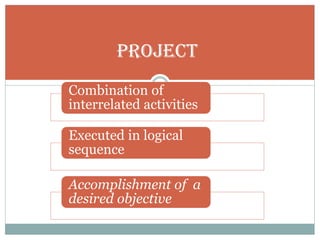
PROJECT
Combination of
interrelated activities
Executed in logical
sequence
Accomplishment of a
desired objective
“A project is a temporary
effort undertaken to create a
"unique" product or service”
Plan your work first…..then work
your plan
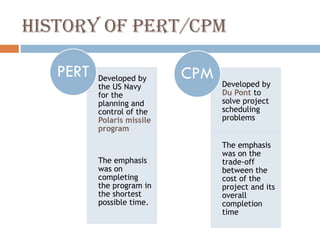
HISTORY OF PERT/CPM
Developed by
the US Navy
for the
planning and
control of the
Polaris missile
program
The emphasis
was on
completing
the program in
the shortest
possible time.
PERT
Developed by
Du Pont to
solve project
scheduling
problems
The emphasis
was on the
trade-off
between the
cost of the
project and its
overall
completion
time
CPM
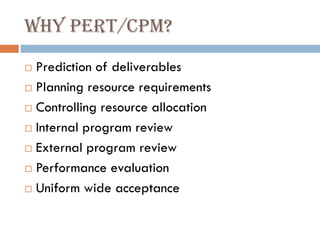
Why PERT/CPM?
 Prediction of deliverables
 Planning resource requirements
 Controlling resource allocation
 Internal program review
 External program review
 Performance evaluation
 Uniform wide acceptance
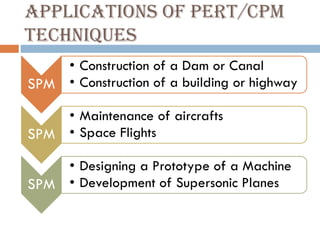
APPLICATIONS OF PERT/CPM
TECHNIQUES
SPM
• Construction of a Dam or Canal
• Construction of a building or highway
SPM
• Maintenance of aircrafts
• Space Flights
SPM
• Designing a Prototype of a Machine
• Development of Supersonic Planes
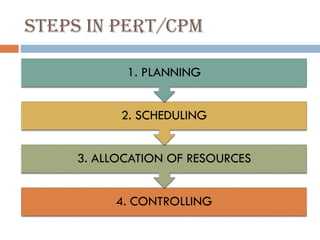
Steps in PERT/CPM
4. CONTROLLING
3. ALLOCATION OF RESOURCES
2. SCHEDULING
1. PLANNING
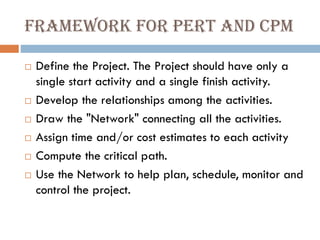
Framework for PERT and CPM
 Define the Project. The Project should have only a
single start activity and a single finish activity.
 Develop the relationships among the activities.
 Draw the "Network" connecting all the activities.
 Assign time and/or cost estimates to each activity
 Compute the critical path.
 Use the Network to help plan, schedule, monitor and
control the project.
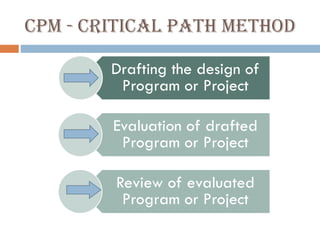
CPM - Critical Path Method
Drafting the design of
Program or Project
Evaluation of drafted
Program or Project
Review of evaluated
Program or Project
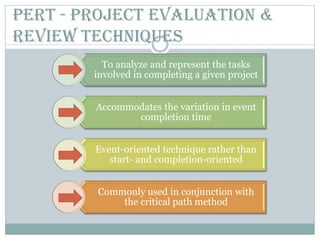
PERT - Project Evaluation &
Review Techniques
To analyze and represent the tasks
involved in completing a given project
Accommodates the variation in event
completion time
Event-oriented technique rather than
start- and completion-oriented
Commonly used in conjunction with
the critical path method
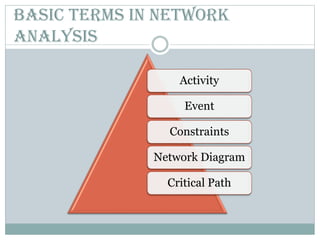
Basic Terms In Network
Analysis
Activity
Event
Constraints
Network Diagram
Critical Path
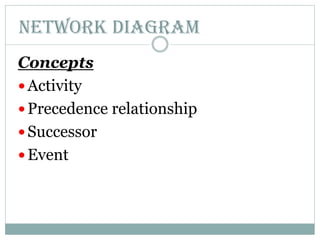
Network Diagram
Concepts
 Activity
 Precedence relationship
 Successor
 Event
Guidelines for network
diagram
1. Before an activity can begin, its
preceding activities must be completed.
2. Arrows indicate logical precedence.
3. Flow of the diagram is from left to right.
4. Arrows should not intersect.
5. Dangling should be avoided.
APPRAOCHES FOR NETWORK
DIAGRAM
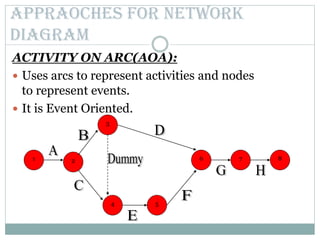
ACTIVITY ON ARC(AOA):
 Uses arcs to represent activities and nodes
to represent events.
 It is Event Oriented.
1 876
54
3
2
DUMMY ACTIVITY
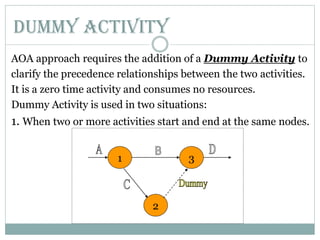
AOA approach requires the addition of a Dummy Activity to
clarify the precedence relationships between the two activities.
It is a zero time activity and consumes no resources.
Dummy Activity is used in two situations:
1. When two or more activities start and end at the same nodes.
1 3
2
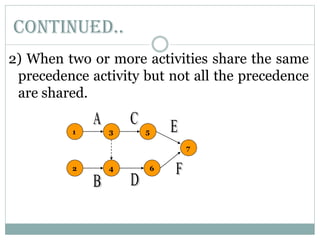
2) When two or more activities share the same
precedence activity but not all the precedence
are shared.
1 53
6
7
2 4
Continued..
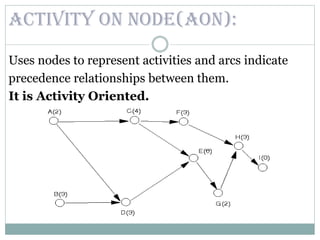
Uses nodes to represent activities and arcs indicate
precedence relationships between them.
It is Activity Oriented.
ACTIVITY ON NODE(AON):
ESTIMATING TIME OF COMPLETION
Planning the schedule of the project
Time estimates include:
1) Total time for completion.
2) ES- Earliest start time: the earliest time at which
the activity can start given that its precedent activities
must be completed first.
3) EF-Earliest finish time: equals to the earliest start
time for the activity plus the time required to complete
the activity.
4) LF- Latest finish time: the latest time in which the
activity can be completed without delaying the project.
5) LS- Latest start time: equal to the latest finish time
minus the time required to complete the activity.
6) FORWARD PASS: The early start and early finish times
are calculated by moving forward through the network and
considering the predecessor activities Considers maximum
7) BACKWARD PASS: The latest start and finish times are
calculated by moving backward through the network
Considers minimum.
8) SLACK TIME: Slack time for an activity is the difference
between its earliest and latest start time or between the
earliest and latest finish time. Critical path is the path of
activities having zero Slack time.
Continued..
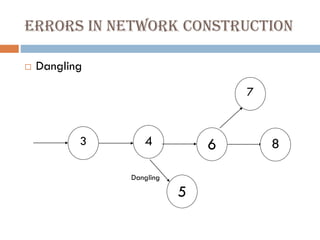
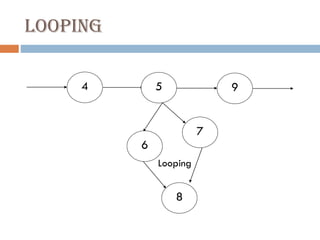
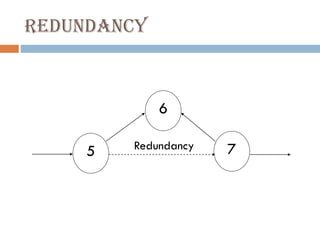
Errors in Network Construction
 Dangling
3 4 6 8
5
7
Dangling
Looping
4 5 9
7
6
8
Looping
Redundancy
5
6
7Redundancy
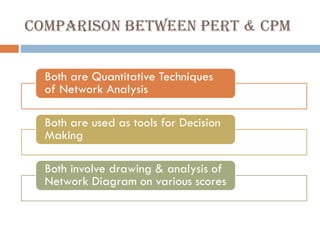
Comparison Between PERT & CPM
Both are Quantitative Techniques
of Network Analysis
Both are used as tools for Decision
Making
Both involve drawing & analysis of
Network Diagram on various scores
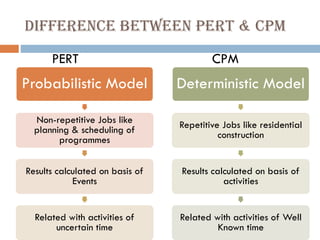
Difference Between PERT & CPM
Probabilistic Model
Non-repetitive Jobs like
planning & scheduling of
programmes
Results calculated on basis of
Events
Related with activities of
uncertain time
Deterministic Model
Repetitive Jobs like residential
construction
Results calculated on basis of
activities
Related with activities of Well
Known time
PERT CPM
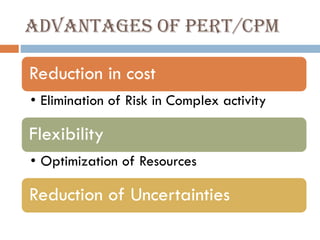
Advantages of PERT/CPM
Reduction in cost
• Elimination of Risk in Complex activity
Flexibility
• Optimization of Resources
Reduction of Uncertainties
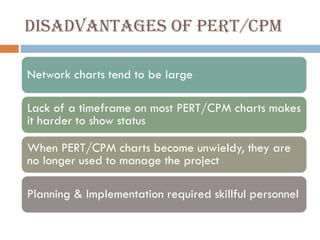
Disadvantages of PERT/CPM
Network charts tend to be large
Lack of a timeframe on most PERT/CPM charts makes
it harder to show status
When PERT/CPM charts become unwieldy, they are
no longer used to manage the project
Planning & Implementation required skillful personnel
References & Assignment
• Introduction to Operations Research 7th
Edition by Hillier & Lieberman (Chapter-10)
• Install MS-Project and build your Final Year
Project structure by using ‘SOW’ and ‘WBS’.
• For better understanding of MS-Project
working, follow any tutorial from YouTube.

Lect-6&7: Network Diagrams, PERT and CPM

  • 1.
    Network Diagrams, PERT &CPM, Practice with MS Project Lecture (6 & 7) Mr. Mubashir Ali Lecturer(Dept. of Computer Science) dr.mubashirali1@gmail.com
  • 2.
    PROJECT Combination of interrelated activities Executedin logical sequence Accomplishment of a desired objective
  • 3.
    “A project isa temporary effort undertaken to create a "unique" product or service” Plan your work first…..then work your plan
  • 4.
    HISTORY OF PERT/CPM Developedby the US Navy for the planning and control of the Polaris missile program The emphasis was on completing the program in the shortest possible time. PERT Developed by Du Pont to solve project scheduling problems The emphasis was on the trade-off between the cost of the project and its overall completion time CPM
  • 5.
    Why PERT/CPM?  Predictionof deliverables  Planning resource requirements  Controlling resource allocation  Internal program review  External program review  Performance evaluation  Uniform wide acceptance
  • 6.
    APPLICATIONS OF PERT/CPM TECHNIQUES SPM •Construction of a Dam or Canal • Construction of a building or highway SPM • Maintenance of aircrafts • Space Flights SPM • Designing a Prototype of a Machine • Development of Supersonic Planes
  • 7.
    Steps in PERT/CPM 4.CONTROLLING 3. ALLOCATION OF RESOURCES 2. SCHEDULING 1. PLANNING
  • 8.
    Framework for PERTand CPM  Define the Project. The Project should have only a single start activity and a single finish activity.  Develop the relationships among the activities.  Draw the "Network" connecting all the activities.  Assign time and/or cost estimates to each activity  Compute the critical path.  Use the Network to help plan, schedule, monitor and control the project.
  • 9.
    CPM - CriticalPath Method Drafting the design of Program or Project Evaluation of drafted Program or Project Review of evaluated Program or Project
  • 10.
    PERT - ProjectEvaluation & Review Techniques To analyze and represent the tasks involved in completing a given project Accommodates the variation in event completion time Event-oriented technique rather than start- and completion-oriented Commonly used in conjunction with the critical path method
  • 11.
    Basic Terms InNetwork Analysis Activity Event Constraints Network Diagram Critical Path
  • 12.
    Network Diagram Concepts  Activity Precedence relationship  Successor  Event
  • 13.
    Guidelines for network diagram 1.Before an activity can begin, its preceding activities must be completed. 2. Arrows indicate logical precedence. 3. Flow of the diagram is from left to right. 4. Arrows should not intersect. 5. Dangling should be avoided.
  • 14.
    APPRAOCHES FOR NETWORK DIAGRAM ACTIVITYON ARC(AOA):  Uses arcs to represent activities and nodes to represent events.  It is Event Oriented. 1 876 54 3 2
  • 15.
    DUMMY ACTIVITY AOA approachrequires the addition of a Dummy Activity to clarify the precedence relationships between the two activities. It is a zero time activity and consumes no resources. Dummy Activity is used in two situations: 1. When two or more activities start and end at the same nodes. 1 3 2
  • 16.
    2) When twoor more activities share the same precedence activity but not all the precedence are shared. 1 53 6 7 2 4 Continued..
  • 17.
    Uses nodes torepresent activities and arcs indicate precedence relationships between them. It is Activity Oriented. ACTIVITY ON NODE(AON):
  • 18.
    ESTIMATING TIME OFCOMPLETION Planning the schedule of the project Time estimates include: 1) Total time for completion. 2) ES- Earliest start time: the earliest time at which the activity can start given that its precedent activities must be completed first. 3) EF-Earliest finish time: equals to the earliest start time for the activity plus the time required to complete the activity. 4) LF- Latest finish time: the latest time in which the activity can be completed without delaying the project. 5) LS- Latest start time: equal to the latest finish time minus the time required to complete the activity.
  • 19.
    6) FORWARD PASS:The early start and early finish times are calculated by moving forward through the network and considering the predecessor activities Considers maximum 7) BACKWARD PASS: The latest start and finish times are calculated by moving backward through the network Considers minimum. 8) SLACK TIME: Slack time for an activity is the difference between its earliest and latest start time or between the earliest and latest finish time. Critical path is the path of activities having zero Slack time. Continued..
  • 20.
    Errors in NetworkConstruction  Dangling 3 4 6 8 5 7 Dangling
  • 21.
  • 22.
  • 23.
    Comparison Between PERT& CPM Both are Quantitative Techniques of Network Analysis Both are used as tools for Decision Making Both involve drawing & analysis of Network Diagram on various scores
  • 24.
    Difference Between PERT& CPM Probabilistic Model Non-repetitive Jobs like planning & scheduling of programmes Results calculated on basis of Events Related with activities of uncertain time Deterministic Model Repetitive Jobs like residential construction Results calculated on basis of activities Related with activities of Well Known time PERT CPM
  • 25.
    Advantages of PERT/CPM Reductionin cost • Elimination of Risk in Complex activity Flexibility • Optimization of Resources Reduction of Uncertainties
  • 26.
    Disadvantages of PERT/CPM Networkcharts tend to be large Lack of a timeframe on most PERT/CPM charts makes it harder to show status When PERT/CPM charts become unwieldy, they are no longer used to manage the project Planning & Implementation required skillful personnel
  • 27.
    References & Assignment •Introduction to Operations Research 7th Edition by Hillier & Lieberman (Chapter-10) • Install MS-Project and build your Final Year Project structure by using ‘SOW’ and ‘WBS’. • For better understanding of MS-Project working, follow any tutorial from YouTube.