Dr. Jerusha
Assistant professor
CONTENTS
 INTRODUCTION
 NETWORK ANALYSIS
 WHY CPM/PERT???
 KEY CONCEPT
 THE FRAMEWORK FOR PERT AND CPM
 PERT
 CPM
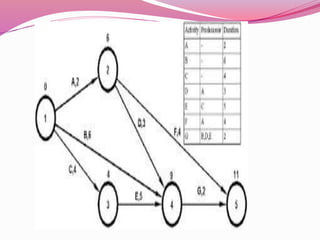
 DRAWING A NETWORK
 DIFFERENCES BETWEEN PERT AND CPM
INTRODUCTION
 PERT (Programme Evaluation Review Technique)
and CPM (Critical Path Method) are network analysis
techniques, used in project management.
 Developed along two parallel streams, one industrial
and the other military establishments to plan, schedule
and control complex projects.
NETWORK ANALYSIS
 A technique whereby:
 objectives are identified
 activities involved in attaining the objectives are
determined
 interrelationships are presented graphically in the form
of network
 used as a basis of determining sequence of activities and
allocation of resources.
WHY CPM/PERT???
 How long will the entire project take to be completed?
What are the risks involved?
 Which are the critical activities, which could delay the
entire project if they were not completed on time?
 Is the project on schedule, behind schedule or ahead of
schedule?
Key concepts
 A small set of activities, make up the longest path through
the activity network, control the entire project.
 Identifies the critical activities(critical because if any of
these activities are delayed by even a short period, the
entire project will be delayed), determines the fate of the
entire project.
 Non-critical activities can be re-planned, rescheduled and
resources for them can be reallocated flexibly, without
affecting the whole project.
The Framework for PERT and CPM
1. Define the Project- all of it’s significant activities.
The Project-only a single start activity and a single finish
activity.
2. Develop the relationships among the activities.
Decide which activities must precede and which must
follow others.
3. Draw the "Network" connecting all the activities.
Each Activity should have unique event numbers.
4. Assign time estimates to each activity
5. Use the Network to help plan, schedule, monitor and
control the project.
Compute the longest time path through the network.
This is called the critical path.
Important points in constructing a network:
 Is this a Start Activity?
 Is this a Finish Activity?
 What Activity Precedes this?
 What Activity Follows this?
 What Activity is Concurrent with this?
HISTORY OF PERT
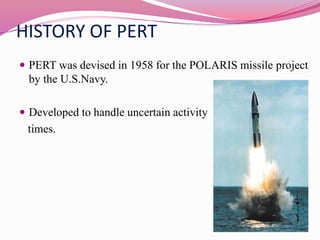
 PERT was devised in 1958 for the POLARIS missile project
by the U.S.Navy.
 Developed to handle uncertain activity
times.
PERT
 It involves planning, monitoring and controlling of
projects where time taken for each activity in the project
is not known.
 Used in project management - for non-repetitive jobs
(research and development work, launching of new health
programs).
 Uses probability to estimate the timings of various
activities (Probabilistic Model)
 Optimistic time (a): – It is the shortest time in which the
activity can be completed, if all goes as per the pre-
determined plan.
 Most likely time (m) – It is the probable time required to
perform the activity. Time taken most frequently in
completing a particular activity.
 Pessimistic time (b)– It is the longest estimated time
required to perform an activity, under most adverse
conditions
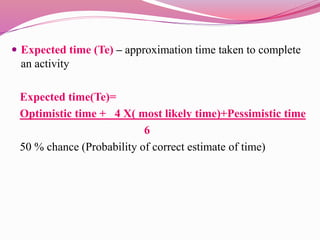
 Expected time (Te) – approximation time taken to complete
an activity
Expected time(Te)=
Optimistic time + 4 X( most likely time)+Pessimistic time
6
50 % chance (Probability of correct estimate of time)
History of CPM
 Developed by Du Pont to solve project scheduling
problems.
 The first test was made in 1958,when CPM was applied to
the construction of a new chemical plant.
 Developed for industrial projects for which activity times
are known
Critical Path Method
 Used in production management - for the jobs of
repetitive in nature where the activity time estimates
can be predicted with considerable certainty due to the
existence of past experience.(Deterministic Model)
 Repetitive Jobs like construction projects.
 Durations of individual activities in a project are known
with certainty.
KEY ELEMENTS
 Arrows:- leading from tail to head directionally
indicate activity
 Nodes:- Indicate Event, a point in time where one or
more activities start and/or finish.
 Earliest time: It is categorized in two sub elements.
 Earliest Starting time (ES):-This is the earliest
time an activity can begin without violation of
immediate predecessor requirements
 Earliest finishing time(EF):-This represent the
earliest time at which an activity can end.
 Latest time :It is categorized in two sub elements.
 Latest Starting time (LS):-This is the latest time an
activity can begin without delaying the entire project
 Latest Finishing time (LF):-This is the latest time
an activity can end without delaying the entire
project.
 Slack time:-The difference between its earliest start
time and latest completion time.
 Critical Path:-The path of activities having zero
Slack time
FLOAT/SLACK
 The amount of time that an activity in a project network
can be delayed without causing a delay in the entire
project so that the project can be completed on time.
 Forward pass : The earliest start time is
calculated by moving forward through the
network and considering the predecessor
activities.
Considers maximum
 Backward pass: The latest completion time is
calculated by moving backward through the
network.
Considers minimum
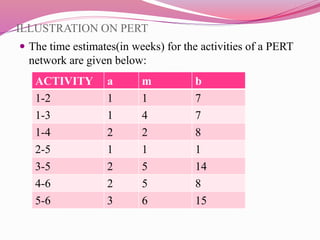
ILLUSTRATION ON PERT
 The time estimates(in weeks) for the activities of a PERT
network are given below:
ACTIVITY a m b
1-2 1 1 7
1-3 1 4 7
1-4 2 2 8
2-5 1 1 1
3-5 2 5 14
4-6 2 5 8
5-6 3 6 15
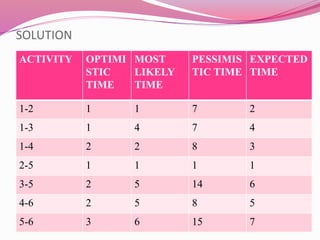
SOLUTION
ACTIVITY OPTIMI
STIC
TIME
MOST
LIKELY
TIME
PESSIMIS
TIC TIME
EXPECTED
TIME
1-2 1 1 7 2
1-3 1 4 7 4
1-4 2 2 8 3
2-5 1 1 1 1
3-5 2 5 14 6
4-6 2 5 8 5
5-6 3 6 15 7
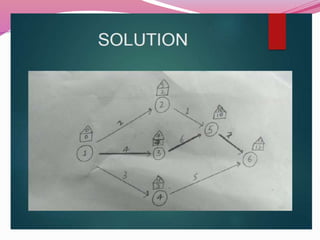
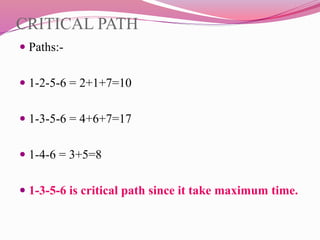
CRITICAL PATH
 Paths:-
 1-2-5-6 = 2+1+7=10
 1-3-5-6 = 4+6+7=17
 1-4-6 = 3+5=8
 1-3-5-6 is critical path since it take maximum time.
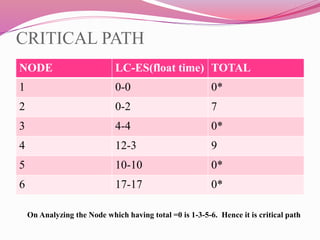
CRITICAL PATH
NODE LC-ES(float time) TOTAL
1 0-0 0*
2 0-2 7
3 4-4 0*
4 12-3 9
5 10-10 0*
6 17-17 0*
On Analyzing the Node which having total =0 is 1-3-5-6. Hence it is critical path
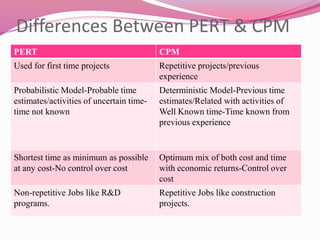
Differences Between PERT & CPM
PERT CPM
Used for first time projects Repetitive projects/previous
experience
Probabilistic Model-Probable time
estimates/activities of uncertain time-
time not known
Deterministic Model-Previous time
estimates/Related with activities of
Well Known time-Time known from
previous experience
Shortest time as minimum as possible
at any cost-No control over cost
Optimum mix of both cost and time
with economic returns-Control over
cost
Non-repetitive Jobs like R&D
programs.
Repetitive Jobs like construction
projects.
 Thank you
Thank
you

Pert cpm

  • 1.
  • 2.
    CONTENTS  INTRODUCTION  NETWORKANALYSIS  WHY CPM/PERT???  KEY CONCEPT  THE FRAMEWORK FOR PERT AND CPM  PERT  CPM  DRAWING A NETWORK  DIFFERENCES BETWEEN PERT AND CPM
  • 3.
    INTRODUCTION  PERT (ProgrammeEvaluation Review Technique) and CPM (Critical Path Method) are network analysis techniques, used in project management.  Developed along two parallel streams, one industrial and the other military establishments to plan, schedule and control complex projects.
  • 4.
    NETWORK ANALYSIS  Atechnique whereby:  objectives are identified  activities involved in attaining the objectives are determined  interrelationships are presented graphically in the form of network  used as a basis of determining sequence of activities and allocation of resources.
  • 5.
    WHY CPM/PERT???  Howlong will the entire project take to be completed? What are the risks involved?  Which are the critical activities, which could delay the entire project if they were not completed on time?  Is the project on schedule, behind schedule or ahead of schedule?
  • 6.
    Key concepts  Asmall set of activities, make up the longest path through the activity network, control the entire project.  Identifies the critical activities(critical because if any of these activities are delayed by even a short period, the entire project will be delayed), determines the fate of the entire project.  Non-critical activities can be re-planned, rescheduled and resources for them can be reallocated flexibly, without affecting the whole project.
  • 7.
    The Framework forPERT and CPM 1. Define the Project- all of it’s significant activities. The Project-only a single start activity and a single finish activity. 2. Develop the relationships among the activities. Decide which activities must precede and which must follow others.
  • 8.
    3. Draw the"Network" connecting all the activities. Each Activity should have unique event numbers. 4. Assign time estimates to each activity 5. Use the Network to help plan, schedule, monitor and control the project. Compute the longest time path through the network. This is called the critical path.
  • 9.
    Important points inconstructing a network:  Is this a Start Activity?  Is this a Finish Activity?  What Activity Precedes this?  What Activity Follows this?  What Activity is Concurrent with this?
  • 11.
    HISTORY OF PERT PERT was devised in 1958 for the POLARIS missile project by the U.S.Navy.  Developed to handle uncertain activity times.
  • 12.
    PERT  It involvesplanning, monitoring and controlling of projects where time taken for each activity in the project is not known.  Used in project management - for non-repetitive jobs (research and development work, launching of new health programs).  Uses probability to estimate the timings of various activities (Probabilistic Model)
  • 13.
     Optimistic time(a): – It is the shortest time in which the activity can be completed, if all goes as per the pre- determined plan.  Most likely time (m) – It is the probable time required to perform the activity. Time taken most frequently in completing a particular activity.  Pessimistic time (b)– It is the longest estimated time required to perform an activity, under most adverse conditions
  • 14.
     Expected time(Te) – approximation time taken to complete an activity Expected time(Te)= Optimistic time + 4 X( most likely time)+Pessimistic time 6 50 % chance (Probability of correct estimate of time)
  • 15.
    History of CPM Developed by Du Pont to solve project scheduling problems.  The first test was made in 1958,when CPM was applied to the construction of a new chemical plant.  Developed for industrial projects for which activity times are known
  • 16.
    Critical Path Method Used in production management - for the jobs of repetitive in nature where the activity time estimates can be predicted with considerable certainty due to the existence of past experience.(Deterministic Model)  Repetitive Jobs like construction projects.  Durations of individual activities in a project are known with certainty.
  • 17.
    KEY ELEMENTS  Arrows:-leading from tail to head directionally indicate activity  Nodes:- Indicate Event, a point in time where one or more activities start and/or finish.  Earliest time: It is categorized in two sub elements.  Earliest Starting time (ES):-This is the earliest time an activity can begin without violation of immediate predecessor requirements  Earliest finishing time(EF):-This represent the earliest time at which an activity can end.
  • 18.
     Latest time:It is categorized in two sub elements.  Latest Starting time (LS):-This is the latest time an activity can begin without delaying the entire project  Latest Finishing time (LF):-This is the latest time an activity can end without delaying the entire project.  Slack time:-The difference between its earliest start time and latest completion time.  Critical Path:-The path of activities having zero Slack time
  • 19.
    FLOAT/SLACK  The amountof time that an activity in a project network can be delayed without causing a delay in the entire project so that the project can be completed on time.
  • 20.
     Forward pass: The earliest start time is calculated by moving forward through the network and considering the predecessor activities. Considers maximum  Backward pass: The latest completion time is calculated by moving backward through the network. Considers minimum
  • 21.
    ILLUSTRATION ON PERT The time estimates(in weeks) for the activities of a PERT network are given below: ACTIVITY a m b 1-2 1 1 7 1-3 1 4 7 1-4 2 2 8 2-5 1 1 1 3-5 2 5 14 4-6 2 5 8 5-6 3 6 15
  • 22.
    SOLUTION ACTIVITY OPTIMI STIC TIME MOST LIKELY TIME PESSIMIS TIC TIME EXPECTED TIME 1-21 1 7 2 1-3 1 4 7 4 1-4 2 2 8 3 2-5 1 1 1 1 3-5 2 5 14 6 4-6 2 5 8 5 5-6 3 6 15 7
  • 24.
    CRITICAL PATH  Paths:- 1-2-5-6 = 2+1+7=10  1-3-5-6 = 4+6+7=17  1-4-6 = 3+5=8  1-3-5-6 is critical path since it take maximum time.
  • 25.
    CRITICAL PATH NODE LC-ES(floattime) TOTAL 1 0-0 0* 2 0-2 7 3 4-4 0* 4 12-3 9 5 10-10 0* 6 17-17 0* On Analyzing the Node which having total =0 is 1-3-5-6. Hence it is critical path
  • 26.
    Differences Between PERT& CPM PERT CPM Used for first time projects Repetitive projects/previous experience Probabilistic Model-Probable time estimates/activities of uncertain time- time not known Deterministic Model-Previous time estimates/Related with activities of Well Known time-Time known from previous experience Shortest time as minimum as possible at any cost-No control over cost Optimum mix of both cost and time with economic returns-Control over cost Non-repetitive Jobs like R&D programs. Repetitive Jobs like construction projects.
  • 27.