Chapter –6 
Critical Path Method (CPM) 
Course Code -CIE 403 
Mr. Ramesh Nayaka, (M.Tech. –IIT Madras) 
Assistant Professor 
Department of Civil Engineering 
Manipal Institute of Technology, Manipal -576104 
Karnataka, India
Content… 
•Introduction to CPM 
•Difference between CPM and PERT 
•Terms and Definitions 
•Calculation of Float 
•Critical Path
Introduction to CPM 
CPM network are usually used for repetitive type of projects, where fairly accurate estimates of time can be made for the activities of the project. 
The activities of these projects are characteristically subject to relatively small amount of variation. Hence CPM is not suitable for research and development type of projects. 
Examples from fairly diverse field where application of CPM can be made: 
Building a new bridge across river ganga, Constructing a multi-storeyed building, extension of a factory building, shifting a manufacturing unit to other site and manufacturing of a new car etc.
Difference between CPM and PERT 
CPM 
PERT 
Activity Oriented network 
Event oriented network 
The time estimatesare of a fair degree of accuracy 
Time estimates are not that accurate andthere is an uncertainty attached to it 
Follows deterministic approach 
Followsprobabilistic approach 
Cost is governingfactor 
Time is governing factor 
Project duration is so fixed such that the cost is minimum 
Assumed that cost is directly proportional to time so time is reduced maximum possible to enjoy least cost 
Critical path is thatpath which joins the critical activities 
Criticalpath is the path which joins the critical events
Terms and Definitions 
Activity Times 
Forward Passing : 
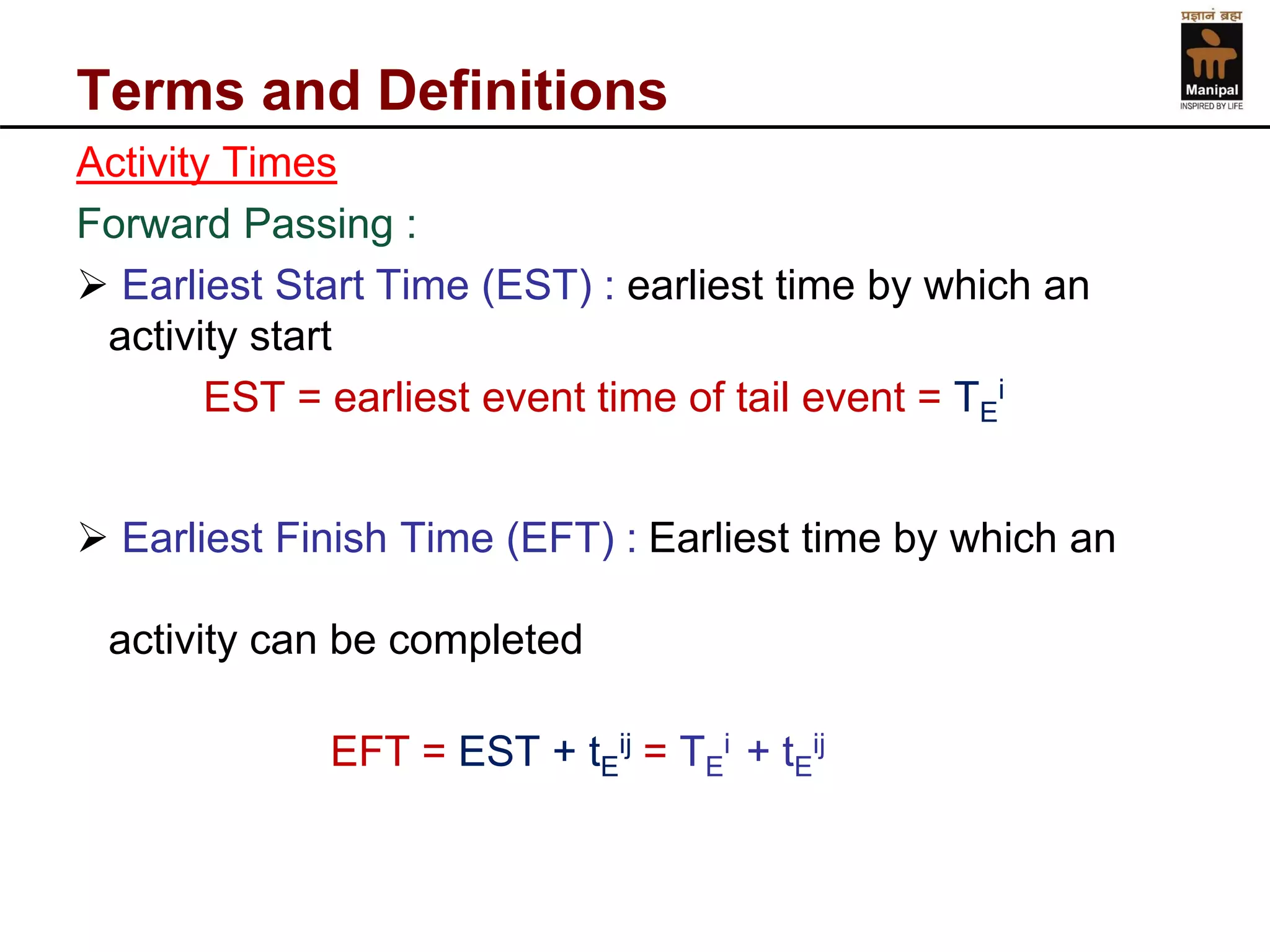
Earliest Start Time (EST) :earliest time by which an activity start 
EST = earliest event time of tail event = TEi 
Earliest Finish Time (EFT) : Earliest time by which an activity can be completed 
EFT = EST + tEij= TEi + tEij
Terms and Definitions 
Activity Times 
Backward Passing : 
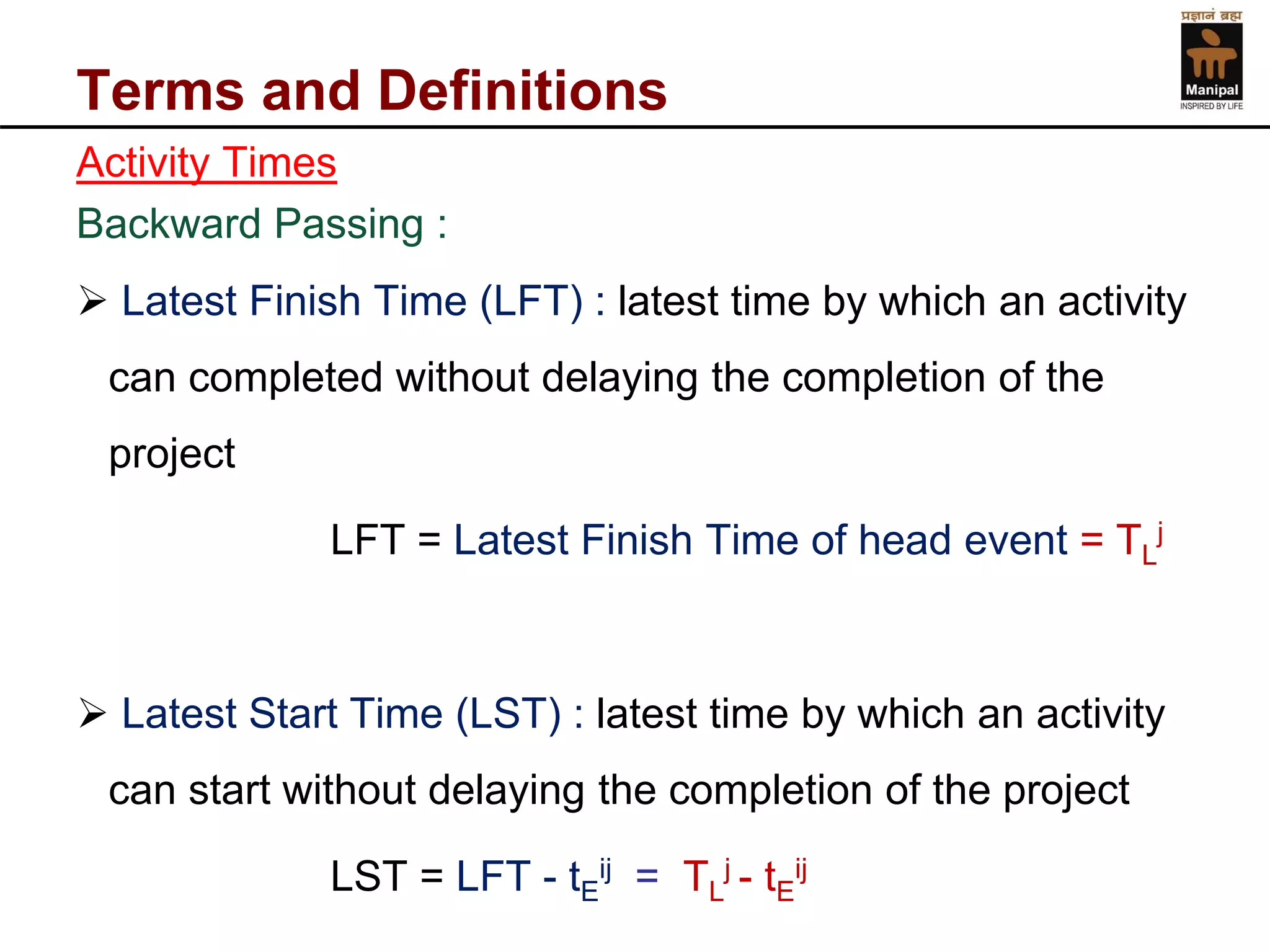
Latest Finish Time (LFT) : latest time by which an activity can completed without delaying the completion of the project 
LFT = Latest Finish Time of head event = TLj 
Latest Start Time (LST) : latest time by which an activity can start without delaying the completion of the project 
LST = LFT -tEij= TLj -tEij
Terms and Definitions 
FLOATS 
Similar to slack in PERT 
Associated with activity times 
Denotes flexibility range within which the activity start and finish time may fluctuate without affecting the total duration of the project
Terms and Definitions 
TYPES OF FLOATS 
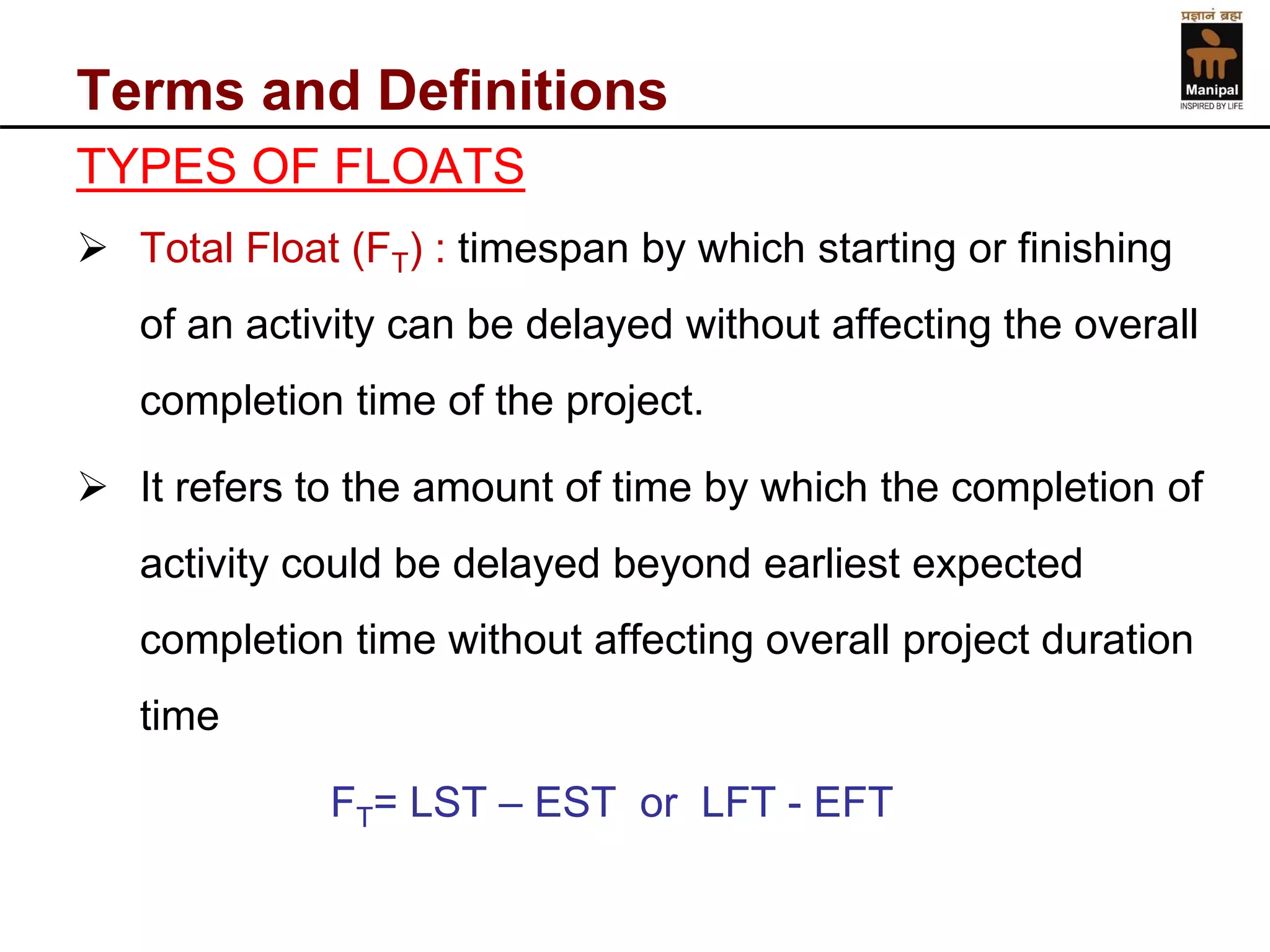
Total Float (FT) : timespan by which starting or finishing of an activity can be delayed without affecting the overall completion time of the project. 
It refers to the amount of time by which the completion of activity could be delayed beyond earliest expected completion time without affecting overall project duration time 
FT= LST –EST or LFT -EFT
Terms and Definitions 
TYPES OF FLOATS 
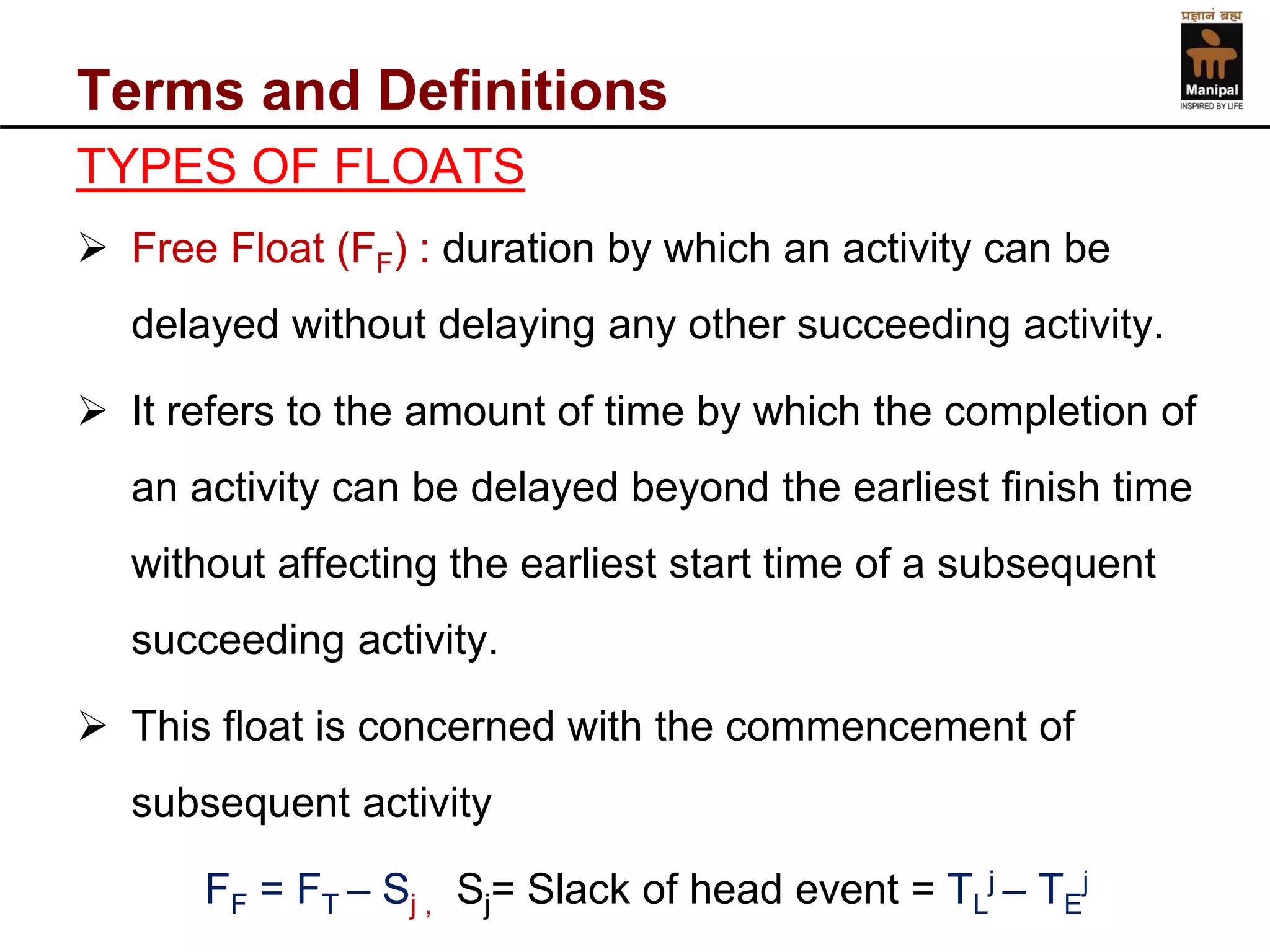
Free Float (FF) : duration by which an activity can be delayed without delaying any other succeeding activity. 
It refers to the amount of time by which the completion of an activity can be delayed beyond the earliest finish time without affecting the earliest start time of a subsequent succeeding activity. 
This float is concerned with the commencement of subsequent activity 
FF= FT–Sj , Sj= Slack of head event = TLj –TEj
Terms and Definitions 
TYPES OF FLOATS 
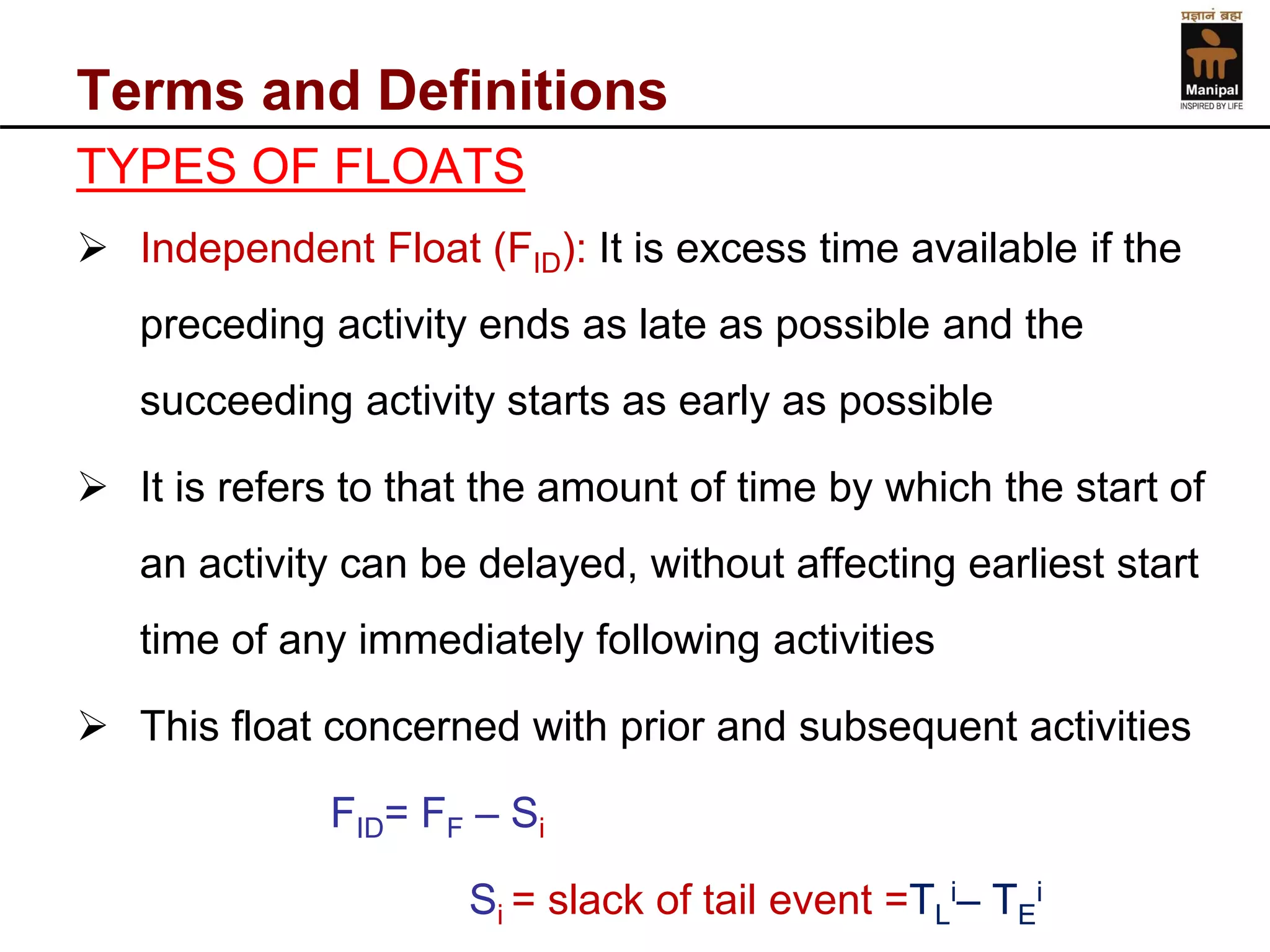
Independent Float (FID): It is excess time available if the preceding activity ends as late as possible and the succeeding activity starts as early as possible 
It is refers to that the amount of time by which the start of an activity can be delayed, without affecting earliest start time of any immediately following activities 
This float concerned with prior and subsequent activities 
FID= FF–Si 
Si = slack of tail event =TLi–TEi
Terms and Definitions 
TYPES OF FLOATS 
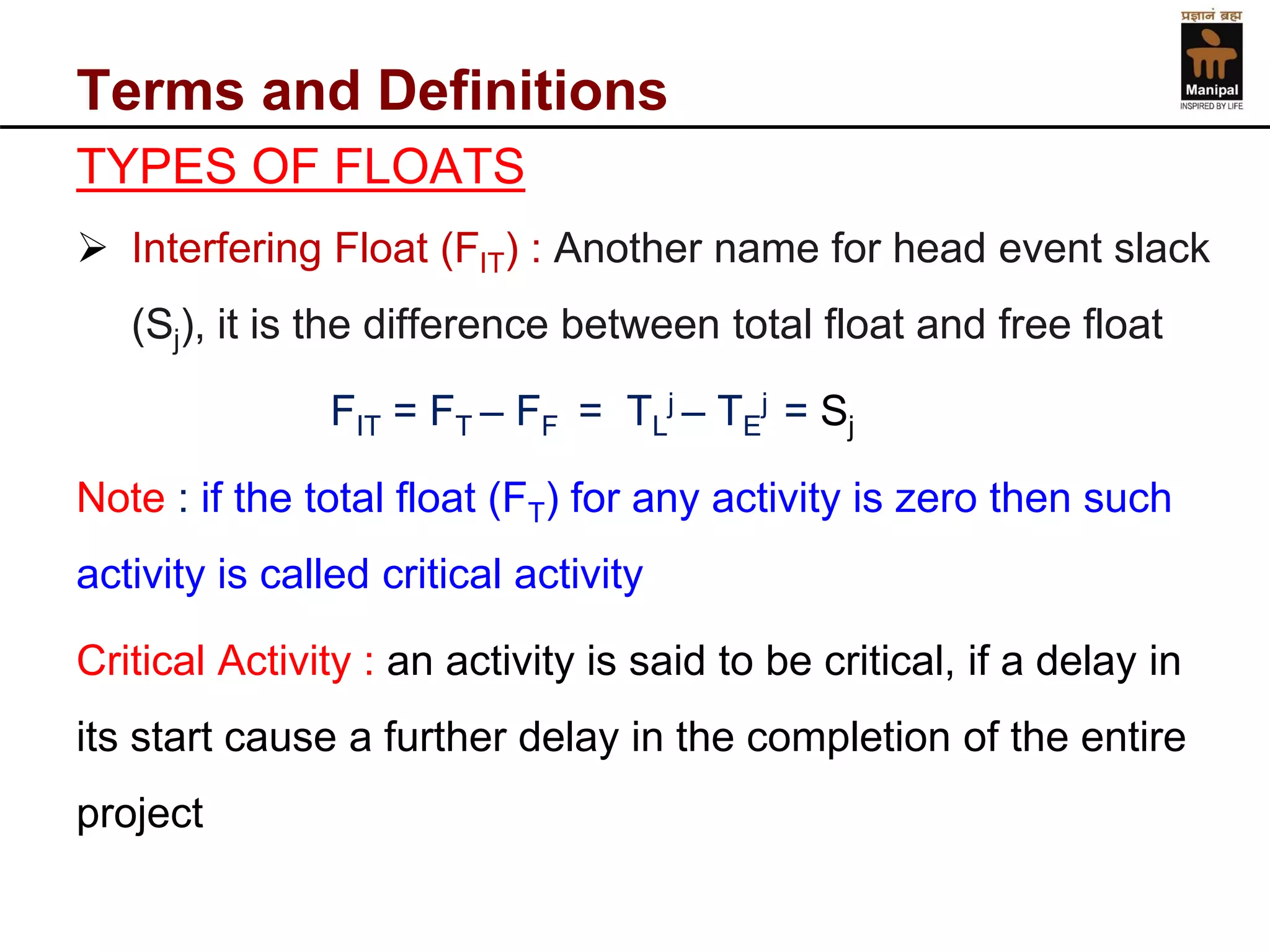
Interfering Float (FIT) : Another name for head event slack (Sj), it is the difference between total float and free float 
FIT= FT–FF = TLj –TEj = Sj 
Note : if the total float (FT) for any activity is zero then such activity is called critical activity 
Critical Activity : an activity is said to be critical, if a delay in its start cause a further delay in the completion of the entire project
Terms and Definitions 
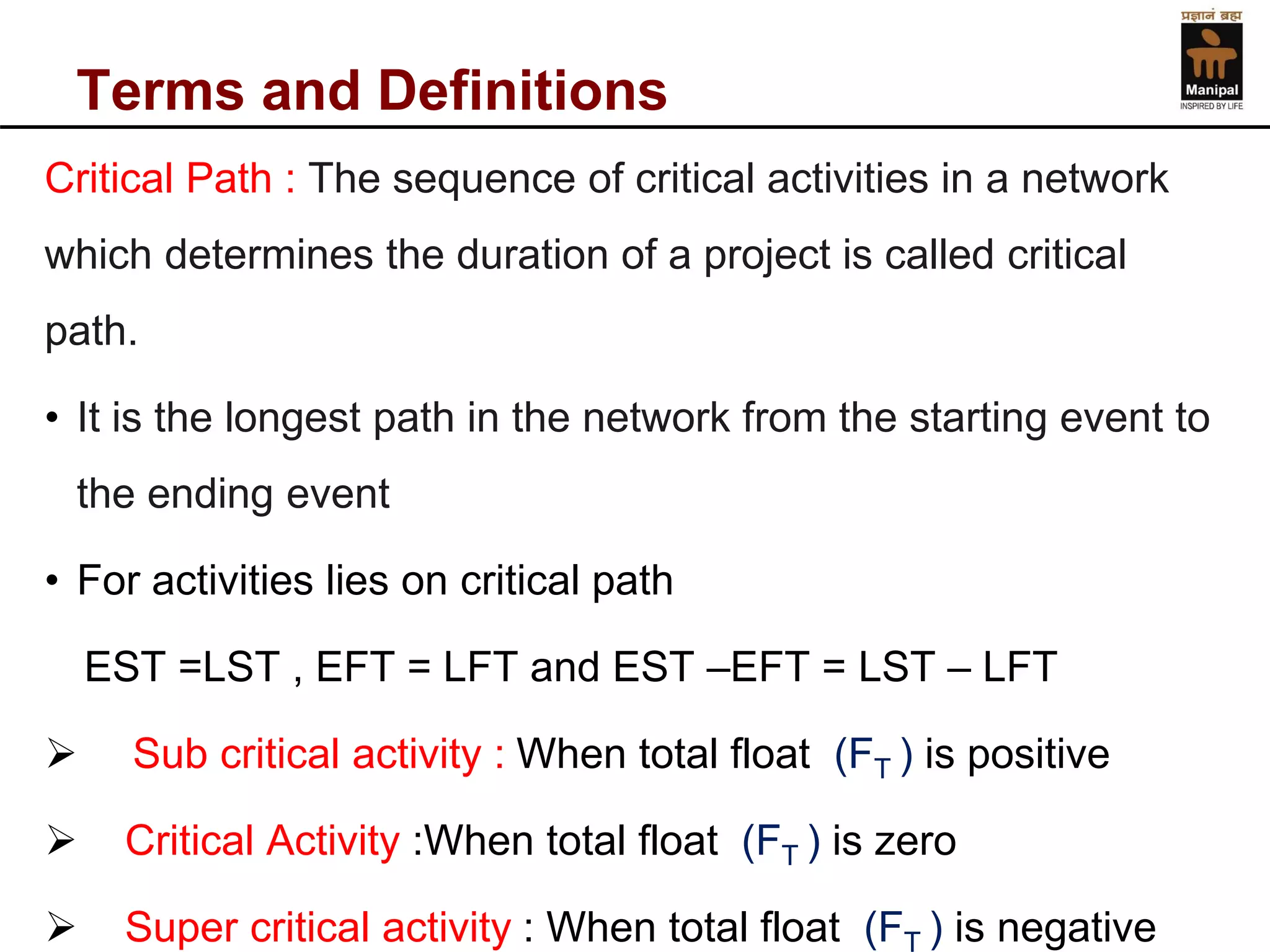
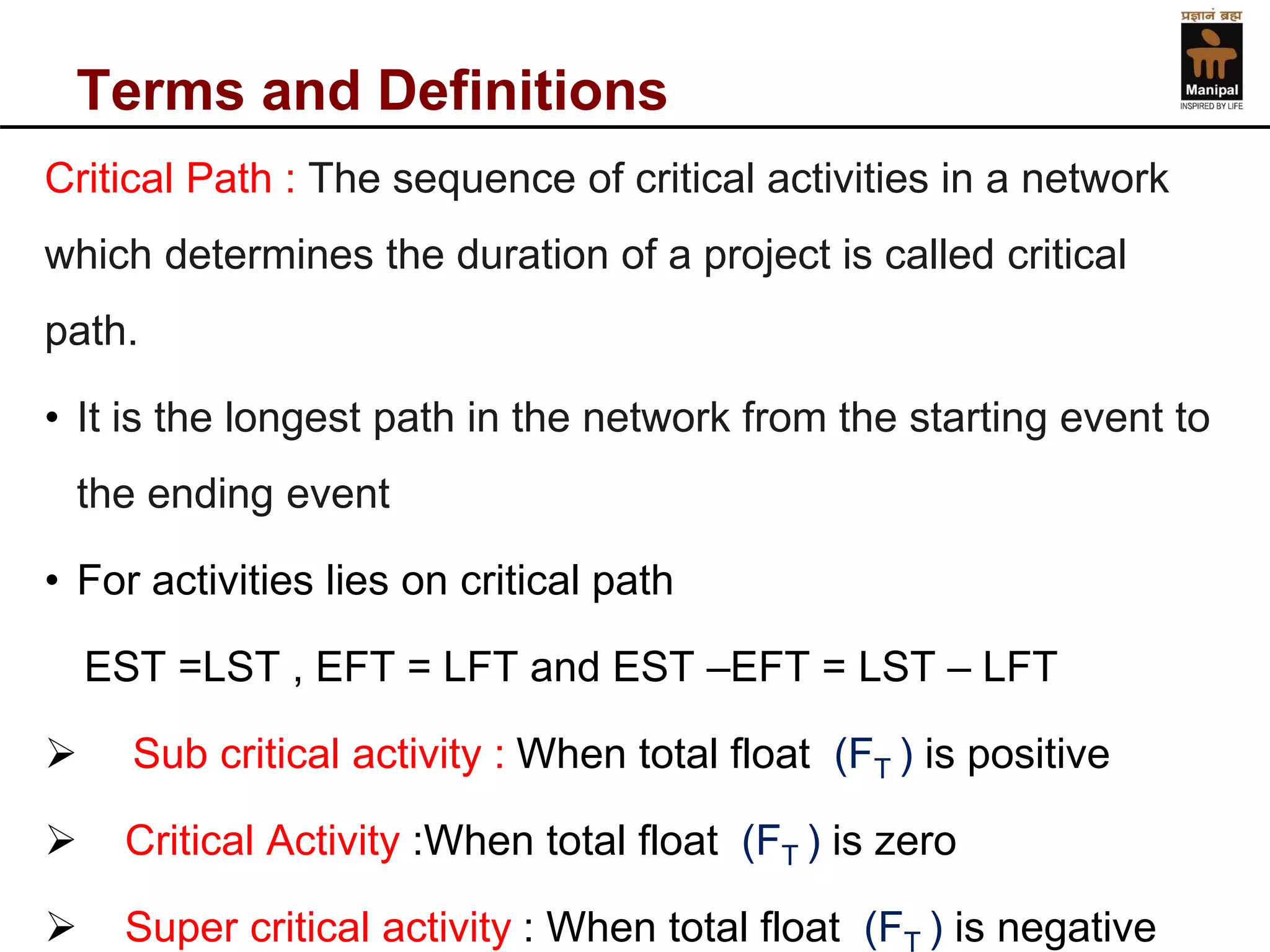
Critical Path : The sequence of critical activities in a network which determines the duration of a project is called critical path. 
•It is the longest path in the network from the starting event to the ending event 
•For activities lies on critical path 
EST =LST , EFT = LFT and EST –EFT = LST –LFT 
Sub critical activity : When total float (FT ) is positive 
Critical Activity :When total float (FT ) is zero 
Super critical activity : When total float (FT ) is negative
Calculating Critical Path & Float for a Network Diagram 
Find out the length of all the paths in the network diagram 
The longest path is the critical path 
Float = EF –LF = ES -LS
Terms and Definitions 
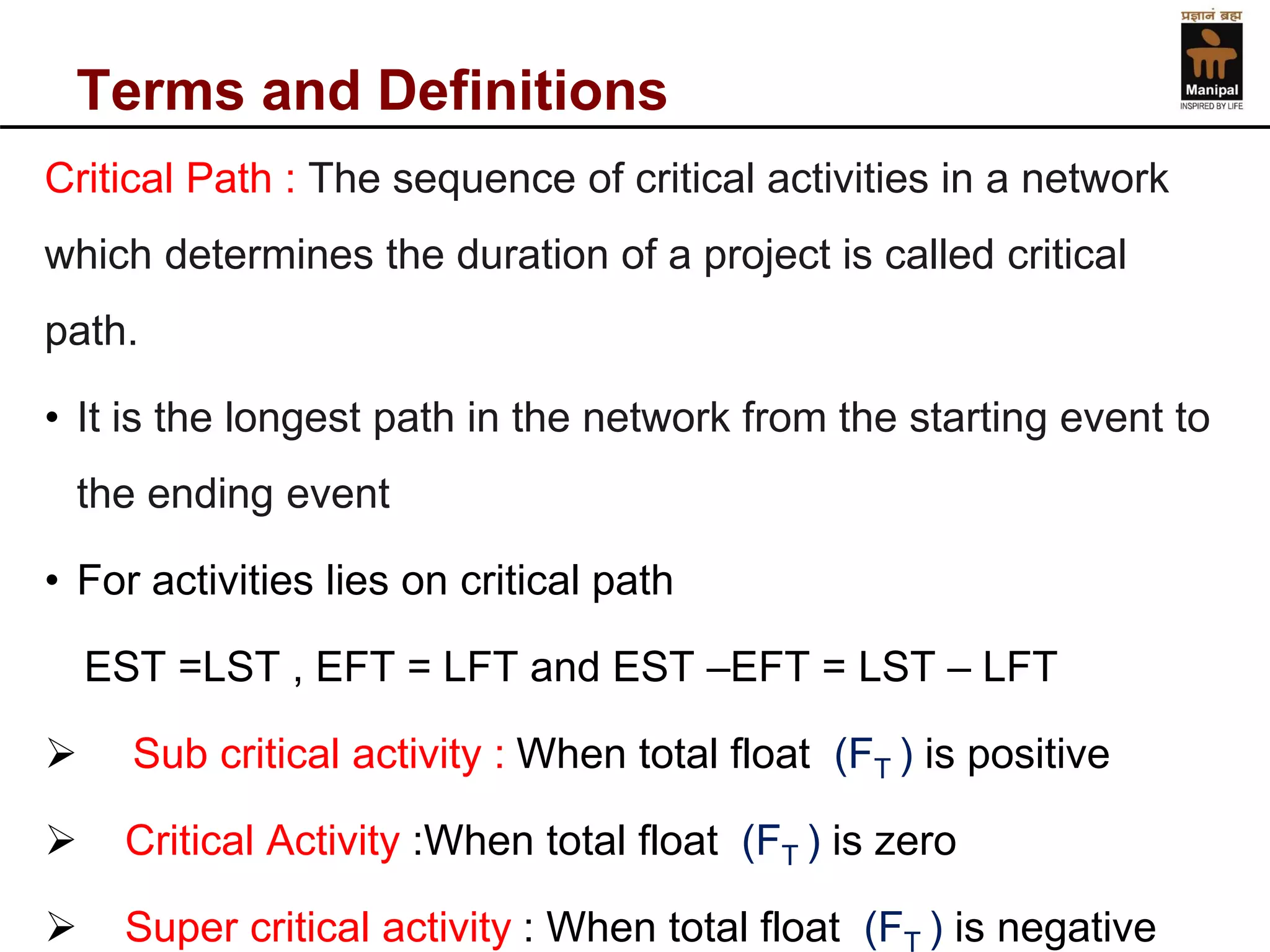
Critical Path : The sequence of critical activities in a network which determines the duration of a project is called critical path. 
•It is the longest path in the network from the starting event to the ending event 
•For activities lies on critical path 
EST =LST , EFT = LFT and EST –EFT = LST –LFT 
Sub critical activity : When total float (FT ) is positive 
Critical Activity :When total float (FT ) is zero 
Super critical activity : When total float (FT ) is negative
Terms and Definitions 
Critical Path : The sequence of critical activities in a network which determines the duration of a project is called critical path. 
•It is the longest path in the network from the starting event to the ending event 
•For activities lies on critical path 
EST =LST , EFT = LFT and EST –EFT = LST –LFT 
Sub critical activity : When total float (FT ) is positive 
Critical Activity :When total float (FT ) is zero 
Super critical activity : When total float (FT ) is negative
CPM Analysis 
F 
1 
2 
4 
3 
5 
6 
7 
8 
A 
B 
C 
D 
E 
H 
K 
J 
I 
10 
8 
12 
8 
10 
6 
5 
12 
6 
12 
8 
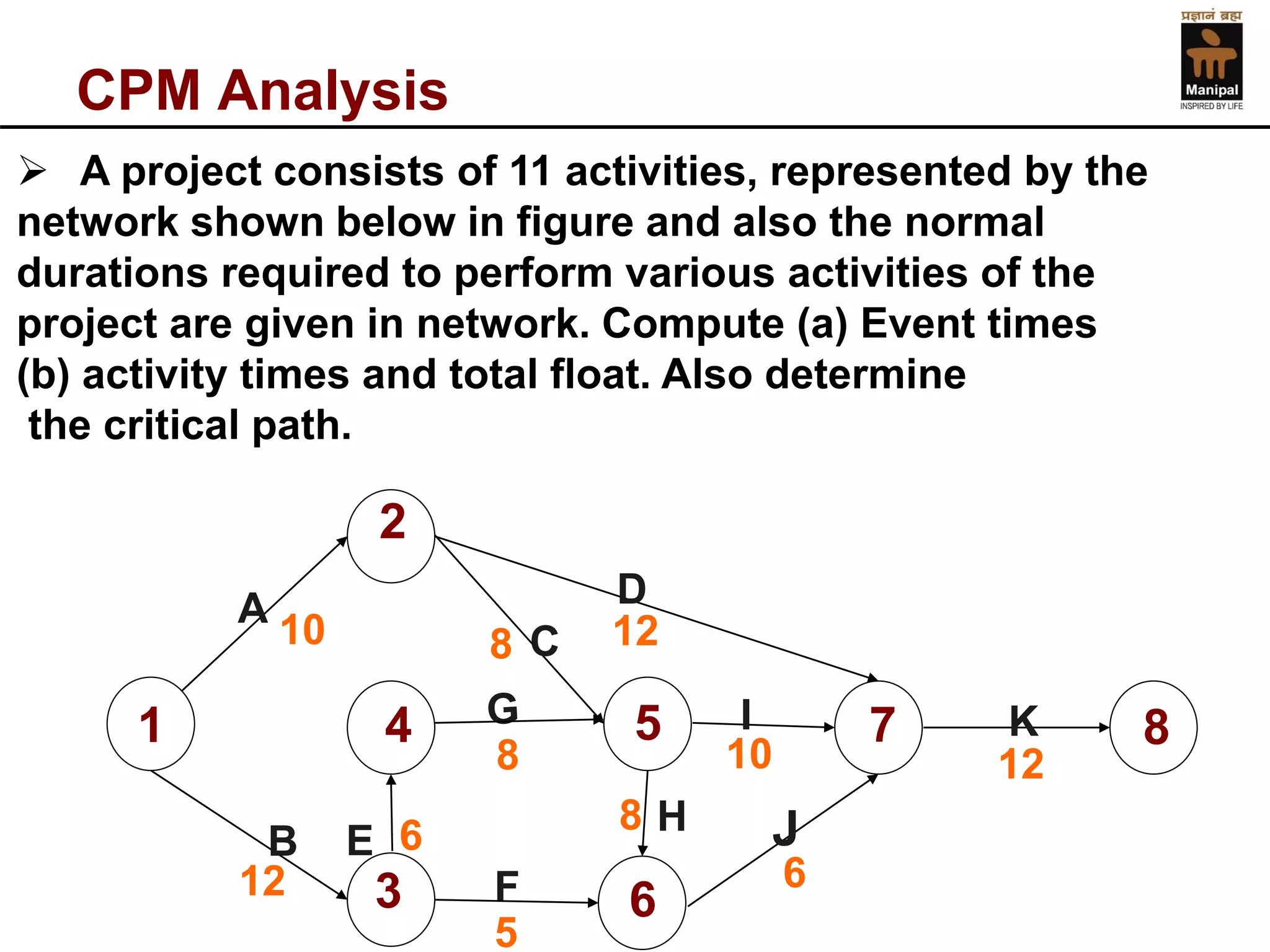
Aprojectconsistsof11activities,representedbythe 
networkshownbelowinfigureandalsothenormal 
durationsrequiredtoperformvariousactivitiesofthe 
projectaregiveninnetwork.Compute(a)Eventtimes 
(b)activitytimesandtotalfloat.Alsodetermine 
thecriticalpath.
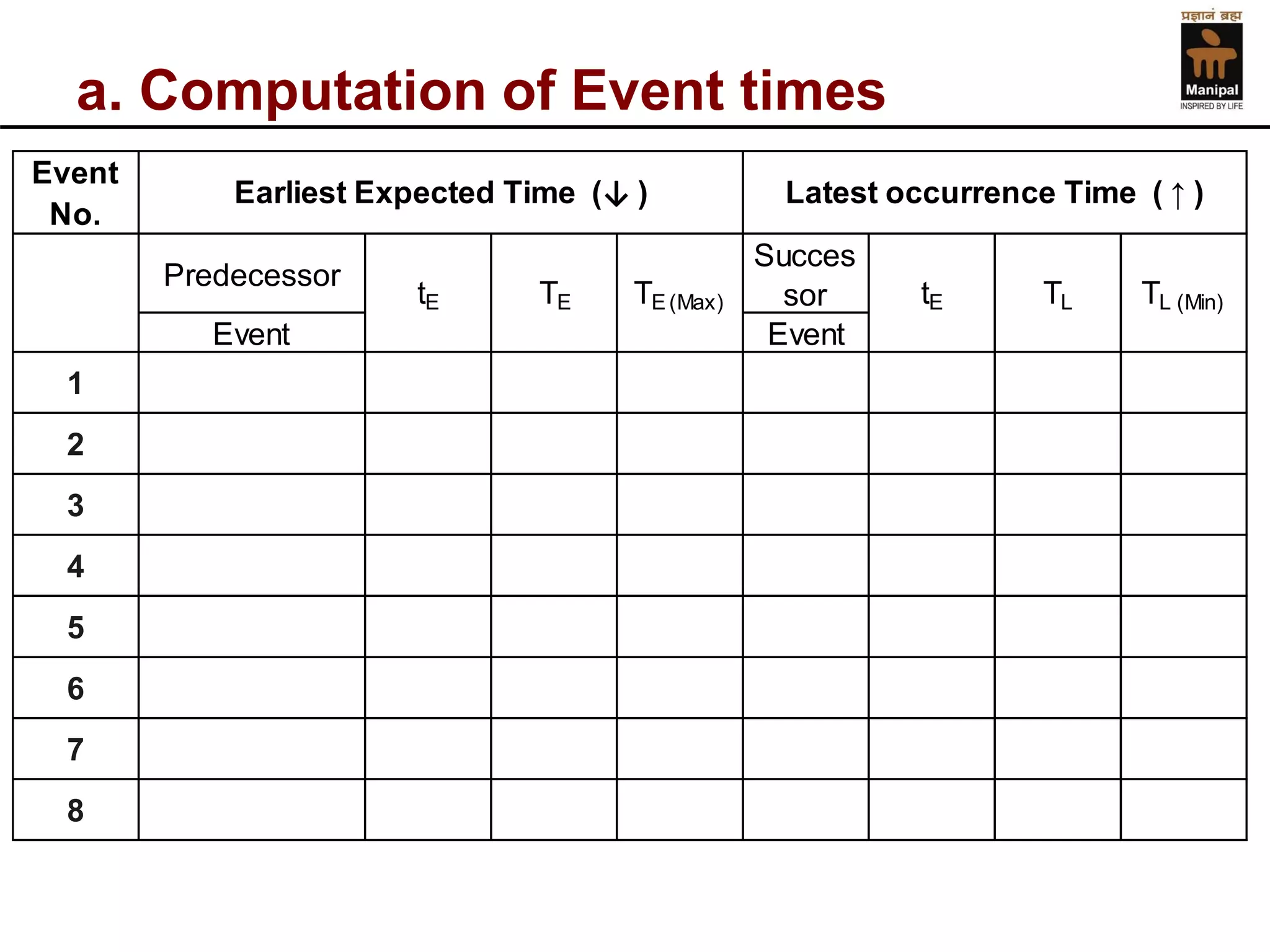
a. Computation of Event times Event No. PredecessorSuccessorEventEvent12345678Earliest Expected Time (↓ )Latest occurrence Time ( ↑ ) tETETE (Max)tETLTL (Min)
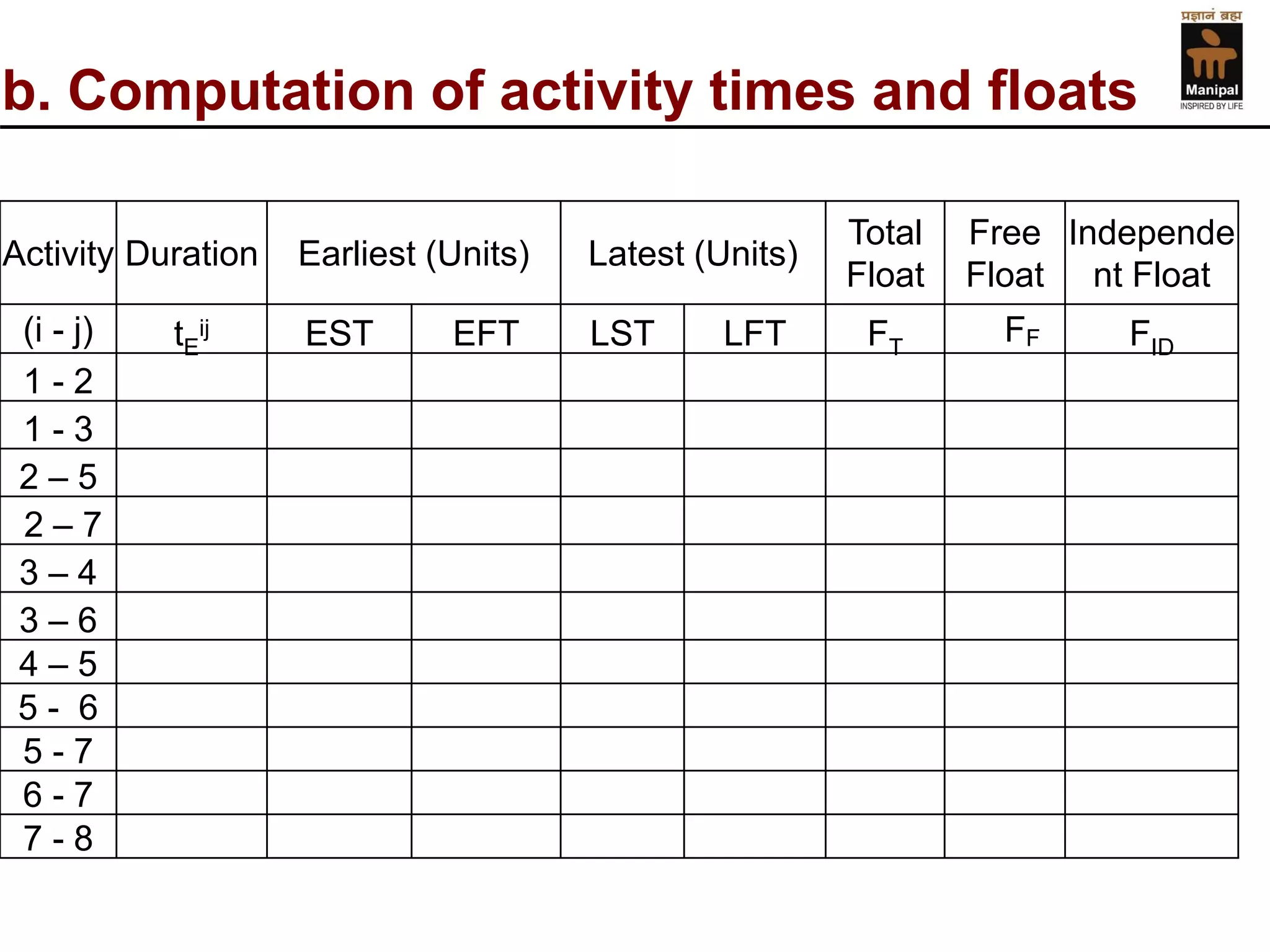
b. Computation of activity times and floats 
Activity 
Duration 
Earliest (Units) 
Latest (Units) 
Total Float 
Free Float 
Independent Float 
(i -j) 
tEij 
EST 
EFT 
LST 
LFT 
FT 
FF 
FID 
1 -2 
1 -3 
2 –5 
2 –7 
3–4 
3–6 
4–5 
5 -6 
5 -7 
6 -7 
7 -8
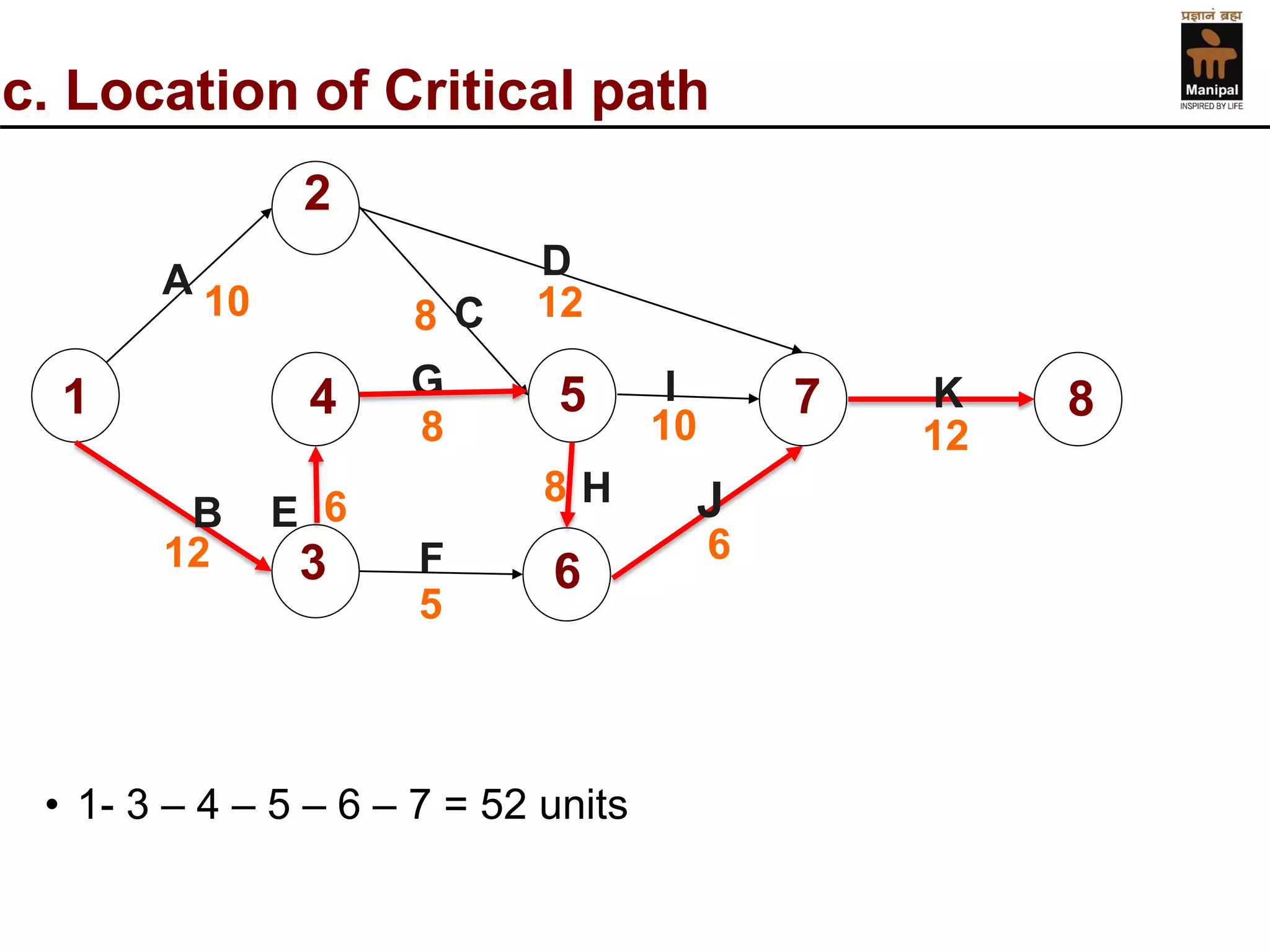
c. Location of Critical path 
•1-3 –4 –5 –6 –7 = 52 units 
F 
1 
2 
4 
3 
5 
6 
7 
8 
A 
B 
C 
D 
E 
H 
K 
J 
I 
10 
8 
12 
8 
10 
6 
5 
12 
6 
12 
8
Problem –2 
F 
1 
2 
4 
3 
5 
6 
7 
8 
A 
B 
G 
E 
D 
I 
L 
J 
5 
4 
4 
6 
2 
6 
7 
8 
0 
6 
7 
C 
K 
3 
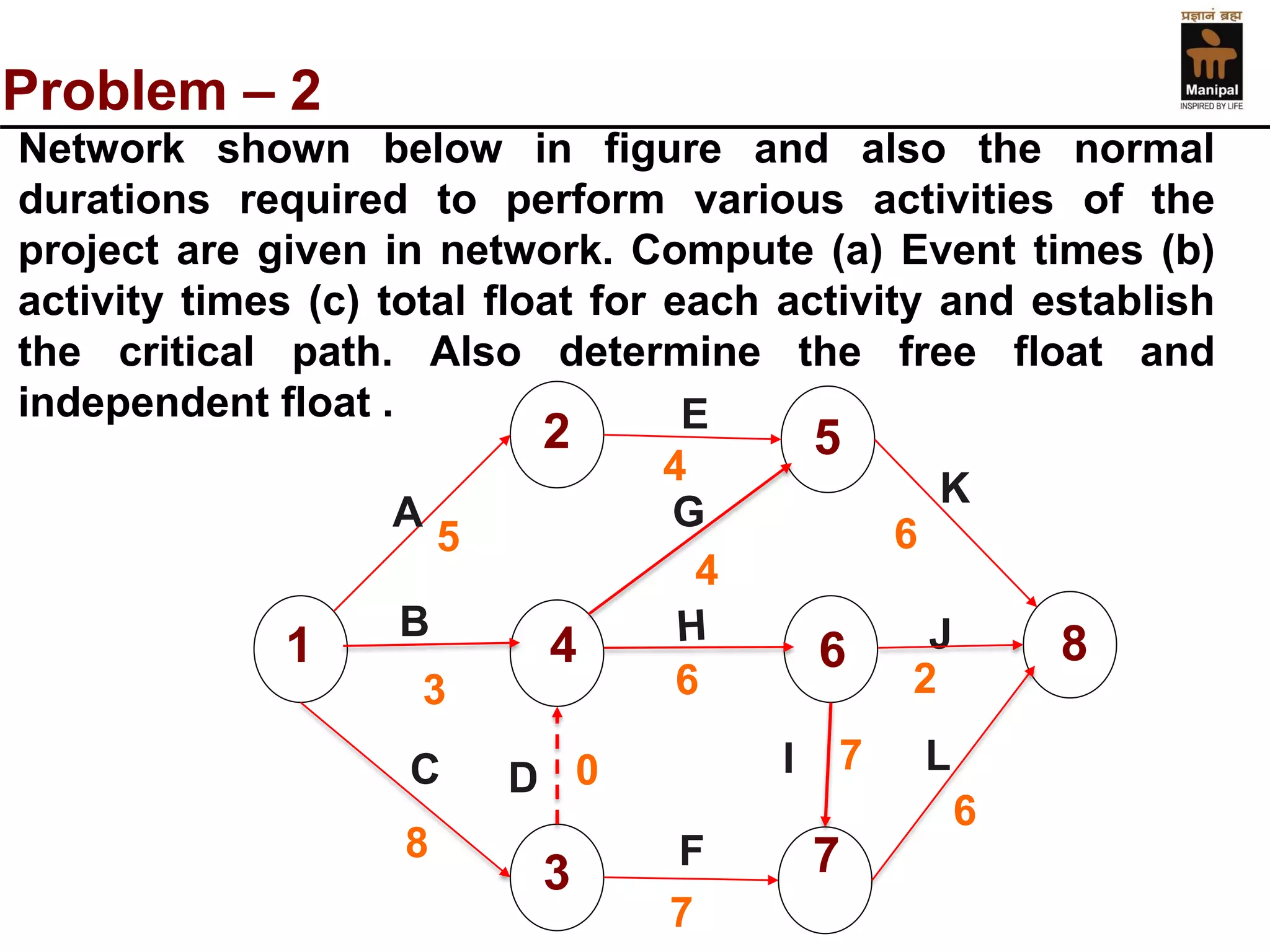
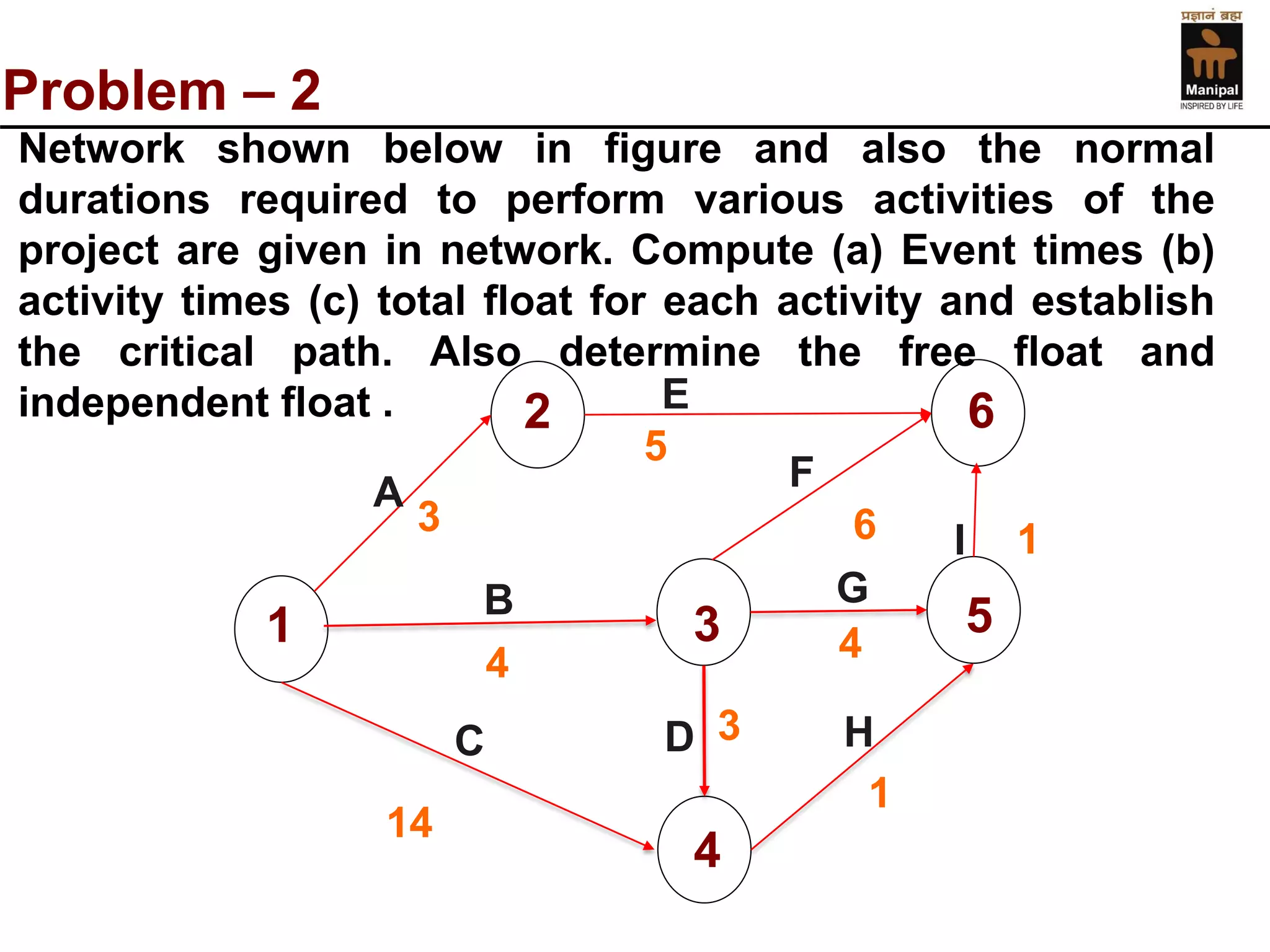
Networkshownbelowinfigureandalsothenormaldurationsrequiredtoperformvariousactivitiesoftheprojectaregiveninnetwork.Compute(a)Eventtimes(b) activitytimes(c)totalfloatforeachactivityandestablishthecriticalpath.Alsodeterminethefreefloatandindependentfloat.
Problem –2 
1 
2 
3 
6 
4 
5 
A 
B 
E 
D 
G 
H 
3 
5 
3 
1 
14 
4 
C 
F 
4 
Networkshownbelowinfigureandalsothenormaldurationsrequiredtoperformvariousactivitiesoftheprojectaregiveninnetwork.Compute(a)Eventtimes(b) activitytimes(c)totalfloatforeachactivityandestablishthecriticalpath.Alsodeterminethefreefloatandindependentfloat. 
6 
1 
I

Critical Path Method

  • 1.
    Chapter –6 CriticalPath Method (CPM) Course Code -CIE 403 Mr. Ramesh Nayaka, (M.Tech. –IIT Madras) Assistant Professor Department of Civil Engineering Manipal Institute of Technology, Manipal -576104 Karnataka, India
  • 2.
    Content… •Introduction toCPM •Difference between CPM and PERT •Terms and Definitions •Calculation of Float •Critical Path
  • 3.
    Introduction to CPM CPM network are usually used for repetitive type of projects, where fairly accurate estimates of time can be made for the activities of the project. The activities of these projects are characteristically subject to relatively small amount of variation. Hence CPM is not suitable for research and development type of projects. Examples from fairly diverse field where application of CPM can be made: Building a new bridge across river ganga, Constructing a multi-storeyed building, extension of a factory building, shifting a manufacturing unit to other site and manufacturing of a new car etc.
  • 4.
    Difference between CPMand PERT CPM PERT Activity Oriented network Event oriented network The time estimatesare of a fair degree of accuracy Time estimates are not that accurate andthere is an uncertainty attached to it Follows deterministic approach Followsprobabilistic approach Cost is governingfactor Time is governing factor Project duration is so fixed such that the cost is minimum Assumed that cost is directly proportional to time so time is reduced maximum possible to enjoy least cost Critical path is thatpath which joins the critical activities Criticalpath is the path which joins the critical events
  • 5.
    Terms and Definitions Activity Times Forward Passing : Earliest Start Time (EST) :earliest time by which an activity start EST = earliest event time of tail event = TEi Earliest Finish Time (EFT) : Earliest time by which an activity can be completed EFT = EST + tEij= TEi + tEij
  • 6.
    Terms and Definitions Activity Times Backward Passing : Latest Finish Time (LFT) : latest time by which an activity can completed without delaying the completion of the project LFT = Latest Finish Time of head event = TLj Latest Start Time (LST) : latest time by which an activity can start without delaying the completion of the project LST = LFT -tEij= TLj -tEij
  • 7.
    Terms and Definitions FLOATS Similar to slack in PERT Associated with activity times Denotes flexibility range within which the activity start and finish time may fluctuate without affecting the total duration of the project
  • 8.
    Terms and Definitions TYPES OF FLOATS Total Float (FT) : timespan by which starting or finishing of an activity can be delayed without affecting the overall completion time of the project. It refers to the amount of time by which the completion of activity could be delayed beyond earliest expected completion time without affecting overall project duration time FT= LST –EST or LFT -EFT
  • 9.
    Terms and Definitions TYPES OF FLOATS Free Float (FF) : duration by which an activity can be delayed without delaying any other succeeding activity. It refers to the amount of time by which the completion of an activity can be delayed beyond the earliest finish time without affecting the earliest start time of a subsequent succeeding activity. This float is concerned with the commencement of subsequent activity FF= FT–Sj , Sj= Slack of head event = TLj –TEj
  • 10.
    Terms and Definitions TYPES OF FLOATS Independent Float (FID): It is excess time available if the preceding activity ends as late as possible and the succeeding activity starts as early as possible It is refers to that the amount of time by which the start of an activity can be delayed, without affecting earliest start time of any immediately following activities This float concerned with prior and subsequent activities FID= FF–Si Si = slack of tail event =TLi–TEi
  • 11.
    Terms and Definitions TYPES OF FLOATS Interfering Float (FIT) : Another name for head event slack (Sj), it is the difference between total float and free float FIT= FT–FF = TLj –TEj = Sj Note : if the total float (FT) for any activity is zero then such activity is called critical activity Critical Activity : an activity is said to be critical, if a delay in its start cause a further delay in the completion of the entire project
  • 12.
    Terms and Definitions Critical Path : The sequence of critical activities in a network which determines the duration of a project is called critical path. •It is the longest path in the network from the starting event to the ending event •For activities lies on critical path EST =LST , EFT = LFT and EST –EFT = LST –LFT Sub critical activity : When total float (FT ) is positive Critical Activity :When total float (FT ) is zero Super critical activity : When total float (FT ) is negative
  • 13.
    Calculating Critical Path& Float for a Network Diagram Find out the length of all the paths in the network diagram The longest path is the critical path Float = EF –LF = ES -LS
  • 14.
    Terms and Definitions Critical Path : The sequence of critical activities in a network which determines the duration of a project is called critical path. •It is the longest path in the network from the starting event to the ending event •For activities lies on critical path EST =LST , EFT = LFT and EST –EFT = LST –LFT Sub critical activity : When total float (FT ) is positive Critical Activity :When total float (FT ) is zero Super critical activity : When total float (FT ) is negative
  • 15.
    Terms and Definitions Critical Path : The sequence of critical activities in a network which determines the duration of a project is called critical path. •It is the longest path in the network from the starting event to the ending event •For activities lies on critical path EST =LST , EFT = LFT and EST –EFT = LST –LFT Sub critical activity : When total float (FT ) is positive Critical Activity :When total float (FT ) is zero Super critical activity : When total float (FT ) is negative
  • 16.
    CPM Analysis F 1 2 4 3 5 6 7 8 A B C D E H K J I 10 8 12 8 10 6 5 12 6 12 8 Aprojectconsistsof11activities,representedbythe networkshownbelowinfigureandalsothenormal durationsrequiredtoperformvariousactivitiesofthe projectaregiveninnetwork.Compute(a)Eventtimes (b)activitytimesandtotalfloat.Alsodetermine thecriticalpath.
  • 17.
    a. Computation ofEvent times Event No. PredecessorSuccessorEventEvent12345678Earliest Expected Time (↓ )Latest occurrence Time ( ↑ ) tETETE (Max)tETLTL (Min)
  • 18.
    b. Computation ofactivity times and floats Activity Duration Earliest (Units) Latest (Units) Total Float Free Float Independent Float (i -j) tEij EST EFT LST LFT FT FF FID 1 -2 1 -3 2 –5 2 –7 3–4 3–6 4–5 5 -6 5 -7 6 -7 7 -8
  • 19.
    c. Location ofCritical path •1-3 –4 –5 –6 –7 = 52 units F 1 2 4 3 5 6 7 8 A B C D E H K J I 10 8 12 8 10 6 5 12 6 12 8
  • 20.
    Problem –2 F 1 2 4 3 5 6 7 8 A B G E D I L J 5 4 4 6 2 6 7 8 0 6 7 C K 3 Networkshownbelowinfigureandalsothenormaldurationsrequiredtoperformvariousactivitiesoftheprojectaregiveninnetwork.Compute(a)Eventtimes(b) activitytimes(c)totalfloatforeachactivityandestablishthecriticalpath.Alsodeterminethefreefloatandindependentfloat.
  • 21.
    Problem –2 1 2 3 6 4 5 A B E D G H 3 5 3 1 14 4 C F 4 Networkshownbelowinfigureandalsothenormaldurationsrequiredtoperformvariousactivitiesoftheprojectaregiveninnetwork.Compute(a)Eventtimes(b) activitytimes(c)totalfloatforeachactivityandestablishthecriticalpath.Alsodeterminethefreefloatandindependentfloat. 6 1 I