
Technical Note 4 Job Design and Work Measurement
Job Design Defined Job Design Decisions Trends in Job Design Work Measurement Basic Compensation Systems Financial Incentive Plans  OBJECTIVES
What is Job Design? Defined Job design  is the function of specifying the work activities of an individual or group in an organizational setting The objective of job design is to develop jobs that meet the requirements of the organization and its technology and that satisfy the jobholder’s personal and individual requirements
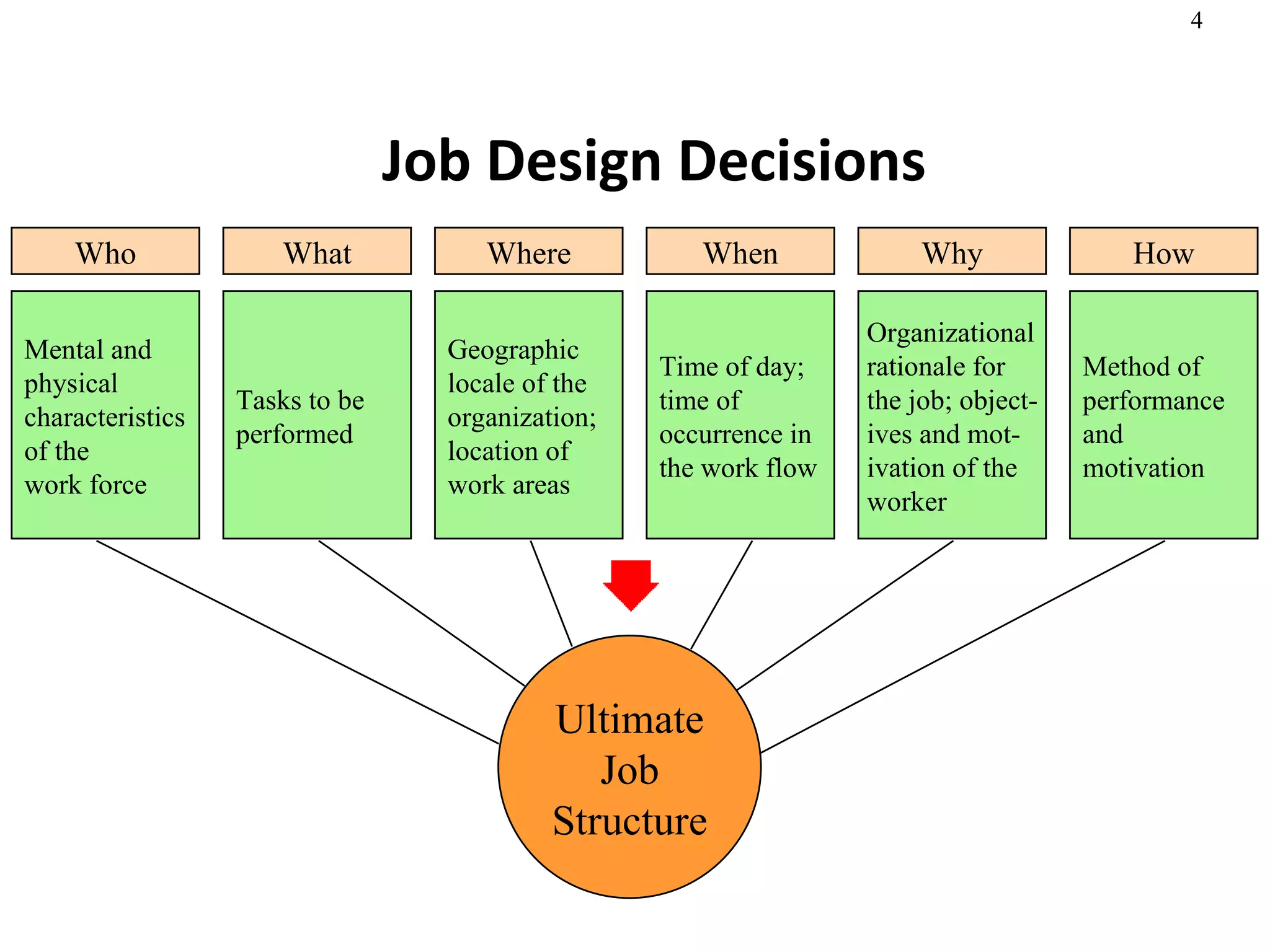
Job Design Decisions How Why When Where What Who Mental and physical characteristics of the  work force Tasks to be performed Geographic locale of the organization; location of  work areas Time of day; time of  occurrence in the work flow Organizational rationale for the job; object- ives and mot- ivation of the worker Method of  performance and motivation Ultimate Job Structure
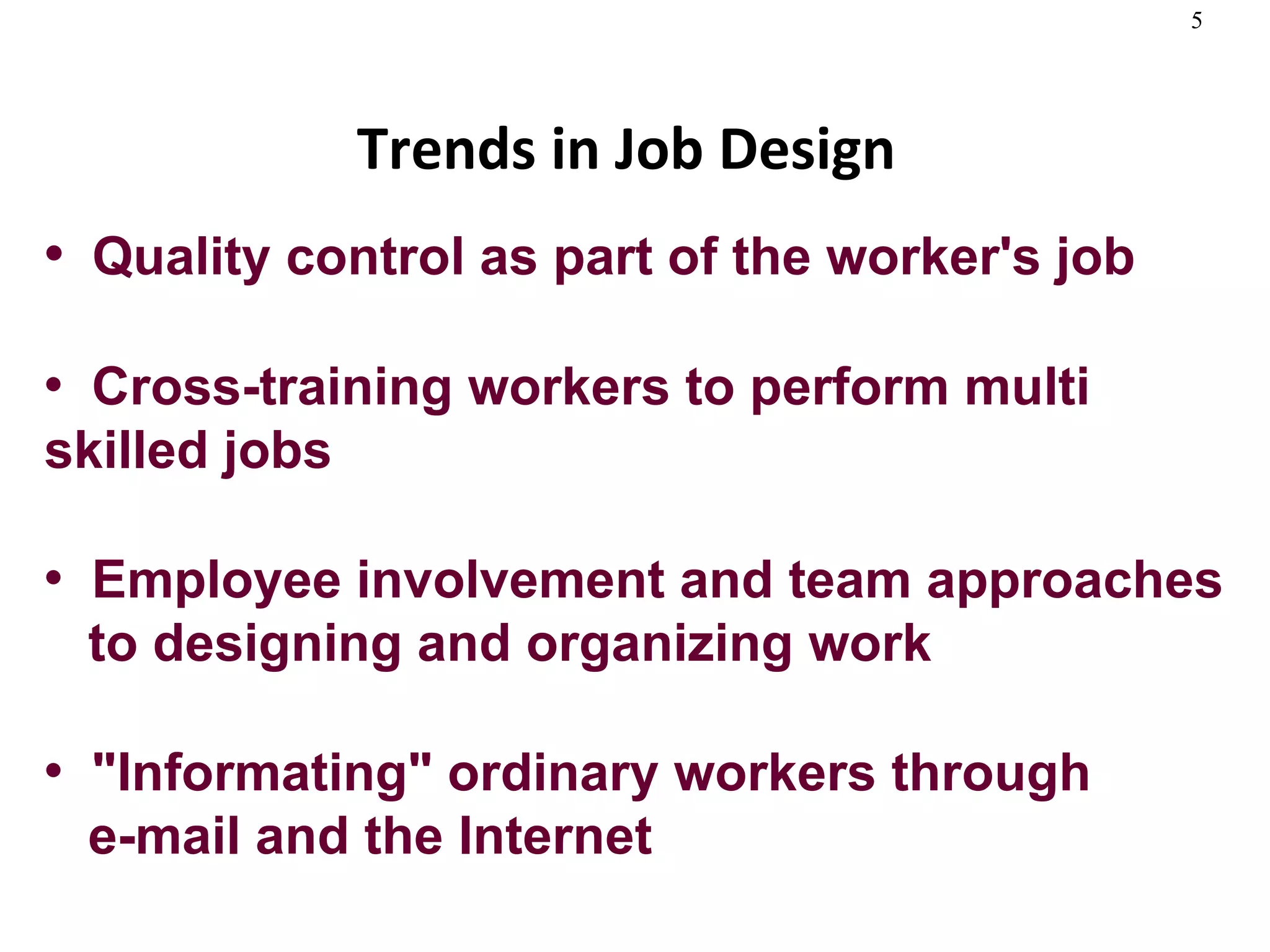
Trends in Job Design   Quality control as part of the worker's job Cross-training workers to perform multi  skilled jobs Employee involvement and team approaches   to designing and organizing work "Informating" ordinary workers through    e-mail and the Internet
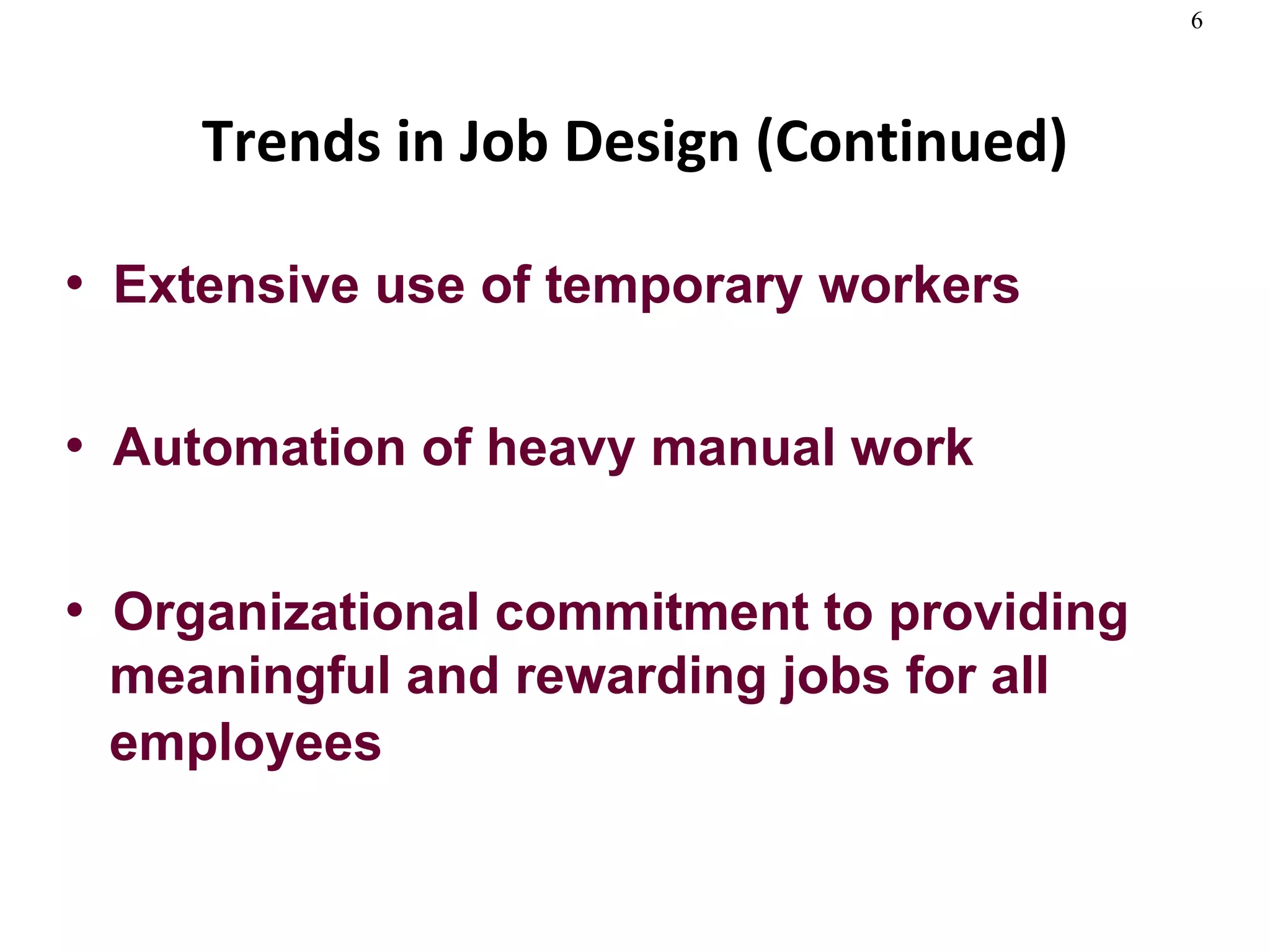
Trends in Job Design (Continued) Extensive use of temporary workers Automation of heavy manual work Organizational commitment to providing   meaningful and rewarding jobs for all   employees
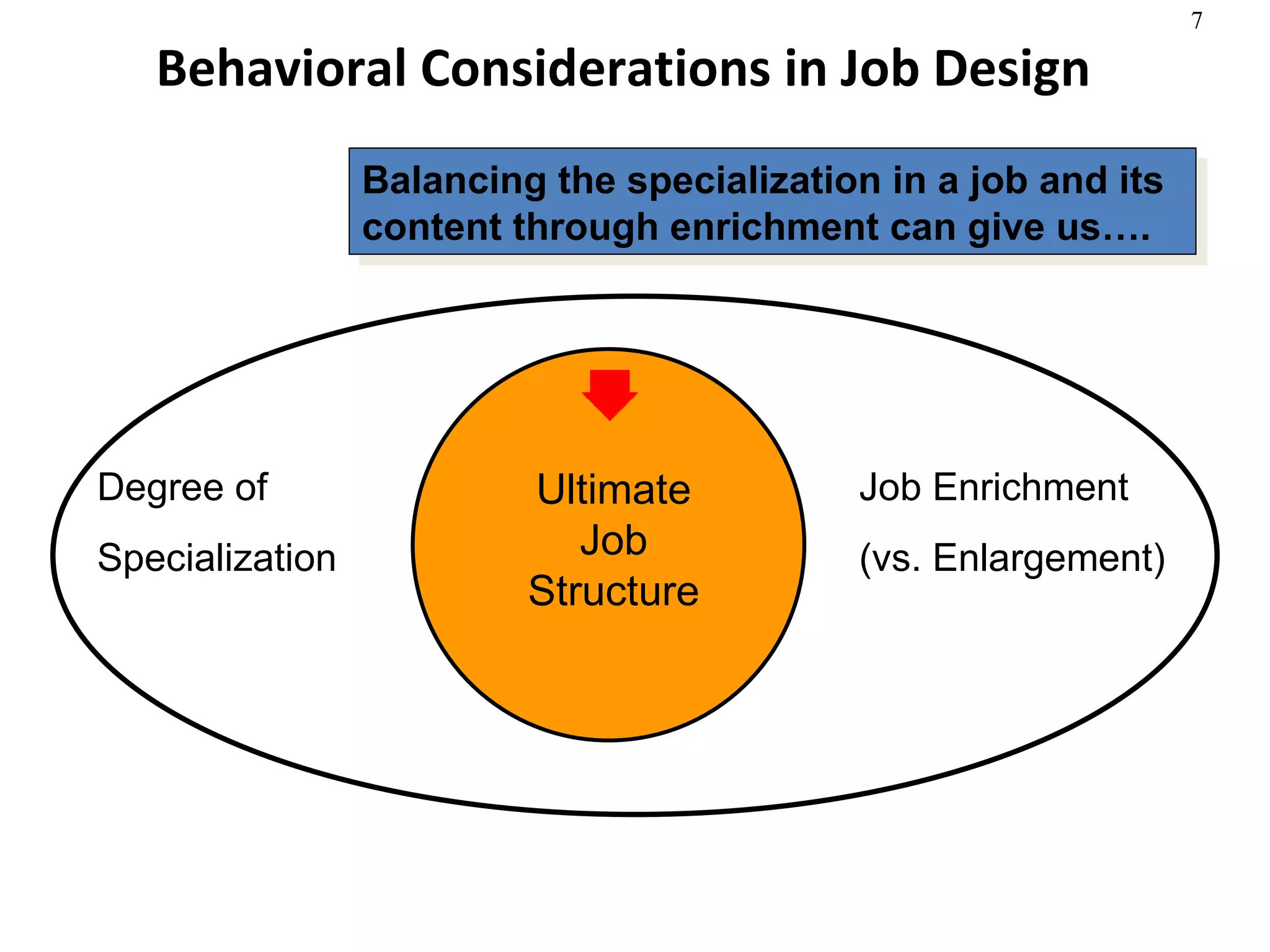
Behavioral Considerations in Job Design   Ultimate Job Structure Degree of  Specialization Job Enrichment (vs. Enlargement) Balancing the specialization in a job and its content through enrichment can give us….
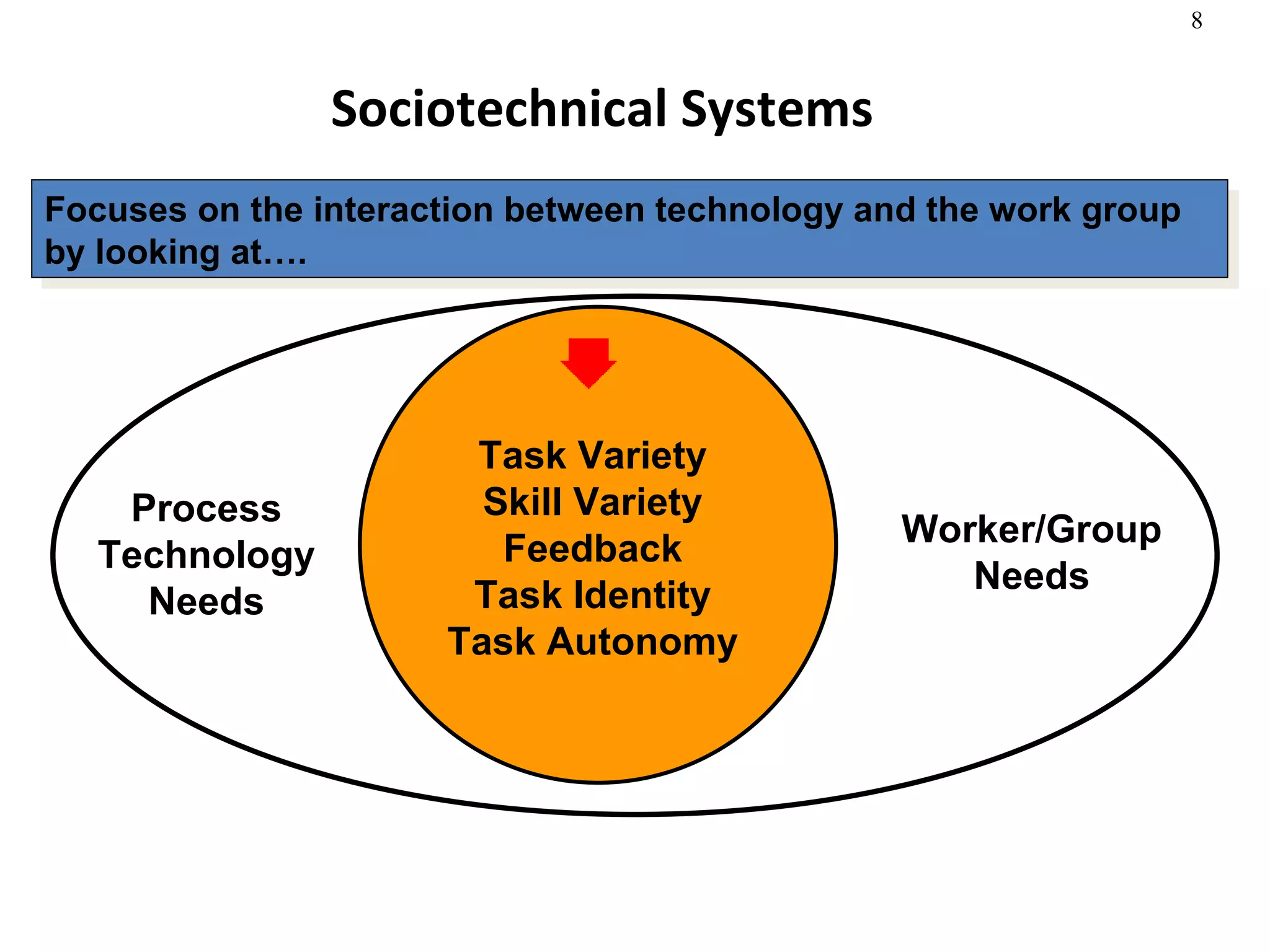
Sociotechnical Systems   Task Variety Skill Variety Feedback Task Identity Task Autonomy Process Technology Needs Worker/Group Needs Focuses on the interaction between technology and the work group by looking at….
Physical Considerations in Job Design Work physiology  sets work-rest cycles according to the energy expended in various parts of the job.  The harder the work, the more the need for rest periods. Ergonomics  is a term used to describe the study of the physical arrangement of the work space together with tools used to perform a task. Fit the work to the body rather than forcing the body to conform to the work.
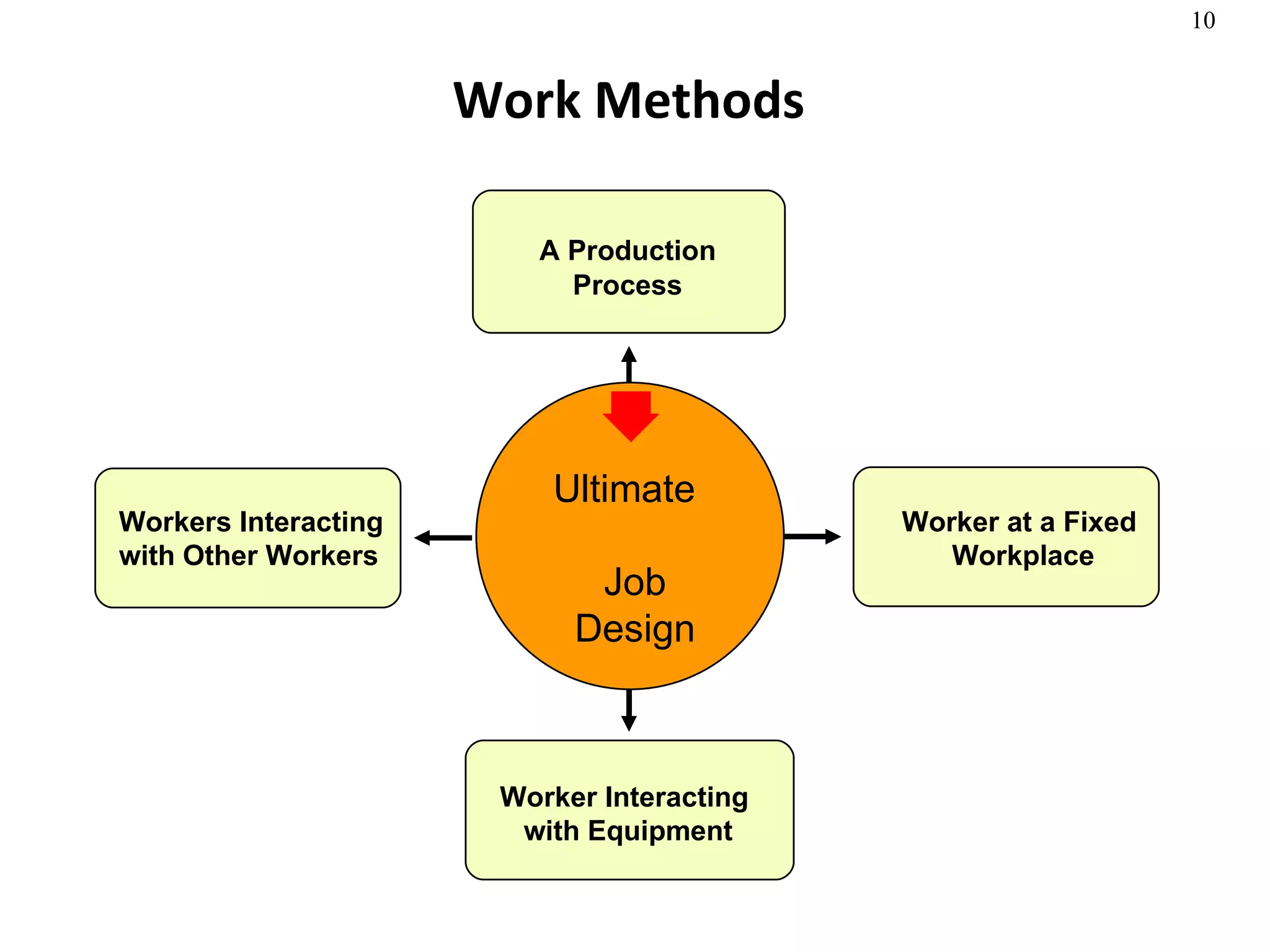
Work Methods  Workers Interacting  with Other Workers A Production  Process Worker at a Fixed  Workplace Worker Interacting  with Equipment Ultimate  Job Design Ultimate  Job Design
Work Measurement  Defined Work measurement   is a process of analyzing jobs for the purpose of setting time standards Why use it? Schedule work and allocate capacity Motivate and measure work performance Evaluate performance Provide benchmarks
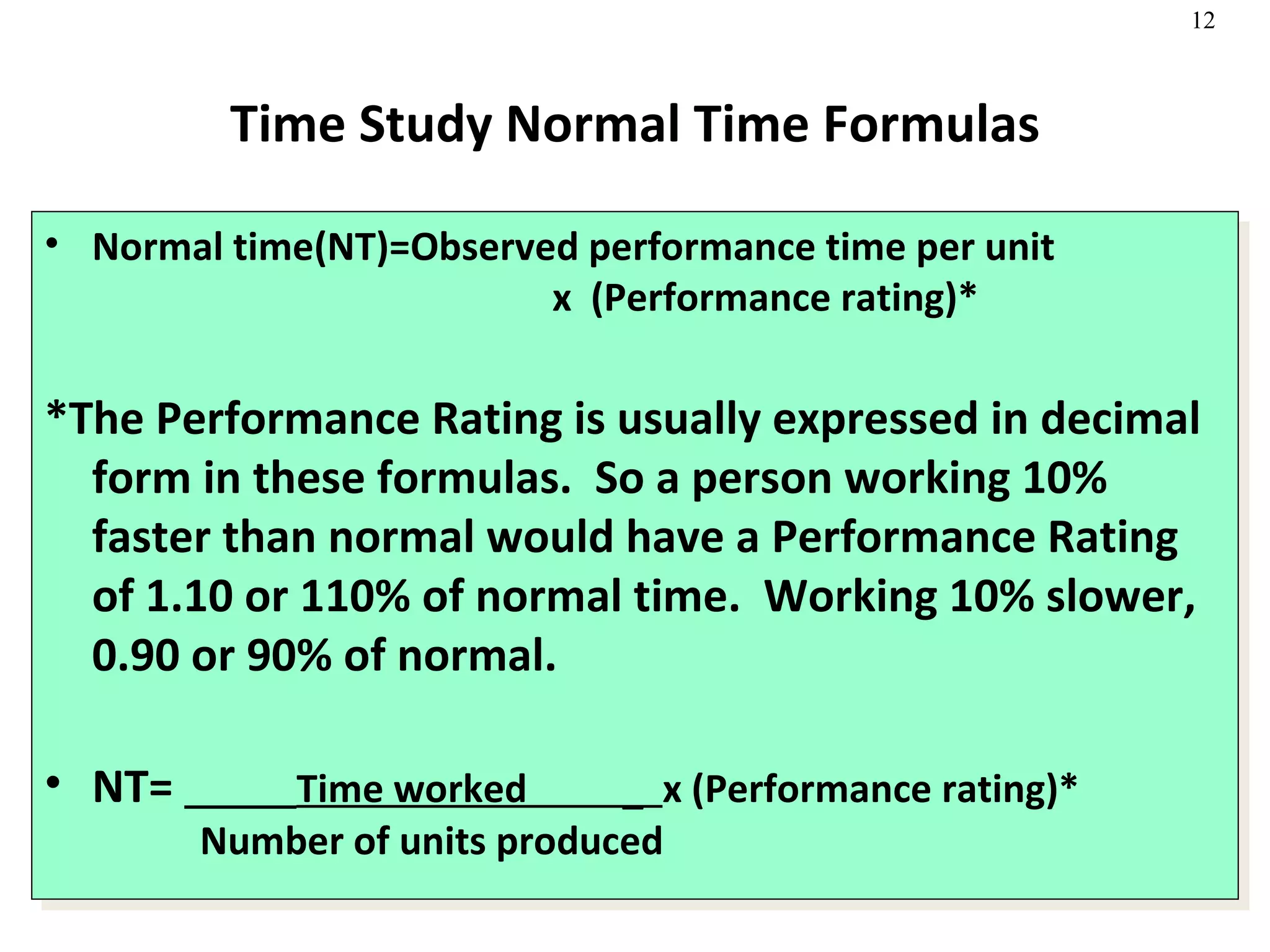
Time Study Normal Time Formulas Normal time(NT)=Observed performance time per unit   x  (Performance rating)* *The Performance Rating is usually expressed in decimal form in these formulas.  So a person working 10% faster than normal would have a Performance Rating of 1.10 or 110% of normal time.  Working 10% slower, 0.90 or 90% of normal. NT=  Time worked  _  x (Performance rating)*      Number of units produced
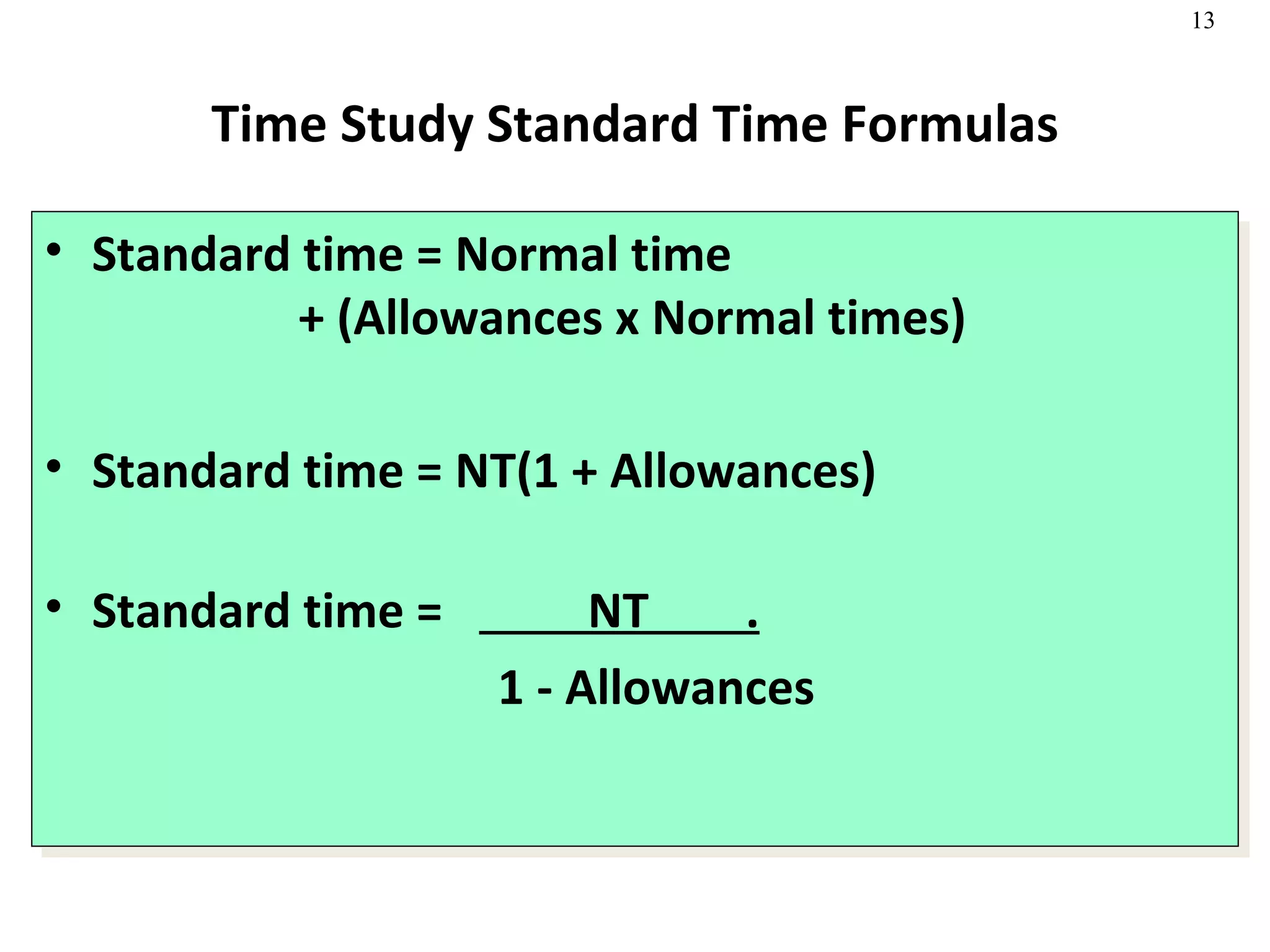
Time Study Standard Time Formulas Standard time = Normal time  + (Allowances x Normal times)  Standard time = NT(1 + Allowances) Standard time =  NT  .     1 - Allowances
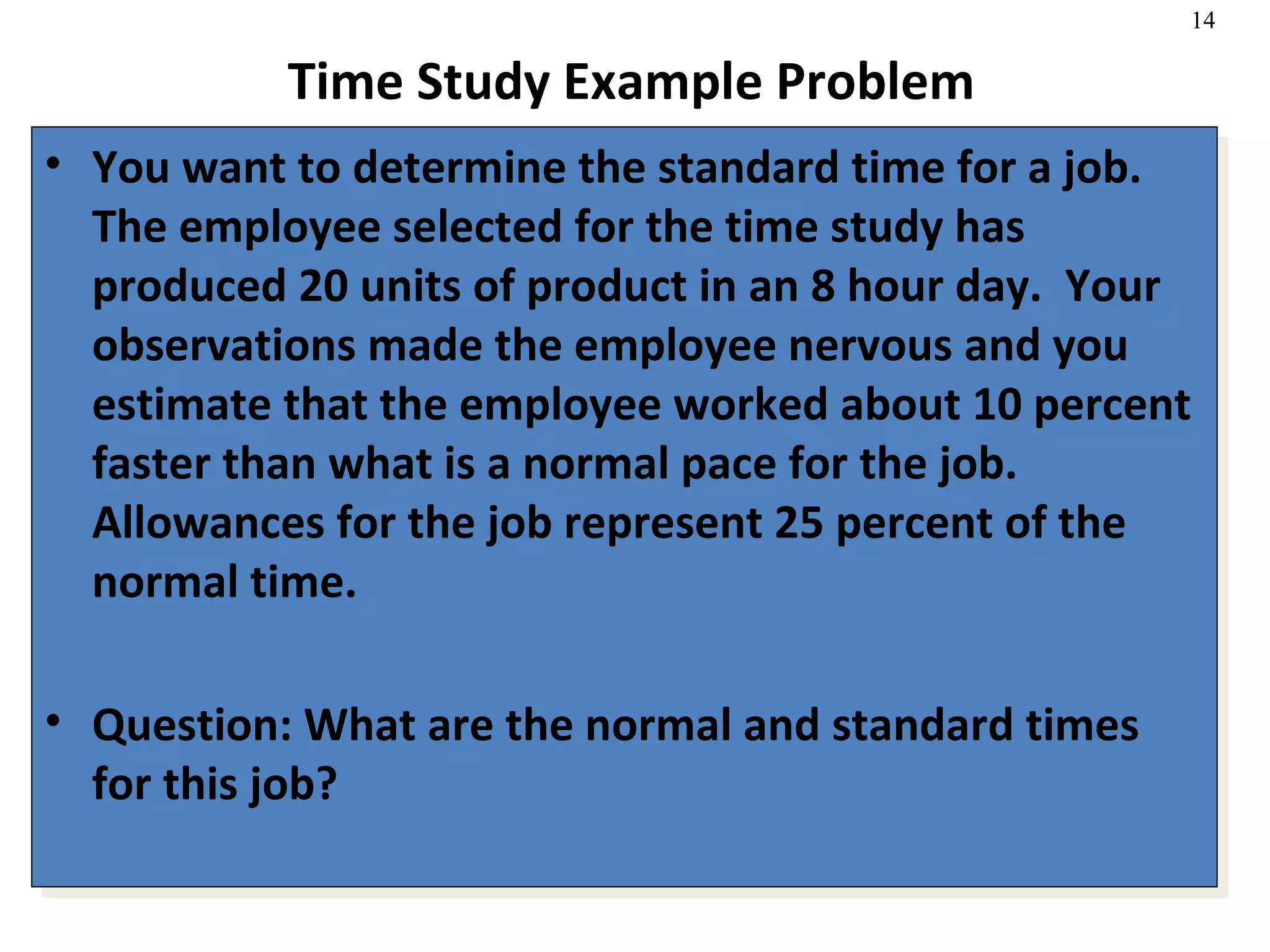
Time Study Example Problem You want to determine the standard time for a job.  The employee selected for the time study has produced 20 units of product in an 8 hour day.  Your observations made the employee nervous and you estimate that the employee worked about 10 percent faster than what is a normal pace for the job.  Allowances for the job represent 25 percent of the normal time. Question: What are the normal and standard times for this job?
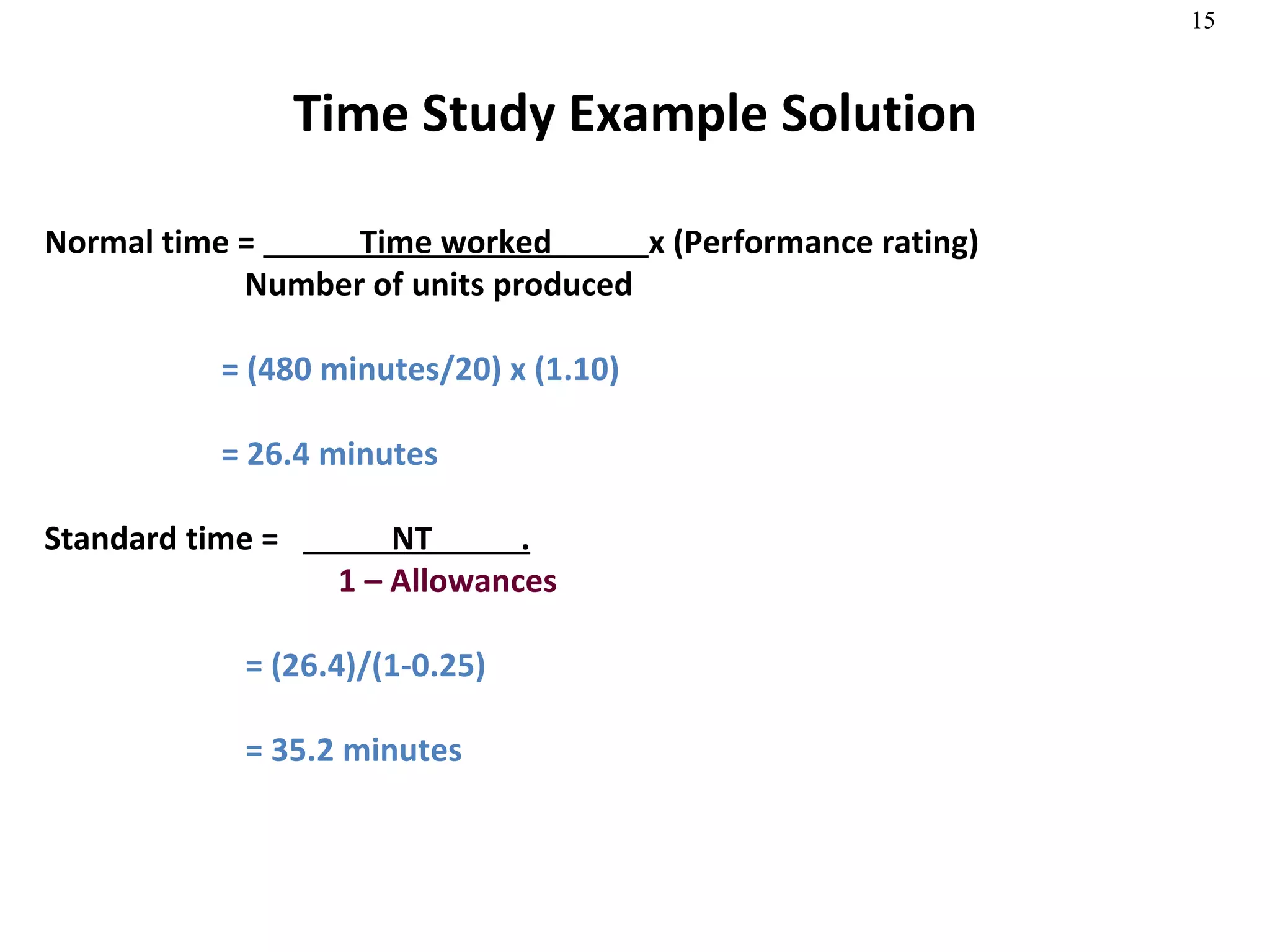
Time Study Example Solution Normal time =  Time worked  x (Performance rating)   Number of units produced = (480 minutes/20) x (1.10) = 26.4 minutes Standard time =  NT  .   1 – Allowances = (26.4)/(1-0.25) = 35.2 minutes
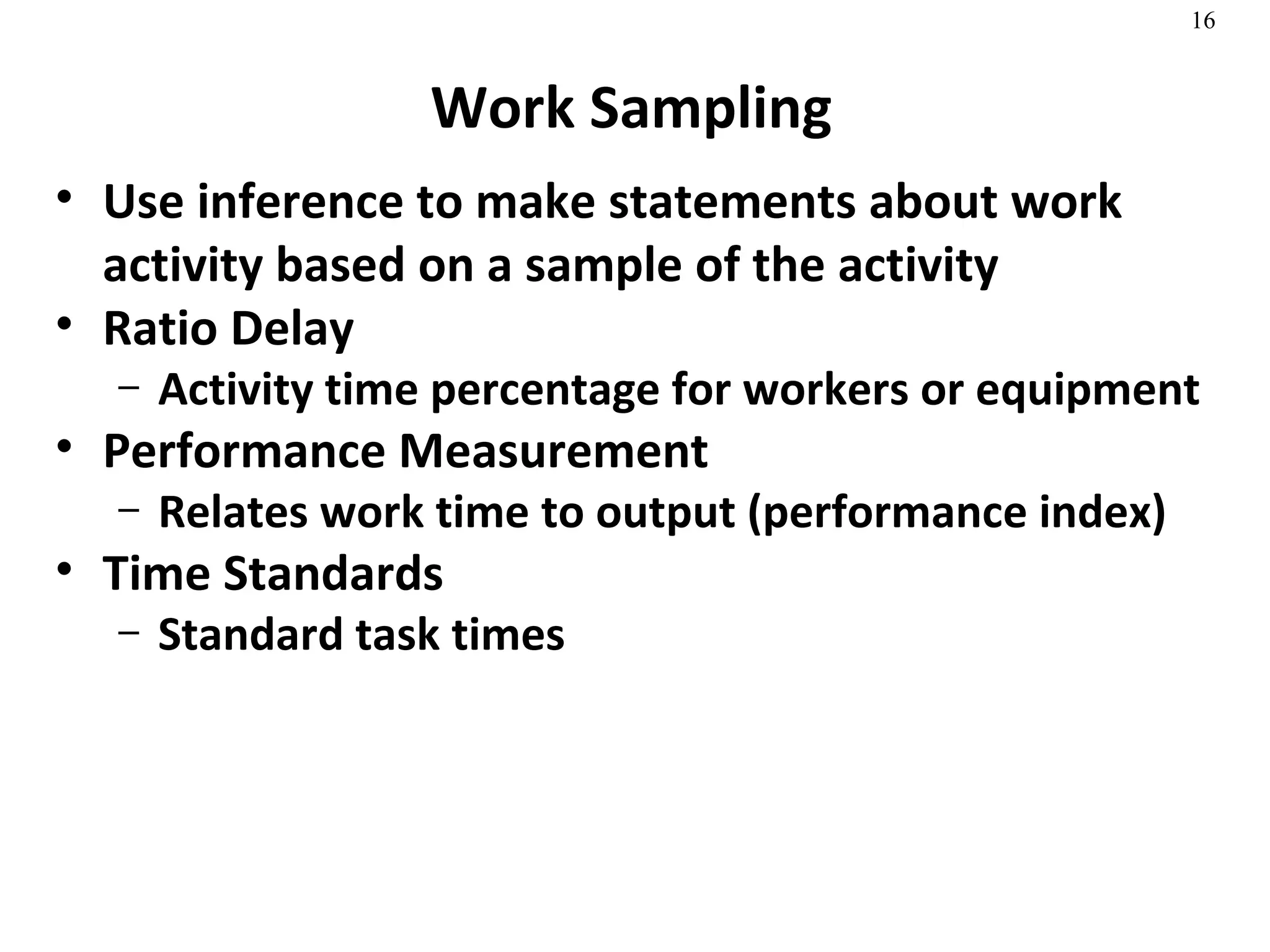
Work Sampling Use inference to make statements about work activity based on a sample of the activity Ratio Delay Activity time percentage for workers or equipment Performance Measurement Relates work time to output (performance index) Time Standards Standard task times
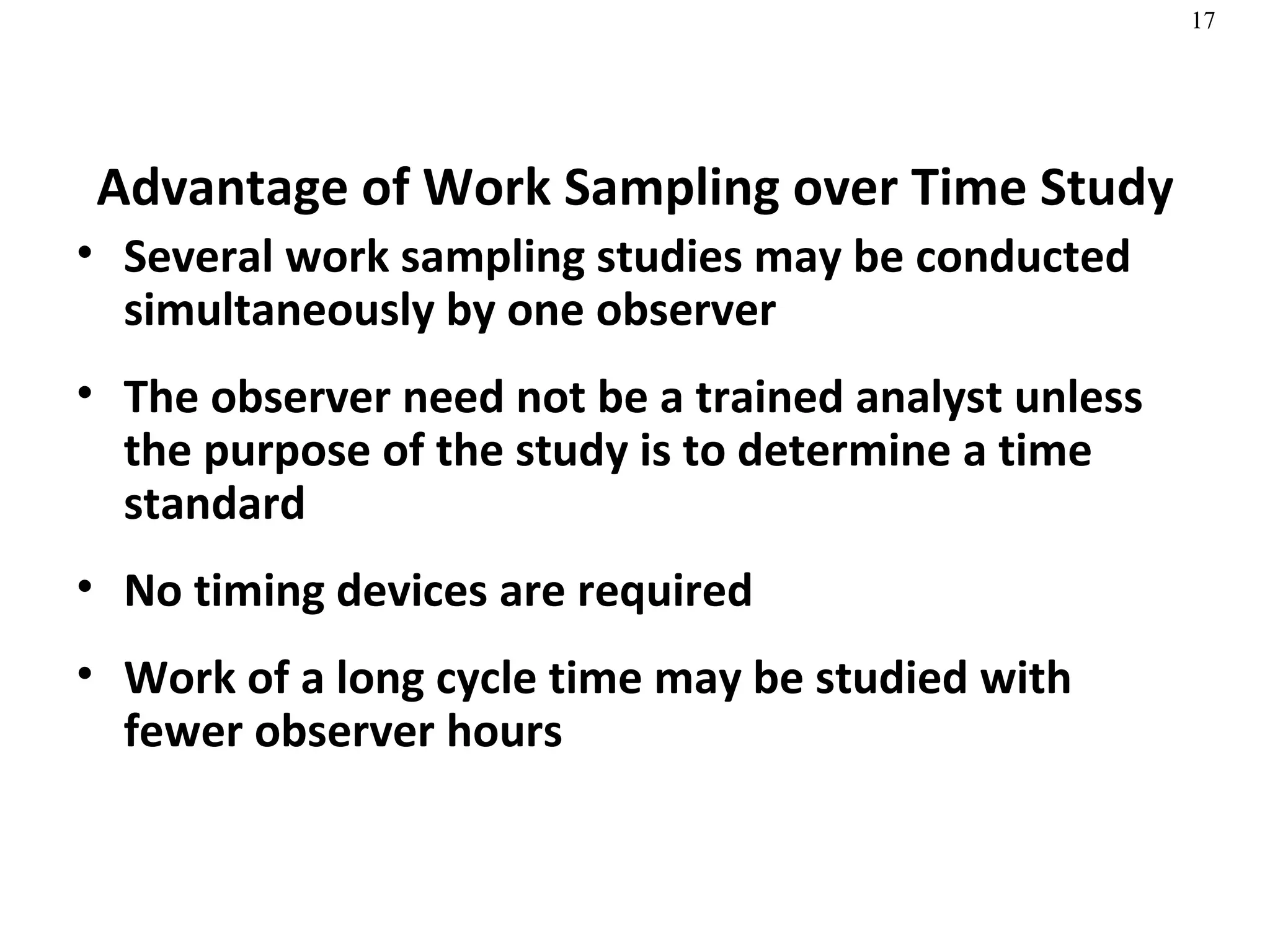
Advantage of Work Sampling over Time Study Several work sampling studies may be conducted simultaneously by one observer The observer need not be a trained analyst unless the purpose of the study is to determine a time standard No timing devices are required Work of a long cycle time may be studied with fewer observer hours
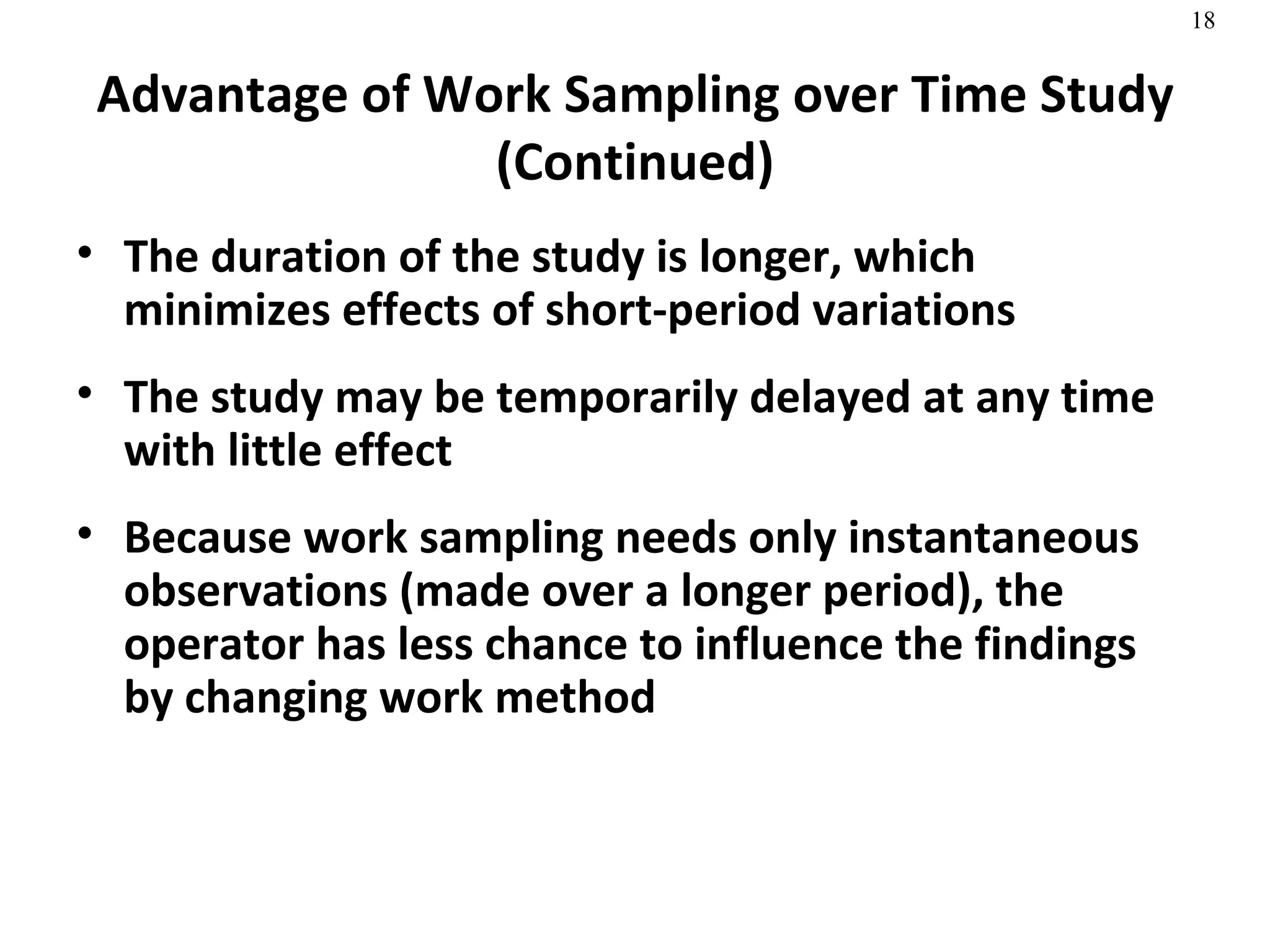
Advantage of Work Sampling over Time Study (Continued) The duration of the study is longer, which minimizes effects of short-period variations The study may be temporarily delayed at any time with little effect Because work sampling needs only instantaneous observations (made over a longer period), the operator has less chance to influence the findings by changing work method
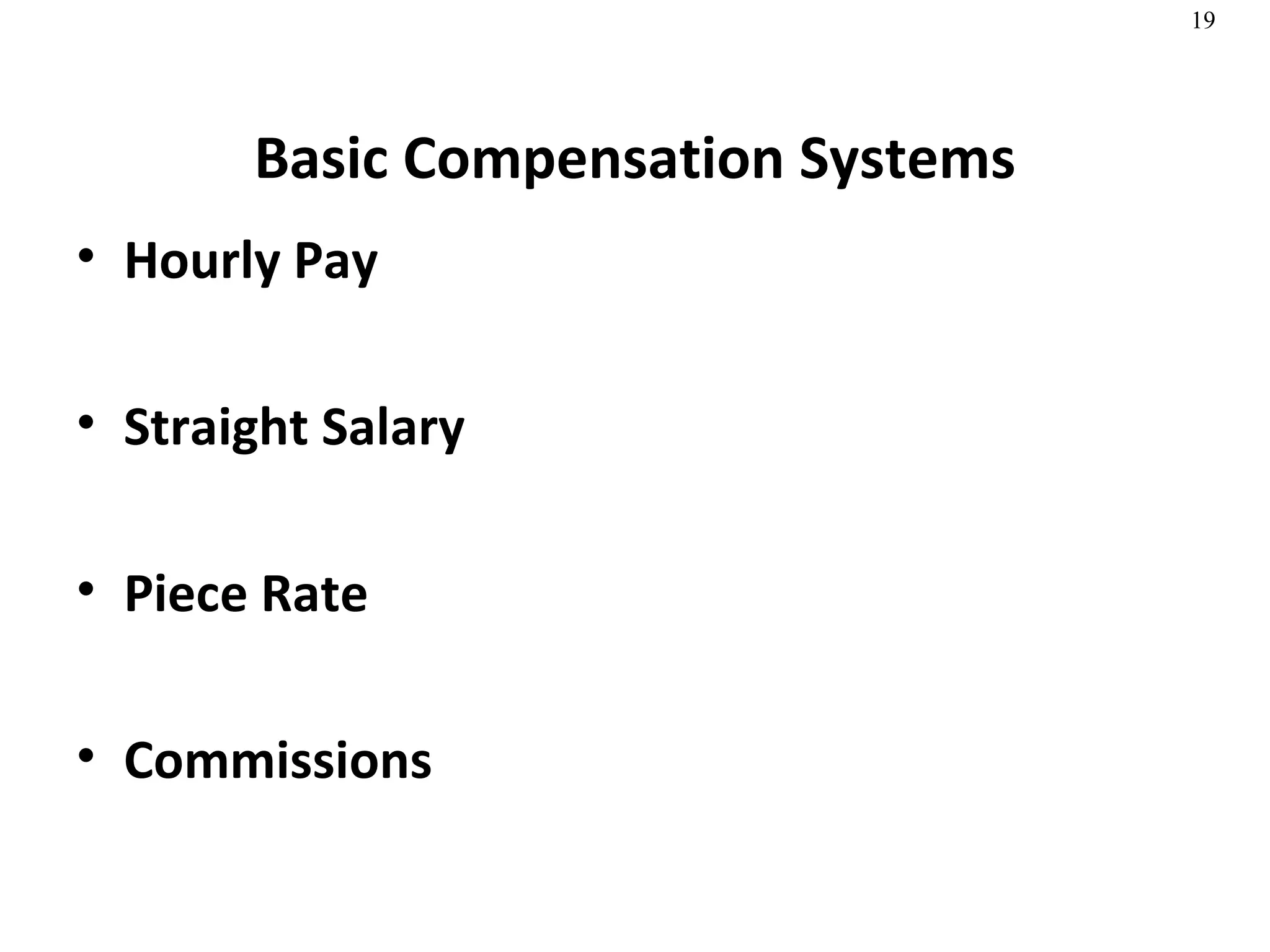
Basic Compensation Systems Hourly Pay Straight Salary Piece Rate Commissions
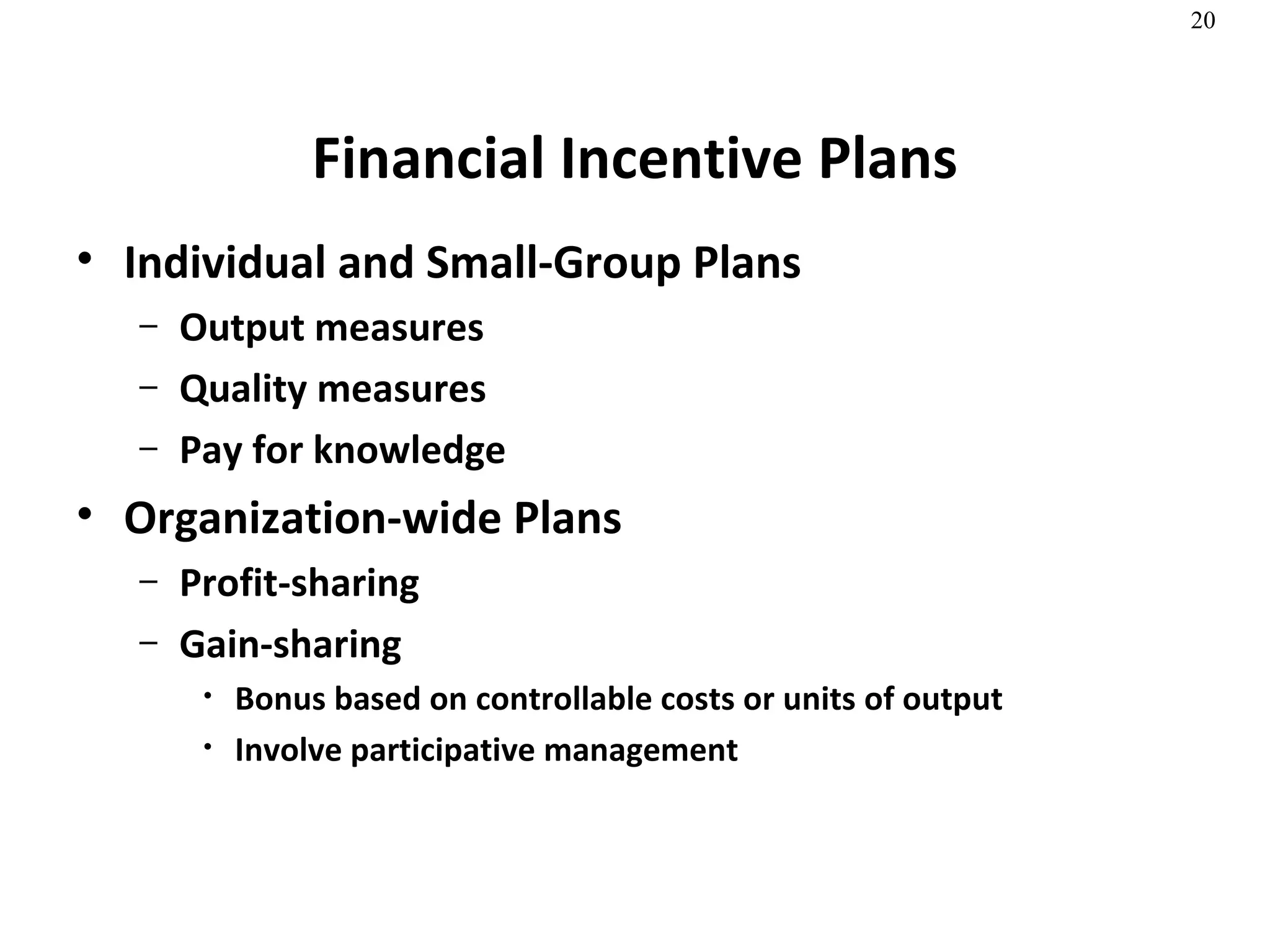
Financial Incentive Plans Individual and Small-Group Plans Output measures Quality measures Pay for knowledge Organization-wide Plans Profit-sharing Gain-sharing Bonus based on controllable costs or units of output Involve participative management
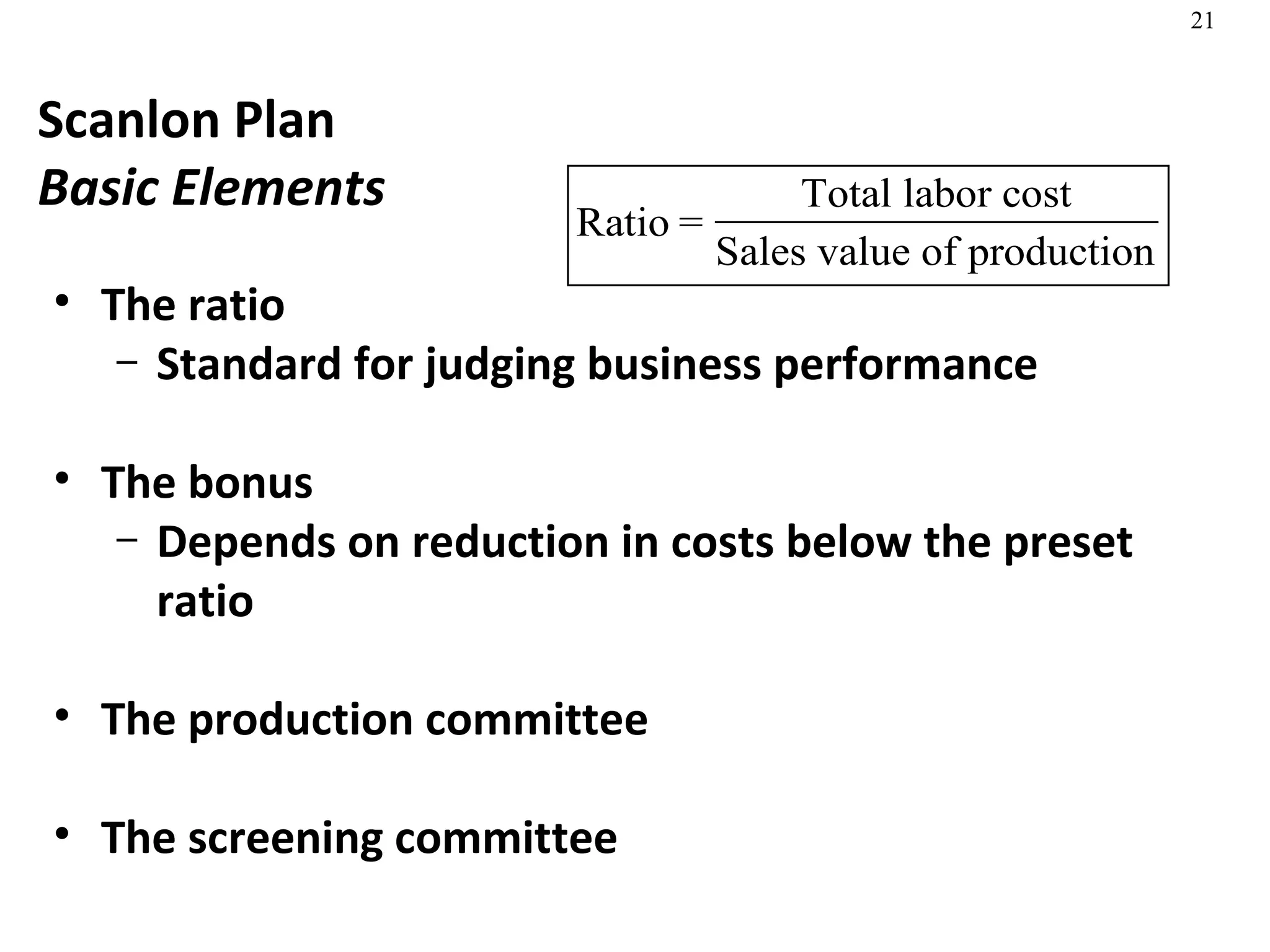
Scanlon Plan Basic Elements The ratio Standard for judging business performance The bonus Depends on reduction in costs below the preset ratio The production committee The screening committee
Pay-for-Performance Paying employees based on their performance works--improvements in productivity and quality Pay-for-performance will become increasingly common components of performance management strategies and systems
End of Technical Note 4

Job Design and Work Measurement

  • 1.
    Technical Note 4Job Design and Work Measurement
  • 2.
    Job Design DefinedJob Design Decisions Trends in Job Design Work Measurement Basic Compensation Systems Financial Incentive Plans OBJECTIVES
  • 3.
    What is JobDesign? Defined Job design is the function of specifying the work activities of an individual or group in an organizational setting The objective of job design is to develop jobs that meet the requirements of the organization and its technology and that satisfy the jobholder’s personal and individual requirements
  • 4.
    Job Design DecisionsHow Why When Where What Who Mental and physical characteristics of the work force Tasks to be performed Geographic locale of the organization; location of work areas Time of day; time of occurrence in the work flow Organizational rationale for the job; object- ives and mot- ivation of the worker Method of performance and motivation Ultimate Job Structure
  • 5.
    Trends in JobDesign Quality control as part of the worker's job Cross-training workers to perform multi skilled jobs Employee involvement and team approaches to designing and organizing work "Informating" ordinary workers through e-mail and the Internet
  • 6.
    Trends in JobDesign (Continued) Extensive use of temporary workers Automation of heavy manual work Organizational commitment to providing meaningful and rewarding jobs for all employees
  • 7.
    Behavioral Considerations inJob Design Ultimate Job Structure Degree of Specialization Job Enrichment (vs. Enlargement) Balancing the specialization in a job and its content through enrichment can give us….
  • 8.
    Sociotechnical Systems Task Variety Skill Variety Feedback Task Identity Task Autonomy Process Technology Needs Worker/Group Needs Focuses on the interaction between technology and the work group by looking at….
  • 9.
    Physical Considerations inJob Design Work physiology sets work-rest cycles according to the energy expended in various parts of the job. The harder the work, the more the need for rest periods. Ergonomics is a term used to describe the study of the physical arrangement of the work space together with tools used to perform a task. Fit the work to the body rather than forcing the body to conform to the work.
  • 10.
    Work Methods Workers Interacting with Other Workers A Production Process Worker at a Fixed Workplace Worker Interacting with Equipment Ultimate Job Design Ultimate Job Design
  • 11.
    Work Measurement Defined Work measurement is a process of analyzing jobs for the purpose of setting time standards Why use it? Schedule work and allocate capacity Motivate and measure work performance Evaluate performance Provide benchmarks
  • 12.
    Time Study NormalTime Formulas Normal time(NT)=Observed performance time per unit x (Performance rating)* *The Performance Rating is usually expressed in decimal form in these formulas. So a person working 10% faster than normal would have a Performance Rating of 1.10 or 110% of normal time. Working 10% slower, 0.90 or 90% of normal. NT= Time worked _ x (Performance rating)* Number of units produced
  • 13.
    Time Study StandardTime Formulas Standard time = Normal time + (Allowances x Normal times) Standard time = NT(1 + Allowances) Standard time = NT . 1 - Allowances
  • 14.
    Time Study ExampleProblem You want to determine the standard time for a job. The employee selected for the time study has produced 20 units of product in an 8 hour day. Your observations made the employee nervous and you estimate that the employee worked about 10 percent faster than what is a normal pace for the job. Allowances for the job represent 25 percent of the normal time. Question: What are the normal and standard times for this job?
  • 15.
    Time Study ExampleSolution Normal time = Time worked x (Performance rating) Number of units produced = (480 minutes/20) x (1.10) = 26.4 minutes Standard time = NT . 1 – Allowances = (26.4)/(1-0.25) = 35.2 minutes
  • 16.
    Work Sampling Useinference to make statements about work activity based on a sample of the activity Ratio Delay Activity time percentage for workers or equipment Performance Measurement Relates work time to output (performance index) Time Standards Standard task times
  • 17.
    Advantage of WorkSampling over Time Study Several work sampling studies may be conducted simultaneously by one observer The observer need not be a trained analyst unless the purpose of the study is to determine a time standard No timing devices are required Work of a long cycle time may be studied with fewer observer hours
  • 18.
    Advantage of WorkSampling over Time Study (Continued) The duration of the study is longer, which minimizes effects of short-period variations The study may be temporarily delayed at any time with little effect Because work sampling needs only instantaneous observations (made over a longer period), the operator has less chance to influence the findings by changing work method
  • 19.
    Basic Compensation SystemsHourly Pay Straight Salary Piece Rate Commissions
  • 20.
    Financial Incentive PlansIndividual and Small-Group Plans Output measures Quality measures Pay for knowledge Organization-wide Plans Profit-sharing Gain-sharing Bonus based on controllable costs or units of output Involve participative management
  • 21.
    Scanlon Plan BasicElements The ratio Standard for judging business performance The bonus Depends on reduction in costs below the preset ratio The production committee The screening committee
  • 22.
    Pay-for-Performance Paying employeesbased on their performance works--improvements in productivity and quality Pay-for-performance will become increasingly common components of performance management strategies and systems
  • 23.

Editor's Notes